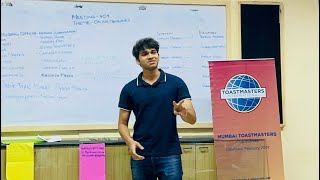
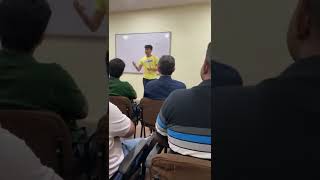
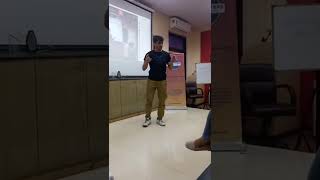
Tanay delivers a Level 3 Toastmasters speech about losing his pride while working in his family's commodity-trading business. The project focuses on vocal variety in humorous speaking. He opens with a rhetorical question about dream jobs to draw the audience in.
Chapters
Good morning everyone.
Good morning. Good morning.
So my speaker Tanay is attempting Level 3 Project 2 of Engaging Humor. The purpose of this project is for member to practice using vocal variety to enhance the speech. For everyone's interest, The member has spent some time developing or improving his vocal varieties. The topic of the speech may be humorous, informational, or any style the member chooses. With that, I wish my speaker all the best. Thank you.
Toastmaster Kanhai, losing my pride, losing my pride. How many of you here have had a dream job at some point in your life? What was that?
Anyone?
Awesome. Yeah, we all had dream jobs. Now, when I was young, I had one very clear dream job for me. I wanted to be— I wanted to be like my hero, Elon Musk. Now, I had known Elon Musk since I was 7 or 8 years old because I remember watching a Tesla Roadster video way back then. But I became— and I started admiring him, and I started considering him a role model. Just a few years ago, because I found out about SpaceX. Now I'll explain why SpaceX is, I think, the best company in the world. SpaceX is the only company in the world that lands a rocket that is 16 stories tall in height from a height of 100 kilometers and lands exactly at the perfect place in the middle of the ocean. And it's been doing this every single week for the last 9 years. There is not a single company, group, government, or a bunch of people that have ever even attempted to land a rocket. This is the kind of technological growth and competitive advantage that one man alone has done and changed the world. Now, when I used to read about all these stories, I was pretty convinced I want to be like this when I grow up. So I gave myself two choices. I will either join— I will either create a company of this kind, or I'll join a company of like this. So after I graduated from college, I sat down for all my different interviews, but I spent most of my engineering days sleeping 10 hours a day and playing PlayStation. So my chances of getting a job are pretty slim. So I had to jump to option number 2. I had to join my family business, my simple commodity trading, very traditional family business, and I hated it. For those of you who don't know, my family business is basically where you It's commodity trading. We buy polymers from refineries and we give it to manufacturers who use it to make products. It's exactly as boring as it sounds, and that's why I didn't want to join it. But since I had no choice, I joined it anyways. Now my schedule when I joined my office was pretty simple. For months, this was my schedule. On the weekdays, I would make bills and invoices of the deals that my dad would do and learn accounting every single day. And on the weekends I would travel to— I would travel from one factory to the other meeting one customer after another trying to sell plastic in places like Daman and Vapi and all these different places where you have a lot of factories. On most days I came back home with no sales, no new leads and a lot of sweat. And I was always confused about is this really what I wanted to do. I thought my first job out of college would be coding or building some product that people people would be using, but here I'm selling plastics to old people. I definitely didn't want to do it. A few months after this, I was lying on my bed trying to sleep, staring into the ceiling, trying to come up with some scheme about how I could escape this trap. I didn't want to work here. I genuinely hated it. So the next day I came up with a scheme. I went to my dad and I said, Dad, I'm not coming to office today. I'm I said, "No, shizz, take a day's break, but come tomorrow." I went back in my room, opened my laptop, and I played the first Netflix series I could find and laid back on the sofa thinking, "Today I will just relax." 15 minutes after watching it, I just remembered that I closed a deal yesterday, so I had to make a call to make sure everything was okay. So I just made a call. "Hello, is anything okay?" Is the material on time? Okay, perfect. Back to the show. I played the button, but I remembered I had done another deal and a couple of people were coming to the office today, so I just called to make sure if everything was fine. Hello? Yeah, are they here? We have all the documents? Okay, good. I started to realize that I hated not doing something. More than the job, I hated not doing something, sitting at home and chilling. The job that I thought I hated, I actually enjoyed it a lot. And in the next 15 minutes, I was back in my office, and my dad welcomed me with open arms and said this time that, you know what, I knew why you picked up. It was very clear you were not sick today, but now that you've come, I want you to realize that you're not an employee here anymore. You're my partner, so you decide where you want to take the company. That completely shifted shifted my mindset. From that day onwards, every single thing that I did at the office, whether it was making bills, invoices, selling stuff, anything, I simply focused on doing other tasks. All the negative chatter that went on in my mind for months— this is not the job that I want, this is beneath you— all those thoughts went away, and I just did my job. And because of this, I developed discipline. Discipline is doing what you hate like you love it. And if you do it for a long amount of time, you develop self-respect and most importantly, confidence. And this confidence helped me a few weeks later when I started doing sales full-time. At that time, it was the first time that I did something at my office, something new, where I did not have another thought about it. I didn't care if it was fun or not, whether it was cool or not. I just focused on achieving my goals. That's it. What I learned from this entire experience is that oftentimes in our lives we look down upon certain things, that this thing is beneath me, I won't do it. That can be a result of our profession, our birth, where we come from, can be anything for anyone. But every single person in this room and in the world has an ego and has some pride. There's always some work that that you think is beneath you. But the moment you start doing it, you start realizing the biggest lesson that life has to teach you. No work is beneath you. There is no need for an ego. And most importantly, you develop some solid discipline. And with this discipline— and this discipline, thankfully, is one of the most transferable skills— if I can sell polymers without crying about it, I can run 6 kilometers without crying about it. I can write my speech without thinking too much about it. That's the best part about it. So I implore all of you, spend some time thinking about what you think is beneath you and do that. Not to get— not to do it well, but simply to lose your ego and develop discipline. Thank you so much.