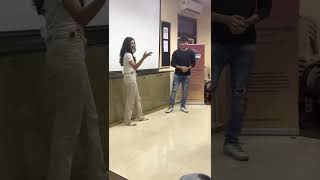
In this Toastmasters speech, the speaker explores why asking questions matters, using humor and vivid examples. He begins with the Coriolis effect—hurricanes and even urinals spin opposite directions in different hemispheres—to illustrate how curiosity leads to scientific insight. He then critiques the “why game,” arguing that while endless why‑questions can be annoying, they reveal our innate drive for explanations. The speaker proposes journaling as a practical method to formulate and pursue questions, describing how writing down queries creates connections between disparate ideas. He references Douglas Adams’ Hitchhiker’s Guide to the Galaxy to show that a good question is more valuable than an answer, and shares a personal school story where a teacher’s thoughtful questions transformed his academic performance. The talk expands to a broader view of human uniqueness: unlike apes, humans ask questions, a trait that fuels progress. He concludes with an Einstein quote urging continual questioning. The overall message is that cultivating curiosity through well‑crafted questions and reflective journaling can enrich learning and personal growth.
Chapters
Do you know that hurricanes rotate in the opposite direction based on where they are on the planet? So if they are in the Northern Hemisphere, they rotate clockwise, and if it's in the Southern Hemisphere, they rotate anti-clockwise. But did you know that the same principle applies for the urinals in your washroom? It is true. If your urinal is in the Northern Hemisphere, the water will rotate clockwise, and anti-clockwise if it's in the Southern Hemisphere. This happens because of an effect called the Coriolis effect. The Coriolis effect is basically an inertial or fictitious force that acts on objects that are in rotational motion. Now, without an accurate understanding of the Coriolis motion— Coriolis effect, we wouldn't have large rotating space stations today. But why do we need large rotating space stations? Well, because we need artificial gravity for the astronauts. But why do we need artificial gravity? Because astronauts would lose mass in space. But why do we— you guys see what I'm doing? I'm playing the why game. Kids do it all the time, and adults should do it more. Actually, don't. It's very annoying. Don't. But why do we do this? Why do we ask questions? I mean, seriously, what's the point? Who cares? Who cares why hurricanes move in certain directions? Who cares why space stations need to be rotating? I think the reason is we all love a good explanation. I think we all are inherently curious and we look for answers, but most of the time we don't find a convincing answer, and that is why we end up not asking more questions. Now, we usually find these answers in books and articles, and usually from very competent people who have spent decades on a subject. But what if we want to find that answer ourselves? What do we do then? There are many different ways, but the best way that I know is journaling. How many of you journal regularly? How many of you guys have thought of journaling? You have to change that ratio a little bit. Now journaling is a very simple thing. You write down a question and you write about it. And what usually happens is that as you journal, you end up connecting that seemingly random topic, that seemingly random question, to something that you already know. And that connection is something that we did not know exists, and that makes you excited. That makes the whole thing very exciting, and you feel, wow, how many more connections are there to find? Because you didn't know that the world worked this way. But this also works because you ask the right question. Let me explain to you what I mean by that. In the legendary science fiction book Hitchhiker's Guide to the Galaxy, a supercomputer called Deep Thought was asked the question, what is the ultimate answer to the— what is the ultimate— yeah, what is the answer to the ultimate question of life, universe, and everything? The universe took its time, around 7.5 million years, and came up with the answer: 42. 42. What does that even mean? How can a vague, indifferent number like 42 be an answer to such a fundamental question like life? As it turns out, the answer isn't wrong. The question is. Yes, you see, the author of the book, Douglas Adams, he went on to explain that asking questions is a craft in itself. That finding an answer to a question is usually an easy part, but crafting a good question is the difficult part. In fact, even in the book, as the book progresses, the supercomputer Deep Thought, he goes on to build an even more powerful computer which is simply capable of asking a better question. So that's the absurdity and relevance of asking good questions. Good questions are hard to come by, and— but these good questions can change your life too, for good. I mean, it did for me when I was in school. When I was in school, there was this one particular teacher who apparently behind my back promised my mother that she will transform me in 2 years this time. And mind you, this was a time where at the end of every academic year My brother and I, we would place our achievements on the wall. My brother would place his first place gold medals and all of that, and it would look beautiful next to my 7th place ribbon collection. Now, that happened, and I wasn't very good at that. I wasn't good in sports. I wasn't particularly very good in studies as well. I was always in the middle. But this teacher recognized that. She realized that I needed more help. I needed to be taught separately and differently. So instead of the teachers at school who simply told me that I couldn't do it, who simply asked me questions sarcastically, this teacher, she asked me different questions. Instead of telling me that I couldn't do it, she told me, "How can you do it?" She made me think about it. Instead of telling me which degree I should pursue in the future, she told me to imagine what I would be like in 10-20 years, and she made me write about it. I realized the importance of asking good questions and how A simple, even a slightly modified question can completely change your perspective on something. Completely. It did for me. I went on to score amazing marks in my last year. What she didn't tell me though was instead of the 7th place, I now have a 20th place ribbon collection, but that's okay. I guess that's a part of it. But asking questions is just fun. Honestly, it is just a lot and lot of fun, especially once you find something that you like. And this supposedly annoying "Why?" game will become all the more fun and joyous. It will become satisfaction. It will become very satisfactory. Now, as we ask more and more questions, we realize that there are many different kinds of questions. Sometimes the questions that we ask are rather lame. Sometimes we think that we are stupid when we ask questions. Actually, we are right the second time. There are no stupid questions. There are only questions that make you feel stupid. Okay? So, especially like that question of life. People have been writing books about it for years and years and years, and we still haven't found an answer. And that is the reason we are writing the book. But my point is a little different. I see in it the uniqueness. For a species that has existed for just a couple hundred thousand years, we've come a very long way compared to our ancestors, especially chimpanzees and apes. Apes. That have been taught to use sign language can communicate with us. They can express novel thoughts, they can express emotions, they can even answer complex questions. But an ape who knows sign language has never been observed to ask a question. Never. Chimpanzees are clever, but they fail at a seemingly simple task of telling behind which door is their food hidden when they see a person carrying their food walking through the door. Now whether or not animals can question or not, it's still being debated. But there is one species, one group of people to whom it most certainly is unique. Us. Humans. I believe it is this quality of ours, the ability to reason, to ask a question, that makes us unique. So if anything, to be more human, all you need to do is ask more questions. I'd like to end with a quote by Albert Einstein. Learn from yesterday, live for today, and hope for tomorrow. The important thing is to never stop questioning. Thank you so much.