Tasha K x Angela Stanton, Tillman, and Bosco on CJM Reform Tour and Much More!!
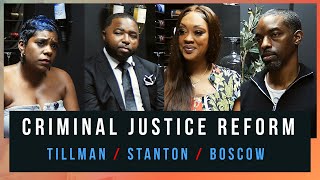
Tasha K hosts activists Angela Stanton, Lionel Tillman, and Bosco Adams to discuss their "A New Dawn for Justice" criminal-justice reform tour. Tillman accumulated wrongful child-support debt from a teenage pregnancy; Bosco served 35 years for marijuana before a Trump pardon. They argue state financial incentives drive harsh enforcement and call for entrepreneurship and financial-literacy education instead.
Chapters
All right, so I'm excited, Angie. You know, I told her me and you used to have real beef on social media.
Did you tell them that story?
I did. I didn't get into details. I said it's women. She didn't know.
She tried me, but it was a little bit.
Then when I saw how tall she was, I said, let me shut the fuck up. For real.
But you know what it was? What I really appreciated about you, and I will never stop telling this story, is that when me and my son were at odds about his decision to transition, like out of everybody in the media that was attacking me, you were the only one that really just came to me as a mom and was just like, you know, let me see what I can do to help bring this situation back together. 'Cause you had an outside world with their opinions and then as a mother, we have to think about that personal relationship between mother and child. And you gave me that opportunity to not come from a place of anger. And I appreciated that. And we've been cool ever since.
Yeah, no, we've been cool. Like I said, because we have common issues. Like I told him the same thing about Just Hilarious. Like, don't get it twisted. Do me and her have beef? Yeah. But let us come together as Black women. We going to stand on business, OK? Especially in media. And that's what it's all about. And so I'm happy that you're back today again. All right? You guys are all on tour. Now, this is a different type of tour because— Even though you guys have all had your different, very dramatic run-ins with the law. Okay, so we have Lionel Tillman here. Now you've had, you've been, I guess, falsely accused of owing child support when you was a child. You was 12 years old and accused of fathering a baby. And then they had you in arrears of like $60,000 to $70,000.
Correct.
Okay. And of course you went to jail, ended up having a baby in jail. You was pardoned by Donald Trump. And then we have Quantae Adams here. Bosco.
Same thing.
I mean, that's an old name. Right. I know he got in the film.
It's the movie Bosco.
Yeah, Bosco. And definitely, because you got your book here, so I was just like, oh, I forgot that you had wrote a book. And your movie just premiered on Peacock. So you were sentenced to 35 years in jail for marijuana possession as a Black man.
Attempted to possess.
Attempted to possess.
They didn't have it.
How much?
You didn't even have it on you.
No.
What?
Reverse thing. I was going to get it from undercover federal agents. Never saw it, never smelled it. I don't even know if it was really there.
And they put you— when I— that term we hear, under the jail, they put you under the jail.
Yeah.
So you got out 19 years early, but you were, you were sentenced 35 years, so you served about what, 16? 16.
Yeah.
Did you sue them people? Did you sue them people? Nah, I didn't sue them people.
Man, listen.
I'll let you know. Man, hell no. That's been the first thing I would have went down there and did. Where is my money? My reparations? But congratulations, you just had a movie premiere last month on Peacock. You told me you self-funded that movie, sold that movie, brokered that movie, and now it's being talked about everywhere. So I'm proud of y'all. Look at my people, y'all in suits and shit. They trying to make me mad too.
I'm trying to be.
Well, you look cute. Thank you.
Thank you. I tried. I tried. That's date night tonight. It's Saturday. Y'all got me working on a damn Saturday.
Date night. Date night.
Gotta get them date nights in.
Yeah, so tell me, what made y'all come together and do a tour?
Wow.
I think I'll let you run with that.
Because, you know, my passion is after everything that I've been through in the criminal justice system and so many other people still left behind, even after we had such acts like what she helped pass, the First Step Act. There's still a lot of people that are stuck in prison and, and who need us to come out there and kind of advocate for them. And also a lot of people in our communities who need certain opportunities to help them develop and reach their full potential, because I think it all correlates into criminal justice reform. It's not just about the people that are in prison, but the laws that are designed to help people from school end up in prison, like the, you know what I'm saying, the pipeline to prison, school to prison pipeline system that needs to be addressed. And so I'm very passionate about it, and, uh, Angela seems to be very passionate about it, and TJ. We all have unique stories that touch on every aspect of criminal justice, and I think us coming together is what's going to make this a more powerful reform advocacy.
Yeah.
And I think for me, after— when it comes to politics, because everybody knows me for being political—
we're going to talk about that.
I know we're going to talk about it, and I'm tired.
I'm tired of politics.
But I'm going to say this. When it comes to my political career, I have been most successful in criminal justice reform.
Okay.
And because of that, I agree with what he says. There is a need for us to continue and keep going because there are a lot of people that have been left behind. And because I've had that experience of being in prison, being separated from my family, but also having a chance to come home, be reformed, have a second chance, show the world that you can still be successful regardless of whatever you've been through, is another addition to this tour that just makes it so much more powerful.
And you got pardoned after you were released.
I did. I got released in 2005, and I got my pardon in 2019.
How the hell did you swing that?
Well, I was actually advocating for everyone else. So when Trump's— one of Trump's initiatives was criminal justice reform. And so I went in with my story. And my story was very effective in helping him make a decision to pass the First Step Act. But I also went in with a list of 100 names of people that I believe deserved a second chance. And my godmother was like, Alvita, who's very close to Trump, she said, Angela, she said, you know, you advocate for everybody else. She said, I'm going to advocate for you. So she put in the paperwork, she put in a request, and I was pardoned the day before my birthday.
That's why they brought you and Kodak Black right now, because y'all stand on business when it comes to Trump.
Hey, it is what it is. I mean, when you have a personal experience, it's much different than what you see in the media. And whether people believe that he's a racist or not, it was this story of this Black woman giving birth to a Black child chained to a bed with a white sheriff watching that encouraged him to pass the First Step Act and set a lot of people free just by my ass. So I mean, that in itself tells me, and changed the law because he made it illegal for them to chain women to the bed federally once he heard my story. So I'm like, you know.
Oh, so he did all that? He did a lot.
But I mean, I ain't here to talk. We ain't going to get into Trump today. We're talking about A New Dawn, the criminal justice tour. But I will say my relationship My relationship with Trump is what kicked this off. And American King Foundation, my organization, partnered up with Chasing Freedom and TJ, and we about to change the world.
Okay. And so TJ, for your story, like yours was really bizarre. So there was a fake baby placed on you?
I don't know. I ain't gonna say fake baby.
The baby was real. Was the baby real?
So you were accused of accused of giving birth, or I guess conceiving a baby at 12 years old?
Yes.
Okay.
Yeah, so a child was conceived around the time I was 12 years old, and I was the said father. She was a minor herself, um, so she obtained cash aid, food stamps, and benefits because she's a minor. She can't work, so the child had to be cared for in some capacity. Um, what the system does, if once there's a cash aid, food stamps, or benefits, they're coming after the non-custodial parent.
Yes.
So that was me. I was the non-custodial parent. So when I turned 18, they retroactively went back to the time when the benefits was initially started. And that's how when I found out about the case, I was $24,000 in arrears at that point.
That's not including interest.
That's— that was with the interest and everything. Yeah.
So how did you get to $60,000?
Because it went on for another 13 years.
So she was still drawing money?
It was still, yes.
Now did you, now did you hit the lady that got pregnant? Did you know her?
I met her that day. So it was, she was one of my cousin's friends.
Okay.
12 years old, of course you don't know what you're doing. I never pat, I don't like to—
You were having sex at 12 years old and they put you on child support?
Yeah, we was talking about it.
And they put you on child support at 12? That is crazy.
I mean, just PG, because I know, I know that she has other children. So I don't want to be talking about intimate things about her and her kids.
I don't even know her name. I'm just talking about the bizarre things behind my son.
I never passed go. I didn't collect $200. I never penetrated the woman.
Okay. So she was older?
She was older than me, yes.
How much older?
2, 3 years, somewhere around there. I don't know, but she was somewhere around there.
So she was like 15, you were 20?
Somewhere around there.
And you were 12?
Yes.
What the f— That is insane.
Yeah, it was.
So she gave them your name?
Yes.
Said that you was the daddy?
Yes.
And they said okay?
Yes, because there's no checks nor balances. There's something called prima facie. Someone just told me the other day I'm pronouncing it wrong. They said it's prima facie. Yeah. Prima facie.
Yeah. Prima facie. Okay. I've never heard of it.
But Ultimately, it says that, um, the— we've heard of the term innocent to proven guilty. That's in the judicial process. But prima facie says that the courts is taking whatever's filed as true and correct until you provide evidence to say that it's not.
Sort of like temporary restraining orders, because I've had a few of them placed on me as of recently. Kevin Hart. And you have— and they'll— if you don't show up, yeah. But we don't have one in place. But people will attempt to get restraining orders if they don't want you, like for me, they don't want me talking about them and things like that, right? So they can go down there, file something, and I have a restraining order on me until we get a court date. So which means if I don't know that I have a restraining order in place and I say something and I don't know that the court has entered this, I could go to jail. And it happened to me twice. I didn't go to jail, but I had detectives call me saying, if you say something, who the what the fuck on? I ain't even been it's freedom of speech, but there's what, like the way the law does it, they just tell you to cease. But I'm like, but if I don't know about these things, like how am I supposed to know? So it's kind of one of those things that you could get locked up for or somebody put a restraining order on you. Like say for instance, you leave your house and your wife go puts a restraining order on you. Whether you know or not, if she calls and says you violated that restraining order and you come home, she can lock your ass up.
Wow.
Yeah.
So that's kind of what that reminded me of. Yeah.
It's wild. So until you provide evidence to show that what filed isn't correct, it's going to stay in place. So I, once I didn't know this, so once I found out about the case, um, I went to child support, of course, because that's the first thing to do. And they was like, well, it's been 7 years since the case started. You had 6 months to respond, so there's nothing that can be done. They said you may want to go to speak to the family law facilitator at the court. I go to the court, they tell me the same thing, 6 months passed already. There's nothing that can be done. So, um, that went on for another 13 years.
And you were 12 years old when it happened?
It was— I was 12 years old when it happened. I was 25 when I found out about the case.
And they said because you didn't respond in 6 months?
6 months, yes. And the reason why I didn't respond within those 6 months is because— and that's the reason why the case actually got dismissed for extrinsic fraud— because Child Support Services, they didn't follow their own procedures. So They forced the signature with the substitute service. And then they also served, allegedly served me, which I later proved was at a vacant house.
Why do you think they forced the signature? Because I heard child support makes the most money. It is the highest profitable court in the United States of America.
Well, the reason, because they're incentivized. There's something called, it's a 42 USC 658A, as in apple. It's incentive payments to states. So based on their performance to collect child support, they get a bonus, they get a kickback based on the— the more child support that they collect, they get an additional bonus based on that performance from the federal government.
Yeah, and that probably would explain why there's such a push to keep families divided, right? Because if our families are together, then you—
there's no child support. Yeah. Very interesting there. So it's all systemic. Yeah. Yeah.
Because I remember, you know, I'm married. Um, my daughter was like around 5. This is when Obamacare had just kicked in and it was really expensive. I don't think people understood what Obamacare did to a lot of like healthcare benefits and stuff. It was to the point where the companies dropped you. You got to go to the marketplace if you're not within a certain income, and then you go to this marketplace and they're saying, okay, you qualify, but your kids don't qualify. Right? And so I go trying to get health insurance and they tell me it's going to be $500 a month just for me, an additional $300 for my husband, and my kids don't qualify because I either make too much money or too little money. So I got to go through PeachCare. This was in Georgia. So when I go through PeachCare, I'm like, hey, so let me get them some health insurance. They tell me, well, is the dad in the picture? I'm like, yes. Well, you don't qualify. So I'm like, wait a minute. Wait a minute. I can't pay privately through this Obamacare thing. Y'all saying I make too much money or too little money. And then you're trying to tell me in order for my kids to qualify for a peach care, they cannot have a father. Yes.
Because they want to go— I didn't mean to cut you off. Because they want to go after the non-custodial parent so they can get those arrears and then they can get those incentive payments.
Yeah. Then I found out the hospital's got a lot of donors. Right. And so we just went without insurance. Insurance, and all you do is submit your income and then they write it off because they get a lot of donor money, private money that's donated to them.
So how do you collect on that? How do you qualify for that donor money?
You basically— they don't have you provide or prove anything. You just put your income, and if it's below a threshold of like $30,000, $40,000, sometimes $50,000 a month, they just write it off. So $50,000 a year? Yeah. So they just write it off.
Yeah.
So the surgery, because I remember having my appendix removed, this happened around that time, and my surgery was $80,000. So they were, of course they're not going to let me die. So they did the surgery, right? It was an emergency surgery. We got to wheel you in, go. We'll work out the details later. So they ended up telling me, you owe $80,000, but all you got to do is submit saying you ain't got the money and they'll write it off. So they ended up writing it off. To about $10,000, right? So they took off $70,000.
Mm-hmm.
$70,000 because of donor money. I was left with $10,000. And then I just called them, say, I ain't got the money. And they just—
Wow.
And that's good need-to-know information. But all of this is a part of why we need to reform our system and why we're bringing this trio together. Because one of the things that I realized with working in criminal justice reform and focusing on reducing recidivism through my nonprofit organization is that when a lot of men get out of prison, they are already in debt. So the reality of getting out and jumping on your feet and trying to start over, if you've been incarcerated for 10 years and you've got an $80,000 child support debt over your head, that's something in our system that needs to be reformed. And if they have men working in prison making money to pay the state, then why can't these men work in prison and make money to send back home to take care of their families? So just the unjust persecution of people in the justice system, the unfair treatment of men and women in the justice system, the unimaginable debt and the direct intent to keep our families separated is why we all need to come together and get behind this tour. And we may be the keynote speakers of the tour, but we're going to each community to connect with the activists in that area, the legislators in that area, the organizations in that area, because At the end of the day, these last 4 years, 6 years, whatever we done had, all of us have had enough. And it's just time that we stand together on a united front. We got to all come together and just fight for what's right.
You guys, I'm glad that you guys are doing this because last night I did a piece on Young Thug. Now, I'm not for gangs. I don't believe in gang culture or anything, right? And yes, I do believe, I don't care if you're white gangs, Mexican gangs, and they trying to paint Black gangs out here to be the worst. I'm like, ain't nobody said nothing about the cartel, right? So I'm like, we're not gonna do that. There's a lot of, you know, we can, we can open the door to go there. However, when I saw that they are gonna take him, like, it's gonna take till 2027 to be done with his trial. They have 400 to 700 witnesses.
Damn.
Wow.
He has to pay to defend himself. This is the state of Georgia. This is Fani Willis bringing a case like this. And my thing is, I'm like, oh my God, like, let's just say he did it, right? Let's just say he did it. I've seen murderers get faster convictions. I've seen child molesters get faster convictions. Why is it taking 5 years and 700 witnesses to convict one black man and a few others that allegedly are causing all of this chaos in the city of Atlanta.
So it made me think, I said, they don't have a way through Trump case already.
Yeah, and a RICO, he got a RICO case, right? A RICO case, but, but it's a state RICO, right?
5 to 7 years in trial, on trial, which means jurors are coming in every day.
Well, and not only that, let's just think about, right, the mental trauma though, having to stand and appear in a courtroom every single day for the next 3 to 4 or 5 years, whether you guilty or not. That is completely crazy.
And he doesn't get that money back if he's found not guilty. So that made me think too, when I brought y'all in, like, I really need y'all thoughts on this. Like, they are not— it's taking him money to hire these high-profile lawyers to fight his case. Of course, he's got fans. He's already in the prison system. He's not working. And then when they do get to— they haven't offered no plea deal or nothing for him to take in order to save money. So it's like he has to go through this or either just plead guilty and lose his whole life.
And my question is always, what happens to the children, right? Because how many children Thug got? I think Thug might have—
he got like 2 or 3.
Nobody ever thinks about what happens to the children. And I think that's why criminal justice reform is important to me because I've felt both sides of it. I've been the parent that has been taken away, and I've been the parent that has been left behind while one has been incarcerated. And I don't think that our justice system— I don't think that us, when we're out there acting a fool, nobody is taking the children into consideration.
Yeah, and I think that goes both ways. I think, like, even when we're out there committing crimes, we're not taking the children into consideration. But it's, it's bigger than our children. If I love my children, I love everybody's children.
Exactly.
So we got to take in consideration how what I'm doing can also impact thousands of other kids. When I'm out there shooting up the neighborhood, I'm instilling fear in other kids and making them want to be a part of the gang culture because they'll feel, feel a sense of belonging and security because I'm glamorizing it. We got to take all of that in consideration, not just our kids. And that's where my stance is like, I love my child so much that if I, I see my child and several other children. And so it's not about me and my child. It's about every other child that's been affected. And not only just the entire system as a whole. And when I say criminal justice reform, it's not just about the prison system and locking people up. It's about all of these things in our community that are sending us to prison. That are glamorizing, that are making us as young Black men want to be part of a gang or be a drug dealer and take that path, as they call it, step into the trap. Because it's a trap out there that is pulling us into this system, and then we might have a bunch of other people who glamorize that to encourage other people to take that path. And I think criminal justice system is about putting things in place in this system so that us as young Black men don't find ourselves taking that path and falling ourselves into the trap that they put out there.
You hit on something there. I, you know, and I wholeheartedly support you guys in doing this because I really feel that in order to really get underneath like the root cause of why we have so many children going to jail, why so many fathers are going to jail and kids are following behind their father's footsteps or mother's footsteps and stuff like that. That, you know, I really feel it starts with education. And two, not sending our kids to these public schools, educating them about entrepreneurship, showing them how to make money legally, doing it the right way, you know what I'm saying? And giving them those tools. Like, I just— when I think about the education that I had versus like even the education that my daughter has, and luckily I can afford to make sure she has a great education, it's just that they don't teach entrepreneurship. They don't teach them how— they just teach them to be employees to be slaves. And then, you know, they, they rack up on taxes, all these excessive bills, inflation. It will push one to become a criminal. Let me take it from the rich, give to the poor, okay? Or let me, uh, uh, sell drugs to my community just so I can incentivize myself and become rich. But you don't understand, that really affects all. And so entrepreneurship, I think, is just 1,000% key with kids and showing Lemonade stands, cutting grass.
Yeah.
Wash whatever you can do. Sell what your skills are.
And that, and that goes to when we look at criminal justice reform, instead of spending $60,000 to $100,000 a year per inmate, we can take that $60,000 to $100,000 and implement and utilize it in our community, underprivileged communities, to teach people how to become entrepreneurs. Most drug dealers— I would say 70% of drug dealers don't even make that much money a year, right? So just thinking you could take that $100,000 and invest it into where 4 or 5 drug dealers will retire and be able to use that $100,000 to get some type of training or education to where they can become entrepreneurs or, or be able to find jobs that pay more than the $30,000, $40,000 a year they making.
And I, just to kind of piggyback off what you touched on, I 1,000% believe like there should be financial literacy classes teaching, especially in high school, about taxes, about real estate, about things that real life— you still have— my daughter, she just turned 18, and one of the classes that she had at her school is still talking about, uh, world history. And yeah, history is cool, but Y'all, it's like social studies. Why is this? You're still talking about Christopher Columbus right now.
It's like, yeah, yeah.
Like, why are we still having these same conversations? Why are you still teaching these kids about Christopher Columbus when it's— that's a whole nother conversation.
They don't want to tell them that he killed Indians and inflicted genocide.
I think that everything that all three of you all touched on also goes back to prison prevention. Right? Because we want to keep people from going to prison. And why are they going to prison? Most people that go to prison, they go to prison because they are committing crimes of survival, just like the people at the border. I hate to go there, but they looking for a better life. Well, you got people in the hood looking for a better life too. You have some single mothers in the hood that may have to write a bad check just to put some food on the table and just to keep things going to the next week, not knowing that she could be, you know, prosecuted for it. So most crimes are crimes of survival. So when we put financial literacy into play, then what do have. We prevent people from going to prison. And even the majority of people that go into prison, they come out and become entrepreneurs, because while you are in prison, you discover what your true talent is. And that's exactly what I did with writing. I was able to take my talent and turn it into a profitable business, Stanton Publishing House, right? We all have God-given gifts and talents. Learn how to turn that into a business that works for you.
What do you, how do you guys feel about that $1 billion prison that the state of Maryland is building?
Damn, $1 billion? What is that like?
I heard about that. $1 billion facility. It's gonna take them 5 years.
Well, I don't think we got, that's for the illegal immigrants. That ain't for us. I mean, if you wanna, I'm just being honest. I mean, because they got a whole new demographic of people right now that they are focusing on, that they are considering criminals. If you just look at what's going on in the media, I think for us, the best thing for us to do is come together, regroup as a people, try to figure out— it don't even matter where we went wrong, we just need to get it right. And our focus needs to be community involvement, right? We have to be hands-on with this thing. We can't really so much depend on the government because where has depending on the government got us so far? It seemed like we still, we still fighting for the same thing.
And that's our problem. We keep depending on the government and we keep depending on certain presidents to save us when we got to save ourselves. I mean, you look at it, it's been going on for hundreds of years. Like, nobody's going to save us. We have to go out there and save ourselves. And we can get some allies who can kind of support us in our fight, but I think we have to be at the front of this movement.
I kind of sometimes feel like we're a little in over our head though. We like the more we— we definitely are. It's like we forever drowning and can't get Yeah, and but you gotta— you—
we have every, every generation has to have a Martin Luther King or a Malcolm X or, you know, a Fred Hammond. Like, every generation we have to keep going. Like, and however many we can get, we get.
Yeah, just imagine without them people how far behind we would even be today. Today, right? So you have to— we— she is right, we need Even if it doesn't have this huge impact, it kind of keeps us in the race. We're still, you know what I'm saying? But without them, like without people stepping out there to be vocal and advocate and fight for us, then we'd be, we'd be done.
We'd be further than where we are now.
So how many cities are you guys going to?
Oh, right now we got 6 cities planned on a tour. We're hoping to expand. This course is going to be free to the community. So we're looking for any community partners. Anybody that wants to sponsor, help us out with this tour, we want to partner with the people in the community that are on the ground doing the work. So our next stop is Houston in May, then I think we'll be in Detroit in June. And everybody can go to the website, a new dawn for justice number 4.com, and they can find out when we're coming. And you guys can contact us directly through the website. Let us know who the people are in your city that's doing the work. We want to link with the people doing the work. I don't care about who's the most popular, who get all the clicks and the likes on social. I want to know who is in the community, on the ground, doing the work, who's been doing the work. Connect me with those people.
That's who we want.
Well, shots fired.
Yeah. Shots fired.
That's who we want. Where there's smoke, she coming with all the smoke. Listen, listen. Tell us about your new movie.
Yes. Bosco.
Yeah, Bosco. Derived a true story from you. I guess it's a play on your book.
Yeah, it's a little small piece of that book. That book gives you all the details. Detail about, okay, how I grew up and my life story, how I became the person that I was and the person that I am today. But the movie is about me escaping from prison, and, uh, I'm not gonna give away too much. I don't want to spoil it.
Okay.
It's a— it was number one on Peacock first 4 weeks, been out for like 6 weeks now.
Okay.
Put it together independently, then it was picked up by NBCUniversal, made it a Peacock original. We got Tyrese Gibson in it, Vivica Fox, DC Young Fly.
Oh wow.
Yeah, uh, Nikki Blonsky from Hairspray, Thomas Jane, Theo Rossi. Star-studded movie.
That's dope. Congratulations.
And a good movie.
Yeah, just the names alone. You know me, you drop some names. Biblical Fox. Oh yes, I love her. She's one of my favorite actresses. And I love DC Young Fly as well too. So yeah, um, yeah, so I, you know, we love Tyrese.
We gotta get Tyrese some love. We love you, Tyrese.
All right, listen, but the movie is great, everybody.
Y'all got to go watch the movie.
The movie is awesome.
Tasha, don't get messy. This is Tasha's professional interview today, okay? I know y'all was looking for the mess, but this is our professional interview today.
We're not—
and it's not being edited. Everything you get, you get. Like, this is what it is.
We'll talk about Tyrese. Okay, him and his black queen. They got him tied up in the court. You helping Tyrese right now with his child support issues?
No, I'm not.
Child support guy, you shouldn't. He kept taking him for $10,000. Now he done told the court, I ain't got it.
Yeah, I mean, even when you look at those, the way that those numbers are calculated, it's just all wrong. It's just all wrong. Like, the, they, here's the thing. If a person, and I kind of looked into what he was saying, if in the state of Georgia there's a cap on how much money that can be given out, um, depending on who the judge is, then that's, that's the problem itself. That's the problem. You see what I'm saying? Now that's the whole reason why we don't criminal justice reform, because because it cannot depend on who the judge is, because if you are a judge, you are bound by the Supremacy Clause of the United States Constitution. And then you have the 14th Amendment, which says that no person shall be deprived of their life, liberty, or property without due process of law. You have the right to be heard and a right to a fair trial.
Supposedly. Allegedly. I tell them, I can't think right now because I ain't had nothing to eat. I'm fasting. But, um, I had some fees associated with my defamation case, right? And so normally in Georgia, they have a cap on, um, what they call like your punishment fees, right? And the cap is $250,000. I got hit for $1 million.
How is that? If it's capped at $250,000.
Judges. Judges. He, he, if, if a jury goes back and awards something that's not within Georgia law as a judge. You would think it's your duty to go ahead and make those adjustments. Oh no, take it to the appeal board. So that's more money you got to spend on an appeal where he can make an adjustment right there.
Well, you know what? It sounds like you're a part of this.
I am. Because we do reform our health system. So let's talk about that. He decreased the medical cost because he was like, well, you didn't prove this. So he took it from like. I think it was like 250000 to 25 000. But I'm like, well, what about the punishable award? How are you getting hit up? Who are you? You got restraining orders? Listen, every time I get to Georgia, y' all find all way around the law. I said, hell no. I had to get the up out of Georgia. I was like, they ain't doing no. I was talking I'm not even political. And I'm like, you would think, you know, they come at the people that come after political figures and stuff. I'm like, these ain't even no political figures. These motherfuckers is preaching about gangs and prostitution, selling all types of shit. And I got to, I don't sell pussy.
Well, they say Fannie got that gorilla grip.
For Fannie to be a district attorney, okay, and a side bitch at the same time. I don't want to hear nothing, Fannie. Because she didn't come after me with the election fraud.
Podcast, and I actually ran it. I like Fannie. I don't have an issue with Fannie.
And if she got it, you know what, you know what, shout out to her. That was Kemp. That was Kemp putting that battery on.
Well, thank you, Kemp. That's my boy. I'll see you when I get back to Georgia.
That's how I think about it.
Georgia.
Yeah, I'm glad.
Yeah, um, yeah, that was a whole mess, you know.
And that's another reason why I still ain't out of hot water though, because you know the Georgia Senate is coming for her.
Hopefully, you know, Marjorie Taylor Greene is who is coming after her. That's, that's her problem. So she got it.
Richer too.
And right. And I don't want none of that smoke.
But in my defense, Nathan's wife was the culprit. They ain't been together in 10 years. Like almost 15. And so she out here acting like they was still together. I was just like, but Nathan, no, he should have divorced her and made Fannie a wholesome wife instead of a mistress that's a district attorney. But that's neither here nor there.
A lady. I was getting ready to say, ding ding, ladies.
I fuck with Fannie, so we gotta give it a little bit of edge.
I mean, there needs to be accountability, but I wanna just really applaud Black women for the strides that they have made in entertainment and you know what I'm saying? In law, in the medical field, you know what I'm saying? Let's just take this as an opportunity to just say shout out to Black women.
We go through a lot of shit. Just to do the right thing.
Yes. And so no Black women should be taking any other— nobody should be taking Black women down. I think Black women got it too difficult as it is, right?
True.
So I think—
but you know, they, they're gonna blame it on the men, right? Blame it on y'all.
You know, y'all get blamed for everything. I'm with you on that. That's why Nathan going through it now because I mean, we strong.
We strong. We can carry a lot. You know what I'm saying? You got to look at what Black women did for us so much, so many years. Like, Black women have carried so much for us.
Yeah. Like, so you date Black women?
Yes.
Married to Black women?
I'm not married, but you date Black women? Yes.
Oh, okay. Just making sure. You know, we got a lot of them right here preaching that, but it's like, they going home to Susan. It's like, wait a minute. I just wanted to make sure I'm just being a little messy, but go ahead.
You know, you know, they like, you know what they like.
I know.
Yeah, I didn't interrupt you, but go ahead.
Yeah, so where was I at?
We were talking about Black women, right?
I think Black women are overlooked in a lot of things that Black women contribute in a lot of the fight that Black women go through. And I say this because when I'm in prison, like, my mother has always been there for me. So it's like, no matter what, and she's raised me by herself and and just everything that she's been through as a Black woman and my grandmother. And you just see it repeatedly over and over and over again.
And I think that's most Black men. Yeah. Got that same story.
You know what I'm saying?
There's a Black woman that was there for them. You know what I'm saying? So, you know, we are the nurturers of life, and that's why it's important for all of us to remember our assignment and remember who we were born to be. But without a doubt, I just want to say though that this tour, we need empowerment right now. Don't you think it's time for a wave of empowerment? Like everything just so messy.
Yeah.
For me too, like, like my father passed away when I was 7. So my, you know, I was raised by a single mother and I know you have a large women following. So I just want to make this very clear. Like I don't advocate for, uh, I don't challenge a woman's or any parent's responsibility to take care of their children. I'm challenging the child support system itself to ensure that it's following its own procedures within the law.
And let's, I want to do, let me, let me ask something because I think a lot of people get him misconstrued to like this man has his kids. And that's what I was going to piggyback on because sole custody father type thing.
You catch the way, I don't know if it's the way you entitled your stuff, right? But you catch a lot of, like, you catch a lot of smoke out here because people think you're advocating for, like, against men taking care of their kids and finding a way around the system and stuff like that. But you had a baby put on you that was not your baby and you were financially responsible for that baby.
Correct.
I have had multiple women, because I do where it's like an intimate call-in with my winos and stuff. That's what we call them. And you know, these are typically Black women or Hispanic women. Who end up putting the wrong man on child support. And they'll call me and tell me, and they're like, well, what do I do? I'm like, do the right thing. Go take him off.
They can't.
You know? And so I don't know if they can't, but they're like, I found out that he's actually not the father, but the state is still requiring that he— So I'm like, well, go up there with him and take him off and bring the right dad.
Because once they're— I didn't mean to cut you off.
No, you're good.
Once a person is deemed the legal father, and especially if there was government assistance that was given, the custodial parent, she don't have the right. She waived her rights. She waived her rights to get the benefits. So that money was, uh, calculated. It was collected. So therefore they're saying that it's owed to the state.
So she has to pay that back.
She don't have— no, she doesn't have to pay it back because if she have to pay it back, then they got to pay it back. They not paying nothing back unless the case was dismissed for fraud.
And see, and I wanted to clear that up too. So people won't think that you're out here telling people, don't take care of your kids. Find a way around the system. This was a totally different situation. You actually take care of your children, but that particular baby was not yours. And at 12 years old, I don't think anybody should be, especially if you don't have a job. You can't even legally work at 12. How the hell that click?
I just want to say that I don't support men not taking care of their children. So I wouldn't align with somebody that I felt wasn't men, you know, responsible or taking care of their children. But from a woman's point of view, me, one of the things that I never did was use my children as a pawn. Um, you know, God bless the dead, Justin Cody Decatur, Slim, the father of my children that was murdered 3 years ago. And everybody in Atlanta know he had plenty of money, but I never used my children as a pawn. Like, if you decide to lay down with somebody and you create a life with that person, that child is half theirs and half yours. And I think that we as women a lot of times use the child as a pawn. If the man no longer wants to be with you, if the man has moved on, if he has family somewhere else, or if you just bitter, and that's not right because when we fight to destroy the man, we destroy the child's legacy. And you should always want your child to have a legacy. And that's why we need to make sure that before we even decide to have children, that we are having children with somebody that can leave a legacy to our children.
And that part, that part, I literally just had a conversation with my daughter. I was like, Listen, I don't care what you own out here, but you're going to marry somebody from your daddy tribe. There's millions of Black men to choose from. Because when you marry somebody from your daddy tribe, the elders of that tribe will ensure that one, that man can afford to take care of you. Two, they know, he knows that you have a group of men who love you and they will take smoke with him if he don't treat you right. And three, it will ensure accountability. This is somebody's daughter. We don't have that in our our communities now. And so like, if she go and take somebody, like, or if somebody wants her as a wife outside of our community, we can't, we can't control what he tries to do for our, to do to our daughter, or what the fan, or how the family treats them. No, I was like, no, your ass going right up over there, and I'm gonna make sure. And she's like, but isn't that like marrying family?
No, I was thinking the same thing. I was thinking the same thing.
Not millions of people. Like, I mean, you got millions of people, the tribe stretches from Mali to Ghana to Ivory Coast, they're not all related.
No.
But I will tell you, going to Africa as much as I do, when I see Black people over here and then I see the tribes over there, and then the tribes got the same features, I— it makes me wonder, like, did this girl here in the United States possibly come from that tribe since everybody looks that way? Like, there's a tribe that looks exactly like you, all the women And when you look at Ethiopians or like Asian people, how they have distinct features and the way they kind of took us and extracted us and just kind of put us everywhere and muddied us out with slave masters and shit, sleeping with our people and everything like that. It just makes me think like, damn, like that shit is really deep.
I need to go meet those white people.
I'm telling you.
Everybody like me.
Like, think about it. You know an Ethiopian when you see an Ethiopian, right?
Yeah, I know that.
You see what I'm saying?
You know what I'm saying?
Right. So it is that distinct over there. We're the only ones that have been like separated and taken from our land. And we don't know because it stretches across West Africa and we don't know where we actually came from. But these features, they don't go nowhere. We have very, very strong features. You'll have men that look like you. They're very tall, thin. You know what I'm saying? Same with you. You know what I'm saying? I see a lot of men that look like you that are Ghanaian, you know, or Nigerian. I'm telling you, y'all got to go and see that shit.
And it's crazy that you say that because people always ask me, like, you do look Nigerian. Are you from Nigeria? Or it's like, I know my people when I see my people. Like, this guy was in Vegas, totally off subject. Yeah, no, we're not.
We're on subject. This is about connecting Black families with their roots.
It was a Haitian guy. He was like, I know my people when I see my people.
You are Haitian.
You have Haitian blood in you.
I can see that too.
Yeah.
And he was like, all right. I know my people when I see my people.
And I was like, I've never been to Haiti, but you know, I tell everybody, get a blood test, see where you come from. It is astounding, like, what I discovered being over there. And I'm like, oh my God, like, that's crazy. So you even in Africa, they know the different tribes. They can tell by the way you look. Yeah, but we can't do that.
I was in Kigali, Rwanda, like, and they have two tribes, like, you have the Hutus and the Tutsis.
And you know the difference?
Yeah. And I blend in because I would— people thought I was a Tootsie, I think.
Yeah, very tall, swag. Yeah, it's the same thing. So yeah, y'all gotta go.
I want some.
You gotta go, you gotta go.
Everybody gotta go there.
Yes, everybody has to go. But, um, how much are the tickets for the tour? What are they starting at? Free.
Free? Yeah, it's free.
We just want the community to pull up.
Yeah. Are you serious?
I am so serious. This is, this is God's work. This is something that has to be done. Each community that we go into to. Um, the tickets are absolutely free of charge, but for those listening, if you want to partner with us, you know we need sponsors. You know, stuff— take money—
I would at least charge something so y'all can use it to help people get out of jail or afford lawyers.
That's where I think we hold corporations and different people with money to be sponsors and get behind this, because you have some people who have money and who say they're for the cause. Here's your opportunity to contribute. Give it to people who's going to actually fight, okay, and advocate and affect that cause that then people don't have the time but have the resources and finances to get behind.
Okay, well, y'all really out here starting no business and going in your own pocket, funding your own tour, and you got sponsors to support you, and you're really looking right now.
We're just coming out of pocket, and we're, you know, hopefully people get behind Okay.
Okay. Great. Well, listen, um, I want to support in any way that I can. We're definitely going to, you know, get this up as fast as we can. Um, you want to tell everybody where they can like follow you, find you, buy your book? Cause you do have a book.
I wanted the book here cause I'm sorry. That's okay.
That's my fault.
I left it at the hotel. Um, but everything can be found on Child Support is Fraud and that's Instagram, YouTube, and the website childsupportisfraud.com. Um, but again, Take care of them kids though, 'cause this ain't no get out of jail free card.
Mm, heard that. Angie?
Well, you can find all of the information that you need to find at a newdawnforjustice.com with the number 4. Because when you go there, not only does it tell you about the tour, but it also links you to each one of our individual sites, which will give you the way to contact us individually. So I think the best way is to just head on over to the tour— to the website again. New Dawn for Justice. The number 4, don't spell it out,.com. And you will find everything Angie, Bosco, and TJ related there. You guys know me. You always see me in Tasha's comments. I'm a moderator. I get in there with my wrench sometime when Tasha get a little too loose. But I love you all. And we just tell the community that we're coming. You know, come out, get involved. Let's make a difference in our community. That's what this is about. And watch the movie. Watch the movie, Bosco.
You said it. If you want to contact me, New Dawn for Justice, or just watch the movie Bosco. And watch the movie and read the book.
I love it, I love it. I can't wait to read it. I'm gonna read it and then I'm gonna watch the movie. So yeah, or should I watch the movie?
Watch the movie, then read the book. Oh, because it's a lot more in that book.
Yeah, okay. Because that may leave a lot of questions like, why do you put this in the movie?
Yeah, exactly. There you go. But now when you watch the movie, you're like, I wonder what happened with this, and you go to the book.
Okay. All right. So Chasing Freedom by Quante. Am I saying your name right? Quante? Quante Bosco Adams. All right. A true story. So thank you all so much. And thank you for your contributions just to the community as a whole. Angie, you're always welcome here. I got in his ass when he got here. Because I was like, you over there on that porn-ass show.
He was like, Angie, she good?
I was like, she good, we going. I mean, I told you the white boy put me onto you. He was like, that guy is the truth. It was a white boy that we interviewed. He had like 7 kids and he pays like $200 a month for 7 kids. And he said that this guy was his inspiration to fight the justice system back. Based on his income, he paid one baby mama $7 a month.
And that's the thing. So it's just like, no, what I'm talking about as far as like—
You said it was a white boy?
Yes. Oh, okay. It ain't just us. Okay, probably he was like, yo, I got 7 baby mamas and I paid them $200 a month. He said TJ was his inspiration to learn how to fight his case.
Oh man.
I mean, that's the law is available available to everybody. Yeah, it's available. And you know, some, some people, it can get in the wrong hands. And as far— that's— it's available. So all I'm doing is showing you this is the law, so you have equal rights. There's, there's people that, as far as like with taxes, and people are saying, well, would I— this person paid this— it's a tax code, it's there. Do your research. So that's all it is.
And that's the same thing too with a lot of stuff that go on as far as grants and stuff that come down from my government. Having the information, knowing how to apply die for it, you know what I'm saying? And being able to get it. So we want to make sure our people got the information, all justice reform information as it relates to prison, as it relates to the court system, as it relates to child support, as it relates to defamation cases. We are all things because there's no such thing as equality.
None of us are going to ever have an equal hand.
No.
So it's about teaching us how to play the hand that we're my hand is like the worst hand ever. I'm not supposed to be here and doing what I'm doing, but I took my hand and I'm playing it right, and I'm making something great of it. And I think that's something that needs to be taught to a lot of us.
You're gonna sue, right?
Nah, I'm gonna get it another way, more than the suit.
And, and I don't— he didn't touch on that, but I— as far as with him, like, he actually represented himself to get out 19 years earlier.
Fired his own attorney, right? And hired and represented himself.
I mean, he could tell the story better, but I'm just saying, the attorney gets you out of jail, he ain't getting paid though, right?
But if he keep trying, he keep getting paid.
Yeah.
Damn. Yeah, I definitely got to bring you guys back all separate to really kind of unpack a lot. And so today was just the focus of the tour. So if you want to come see you guys, want to support you, buy your books and things like that, follow you on social media, and of course support a new dawn for justice number 4.com. Criminal justice reform tour. All three of you guys are doing this just out of your souls, and I really do appreciate that.
Yeah, come check us out. The first day is in Atlanta, April 6th, um, 2024. We'll be at the Martin Luther King Center, the national park site. Y'all pull up.
And the second one, Detroit.
The second one is Houston. Houston. We'll be in Houston, and then we're going to Detroit. So head over to the website.
Right.
Come out of support.
And look at that camera and say, now you got to go for now. Bye. All right, cool, cool.
All right, it's a wrap.
All right.
More from Latasha


Ray J Debt EXPLODES? | Tasha K & Chad Van Horn Talk Financial Secrets They Don’t Tell You!

LATE POST‼️ Winos PLEASE don’t run my team off! I need them for these events!😩😳