Webinar | Learning From Failure: Mapping A Path For Startup Success
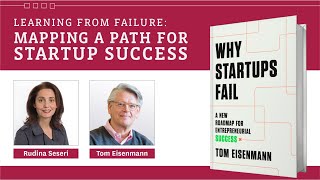
Rudina Seseri and others discuss Tom Eisenmann's research on why startups fail. They cover failure patterns at different stages, product-market fit challenges, unit economics like LTV and CAC, and how founders can recover after setbacks.
Questions this video answers
Tom Eisenmann
Glasswing Ventures and Silicon Valley Bank (SVB)
Chapters
Well, good afternoon everyone. We want to thank you all for joining us here. My name is Emma. I'm the Director of Platform and Marketing here at glasswing. For those who know Glasswing and those who don't, just a brief background, glasswing is an early stage venture capital firm dedicated to investing in enterprise platform and security startups that harness the power of AI and frontier technologies to transform markets and revolutionize industries.
My name is Jesse Bardo and I lead the startup team for Silicon Valley bank here in Boston. SVB is the financial institution behind 68% of US venture capital backed tech and life science companies with an IPO in 2020. I have the pleasure of working closely with Emma and Radina at Glasswing and I'm delighted to be here for for a really important topic and one that I know all too well as a recovering founder. Today we are excited to present Learning from Mapping a Path for Startup Success. Joining us we have Regina Sasseri, Founder and Managing Partner of glasswing Ventures, and Tom Eisenman, a Howard H. Stevenson professor of Business Administration at Harvard Business School and the faculty co Chair of the Arthur Rock center for Entrepreneurship, to discuss Tom's latest book, why Startups Fail. Welcome and thank you to Rudina and Tom.
And with that I will hand the mic over to Rudina. Thank you, Emma. Thank you Jesse and welcome Tom. What a delight. I have to share with the broader audience that Tom was my professor at hbs. It has taken over a decade for me to still be comfortable to call him Tom and not Professor Eisenman. So still it takes a bit of effort. But.
Tom, I'm going to somewhat shift the tables on you and say that as you write a book about failure, if it was an easy book to write, everyone would be writing about failure. So there is a bit of an entrepreneur, risk taker, or not a bit, a lot of it in you. I'm going to write a book about failure and I'm going to be successful. So what was the impetus? You talk a little bit about what you thought the class would be like and so how get us started on that on the emotional side somewhat. And I'm going to go for it.
All right, well first thanks to Jesse and Emma and to Glasswing and Silicon Valley bank for sponsoring, for hosting us. You know the original, the working title of the book for a long time was False Start. It's actually one of the failure patterns discussed in the book. But.
The irony of that is I started working on the book in 2014 and, and I had many false starts, sort of would outline it, make some progress, put it aside and it finally came together.
And the motivation for the book does come back to that timeframe. 2013, 14 and a team. I'd worked closely with former students who had launched a venture. I coached them on the startup idea. I was an investor in the company. They had what I thought was a great idea. They followed the minimum viable product.
Approach, lean startup approach in a textbook perfect way. Exactly what we were at the time trying to teach at Harvard Business School and still trying to teach and validated demand, raised a million dollars, wanted to raise a million and a half and that is part of the failure story.
The business only lasted a year. They actually had consistent with validating demand, had good strong sal and repeat purchases. They couldn't get operations together and hadn't demonstrated enough traction to either get a bridge from their existing investors or raise new capital. And failed. And I could point to a lot of reasons why, but I couldn't pinpoint the precise cause. So here I was supposedly an expert on entrepreneurship.
Failure happens depending on how you define startup and define a failure, maybe to 2/3 of venture capital backed startups. And I was a failure at explaining failure. So that was disconcerting. Was I teaching the right things? And it set me on this quest to learn everything I could about were there patterns, recurring patterns to speak to scores of failed founders and the investors who back them, do a lot of research, read everything else that had been published about failure and and the result is the book seven years later.
So let's jump in. Tom. You know, it's interesting because the tendency for all of us to level set is to say please define failure. But I'm going to take that off the table. I'm going to say that we know how to define success in that everybody benefits and then we rather than defining failure, we know we're not making enough money for the somebody's unhappy. The investor, the investors, the founders, the employees, the customers, the other stakeholders, somebody collectively really lost, if not all of them. In the book though, what I find interesting, you talk about smart failures without quotation marks or good failures and not so much get us started on that.
Yeah. So.
When you write about startup failure, I mean there's a whole class of failures that are neither good nor bad. They just happen and they happen through no mistake on the part of the entrepreneur. Think of it as asteroid strike, right? You're a dinosaur hundreds of millions of years ago and you know, this giant asteroid wipes out the planet. Same thing happened with COVID hundreds of Thousands of young businesses wiped out and, you know, again, completely out of the control of the entrepreneur. Same thing happened with the Great Recession of 2009. So we can sort of set those aside. They're easy to explain, they're tragic. We can feel for the entrepreneur. And so really what we're interested in are startups that showed promise. I mean, there's also a set of, frankly a set of businesses out there that were doomed from the start and maybe only the founder sort of saw potential and they went at it and they were ill suited for the task and the idea was terrible and they just didn't listen to people. And the good news on those, again, they're tragic, but they fail quickly without raising a lot of capital or taking, taking too much of anybody's time. So these hapless, hopeless ventures we can also set aside, the ones that are really interesting are show some initial promise, but through some combination of mistakes by the founder and misfortunes, they don't work. Then to your point about smart failure or good failure, there's a set of failures where the entrepreneur has a hypothesis, if we want to use sort of the terminology of science, a set of assumptions and needs to test them and goes out. And I mentioned minimum viable product before in the cheapest but still rigorous way, without wasting any time, without wasting any money, finds a way to validate the assumption or fail to validate. And some businesses.
The entrepreneur and the investors who back them have reasonable assumptions and it just doesn't work. When you're an entrepreneur, you're doing something new and by its nature it's going to be risky and sometimes the risk doesn't pan out. The key is just sort of recognizing that as quickly as possible, without waste and without sort of getting caught in the mental trap of sort of stubbornly persisting beyond the point where it makes sense to keep going. These are good failures. We should celebrate them and VCs should back them all day long.
So, Tom, let's dig in a little bit deeper. And invariably we'll be talking about the companies in the book. You know, well, the stage we invest in sort of, it's the core founders, some developers, sometimes showered, sometimes unshowered, and then they're in the product development and then they're about to launch in the market, right? So everybody's a generalist. It is a classic product, classic, classic problem that we deal with this challenge around the founder, slash, early employees that are generalists versus specialization. And I cannot tell you how much I resonated with that topic in the book, and I mean 15, 16 years of doing this, we still struggle, we still get it wrong. So let's talk a little bit about that, if you don't mind.
Sure.
One of the failure. So the book is divided into three parts. First part is early stage failure patterns. What are they? Three of them.
How to anticipate and avoid them. Then the second part of the book is late stage failure, later stage startup, Series C and beyond, if you will. Again, three patterns and how to anticipate and avoid them. One of the early stage failure patterns I call good idea, bad bedfellows. So these are entrepreneurs who've got a good idea. This is the example I started with when you asked about the motivation for the book. The company is Quincy Apparel and the founders had a concept for.
Wardrobe for young professional women. The problem they had is they were tall and clothing didn't fit them well. So they wanted better fitting, affordable and stylish. And you can kind of get two out of the three. It's hard to get all three. And it turns out that to your point about generalist and specialist.
Apparel design and manufacturing is a specialty where you need a lot of expertise to do it and to recruit and manage a team that's going to do all that many, many specialized functions that all have to be coordinated carefully. Fabric source or pattern maker, quality control, step by step by step. And these founders had a great idea, but no industry experience. They'd never designed or manufactured apparel. So they went off and hired specialists right from the start who could play these roles that I just mentioned. And the problem was they pulled them out of big apparel companies, big fashion companies, people who were not used to the chaotic rhythms of an early stage startup where everybody dives in to put out whatever fire is burning hottest. These people would quite literally sit on their hands and say, I'm the fabric source or I don't know how to help with the pattern making.
And so they really, they hired for skill, not attitude. And often you need both. But they got the balance wrong. They.
Went for investors. They made a mistake. I think a lot of MBAs make. We lionize, you Ridina and your ilk, venture capitalists. We sort of assume that anybody is going to launch a business out of Harvard Business School, should go wrench, go raise venture capital. And that's what so these founders positioned their business as direct to consumer, which was just taking off at the time, sort of Warby Parker and.
Bonobos and so forth. And VCs got interested around that time in D2C and so they raised from tech oriented VCs who really didn't know that much about apparel manufacturing, who pushed for hyper growth. That's what VCs are supposed to do, right? That's how you win as a vc. So get a fast growing business. And apparel is a tricky business to grow fast, right, you've got to build inventory. If the inventory isn't synced with fashion trends, you're in trouble. So they had the wrong investors, the wrong team. You tend to outsource manufacturing in apparel to third party factory, especially when you're small. And those factories just ignored this team. They would push their orders to the back of the queue because Ann Taylor would come in with a big order that needed to be expedited. So our founders had no reputations or relationships, so there was not much they could do. So all together, sort of the whole constellation of players that need to contribute their time or their resources to the venture, they were deficient or dysfunctional on all fronts. And a lot of it can be traced back to the lack of industry expertise, the lack of domain experience of the founders. I've come through this research to have a real appreciation for how important that is in some ventures, but really not in others. I mean, I had the confidence to invest in Quincy because I'd invested successfully in Rent the Runway. Again, to HBS founders who didn't have fashion backgrounds renting. Turns out renting party dresses or dresses is very different than actually designing and making them.
So hindsight in 2020, you could say, no kidding, because one has to produce. One is dealing with the tech enabled business period that somebody else dealt with that problem. But where I looked at Quincy very, very closely was concerned about lack of expertise. But I love the founders and sometimes the founders move mountains. You know, we talk about execution and those two women could actually execute. Domain expertise lacking notwithstanding. So then Contrast that with DoDemVo. I think it was where they had, you know, generalists and needed more specialization. Because what I'm trying to really get at, Tom, is as our companies grow, when is that right dynamic for the skill and the attitude to come together.
Yeah, Dot and Bow is what is. Each of the chapters in the book is anchored by a case study. And Dot and Bo is the anchor case for a late stage failure pattern that I call Help Want It. And Dot and Bow is an online retailer of home furnishing. So if anybody in the audience just looks around them, all this stuff was shipped from somewhere. The chair you're sitting on, the lamps, the couch and so forth. That's what they did. They sold home furnishings through a website. And there were. There have been some disasters in this space. Fab.com also in the book, lost hundreds of millions of dollars.
One Kings Lane had a unicorn valuation and then didn't was sold for something like 30 million. And dot and Bow actually mastered the demand generation formula. The founder, Anthony Suhu came out of the television business and he put the ideas of television episodes to work in marketing the home furnishings. The chairs and tables and lamps would become characters in a sitcom. And it actually worked. People wanted to buy the whole room because of the way it was marketed. But Anthony, with a media background and some tech, lacked an understanding of integrated logistics. And it turns out that shipping a couch from the west coast, where they were to Kansas.
Is really, really, really hard. And so first off, it had to come from Asia to the West Coast. That's hard too.
And Anthony.
Knowing what he was doing. His first hire for vice president of operations. By the way, if that couch arrives two days early, unlike your Amazon books where you'd be delighted to get them two days early, the couch comes two days early. You have a big problem on your curb because you're not there to get it into the house. So at least, maybe, maybe different in Covid times. So Anthony's first hire for vice president of operations. He wanted a generalist who he could turn into his chief operating officer. As it turned out, the person had no experience with integrated logistics. The second hire came from Netflix back in the days when they had the red envelopes stuffed with DVDs and had experience shipping those by literally the hundreds of thousands. But again, very different than a couch.
The first generalist COO type bought the wrong ERP system, the system that you need to manage your inventory. They had no idea what was in stock and out of stock. That generated a flurry of customer queries about where's my stuff? And they couldn't track the orders properly. The operations were not quite out of control, but really a whole bunch of diving catches and spending money to expedite orders and so forth. Took three tries to find the right specialist and they finally found somebody who could put in the right information systems and manage the vendors and the shipping and so forth. And that probably killed the company. The company had great demand generation. That and the one, two punch Rodina of not having the right person in operations for a long time and burning cash faster than they should have. And then the E Commerce capital market slammed shut in 2015. I mean, basically Zulily had gone public and the stock crashed and some other things happened and basically investors just paused for months on end, basically saying, you got to figure out if people can make money in E commerce and we're not going to invest in anything. Good companies, bad companies follow on investments. And so just as Dottenbo was getting things under control and needed a series C, there was no money out there and basically they were forced to liquidate.
So Tom, let's tie the thread. We have Quincy Apparel in the early days, too specialized. We have the furniture company and then Fab, because there are things that we can draw strings from that learning if we put them in a straight line, sort of from immature to mature, maximum maturity, bringing some of the frameworks to talk about. I'm a founder, I have my two co founders. I know one of them is not going to scale. I am torn between my loyalty to that, him or her. I am dealing with the board members breathing down my neck. Here comes Rudina saying, show me growth, show me this, show me that. What do I do and when do I do it and what are the measures?
Yeah, no. So again, I think it comes down to understanding what kind of experience is really important and when. I mean, basically once you start to scale, there's bound to be some functions where you need specialists, right? Your early adopters may come through word of mouth referrals and if you could sort of manage some social media, you can sort of keep stoking that fire later on. If you have to turn to digital marketing, you're going to need a performance marketer. When you start to spend millions of dollars on Instagram ads and Facebook ads and Google Ads, you need somebody who knows how to do that, how to buy efficiently, how to run experiments, run the AB tests and so forth. So for sure a lot of functions are going to need specialists when they're scaling. And for sure that'll be disruptive because there will have been some generalist who is running that function up to that point and that person's going to feel dislocated. They may have to leave the company. They may end up in a subordinate role. You get all sorts of old guard, new guard conflict. The specialists feel that their contributions aren't appreciated or understood.
And they look at the old guard and say, hey, you seem to be sitting on stock options that are worth a lot. I'm just drawing a salary at this point and my options aren't worth anything yet. So all sorts of conflict. And then likewise, there's a question, there's the question of functional expertise and then industry expertise. And I have to say, I don't have a food and beverage example in the book, but I've learned something about that over the years and a lot more as I start to think through the lens of the work I've done on failure, boy, is that a place where industry expertise is just pivotally crucial. Right. When do you step on the gas and start to pay the slotting allowances? And how do you read the signals you're getting from the national chains about whether they're actually going to buy more of the product and packaging? How do you design packaging in a way that actually appeals to the consumer? Tons and tons of small and large decisions that you can screw up if you're an entrepreneur who lacks the experience. So unfortunately there's no easy answer. As an early stage founder, are you in a sector where that industry experience is necessary and when do you need the functional specialty?
So Tom, if I bring this a little bit to a 30,000 foot level, Scott Matthews has a question around along the same lines, when you are in, I will call it C day round startup, which behaviors result? You know, behavior result is most important to the investors. And then as you evolve in growth, what changes? Is it growth? Is it innovation? I would love to bring in the LTV to CAG discussion for context though. Scott Matthews, I would call him One of my CEOs, he's a favorite. We brought him in to run Crowdtwist, which was a very successful exit ultimately to Oracle. But that's the context. So this is an entrepreneur, founder, CEO, how do you think about that transition? We talked a little bit about a blurry line at best between, you know, generalist to specialized. But how do we think about that growth transition and what matters?
Yeah, A is vexing and I've again through this work come to have a new appreciation for how tricky Series A is in theory. That's when you should achieve product market fit.
It's a fuzzy concept. I think. We all think we know what it means. But if, if we interviewed all the people on the call, we'd probably get many, many different definitions. Some would come back to Sean Ellis sort of wanting 40% of the people jumping up and down screaming if you try to take the product away. And there is something to that, obviously that gets an engagement and so forth. The trick I think comes. So what the BC's really want is sort of signs of accelerating growth at that stage. And they want, if they're careful, they want some indication that the entrepreneur can see a path toward profitability. And by profitability, I mean an acceptable ratio between the value of the customer, lifetime value of the customer over, over the, over the, over the length of the relationship and the cost of acquiring that customer. We don't need to see a positive LTV cac early on yet, but we need to have a concept for how we're going to get there. The problem that I've come to recognize is, and this comes through with the Fab.com example in the book, is it's often the case at seed and series A that you're still driving growth off of early adopters and.
The early adopter pool can get saturated. And it's true that that early adopters often have different needs than the needs of mainstream customers. You're going to build a big business, a fast growing, successful business. You obviously need the early adopters, they're going to get you going. But you almost always need mainstream beyond that. And if the mainstream needs are weaker than the early adopters or different than the early adopters, you can have your foot jammed on the accelerator trying to grow and find that the next wave of customers are much harder to get. You have to discount to attract them. They're not as interested in your features, you're not getting word of mouth referrals, they're not repurchasing with the same frequency, they're not staying around as long. And by the way, your early hyper growth has probably attracted clones and competitors to the space. So there's some pressure both on downward pressure on price, upward pressure on cost. So you're in an LTV CAC squeeze, your customers are worth less and it's costing more. And the product market fit you thought you had with the early adopters and indeed you had it with the early adopters, they loved what you were doing, dissipates. So the tricky thing about product market fit is you actually can lose it over time and it's actually quite a natural dynamic for it to weaken over time as you try to expand beyond the sweet spot of the people who love your product the most.
So I'm going to parse that conversation into two pieces. I'm going to bring in Michael Donahue, who has asked a couple of questions, but I'll focus on your second question, Michael, which is sort of this focus on there's a maniacal focus on customer acquisition. But then where does the retention piece come in? And what you just talked about is not all customers are created equal. In the fab example, you had sort of the community that was really looking into the funky, highly curated pieces at first and then that sort of, you know, got weaker and weaker. You also have. This is not in your book, but I call it the leaky bucket problem. You see them, particularly with publishers, the big names, New York Times, you know, Washington Post, where they acquire very effectively and they're paying attention to that. They're not paying attention that the bucket is leaking, you know, at the bottom, so to speak. How do we think about the retention piece?
Yeah, so, so I mean, that's right at the center. And again, it's deceptive because your early adopters are probably going to stick around and come back and be enthusiastic. But you just have to, you have to do cohort analysis. And I think it's well understood, certainly in the SaaS business and in E Commerce, that you need to track the performance of cohorts very carefully. And that will tell you basically whether retention is starting to wobble with the more recent cohorts. My colleague Mark Robert, he's not the only one with this concept, but I think he's got a well honed sense for it. Mark was, he's now a faculty member at Harvard Business School, but was one of the first employees at HubSpot and built the, built the salesforce. At HubSpot, he talks about not only looking at retention through cohort analysis, but finding predictors, early behavioral predictors of retention. So at HubSpot, it turns out that their suite of tools has something like 25 different features. And they have determined that if you, if you, within a certain period of time, I forget what it is, 30 days or something like that, use five of the 25, you're much more likely to turn into a great loyal customer. So for all the entrepreneurs out there, if you can find those behavioral correlates with retention, it really gives you an early warning system and you can come in and you can target those actions and try to stimulate them and turn an okay customer into a great customer. It's much better than say, tracking Net Promoter score, which is so late. I mean, it does precede attrition, which is the good news, and lets you act. But a Net Promoter score can be wobbly or flawed for any number of reasons. So you really haven't done anything to pinpoint the problem. Whereas these correlates with early engagement, sort of leading to retention, I think can be very powerful tools.
So, so to that end, we've sort of talked about the components that ultimately fit in the numerator, which is the ltv. Let's talk a little about the cac. This is an ongoing discussion and It's a pain of my existence because, you know, again, we're investing in companies that are going to market and they've just launched. When is the CAC meaningful? I will tell you, like, I'm thinking of a particular portfolio company and, you know, if the founders are on, which I expect they are, they'll be like, yes, that's us. You know, we hired, I believe, six people on the sales team in one day. We could train them at the same time. They were learning as a cohort. It actually has been one of the most brilliant moves they've made so far anyway. And we loaded them on our cac. Guess what? That's an ugly LTV to CAC ratio overnight because of one move. So it's not just sort of calculating the, you know, acquisition cost, it's actually when do you load it? Is that the right time to load it? Or do you give them three months to be productive? So you're comparing apples to apples because you've loaded the cost, not captured the impact.
Yeah. So, you know, again, through this work, I've come to appreciate how complicated CAC can be and how there are offsetting forces at work. So my advice would be start tracking it right from the start. You don't necessarily manage against it, but you need to monitor it. And I mean, a team is going to get better at the performance marketing. Right? The CAC will come down as you sort of figure out what works and what doesn't. So that's one effect. The other effect, though, is as you try to grow, I mean, there are many marketing channels that just. They're like.
A reservoir that you can deplete and maybe it'll replenish itself over time, naturally, but you can only do so many searches a day with the good keywords. And if you try to market through search engine marketing, beyond that, you're going to go for peripheral words for customers who aren't as interested. So your CAC is inevitably going to rise when you saturate the marketing channels. There's also saturation of the customer pool itself. So as you sort of expand beyond the sweet spot to people who are less and less interested in your. In your. In your product, you're going to have to market harder to get them. And there's also competitor effects, right? As sort of people come into your space, they're going to bid up keywords, they're going to bid up some of the channels. So all of these things are forces that are. That are sort of pushing CAC down. I mean, basically over time you should have brand equity and that should make it cheaper to acquire customers. But there are these other forces that are pulling it up and you just have to watch it like a hawk and track it and really try to decompose, you know, if it's going in a direction you're not happy with. Is it because we've saturated the target market of consumers? Is it because we're overusing certain marketing channels? Is it because our competitors are bidding up the cost? You know, customers are still very good, but it's just more expensive because we're fighting over them.
Yeah. So along the same lines, in a number of instances, in the case, in the cases in the book, we had early successes. I mean, in some of them we had unicorns and they were real unicorns and people paid real money, whether it is the Israeli company, I mean real dollars that went behind that. Arbor Rucci from New York actually asked the question in our feed, basically said, if you have had early success and then failure in lean startup lingo, does it mean that the market has been resegmented or was it a fake success? That's my the or is my addition. And then Vlad Sainoa, former CT of Nuance, they did well by him. And now, luckily for us, venture partner at Glasswing, asked I think a similar question, but at the 30,000 foot level which says insufficient market research. So he's starting with that premise. Leads to false starts and false positive. Too much research. I'll say, who the heck has time for that when you're doing a startup? But can lead to paralysis analysis. And then in between you're trying to hire and get the venture capitalists attention and find a location or manage a remote team and build culture and get on front of the media. How do you balance these things? Is early success false and how do you balance false starts with false positives?
Yeah. So early success is early success. Sometimes it comes from great salesmanship, great storytelling, you know, so we can raise a big round without having proved much of anything if we can dazzle the investors. So let's set that aside. We all understand what that is. Sometimes, as I said, you can have big, big success with the early adopters that can dissipate over time. And that's just something that as an entrepreneur, as an investor, you got to track. And the best way we have the toolkit for tracking it, that's cohort analysis and tracking, ltv, CAC and so forth. This question of overanalyzing, I think it's real. I mean, I've spent 23 years coaching MBAs at Harvard Business School. And you know, A problem with MBAs is they're trained to find fault. And you sort of, many will just keep. I mean, you look at any startup and there's no end of the problems you can identify. And some of those problems lend themselves to deeper and deeper analysis and you sort of can get paralyzed by that.
I think it's much more common for entrepreneurs to sort of swing the other way and assume they can see around corners, they've got the vision burning bright of the problem and solution they want to go after. This is the false start, where basically you skip the hard work. Not very time consuming by the way of making sure you found a problem worth solving.
By talking to customers about unmet needs and exploring. There's always a way, a range of solutions to those problems. And it's easy to assume that you've got the right one. I mean, entrepreneurs. What defines an entrepreneur? It's a bias for action. And so it feels like you're being a great entrepreneur if you just dive in. And as fast as you can build and sell, it actually feels like you're following lean startup logic. Because what do we tell? We say launch early and often fail fast, get out there, get it in the hands of consumers, get feedback and iterate and pivot. You can do all those things. But if the first version of the product is more likely to fail because you skipped some upfront research before you started your engineering work, you've probably wasted four months. That's the amount of time it might take to actually build the thing, launch it and see if it's working, you know, and then figure out how you're going to pivot. You've basically sacrificed four months in order to avoid spending four weeks up front doing some upfront research with simpler prototypes and talking to customers. So I think entrepreneurs are much more vulnerable to the false start.
Than they are to analysis paralysis. But I think they're both real and the false positive is just there's a lot of human nature here, right? We get so turned on. When you've had early success and you have early access with the early adopters, you relate to them. If you're a good entrepreneur, you're close to your customer, you want to make them happy, and it is possible to sort of skew too far in the direction of the early adopters and, and accelerate in that direction, maybe come up with a feature set. They're often sophisticated power users with more advanced needs than the mainstream customers. So you can over engineer your product. You can make a lot of mistakes.
And you talk about that in the book. You talk about that how you talked about Dropbox, how they were. Actually, I think it was Dropbox and not Boxes. They were late to market, but they really oversimplified the product and got ahead of everyone else. Am I mischaracterizing?
Yeah, no, no, that's exactly right. Dropbox box is intriguing.
Drew Houston, he. It's fascinating. You can find his Y Combinator application online, and it's intriguing to read about it. So he. He recognizes that he needs the early adopters, that they are going to spread the word about the product. They're actually going to become unpaid customer support, which they did, sort of. If you think about how your mother may have sort of set up her Dropbox account, it's probably talking to the child who actually is a software engineer or something like that.
And so he listened to this early group. He got feedback from them. They wanted all these advanced features. I mean, imagine software engineers sort of collaborating with each other, working with many different devices, sort of big files, sort of very complicated needs compared. In his Y Combinator application, he actually talks about building a product that's so simple to use, My mother can use it to store her recipes. And he had the discipline. He made a calculated bet that creating something simple would still be so much better than what the software, what the. What the early adopters were working with, that they would adopt it, which they did, you know, and yet meet the needs for simplicity. There are other ways to skin that. I'm sorry, it's a terrible expression to solve that problem.
And, you know, you can build two versions of the product, it takes longer, or you can build the complicated one and then hide those features as you start to bring the mainstream on board. So there are lots of ways to do it. The point is, as an entrepreneur, know the difference between early adopters and mainstream and have a strategy, have a roadmap for how you're going to meet both sets of needs.
So.
My partner, Rick Grinnell. Was Rick your student as well, Tom? I think he was.
I think so, yeah. Yeah. After several thousand, the names and faces do blur a little.
No, no. You talk about network businesses. I took network businesses.
But Rick raises another point, which I'm so glad he does, because it's another thing that we see in the portfolio across companies, which is marketing is not necessarily the immediate background that founders come with. They tend to be technical. In fact, especially for some of the sort of B2B businesses. And in this back and forth exchange that we've been having. And a of what the book focuses with on rather implicitly and explicitly is around how understanding marketing, analysis, segmenting, even the LTV to CAC discussion are critical. So Rick's question is, when is the right time for a company to bring in the marketing expertise at a senior level? You know, marketing is an afterthought. I mean, I'll give you all to that, if Rick won't mind. I walk into a board meeting, I cannot tell you how much complaining there is by the founders themselves saying, and you know, we need these sales engine, we don't have enough coverage. But then we say, let's build the marketing team. And that's the last thought that they want to have in the last expense. How do we balance?
Yeah, sales can't scale, obviously, until they have leads. And marketing needs some time to figure out how to generate quality leads and how to qualify those leads and so forth. They're going to fight forever, right? For the end of time, marketing and sales will be fighting over the quality and quantity of leads that are being generated.
I think pretty early.
I had the not many people on the call will know who Ben Shapiro is, but he was a legendary marketing professor at Harvard Business School. He's retired a few years ago.
So I published a summary of a couple of the early stage failure patterns in Harvard Business Review recently. And Ben just wrote me a wonderful note and it's like, you know, I mean, we're still all insecure enough. Like when an idol says, you did nice work. It was moving, but it basically said, I read your thing, I loved your thing. You think you're writing about entrepreneurship, but you're writing about marketing. Everything I read in here is about marketing. And he talks about his mentor, Ted Levitt, the like, the truly legendary marketing professor, sort of getting angry when Ben was an MBA years and decades ago, getting angry with the class and sort of filling out one big blackboard in the front of the room with just the one word, customers. You know, it's all about. Ben says that whatever it is, probably 50 years later, you know, he remembers that moment. And Ben said in this email, you know, I never met an entrepreneur or for that matter, somebody in a big company who said, we've learned too much about our customers.
And a good marketer, someone with the right sensibility is going to bring that in. Obviously it's important early on for the founders, when they're still designing the product and searching for product market fit and pivoting, to be in direct touch with the customers and Especially.
Especially around the sales function. So that's it.
But I think it takes a while to figure out which marketing channels are going to work. I find that entrepreneurs are often surprised. They sort of assume a channel is going to be productive and it turns out to not be, but something else works and those things just have to be tested. So essentially it's a bunch of experiments and you need somebody who's been around that track before and knows the patterns and knows how to run those experiments. So I would bring the person in pretty early.
They do need to be stage compliant. Right. So if you bring in somebody that's too much a late stage person and they're confused about why is it so chaotic here in this series, a company that might not work or might be a waste of money and a poor fit.
One final question on this topic and then we have a number of questions around evil VCs board dynamics. So we'll move on to that. But Ken Morse. Hello Ken. Legendary Ken Morse out of MIT and beyond.
You know what the book or some of the cases have uncommon is that the founders were lacking that deep 10 to 15 years of industry experience and didn't have the network of recruits of having done it before. In quotes, to what extent does the 3k rule hold here? And that's know the market, know the people in the market and be well known in the market. And if I could tie to that, I often think when I evaluate companies, particularly of first time founders or non domain experts in a new space, I think about them as the disruptors and then how do they attract the adopters? So different lingo. But I think on Ken's questions, what are our thoughts?
Yeah. So I would say, you know there's seven deep case studies in the book and two of the seven fit. His did not have 10 to 15 years of industry experience profile.
And the other five did. They're actually pretty, I mean Steve Chambers who he wasn't the founder of Jibo but he was the CEO of Gebo. You can't ask for a deeper industry background. The founder of Dot and BO was a serial entrepreneur. He'd been at in both startups and then the startups he sold to big companies. At least 15 years of experience. Shia Agassi a better place, many, many years at SAP and at a startup he built before that. So.
Yeah, I think it's right. But it's interesting.
The ones that fit the pattern Ken is concerned about. The Quincy founders absolutely suffered from lack of understanding of the apparel industry and to his to Ken's point a lack of relationships. You don't have a network risk with people so you can't hire the right, can't find the right people. And even when you do bring a candidate in, you don't know what you're looking for. So there are ways to compensate for that to some extent by having advisors, by having investors who can help and by outsourcing the evaluation of skill to somebody who can assess the skill, you can still recruit for attitude yourself as the founder.
So the other venture though, Sunil Nagaraj was a dating site. Dating turns out to be a place where you don't need, I mean we all have some experience with dating and.
You don't need a lot of industry experience to launch a winning. You know, there's been many, many, many losers in that space, but some interesting winners. And if you sort the winners from the losers, it's not anything but the background of the founders or their prior market experience, industry experience that sorts out the coffee and bagels and okcupids of the world from the losers.
So Tom, let's talk about the combination of what kind of money do you raise fast growth versus managing for profitability but also how you evolve the board. So Laurent Gill is asking a question around.
Are the early board members, whatever that looks like the same as what you need when the company enters a growth stage board. So Lauren, his company cast AI is basically optimizing your usage of cloud, let's just put it at the highest level. So how do you manage your kubernetes and how do you bring down the cost to be as much on demand as possible and they're leveraging rules based AI. But how should he think about board evolution as the company evolves?
I mean the company evolves the need for specialists, the kinds of pressures they're going to encounter. I mean little company that's doing something disruptive in a regulatory sense isn't going to attract much attention when you get big you need people that have sort of understand the policy linkages and so forth. So I would say and just sort of all the dynamics of scaling, scaling the team, managing the culture, so many things, so many pressures and challenges are different in a scaling startup. And ideally you've got board members who've seen it before and can continue, can add value.
So basically an interesting question is whether your early stage founders, if they lack late stage experience, they may not be adding that much value anymore. What they probably do bring, which can be quite helpful, is a very strong relationship with the founders and an understanding of their strengths and Weaknesses and whether they can manage the very tricky transition from early stage to late stage and what roles they'll play in the company as the company evolves. So you know, I'd say.
But it's going to be natural for your late stage investors to have the kind of expertise you need at late stage. So I think it happens more or less automatically as you if you bring in a new board member with a later and later round that ought to be happening, what you will get is very tricky conflict between the early stage investors. And this comes up in some of the case studies in the book where the early stage investor has such a low basis on their stock that they want the company to continue to be successful and grow. But what they really want is for the company to not screw it up. Whereas the late stage investor, if they're going to get a positive return on their investment, the thing has to still double or triple, which means lots of growth, it means entering Europe, it means launching a second product line. And so the board's collective tolerance for risk is going to get messy and you'll see board conflict over how much risk to take as the company matures.
So let's take that complete picture and sort of pull out the different puzzle pieces. So you talked about the misalignment between founders and investors but also within, you know, you talk in the case of Quincy the bad I think it was Quincy bedfellows but also the misalignment between not all VCs are created equal. Forget personalities and banker and backgrounds and value it or not. Just what money are we managing and what risk have we taken and the reward one one piece around that is several times it comes up that the VCs were either losing faith or for the right and sometimes the wrong reasons were push in the company toward an acquisition. There is a question by Lawrence to that end like could a VC be destroying a company effectively because they're pushing it in a certain way? Part B to that. So that's one question. Part B to that is how many founders have you met, Tom? Give me a percentage that say I am the initial founder. I know for a fact, I am aware of myself and I know my skill set and I know for a fact I will not be the same in the CEO seat when we are north of humor me 30 million.
Yeah. So.
We know the statistic which is Noam Wasserman, my former colleague did the research and at Series D only 40% of Series D companies are led by a founder CEO. 60% have brought in a professional CEO at that point point. So we know and you know, sometimes those folks are forced out against their will. Sometimes they see, they feel it, right? They feel they, they no longer have the skill to sort of take the company to the next level. And Noam actually has interest in his book Founders Dilemmas. He has the data on the fraction, I forget the fraction. I think it's something like one third step away voluntarily or you know, step into a new role. And two thirds are essentially forced out by a board that now outnumbers them and can vote them out of the CEO role.
So what that says is I think there are many founders who are self aware and sort of see and feel the challenges and how much they are beyond their capability. There are also some who frankly just love the rhythm of building something new, building something from scratch. And you know, that's actually dangerous. If that person wants to hang onto the CEO role but wants to sort of relive over and over again the chaos of creation, you know, they're sort of Peter Pan principle, they don't want to grow up and.
Boy, if that person still controls the board and can't be voted out, you can have a real mess on your hands.
And I think that's interesting because if that person, there is a constant need for innovation and they are comfortable, comfortable doing that, there's a role for them to play or they need to be startup, an engine of startups, almost their own set of incubations that they bring in the professional management. I asked that question because it is not uncommon for VCs to get the bad rep of, you know, you pushed out the founder. At glasswing we take the approach of there is always a role for the founder. It is not always the CEO role, but it's a inherent conflict because it requires self awareness on the VC's part and on the founder's part. To be perfectly honest.
Tom, at the end of the book you write a letter and I went over it at 11pm last night. I needed it.
All the case studies tell us a little bit. And what is uplifting about failure. How do you get up the next morning in that void when it feels like part of you has died?
So it hurts obviously.
For months afterward it's going to hurt. And the founder, I mean you've trashed your personal relationships because you've been working so hard and not going to dinner with your friends and your spouse is tired of hearing about it and maybe lost patience too. You may, depending on your family circumstances have trashed, you know, completely depleted your bank account Sort of be staring student loans in the face, et cetera, et cetera. So all that hurts.
What can be good about it? And by the way, I worried. I created a companion course at Harvard Business School entirely devoted to entrepreneurial failure. And I worried quite a bit that I was going to just basically push it in the face of all these students and somehow scare off a generation of Harvard Business School students from being entrepreneurs. Now I'm in charge of a lot of the entrepreneurship programs at the school. And five years from now there'd be this article that basically, you know, there's been an alarming drop off in entrepreneurship at a Harvard business school and we're looking for the cause, trying to figure it out. Eisenman's course. But it had just the opposite effect. The course I actually survey the students at the end and ask them, are you more likely or less likely to become an entrepreneur over the next five years as a result of this course? 20% do say they're less likely. That basically they've stared it in the face and excuse my language, just scare the living crap out of them.
And they should be, they should know that. 40% said, I've seen it, thank you for showing me that.
But I think I can handle it. And.
I actually relish the challenge. So, you know, so the course is, has sort of given them a more nuanced sense. And the remaining 40% by the way, say I was always going to do it, I'm still going to do it, I may do it later and I may think twice about whether venture capital sort of signing up for hypergrowth is the way to go.
Yeah, sorry about that. You'll be fine. My Ms. MBAs are gonna, are gonna be in your portfolio anyway. I can't turn them away from entrepreneurship.
So I think. And one of the reasons the students who are enthusiastic I bring in the failed founders and granted it's a curated set of people who are quite thoughtful about the failure, many of whom got the self confidence to come in and talk about it because they've gone on to do amazing things afterwards. But it is quite true, I think of.
Many founders out there who failed. If you fail gracefully, sort of responsibly in ways that protect your relationships, pay people, vendors and employees who are owed money get paid back. And if you show you can be thoughtful about your role in what happened and what you've learned from it and what you'll take into the next venture, these folks I think can bounce back stronger. It's the founder who remains in denial about what happened. It was everybody else's fault, who I think is not the role model. So my students saw these fantastic role models and they could see themselves in that role and see that, yeah, it hurts, but you can bounce back from it. And that I think is that's the silver lining. And those are going to be better entrepreneurs as a result because they're going.
In, I think, eyes wide open. So I started our discussion with saying you had your own entrepreneurial, big entrepreneurial moment with this book. You're writing about failure and expecting strong sales. I will tell you that as a VC and Rick and myself had our own and have our own entrepreneurial journey. Literally throughout the book, I'm reliving some of the stories, but also constantly we're thinking about how are we doing this at Glasswing? Because it feels like long forgotten, but there was no Glasswing six years ago. So we're as much the medieval VCs, but we can also relate to the founders. So as we wrap this conversation.
What would be one sentence, one parting thought that you'd leave us, whether it's on the success and incredible success that you're having around the book, whether it is that all of us are taking risks, entrepreneurial in many ways, what do we leave these founders as we read this lunch session?
Yeah. So I'll steal from the letter to a first time founder that you mentioned at the end of the book. And it sort of talks about how some of the conventional wisdom on what makes a great entrepreneur, while very sound, be frugal, grow, be focused, be persistent. That's all good stuff. But taken to the extreme, can actually get you into trouble. And sort of in that same spirit, entrepreneurs hear all the time to trust their gut, to trust their instincts, and they should. And it's an advantage. It allows them to move fast in a world where people have more resources. But there's a certain set of decisions where you, Kahneman, who won the Nobel Prize for his work on the psychology of decision making, talks about fast thinking and slow thinking. You do want to slow down as an entrepreneur on some decisions. Sleep on it. Sleep on it two nights. Talk to a lot of people and don't trust your gut because your gut is going to be racked by emotion on some of these big decisions you have to make. So understand when fast thinking is okay and when slow thinking is the right way to go.
Thank you, Tom. We're always learning and perpetual students of yours. Thank you. Thank you on behalf of everyone. And thank you everyone who joined us today.
Yeah, thanks for listening. Everybody. And to Silicon Valley bank and to Glasswing. Thank you for hosting.
More from Tom
"Why Startups Fail" with Tom Eisenmann, Author & Harvard Business School Faculty Chair


Why Startups Fail with Tom Eisenmann (HBS Professor) || Harvard Alumni Entrepreneurs

12. Tom Eisenmann & The Other F Word (Failure) | FOMO Sapiens with Patrick J. McGinnis