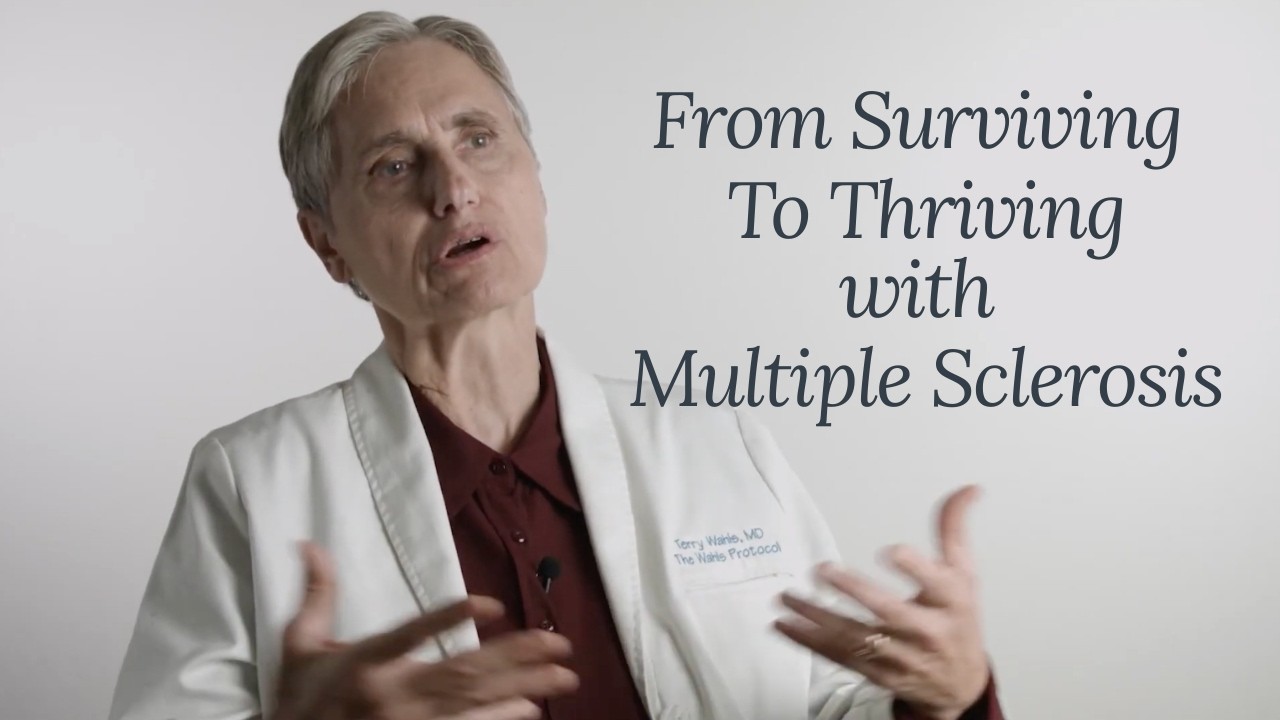
Dr. Terry Wahls was diagnosed with MS in 2000 and became wheelchair-bound, but reversed her decline through meditation, physical therapy, and a strict anti-inflammatory diet heavy in nutrient-dense foods like blueberries. Six years later she rode a bike again. She developed the Wahls Protocol, a three-pillar approach combining emotional visualization, nutrition, and exercise that showed similar improvements in other MS patients.
Chapters
In 1980, during medical school, I started having episodes of face pain. Over time, they'd get progressively more severe, more difficult. In 2000, I was diagnosed with multiple sclerosis. Within 3 years, I was in a tilt recline wheelchair and continued to go downhill. I was taking the newest biologic drugs, now spending tens of thousands of dollars each month. I had two young kids. I was facing a very grim diagnosis. I was watching them, knowing that they were watching me, and I could either model giving up or I could model that, yep, life's not fair, but you get up every day and you do the best that you can. So I spend about 2 hours a day, I meditate, I do my physical therapy, I have a variety of workouts that I do every day, and I am meticulous on avoiding the harmful foods and eating those recommended foods. Numerous studies have shown that having even just a cup of blueberries improves cognitive performance, and you can measure this really very quickly in just 16 weeks. So I have about a cup of these every day. Deep blue purple-black, rich in acanthocyanins, incredibly rich in polyphenols, great for lowering the risk of heart disease, of stroke, of cancer, and of cognitive decline. You can build more muscle by using electrical current, but if you want to— it's incredibly helpful to use the current to reduce the harms of inactivity. If you will also exert your muscle at the same time, now you're building the connection between your brain and the muscle in addition to building the muscle volume. Now keep in mind, I was doing all of that not to get better because I, I knew with progressive MS no one gets better. It's always just downhill. I was doing all of that to model resilience for my kids and to slow down my decline. I was quite surprised when not only did I slow down my decline, I stopped it. And then I was even more surprised and frankly quite amazed when I began to get better and better and better. And then when I finally rode my bike for the first time in 6 years, I was stunned. It felt very miraculous. I'm crying, my wife's crying, my kids are crying, and if I talk about it much longer— I can't talk about that without crying. It transformed how I thought about disease and health. It would transform the way I practiced medicine. My chief of medicine asked me to get a case report written up. About my own remarkable recovery. And when I did that, then he asked me to, uh, conduct a clinical trial. Started doing research testing my protocol in others with multiple sclerosis. We could show that, yes, others could implement this, and when they did, they too experienced remarkable improvements in quality of life. When I'm working with folks, I have them first visualize a big physical goal of a dream that they'd like to do. So it might be dancing with your son or daughter at their wedding. Then on the nutritional pillars, we have to help them address their— what they're going to do about diet. And so we talk about removing the foods that are really most inflammatory and to get that environment I have them get these tempting foods out of their eating environment. And then we talk about what are the foods that we have to ramp up so their cells and their brain cells have the building blocks that they will need to conduct the biology of life properly. I ask them what do they want their health for? Uh, this comes down to what's your mission, what's your purpose? What do you want your health for? So that you're willing to do all of the work that will be necessary for this health journey. Those are the, the three big pillars that we work on: the emotional, the nutritional, and the physical. I think for most people, we need to have a meaning that is bigger than us, a purpose that is bigger than us. And so I have this tremendous, uh, moral obligation to teach the public, to teach my health professional colleagues that an epidemic of health is possible. We could have millions, hundreds of millions of people here in the U.S. reclaiming their lives through health behaviors. We could have billions of people around the globe reclaiming their lives through health behaviors.