Alex Episode Interview: Shares Key Takeaways From His New Book, The Anti-Hustler’s Handbook.
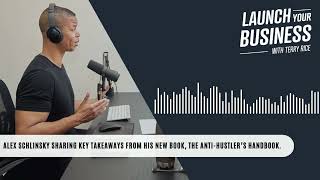
Terry Rice interviews Alex Schlinsky about his new book, The Anti-Hustler's Handbook, which challenges hustle culture and redefines success. Schlinsky discusses his entrepreneurial journey, health struggles that shaped his philosophy, and how to build a business without burning out.
The anti hustle model inherently is all about identifying what the true goal of entrepreneurship is. And to me, pretty much every single person that I speak to, everyone wants to be happy and they want to be free. The thing is with freedom is most people posit freedom as financial freedom and time freedom. And yet so often time is just thrown aside, cast aside for the benefit of financial freedom, financial freedom, financial freedom without ever defining what even financial freedom was. And worse, never taking the time to define it and allowing someone else to define it for you. Because you never do the deep work to identify, well, what is my version of success? What is my version of time freedom? What is my version of financial freedom? And so instead you'll listen to someone else tell you what that is.
This is the launch your business podcast because we know starting a business is challenging, but it doesn't have to be confusing. Each week we'll give you the tactical advice and the necessary tools to scale your business without feeling burnt out. I'm Terry Rice, business development consultant and staff writer here at Entrepreneur Magazine. Let's dive in. I don't know many people who have taken a straight and narrow path to entrepreneurship. I mean, even on my side. I studied entrepreneurship in college but didn't actually do anything about it until 10 years later. Most entrepreneurs I know had a 9 to 5 for a while and then decided it was time to do their own thing. But today's guest, Alex Schlinsky, is different. He actually started off doing his own thing. He never had a traditional nine to five and we will get more into that later. But what I want to focus on right now is the reason why he was so drawn to entrepreneurship. It's because he thought there was a chance he might die young. And look, I don't want to make this overly dramatic, but I can imagine feeling like you don't have much time left can encourage you to truly live for the day and make the most out of however many days you have left. But you don't have to go through a life or death experience in order to take more control over your future, because Alex is going to share the lessons he learned with you today. And as you listen to Alex, you can't help but get wrapped up in his story and even probably see some parts of yourself in it as well. The strategy, execution and resolve displayed is encouraging, but also prescriptive, meaning you can just follow some of the same steps he's taken. So I know you'll be inspired, but you'll also pick up on some great business building tips along the way. We'll discuss the power of persistence and why it's the key to getting what you want out of life, how to build a robust and lucrative online community, and why the hustle hard mentality makes no sense, and what you should do instead. And on that last note, we'll also discuss Alex's new book, the Anti Hustlers Handbook. So let's jump into that right now. Alex, welcome.
Harry, thank you so much for having me. Man, what an honor to be on the podcast.
Yeah, I'm looking forward to chatting with you, because often we bring on experts who are just giving their advice, but they're not telling their story of how they learned this guidance that they're providing. So today's a great opportunity for us to unpack that with you and your career. But do you mind us introducing yourself first?
Yeah, absolutely. My name is Alex Shlinsky. I'm an entrepreneur, coach, sales consultant, heart surgery survivor, a huge Miami Dolphins fan as well, out here in Tampa, Florida.
All right, so obviously we need to get to the heart surgery part, but let's build up to that. So you're. You're an entrepreneur now, but what were you doing just before that? You mentioned the Miami Dolphins and I think UFC as well. So just walk us through that.
Yeah, absolutely. When I was in college, I actually was running a digital marketing agency, but I didn't know it at the time. The reason being is that I was going to school to either become an attorney or a psychologist. I ended up choosing the psychology route, worked really hard to be successful at school, but then ultimately burn myself out by working too hard. So the idea. Idea of going back to school was just null and void. There was no way I was going to be able to do it. And even though I had the business that was available to me, I think I didn't have a strong enough entrepreneurial curiosity in terms of building, you know, my marketing agency out more. And so I focused on, you know, passions. And I love sports. I love the ufc. I love Miami Dolphins, Miami Heat. So I tried to become a journalist. I called the Miami Dolphins media department every single day for two months straight before training camp, trying to get this credential because I was committed to making it happen. And ultimately, after hearing every single objection in the book, I knew one thing that was really important to me, which was I was willing to hear no more than they were willing to say it. And so I just called and called and called, eventually knowing that the brow beating will eventually make them capitulate and they would give me this Opportunity. And finally one day, you know, the assistant for Jason Jenkins, the media member or the media PR professional at the Miami Dolphins, finally patched me through. And I remember that hold music, Terry. And I was like, I don't. I don't even know what I'm gonna say. I've been trying to get on this call for two months, and I don't really remember what it was. I think I blacked out. It was something along the lines of, jason, Dolphins fan, media member now, please. And he said, cool, we'll see you on Sunday. You're credentialed. And there it was. And that was the first time in my life that I. I really put something into work as the idea that my parents would always share of, like, you can set your mind to anything if you get it, if you do it, if you want it, you can accomplish anything.
I think it's amazing, the statement you just said where you said, I was willing to hear no more than they were willing to continue saying it. And just that mindset, that determination, I'm sure has benefited you going forward as well with your career, but some people just stop it. No. And like, okay, well, that's it. It's like, no, you gotta be persistent and keep on pushing through, because that's how you stand out, and that's how you get the great results you've had. But. But walk us through this, right? So you. You heard no bajillion times. You finally got the. Yes. You're now a credentialed journalist. What's next? What happens after that?
Yeah, I remember they gave me the badge. They gave me the media member badge. I still have it in my office. They gave me the badge, and it's, you know, the Miami Dolphins logo, it says, credentialed Media Member of the Year. And that feeling, that overwhelming sense of achievement was unbelievable. It honestly, like, I have chills still talking about it today, because I remember how that feeling was and desperately wanting to generate that feeling over and over and over again. And so I went to practices, and I went to, I think, six home games that season where I lived in Orlando. I started to drive, like, four hours on Saturday night or Sunday morning to go to the games, but I did not care. I was so excited about the opportunity to do this. And it was amazing experience, even though I made probably collectively $500 for the whole season. Not exactly the most lucrative profession, um, unless you, like, commit to it long term, which I was definitely not going to. But it was an incredible experience.
It's interesting because we're similar in how we got involved with journalism. I'm not. I didn't go to school for it either. I actually met the editor in chief of Entrepreneur magazine when our kids were going to the same gym class. That's the only reason why I'm right now. But I know you eventually moved on from that role. So what made you want to do that and what did you, what did you do next?
Yeah, so I made that comment about. During college, I had a business, but I didn't really know about it. Really what it came down to is when I left high school, before I went to college, I did an internship with my next door neighbor who was a personal injury attorney. And Facebook business pages had just released and he was very confident that it would become very, you know, important in the industry, which he was definitely right. And so he asked me to post for him once a day on Facebook to generate more cases for him and do a constant contact newsletter of which he would pay me $1,000 a month to do that, which was like big money at that time. So I did that for him for most of my senior year. And then after I went to Colle, I asked him if anyone that he went to law school with in University of Florida potentially worked in Orlando, that could also be a client of mine. And he sent me like 20 attorneys, half of which were like, oh, Lloyd sent you, here's money. Like without even any sort of sales pitch or anything. And so magically I was making.
Charged them the same amount because $1,000 a month seems very low.
It was a thousand dollars a month.
Yeah.
So it's funny how you say it seems very low, but to me at that time, it was like astronomical. Like I couldn't even fathom the idea of getting paid $1,000 to do this. And so, um, you know, I, I got about 10 clients and we had them for the majority of the four years I, I was in college. My wife at that time, my fiance was with me in college as well. And I remember we would wake up probably at like 6am, go to the NHTSA website, the National Highway Traffic Safety Administration, pull out like, you know, recalls and issues like things that would create case opportunities and post them on all 10 of these attorneys pages from like 6 to 8 o' clock and then go to class. But it's so crazy because I never really thought about it as a business. It was just a side hustle the whole time. And then after realizing, fast forward four to five years later, finishing college, realizing journalism isn't really going to make me money as much as it is passion. What can I do? And so naturally I thought, is social media a business? And so I started looking that up. And as soon as I started looking it up, that's where ads started coming in. Tai Lopez, Sam Ovens, Dave Rogano's are some of the peers that I've seen. I'm in the industry originally. You know, I bought courses, I invested into mentorship and I built a really successful seven figure marketing agency for personal injury attorneys. Transitioning our offer from social media management to Google advertising, which is a much more valuable solution and creates a much higher ROI and allowed me to change my pricing from 1,000 to $5,000 per month. And then I parlayed that into my coaching program a few years after. And so that's kind of the genesis of how it all happened.
That's, that's amazing. Just to think that you and your fiance, while you're in college, you're waking up at 6am and just working on this side hustle, which, and I didn't mean to be trite when I said that's all you were charging because for me, I know a lawyer is making way more than a thousand dollars a month work, so that's why I'm bringing it up. But when we're first starting out, that's the way we think. 1000 bucks is a lot of money. Right. It's just in regards to roi, you now know, and you know, we all know that you can, you can charge.
More.
And I'll have to assume things were homing along very well. But then you got hit with this, this issue where you ended up having surgery. Do you mind sharing about that as well?
Yeah, absolutely. So after I graduated high school, I was going to take a gap year and go to Israel and do a semester at Bar Ilan University in Tel Aviv. And to do that, you have to do a regular physical. During a regular physical, the doctor told me I had a heart murmur. I was 18 at the time, which was like, how is it possible that of every physical I've ever done, they never told me that a heart murmur. And now suddenly I ended up finding out that I was born with a congenital heart defect. It's called a bicuspid aortic valve. It's basically your heart's supposed to open up in a Mercedes Benz sign or peace sign, but mine opened up in a semicircle, so I only had two valves instead of three. And thus that made the heart work harder. And when muscles work harder and when you overexert muscles, they grow in size. And obviously your heart growing in size is not an ideal thing. The doctor basically told me at 18 that there was like a 95% chance that would have to have surgery, but more than likely would be past 50 years old. Kind of just live your life, which changes you as a human being. That shattered, obviously, a lot of the notions I had about my own invincibility and also my own mortality. And thus, I think it just changed the way that I acted from 18 to 29. And so over the next 10 years, my main mindset was hustle. Like, I was extremely bought into 10x mindset to David Goggins screaming at the top of his lungs about how I have to work harder or Jocko Willink telling me that I need to wake up at 5am or I'm a loose loser. It's a little bit derivative, but you get the point, right? Like, I was really interested in, I have a limited time because I know I have to have surgery which increases my chances of potentially dying. I have less time than my peers. I got to work harder because everything's a competition. And this mindset, unfortunately, is very negative, and I'm very much against it. Now. It's a book I'm writing about, which we'll talk about. But in general, you know, I put a lot of effort into going into overdrive, putting as much effort and work I could to everything. And so putting all that time into it, um, I ultimately found out when I was 28 years old, about 10 years later, that my heart had unfortunately grown to a size that they wanted to intervene. And so I accelerated the surgery by like, 30 years, to which I asked the doctors why that happened. And obviously, you know, clinical doctors can't tell you, oh, Alex, it's because you hustled so hard for the last 10 years that now you have to have the surgery. But it was enough in my mind to know that putting the engine in red all the time, what happens to the engine? It dies. It breaks. And that's what ended up happening. And my brain was so screwed up on work at that time, Terry, that when they told me in December 2019 that I would have to have the surgery, that they knew they do need to intervene. And I said, when? And they said, as soon as possible. I said, can it wait until March after we finish our first POD event, My business prospecting on demands event. That's how skewed my mind was. I just got the bombshell news that I had to have open heart surgery and my Brain was, can I push it until after we do our business event? And that was a really big wake up call for me. And then obviously had to be pushed until October because of COVID And frankly, the waiting was the worst part. But that's the experience that I had for the 10 years prior, from finding out to having this problem to actually having the surgery itself.
How did you and your approach to business change after this? Because I believe your wife was pregnant at the time too.
That's right. Absolutely.
Did you have any kind of shift in your mindset, your approach, anything?
Yeah, so there's two big shifts right from. From 18. As I just shared that the shift was I got to hustle really hard, I got to work really hard, and I put that time in for 10 years. And then realizing that I over engaged the engine, essentially I put in overdrive for 10 years, which then caused the surgery to happen a lot sooner. And so when. When I had that, you know, I really badly wanted to be a dad. And so the reason that I put so much effort into hustling for 10 years is because I thought if I do that, then I can retire early, have a kid, and then I'll have surgery when he's like 20. Right. Like, that was the whole mindset. It's all sk wrong. And that's just how it was.
Let's talk about that, because I see your hat says culture, and I believe you're working on a book about anti hustle. So let's just go into that. How do you. How do you support entrepreneurs through your community in a way that's. That's constructive, but also anti hustle?
Yeah, absolutely. So my community is prospecting on demand. We're a mentorship community for agency owners, digital marketers, coaches, and consultants trying to scale their business. But when I say scale their business, I think the mindset for most people is this capitalist mindset of the acquisition of more is the actual goal. There's very rarely an actual goal in line for most people because the goal is just more. And so when you achieve some sort of financial goal, the next goal inherently is always more. There's always a bigger mountain to climb. There's always a bigger fish to catch. We've heard these cliches many times. And so the anti hustle model inherently is all about identifying what the true goal of entrepreneurship is. And to me, pretty much every single person that I speak to, everyone wants to be happy and they want to be free. The thing is with freedom is most people posit freedom as financial freedom. And Time freedom. And yet, so often time is just thrown aside, cast aside for the benefit of financial freedom, financial freedom, financial freedom. Without ever defining what even financial freedom was. And worse, never taking the time to define it and allowing someone else to define it for you, some other pillar in your community, someone other person that you respect, some mentor you have, some book that you read, because you never do the deep work to identify, well, what is my version of. Of success? What is my version of time freedom? What is my version of financial freedom? And so instead, you'll listen to someone else tell you what that is. So the anti hustle model is all about identifying for you, very specifically, what time and financial freedom means, what success really means, what happiness really means, and doing that deep work so you can build the formula to your ideal and dream life instead of allowing me or anyone else to decide it for you. And that's something that is a core value of my culture, of my community, of myself, of anyone that I speak to. It's absolutely necessary, necessary to share this message.
So I love the focus on culture. I love the focus on you defining success for yourself as opposed to society or media or your peers. But I also know you have a Facebook group, and I'd like to hear more about that. And I'm wondering, do you ever have to almost miseducate people on how to grow? Because they're all hustle, hustle, hustle, and you have to say, hey, man, pump the brakes. That's not what we're about here. So I'm just curious more about your community and more about how you integrate people into your culture.
Yeah, absolutely. Cognitive dissonance is a very real thing. Right? And so, for example, you know, in my Facebook group and in our book, so our Facebook group is the Seven Figure Sales Savages, and my book is the Anti Hustlers Handbook. There's. There's cognitive dissonance, right? Because marketing is identifying what the market wants. And the reality is the market wants hustle culture. Hustle culture is. Is literally everywhere. It's on kids baseball shirts, it's on hats, it's on your favorite burger joints. Hustle is the thing. It is the only thing. And so when we're doing content, if we're talking about, like, vision and passion and, you know, building out time freedom, people don't resonate with that in terms of marketing. They resonate in making more money. And so in our community, both of them, both our Facebook group and our, you know, mentorship program, we do battle that very often. We battle the idea of Are we, you know, towing that fine line between hustle and anti hustle? And the way that it's framed is we're going to give you what you want, meaning we're going to show you how to make more money and how to create more opportunities and make more sales and create more abundance. But then once you're indoctrinated into that, then we're going to show you how to make more money the way you want to and what you're going to do with that so you don't get stressed or burnt out or feel like you're going to move the goalpost forever. And that's kind of how we've figured out how to do it.
Do you have an example, you don't have to say their name of someone who joined your community or your program and was all hustle and you had to teach them how to pump the brakes and they found success on the other side.
Oh my gosh. Yeah, absolutely. So many examples, by the way. And these are the most fulfilling ones for me by far, because I think most people, when they come into a coaching program, mentorship program, their intention is very directly related to, bottom line roi, which makes a lot of sense, and I respect that completely. But ultimately, what we end up finding is how much impact we have on people's lives, on their family's lives, on their relationships with their children and their friends, their family, their peers, their network, their communities, focusing on the things that they care about in that matter. We have a product that's called the success calculator, which is basically like a breakdown of, you know, how much money you want to make, what your expenses are per month, what the investments are that you want to make, and so you can actually come out with a very clear understanding of you particularly how much money you have to make, instead of this indefinite more. Right. Because that lack of clarity is what creates that anxiety and frustration and stress for so many people, that burnout. And so we had this client, Eric, who joined pod, and his initial interest of, you know, joining the community was he wanted to get to quarter million dollars a month. And so, you know, we pressed on that in the first conversation we had, but there was no clarity. Evidently it was just. It sounded sexy, it sounded nice, it sounded fulfilling. And then what he ended up realizing was in developing, you know, a very clear path to what he really wants, the 250 was just the blinders. It was the deer in the headlights thing that allowed him to not have to do deep work to recognize what really mattered to him. Most because everyone else would let him get away with the idea of, yeah, let's just work for $250,000 a month. And so he started working with us at about $35,000 a month or so a month inside of his agency, which was also, ironically, a personal injury attorney agency. And then six months later, he had gotten to $100,000 a month in the agency, recurring revenue wise with a 40% profit margin. And he realized that he was at that time making more money than he had ever made in his life and had such an abundance of wealth, not just financially, but time wise to spend with his family, that he just had totally bought in to the anti Hustle doctrine into this model of, I'm so much more happy than I would have been if I just put my nose to the grindstone to get to a financial figure that never really mattered. And I think it's okay for someone to just hear this advice. You don't have to be Elon Musk or Jeff Bezos or Steve Jobs. It's okay to not be those people, because there will be some of them, but they're like 3 and 8 billion. You know, that's just the reality. And so you don't have to hustle for it. You don't have to be that person. And if you really truly think you are, then I'm definitely not the guy for you, because I don't know what that takes whatsoever. But Eric wanted to maybe be Steve Jobs, but only recognized pretty quickly thereafter. That's not really what I want or care about.
All right, I'm going to ask you an easy question. Have you respond, then I'm going to ask you a hard question, so get ready for both. Okay, easy question. When is your book coming out?
Oh, great question. Yeah, I think I'm actually getting it to come out next Monday, the 17th, which I'm really excited about. I've been doing an immense amount of editing over the last several days, which has honestly been hell, gotta be real. But I'm really excited to get the book out and get it into your hands. And if you guys see, please just. If you see any sort of like, period in the wrong place or like an italics is wrong, just don't ever tell me because I don't want to know. Don't tell me.
I'm aligned with you there. Okay, so here's the hard question and I'll give you a moment to respond if you need it. But I know you just wrote a book, the Anti Hustle book, but what if you are Writing another book about your life. I want to know what this current chapter of your life would be called and why.
I think this chapter of my life, this season of my life, would be cognitive dissonance. I think that's what it would be. Cognitive dissonance is the psychological phenomenon where your actions don't meet the way that your mind thinks about your thoughts. And so I'm so heavily right now involved in the anti Hustle model. I'm writing the book, but inherently to finish the book, to get it over the line. I'm in that final push, which is inherently hustle. And so reading the chapters, writing it out, and spending time doing it at 2am in the morning, frankly, really is cognitive dissonance. And so even though right now I'm in the season of cognitive dissonance, I also give myself grace to recognize that I'll get back to the anti hustle model. Because it's not anti hustling doesn't mean you never work hard. Right. It just means working hard forever was never the plan for Hustle. It's the appropriate times where you put the hard work in. But it's tough, you know, writing the book and realizing kind of hustling my way to the end. And I think it's just a necessary component sometimes, which is the entire theory of the book itself.
I appreciate your honesty because you could have just BS that one. Right. Because, you know, you saying cognitive dissonance is the title of this chapter, which is, you know, against the book to an extent, you know, with the hustle thing. But I appreciate that. Right. So do you speak on stages about this stuff too? Like, what's. Are you spreading the word? Like, clue me in on that one as well.
Yeah. So the main thing that I actually speak on stage about is sales. In the industry. I'm really known as the one called closed guy. That's kind of the main thing that I do. You know, I coach sales. Framing. Objection, handling. I do coaching for my program and other programs. I do one on one coaching, corporate consulting. I go to events. I'm being flown out to Vegas next month to speak at an event of gym owners to coach them on sales. And I'm bringing the Anti Hustle with me. So my intention of having the book is to shift the perspective of just Alex as the sales guy in that niche, which is pretty saturated, I mean, frankly, into something that I feel like is just the opposite of saturated. It's a blue ocean because everyone is in the saturated marketplace of do more hustle more, fight more, get More, do it all. And my model is do less. Figure out what you want. Specifically, I want to ask you a.
Question that I ask everyone who comes on the show, and it's this. What is one lesson about entrepreneurship that you wish you learned sooner?
The one lesson that I wish I learned sooner is that it's supposed to be hard. I think you hear a lot of times that people will say, you know, like, nothing easy is worth working for, right? And so, to me, that cliche is so undercut by the, well, duh. That it's actually not taken for face value. What I mean by that is people have this mindset related to a certain percentage of success scales, and success percentages range so drastically in every industry. And this is something that I love coaching on. Have you ever heard of the power of 36%, Terry?
I haven't.
Okay, so I'm not a big baseball fan. Sorry to all the baseball fans out there, but the highest batting average in the history of baseball is ty Cobb with 36%. Now, in any other walk of life. All right, in any other walk of life, 36% is not just a fail. It's like a mega F. You didn't even try. And so what we end up finding is people measure themselves up to an unrealistic expectation because either they thought it was easy or it was easier for other people due to seeing, like, highlight reels. Only the success, not recognizing the amount of failures that were prerequisites to success. I think that's something I wish I knew earlier. You know, I'm a very committed human being. As soon as I put my mind to something, I'm very, you know, like, competent and capable of achieving it. And very rarely have I failed at achieving it. And some things that I failed achieving, like, the. The experience is so overwhelmingly negative. Instead of it being like, well, that's kind of just part of the process. You failed at this. Let's figure it out and move on. Instead of it being such emotionally draining, like, just challenging weight, dragging it down and drowning you. And I feel so many entrepreneurs, especially new ones or aspiring ones or ones that have just, like, eclipsed that next stage, like, brought on a team or got past a certain revenue number, they're like, oh, my God, this is a slog. It's like I'm walking through quicksand. And I'm like, that is how it's supposed to be. It's not easy. And I think that was something I wish I knew more. And I really, like, listen to it, because I think I just kind of brush it aside and hoping that it was going to be butter on knife instead of knife on pavement. And I think that's, that's kind of the big difference.
Well, you're going to help a lot of people avoid that same challenge, so I appreciate that. But before I let you go, I know a lot of people are going to want to follow up with you. So where can they find you? Where can they learn more about you?
Yeah, so you can find me in lots of places online. Frankly, if you can magically spell my name without looking at this name of the podcast, you win, you get, you get a free prize. You can DM me about it. My last name is S C H L I N Sky. You can find me@alex linsky.com on all profiles, social profiles. I'm active everywhere, thanks to my team and also@prospectingondemand.com and mentorship program where you can find out all how we do white glove coaching and mentorship for agency owners, coaches and consultants.
Awesome. Thanks, Alex. This has been great.
Thank you so much for having me, Terry. It's been awesome.
And that's our show for today. But as we're signing off here, keep this in mind. The anti hustle approach isn't just about doing less work. It's about enjoying your work and being more present in every situation. And this increased mindfulness will lead to you being more fulfilled and making better decisions. Again, I highly recommend checking out Alex's new book, the Anti Hustlers Handbook. It's a guide for how you can run a successful business without being miserable or burning out. You can also learn more about Alex's program where he helps impact driven entrepreneurs achieve time and financial freedom by visiting prospectingondemand.com Again, that's prospectingondemand.com thanks again and I'll catch up with you next time. Apply what you've learned on today's show. You'll find the show notes and more resources at TerryRice Co podcast again, that's TerryRice Co podcast and the best way to support this podcast is by subscribing, telling a friend and leaving a review. Also, you can get more tips by following me on Instagram @TerryRice or follow me on LinkedIn. This episode was produced by Josh Wilcox of Brooklyn Podcasting Studio and edited by Dan Lardy. Special thanks to my wife, Dominique for keeping our kids relatively quiet as I recorded. Thanks again for listening. I'll see you next time.
Sam.
More from Terry







When you want to quit, don’t. #FitnessOver40 #MindsetShift #TiredIsNotAnExcuse #PersonalGrowth




You’re gonna want to give up. Don’t. #mindsetshift #motivationalquotes #motivation #dontgiveup