How to Align Your Talent with Your Motivation with Lauren Maillian
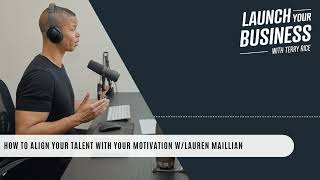
Lauren Maillian, a serial entrepreneur and bestselling author, talks with Terry Rice about finding your talents and what actually motivates you. She covers how to build resilience when things get hard and what success in entrepreneurship really means.
And that's where we're able to figure out where we're passionate. You know, if you had a whole bunch of clients, if you could make a lot of money doing this, would you continue? Would you want to? Would that light you up? Would that motivate you? If not, that's not what you're passionate about. And when life affords us the opportunity to chase our passions while achieving success in doing something that is enjoyable for us, then we get to that point where the timelines don't matter because you're just, you're really being yourself. You're being your authentic self. And that's when you can actually really say, I get paid to do what I love.
Today, serial entrepreneur and best selling author Loren Milan is here to teach you how to align your talent with your motivation, allowing you to thrive even through difficult times. This is the Launch youh Business podcast because we know starting a business is challenging, but it doesn't have to be confusing. Each week we'll give you the tactical advice and the necessary tools to scale your business without feeling burnt out. I'm Terry Rice, business development consultant and staff writer here at Entrepreneur Magazine. Let's dive in. Lauren Milan is the definition of an innovative entrepreneur. She co founded her first business, Sugar Leaf Vineyards, when she was just 19 years old, which made her the youngest self made winery owner in the US before she was even allowed to drink. And at the same time she was working as a model traveling around the world. Since then she's gone on to become a founding partner at Gen Y Capital Partners, an early stage venture firm focused on investments in mobile and consumer facing technology. There's a lot more to the story, but I'll let her get to that during our interview. But what I'm most impressed with about Lauren is her ability to stay grounded even while continuing to challenge herself. And during today's episode, she'll teach you how to do the same. We'll discuss how to optimize the use of your talent, how to discover what truly motivates you, and how to learn from failure and thrive even during challenging times. Let's hop into it right now. Lauren, how are you today?
I am so good, Terry. It's awesome to see you.
Yeah, yeah, you as well. So do us all a favor. Those who are not aware of you, just let us know who you are and what you do.
I'm Lauren Milan, the retime entrepreneur, investor advisor, woman on a mission and a change agent.
So let's go, let's just go back a little bit because three Time entrepreneur. That's a lot, right? So let's, let's unpack that. Like what, what businesses have you, have you started?
And I missed a title. My goodness. Bestselling author, media influencer. You know, I look up a couple of different titles in there, but three different companies. The first one that I started was a vineyard winery when I was 19 years old. Sugarleaf Vineyard sold it when I was 26, made me the youngest self made winery owner in the country. Then I started company number two that I still have today, the LMB Group, where we are a venture brand studio and we do a lot of advisory consulting for C suite executives on brand innovation, marketing and strategy. And company number three, Gen Y Capital Partners, an early stage VC firm that I co founded back in 2011. And that has really allowed me to jump into venture in fun and exciting ways. I've also done a lot of angel investing. I have a portfolio of my own personal investments that now represent a $5 billion market cap of primarily CPG products and companies that I'm really proud to back and be behind. So it's been quite the journey. It's been a lot of fun, it's been a lot of the things that I'm super passionate about. And now today that's what we call innovation.
Yeah, I'm glad we unpacked that because there's, there's a lot to share. So one thing that I heard you say before was how to understand how you work, the scale you have and what you do, your area of expertise. And for a lot of our listeners, that's what they're trying to figure out. They're starting a new business but they're not really sure like what they do, who they do it for, what their core skills are. Can you unpack that for us?
I think that when we all work in different ways, we all have different superpowers. And I think that the beauty of entrepreneurship is allowing your superpower to be your leverage and learning to be really good at that one thing that might just be your thing and realizing that, you know, maybe in a world where we have a lot of generalist, it might seem like a good idea to go pick up other skills. But if you are really great at generating ideas, if you're really great at problem solving, if you're really great at finding new monetization models, like just stick to that because that will lead to your scale. If it's your secret sauce. I think people are often looking for some sort of a formula or a guarantee of what is going to get them to scale. And the reality of it is, some companies scale on new clients, some companies scale on new products, some companies scale on features, some companies scale on business models, freemium or otherwise. There are so many different ways to achieve scale, which ultimately helps you achieve success. But I think that it is so easy to get caught up in the comparison to other people and trying to copy paste what you see someone else have when they don't have your business, they don't have your ideas, they don't have your experiences, and they probably don't have your exact level of astuteness in that particular area. And so lean into that and realize that that is your secret sauce. I think even thinking about myself, there are so many years that I spent going, gosh, I'm really good at marketing and strategy and investing and this and that. And I almost yearned to have what somebody else would call a higher level of expertise in any one of those areas, just so that I could get the title of expert in their eyes. But what I've learned now, looking back, is that all my years of sticking to my own guns has made me an expert in more than one thing. And that trusting my intuition and the way in which I found my own ability to scale, which was by being a multi hyphenate, which was by having a repertoire of experience, why would I ever want to take that away?
So this question might be hard to answer based on what you just said. What is your zone of genius based on the fact that you have all these hyphens?
Ooh. My zone of genius is game changing strategy. Game changing strategy. I do it all day, every day. It's the way my mind operates. I look at what's working. I look at what could work better. I look at where things can scale and grow and improve. And that's just the way that I am constantly operating. And that has become my real constant, is my approach.
What I'm hearing is you took all the things that you're good at. Let's say good at, or we'll say in your zone of excellence. If we're going through this whole process. And you said, you know what, if I combine all those. Damn it, that's my zone of genius right there. Right. So I don't have to be a zone of genius on marketing or sales. It's all these things knowing how to apply them. Because there are some people that are good at different parts of it, Right. But they can't apply it to a bigger picture. So unfortunately, they have to take roles where someone Else is telling them what to do, which you're like, no, I understand all these things, but I understand the big picture as well. And I can put that in this, the strategy that you're developing. So that's, that's, that's good to hear to, because I know other people are having that same challenge. Like, what does this actually mean? You know, how can I, how can I optimize my talent? And I know that you have thoughts around that too. So can you just share that? How can someone who, you know, they finally get clear on what they do and what they're good at? How can I then optimize that, that talent?
I think optimizing that talent ultimately comes down to digging deeper into how you figured out what you do well. Right. A lot of us do several things well. Are those the things that we want to be known for? Are those the things that if we had a hundred more clients or we could make millions of dollars, that we would want to make millions or even billions of dollars in the future doing? I think we really have to dig into what makes us good at what we do, especially for multi hyphenates, to figure out what is that consistent skill that carries through all of our instances of having been successful. So let me break that down a little bit more. Pick your top three to five successful professional experiences. Make sure that at least one of them is an experience that was a challenge that you created a solution towards and two that led to your success. And then think of three top things that you did to get those top five career wins, successes or results. I think if you keep digging, you will figure out, like, what is that one thing that you do consistently? It could be that you are really great at evaluating problems. It could be that you're really great at implementing solutions. It could be that you're really good at drawing models. It could be storylines and narrative change. It could be a lot of different things. But for me, I look back and it's always game changing strategy. It's always strategy and maybe it's a little creative and maybe it's a little this and maybe a lot. Maybe it's a sales strategy, maybe it's a marketing strategy, maybe it's an innovation strategy, maybe it's a cost cutting strategy. It is always, though, at its core, game changing strategy. And I think it's easy to be superficial and just be like, I'm good at this. Like, I called myself great at marketing for a long time. I actually flipped the script on that. Like, I'm. Yeah, I'm Good at marketing. It's not my greatest asset. My greatest asset is that I'm wonderful at driving growth. Sometimes that's by marketing. I think early on in my career, it was predominantly by way of marketing and narratives and compelling stories. But over time, it's become partnerships, it's become strategy, it's become a lot of other areas. And I think when we continue to ask ourselves those deeper questions, we're able to figure out what that real, true one thing is. That is our secret sauce that allows us to be successful. And then we can go to the next level by learning how else to apply that skill in other areas that we have not already utilized that skill. Then the game changes.
I think a lot of people, their challenge is they skip that deep work because it doesn't feel like real work. It's not like building your website or sprucing up your LinkedIn. It's like, oh, I'm just sitting around and thinking about myself. I don't get paid for that. But if you actually do, you'll get paid a lot more on whatever you land on, because you're more clear about your core values, what motivates you, which I want to talk about momentarily. But when people skip that step, I can almost tell because they don't have, like, a personal philosophy to anchor their thoughts, their words and their actions around. They're just kind of existing, and that's why they're lost, because they're not really sure, you know, who they are internally. So how do you know where you want to go from there? But on your end, what motivates you? Because you have a lot going on, and what motivates you to keep going? Because you could presumably just kind of chill for the rest of your life and, you know, just, like, hang out.
I think that's a great question. That's a question that my husband asks me right now because he thinks I should be spending maybe a little more time with the family than I am. Although I spend a lot of time with the family, I'm just not done yet. I'm constantly curious. That's it. There's more that I want to see and discover. There's my own potential that I want to know what optimizing that at this stage of my career looks like. I don't have the answer. But work is really fun for me. I love working. I truly love, love working. Like, I. I don't know how to turn off because it's what I love and sincerely enjoy doing. And I think when it's no longer fun Then I'll absolutely stop. And you're right, I don't, I don't have to keep working at this stage of the game, but I would be doing my, myself, my children, my family, my legacy, a disservice to not keep working if the work I do produces the results that it does. And it's fun to do in the meantime. Like, who knows? Sky's the limit and let's see how far we get. That's, that's my life philosophy right now.
No, I haven't, I have the same approach because I don't, I don't idle well. So when there's days when like I'm, I'm supposed to be technically just relaxing. Like, a lot of my work is based on being creative. So when I'm relaxing, that's when these creative thoughts come and I'm like, oh, great. You know, I want to write this down because it's going to be a great strategy or whatever. So when I hear people say things like, oh, I never work on the weekends, I'm like, that's because you hate your job. Like, I wouldn't either. You know, you don't want to work during Monday through Friday either. But when you enjoy what you're doing, you're not waiting for a finish line. You're like, oh, what's next? What's the next problem I can solve? Okay, we're going to take a quick break here, but when we come back, Lauren's going to share an exercise to help you discover what motivates you. Just get started. If you've ever looked for tips on launching a business, just get started seems to come up a lot. And while that's vaguely motivational, it does not provide any real direction. Because the next logical question for anyone would be, well, how do I get started? What specifically should I do? Well, if you're looking to quickly start a business without the confusion, risk and pressure of doing something entirely new, I've got a solution for you. It's called the Solopreneur's Fast Track, a step by step process on how to start a business using the skills you already have and actually enjoy using. So let's say your favorite part of a previous job was email marketing. You'll learn how to start a business offering other companies advice on how they can improve their email marketing. Or maybe you are really good at integrating complicated tech tools. You can help other organizations do the same thing without the need to bring on a full time hire. So the main point here is that everything you need to start A business is already within you. You don't need a cool website or fancy tools. And by completing the course, you'll also discover a simpler approach for attracting clients with. Without using complicated funnels or cheesy sales tactics, you can finish it over a weekend and start making money in as little as 30 days. You'll gain the clarity and confidence you need to start your business and receive a one page business plan so you can immediately apply what you've learned. Get started today and receive a 20% discount by heading to terryrice co. Fast. That's terryrice co. Fast. So if you can help with this, and I know this is challenging, how can other people determine what motivates them?
I think that is also baked into the process that we were just talking about. And I'll add a comment there that I didn't already make, which is you had said, Terry, that a lot of people skip that step, right? That they skip this deep work or they feel like sitting and thinking about themselves by themselves or in small group format doesn't feel like work because it's not creating any remuneration. You're not compensated for it. But that is, that's your strategy. That is your strategic plan. And you have to have a strategic plan as well. As a leader, as an entrepreneur, as a visionary, as a consultant, as a career person, like, what is your strategic plan for your life? And I think people are able to figure out what they're passionate about by continuing to do that deep work. And when you ask yourself the question, you know, I have a friend the other day that has a great job and she's like, oh, but I love doing hair. Maybe I want to be a hairstylist. I'm like, I mean, it's cool if you want to be a hairstylist, but like, that's not the thing that you're amazing at. It might be the thing you love. And I said to her, okay, so if you want to be a hairstylist and tomorrow we find a salon and there's no problem with you, you know, opening a salon and you had 100 people wanting appointments with you, would you want to do 100 people's hair? She's like, I want to do all the simple hair. You don't want to be a hairstylist, right? Because that's just like, clearly not what you want to do. If I tell you, if you have 100 people lined up for that service, do you want to do it? No, she wants to do my hair. She wants to do her girlfriend's hair. She wants to do her daughter's hair. That's cool. But I think start asking yourself those kinds of questions. Like, if you had 100 clients lined up, unless you say, like, oh, my God, that'd be nirvana. That'd be the jackpot. I've been waiting for that day, then that's not what's going to light you up. That's clearly not what you're passionate about, even if you think you're good at it, right? I give the example all the time when I'm working with folks on branding. I'm a wonderful cook. I'm a really great cook. I'm not like a chef. It doesn't make me look beautiful all the time, but it tastes really darn good. And a lot of my stuff looks really good. But I don't want to cook bad. I want to cook for my family. Not bad enough that I want to make Thanksgiving meals and have a catering service to supply food for other families. Even if you would pay me money to do it, even if you'd pay me tons of money to do it, I wouldn't want to do it, right? But I don't get the same satisfaction that I do out of making a meal for my family, which is what I enjoy doing most. And that's where we're able to figure out where we're passionate. You know, if you had a whole bunch of clients, if you could make a lot of money doing this, would you. Would you continue? Would you want to? Would that light you up? Would that motivate you? If not, that's not what you're passionate about. And when life affords us the opportunity to chase our passions while achieving success in doing something that is enjoyable for us, then we get to that point where the timelines don't matter because you're just. You're really being yourself. You're being your authentic self. And that's when you can actually really say, I get paid to do what I love. And that's not exactly what I ever was. Never my explicit goal. But I can tell you, to be here now, to be able to say that is. It's life changing. It's life affirming, and it's life changing.
As an entrepreneur especially, I do want to pivot a bit, right? Because these are challenging times, right? People are concerned about getting their, you know, getting laid off or going out of business. So on your end, I mean, there's no way you could get where you're at now without going through some times of uncertainty and adversity. So how can we not just survive, but actually thrive through these challenging times?
I hope that the experience of the pandemic has taught folks that are listening and with us today to have more confidence in times of uncertainty, but to also mitigate against the risks that you feel are posed to your own life, to your own careers, to your own advancement, success, achievement. I think I hope again that for so many people that went from getting weekly bi weekly paychecks to no paycheck in Covid, I hope that you've learned to flex those muscles of resiliency and cost savings and stacking your paper for a rainy day. Because these are the things that, that are going to get you through the difficult times. But I think those are the things that also force you to be resourceful, which is one of the greatest skills that I also have. And what most entrepreneurs really have in them at their core is the ability to be that resourceful in times of need, to not back down and say, oh God, I don't have the answer. It's like, no, you go into hyper mode of I'm going to go get the answer right, I'm going to go find the answer, I'm going to go find the solution. Because you realize that you might have to, you know, you're not always able to create the solution. Sometimes there is a solution that already exists and you have to go find it. And so learning how to do both of those things is what I hope the experience and the uncertainty of the pandemic has taught people to be more comfortable with and also to just have faith. At the end of the day, it sounds so trite, but if you don't have faith that your own intelligence, your drive, your work abilities, your credentials that you will get out of whatever that tough and difficult time is, you're going to psych yourself out. So here's an easy example. You can need a plumber. You can have two plumbers that are both qualified, licensed plumber, both down on their luck, both facing professional adversity at the same time. The one who shows up seeming like they're not confident, they don't have the answers, maybe a little sad, a little just like not on his A game. Are you going to work with that plumber? Are you going to work with the other one that says, I know how to fix your problems, I'm licensed, you know, thank you for this opportunity to do the work. I'm looking for more work. Who are you going to go with? You're going to go with the one who is more confident, who is more professional, who is ready to do their job. Right. And so the faith. Just have the faith that you deserve to be there. Have the faith that your skill is enough to get you through. Have the faith that you are qualified to get yourself out of whatever situation you're in. Because the internal battle that you have with yourself when you feel uncertainty is seen and felt and reverberates to people around you who then doubt. Who then unfortunately begin to doubt all of who you are, because they don't know why you are acting insecure. They don't know what it is that you're maybe facing. They are not intimately aware of the difficulties that you're up against. And so no harm, no foul. They will make an assumption, and the assumption will be, maybe they're not good at what they do if they're not competent, not. Oh, they're having other issues in their life. Right. So make sure that your confidence is unwavering in yourself and your skill when you are in these difficult situations. I can't stress that enough because, you know, especially for founders, we are our own marketing department. We're our own sales department. But at the end of the day, it's that confidence. And if you don't have it, the clients that you want to have confidence in your ability to do a job, to provide a service, they won't have it either. And it unfortunately won't be their fault if it's the way that you are not showing up.
So one thing I heard you say recently is, ask yourself, even if I fail, is it still worth it? Can you just share the sentiment behind that?
Yeah. So that's something that I wrote in my bestselling business book. The Path Redefined came out in 2014, so I wrote that in 2012. And we have heard different iterations of this, But I think, for me, is it worth it even if you fail, Lauren? Like, blank, insert your name, whoever you are listening. That is what this is designed to help us figure out. It's a real question to ask yourself, is it worth it, Terry, if you fail? Even if you fail, Is it worth it, Lauren, even if you fail? Once that question is yes, I go full steam ahead towards that particular opportunity. Because to your point, Terry, the experience is what I get to own. I get to keep. I get to use and leverage to build, to build momentum and opportunity for the next thing that I want to do. I get to add it to my resume. Like, is the experience in itself more valuable than if I win or lose? If the answer is yes, then go ahead so don't worry about if you fail or if you succeed. You know, there are some things that I've done and I wouldn't even call them failures. I will just say they weren't my greatest successes. But I didn't fail even then because I learned so much in that experience that can never be taken away from me. That is added to the repertoire of who Lauren Mylan is and what I can do and what I have accomplished that I get to take and I can leverage that momentum to go ahead and build into the future, which I'm kind of planting a seed there because we just renamed LMB Group to Leverage Momentum Build Group because that is exactly what we do and that's exactly the way in which I think you need to do it. There is a level of fearlessness that you do have to have and a level of certitude in yourself and confidence in yourself in order to make big, bold, game changing decisions with your life or your career. And that's the question that I always ask myself. Is it worth it even if you fail? If so, go ahead.
Where does your confidence come from? Were you always this way? Like as a nine year old, did you have some experience in like high school? Like where does it come from?
I think this has always been me. The reality of it is though, Terri, I'm not going to sugarcoat it. I'm going to be really honest. Yeah, I'm confident, sure. I don't know exactly where it's come from. I could give you a variety of instances. The honest truth is that if I look back on my life as a kid, I had terrible bullying experiences. I was made fun of. I was not pretty and I wasn't not pretty because I didn't think I was pretty. I was not pretty because they said I wasn't pretty. Black wasn't known to be as beautiful than in the eyes of other people, certainly wasn't as cool. So imagine me as a little black girl growing up in New York City, the only black African American. As we then said at that time. Kid in my grade from nursery school all the way through to eighth grade when kids came in to primarily play sports and my mom had to start a mentoring program. I went to Dalton in New York City at the time, in the 80s and the 90s, there was zero diversity at Dalton. That was not a thing. It was not in vogue. So I went through adolescence only and othered. I was tall. I was called Twiggy. Black kids called me Oreo. Non minority kids made fun of me, wanted to know how often I would, you know, I wore braids, I had glasses, I had braces, I was tall, I was skinny, I had a size 9 foot when I was 10. And nothing felt good. Nothing felt confident. And I think, to be honest, I got so accustomed, Terry, my entire life of feeling so othered, so unwelcomed, that after a while of, like my mom always saying, well, sticks and stones can break your bones, but words will never hurt you. Like, I was the girl walking around, like, telling myself that, walking away with my glasses and my braces and my braids and my long, lanky legs and my big feet. And I was like, you can't. You can't break me. But you know what? If you start telling yourself enough times, you can't break me, guess what? You can't break me. And that's. That's the truth.
Yeah, I love that. I didn't know that about you. That's. It's inspirational for several reasons, but one thing you said a few times is successful, successful, successful. What is your operational definition of success?
Ultimately, success to me is being able to decline opportunities because they don't align with what you want. And with that not changing your circumstance, which is a decision, having the ability to say no, and knowing that you saying no does not change your circumstance in any way. Financial, environmental, in terms of the opportunities that you're going to get in the future, any of that. In my case, I'm a far cry from where I was before in terms of I have to do this, because if I don't do this, I'm never going to have a chance to do this. Right now, it's like, does this align with who I am? Do I want to do it? Does it make sense to do not? I feel I'm required to do it, or I am really required to do it, or I have to maintain this relationship, or if I don't do this, I'll never know the next thing, Right? There's no prerequisite anymore for the next opportunity other than, is it something I want to do? Is it something I'm capable of doing? And ultimately, we know that we are successful when we have the power, the ability and the autonomy to say no on our own without getting the approval to say no from anyone else. And when, if we say no, it does not in any way impact, change, decrease or limit our circumstances, opportunities, money, invitations, whatever that might be, that is ultimately success. That's how I judge it.
And that is our show for today. And for me, the main takeaways were a combination of strength and curiosity. Having the curiosity to discover more about yourself so you can use your skills more effectively, and having the strength to push through challenging times so you can apply what you've learned and be even more successful. And I like Lauren's operational definition of success, which is being able to decline opportunities without worrying about the ramifications. And once you get to that point, you've truly achieved the time, lifestyle and financial freedom that can come with entrepreneurship. Apply what you've learned on today's show. You'll find the show notes and more resources at TerryRice Co Podcast. Again, that's TerryRice Co Podcast, and the best way to support this podcast is by subscribing, telling a friend and leaving a review. Also, you can get more tips by following me on Instagram @TerryRice or follow me on LinkedIn. This episode was produced by Josh Wilcox of Brooklyn Podcasting Studio and edited by Dan Lardy. Special thanks to my wife, Dominique for keeping our kids relatively quiet as I recorded. Thanks again for listening. I'll see you next time.
More from Terry







When you want to quit, don’t. #FitnessOver40 #MindsetShift #TiredIsNotAnExcuse #PersonalGrowth




You’re gonna want to give up. Don’t. #mindsetshift #motivationalquotes #motivation #dontgiveup