How to Attract Customers using the Power Method with Brittany Barnhart
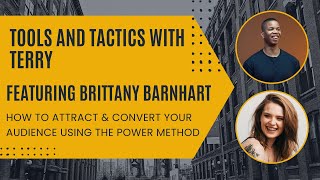
Terry Rice and Brittany Barnhart walk through the Power Method, a five-step framework for solopreneurs to clarify their business purpose, understand their audience, build workflows, execute strategies, and refine their approach to attract clients.
Looking forward to chatting today, everyone you know. My name is Terry Rice and I'm a business development consultant. I'm also a corporate trainer, which is what I'm doing at Amazon right now, helping a lot of startups learn how to set up their go to market strategy and how to do some testing as well to make sure they're doing the best they can in regards to customer acquisition. So a lot of fun there. But outside of that, I also help solopreneurs build their brand and revenue. And I do want to bring this up before we get started. I actually have a survey right now that's going to help me get more information in regards to a product that I'm working on. So if you can go to, please go to my profile and fill out that survey. It's in the featured content section. It's also directly below my picture. And Megan's going to drop it into the chat right now. It'll take you four minutes, but it'll help me out a lot. So greatly appreciate that you can do so. So there's that. But outside of that, let me go ahead and introduce B and then we'll talk about what we're going to talk about.
Hello everybody. I am Bea Brittany Barnhart. I go by BE and I do brand business strategy for impact driven entrepreneurs using my power model, which we'll be talking about today. And so I work with a lot of like solopreneurs, small business owners who have small teams who are looking to expand from their creators, anything like that, to make sure that we're aligning their vision with their actual like business development.
Cool. All right. And Megan's saying I need to go to Biscuit Bitch, which is down the street because they have a good breakfast or lunch. Awesome.
So nice.
Something else to do. So what we're talking about today is a process that you've developed to streamline and clarify the process that people can use to both attract and convert their clients. Target audience in general. And it's based on, you know, years of experience. But I think it's also like the actual framework is based on a breakthrough that you and I had in regards to talking about how to describe what you do. And I think a lot of people can benefit from just even hearing this story of how we're going through it because often you'll have really good ideas and can provide really good outcomes. But outside looking in, if you can't describe how you help people in a succinct and memorable fashion, going to fall flat. So do you mind just Kind of giving some background on how we came up with this name for the Power method that we're going to talk about.
Yeah, absolutely. So for context, for anybody who doesn't know me, I have been running Powerhouse Brand Studio for about eight years now. And so the first four years, I was just strictly focusing on graphic design. And it's been the last three, four years where I've transitioned into doing brand business strategy. And so through a lot of that, I've been honing in on my process, learning from, like, other experts in the industry. I really, really trying to identify a process that can help my clients build their brands and businesses in a way that makes sense for them. And so this breakthrough that Terri and I had, that Terry helped me with, is we're trying to figure out how can I concisely say what I do, you know, and how can I really set myself apart from other strategists or designers and really make my process memorable? So much so that it's easy to remember. And you can also apply it to your own business without even having to work with me, which was the goal, really the ultimate goal of, like, I do this with my clients, but also how can I educate people so that they can either build a foundation using this or audit their business using this particular model and grow from there? And so you and I were having a conversation and trying to figure out, like, how can we create this, like, acronym, basically? And it's been top of mind for a very long time. And I was like, obviously my business name is Powerhouse. I would love to have power in it of some sorts. Like, it just. It feels good to say that. And so just going through this thesaurus, trying to find words for each particular part of the process. And we then we landed on the power model, which I was really excited about. So that's kind of how it came to be.
Awesome. Thanks for that. So for everyone who's following along, if you have a service, a solution, a formal way of helping people, it helps to have a memorable way of talking about it. So if it spells something that helps, or it could be the three C's or the four F's, whatever it is. But you need a thing. Because that way, when people ask you, how can you help? You're like, oh, I have this thing. And when you're on podcast, you're like, they're like, oh, talk about the thing, right? And you're writing articles saying, this is part of the thing. So when you have a trademark or a signature approach to helping people, it just makes you first of all feel more confident because you are. It's easier to digest and to remember. Right. So we're going to get into that momentarily. But right now Shelby is saying she has her learning socks on. So that's, that's good. Glad to hear that. But let's go ahead and get started here. And the first question I'm going to ask the audience actually is yes or no, do you currently have your own business? I just want to kind of level set. And then, Brittany, while they're answering the questions, because it takes a while to bubble in, can you explain on a let's go line by line basis what the power method is and how we can apply it to our business?
Yeah. So the power model, what it stands for is P is for purpose. And so I guess I'll outline it first and then I'll kind of dig into like each one. P is for purpose, E is O is for observation, W is for workflows, E is for execution, and then R is for refinement. And so it's this five step process that I work with all of my one on one clients with and teach people on how to apply to their own businesses. So what that means is for the purpose. We really try to identify what is the purpose of your business and how can we amplify that, how can we create a vision around like what you want your business to actually be and then also on the other side of it for your customers or your clients, what is the purpose of your services or your products for your clients? Like why is it important for your audience to know that you exist? So getting really clear on your purpose, observing your audience, let's go back to the purpose parts.
So let's think of the purpose part. I want to kind of dig in here. This is important in my opinion, for a few reasons. Right? Because again, you've heard the phrase, people don't buy what you do, they buy why you do it. And if you don't have a clear purpose for why you're doing, you know, have your business, then you can't express that. And what I love to say is like, you don't have to have a passion for your business. If you do, great, who cool. If you don't, that's fine too. Maybe the purpose is to make money so you can actually enjoy your passions on the side. But if you don't have this, this like this anchor more or less to say, like, here's why I'm doing this, here's what I stand for, then you can be swayed in different directions by different forms of influence. And it's clear that you're not stable, you're not clear, and your audience will pick up on that. And what we talked about before was having a clear purpose for how you're helping people too. Okay, so, like, what's the mission of your company? And. And when I was in business school, I thought mission statements were just stupid because, like, I was like, this is, you know, like, it was a waste of my time because I want to go, like, drink or something. But when you have a purpose and a mission, then it's very clear what your next step should be in regards to growing your business. So we want to double click on that as well. So can you give examples of people that you worked with where maybe they didn't have a clear sense of purpose for their business and the impact that might have had on your work with them?
Yeah, absolutely. So I have had some clients who come to me and they feel just things kind of up in the air, you know, Like, a lot of solopreneurs tend to have so much on their plate and all these ideas of how they could be making money, how they could be connecting with their audience, so many different services that they want to do. But all that, in my opinion, is really anchored with your purpose. You know, if you're not clear on what the impact of your work, like, what do you want the impact to actually be? All of these different things that you want to do just kind of don't make sense. So it's going to feel foggy. And so I've had clients who come to me before who have just come really hard in with, like, I want to do this, this, this, and this. And I'm like, let's pause because we really need to figure out why is any of this important. And then also, like, how are we going to define goals that actually help you act on your purpose? So how can we make this goal actually actionable so that you have a clear sense of purpose for your business and then for your audience? So a lot of solopreneurs and entrepreneurs, when they don't have a sense of purpose, there's just too many ideas and they have a hard time finding out which one should I actually move forward with?
Yeah, I love that. And one question you can just ask yourself when it comes to your business is, what is it for? Like, what is it for to your audience, first of all. And for me, I create a lot of content, so what is it for? What is the point? It's to educate but at the extreme example, it's to form relationships. And from these relationships, yes, you can make money, you can generate revenue, but whatever you're doing, you have to sit and think, okay, what is it for? Right? You know, maybe you're a consultant, you help people pick the right office space. What is it for? Well, I want to help people avoid mistakes and they might have a really good idea, you know, in regards to what they want to do, but they're putting doing it in the wrong spot. So what is it for? You know, I save people the heartache and the frustration of making a bad decision because, gosh, you know, that happened to me before and that's how I got in this business. So whatever you're doing, if you can just like literally distill down, like, what is it for? You know, what is it for? What is it for? And just take some time with this, you'll have a clearer mission. And when I say, you know what my mission is, I used to work in corporate, right? So I'm at Amazon right now, and I used to consult companies like Walmart. And I always say to myself, look, you know, I don't want my legacy to be defined by the fact that I helped Walmart sell more, more socks. I want to help individuals monetize their knowledge, right? So they can reward themselves on their own terms and have more time for the people and opportunities that matter most. So that's my purpose. So there's times when I'm trying to figure out stuff like a button's not working or whatever it is. If I can dial back to my purpose and why it's so important to me, then I can put in that extra work. But again, if you can't answer that question, what is it for? It just feels like work and it's not fun.
Yeah, yeah, absolutely.
All right, cool. So what's the. So everyone, that's your homework is what is it for? And let me know when you. Yeah, actually, let me know what you land on. You know, if you want to go ahead and just enter that as a comment, you know, you can think about it because it took me some time too. But answer that as a comment, like, what is the purpose of your business? Right? And don't be like super self serving, like, I want to help people, like, what's it for you too? You know, you get an intrinsic reward for helping people as well. But. All right, cool, let's go to the next part. I forgot how to spell power.
Yeah. Oh, yeah. Oh. So observing your audience and your competitors, so this is really important because I find that a lot of the entrepreneurs that I work with really miss out on creating an experience for their audience. And by experience, I mean really identifying how do people interact with your business from when they're becoming kind of problem aware to when they're working with you to when they're advocating for you. And so the observation piece is all about reaching out to your audience, figuring out what they actually need and what they're asking for through social listening, looking at your competitors and figuring out, like, what are they doing? What are people complaining about in terms of their products? How can I fit a market need right now? And so it's really about just observing the state of things to really carve out your unique space with your business.
Speaking of observing and getting audience research, if you go to my profile, I have a link there to a survey I would love all of you to fill out. I'm building this new product out, and if you could fill that survey out, it'll take you four minutes. That'd be great. It's in my featured content and directly under my picture in my profile. But let's go deeper on social listening because it's the easiest way to observe your audience. And I, and I love telling the story because often founders feel like they already know everything about their audience. And you know what? That might be true. Let's pretend it is. But your audience changes. And one of my friends and former clients is a sleep health educator. She helps people get more sleep. And she started doing some research, some observation during 2020 on Reddit to see if people's behavior around sleep had changed. And lo, behold, it had. And she found a subset of people who previously didn't have challenges getting sleep, who all of a sudden were just having these big problems, and they were teachers, teachers who were not used to teaching in front of a screen like this and getting blue light in their eye and not used to having parents like me email them, you know, in the middle of the night saying, how come my daughter can't read? So as a result of observing her audience, she built out a new feature, a new service where she would help teachers get more sleep. She sold that on an individual level and then sold it on a school level and eventually a district level. That's hundreds of thousands of dollars. So there's revenue in putting in this work of observing and doing this social listening. But my question for you is, I'm sure this has happened before. Why do you feel some entrepreneurs or brands are averse to doing this research? This Observation.
A lot of the time with the work that I do with my clients, they are averse to it because of the time it takes. In all reality, they just want to, they have these ideas, they just want to execute on them, they want to make the money and they want to kind of just get it done, basically. Social listening does take time. It does take effort to ask the right questions, find the right spaces, and to actually thoughtfully revise either your product offering or your service offering, whatever it might be. It's, it takes a lot of time. And so most often when I, a new client comes to me and I'm like, we're going to do audience research and audience outreach, they're like, do I have to? And I'm like, I mean you don't have to if you don't want to. But in reality, if we actually take this time now while we're together to really figure out how people are talking about you, what they're asking for, why they even need it, we can use that in all of your messaging, on your social media content, your website, how you format your services, like it impacts so much.
One of my clients, I was talking to them about doing audience research. I'm like, hey, have you ever surveyed your audience? Do you want to do this? And they said, our audience wants us to tell them what they want. And I said, did you ask them that? Is that what they said? And they didn't get the joke, but. But yeah, I mean this part's important. And the thing is if you don't have a purpose for your business, you're not going to want to do that research because it feels like work. But if you have a purpose, you're like, wow, this is a cool way for me to learn more about my audience and to, to better serve them. So again, that's why it's, it's sequential in this order. We start with having a purpose, then move on to this, this observation phase. And one of the easiest ways outside of social listening to do research is to sign up for your competitors email list and see how they're communicating with their audience too. Because we're not just observing our audience, we're observing the marketplace, right? Because we want to see how other people are behaving, even the tools and technology they're using. So when I get an email from another thought opinion leader, I'll see like how they're sending the email, you know, was it convert kit, is it, you know, mailchimp and see kind of where the puck is moving. And that's also Where I see some cool tools they're using to grow their, their email list. Right. So I noticed. Who was it? Darren Hardy and Tim Ferriss. They use a tool called Sparkloop to grow their email list through referrals. So again, if you're especially a solopreneur. Right. It gets lonely real quick. But that's almost by design because you're not doing enough observation of your, both your audience and your competitors. So put in that work and it's almost like the whole, you know, measure twice, cut once thing. You know, sure, you'll, you'll get to it eventually, but, but you can move forward with much more clarity and confidence if you do put in that grunt work. So I want to ask a question here. Looks like Jeff is already doing a survey. Oh yeah, Jeff, if you want to drop a link to your survey, go ahead because I know you sent me yours and I haven't done it yet, so I'm a hypocrite. But has anyone else here ever done any kind of social listening, any kind of surveys before? Maybe through type, form or even could be. Was it survey monkey? Victoria, thanks for filling out that survey. I appreciate it. Thanks for that. We got Amira here. So, Amira, thanks for joining. Be sure to follow her. She's doing some really great work. But anyone else do any surveys of their audience or even focus groups? But I've had companies that have done those before and I'm like, there's a survey bias because it's like normally often your target audience doesn't have time to sit in a focus group. It's like you got a bunch of bored people sitting in a room who just wanted 50 bucks in a free lunch. So that's why again, like, you can, you can pay for all these cool things if you want, but if you're, you know, short on cash or, you know, don't want to go through that, that hassle. Yeah, just do a survey, do some social listening, sign up for your, your email list, you know, whatever it may be. But that's a good way to get some, some good information so far.
I was gonna say, I personally love using like Facebook groups and Reddit and honestly like LinkedIn a lot to listening if you're somebody who doesn't like to do surveys or feels a little weird about doing it if you're, maybe your audience is a little smaller. Facebook groups and Reddit are really fantastic sources of content around. Like either like whatever topic or industry that you might be in, you can easily go see the conversations that are happening in those spaces. And so that's kind of another way to actively social listen and figure out how you can apply that to your own business.
Yeah, I love that. And Angela's saying phone calls. That's old school. I dig it. Angela saying, A 20 gift card for 30 minutes of someone's time goes a long way. So sorry. Elmira said that. So let's talk about that for a moment, because Elmira is saying, hey, if you give someone a $20 gift card to talk to them for the half an hour, they might do the survey. And it's funny, because that same person might be a consultant who charges way more than that, you know, per hour. But since you're helping them, they're helping you, they would do it. I've also found this. If you'll say, I'll donate to Your favorite nonprofit 20 bucks for 30 minutes of your time, that can be even more of an incentive, because it's like, hey, I know you don't need, you know, 20 bucks, but you really want to take that out of the pockets of your nonprofit you care about. Because now you're using what's called commitment bias, more or less, where they say that they're, you know, we want to support this thing, and you're saying, cool, if you want to support it, you know, give me half an hour. Lindy's saying, you know, she hasn't done surveys, but she's part of a networking group that includes other designers and always learning and getting insights from them. Yeah, I mean, one thing that you're bringing up, and b, you brought this up, too, is the benefit of being in groups to get this information. And one of my colleagues, by design, will join paid groups to do social listening because he says, you know, once someone pays to be a member, just like the quality of the questions is much higher. And sometimes they also let you drop surveys in there as well. So I'm not saying pay to be a member of a group, but you might find people are more aligned with your Persona that you're going after because they're. They care enough to invest in a community, and therefore you can learn more from them.
Yeah, absolutely.
The question here is our statement from Elmira. Actually, there's a way you can actually pin these so they show up. Bam. I learned that last week. Here we go. People are usually happy to help a smaller new business, but curious to know how to creators entrepreneurs feel when big brands ask for feedback. I'll let you take that one first, and then I'll chime into.
For me Personally, I find it fascinating. And also as an opportunity, basically, I think that if a big brand were to reach out to creators, entrepreneurs to ask for feedback, I'm like, well, for me personally, that could be. Be a great way to make a connection with somebody who's higher up in that. That platform, basically. So if we're talking about LinkedIn, for example, I'd be like, oh, LinkedIn cares about my opinion. That means I'm on their radar, you know? And so I think it. I think it's fascinating, but also depends on, like, what the brand is. So, yeah, I guess I just. It depends. I'm curious, Terry, what your thoughts are on that too.
Yeah, I think we're aligned there. It depends on how much I care about the brand, first of all. So LinkedIn. Yeah, sure, Holler. But if it's like, some, like, app that I use sparingly and probably not. And it's also what the ask is, because I've seen some emails where they're like, oh, it only takes 20 minutes. And I'm like, well, so does a good workout. Like, you know, that's, That's. That's. That's a lot of my time. So that's why, by design, my survey is only four questions, or, sorry, four minutes to complete. And what you can do to increase your odds of getting it completed is just to make it short. So, yeah, I think another thing you can do is incentivize people to fill out the survey. So here's money. Or you're in a raffle, so and so forth. But I think it's. It's. It's a healthy conversation to have and to figure out, because if you don't, then you're still guessing. Right. So I think it's how you approach people, not just the fact you're doing it, but it's how.
Yeah, absolutely.
And Shelby saying, like, the message and outreach has to be genuine. Yeah. Otherwise, it's like, I'm just doing you a favor and you're taking my time for it. But let's go into the W part. Sorry. Good.
No, I was just gonna say there are some brains that I follow who. I think that they track my interactions with them, and then they send me a survey at a certain point, which I think is a really great way to also just, like, for me, interacting with big brands who want to. Who want that insight. So, yeah.
Big. All right, W. What are we doing?
Workflows. So workflows comes from creating things internally and externally to actually build out things that benefit your brand. So in my process we've gone over your purpose, which clarifies the vision for your business and your long term goals. And then from there we build out that customer journey. So we identify how are people interacting with our brands or our brand and then what needs to be built out in order to increase that experience or enhance it so that people advocate for us. Because like, we all know that as solopreneurs or as like entrepreneurs, referrals are amazing, you know, so if we can enhance the experience for a client or somebody buying a product from us, it's going to be a lot easier to actually get more referrals when we have a really great experience.
Experience.
So workflows is all about internally. So what needs to be done internally to make your life a whole lot easier? A lot of my clients goals is to work less. And so a consistent theme has been how can I work four days a week and not eight hours a day basically? And so it's like, okay, well with that in mind, what do we need to create so that you work less? Does that mean there are certain tasks that you're doing now that we need to find a virtual assistant for you for? Are there tasks that you're not good at that you need to hire out to somebody else? Like how can we really, what workflows or things that need to be created to make sure that you're meeting your goals and then on the external side for your clients or people who are buying your products, it's like what services can I create to nurture somebody into my business? So like my favorite example is that like some people post on social media and then expect folks to pay them 2,000, $5,000 right out the gate, you know. And so with my clients I love to figure out how can we segment people or like filter them in, in a way that makes sense. So maybe that's like a smaller offer, like a master class that they can buy and learn from you. And then from there that could be an audit or a consulting call or whatever it might be. But it's things like that to build out those workflows for your audience and then also internally for your business.
Yeah, those workflows for me, internally have been a challenge forever just because, I don't know, I just like the way I work. I just, it's sporadic, it's, it's not organized. It's like it works, but it's like it'll be hard to replicate. And that's why when I fortunately partner with an executive assistant, Megan, who's On the line, she's like, okay, you're kind of a mess. And just spend a lot of time initially building out workflows so I can just, you know, do my work, but more efficiently and more predictably. So it can be little things like having templates for your Instagram or having a process for getting your videos edited, you know, sending out invoices on time, like, things like that, like things that grown adults should do. But again, when you're a solopreneur, you know, it's. It's challenging. And I like how you're flipping it back on the customer perspective too. Like, how are you? What's your go to market? Right? You know, how do you get in front of them? How do you provide value? How do you nurture them through the sequence? Because I've seen so many people with really good ideas and really good solutions, but no one knows they exist because they don't have the proper workflow. And we can call it a funnel in this case, if that. That works better. And I'll say things like, oh, you should have a lead magnet, right? Some kind of free information you're giving away for their, their email address. And like, oh, yeah, but I'm afraid, you know, if I give the information away for free, they won't want to work with me. And I'm like, right now your problem is no one knows who you are. It's not that they're like, you know, they don't need your help. It's like they don't know who you are. And the thing I often say is, people, you know, information is free, but really what they want is customization and implementation. That's what you're selling. Yeah, but if they don't know that you have good information to provide, it ain't gonna work. So again, partnering with someone like you, where it's like, we build these things out sequentially in a way that makes sense and is repeatable and measurable and scalable too. That's super important. So I'm glad we checked that box off, but I do have a quick question for the audience too. Yes or no, do you use some kind of project management platform? Maybe it's Asana or Trello or Notion. What workflows do you have internally to make sure that you're keeping track of stuff and that, you know, things aren't falling through the cracks and be on your end. I know you're really good with notion. That's your jam. What's a common notion board that you build out for people that you work with?
That's a great question. So they tend to be a lot of the content marketing dashboards and then team dashboards, which people often will customize also for like client portals. So kind of three different boards that are pretty consistent. The content planning is, I mean, kind of self explanatory. We're living in a very content heavy era and it's really important to be creating great content, you know. And so the notion boards that I'll build out for folks is we land on, we create that workflow of like, cool. How often do you want to be present on social media? What platforms will you be posting on? What kind of content should we be posting about? And building out a workflow and notion that makes sense for them and then same with their team and then client portals as you continue to build your business. I mean like you said with your executive assistant Megan, it's really important to have documented workflows and processes so that when you hire people it's a lot easier to actually embed them into your business and so that it's easy for them to do their job. And so a lot of the time it's helping my clients either build out trainings or templates in notion to assign tasks to their team and things like that. So those are the common notion boards that I end up building out for my clients.
Yeah, and you made a good point about content being so important because even with your content you can templatize and then customize. So with my LinkedIn content, the template is always going to be some kind of thumb stopping opening line, then some kind of meaty content that's relevant and valuable and then a call to action. Right, so just again templatize and then customize. But I was talking to Justin Welsh about this, who's an amazing creator. You should all check him out. He crushes it with his content. His workflow is such that he wants people to eventually buy his his online course, which helps you do LinkedIn marketing. But the way that he sets it up is he pretends on Monday that people have never heard of him, they have no idea who the guy is, nothing, you know, no background whatsoever. And he has upper funnel content. So content that's going to be valuable to a broader audience and gets them to follow him. And then Tuesday, Wednesday, there's a stronger call to action like hey, hey, get on my email list, so on, so forth. And then by Thursday, Friday, Saturday is like, hey, buy my course. And it repeats every week. Right. So that's his workflow and that's the way he writes his content. And, you know, you can all take it any way you want and, you know, change it to how you see fit. But when you're that dedicated to a process, it's easier to optimize because you see where you're falling flat. But it's just so much more predictable, too, because, you know, okay, my Monday post, my Tuesday post, my Wednesday post. How do I do my Monday post? Well, bump. Stopping content. Good content. Call to action. That's it. So temple minds and templatize and customize, because we often waste a lot of energy. Either the switching cost between one task and another or just the confusion in the back and forth between not having a process. And I'm speaking from experience with that, but after working with Megan and having her, you know, onboard me to this. This new process, this new system, life's a lot easier. Like right now, I'm chilling at Amazon, you know, doing my thing. Someone just walked in. I think they're okay. And. And, you know, I'm away from home right now, but there's so many things that have been automated or just getting taken care of that, you know, I'm enjoying Seattle. So. Good look.
Yeah, absolutely.
So, Jeff, saying thumb stopping content is a new one for me. Yeah, I mean, you know how it goes with LinkedIn. Like, everyone, they're looking for content. So I'm not saying use clickbait, but your goal is to get people to stop scrolling and pay attention. And if you don't do that, you might do what we call burying the lead in journalism, where you have really good content. But. But people missed it because you start off by saying, hey, everyone, I have really big news. Which just tell them the news, you know, and then at the end say, that was really big news. Like, don't, don't, don't do that. And Elmira is chiming in saying, consistency is everything. Yeah, it is. I mean, that's how you optimize. That's how you structure, you know, your day. And it's. It really is. The. The only cheat code in life is being consistent.
But my favorite phrase recently. Yeah, my favorite new phrase recently on the, like, workflow and like, creating content is like, say less. Like, I'll write out the post. You know, like, how can I remove this? Like, what's that? What? Going back to, like, what is the point? How can I remove all the stuff that actually does not matter to this post at all?
Yeah, I mean, that's. That's healthy because it should actually hurt a little bit when you're editing your content, right? You're like, oh, I want to leave this in, but, you know, I got to take it out. And, you know, your content, by design, should be as long as necessary, but as short as possible. So if you can take some of those filler words out or whatever it is, then you can say less and January away. But, yeah, let's get this E down. What's up with E?
Yes, E is execution. So in the workflow process with my clients, we identify all possible workflows that we could possibly build out, basically, and a lot of time, depending on where they're at.
More from Terry







When you want to quit, don’t. #FitnessOver40 #MindsetShift #TiredIsNotAnExcuse #PersonalGrowth




You’re gonna want to give up. Don’t. #mindsetshift #motivationalquotes #motivation #dontgiveup