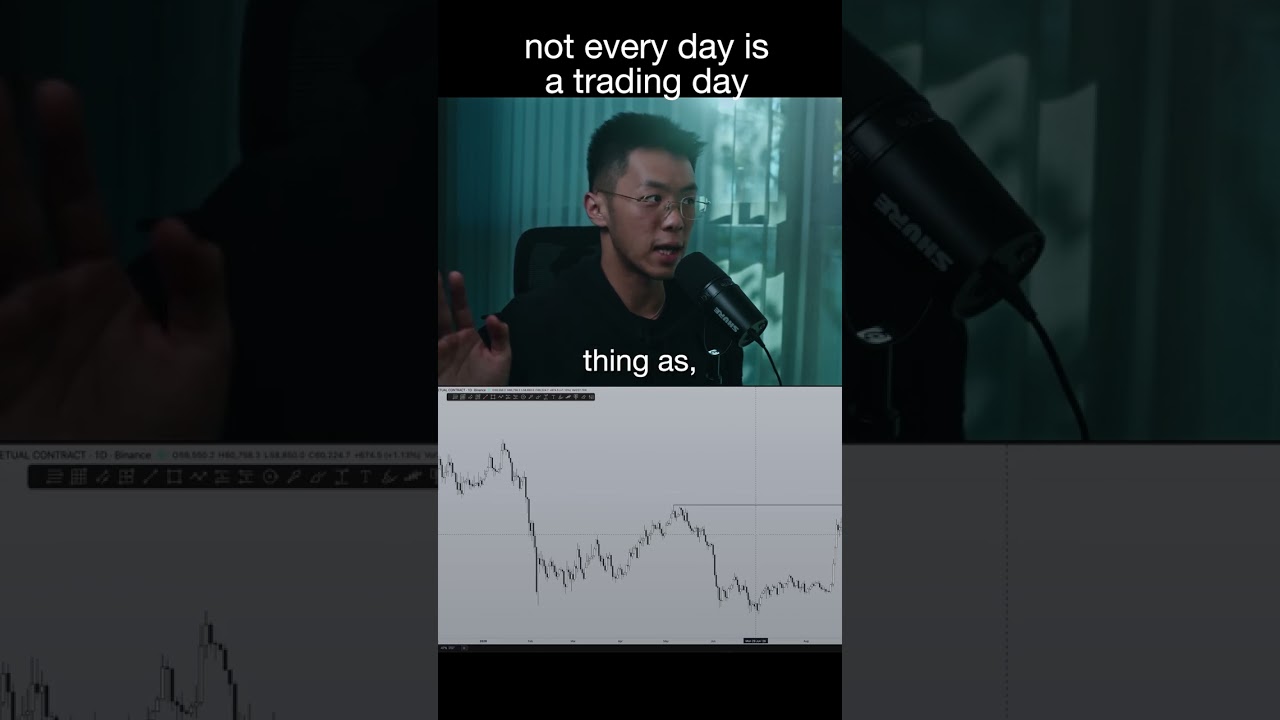
In this introductory episode of the $10K to $100K trading challenge, The Art of Crypto walks viewers through a real BTC short trade executed on May 24, 2022. He explains how the trade was sized as if using a $10,000 account with 10× futures leverage, resulting in a $90,000 position that generated roughly $1,500 profit (about 15% of the account) on a 2% price move. The video covers the rationale behind using leverage, the importance of risk‑to‑reward ratios, and the specific risk taken (≈4% of the account). The core of the tutorial focuses on the “Friday high/low” weekend range concept, noting a 90‑95% probability that price respects the Friday range over the weekend and typically breaks one side at the start of the week. The speaker shows how a break of the Friday high signaled a short‑bias, and he combines this with session‑flow analysis (Asian pump, London pause, New York reversal) to time the entry around the 9:30 AM New York open. He then delves into market‑structure tools: breaks of structure, intermediate‑term highs, liquidity pools marked by equal lows, imbalances, and bearish order blocks. These concepts, borrowed from the Inner Circle Trader and a Discord member named Dean, guide the exact entry and stop‑loss placement (just above the broken structure, ~0.4% risk). The take‑profit was set at $29,900, which he admits was conservative; a wider target could have doubled the profit. Risk management is emphasized throughout: using a stop‑loss that limits account risk to ~4%, maintaining a 4:1 reward‑to‑risk ratio, and the necessity of back‑testing 100‑300 trades before going live. He discusses the psychological challenges of live trading versus paper trading, framing trading as a form of gambling that requires a mindset shift and confidence in one’s stop‑loss. The video also promotes community resources – a private Discord where trade updates are posted, an operations manager conducting statistical back‑tests of the Friday‑high strategy, and an upcoming paid trading course that will expand on these concepts. The speaker encourages viewers to rewatch the video, study the linked resources, and adopt the presented framework to improve their own trading performance.
Chapters
What's up everybody, welcome to episode 1, officially episode 1 of the $10K to $100K challenge. And this in particular is going to be the trade that I'm going to be talking about, how I identified the— well, close to the top of this level and how I managed to take profit here. Although it's a little bit early, but profit is profit. And in this first trade here, I think I made about $1,500 or something, I'm not really sure. Let's check the account history and we will find out. So yeah, $1,500 right here on the 24th of May, right there, $1,500 closed BTC short at $29,900. Now one thing all of you are going to be immediately curious about is going to be the fact that, hey, isn't this supposed to be a $10K challenge? Why does he have $200 grand in his account? So to clarify this, I— the last time I used paper trading was back in 2021 Um, in about August, right? And because of that, I did not reset the settings before jumping into this one. You can see that this is taken on 2022, May 24th. Now, no concern here because the position size that I used was as though I was trading with a $10,000 account. In this case, I sold 3 Bitcoins, so this puts the total position size at about $90K. Now again, you'll be wondering, hey, doesn't he only have $10K? Why can he open a position worth $90K? Now here's the important thing that you need to understand. When you are having, let's say, a $10K account, if you go on to futures and use 10x leverage, you will have access to $100K position size max. Now that is what I'm utilizing here, because if I were to do this with a real live account, I'm going to do it with leverage as well. And then the other question that poses to all of you guys is, you know, isn't leverage dangerous, right? Assuming you only have $100K, you know, max position capacity, and you're using all $100K in that position, isn't that, you know, a bad idea? Well, that is relative, because for example, let's say if I entered right there and my stop loss was above this high, or maybe I entered here— in fact, we will find out the exact entry later— but in this situation, the stop loss is only 0.69%, which is 6.9% if I was using 10x. And because I was using about 90% of account capacity, I I think my stop loss was closer here rather than there. So in this situation, the actual account risk that I was taking was close to about 4%, which is still a little bit higher than sort of my max, you know, tolerance. But still, it ended up playing out well, and that's how I was able to get about $1,500, right? This is 15% on the account in one singular trade with just a 2% move, essentially. And that is how I'm able to get these kinds of gains. Now we will dive into the, you know, exact entry in a bit, but that is just to clarify that after, you know, after this video, after filming the couple first couple of episodes, I'm going to reset the current $10K, you know, the current $10K account and reflect the current profit and loss. So this was the first trade that I was taking right here on the 24th. Yeah. And Ignore this one at the 21st of May because this one was a really, uh, it's a really stupid position. I think I opened a short of about 300 ETH or something, which is, you know, it's not in the context of the $10K challenge anymore. I was sort of just playing around with paper trading because I haven't done this in a while. So this is the first official trade, and as you can see, I've only traded for about 3 days, and current profit and loss is sitting at about 30 to 35% on the account at the moment. So in about 3 days, I grew my account up by 35%. So am I saying that this is going to be replicable across many, many days in a row? Um, that's not what I'm saying. But hopefully throughout this challenge, you guys will be able to learn a couple of things that you guys can look out for so that you guys can implement it in your own chart as well. Now to actually explain the thought process behind this trade right here and how I was able to catch the exact top, uh, although, you know, again, I TP'd a little bit early should have held on to take profit here would have been double the money actually. So that's 4%, so it would have been $3,000 instead of $1,500. But again, these gains compound over time. Remember, 1% of a $10,000 account is $100, but 1% of a $100K account is going to be $1,000, right? So it's all relative. When you start with a small account, it is very important to understand that you're not trying to hit a home run. You're not trying to get 10x in one trade. What you're trying to do is you're trying to get 5%, for example, on 100 different trades, and that's how you grow your account really, really quickly. So in this situation here, if you've watched my channel for any, you know, length of time, you would have understood that I like to talk about the Friday high and low pattern, right? So this right here was the Friday's high, and this right here was the Friday's low. I want you to take a look at the date here. It is on the 28th of May, right? So that's Friday. Now the reason why I bring this up is because during the weekends, price has like a 90 to 95% chance of respecting the range, which essentially just means that if the Friday's high is here and the Friday's low is here, 90% of the time you will not break out of that range during the weekends, right? But eventually, when you get close to Monday— it can happen on a Sunday— you will get a break of either one of these levels, right? Let me just mark this level out so that you guys can see this, right? you would get a break of either one of these levels. When something like this happens, this is known as the false move, right? The reason I am usually able to identify what Monday is going to do and why I always make my videos on Monday— like, if I make any update videos, I'm gonna make them on Monday because then I will have the information of which level was taken out first. For example, if Friday's low was taken out first, then I would expect Monday and maybe Tuesday to Wednesday to head up instead of down. But in this case, when the Friday's high is taken out, I'm expecting downwards. And I posted this in the private Discord group as well. So if you want just all the updates and follow along with my trades, then this is the place that you're going to be able to do so. But otherwise, I'm going to give credit where credit is due because this is not my discovery actually. This was the discovery of this guy called the Dean right here. He is a moderator in the AOC Discord and he's the one who made this discovery. So Big shout out to that guy. You know, this is this is a game changer essentially. And currently, I have my operations manager. He is you know sort of my right hand man. You know, he's sort of doing a back test at the moment of the past hundred weekends and how you know what's the exact statistics of you know if you break Friday's high then you go take out Friday's low or maybe you just go to the midway point and then reverse. You know, we are quantifying that at the moment, and that is a result that is going to be published in the upcoming trading course that I'm in the process of making at the moment. Anyways, given that. Once you broke Friday's high, then you're going to look for some sort of entry into short, right? Because more likely than not, it's going to go down. Now, is it always guaranteed to go down? What if it just, you know, just blows past Friday's high? That is not what we are trying to predict here. Trading is a game of probabilities essentially. And the way that you succeed over time is by taking the higher probability move over the lower probability move. And over a sustained period of time, you're gonna be successful. And in this case, we know that the high probability move is going to be downwards, and so we're going to be primarily looking for shorts. We don't really care about, you know, the small up moves. We're trying to catch the big move here. Now, a lot of people can make really, really good money trading these small, you know, these small little moves and catching every little move up and down, up and down, up and down. In fact, recently I think I made about $300 off of, um, like a 0.4% move or something. Either way, it was really quick. Closed the position within five minutes, and that was three hundred dollars secured in the bag. But is that sustainable? Are you going to need a lot of time for that? Are you going to have a kind of subpar win rate? Yes, you are. But very good money to be made, especially when you understand the concept of risk to reward ratio. I've made a full video about that, so check it out if you want to. But otherwise, back into the trade. So currently, we are on the fifteen minute. Now, once you broke. This key level, then we will start looking for an entry. Clearly, we did not get the entry here because price eventually, you know, it sort of did nothing for the period of about 6 hours. And I want you to take a look here, right? This is the London session right here. Notice the time, right? This is 3:30 AM New York to 9:15 AM New York. Now, why is this important? This is very important because currently this setup right here is, you know, sort of a classic pattern of pumping in Asia, Right? Asia, it starts from about 8 PM, 8 PM New York-ish. So 8 PM is right here, right? But you can see that from about 10 AM New York to the London open, Asia session showed that it was going up. And then we got the second clue as to why things were going down, right? When London opened, it sort of just ranged, it sort of did nothing. And whenever you see this kind of a setup where you pump in Asia and then you hold in London, then most likely, right, rule of thumb, general rule of thumb, right, New York will tend to reverse. So you can see that the moment New York opened, which is about 8:30, 8 AM, or 9:30 AM, which is exactly where I entered into the trade right there, 9:30. And of course there is a reason why I chose to enter on 9:30 AM. I will get into that in many, many videos. Not only do we have a confluence factor of a Friday's high taken out, not only do we have the confluence factor of this setup, but We also— the most important thing that allowed me to determine that this was the entry that we're going for— we're going to need to hop onto the 5-minute chart in order to view this in a little bit more detail. In fact, you will not even see it on the 5-minute, but let's discuss the 5-minute first. So what I want you to see here is the fact that you broke multiple structures. I want you to take a look at— bring your attention to this low and this low right here. Notice how they are relatively equal lows, right? This is important because whenever you see relatively equal lows, you have liquidity below these levels. When you have liquidity below these levels, you need to understand that the market makers are going to wick below this level in order to take advantage and stop everybody out, essentially. So when you break market structure here, then the up move is going to be the move that you want to look for in order to get into a short entry. Now, this is a rule of thumb. I always look for an entry only after a break of structure, and this was very clear to me, and it just happened at 9:30 AM New York, which is prime time to be hunting for entries. Now, if you want more of an in-depth explanation into how all of this works, you're going to want to check out episode 1 of— I mean, unofficially episode 1 of the $10K to $100K challenge, where I lay down like an exact strategy and it gets really deep into exactly what I look for and why, you know, these things happen. If you want to figure out more of that, check out that video, but make sure you come back to this video afterwards. So once you've got the breaker structure, then you want to start looking for an entry on the up move. There is one very key distinction here Right, this is what you would call an intermediate term high, right? I'm just going to mark this out as ITH at the moment. So this term is coined by the Inner Circle Trader, or either that, Larry Williams, one of them, right? I'm gonna link the episode where Inner Circle Trader talks about this down in the description box below. So full disclosure, I did not invent this, and you'll find that in this world there are very little things that are actually like truly, truly like an invention. Right, see, the thing is, we always take parts and bits and pieces from everyone around us. We take the good ideas around us and then we combine those ideas to create something that is better than the sum of its parts. It's not that, oh, this guy's just regurgitating Inner Circle Trader stuff, but at the same time I'm applying my own take on it, right? Everyone's flavor is going to be a little bit different, and you know, I give credit where credit is due. You know, if you go watch every single video in the past I do link the fact that my mentor in these smart money concepts is Inner Circle Trader. I don't hide that, right? If you go to any video that I've ever posted, go into the description box below, you will find a link to his YouTube channel. So again, you know, at the end of the day, I'm just talking about what works here. So anyways, this was the break of structure right here. So the moment that from this intermediate term high— let's define that, right? Let's define that. The intermediate term high can be defined as the move that is rebalancing imbalance. I want you to draw your eyes to this right here, right to this right here. This blue box right here is what you call imbalance, and I talk about this more in, you know, that strategy video that I made. You could have entered into a short right here, right there, right there, but this move right here filled in the whole imbalance, and this is sort of like a turning point for me. So after you went to rebalance this imbalance, in the same move you broke structure. Which indicates that market— the market wants to go lower, which means on the retrace you go into a short with the expectation that this intermediate-term high is not going to be broken. And the second piece of confirmation that I get, that I sort of have, was the fact that something like a heads and shoulders formation, right? When I went short, I went short here, which is admittedly a little bit too early. I missed it by about 0.5%, but either way, my stop loss was above here. So looking back to the entry, my stop loss is about 0.4%. So when you see that I risked 90% of my account, the total account risk I was taking on was about 3.7%, give or take, to about 4%, which is still within my risk parameters. And if you don't know what risk parameter is, you want to watch, you know, episode 0, like the intro of this $10K to $100K challenge. So right there, I entered into a short with the expectation, right, with the assumption that the intermediate-term high will not be taken out. And if it is taken out, then you are simply wrong in your analysis. And that is where risk management comes into play. When you lose a trade, you're not supposed to lose too much money. When you win a trade, well, depends on how many— how much risk you take on and what is your risk-to-reward ratio. But you can make really good money taking these kinds of trades. So in this case, you know, I will talk a lot more about this kind of market structure, and, you know, I'll talk a lot more about intermediate-term You know, highs and stuff. But you can also see that this blue block right here is sort of a bearish order block. So you not only have you filled in the balance, but you went straight into a bearish order block. And that's, you know, that's how you sort of get the short idea. In fact, you can see that after I have entered into the position, my TP was 29,900. So let's talk about that. Why was my TP 29,900? Now go before to right here, right there. So I want you to visualize what I'm seeing here when I place the TP at 29,900. So admittedly, I was a little bit too zoomed in because I only took into account these swing lows instead of looking at this one right here. I could have got way more profit. In fact, I— if I just placed my target right there, I could have got way, way more profit. But it's all right, a little bit of profit compounded over time is going to give you massive, massive returns. So these equal lows here, right, equal lows and equal highs are one of my favorite things. Whenever I see these, I immediately know that these are levels that the market makers are going to target. These are areas that essentially price is going to be attracted to. And so I always look out for that. Whenever the one of these levels are taken out, it gives you an opportunity to enter, right? For example, right here you get equal lows, you've taken out, that is where the short opportunity is. Now that you understand where is my take profit and why I use that take profit instead of, you know, just some random arbitrary number, then we're gonna have to go back to this instance right here because you can see that from the time I entered into the position until the time that it hit the take profit, it took about 5 hours. Admittedly, I was asleep at the moment because when I entered into the trade, it was you know, nighttime in Asia. And during the entirety of the process here, I was asleep. But again, that just goes back to what I said earlier about the intermediate-term high. When you enter into this type of setup, you enter with the assumption that the intermediate-term high is not going to be broken to the upside. In fact, you enter with the assumption that price is going to continue to make lower lows and lower highs, or at least like just this level is not going to be violated. And indeed, we got that, right? The highs that it came back to, it did not even violate this swing high right here. So it ended up playing well. And this is the point where you guys will ask, hey, I would be really nervous if my position— now let's, let's put this position into perspective here. Now my position was up about 1.6% at some point, right? That is a 4:1 risk-to-reward ratio, which means that, well, yes, I, I— we was actually really close to the profit target. Now that I look at it, so I was up about 4R at the moment, and 4R, given my account risk of about 3.5%, give or take, that would've been about, you know, 13, 14% gain on the account. And since I was asleep when this was happening, it did not hit my profit target until 5 hours later. So assuming that you run into the same situation here, should you be worried? Because a lot of people are going to panic at this moment right here when price returns back to your entry and even above your entry. and potentially stopping you out. The trick to overcoming this, right, the trick to not panicking and closing your position early before the ultimate TP target is hit, is just having confidence in your stop loss, right? And how do you gain that confidence to believe in the stop loss? That goes back to what I mentioned in the introduction video of this $10K to $100K challenge, which is the fact that all of you, all, every single one of you, needs to backtest like 100, 200, 300 times And do some forward testing before you even play with live funds. Because here's the difference: when you're playing with paper, you know, yeah, my reputation is on the line. Like, if I, if I take really stupid trades, then people are going to look at me like, hey, this guy doesn't really know what he's doing, and he's selling a, you know, he's selling a private course, you know, he's teaching people on YouTube, you know, this guy's a charlatan, absolutely horrible, this guy. My reputation is on the line, but I'm not risking live money, so I can generally be quite chill about it. But when you are playing with live money, you tend to be very, let's just say, fidgety, right? Because if price really were to get stopped out, you would lose about 4% of your account, give or take. That is, that is potentially a very big number for some people, right? People are not comfortable losing their money because people don't understand that trading is a game of risk, right? And trading is essentially just gambling in a glorified way, right? And I made a full video about this as well, by the way, but trading is just gambling. And in any form of gambling, right, you have to expect to lose money. You don't expect to win every single trade. That's how people are conditioned, and it's not their fault really, because people are conditioned to think that if you work, right— trading to some people, to a lot of people, can be work— and when we work like a full-time job or whatever, you know, we work and we get paid. We don't work and lose money, right? But that's the fact of trading. You have to start by having a mindset shift. You don't start by researching, oh, the best trading strategy on the 1-minute. You don't like the best trading strategy on the 5-minute. You know, this guy just made me 100% of the account in 5 minutes. You know, you don't look for that first. First thing you change is your brain. You rewire your psychology first. How do you do that? Backtesting, changing the way you think about the markets, because you are going to lose money when you are a, you know, fledgling trader. You go straight into this with live funds You're not going to get used to this. You're going to see your position go into the red, and you're going to have the temptation to stop it out. Even at this point right here, right? If it does go even here, right? I entered here. Price went about three percent over my entry, right? Zero point three percent above my entry. With a position size of about ninety k at the time, this would have been about give or take about two to three hundred dollars. So that is that can be a lot of money for some people. Again, you just have to have confidence in your stop loss, and you need to rewire your psychology first so that you're comfortable to let price do its thing, right? Because once you enter into a trade, right, your work is done, right? You can watch the charts to see what kind of reaction it's giving you. For example, after I entered into this trade, if I just set my take profit slightly higher, I would've been in and out of the trade. I would've made $1,500 in less than half an hour. So that's the kind of bread and butter setup that I'm going to teach you guys, hopefully, over the course of this series to identify so that you guys can do this yourselves. But you don't get there immediately, right? So even me, right, as familiar as I am with this, I'm not perfect because clearly I set my take P a little bit too low, and instead of getting out in half an hour, I got out in five hours, right? And price even came really close to stopping me out. And again, just got to have confidence in your stop loss, right? So I'm sure this video has been very hard to digest because there's just a lot of concepts that I've spoken. You know, in this video. So if you're finding it hard, I highly encourage you to rewatch this video because a lot of the things that I said in this video is just high-level concepts. This is stuff that I would teach in the trading course, like my paid trading course. So I'm putting it all out here on YouTube for free. Just learn it, you know. Believe me, your trading is going to go to like another level if you start learning and start seeing these things on the chart. So it's a lot to take in if you've never had any prior experience into these concepts before, but hopefully we're going to try to change this in the series. And for now, if you're interested to get access to the full trading course that is going to transform some lives— honestly, I'm going to make it so that it will transform lives— you're going to want to check out the link in the description box below, head over to the website and sign up. At the moment it's not released yet, but anyways, for now, may the gains be with you, my friend. Stay safe.