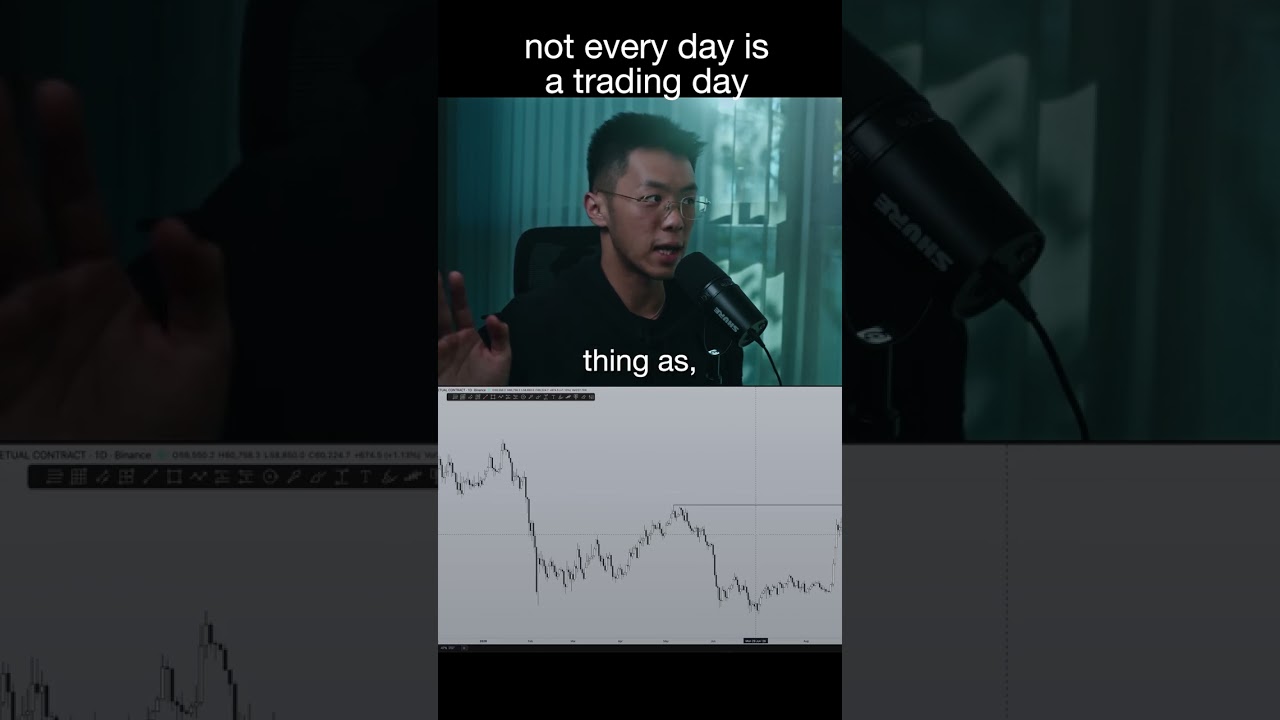
Make Easy Gains in Crypto on the weekends (THIS REPEATS EVERYWEEK)

In this instructional video, Xuan (The Art of Crypto) explains why trading crypto on weekends is generally low‑probability and how traders can instead exploit the predictable "weekend range" (Friday 5 PM ET to Sunday 5 PM ET) to capture higher‑probability moves. He outlines the market‑maker dynamics that cause false breakouts immediately after the weekend, describes how liquidity is typically concentrated in candle bodies rather than wicks, and presents a mechanical, rule‑based strategy: identify the weekend range, watch for a sweep of either the high or low at the start of the week, fade that false move, and target the opposite side of the range. The method reportedly yields a 75‑80 % win rate when applied correctly. Xuan also stresses the importance of systematizing trades for people with full‑time jobs, limiting exposure, and back‑testing the approach before risking live capital. The video concludes with a modest call‑to‑action for further training resources.
Chapters
What's up everyone, welcome back to another video. This one's going to be a pretty quick one, but I just wanted to make a video on something called the weekend range, which happens like clockwork week after week. And I'm going to give you a very simple strategy that you can use to profit off of this thing that quite literally repeats week after week. And not only that, you will come to understand why there is such a popular saying that you shouldn't be trading on the weekends. And right before we get into the video, guys, you don't know who I am, hello, I'm Xuan, and I'm currently on a mission to create the world's best trading education suite by making trading easy Now, without any further ado, let's jump right into the video. So before I get into this video, I have a couple of disclaimers that I have to make. Firstly, this is the most well-documented on Bitcoin. I haven't exactly tested this on many altcoins. And secondly, I have not tested this with forex. So if there's any forex guys that are watching this, I don't know if this will be relevant to you because of the fact that crypto is the only market in the world that is 24/7, meaning the forex markets are usually closed during the weekends. In fact, if you go onto any forex chart, you will see that And the price action, you know, ends on Friday at 5:00 PM and then it'll automatically shoot forward to Sunday at 5:00 PM New York time. That's when the Asian session begins and that's when the week begins. And so you have a gap during the weekends. But on crypto, you don't get the same problem. With crypto, it's 24/7 and that's why you still have price action during the weekends. Although it is very important to first establish that you should not be trading during the weekends. And if you look at the chart, you will very clearly see why. And especially after you finish this video, you will again very clearly see why you shouldn't be trading on the weekends, although you will walk away with a strategy that allows you to make, you know, way higher probability moves compared to trading on the weekends, which has a very high likelihood of stopping you out. So if you pay attention to the weekends, I want you to just take a moment to notice how low the volatility is and how choppy weekends tend to be, right? You look at the entire week. Now, this week itself was a pretty choppy week, but still the weekends were especially choppy with price moving no more than one 1.5% down and about 1.7% up. And it's the same case over here as well. So that's 3% up and that's, you know, roughly, I don't know, like 2.5% down. And so this isn't exactly ideal trading conditions. The best way to put it would be choppiness where you won't really get any sort of clear direction. You won't really get any sort of clear move until you head out of the weekends. And so for the people out there, especially if you have a full-time job, I want you to never ever think of crypto as something that you can do, you know, on the side, like after work. Like, okay, finally have the weekends off. It's time to trade. Chances are the highest probability trades that you're going to be able to take, not only the highest probability, but also the highest profit potential trades that you're going to be taking, they're all going to be happening throughout the weekdays rather than the weekend. In fact, the only thing that weekends are good for is for reflecting on the trades that you took during the week, or to learn something new about psychology, a new strategy, some new technical analysis, and for practice. Like if you ever want to do practice runs, taking trades that are not serious with much less capital. Maybe if we want to do some paper trading or backtesting, you know, the weekends are great for this because there's nothing much going on in the markets anyways. And even if there is, they're not exactly high probability. So like, you don't really want to be stuck in those trades that always leads you wondering, like, you know, did I make the right decision going into this trade? They're not moving. They're always making you wondering. And overall, you're just going to be like checking the charts every 5 minutes wondering you know, did you make the right call? And by the end of it, you're gonna be so exhausted, you're not gonna be able to be present with your loved ones, which, you know, usually on the weekends, you're probably most likely spending time with your loved ones. You won't be able to be present. You're gonna be feeling stressed, anxious. Like, it's just not a good state to be, and it really drains your mental capital. And so, you know, weekends, take time off to recharge. And so, especially for the people that, you know, work a full-time job, like, you might be wondering, like, okay, like, if I'm busy during the weekdays, how am I supposed to trade then? Like, do I not just not trade? Well, not really. There are a lot of ways that you can systematize your trading down to a point where you— it will take you no more than 5 to 15 minutes a day to, you know, place a trade and just walk away. And of course, that comes with some level of expertise, because otherwise, like, if you don't have that baseline level of knowledge and skill, you're just going to run into the same problem where you're going to take a trade, you're going to be wondering, like, did I take the right trade? Like, oh, prices seems to be going up right now. Do I take profit? Price seems to be going down right now. Do I close the trade? You're going to have a lot of questions like this. But there are a lot of people that I know, including myself, that have managed to systematize their trading down to like 5 to 15 minutes a day. And in fact, having a full-time job is actually conducive to trading because when you are taking trades or when you're investing in crypto in general, you usually want to be patient. Otherwise, you're not giving your plays enough time to move. And when people don't have anything to do, they feel a very strong urge to mess around with the charts, to come look at the charts, and then like they'll start seeing things that are not there on the charts, but they're sort of just making it up because they have nothing better to do. And like they just want to do something, right? Click some buttons and they mess around with the trade. That's how they stop themselves from, you know, not extracting the full profit potential that the trade could have given them. And so having things to do and having a job really helps you be patient, right? And it's also really tough. And just to explain what I mean by that, for me, my definition of patience is simply occupying myself with some other thing. Like some of my best trading I do when I take the trade and I go to the beach for a swim or something, or maybe I start playing a video game and I'm not thinking about the trade for the next like hour, couple hours. And I come back, like I'm either getting stopped out or, you know, it's close to hitting my profit target. And if I didn't do these other things to keep myself occupied, I'll keep thinking about the trade. And you know, that's how you mess up your trades. So for those of you who are, you know, having a full-time job and that, I really want you to focus on systematizing and getting yourself to a point where you don't have to think much about the trade. It's like when certain conditions are met, you just hop into the trade following a set of rules that you've developed. Once you take it, you set your stop loss, you forget about it. And this is how you're able to continue to do this even with a full-time job. And this video also happens to help with that problem because this system you can take during Sunday night Monday morning, and it's also very mechanical, meaning the rules are already set. You just have to follow them. So I know we've established why you don't really want to be trading during the weekends. Let's actually talk about this weekend range trading strategy that I promised you from the start of this video. And essentially, all you need to understand about this weekend range trading strategy is that when you come out of every weekend, there is a very high chance—I'm talking like 75 to 80 chance—that you sweep both sides of the equation, both sides of the range. And when I say range, I mean the weekend range, meaning starting from Friday, like in crypto sense, for I like to use Friday 5 PM until Sunday like 5 PM. That is your weekend range. And when I say sweep both sides of the range, I mean sweep both sides of the weekend range. So coming out of the weekends, you tend to sweep both sides before the market shows the true move. And very often, right, very often, that first move that happens coming out of the weekends or during Sunday night tends to be a false move, which you can fade to target the opposite side of the weekend range. So this is one example. Where that initial move coming out of Sunday, that pump will lead a lot of people into thinking like, oh, you know, like the market's breaking out, let's go long, whatever. You're going to get a lot of people that are buying really high up here. The market makers are immediately going to reverse the markets, trap all the traders up here, and stop them out just to target the other side of the weekend range, which they were planning to do right from the get-go. And for the nerds out there who like to understand why this happens, it's very simple. At every given point, you have to imagine that when the market goes into a consolidation. And for the nerds that want to understand the mechanism behind why this happens, I'm just gonna take a couple minutes to explain it to you. Now, during the weekends, not only are we taking time off work, but you have to imagine that the people at, you know, these stock exchanges and the market makers, they're also taking time off work. And when that happens, they usually just set their algorithms to, you know, deliver price that, you know, ends up with some kind of consolidation because like they know there are gonna be a lot of retail traders who think that it's a good idea to trade during the weekends because that's the only time that they're free. And they're going to start taking bets on these low probability price action. And when the time the market makers come back from the holiday, they're like, oh, look, you have so many people who are placing their stop loss above this level. You're going to have so many people placing their stop loss right beneath this level because, you know, they took some bets right in the middle because they thought, you know, weekends are the only time to trade. So they're going to trade even though it's low probability conditions. And when they come back, boom, right? Just stop everyone up here, stop everyone down here before delivering the true move that they were going to deliver during the week. And when I say like stop people out like high and low, again, I just want you to understand this very simple concept. The markets are a zero-sum game, meaning when you make money, you're not actually making money. You're taking money away from somebody else. Every dollar that you make, somebody else is losing that dollar. And when you lose money, chances are your money's going to the market maker's pockets. And when you win money, the market makers are paying you out of their own pockets. It's in their best interest to make sure that as little people win as possible. And that's why like stopping as many people out is in their best interest so that they can collect a lot of the profit and you know everyone else loses. So let's just study another couple. Couple of examples just to illustrate this for you. So you have this weekend range right here that you mark out, boom and boom. So coming out of the weekends on Monday morning, or in this case Sunday night, you sweep the weekend range low, and immediately this is the false move, which means you can fade this towards the top of the range where you take profit. So essentially this would look something like this, right, to the top of the range, you take profit, boom, that's a 5-hour trade. And now let's like look at other examples. Over here you have the range low of the weekend range, in this case it would be right here, and you have the range high of the weekend range. So one thing to note is that Sometimes that initial fading move doesn't have to happen right away, right? Because Monday is a trading day as well. And sometimes it might not even happen until, in this case, all the way until Wednesday. So in this case, when you take out the weekend range high, you know, you don't come back down until all the way on Wednesday. So earlier on when I mentioned that this is like a 75 to 80% win rate strategy, I mean that it happens pretty instantaneously, 75% to 80% of the time, but there are still going to be those off days where You know, you sweep the high, you start going short and you get stopped out and it's fine. There's no trading strategy in the world that's going to give you 100% win rate. In fact, the goal isn't even to have 100% win rate. You just want to make sure that you're making more money than you're losing. And that's all that matters. But still, this is a very powerful framework that you can use to think about the markets. And once more over here, you have a high, you have a low, you sweep the high first, you sweep the low, market retraces, and that is the true move of the day. Now let's look at this one. So this is your weekend range. So in this case, we do come down to sweep the liquidity down below here. And this is a very— I'm glad I saw this example because one of the common mistakes that tends to get made when it comes to this strategy is that people use the wick as, you know, the liquidity points without knowing that most of the institutional liquidity is concentrated within the candle bodies. So just to explain what that means, I want you to imagine that considering right now that we're looking at a 1-hourly candle. So let's say that this is your candle and this is how it would look like on, let's say, a 5-minute chart. Price would mostly be staying within the candle bodies. You're going to have some kind of manipulation, but most Most of the volume stays within the candle bodies. The wicks are really easy to manipulate, especially if you're the market makers and you have billions of dollars of capital at your disposal. This is the reason why we don't use the candle wicks and why, for example, over here, the moment you sweep the candle body low, boom, right? You go to the opposite side. So it doesn't always have to be like the most extreme point of the weekend range because you can see here that this has already been swept, at least not enough liquidity for the market makers to want to bring the markets to this level just to stop them out and go up. And when I say liquidity, it's what I described to you before about people placing their stop losses at this area and people placing their stop losses underneath this area. Like, they've already been stopped out. There's no reason— like, let's just say that there's not enough money to be made for the market makers to consider taking the extra step to bring the markets down this low. And so this, like, heading into Monday morning or heading into Sunday night, this was the only point of liquidity right here that wasn't swept. And so you sweep it, that's a false move, boom, go to the opposite side of the range, in this case much higher, which can happen. Let me see if I can You know, just right here you have another one. So over here it's a little bit tougher to see because the liquidity sweep actually happens right at, you know, 7:00 PM Sunday, which is when the Asian session of Monday begins. This is Eastern time, by the way, like New York time. So this still technically counts because the weekend range prior to this level was like, that's the high, right? That wick high right there, or even that candle body high. Either way, the sweep happens the moment the weekends go out and boom, it's your false move. And boom, you go to the opposite side of the weekend range, which would technically be there. Or you can also use there, right? Both are valid. But all in all, the key things that I want you to take away from this video is number one, the next time you find yourself in a weekend and you find the urge to trade, especially Bitcoin, just understand that you're trading in very low probability, you know, environments. Number two, that first move coming out of the weekends, usually, right, statistically speaking, it is usually more often than not a false move. And you can take advantage of that false move to target the opposite side of the weekend range, especially if there's still liquidity over there. I believe I've explained to you The mechanism behind why that works. Number three, this is a very high you know probability event that happens coming out of every weekend. It doesn't happen every weekend, or at least it doesn't happen in the exact way that I've shown you in this video. So you just got to keep that in mind. High probability, but not like invincible. You shouldn't ever like put too much that you cannot afford to lose onto trades like this. In fact, before you even take trades like this, make sure you study the chart. Take some time to go back onto a Bitcoin chart and. You know, maybe plot out how many times this happens versus how many times it doesn't, or just take a look, right? Study the price action. Like, one of the worst things that you can do is to just take the advice, is to just watch a video by someone random on the internet like myself, and then immediately jump into a trade right away with your live money on a concept that you've never tested before, but just because somebody from the internet told you. Like, I'm never trying to share information that will hurt you. I'm never trying to share information that doesn't work. You should also still take the time to go through it yourself just to feel how it works. And by the way, if you truly believe that trading is able to give you the freedom that you deserve to do whatever you want, to spend your time however you want, but you cannot for the life of you figure out how to make this work consistently, then I want you to click the first link in the description box below. Now don't worry, it's not some $997 course. It's just a website showing you how my company is able to help you solve your problem. Now, you don't have to click. In fact, I don't really mind if you click or not. But for those that this is relevant to, and if you would like some help fast-tracking the learning curve when it comes to trading, then check it out. But otherwise, if you found value from this video, drop a like. It does truly make my day. And if you want to see more content like this, subscribe. And if you want to see a video on a topic that I haven't covered yet, then drop it down in the comment section below. But otherwise, I thank you so much for spending your time with me. Truly do appreciate it. And I'm wishing you a wonderful day. Cheers.