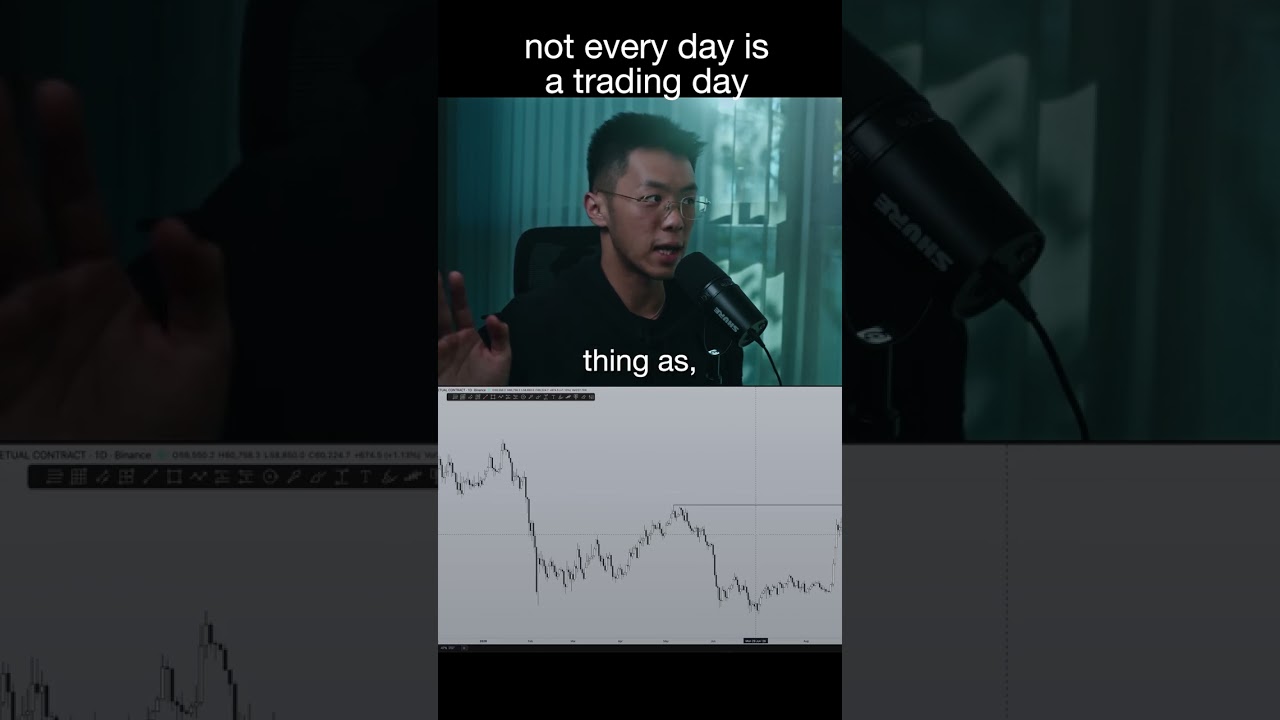
In this monologue, The Art Of Crypto explains how traders must continuously adapt their risk management and trade execution to shifting market conditions. He argues that in a strong market a conservative trader should increase aggressiveness—risking more capital and requiring fewer confirmations—while in weaker markets the opposite applies. He introduces the concept of "swept" or "protected" highs, describing how liquidity removal above a price level makes the next reliable liquidity source lie below, turning a high into a strong, high‑quality short entry. Finally, he cautions against relying on double‑top or double‑bottom patterns, noting that their historical success rate (~40%) makes them statistically unfavorable for long‑term profitability.
Chapters
The reality of trading in any financial market is that you're always just dealing with ever-changing conditions. It's always a game of a balancing act, right? If the market conditions are absolutely amazing and you're, let's say, a very conservative trader, a mistake would actually be to continue to remain too conservative in an amazing market condition. Because by you doing that, you're literally shooting yourself in the foot and just missing out on opportunities where they are abundant. So in that case, you would actually be more risky, right? And usually you would wait for 2 confirmations. Well, now you only need to wait for 1 confirmation and then you can start Entering in, if usually you would only risk $500 per trade, then now you would risk $1,000 per trade because of the market conditions. The event that you know next time you see relatively equal highs forming, you want to be trading into highs that have already been swept. Like it would be a completely different story if we actually swept out this high and then you get that CSD. This high becomes a protected high. This high becomes a strong high. Now, no, that sounds like a fancy term, but it literally just refers to again the understanding of liquidity. Knowing that the markets usually move somewhere because of liquidity, can imagine that when liquidity above has has been taken out, well, guess what? The next most reliable source of liquidity is gonna be below. And assuming we are going for a short, which we were yesterday, then if we had a strong high, this would be a much higher quality trade and I would be way more confident not only calling this trade but also putting more money behind this trade. As tempting as it might be to trade into double tops or double bottoms, they rarely play out. And in the rare event that they do, it doesn't matter anyways because statistically, right, if you play double tops and double bottoms out for like, I don't know, 1,000 times, Chances are you're going to end up with maybe 40% of the time they work and 60% of the time they don't work and they end up stopping you out. That is statistically a bad kind of decision over the long run.