Insights from the Race Across America
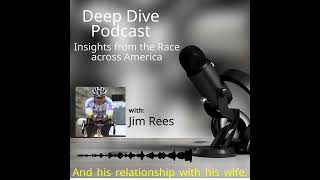
This is a YouTube video titled "Insights from the Race Across America" containing a recorded conversation featuring Jim Rees and another speaker discussing the ultra cycling endurance event Race Across America (RAM) and the life and challenges of Jim Rees. The dialogue explores Jim's personal background, his physical and mental struggles during the races, the impact on his personal life, and his philosophical insights on growth, self-acceptance, and human connection. The content is a deep dive into both the athletic and emotional journey of Jim Rees, recorded in late 2024.
Welcome, everyone. Ready for another deep dive? Today we're tackling the world of ultra cycling and the incredible life of Jim Reese.
Yeah, it's. It's really a story about pushing limits, you know, both physical and. And inner battles. Those personal transformations that happen when we really challenge ourselves.
Exactly. And to do that, we've got some great material to work with. Excerpts from his autobiography, which takes us from his childhood all the way through his Ram attempts.
And adding to that, we'll be using a documentary film about his 2009 RAM experience. It really brings his story to that.
2009 race was just wild, right? I mean, 3,000 miles across the US nonstop cycling, the race across America. It's considered one of the toughest endurance races anywhere.
Oh, absolutely. The documentary really gives you a sense of the sheer magnitude of ram.
You know, I've done a few marathons myself, and I thought that was pushing it. 3,000 miles just boggles the mind. What kind of person even attempts something like that?
Well, that's one of the things that makes Jim's story so fascinating, is that his journey starts in a place so far removed from ultra cycling.
You mean his childhood?
Exactly. He had a pretty unusual childhood. Abandoned as a toddler, raised in Australia. There's this constant search for belonging throughout his life.
Makes you wonder if those early experiences, that feeling of being adrift, somehow fueled his drive to push himself to these extremes.
It's a compelling thought for sure. Almost like he was trying to prove something, not just to the world, but maybe to himself as well.
So where does the bike fit into all of this? When does that passion emerge?
It starts with that blue Malvern Star dragster he had as a kid. It was his escape, his freedom, that ignited this lifelong passion for cycling. He started racing friends down the street, and that led him to Ironman triathlons, which are already a massive test of endurance.
Right, but Ironman was just a stepping stone.
Yeah, he discovered Ram, and that's when things really shifted.
So how would you compare RAM to something like the Tour de France?
Well, the Tour is a glamorous spectacle. It's a team effort. RAM is raw, grueling, and almost entirely a test of individual willpower.
Wow. It's like the ultimate test of what the human body and mind can endure. And it's not just the physical challenge. Right. It's the mental aspect, too. You're sleep deprived, hallucinating, battling extreme conditions. It must be like entering another dimension.
Absolutely. And in Jim's first ram attempt in 2007, he's doing all of this while leading Team Inspiration, a multi team effort aimed at showcasing human potential.
Talk about setting the bar high. What was his training like leading up to that?
Intense, long rides, focusing on speed, work with his friend Carmelo Lugari. But what's striking is his approach to recovery. It was, well, casual.
Casual? How so?
He prioritized cycling over rest. It might have even impacted his performance during the race. It's almost like he couldn't switch off, couldn't allow himself to slow down. Like he was afraid of what might surface if he did.
That makes sense, considering his background. So we know from the documentary that Ram 2007 was full of challenges. The heat, the team dynamics. And then there's the infamous Shermer neck.
Ah, yes, Shermer neck. It's a condition where the neck muscles get so fatigued that riders can't hold their heads up. Makes it almost impossible to stay aero on the bike. It can be incredibly debilitating, and the.
Documentary really shows how much it impacted Jim. But what I found amazing was the cruise solution. A makeshift neck brace made from a Pringles tube.
Right. It was a testament to their ingenuity and, you know, a rather hilarious reminder of just how extreme things get during ram. You have to be able to think on your feet, adapt to anything.
That Pringles tube moment perfectly captures that MacGyver spirit that RAM demands. So despite all of this, Jim finishes the race.
He does. It's a true testament to his willpower. But it also brings up a question. What drives someone to push themselves to such extremes, even when their body's screaming for them to stop? That's what we're going to delve into next time. As we look at Jim's 2008 and 2009 ram attempts.
Can't wait.
Things get really interesting as we move into Jim's next two Ram attempts. The story becomes less about the physical challenge and more about facing those inner demons.
Right. The documentary shows how much his personal and professional life started to unravel before Ram 2008. Like the Financial meltdown hits him hard. His work as an executive coach suffers.
And his relationship with his wife, Tracy. There's a growing disconnect there. You really feel for him during that time?
Yeah, it's like the harder he pushes, the more things seem to slip away. Makes you wonder if his drive to succeed in ram, to beat his previous time, was connected to all that. Was it like a way to compensate for what was falling apart elsewhere?
It's possible. He talks about wanting a more compelling story for his clients. Something to set him apart.
Something to.
And he admits to seeking external validation.
Through Ram, trying to prove his worth not just as an athlete, but as a man, a husband, a father.
Exactly. And those pressures, those insecurities bleed into his approach to RAM. 2008 becomes less about inspiration and more about personal ambition. It's like he lost sight of why he started in the first place.
That's something a lot of people can relate to, I think. Getting caught up in achieving and losing sight of what really matters.
It's a good reminder that external validation can be an empty pursuit.
So in 2009, he tries something different. Right, to help his crew understand what he goes through.
Yeah. He challenges them to each do a hundred mile bike ride, which, let's be.
Honest, for anyone who's not a serious cyclist, is a huge undertaking.
It was an exercise in empathy. But as the documentary shows hilariously, most of them underestimated it by a lot.
I think not one of them finished the whole hundred miles.
Okay.
It's like that saying, you can't understand someone until you walk a mile in their shoes. Or cycle 100 miles in their bike shorts.
Exactly. It highlights the difference between intellectual understanding and actual experience.
So both the 2008 and 2009 Ram attempts really pushed Jim to the limit. The documentary shows the toll it takes mentally and physically. The hallucinations, emotional outbursts, and moments where he seems to lose touch with reality.
Those scenes are raw and powerful. They show just how fragile we are when pushed to extremes. Like at one point he's convinced his crew is actually his four man team from the year before and that they're slacking off while he's doing all the work.
Wow. You can really feel the sleep deprivation and exhaust fueling those delusions.
And then in 2009, we see how unpredictable Ram can be. He gets caught in this torrential downpour. They have to stop for hours because a river floods. It reminds you that no matter how much you prepare, there are things you just can't control.
And then there's that crazy encounter in Gramania with the locals.
Oh yeah, the guys in the pickup truck using their backfire to torment him. It's absurd and infuriating, but it also speaks to the random obstacles that Ram throws your way.
Like battling sleep deprivation, hallucinations and extreme weather wasn't enough. Ram finds ways to test you on every level. It's incredible that he finishes both races.
And in 2009 he beats his previous time. It's a testament to his resilience. But it makes you wonder at what cost? Is this level of suffering really necessary for growth? Or is it masking something deeper?
It's a paradox. Pushing himself to the extreme is a way to confront his demons, but it might also be making them worse.
And that tension, that struggle between self destruction and self discovery is what makes his journey so compelling.
It feels like Jim's story really changes after these RAM races. He achieves these incredible things, but then it's like, okay, what now? What happens when you've pushed yourself to the limit and you're still left with those questions about who you are, what it all means?
It's interesting because Jim's journey of self discovery doesn't actually begin during the races. It starts afterward.
That makes me think of something I heard a therapist say once, that sometimes the hardest part isn't the challenge itself. It's figuring out how to go back to normal life when it's over.
Yeah, that's what we see in Jim. He's searching for validation, wants to prove himself. But it seems to stem from his childhood, that feeling of abandonment, like if he achieves these extraordinary things, if he can be someone's hero, it'll fill that void.
It's a common thing, right? We seek external achievements to feel worthy, but true worthiness has to come from within.
And that's the lesson Jim eventually learns, but not without a lot of pain. He realizes that validation has to come from inside, and it affects his relationships, especially with his daughters.
Right. The documentary shows how his drive for success impacted his family. He talks about repeating those dysfunctional patterns from his parents, how his pursuit of validation hurt those closest to him.
It's tough to watch, but it's also what makes his story so relatable. It reminds us that even people who achieve incredible things are still human. They still make mistakes.
What matters is what we learn from those mistakes. So this period of reflection leads to a big change in Jim's life. He goes from executive coaching focused on professional development to emphasizing emotional intelligence and personal growth.
It's like those ram races forced him to confront the deeper parts of himself that he'd been avoiding.
And through that, he discovers self regard. Learning to love yourself before you can love others. This becomes central to his work.
He develops this whole philosophy around acceptance, enjoyment, and enthusiasm as keys to a fulfilling life.
It's a powerful framework, and it makes you think how often we get so caught up in chasing happiness that we forget to accept ourselves except where we are.
And Jim doesn't just talk about it, he lives it. He's known for his enthusiasm his ability to connect deeply with people.
Which brings us to one of the most interesting things. He talks about leaving fingerprints on everyone we interact with. What does that even mean?
It's this idea that every interaction, no matter how small, leaves a mark. We're constantly leaving impressions, good or bad, on the people around us. And Jim says we need to be aware of the fingerprints we leave to try to make a positive impact.
I love that analogy. It reminds us we're all connected, Our actions have consequences.
And Jim shows us how to do it through his own actions. He uses examples from his life, the good impact he's had and the negative fingerprints he's left, especially on his family.
Again, it shows that growth is a process. We all make mistakes, but we have to learn from them and try to do better.
And there's this great story he tells. It's an analogy about the two wolves. This idea that inside each of us there are two wolves fighting. One wolf represents our good qualities. Kindness, compassion, strength. The other wolf is our negative side. Anger, fear, greed.
Oh yeah, I've heard of this. So which wolf wins?
The one you feed. It's simple but profound. It's about choice. We can choose which parts of ourselves to nurture, which impulses to act on. It's a constant battle, but worth fighting.
I like that quote. We are what we repeatedly do. Excellence then is not an act, but a habit. Jim's story is about breaking bad habits and choosing to feed the good wolf.
Confronting those parts of ourselves we might not like and working to change them. It takes awareness, effort, and self compassion.
That's a big takeaway from this whole deep dive. Jim's journey isn't some perfect path to enlightenment. It's messy, complicated, and ultimately inspiring. It's about becoming a better version of ourselves.
And it raises questions for all of us. Can pushing ourselves to the extreme lead to growth? Or is it just a temporary escape? How can we be more aware of the fingerprints we leave? Make sure we're feeding our own good wolf.
So much to think about. This has been a fascinating deep dive. Thanks for joining us.
Keep exploring, everyone, and keep feeding that good wolf.