AI Agents Are Replacing Finance Workflows While Revenue Gets More Complex with Ali Hussain
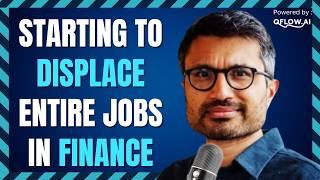
Ali Hussain, CEO of Tabs, discusses how AI agents are automating contract-to-cash workflows for finance teams. Within 12 months, AI will displace lower-level billing and collection tasks, while revenue accounting roles will take longer. Tabs uses a proprietary graph to read contracts and handle complex pricing models like usage-based and tiered pricing.
Chapters
Welcome to the Future Finance Show, where we talk about treasury management on Mars.
I wouldn't be surprised, at least in our lifetime, we see some type of bill that passes that says an agent can vote in an election, and that may be the biggest trigger of change. As crazy as that sounds, that's my hot take. Today our guest is Ali Hussain, the CEO and co-founder of Tabs, the first AI-native platform automating the full contract-to-cash cycle for modern finance teams. He's also a former COO at Latch. Ali is emerging as a leading voice in vertical AI and the future of finance infrastructure. The problem with a public LLM is you can do it 3 times and you'll get 3 different answers, and that's very difficult. Revenue is getting more complicated, but no one actually knows the right answer to it other than we have to move away from flow. Flat fee and even seat-based pricing on the software side.
How would you define an AI agent? What are their limitations and where are we going with them?
If the agent is working on something that is imperfect that a human would have been able to solve without a system, like, we have a big problem. I can bet when we're on this show together a year from now, we'll be—
Future Finance is brought to you by Qflow.ai, the strategic finance platform. Form, solving the toughest part of planning and analysis. B2B revenue aligns sales, marketing, and finance seamlessly. Speed up decision-making and lock in accountability with Qflow.ai.
Welcome to another episode of Future Finance. Paul, I've been back-to-back meetings all day. I don't even know where I am. I'm going to be leaning heavily on you in this episode to really keep us on the rails and welcome our next guest. And let me know if I just fade off and start rambling. And well, wait, that's what I do in every episode.
This is what's changed, Glenn. No, great to see you, Glenn. Excited to be here with you. And this week we have Ali Hussain with us. Ali, welcome to the show.
Thanks, Glenn. Hey, Paul, both of you. Thanks for having me. Very excited to be here. I'm glad I get both versions of you today.
Well, thank you. We're glad you're joining us. I know we, uh, had hoped to record this a little earlier and had to delay it. So I'm glad we could get our calendars back together and make this work.
So this will be a lot of fun. 100%. Post-tax season, always a better time to roll through it. We'll have more, uh, more listeners as well.
All right. So a little background about Ollie and then we'll jump into things. So Ollie is the CEO and co-founder of Tabs, the first AI-native platform automating the full contract-to-cash cycle for modern finance teams. Before founding Kabs, he served as COO at Latch, where he scaled the company from seed to IPO and experienced the inefficiencies of legacy accounts receivable systems firsthand. His background spans product leadership at Google, strategy consulting at BCG, and public policy. At Tabs, AI is modernizing the $125 trillion— how is that all— global B2B revenue market by replacing fragmented finance tools with intelligent AI agents that handle billing, collections, and revenue recognition. Under his leadership, Tabs has scaled rapidly, crossing $1 billion in annualized billing volume and serving over 300 customers. Ali is emerging as a leading voice in vertical AI and the future of finance infrastructure. So again, welcome. Love the background, love what you're doing at Kabs, and really excited to get some of your thoughts today.
Appreciate it. No, it's, uh, I appreciate the bio and thanks for introducing us. And I think the cool tidbit is when even when we wrote that, it was close to a billion, I think, and now we're close to 5 billion. So When you just think about the velocity of how much money is moving in systems that are now leaning on AI, it's been amazing to see the scale in the market.
Well, it's exciting. Congratulations on closing in or getting that $5 billion. Here's to $50, $100, $200, you know, wherever it ends, right?
Oh, you said that multi-trillion number. I'm not even, uh, scratching the surface yet.
So talk a little bit about why you started Tabs. I mean, your background's consulting and operations, not finance. So why a finance company?
It comes out of being a humble observer of just different systems. And one of the things that you mentioned earlier, I'd been a COO before of a B2B business in which one of the things the COO gets to do is go wide versus just deep. And one of the observations when I was kind of helping oversee enterprise applications is I got to see what the CFO was buying in ERP, the CRO was buying in sales tooling, and the CTO was buying in product and engineering tooling. And for me, the fascination always was how much I saw a lot of the ERP and kind of the way you buy and service those products kind of lag. And this is well before AI, and we're talking a decade ago when people were buying pre-Oracle NetSuite. And then on the other hand, you have folks buying HubSpot and Salesforce, and we started to see things like AWS and different cloud products come out. And so part of my fixation was seeing a lot of the breadth in different parts of the stack and always feeling like finance was being shortchanged in terms of innovation and product support that was coming into market. And so that was a combination of seeing where I felt that. And the thing on top of it, and what's fascinating, Paul, is like Office of CFO ERP spend is maybe the highest. So it's not like finance is underpaying for these systems. If you look at overall finance and ERP spend, it is more than the market caps of Salesforce and HubSpot combined annually. And so that reconciliation of seeing other areas of enterprise apps advance and seeing the ERP lag was an area why I was hyperfixated on trying to build a company here. Specifically, revenue then came to being the partner to the CFO and seeing how they were going about their ERP stack. I noticed a very interesting trend. In the business I was at, which is a lot of the use of a single ERP was unbundling. And I saw that happen with AP and spend as we left NetSuite's procurement module and AP module and went to products like Coupa and Ramp. And I obviously, payroll and benefits has always been in that bucket, but we went from a world where you could not move unless you went to Workday or ADP with products like Rippling and Gusto and a handful of like modern stack And so revenue, just when I decided I wanted to go build a company bigger, better, faster, finance systems is the largest bucket of spend in the world. And then on top of that, I had this fixation with the revenue side being way behind the vendor management and employee management side of the ERP. And that was kind of the, the precipice for going and wanting to start Taps.
So it was really, you were looking at a problem with kind of within that ERP, within the whole finance system and. Revenue was the area that kind of fascinated you in the sense of where you felt that's the area to focus. Exactly.
I had full fixation seeing that I saw what happened with the unbundling of my ERP, and I saw modern platforms like Rippling ramp, and revenue was like, it just doesn't make sense. It's not like revenue is a second-class workflow. Like it's the lifeblood of the business, but there's no equivalent product tooling to what I saw in AP spend and payroll. On the revenue side. Got it.
Makes a lot of sense.
So, Ali, we were talking before the show, and it's, uh, completely unrelated to this podcast, but I, I feel like, uh, Tabs is everywhere right now. And this is just anecdotal, but I just was, um, a Tabs demo with a client, and, uh, we're looking at a Tabs partnership through my firm. Again, not a sponsor. This was just happening through the natural ecosystem of business, so I just need to bring that up. No, uh, no news conflict of interest here or whatever.
No money has exchanged hands.
Yeah. But because of that, before we talked, I've, I've got a pretty good idea of what Tabs does, but I realized, you know, we get, we gave it the, the once over in the intro, but if you could, for our listeners, uh, maybe kind of walk us through what problem you're solving for businesses and, and what Tabs does at a, maybe at a little bit deeper level than what we, uh, talked about in the, uh, in the intro.
So happy to do that. So ultimately the problem we solve is we believe that at the end of the day, if you're running finance and accounting, there's 3 kind of core operational layers. As I mentioned earlier, there's how do you manage your spend, how do you manage your employees, and really it's how do you manage your customers from a finance standpoint. Historically, most companies manage their customer relationships in CRM, whether that be HubSpot or Monday or Salesforce. The problem with those tools is they're really good at kind of lead to close, meaning how do I drive a lead, how do I demo them and drive them to a closed one deal, but they're not built for finance and accounting teams, which are really the performers around the obligation after an account is closed one, meaning you've taken the customer and they've actually decided to move forward and sign up for your product. And so what Tabs does is it effectively automates everything after the day of closed one. And what that means is, is we use an AI layer, which is our commercial graph. To read and structure all of your order forms or contracts, whatever way you do business with your customer. And that's like the key wedge of our product. So before AI, the reason people often say is why was revenue so left behind when Bill.com came out and Ramp came out and Brex came out or Zip came out? And the reality is, is revenue or that customer relationship, Glenn, as I'm sure you've seen on these demos, is a highly complex commercial relationship. And unlike just scanning a receipt or understanding payroll, this is very complex and intimate. And so AI starting in 2023 started to give us the technology to read and understand that. And so historically you would have a finance team who would have to go read contracts and type in the billing terms or the products, or you would pay a third-party service provider to go in and duct tape into your Salesforce order and contract objects and try to pull that data that a sales rep typed in and it was never accurate and always missing things. And so our whole magic is we go in and we read these documents using AI, and from there we structure and organize them within tabs. The primary use case for many of folks who use us is to then run all billing. So that goes and creates invoices. If there's a usage component, we can compute the invoice. We handle all of the communication, which I, I accounting is often referred to as dunning, all the way to payment in Cash App. And so we do that. On top of that, what makes us a revenue platform versus a billing platform is we, because we have all of that intimate kind of contracts, amendments, renewals, we can then understand all of the performance of those products from a 606 standpoint, because we're not just capturing billing terms. We can understand contract terms. We can understand different types of performance obligations. Amendments, and then we can run your deferred revenue. And because we have that deep data within the system, we also know, is it a flat fee product? Is it a usage product, a tier product, a, a milestone-based product? So we can appropriately allocate that revenue and do much more comprehensive, complex RevRec than most systems. And then obviously all that data lives in the system, so we can do a lot of non-GAAP reporting, like your cash forecasting, which is often the most missed metric. People often ask like, What's your favorite part of the product? Uh, it's actually cash forecasting because we have all this amazing data. We can give you very clear view of how much you'll collect each month on a 13-week basis. And so those are the different parts of revenue that we help companies just scale with a lot leaner teams and avoiding to do a lot of manual work.
I'm going to reference something we said off air again because we were talking for a couple minutes before the show, but we were— Paul was mentioning what being an AI company right now and the LLMs, the frontier models are getting so much better that there's this, well, why couldn't I just vibe code that myself? And I'm thinking about exactly what you're talking about. This wasn't an AI job. This was just some basic fractional finance work I was doing for a company and we were going through and trying to use an LLM to find some contract. There's several hundred contracts. Some had one specific line for cancellation and terminate. Anyway, it was when you're trying to chunk and vectorize and go through all the data, it was very hard to find that specific use case that we were looking for. And it, it was interesting 'cause I, we thought it would be something that an LLM would have a really easy time doing, but just the way that the chunk, and it was, some were PDF, some were like the image kind of P anyway, it was a total nightmare of a situation. And for you guys to solve that at scale, I, I always have a hard time not getting into making the sausage here. And obviously a lot of that's proprietary too, but this isn't something somebody's gonna just go vibe code in a week.
And, and I think it goes to my philosophy, right? Like I think LLMs are amazing tools, particularly for reporting. Once the data is cleansed and structured and understood from multi-system, multi-contract, et cetera, downstream. When I think about finance use cases, I was at a talk recently with the CFO of Anthropic, Krishna, and like, they're using LLMs for amazing reporting, but they're still using traditional systems to run core accounting workflows. And so back to your point, like contracts, taking them over and putting them into operational parts of finance are very hard to do with just yourself. Out of the box with LLMs. And the reason is, is by nature LLMs are non-deterministic, but things like invoices and RevRec are highly deterministic. And I think there's a reason why a lot of them have been very effective in legal and areas of just understanding a simple clause and trying to get an alternative to that clause and those type of workflows. But something to get to a level of taking pricing out of a contract and producing an invoice. The problem with a public LLM is you can do it 3 times and you'll get 3 different answers, and that's very difficult. It's still cool and like you get to some insight very quickly. And so a lot of where we think the best finance systems are gonna be highly defensible in the world of public LLMs is really tightly built context graphs, which use LLMs, but they also use other types of AI. So when you look at our commercial graph, there's a lot of last mile machine learning that is required to get to consistency so that if you load those 200 contracts, every time an invoice comes out or every time we build your deferred revenue from a GAAP standpoint, it is the same over and over again in line with the memory and the direction you've given on how to, uh, infer your contracts. And so we think that billing is a really bad use case of out-of-the-box LLMs, But once we have all of your data right, we're happy to give it to you in the way you want to manipulate that to do reporting. It's an amazing use case. And so that's one of the ways many of our customers have been able to live the best of both worlds, where they rely on Tabs to get the contacts, read contracts, build invoices, do all their rev-rec. But then we can give them their data to do a lot of their FP&A and a lot of their reporting in ways where they can pull data out of Tabs and bill and and gusto in a way that otherwise would've required a lot of tooling and a lot of human labor in Excel.
You know, as I listen to you talk, it reminds something you and I have said a few times, Glenn, you gotta have good data before you, uh, expect the LLM to give you good results.
So extracting the data has to be, yeah, that's a huge part of it is pulling out the right data to, to feed these systems so that they can add any value.
Yeah. And to me there's like 4 layers of where the future's going. There's a data layer, which is the most important. Think about it like the, the gasoline or the actual vitamins you put in your body. Like, it's the most important— not gasoline in your body, in your car— but like, it's like quality of what you're fueling. And if that's broken, everything downstream, you're gonna have a poor drive or your health's gonna weaken or whatever it may be. And so that context is the most important thing in the world of AI, and that's where hyper-specialized tools that know the domain, that can pull out contract data, usage data, key fields from your CRM, your data lake, etc. That is where you should always buy versus try to build. The actual interfaces, the software, I do believe is going to be the most commoditized. And that's why in certain areas I'm just skeptical of all these AI tools that like are purely just a operational or software layer if they don't have a data mode. That I do think is a race to the bottom, but it is a necessary part because whether you or your accounting firm or your agent are working, you still need systems of record that show the work and show the audit trail. And I have a hard time believing you're going to build something that's good enough for an auditor or a third party yourself. So I still think you should buy, even though it's not as— it's not going to be as expensive as it was in the past. And then the final piece, to your guys' point, the reporting part, I do think gets more commoditized because that's so bespoke. So long as you have good data coming from these systems, the final part though, that we're not yet talking about, but I'm, I can bet when we're on this show together a year from now will be the specialized agents that are not humans that are also working on top. That is the other area. There's the data part and then the last mile agent. I do believe those agents are going to get hyper-specialized to these roles. And that will be another area that will be incredibly hard to build and you will just buy. So everything in the middle gets commoditized, but the data mode and the actual agents that start to look and feel like team members, their fine tuning of agentic work and context will get specialized enough where it'll make sense to pay up for because of the quality of work they do and the specialty of accounting workflow. They know how to do.
Got it. Speaking of agents, yeah, obviously we keep hearing about those. It seems like, yeah, first it was the LLM, it was prompting, you hear a lot of scripting, but now we're hearing a ton on agents. So how would you define an AI agent? What do you think they're good at today? What are their limitations and where are we going with them? Ever feel like your go-to-market teams and finance speak different languages? This misalignment is a breeding ground for failure, impairing the predictive power of forecasts and delaying decisions that drive efficient growth. It's not for lack of trying, but getting all the data in one place doesn't mean you've gotten everyone on the same page. Meet Qflow.ai, the strategic finance platform purpose-built to solve the toughest hardest part of planning and analysis: B2B revenue. QFO quickly integrates key data from your go-to-market stack and accounting platform, then handles all the data prep and normalization under the hood. It automatically assembles your go-to-market stats, makes segmented scenario planning a breeze, and closes the planning loop. Create airtight alignment, improve decision latency, and ensure accountability across the team.
I think there's gonna be a lot of— for a little bit, a lot of noise around agents where people will look at something cool that an LM can do and be like, oh, that's an agent. And I, my bar is much higher for that. That is just a cool workflow or table stakes, like automation. And so to me, there's a distinction between things that more move more automated but are still requiring a human to work on top. That to me is AI automation. It's not necessarily agentic. Agentic to me are end-to-end workflows that are being fully done independent of a human being involved. A human can give direction, but a human's not coming in and really touching the steering wheel. The agent is getting from X to Y location totally on their own and starting to completely displace entire jobs that people do, whether it's a part of their job all the way up to their entire job. And so to me, I think the bar for an agent is very high. I think we are still in very nascent days of like who's actually accomplished end-to-end agentic outcomes. I think there's a lot of end-to-end AI automation, but an actual ability to say, hey, I'm not hiring anyone else in billing because now I get an agent from Tabs, or I don't need a payroll admin anymore because I have an agent from Deal. I think we're a little bit out from there, but we're not that far away. And so to your question, Paul, where I think we're headed is in the coming 12 months, we're gonna see a lot of lower level jobs to be done starting to get displaced. That doesn't mean necessarily you're cutting all your headcount, but you're able to continue to scale and do more with less. So my prediction for the next 12 months, and a lot of where our roadmap is headed, is what are the entire jobs that can be done that are highly tactical? And billing's a great example, like the amount of people that spend time, a good portion of their time each month building invoices, sending them, following up, sharing a PO number, submitting, um, portal, a W-9, trying to reconcile payments from a bank account. That is an area of where we believe the technology is good enough to fully take that over end to end going into the next 12 months. That is not a hypothetical. That is an inevitable. And the quality of the data, the LLMs, the tooling that vendors like us have built is starting to yield results where you can imagine that happening in a good amount of the market in the decent future. The harder part of agents is what I call the more intimate workflows, like replacing what someone like a revenue accountant or an FP&A lead or a strategic finance lead does. That I think is going to take a little bit longer, but that is also an area where agents are going to fully take over. And so my threshold for agent is less about, is it eating into ERP spend or software spend or services spend? That to me is AI automation. Like if you're displacing modules and services from your ERP vendor or your third-party admin, like that is like automation. But if you're starting to look at your finance team of 15 people and you're saying, look, I don't actually need to hire 2 more people in billing. Or in payroll or in revenue accounting or FP&A, that starts to actually, that's where I use the A word, like where the agents have arrived.
Yeah. Paul, I can't believe you asked about agents before I got a chance to.
So, I wanted to go for it for once, because I didn't want to hear your rant.
No, I'm just kidding.
I'm so aligned with you on, people were calling everything an agent for a while. And if you, I think last time I checked, agents were at the absolute peak of the Gartner hype cycle. Right now. And like, like what you were saying about using machine learning at various steps in there, I've fought this and Paul's heard my rant a million times, so I won't do it again. But when you call everything an agent, it lessens what a true agent is gonna be. I eventually gave up that fight and I would build for clients an agentic workflow that had deterministic steps along the way. You sprinkle some AI where it makes sense, but otherwise it's like a decision tree that it just goes and it you know, it's a deterministic workflow and all that. But I mean, I'd be curious, like, I know, uh, some of the coding apps, I don't remember which one on the benchmark had the longest running agent or whatever. It might've been Cursor, but, you know, they've got coding agents that will go out and work for like 9 hours on, on something and then come doing truly agentic work as, as far as, as I can tell. But I do think it's important to really understand, and this goes back to your probabilistic versus deterministic approach comment earlier, where an agent is still, if it doesn't have those decision gates and those guardrails, it may go off and do a task and do something completely different than it did before. So it's gonna be interesting to see how it shakes out and then how we rein in the agents to keep them, I'm going to Nick Bostrom's, you know, like paperclip thought experiment right now, but it's, wild times in the last 6 months.
100%. And like, that's why we're so fixated on this. I, I still think the most important part is the data context. That has to be perfect, cuz if the agent is working on something that is imperfect that a human would've been able to solve without a system, like we have a big problem. And so the data part's huge. But to your point, there are decision rails, there are controls, there are areas that avoid hallucinations or things that could go in send the agent array, but you also, if you think about something like billing, you need preferences stored in, uh, memories, like this is the way we want you to communicate, this is the tone, don't go escalate Dunning to Chipotle, it's our top customer, we don't want to piss them off, like turn off Dunning, like those type of controls are incredibly important, but they can be built and I don't think you should build it yourself. But the way, if you now have vendors like Tabs that have best-in-class engineering teams are building off datasets that aren't just yours, but off of hundreds, if not thousands of companies and getting data on hundreds of thousands of invoices being sent, you can actually pattern match to a pretty good system. Like if you think about cars now autonomously driving on complex highways and in cities, It's not that unfathomable that a billing agent can take you from a contract to cash without a human basically touching anything other than once in a while touching the steering wheel to make sure you approve of invoices or who can send the invoice or of a certain size, or if you're going to accept credit card, etc. So that's the direction, Glenn, I do think we are headed, but it's going to require really thoughtful specialists. Like us to get it right versus you going out and on a $50 million business trying to vibe code something. I literally had a client, one of our customers that were about to go onboard, like they went from one system to another, not on the billing side, but on the ERP side. And like something got triggered and they sent 900 invoices twice to all of their customers on a completely different ERP. And it's just like, like those mistakes can be incredibly costly. Just using a specialist tool and not spending your engineering time on it is incredibly valuable. Yeah.
And maybe this is tangential to that, or maybe I'm completely changing the subject now, but I'll, I'll be curious to hear your response on this. You mentioned 606, and I'm thinking about sort of standard, you know, whatever SaaS contracts and all that. But as especially with AI being more and more a factor of what people are delivering, the pricing models are changing. So there's, you know, it's usage-based, it's seat-based, it's value-based and all that. I don't know. I mean, I guess ultimately that will impact, you know, the kinds of agents you're building, but how are you, or maybe you already have it, but how are you handling increased complexity in, in contracts and being able to do this pricing? Because I know that's a big, especially around usage-based pricing rather than the seat pricing.
100%. The reason we've done so well in the last 12 to 18 months, like I, I, I earlier Paul asked why I started the company. I was because I believe revenue had been left behind for finance operators. And the second reason, and I didn't get to this, Paul, is like, if you actually look at the $4.7 trillion accounting and finance economy, when you look at the jobs that are being done from a finance composure standpoint, most are tied to the controllership and accounting, whether that at the corporate level, doing things under the controller around billing and RevRec, That is typically 60 to 70% of finance teams. But then if you look at the professional service side of a lot of these big top 100 firms, many of the people are in audit, revenue-related audit, revenue compliance, et cetera. So one is it's just a massive labor market. But Glenn, you're going on to something which is like the holy grail of what's going on right now, which is revenue is getting more complicated, whether we acknowledge it or not. The prior, like, conventional wisdom is you hire a mature finance team, they come in and they standardize your contracts. They once in a year align on pricing and packaging, and they create structure and controls. The last 12 to 18 months have thrown that out of, like, completely out. Meaning with AI, revenue is getting more complicated, but no one actually knows the right answer to it other than we have to move away from flat fee and even seat-based pricing on the software side, but even on the non-software side, the way service providers, professional service firms, even hardware manufacturing companies are moving the way they sell products and the terms and all of that. And so our general mission is internally as a company is to make complex revenue simple at scale. And the way we handle is it goes back to that LLM layer. Like we're agnostic to your pricing and packaging because We understand and structure it at the moment a contract signs. So we're not relying on a price book, any type of historical structured pricing or knowledge of your business model. The same way an accountant or a human reads a contract and then types in what their understanding is, the LLM and other deterministic machine learning is highly discerning of that and can support any type of business model. And so if someone asks me, what's the most surprising thing about your business? 60 to 70% of our clients now have a usage component to it. And that's not just clients like Cursor and Together and others that are like AI companies. A lot of legacy platform companies are now adding some form of usage structure on top. And we are getting incredibly good at not only structuring it, but most companies then feed a usage feed into tabs. It doesn't have to be API. The LLM's really good at capturing unstructured CSV uploads as well from BI tools like Looker and Tableau. We do the math and we do the invoicing, but then most of my roadmap right now is going really deep on the RevRec side. Because to your point, when you add usage and all these complexity, doing your 606 on usage-based products with tiers and minimums and pre-commitments and performance obligations, it is like a 7-Eleven Freezy times 100 times over. And I, I mean, like, people are truly lost. How do you do SSP and revenue allocation at a time of usage and professional services at the same time? And these are all breakthrough macro chaotic moments that are really allowing us to go back and build products that are helping support finance teams going through immense change right now.
The pricing landscape is a changing animal. It's why I'm glad my business is relatively simple on the pricing. All right, enough of the, uh, the humor. But, um, yeah, great answer there, and it's fascinating. It'll be really interesting to watch over the next couple years how this settles, because yeah, if you're not careful, that pendulum will swing too far in complexity and pricing. But there's a balance. Usage and all these different things are great, and getting to value-based pricing, holy grail. At the same time, if it's overly complex Does— do people want value-based pricing? And you never know what the number is going to be every month, right? So this will be fascinating to watch how it plays out.
Yeah, you'll be— Paul, my hot take right now is we're not actually seeing a lot of pure outcomes-based pricing yet, even though people say they're value— or, and even in usage, it's not pure risk-based. Most people are really moving to some form of tier-based pricing, like, and on top of that But, but we're seeing a lot of upfront commitments too, because especially folks who are moving and selling more AI products to the enterprise, they need some certainty on payment and term. And so I think as much as people are posturing really advanced, complicated usage, we're starting to pattern match a little bit. The problem just becomes the discounting and the things that it requires to get the deal done are highly sales creativity and what the customer is willing to pay. And that's actually where a lot of the complexity still happens today in the market.
So AI hasn't solved the relationship and all the things salespeople do that you're like, I got to figure out now how to manage that.
Saves maybe one engineering of resourcing. They're going out and hiring 5 more salespeople. So I've, I've yet to see that happen.
Yeah, I know.
I'm with you. All right. So we're going to move into— we have a little section we like to do at the end. This is our AI section. So here's how it works. We feed an LLM and we use different ones depending on which week it is. I think this one was Claude, but I'm not sure. And so we feed it questions we had for the interview, your bio, your LinkedIn profile, and tell it anything it can find on the web and to come up with a mix of kind of personal, fun, and quirky questions. So we never know what we're gonna get. We haven't even read the questions. Glenn and I each take a different approach. So my approach is You have two options. There's 25 questions here. We can stay with, you know, computer here and let the random number generator pick the number between 1 and 25. Or you can pick a number between 1 and 25 and we'll put a human in the loop. And then we'll ask that question. All right.
I'm a big human in the loop guy still. I still think we need humans in the loop and we will for some time. So let's go, uh, let's go lucky 13.
13. I'm not sure if we've ever had that one. Hasn't been many. All right, here we go. If AI agents were employees, what title and job description would you give the Tabs agent, and what would its performance review look like after year 1?
Amazing. I am a big believer that agents must be named like employees, uh, humans. And so I would pick whoever firstname@tabs.com is still available. I don't think we yet have a Regina, so let's go Regina at tabs.com. And the way I would assess Regina today is pretty similar to how I assess employees at Tabs. I put them on a 1 to 4 scale with 3 to 4 being, uh, no one gets a 4, so I'd be very surprised if, which is a top performer. I don't think yet Regina's at the level where they can be a 3 either, which is like overperforming. Performing. So I'd probably put them at a 2. I don't think they're a 1 anymore. Last year, 1 is typically someone who's on the lower end and struggling, but I think Regina is like probably a 2. The only thing on top, I want to make sure Regina is not costing me more than an employee. So I'd also track their token utilization to make sure that the ROI in Regina is good enough so that it's not only better than employee, but I'm also getting some real ROI out of it.
Great answer.
Complete. I like it. Good, right on the fly. Thought about that one.
So, Haskell the LLM on the 13 there.
So for my approach to these questions, I feel like I'm just throwing everything over to the AI overlords and instead of just putting a human in the loop at all, or even just a random number generator, I ask it, what was, uh, you know, you came up with the questions, what, uh, which one of these do you like best? Should I ask? So I ran this.
Let me guess, question 13?
I'm just kidding.
We have had that happen a couple times lately, just a weird glitch in the matrix or something. But now this is number, this is number 5. I almost want to do a human in the loop and call an audible here. This is an okay question. The AI question is, you worked on Capitol Hill before any of the tech roles. And this is the part I want to change. They say, what's one thing about how DC actually works that you wish more tech founders understood? I want to change the question to be, how on earth are we going to make our octogenarian representatives understand the first thing about AI? So harder question, sure, but I'd love to hear your answer on that.
This is not one I've thought about other than I think the sooner agents get to also vote may start to create some changes. And so I— we may be not as far out from that than we realize. I, I don't know if it's— I wouldn't be surprised at least in our lifetime we see some type of bill that passes that says an agent can vote in an election, and that may be the biggest trigger of change. And I, as crazy as that sounds, that's my hot take.
Well, love the answer. Loved that you took the time to join us today, Ali. It's been a lot of fun chatting.
It's a deep pleasure, Glenn, Paul. I know you're both, both very busy, so thanks for humoring me this afternoon. I'm excited for the next time.
Hey, we appreciate you joining us. It's been a lot of fun, and we'll look forward to the next time as well. Thanks for listening to the Future Finance Show. And thanks to our sponsor, Qflow.ai. If you enjoyed this episode, please leave a rating and review on your podcast platform of choice. And may your robot overlords be with you.
More from Paul








AI Is Accelerating Faster Than Humans Can Keep Up: What Should Finance Pros Do