The CFO Should Own AI, Not IT | Glenn Hopper on The AI-Ready CFO
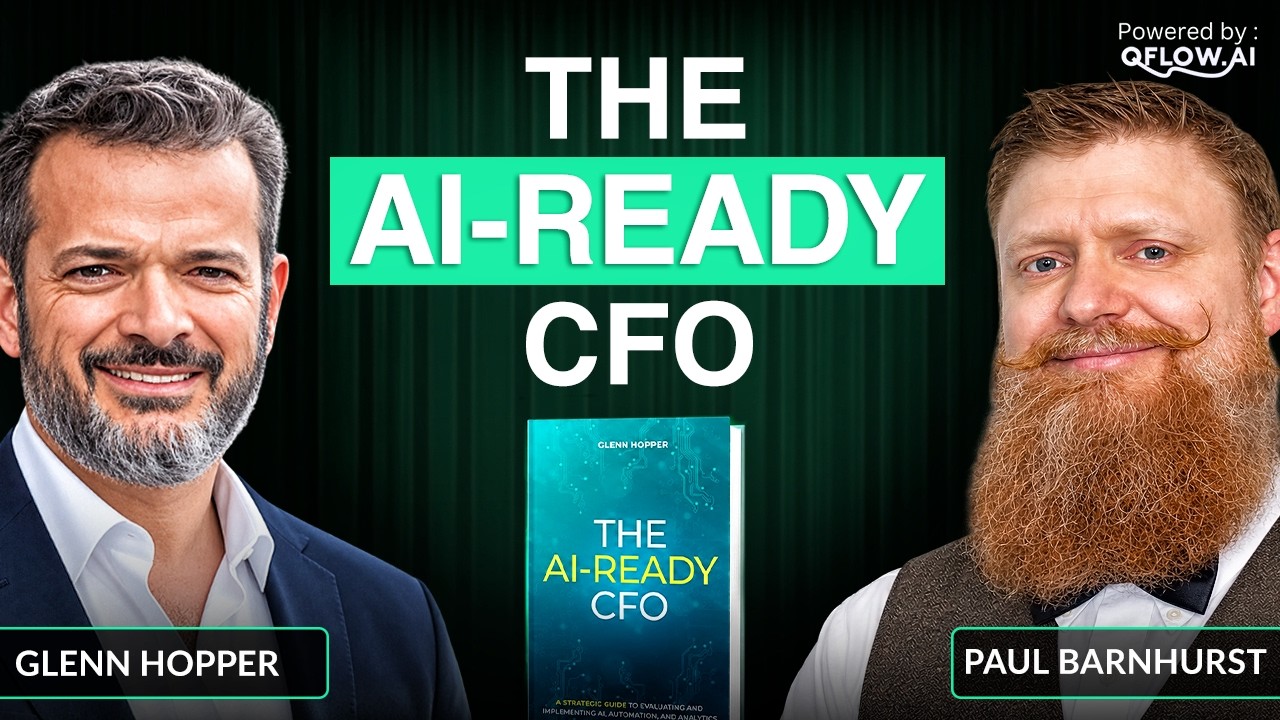
Glenn Hopper argues CFOs should lead AI adoption, not IT, because finance already has the control frameworks and audit responsibilities. He outlines a 90-day pilot approach with decision gates to avoid "pilot hell," and says trust and transparent audit trails are what earn buy-in from auditors and business units.
Chapters
Welcome to the Future Finance Show, where we talk about treasury management on Mars.
I don't think AI is going to take all of our jobs, but if you're not going to learn AI, then you're not part of the program.
So today we're going to talk about his new book.
The title of the book is The AI-Ready CFO. What I'm arguing in the book is the CFO in the era of AI is even more than the CFO.
Do you have fears that's going to lead to burnout? Are we expecting too much from CFOs?
My whole reason for this book was I'm getting pressure as a CFO, whether it's from my CEO, from the board, whatever. I'm being asked for an AI strategy. I'm not an AI expert, so how do I come up with a strategy? The same controls that we use for people are what we use for AI. So if you think of the CFO as maybe the chief accountability officer, that's the person who owns the trade-off between speed and risk. And we talk about that in the book a lot.
What do you say to those that are struggling with the trust?
Big themes across the book are governance and accountability. The real way that you earn that trust is having—
Future Finance is brought to you by Qflow.ai, the strategic finance Platform, solving the toughest part of planning and analysis. B2B revenue aligns sales, marketing, and finance seamlessly. Speed up decision-making and lock in accountability with qflow.ai. Welcome to another episode of Future Finance. Super excited to be joined once again by my co-host, Glenn Hopper. Glenn, how you doing?
I'm good. I'm— am I a guest today or am I the co-host? I don't know how we structure this.
I don't know. I believe you're the man with the sultry sounds, if I remember right. So our audience is probably like, what is he talking about? I told my wife I would have a little fun on the episode, so hopefully I won't be too much in the doghouse. But she was going on and on about how much she enjoys listening to Glenn because 'Cause he really knows his material, he's really smart. And I was like, wait a second, am I chopped liver? Like, Glenn just sounds so nice. So Glenn, just wanna let you know, you sound intelligent. My wife was impressed. I told her I'd introduce you with Sultry Sounds and I would just be the mascot who's the kind of the bearded wonder, the eye candy, so to speak.
Exactly. You know, the funny thing is I was a journalist before I went to business school and I always felt like I had a, you know, a face for radio. but unfortunately a voice for print. Kind of that, uh, sounds like Billy Bob Thornton with a mouthful of marbles. I don't know, maybe, maybe I've gotten better at my diction since then, but it's really, it's, it's that, it's the, uh, off-putting Southern accent, I think maybe lulls people into, uh, a sense of calm. You think that might be it?
I like the accent. And I think the biggest thing is she's, she was saying she could listen to you all day is she just really appreciates how well you know your stuff. She commented about that.
Make it till you make it, Paul.
That can help her learn a topic, and you know the topic well. So there you go.
Tell your wife I said thanks. And, uh, and, um, if she ever needs help falling asleep, she could just listen to one of our podcast episodes.
I, I will definitely let her know that. I, I've considered it myself. No, um, all right. So today Glenn's going to be my co-host slash our guest. So we'll go guest more than anything. But, uh, we're going to talk about his new book, book number 3, right?
That is it. Yep.
So let's start with, tell our audience what the title of the book is and give us just a brief little summary. Let's start there.
The title of the book is The AI-Ready CFO. And Paul, I know you and I have our running gag about the AI CFO because CFO is kind of just a CFO, but what I'm arguing in the book is the CFO in the era of AI is even more than the CFO. And I'm, we'll get into it in a little more detail, but really this book, who would've guessed that I would write 3 books on AI and finance with spoiler alert, 4th book already in the works and coming out this spring. We can talk about that later. But when I wrote my first book, It was pre-generative AI. It was during COVID where we all had to come up with things to do while we were trapped in our house nonstop. The first book was, hey, machine learning is pretty cool. You should use it in finance. But this was, it was published in 2021. Back then it was great. Machine learning is cool, but what finance team is going to be able to hire a bunch of data scientists and Engineers and people to write Python and all that. So great concept, but maybe a little bit ahead of its time. But then generative AI comes along and suddenly, oh wait, that barrier to be able to use data science principles in finance is knocked down because we can all vibe code our way to fame and fortune, I guess. But so then I wrote the second book, but It's super interesting. I don't know, maybe I'm bad at timing the market, but the second book was AI Mastery for Finance Professionals. And yes, I do talk about generative AI in that. The second book was kind of the book that I wanted to write initially, and it was just think about all the applications, all the ways that you could use AI in finance. So we talk about classical AI and machine learning and that, but we talk about image recognition and generative AI and just Across all, whether it's corporate finance or private equity, VC, high finance, across the board, how can AI be used? And that's great for sort of a, okay, let me just understand the universe of AI and how it applies to finance. The third book, The AI-Ready CFO, was really, okay, these, we all have these tools in our hands right now. And you can train all day on how to use Claude or how to use ChatGPT or We pick whatever the latest and most popular model is. That doesn't really move the needle. And for leaders in AI, leaders in any industry or profession now, you need to know how to incorporate AI. So my whole reason for this book was I'm getting pressure as a CFO, whether it's from my CEO, from the board, whatever, I'm being asked for an AI strategy. I'm not an AI expert. So how do I come up with a strategy? And I also address things like, and I think it's getting better now, but kind of everybody's using AI right now, whether it's approved or not. And there's all kinds of risks around that with people using their own tools and all that. So we talk about that. And really the whole idea of this book is hand someone a manual so that if we're starting with, I thought I could just be a finance person and run a finance team and be the, you know, have fiduciary responsibility for the company. And now I'm being asked to do all this other work that isn't related to what I went to school for. So it's really meant to just be, go from not sure what to do to, okay, now I've got a 90-day plan, a 6-month plan, a 2-year plan on how we're going to roll out AI effectively.
Well, we'll definitely dig into that, but something you said at the end I thought was really interesting. You talked about how You know, finance is now being able to take on kind of a role, or I didn't learn in school, or I didn't expect to have to be able to do. Now they're being asked to do a lot with finance. And I'd love just kind of a little bit of a, I guess, almost a detour for a second here. I'm gonna go off the rails, so to speak. Non-AI on an AI show, but bear with me. So you mentioned that, and it feels like over the last decade, I'd love your take having been a CFO. I haven't been in that seat, but I've seen a lot. Everything I read says the CFO's being asked to take on more and do more. You have people that say, hey, the CFO should own data. You have many, you saw Salesforce create a chief operating finance officer. You see a lot of CFOs have CFO and COO or small companies. Sometimes they owned IT and HR. And it feels like I have a friend who he's president and CFO, not a combination you see very often, but he's the president of the company and the CFO. And so just love to get your thoughts in general. It feels like, you know, this is one more thing finance is kind of being asked in many cases or expected, or in your case, you're going to, we're going to talk about how you kind of argue leading a lot of this. Do you have fears that's going to lead to burnout or are we expecting too much from CFOs? We just love your thought on that whole kind of idea.
Yeah. And I've talked about this for a long time and I had, I was in under $50 million revenue businesses and I was in not a full turnaround stage, but when I was brought into companies, I was brought in by the investors and it was usually a company that was kind of long in the tooth, was kind of flat, wasn't really doing anything. So not failing, but just not growing the way a private equity sponsor would want them to. So I would have to come in and figure out how to make changes. And because of that, A couple of times I did have the CFO slash COO role, and I also had the power of the board and the investors behind me so I could get access to data. I could get things done maybe more than normally if you're just swimming in the finance lane. But when I think about what had to be done, the finance was this scorecard and the forecasting that we had to do was how we were going to, if it, whether we were raising money from debt or we were selling the business or whatever it was doing, we had to present like a bigger company than we were. And a lot of times there were layoffs and restructurings around me coming in. And all that is background to say I was in that seat where I had finance and operations and IT sometimes and HR all rolling up to me, very small teams with each, but trial by fire, I guess. But it forces you out of that. It was very easy. And I remember the first CFO I worked for back a million years ago, he could stay right in. Like we would have our, it was a startup telecom company and we could have our monthly meetings where the whole company got together and everybody would give their briefs. And the CFO, all he did was get up there and read, we are EBITDA positive in this market. We are cash flow positive in this market. We're trailing in this, we're ahead of four. And it was all just reading out that report card. And I think that was pre-Sarbanes-Oxley and all that. And I think the CFO role has changed. Since then, and the technology has changed, and the idea we have more power to take in more data and use it in our forecasting and to be able to, if we're spending less time making, you know, manual journal entries, then we can spend more time on that strategic value. And the tools have changed. The access to data that we have has changed. The regulatory environment has changed. And I, in my time in finance going back 30 years. Yes, the role has changed. And to be most effective, I call it a land grab, if you will, but I want access to these other departments as well. And it does make sense. I mean, not always because it's, they're 2 very big jobs, but, you know, in a much larger company, carrying the role of CFO and COO seems like it would be a pretty big burden, especially when you have ESG requirements on top of it and all the other things that We're accountable for, but whether I actually own all of those or whether they roll up to me, I want access to all that information. I want all the data in the company because I'm going to use it in my role as a CFO.
Yeah. And I think your second point is the important one. Whether you own it or not, you need to understand it. And whether CFO should be a COO, size, complexity matter. I think most people probably say in manufacturing, you need that COO, that deep understanding, right? And you're already nodding like, yeah, please don't make me the COO in a manufacturing.
Yeah. But manufacturing especially, we need to be in lockstep on the data we're using for all the job costing and for every, you know, order costing and all. I mean, all we need the detailed accounting. And so it, interestingly, the system in a manufacturing environment, the ERP, the, and the operating system, if they're not the same piece of software, they need to be linked because we need The operating reporting and the financial reporting around it.
Yeah, the resource planning is real. The RP and the ERP is much more important in the manufacturing side, whether you call it MRP, ERP, whatever. I totally know what you're meaning in that data, but kind of stepping back to where we started all this on owning more, you know, you make the point in your book that finance really now needs to own AI adoption, kind of own the AI thing. So when you say own, What does that mean for finance and how do they successfully, how does the CFO leadership do that with this continued ever-growing responsibility?
Yeah, and I get a lot of pushback on this, but it doesn't change my steadfast commitment to it. Let me, I'll tell you the why and then we'll talk about the how. So for the best reporting, not, I mean, Not just general ledger that we're reporting on. I want access to all the data. But I think about if we're supposed to be unbiased reporters of the financial data and we don't have a dog in the fight really with trying to make sales look better or trying to make operations look better or any other department in the company, and we are the arbiter of truth And what comes out of finance is you have to sign the financials and stand by your financial reports. And I think, and we have to have financial controls that are in place. So I think for a long time, we've already sat at the intersection of enterprise data and the internal controls. And no other function really has to balance their efficiency against control the way finance does. We've got process, procedure. We have to stand up to audit. And we have the right mindset. We just didn't know it because now it's not like if you're the CFO, you're not doing AP and AR. And if you're the CFO and you own data, it's not like you have to do the engineering. But if you know what is in the realm of possibility and you have this process thinking and you understand the data, then you're already in a place. The same controls that we use for people are what we use for So if you think of the CFO as maybe the chief accountability officer, that's the person who owns the trade-off between speed and risk. And we talk about that in the book a lot. So that how to do it is not, oh, you need to go back to school and learn how to become a developer. You need to understand what, I go back to process thinking again and understanding all the controls that are in place and applying those. And then you do need a fundamental understanding of the data universe and what works and what doesn't. And in AI, what works between, when we talk, I'm not going to beat this horse, but the deterministic versus probabilistic and where it makes sense to apply it and to manage the whole function, including the data side. And it does take more work, but the idea is as AI and automation are deeper embedded and become a bigger part of how your team runs, then your team can spend more time. And it might be reskilled or upskilled or restructure the team to, guess what? We do have some engineers in the finance organization now who are building around this so that it's not just, you know, Bob in AR vibe coding an app that I'm not really sure what it does under the hood or, or whatever, but that we can start formalizing some of this. So it's a shift and change is always hard. And I, when I'm working with clients right now, The change management is, to me, the harder part than the technology itself.
You know, it's funny you say that. Isn't it almost always the case? Don't projects, in your opinion, I'd love this, whether it's an ERP implementation, AI, FP&A tool, CRM, whatever it might be, any big technical change, isn't the change management almost always the hardest part?
You know what I've really noticed, whether, and I'm thinking about specific clients I've worked with, um, Whether you are doing something where you're migrating a massive database into a new platform and you're trying to put in automation around that and a semantic layer around the data so that other people can query it, you start talking to DBAs and folks that were in charge of the old Oracle database who say, wait a minute, my job is based on, I'm the only person who can pull this because I've got a query that's You know, 7,000 words long, and I know how to pull this, and I know where everything is, and that's my job security right there. So now you're saying anybody with a chatbot and an MCP account into the system can get the data, then what does that do for me? And that's the same with when I talk to people who do very manual processes, they're like, I'm not going to tell you my process because then I'm going to go away. So the change management, I think, is wrapped up in, in To your point, it's not just AI. It's if we're bringing in a new ERP. Well, one, well, with, with an ERP, it's different. It's kind of like, you mean I have to learn a whole new system? I'm, this thing's a piece of junk, but at least I know how to kick it in the right place to make it work.
Yeah. At least it might be a piece of junk.
Yeah.
Because that is fear.
Yeah. Yeah. And change, change is hard and people like to just be in that groove. And when you're in an era of rapid, massive technological change, like we are right now, I don't think AI is going to take all of our jobs, but if you're not going to learn AI, then you're not part of the program. I've got a whole story. It was in my first book about the guy who was, this was in the late '90s, my first employee was keeping a paper, literal paper book.
Yeah, so I remember that story from the book.
Yeah, I mean, and that guy didn't, you know, he was older at the time, but, you know, he kind of aged out of where the world is. He had one One of those big old CRT, the big square monitors on his desk was never even on. He was always just in his ledgers and reading faxes.
Could you imagine trying to survive a job, a business job that way today?
Yeah. I mean, that's just it. It's, yeah, change is tough because we like to do what we do and clock out and go home and not think about work anymore. But I don't know. I mean, all you can, you can either ride with it or put your head in the sand, but I feel like Being in, you know, post the dot-com bubble and still never having logged into the internet or whatever.
So one of the key tensions that we've talked about is kind of that whole argument that really the CFO needs to lead adoption, right? Finance is that function you said, it kind of has to balance controls against efficiency, data. We already have to, if not own data, We better have a seat at the table where we're making sure all the definitions, the data dictionary, things are consistent across the company. Otherwise, we're the ones that look foolish in the board meeting when nothing ties.
Yeah, exactly. Yeah.
We're the ones that look foolish. You can't go out to investors if your numbers aren't aligned. So there's a certain ownership you already have to have. Your argument is because of that, because of efficiency, you also kind of need to lead the adoption. So how does How does the CFO do that? How, you know, I'm sure you give some guidance on how they need to think about it and leading this. In fact, one thing I know you talk about is your 90-day pilot cycle, the MGP, some of those things. But talk about if we got a CFO listening right now and he is like, wait, I need to own this. And what's kind of the, maybe that step-by-step, how should they think about this? Kind of lay out a little bit of how you talk about that in the book or how you think about it. Ever feel like your go-to-market teams and finance speak different languages? This misalignment is a breeding ground for failure, impairing the predictive power of forecasts and delaying decisions that drive efficient growth. It's not for lack of trying, but getting all the data in one place doesn't mean you've gotten everyone on the same page. Meet Qflow.ai, the strategic finance platform purpose-built to solve the toughest part of planning and analysis: B2B revenue. QFO quickly integrates key data from your go-to-market stack and accounting platform, then handles all the data prep and normalization under the hood. It automatically assembles your go-to-market stacks, makes segmented scenario planning a breeze, And closes the planning loop. Create airtight alignment, improve decision latency, and ensure accountability across the team.
What's working out really well for me is, so the, this is AI time, so everything is, is accelerated absurdly. So I finished writing this back in January, I guess. And so now here we are heading into September. The book's supposed to be out at the end of the month. But so I started writing it last summer and putting together these frameworks. What at the time, I mean, they were taken from other technology, ERP implementations, for example, were part of it, but a lot around setting up data systems and really setting up everything we had to do for data is the same thing we do for AI with some different wrinkles. So I'd written all these in the abstract, but since I finished the book, I've been doing these with clients. So I actually am seeing these work in real time. So rather than, and I'm an agile guy too, from way back. So everything is about make it the smallest bite-sized chunks that we can have. And let's knock 'em out one at a time in an orderly process. So what I came up with in the book, and I go into ROI and running a portfolio of projects and all that, but really if I boil it down into, okay, I've been mandated to go, you know, I'm doing air quotes here, do some AI. Where do I start? So where you start is the same place you do if you're going to implement a new ERP or if you're going to set up a data warehouse, or if you're going to add a new piece of software into the, your tech stack in the finance department, is how are we ready for this? Do we, do we have a data dictionary? Do we know our source of truth for all of our data? How stable is our data? How accessible is our data? So the whole first step is just what is our readiness across our systems, our processes, our data? What do we have documented? Where are there roadblocks, speed bumps, whatever metaphor you want to pick there, but where are areas that need improvement and that might hamper AI rolling it out? And you have to look at it more. I think it starts with the actual audit of what the people are doing and where the people are running into problems, because those are exactly the areas that you'd want to apply AI. So if you can solve for that, you're going to get some quick wins and that change management becomes easier too. But I'm, I'm I'm jumping ahead a little bit. It's, but it's understanding this is where we are today. And I want to say in this readiness part, go ahead and define, put numbers on our close process now takes 13 days. We want to get it down to 7. Our, you know, reconciliation takes this many hours for this account or whatever. Have that baseline so that when you start putting AI in, you have something to measure against. It's amazing. How many people start an AI project, but they never did that baseline, and then they want to come back and say, well, there's not really ROI on this. It's like, well, what are you comparing it against? If you'd taken the time to say, this is where we were before, you would have a much better idea than just by going off vibes to compare it. So the first step is determining that readiness. And sometimes it helps to have an outside person come in and do the assessment because people get blind to their own, this is the way we've always done it. And that change management piece and the existential threat around AI comes in. But if you can do it internally, that's great. Just understand the baseline. Where are we today? What do we need to do before we can bring in AI? And then when you, after you've done that, you can know, okay, this is where an error is. Let's come up with some pilots. What could we try to throw AI at and see if we can fix it? But don't boil the ocean at once. Don't treat it as a single, okay, we're doing AI now. That's one project. Everything you do. Whether it's variance commentary, AP automation, AR automation, close, you know, reconcile, whatever you, anything in the finance and accounting process that you're going after, treat that as a standalone project so they can be done without, like if you go in and say, okay, I'm going to automate the close, that's our AI pilot. That way you've picked the wrong pilot. That's a massive process. You might be able to bring it in later and have AI do parts of it, but don't start there. Start with the, Ones that are easiest to access and then go through and work those, compare them against the baseline that you have, evaluate over time. I use a 90-day pilot, gather evidence as you go, and then at the end of the 90 days, there's a decision gate. Do we kill this project? Do we scale it based on evidence? Or do we maybe pause it and come back to it because we realize the AI models aren't there for it yet? So, Readiness, thin slice delivery, evaluate the evidence, have a decision gate, and move on. And if you're looking at all these AI projects as part of a portfolio, then just like a VC investor, it's, or any investor, obviously, but you're going to have some winners and losers, but then you don't sink the whole plan because not every project wins. So it's really just about looking at the process and having an organized way to go through and do it.
So I get it. So the framework kind of I'm hearing is you, it, it has to start with the readiness assessment. And that is really 2 things. You gotta understand your data and the readiness of your data, and you need to understand your processes, right? And then from there, as you decide on what to pilot or where AI would apply, you gotta treat each of those as kind of a portfolio, and you really want to start small. And test them. And then, you know, so you've done your testing, you're finding certain things that work. You then move into an implementation phase of kind of, hey, how do we now make this the new process? Is that kind of the step 3? Or you kill it because you found that, like you said, the model's not there. So you kind of then have to have a go, no-go from that pilot. It feels like a lot of companies kind of get stuck there. I've heard a lot of this. pilot hell, so to speak, kind of like Excel or anything else where you're really struggling to get out of that. Why do you think that is? Any thoughts there?
Yeah, I mean, it's really, it's trust to me because it may work. And if you, it could work 98% of the time, or you could have a 5 nines, you know, this is great, but we all have heard the horror stories about AI hallucinating. And if you don't, If it's black box AI and you don't have like an agent harness or guardrails around it and you're just relying on the black box, or maybe you're not, maybe you have, you do have all that in place and you still think, I'm the one signing the financials here. It's my name on the line. I can't go to the auditor and say, well, that's what the magic bot said. So we are in trust and it's, or we're in You know, trust but verify, I guess. Some people haven't even gotten that far. But even I, I mean, I'm as big an evangelist as there is out there for the use of AI, but there's like, I have AI will go through and create invoices for me and can draft emails for me, but I never let AI click send on any of that stuff. And I, in, you know, and I'm, I feel pretty, in as far as the invoice creation, it's been months since it made a mistake creating an invoice. I still though, I want that human in the loop. So I think everybody's kind of there and people are at different levels of how much they want AI involved in what they do and how much they're going to trust it to do. But it's, and I'm trying to think, I'm trying to come up with an answer of earning that trust and really it's just going to take more time and more reps to get it. But that's what it comes down to. Even so, you go through that and you've got the evaluation and it works perfectly, but people are still scared to flip that switch. And say, okay, now it's in production. This is what we do. So I have clients that I've, that have been running parallel, what are we going back to March that have been running parallel process, like the AI does it, but they're still doing it manually every month since then checking it. And it's going, this particular client, it's going really well, but I think they're just not ready to, uh, let it go. And I get that. And I, to me, it's, it's more similar to hiring a new employee. And maybe, maybe like you hired, uh, the brightest employee that you've ever hired before, but they have zero actual experience. And that's kind of how we're like, it's going to take a while to earn your trust. If they get one thing wrong, especially a big thing wrong early on, they may never overcome that.
You know, it's funny when you mentioned the trusting, I was talking to someone in this space who's done some training and, you know, runs a business and He's like, I have AI doing my books and doing almost all my accounting and invoicing. But he's like, I don't think I trust it at a big company. And it was interesting. And he goes, I realize it's kind of like ironic, or I don't know if he used the word hypocritical, that like, I use it with all mine, but mine's small. You know? And so there's definitely that element that's hard to overcome of the trust. And so what do you say to those that are struggling with the trust? Any, what do you tell them? Like, look, you just have to turn it over at some point and continue to verify. Is that the answer? Or what do you tell them?
Or I guess this is 2 separate ones, but they're in lockstep. Big themes across the book are governance and accountability. The real way that you earn that trust is having an audit trail. If you're, if it's not just this happened in a black box and I don't understand what happened. So all the agent harnesses that I'm building right now, the I would advise anyone is the build an audit trail, see, and then build in human-in-the-loop gates too. So it'll go through and it'll say, okay, the system, I don't, I should have had one open, uh, so I can go more example, but the system pulled this data from this system with this timestamp. It did this transformation to it, applied it here. The AI then evaluated, here's the prompt that it got, here's the response that it got. Here's the timestamp. Then it went to this human in the loop. They either signed off on it or rejected it or edited along the way. And then this is how the math was done, not by AI, but by this deterministic part, you know, by code, because we know we have a data dictionary. We met the threshold at the readiness point that we knew how to tell the AI and how to set up the agent harness so that we're all Using the same data dictionary for our KPIs or whatever metric we're reporting. And then when you can see step by step what happened there for every transaction, that goes a really long way towards building that trust. So I wouldn't say, I'd never advise anyone, well, you just have to trust it. It's been going for 6 months because if you, yeah, it's gotten the right answer, but if there's a lack of clarity around it and you don't understand where that answer's coming from, I mean, how are you ever gonna trust that?
So it sounds like even with AI, it goes back to, it's one of the things that's made Excel, the spreadsheet, stand the test of time. You can audit it, it's transparent, you can see what was done. Now, does it have a great changelog in the sense of when every change was made? No. AI can allow that. So you need to build into any of your processes to help you overcome that hurdle, You need to make it as transparent as possible. You need the harness, you need the looping that we talk about, the multiple reviews. And so it sounds like the better you build the process, the more you should be able to trust it, which would be true whether it's AI or not, right? A good process as a CFO, I'm going to be a lot more comfortable about regardless. In fact, a bad process in some ways I almost want, I don't know if I even want to say I want the machine to do it, but at least I know it will quick and I know it's going to do it this Say not with AI, but generally, you know, it's going to kind of do it the same way, right? Versus the human, you never know. So it's funny. Yes. In some ways I want the human, but I guess I just, it boils back to good process. Is that what I'm hearing?
Yeah. And this is the, this is the tough part right now on those processes. So when I go in and work with clients, we'll, we'll pick, you know, a couple of examples. I'll say, give me the full SOP, give me the source files. And we'll go, and I'm not shilling for one model over the other, but I think everybody knows in finance, we're kind of, kind of everybody's using Anthropic these days. But this company I'm working with now, they pulled a couple of finance processes and we were thinking, let's see, because it's a bigger project, they're going to have a data warehouse and it's going to be a lot more automation that happens. We'll call this the top-down sort of AI implementation. But until that's done, we're trying to do bottom-up. AI implementation, where I look at AI as it's the equivalent of giving every employee their own RPA, their own robotic process automation. But instead of having to go do the setup there or whatever, you just talk to a chatbot and you build a skill or whatever to do this. But there are limitations around that. But where the process is getting, I think it's okay. And this is what I tell my clients too. And I talk about it in the book. If you have employees who are thinking about their processes and they're working to automate their own work just using whatever company-approved tool there is that's out there. And it may be, you know, with your connectors and connected to MCP servers and connected to different parts of your tech stack and maybe into your Dropbox or SharePoint or wherever your files are saved. And you're, and those employees are thinking, they used to just do this. They may not have had their process documented anywhere for it, but now they're having to think about it. Because they're training the AI on it. And you'll get some level of results from that, and it may not be as consistent, but because they're going through and doing this work right now, those are the roadmaps you'll use for the things that the employees can't do themselves. And that's where you do the top-down implementation where, okay, all this, we've mapped it out, we've written SOPs for how to do each of these tasks. We've been doing them, in our desktop app for whatever AI tool we're using. But really, this needs to be a set-in-stone formal process that is actually connecting to our data warehouse and to whatever source of truth and all that. Even if we're not there today, the work that we're doing to document these processes and to see what AI can do at that bottom-up level, this is setting us up for success when the company is ready or when our software providers may start doing a lot of this for us, or the Frontier Labs themselves may come out with a tool that lets you do more of this without having to code anything. But if there were a drag-and-drop way, like, you know, N8N version 2.0, that you could build an agent harness, that you'd have employees doing that more.
That's helpful. You know, we have about 10 minutes left here, so I want to cover, you know, a couple other things in the book. So we've talked about why finance should own it. We've talked a little bit about how to think about the pilot cycle. You know, it really comes down to documentation, the whole trusting, build— building appropriately. What's your view on companies, the whole build versus buy, right? This is an age-old discussion we've had with software since the computer came out in the '60s, and it's not going away. But what's your take when it comes to AI build versus buy?
It's the same as with every other build versus buy tech decision. There's, I think in the book I have it build, buy, partner. It's rare, honestly. I love partner as an option. And I think because I've been in smaller businesses, it's been easier to work with other smaller businesses and do some of that partnering. But a lot of times big businesses partnering can be difficult. So we'll just, we'll, for this conversation, we'll just talk about build versus buy. The whole argument for outsourcing and for using AI in general, or not just AI, any kind of automation would be our company was built to design and manufacture whatever this widget is. That should be our area of expertise. Everything else is a cost center if it's not immediately dedicated to the design and deployment and sale and of that product, then why should we focus there? That said, companies get to a scale and there are all the advantages if you actually own something, especially in an era where the data itself is the fuel for the whole AI boom. And if you build it, you own the data, you own the construct and all that. But trying to determine, okay, do we really have the resources? And if you're a manufacturing facility that has great people in that industry, but you haven't needed a data team or really a data warehouse beyond whatever's in your tech stack, then that's not going to make a lot of sense for you to build your own AI tool. On the buy side, technology is moving so fast. If the time to be able to use the tool from something that someone else has already designed is pretty nice, but If we are really in another, we are definitely in a bubble around AI and who's going to survive and who's not. But the companies that are out there now, there's so many startups right there, out there right now. And if, are you going to, if you're an enterprise-level company, are you going to trust a startup to handle your data and to be around and all this? It's sort of the, it's everything I'm saying here is the same debate we've had for any sort of software decision going back Decades. It's just, it seems accelerated right now.
So, the same rules apply. It's just an accelerated cycle.
Yeah.
So often, you know, I laugh as you talk about all this, right? I learned everything I needed to know, like, in life in kindergarten. It's just, you got to figure out how to apply it to new technology or new situations. It's like, you know, so many of these frameworks, different things, they're, they're the same with a twist. And the twist now is AI. It kind of sounds like so. All right. We got about 5 minutes left here. 2 things. First, what's next? You've written 3 books now. You did the one on kind of just tech and automation in general. You did your AI book on here. Let me help you master AI, really understand it. Now you've written The AI-Ready CFO. You hinted there's a 4th book. So what's next?
Yeah. So the 4th book is going to be a technical manual. And I don't, I don't know what's wrong with me, Paul. I've got, I'm busy. But I am passionate about this. And the first book was for, I'll call it middle managers and up. And it really, it was someone who wanted to be data first in their organization, but was in some management level where they could impact change. The second book was just, let's look at the whole industry. Anybody at any level could, in finance, could benefit from that. This book is for leadership, but there's going to be a requirement for reskilling and upskilling for the people actually doing the work. So my 4th book is going to be on building agents, and it's not going to be theoretical. It's going to be, we're going to use the Anthropic Agent SDK and we're going to build agents that work in finance. And more important than what we actually build in the book is going to be This mindset is what you're going to use because this is the future. And so if I could come out of the heady strategic CFO level and get down to, I think there's an opportunity for a pretty big impact because think about if you're an FP&A analyst who wants to move forward and you're great at Excel and you're great, you have analytical thinking and great at BI. but you want to set yourself up for the future, I think this being able to build agents yourself would be a big step in that direction.
Got it. So this is really going to be a hands-on technical book to help people versus a book where you're talking to leadership.
And maybe it's a weird little flex on my part because, you know, I was, my first CFO role was like in 2007. And so I've been, Technically out of the weeds, but I'm also enough of a nerd.
I don't remember being in junior high then. Yeah.
This is like, it's like a weird flex for me because I want to, it's kind of like, I'm sure you, you have this urge sometimes where it's like, let me show you what I can do in Excel. Well, every day, I'm sure you have that urge.
There are moments I have that urge, especially sometimes watching people going cringing.
Yeah. So this book is kind of me saying, I'm not just talking this stuff. I'm building it and I'm going to show you how. So I'm a little bit excited about it in that way. I just, I guess I'm just not going to sleep for the next 6 months while it gets written.
Well, let's face it. Sleep is overrated. I mean, that's the bottom line. All right. So as we wrap up here, we got just a couple minutes left. If somebody's interested in getting the book, how do they get ahold of it? When does it come out? Where can they find it?
So you can preorder now and it's at Barnes Noble, Books-A-Million, Amazon, all your favorite. I have talked to the publisher and everyone always says Amazon. It's that sort of, you know, just monopoly power almost that they have. But it is at all your favorite booksellers. It is available for preorder now. September 29th is the date that I'm working from. I did see that Amazon had a couple-day delay on that, but sometime in the last week of September, first week of October at your favorite bookseller. And I bet we'll put it— I bet we could put a link in the show notes, make it easy for them.
We definitely will put a link in the show notes on this one. And, uh, you know, Glenn, thank you for giving me the opportunity to interview you and listen to your sultry sounds today. It was a pleasure to, uh, get to ask all the questions. And on a serious note, I think it's awesome that you've written another book. I think— I'm sure it'll be really helpful for people and excited for your, uh, Next book on agents, cuz that's where the world's heading, whether people like it or not. They're becoming more and more important. I'm sure we'll be talking more about 'em on the show, but, uh, thanks again. It was a lot of fun. Any parting thoughts before we, uh, wrap this one up?
My parting thought is gonna be a question for you, Mr. FP&A guy. When am I gonna be interviewing you about a book that you've written?
I almost said when hell freezes over. But I keep toying with the idea. I just haven't been able to bring myself to find the time. So I'll ask you real quick since we have one more minute. What should I write next? My, my training partner, I've tentatively committed, so I probably got to write a few chapters. She's doing a storytelling book and wants me to do some chapters on data visualization. So there's that one. The other I've thought of doing is writing a book of what I've learned from podcasts. So one on FP&A, maybe one around technical and soft skills and what leaders have said and Sharing the key insights I've gained. I thought of doing one on my financial modeling. What should I write? You know me pretty well, Glenn. If you were to tell me to write one book, what do you think would be my book?
The compilation sounds interesting, and I guess it would come down to how much you want to make the world listen to your ideas versus how much you think I could really be an aggregator because I've talked to so many brilliant people and I could bring all their thoughts together. So for me, I'm always, I'm the old man yelling at the clouds. So I'm always just like, well, you're going to listen to me and what I want. But you do have, how many hundreds of podcasts have you recorded now?
I've done over 400. I own the content to probably 340.
There is a wealth of knowledge out there that you've got. I mean, you've taught, you've had some incredible guests on the show too. So that would be interesting. And you could, uh, you know, the, the great editorial, editorializing ability is you pick the, uh, pieces you want and you, uh, can craft a narrative based on what you remember from the conversations and, and what you wanna drive home. So you can use those bigger voices to get your idea across. I, I don't know. I kinda like that one.
Alrighty. Well, I appreciate that. When, uh, like I said, when it freezes over, I'll get started. It's already fall, so winter's not far behind, so you never know. But, uh, thank you again for letting me interview you. And maybe one of these days we'll have you interview me on something. I don't know. We can, you can interview me about how I have no clue on what I'm really doing with AI. I mean, wait, did I even admit that? Don't, don't listen to that, my folks. All right. Well, thanks as always. We appreciate you listening. And we just ask, if you stayed this long, reach out and let us know what you think. We'd love to hear from you, what you'd like us to cover in the show, how you like it. Leave a review. You could tell us, I like it, you suck, Glenn's great, Paul's boring, whatever. None of it will offend us. So on that note, we bid you adieu. Thanks again, Glenn.
Thanks, Paul.
Thanks for listening to the Future Finance Show, and thanks to our sponsor, qflow.ai. If you enjoyed this episode, please leave a rating and review on your podcast platform of choice. And may your robot overlords be with you.
More from Paul








AI Is Accelerating Faster Than Humans Can Keep Up: What Should Finance Pros Do