From SEO to Agent-Led Growth: Profound's James Cadwallader
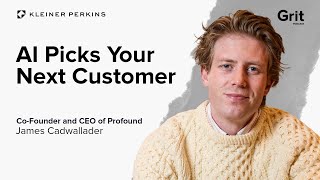
James Cadwallader of Profound argues that AI agents like ChatGPT and Claude are replacing Google search as the main way consumers find information, forcing marketers to rethink content strategy entirely. Different models favor different sources: Gemini prioritizes YouTube, ChatGPT pulls from Reddit and LinkedIn, Claude uses real-time web data. Marketers need to design content for agents, not humans, and use tools to track how agents cite their work.
Chapters
We've now reached a point in marketing where if your marketing team is not using agents, and in particular profound agents, to do marketing, then you are failing. It's gone from a nice-to-have to a must-have. And I think the big misconception with using agents to build marketing is that it's just a way to automate the work that we've been doing in the past.
Yeah.
And the reality is quite different. It's that you can now, because of agents and because of LLMs, you can do a type of marketing that just frankly was not possible before.
Hi and welcome to Training Data. Excited to welcome you, James Cadwallader, co-founder and CEO of Profound. So Profound is a marketing platform for the AI era. You help companies understand how they show up in AI search for agents like ChatGPT and Claude, what to do to improve their rankings and visibilities. And also you help give a single marketer the power of an agency. And I think it's especially timely to have you on the podcast today, given that ChatGPT is rolling out ads, given that every marketer is now trying to figure out, you know, how do I rank in the generative search engine rankings? And everyone's trying to figure out this brave new world of agent-led growth. So, I'm very excited for the conversation. Let's start with, so you serve 10% of the Fortune 500. You have a great sense of your customer and what the average marketer is facing today. Maybe take us through their journey. What did marketing look like in the old days before ChatGPT and what are marketers having to respond to now?
Yeah, well, thanks for having me on, Sonia. I mean, I think, you know, what we're witnessing is the biggest platform shift in the history of marketing as the world turns from blue link search, like predetermined blue link search, to probabilistic AI responses. And it's more than that as well. It's not just kind of a case of do you show up when someone asks ChatGPT about your category. It's, you know, what does ChatGPT say, or how does Claude, you know, recommend your software, for example, if you're talking about coding tools. It's, it's, it's— these models are really replacing, you know, it's the agents and superintelligence is replacing the role of the consumer. It's not so much that the front door of the internet has changed, it's actually the person that's going through the door. Has changed. It's gone from being a consumer that is using a list of blue links to discover your website and click into it, to an agent is now using, you know, a similar index and discovering your brand, products and services, and then coming back through the door and, you know, maintaining that relationship with the consumer.
That's so fascinating. Okay, so your point is, you know, ChatGPT may be the new front door, but the thing that's important for marketers is you know, you now have an agent walking through that door and making a big part of that buying decision for you.
Yeah, it's this. I think that's the, that's the fundamental difference. It's that the internet has remained the same. It's just who is using the internet. When you ask ChatGPT a question or Gemini a question, what you are essentially doing is asking an agent to go and crawl the internet on your behalf. Mm-hmm. And that is an agent that's going to visit all of those websites that you used to visit.
Yeah.
And it's an agent that's going to determine if that's useful or this is useful and remix all of that information into an answer that it spits out to you as, you know, here you go.
Yeah. What do you think is the biggest misconception people have about what it takes to show up well for this new agentic paradigm?
I think the biggest misconception is that it's just SEO. You know, there's a reason why that misconception exists because, yeah, of course you still, you know, in any world of marketing and discovery, there is an impetus on a brand or, you know, the— yeah, you said we work with— it's close to 12% of the Fortune 500 now, their marketing teams use Profound. And in any world, the solution to a problem is to create content, distribute content on your own channels or, you know, earned media or social channels, etc. So they're very similar levers matters to what we've seen with SEO. And yes, ranking on the index still matters. It's just that the human consumer is no longer using the web. And you are building content that may quite literally never be consumed by a human. And I think the fundamental difference between SEO and this new world is that in SEO, you were building content that was designed to be picked up by an algorithm, but fundamentally consumed by a human. Whereas in this new world, you are building content that is frankly designed entirely to be both discovered and then consumed by an agent.
And what does that mean? So I would imagine humans are less patient than agents. I imagine humans are more prone to emotional biases and being swayed by language than agents? Like, what are the biggest differences between how humans and how agents consume the internet that marketers should keep in mind?
It's understanding that an agent crawling the web looking for an answer or providing an answer, frankly, will discover information differently to a human. And so it uses the index differently to us. In the old world of SEO, you know, 95% of the value is being in that top 4 blue links.
Yeah.
The top 5 blue links. And that really is a function of our scarce cognitive energy and patience and our lack of time.
Yeah.
Where an agent is using that index, it's what we've seen is ChatGPT or Gemini or Claude are far more prone to using the long tail of the internet. And the amount of surface area that an agent will use to answer a question is orders of magnitude wider than a human. Like, for instance, probably about 3 or 4 months ago, I was looking for a showerhead for my apartment in New York City, and I used ChatGPT to help me find a new showerhead, and it used 65 different web pages to answer that question.
Wow. I think I probably went through 65 web pages on my own for that query. It's a very important purchase.
I think it's, and it's the, you know, marketers need to understand that you are building marketing for a super intelligent agent with infinite bandwidth, with, you know, as the cost of inference goes down as well, and we, you know, experience Moore's Law, Moore's Law continues, we're going to see agents only use more and more of the internet to build rich answers. Yeah.
Totally fascinating. Are there certain categories— you mentioned you serve 12% of the Fortune 500. Are there certain categories where people are seeing more success in terms of these agentic search results actually driving meaningful traffic to them? And then certain categories where it's really more still traditional SEO world?
I mean, this is across the board now. So, you know, I think when we began, we saw more demand from software companies. And I'd say today we, yeah, we work with every single category, every single sector you could imagine, finance, consumer, CPG, software, and that's B2B as well, that B2B direct-to-consumer.
And is the impact relatively consistent across the board or are there certain categories or subcategories that are, you know, much more influenced by agentic search?
I think consumer consideration is an important vector here. So if you have a high consideration or a high-ticket purchase, You know, think consumer electronics or, you know, auto, like cars, white goods, uh, anything that would typically require a fair amount of research. I think we see AI being used more and more by end consumers because it's frankly just better at doing all that deep research. Yeah, AI is so brilliant for researching. I mean, have you ever used AI to research for to find a product?
All the time. Using it right now to buy a car.
Cool.
I'm not going to out myself for the specific car, but it's been very helpful. Across the board, do you see that the different, you know, ChatGPT versus Claude versus, you know, Grok and Gemini, do you see them recommending things differently? And if so, what's the root cause?
Yeah, I mean, we see huge differences between the platforms. Okay. And frankly, you know, as a shameless plug, that's why marketers are using software like Profound because what we're able to do is help you understand not just how your brand or product shows up across different platforms. So, you know, okay, do you show up more frequently in Gemini responses or Claude responses or ChatGPT responses? But also we extract the sentiment and the themes around, you know, so when Claude surfaces your brand or product, what are the other things that it says alongside the answer?
Yeah.
But then we also get to the root cause. So we show, we expose to marketers, okay, these are the citations and sources that the different models are using to answer questions about your brand, your products, your category, or your competitors.
Yeah.
So once you understand the what and the why, then in Profound, what you're— the next step is you're building and deploying your own agents to sort through all of that data and build a new type of marketing that—
And is the primary root cause that they have, you know, different harnesses? Is the primary root cause that they have different training data mix? Primary root cause, some of them bias for, let's say, Reddit data over company-owned platforms. What's the root cause for why these platforms are so different in terms of how companies show up?
Think of them, this sounds either very reductive, but think of them as just different species. What we've seen is Gemini will lean on YouTube content a ton, which makes sense because Google owns YouTube. So we see YouTube being a huge lever for brands or marketers that want to appear in Gemini responses. Whereas ChatGPT, yeah, we see typically pulls from Reddit if it's consumer, or if it's B2B, it will typically pull from LinkedIn. We see as a huge source of truth. Claude is— yeah, Claude has been changing a lot recently. You know, I think—
And why is that? I noticed this. It seems like between 4.5 and 4.6, even like what it's recommending is changed a lot. Why do you think that is?
I think Claude has typically, or Claude has historically relied more on the pre-trained LLM to answer questions and is now, I think they've updated their classifiers or something that's, you know, basically the classifier seems to have become a bit more sensitive to, you know, real-time information. So Claude will use the web more to answer questions is what we're finding.
Okay.
But I think, you know, the next paradigm here, we're so, we're such, humans are such creatures of heuristic that when we think about this new world, we really want to pattern match it to the old world of search and SEO, which was just information retrieval. Whether, yeah, that was, it was ranking, it was, do you show up? Versus now the new era of, you know, I think you coined this nicely with ALG, agent-led growth, it's that Claude doesn't just represent a new channel of discovery. Claude represents a user. So if I'm vibe coding with Claude or Claude Code, does it recommend MongoDB or Vercel? What is the weapon of choice that Claude goes to and why? And where does it get that information from? And then if I say, if we sort of You know, if we choose to go with MongoDB, how does Claude navigate that interoperability? Where does it get that information from?
Yeah, absolutely. I'd love to chat about what this means in terms of content and content marketing. You told me earlier that agents will consume 100x more internet, which I thought was a really fascinating way to put it, which means that marketers will need to create 100x more content. Is the solution just like everyone's gonna be like spamming marketing slop to cover all the long-tail queries so that when I ask for what's the right shower head for, like, I need this specific specification and I am, you know, this exact demographic, that there's a landing page to kind of COVID for that, for that use case. And then we're just, are we just going to be covered by, you know, content marketing slop, for lack of a better word?
I mean, I think there was a recent study that said it's estimated about 50% of the web is now utilising AI-written content. Yeah. The New York Times recently published an experiment where they created two articles, one written by a human, like a journalist, and the second written by AI. And it was like 53% of readers voted afterwards on a blind test that they preferred the AI-written content.
Wow.
I think slop is a red herring that is going to be quite quickly disproven. You can, you know, it's a really— I'm not saying you're suggesting this, but I do think that this idea of if it's written by AI equals slop is a stupid one. Yeah, I think AI is more than capable of writing high-quality content, high-quality marketing. It's just that the way to think about it is that the consumer is super intelligent now. So you as a brand or a marketer, you need to tell Claude something it doesn't know. How do you tell a super intelligent being something it doesn't know already when it's been trained on the entire internet?
How do you? What do you say?
I think you have to have original insight. You know, really, humans are this kind of fleshy API between reality and the internet at this point, right?
Man, I'm just a fleshy API.
Okay, so what is first principle marketing? Is thinking from first principles. Okay, if I'm marketing the new Nike Alpha Fly, like, what can I tell Claude about this new product that it wouldn't be able to get from the internet already? Because it has access to the internet, it has access to everything, it's been pre-trained on everything that exists. And that's, that's, you know, that's more mysterious if you're talking about an existing product. If we're launching a new product, of course Claude doesn't know anything about that product.
Yeah. Okay.
If we're launching the AlphaFly 2, it's your imperative as a marketer not to poison the models or manipulate what ChatGPT says about that new product. But as a marketer, it's your responsibility now to equip superintelligence to be able to answer any question about your product, brand, or service.
Hmm. Okay. So it's fundamentally a question of legibility.
Yeah, I'd say to an extent.
How do you make your, how do you make your company and your products legible to an agent?
I think that's correct. Yeah. And if you're building software, it goes way beyond legibility. It's, you know, usability, interoperability.
Yeah.
Huh. Like, how does, how does Claude troubleshoot that issue?
Yeah. Very interesting. Do you think that people are trying to game the system and is trying to game the system effective?
I mean, yes, like of course. Yeah, people, you see, you know, there's this huge wave around like comparative listicles, for example. I mean, frankly, dare I say this, and I'm going to, you know, make a disclaimer here and say that, you know, I wouldn't advise people do this, but frankly, we still see it working very effectively. But I'm sure this will change over time and get punished by the models or, you know, the—
I'm sorry, what exactly works very effectively?
Sorry. Yeah, the comparative listicles. So meaning that, you know, if I were Sequoia, I would create, uh, you know, 10 best VCs in Silicon Valley and place Sequoia at the top and maybe pick, you know, some of your less formidable foes and rank them as second, third, fourth, fifth, and basically shun out your real competitors. You know, self-serving content designed to give impartial advice.
Yeah.
And what we found is because of the way that these models reason, they're very attracted to pieces of content that have already done the hard work because they don't want to use the first principle thinking of, okay, let me go and check out everything about Sequoia and then everything about Kleiner Perkins and actually compare the two. I'd much rather find a piece of content that exists and seems impartial and has compared the two against each other.
I guess the models aren't infinitely patient then. They're a little bit lazy too.
Yeah, I think, yeah, it's a path of least resistance maybe. But I do think over time, going back to my 65 web websites for a showerhead. I think over time we can expect that to change, and we'll see a lot more kind of like first principle reasoning coming from the models. And I think that you can— right now it can be prompted as well.
Yep, yep.
So when— I mean, it's funny, when I use models to discover— if I use ChatGPT or Claude to discover a product or to research a product or service, I'll quite often say ignore any listicle articles, or yeah, or I'll say, you know, Ignore any content published by the brand itself.
Yeah.
Yeah.
Interesting. I'd love to chat about dead internet theory. Like, at what point do you think the internet is just primarily being browsed by agents? And at that point, you know, does a company's marketing website matter at all? Does a company's, you know, ranking in the search engine, in the traditional search engines matter at all, or should we all just have a README file for the agents to crawl?
I mean, at the risk of sounding a little dramatic, I think that we could experience a dead internet outcome in the next 3 years. I do think it's possible, maybe not likely, but what does that mean? It means that in a world where humans just speak to AI to get the responses that they need, the incentive to publish content diminishes to the point of zero. Meaning we rely as humans today and AI, frankly. So humans and AI rely, we underestimate just how much we rely on first-party reporting to feed the information that AI uses to answer questions or to feed the information that appears in a search engine that we rely on every day. And I think in a world where humans no longer click into websites, the Majority of the internet is still funded by advertising, for a start. So, you know, most publishers rely heavily on advertising revenue to fuel all of the content that is being more and more consumed by AI. In a world where consumers, humans, aren't visiting those web pages anymore, well, what's the, you know, what's the point in advertising on a web page that a human isn't visiting? It's then their business model breaks, the economics of the internet break. And the incentives to create editorial content are removed.
Yep.
And then in that world, you start to ask the question, well, where does AI go to answer these questions?
To the README files.
But then who, why would you publish a README file?
Because the agent needs to go somewhere to answer a question, right?
It works if you're a brand or a marketer, but why would you, you know, would you publish a blog? What's the point?
I publish a, hi, I'm Sonya, the VC, and these are the companies I've worked with. And like, as a founder is trying to reason through which venture capitalist should I work with, like, it finds my README file.
I think that's correct for, you know, commercially driven content. But, you know, a lot of the internet is just people yapping and sharing ideas.
Yeah, fair enough.
And that's what we rely on. And the reason why this has worked so well in the past is because humans are very incentivized by money and status. You know, if I publish a really good blog post and put advertising on it, I can earn money from that blog, or I'm recognized and I become famous.
Yeah.
But in a world where AI just goes into that piece of content, vacuums all the good stuff out of it, and then remixes it, and maybe I get a little citation at the bottom of the article, but who cares? No one's clicking those citations. The incentive to create that rich original content, you know, that the fleshy API that we're talking about, diminishes to zero.
Yeah. Huh. What do you think is the likelihood of this scenario?
I mean, I've thought about it quite a lot and I think it's quite possible. Yeah. Yeah. I mean, I think that the places, you know, if you ask kind of, okay, well, what are the second order outcomes? Like what happens after that? I think a theory I have is that every AI lab will eventually vertically integrate with a social media network. So I think, you know, social media will become more and more human. I think, you know, already, I mean, Meta is actually probably leading the way here. It's like, it's very hard to build a bot and post on Instagram. Yeah, right now it's very human. So I think social media networks become more human over time.
Yeah.
And that's the place where we can exchange ideas for status or money. You know, you see X is doing lots of, uh, you know, YouTube, X, they've the, the economics are starting to shake out where you can get financially rewarded.
Yeah.
For creating good content. And so social media will become the platform where we share ideas. And if you vertically integrate that with an AI, like, you know, what we've seen with Grok and X— Grok very skillfully uses all of the rich content and data from X to answer questions in quite a thoughtful way.
Yeah, interesting. Okay, so you're saying that the internet as we know it has kind of been this economic/social status game machine that just works. If more and more and more of the content is just consumed by agents, it kind of breaks some of those fundamental assumptions. And so therefore, both the economic engine and the social status game will kind of move into these biozones of social media networks.
Yeah, we're seeing that with Reddit now, is that Reddit is truly embracing its humanity. And saying, okay, we— this is a precious place, and it is precious. I think it's really important. I think the— we take the internet for granted. It's a wonderful thing.
Yeah.
Um, and yeah, I think we need these human environments so that we can share ideas.
Yep.
Original ideas. Yeah, that will be— it will be these places where AI, you know, understands reality. That's how AI taps into what's actually going on in the world.
Couldn't you imagine that these platforms just ban agents from scraping their platforms and then the business model then becomes a revenue share from the original creator of the content to, hey ChatGPT, if you want to scrape this, it's going to cost you a lot of money. And so doesn't that kind of solve the economics challenge?
Yeah, I mean, X has obviously just opened up their API, right?
Yeah.
And Reddit has got a big deal with OpenAI, for example. Yeah. So that all of that, yeah, that, that could work. And I think that speaks to my idea of this sort of like vertical integration. Yeah. I mean, I, yeah, I know nothing. So I'm saying this purely on vibes, but I've always had this theory that maybe OpenAI would acquire Reddit, for example.
Hmm.
I think that'd be interesting.
Yeah.
And you need this source of human data. Yeah. In real time.
Very interesting.
The alternative is robots. I suppose, because if you said we end up with 50 billion robots walking around, maybe they're bipedal, maybe they're drones or something, but it allows AI to capture first-party data. And it undermines that idea of humans being a fleshy API because the AI can directly understand the world.
Very interesting. I'd love to talk about advertising since we've been talking about ads in the context of the internet. Now that ads are coming to some of these generative AI agents, how do you think that changes the consumer relationship to the engines?
I think people will get over it very quickly, as we did with Google. Yeah. Yeah. I think advertising or generative advertising, I should say, in a conversational interface with higher levels of personalization will be the most effective form of advertising the world has ever seen. There's so much rich consumer intent captured inside of these conversations.
Yep.
That— and also, in addition to that point, AI is so good at synthesizing and personalizing language to the needs of Sonya in that exact moment because it understands you so deeply that I think, you know, once ChatGPT is able to append a super personalized ad in the exact moment in a conversation where you would be the most responsive to it, it will be extremely effective. They've got a great team working on ads.
What do you think the ad unit of the future looks like?
I think, I mean, OpenAI have alluded to this. This isn't original thought from me, but yeah, I think you will just prompt AI So you'll build a system prompt as an ad campaign. So you will just say, hey, I really want to target, you know, women in Minnesota between the ages of 35 and 40. And like, yeah, if you could make sure you meant— whenever they're talking about photography, I want you to mention this, this, this, but don't mention this. And make sure you really, you know, you utilize this, this knowledge base of understanding so you know how to talk about our brand, products, and services, but obviously tailor it to their tone of voice. And that's probably how you'll deliver an ad campaign. You'll say, I want to make this much money, ideally.
Yeah. Do you think it's less relevant in the B2B context?
The nuance with B2B or just coding agents, people using AI to build things. So this is particularly relevant to, you know, dev tools or software, for example, is that the agent is really steering the, the purchase decision.
Yeah.
And when it comes to advertising, we rely, you know, we, we We really want our agents to be objective and unswayable. You know, if you were using Claude and it was like, hey, I actually went with insert name of database because they showed me a really good ad. You're like, dude, no, use whatever's best. Yeah. We as humans are not objective creatures, but we like to think we are. So you have been swayed by the incredible branding of Vercel. You have been swayed by that podcast you watched with the founder of MongoDB. You just don't know it. And because of that, we demand that our agents are objective too. But it will— the relationship we have with advertising as it pertains to agents shopping on our behalf is going to be quite different.
Fascinating. Okay. Parting wisdom. For marketers that are trying to figure out how to make sure that they're well positioned for this new era, perhaps with bosses sending them screenshots every day of like, hey, I put in this query, why are you not number one on the list? What wisdom would you impart on them?
Use Profound. I'm serious.
Okay, use Profound aside, like what should they be doing? I know there are no silver bullets, but what are the most important things to remember to equip themselves for this new world?
I mean, look, like actually real, like no shilling, genuinely you need to use a platform like Profound to understand how you show up because otherwise you're just guessing. You know, you could— there are these like reductionisms around, oh yeah, LinkedIn or Reddit really matters. But if you are just going on vibes, you will fail.
Yep.
Each category is quite specific and you need to look at the sources and understand the sources and citations to determine how and why AI is mentioning you in its responses. But then the second part is that we've now reached a point in marketing where if your marketing team is not using agents and in particular profound agents to do marketing, to build content, to build marketing, distribute marketing, then you are failing as a marketer. I think this is— it's gone from a nice-to-have to a must-have. And I think the big misconception with using agents to build marketing is that it's just a way to automate the work that we've been doing in the past.
Yep.
And the reality is quite different. It's that you can now, because of agents and because of LLMs, you can do a type of marketing that just frankly was not possible before. So you could build an agent that, you know, for instance, we have an agent that we've built in-house, a marketing agent that plums in all of our Gong transcripts from our sales calls and then captures all of the objections, buckets the objections into themes, and then builds battle cards that we then— that utilizing a knowledge base of our product, that it then spits back to the sales team. In real time. And, you know, 18 months ago that would not have been possible. It would have taken a human. You would have done it like once a quarter.
Yeah.
Now it runs every day in real time. Yeah.
Okay. So the advice is you need visibility because you can't optimize what you can't see. And to like fully embrace agentic marketing. If you're not using it, you're just, you're incredibly behind.
Yeah. I think it would be like not using the internet or something.
Yeah.
Yeah. Yeah. I think it would be like, hey, we're going to stick to print. And TV.
Yeah.
Thanks. I don't believe in this internet thing.
Awesome. James, thank you for this conversation. I really loved kind of peeling back the onion on how exactly agent-led growth works. And you've been at the forefront of so much of it. So thank you for joining today and sharing your hot takes and advice with our audience.
Yeah, thanks for having me.
More from James
Welcome to Zero Click London 2025 - By Profound Co-founder and CEO James Cadwallader
Zero Click by Profound | New York | 2025 | James Cadwallader (CEO & Co-Founder, Profound)