How Brands Stay Visible When AI Decides | Profound CEO James Cadwallader
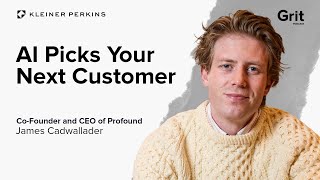
James Cadwallader, CEO of Profound, explains how brands can stay visible when AI systems like ChatGPT decide what information to show users. His startup hired 80-90 engineers in under a year to build an SEO-for-machines platform that helps companies control how large language models mention them.
Chapters
The front door of the internet has changed for the first time ever, meaning that we have relied on Blue Link search to retrieve information for the last 25 years. And now you can talk to the internet and it talks back to you.
Every tech cycle feels exactly the same. Building something that works as a performant product in this space time and time again requires people who've been actually immersed in it very deeply. And simply put, the number of those people at the early beginning of every cycle is very small.
When you're a startup, The number one bottleneck is hiring. It's just such a competitive market. If you're trying to hire the best engineers in the world, they can go to any startup in New York or NSF. They can go to big tech and get paid inordinate amounts of money. In those early stages, you're trying to create this kind of rock and a hard place where you're, you're basically selling a really hard deal and you're saying, hey, come and join this early stage startup that's unproven. So yeah, it is a big deal when you hire those initial founding team members.
Welcome to Grip. I'm Juven, partner at Kleiner Perkins, a show where we go beyond the highlight reel and explore the personal and professional challenges of building history-making companies. Today on the show, we're joined by my friend James Cadwallader, co-founder and CEO of Profound, the AI visibility platform built for the zero-click internet. James has an incredible story, not going to college to start a gold selling business door-to-door. Today, Profound is one of the fastest growing companies I've literally ever seen. We also have a special guest, my partner Ilya Fushman. Enjoy the episode. It's impossible to put your finger on one single thing, but like, it seems like the market is very, very hungry. For something like this. Is that fair?
There's this weird paradigm where at the beginning of 2024, when we were working on this, I was like, I must be really stupid because why is the world not talking about this? So we started building it and then seeing the world has now catch— it's everything's caught up and it's become a very obvious idea. Hence, you know, the, the nature of a very competitive market. But I think, I think these kinds of markets, if you look at Harvey and legal or Clay and go-to-market or Sierra and Decagon and customer support, they are obvious greenfield markets. And it's almost, I think the prize goes to the most aggressive basically. And I think we're a team that's very well suited to those types of market dynamics. We We try very hard.
And can you like maybe the 10-second primer on like, what are you doing?
In a nutshell, we help companies understand and control how AI perceives and talks about them.
So like, if I'm whatever, a car company, it used to be the days where I'm like, hey, what's— consumer says like, what pickup truck should I buy? They put it into Google. Now they put it into ChatGPT or Anthropic. and they have much less control over what happens with their brand relative to before?
Yeah, it's the biggest platform shift in the history of the internet. The front door of the internet has changed for the first time ever, meaning that we have relied on blue link search to retrieve information for the last 25 years. And now you can talk to the internet and it talks back to you. Um, and how it talks back when it's, you know, mentioning a brand or a product or a service is going to become a bull— or is becoming today, is is already becoming a boardroom-level concern for every company on the planet. And we've built software that helps companies not just understand how they show up in these new environments, in these responses, but also distribute information that's aimed at retrieval agents rather than humans to increase their visibility in the answers, in the responses.
One of the things that when we were having lunch in New York last time I saw you, that you said to me that's really stuck with me. And this was maybe a year ago when I think it was a little less obvious than it is today. I think you said like, ChatGPT is going to be the stickiest product in human history by far. And I remember thinking like, seems like it makes sense, but like, can you double-click on First of all, do you still feel that way? Do you feel even more strongly that way now?
I mean, there was just this period of time which is, again, what was obvious now feels, or what was less obvious now feels more obvious. When we were having that lunch, I think this was closer to that time when there was a lot of yap around the models, the foundational models are commoditized. This is just a kind of race to the bottom. And I think while there was this kind of arms race going on with the foundational models, the miracle that came to fruition was ChatGPT just won the consumer mindshare. And yeah, it's because of the personalization in particular. I think the more you use ChatGPT, the better it knows you, the stickier it becomes. And I think that flywheel holds potential for this consumer application to become the stickiest in history? It'd be like ditching a friend or something.
Can I go back to the, like, what is happening in the business right now? One of my favorite things, I was actually telling Ilya this a couple of weeks ago, one of my favorite things that you do that I think is so funny is every time you hire a new employee, you guys take a ridiculous picture. Together and then post it on LinkedIn. And it's— you've hired like 80 employees, 90 employees or whatever in less than a year. So like every day there's a new ridiculous picture. What was the genesis of that? And is this— how long is this going to last? Because it's you and your co-founder that are in every picture.
Yeah, I mean, it's something— it was definitely not part of some you know, master plan. It was just Dylan and I. So Dylan's my co-founder, CTO. He's got a good sense of humor as well. Like he's, he's, uh, you know, both of us have fun with it. And I think when we were first hiring, we just wanted to announce someone joining. And I think, you know, when you're a startup, the, the number one bottleneck is hiring. It's just such a competitive market. If you're trying to hire the crème de la crème, if you're trying to hire the best engineers in the world, uh, which we are, a good engineer, or I should say a great engineer has total optionality. They can go to any startup in New York or NSF. They can go to big tech and get paid inordinate amounts of money. They could probably come down here to Menlo Park, cough twice and raise $5 million. And yeah, you know, you, you're trying to, in those early stages, you're trying to create a mirror, you know, there's this, there's this kind of rock and a hard place where you're, you're basically selling a really hard deal and you're saying, hey, come and join this early stage startup that's unproven. So yeah, we, it is a big deal when you hire those initial founding team members. So it was kind of an outward celebration of hiring some of the most talented people. We would just take a photo with them and, you know, as we were taking, I think as we were taking the photo, we thought it'd be funny. Just like, I think the first one was we took a photo, someone then had someone stand on the desk in the background, just without calling it out at all, just as a sort of Easter egg in the back of the image. And then it got that people thought that was funny, and then we did it again. And it kind of— I think we've had the— it's got to this place now, yeah, where sometimes we're hiring, you know, we'll have 4 or 5 new people join in a week, and we have to take a photo with all of them. But I don't know, I've come— I've kind of gone full circle in that I quite enjoy it now. It's like fun.
I need office space thing on LinkedIn. Was that a shtick or was that real? Like the, like where everybody was posting. I think you guys got a sign in the New York Times or in the, in the whatever, in the whatever, Times Square. Didn't you like, didn't you guys get like billboards? Didn't you guys like do like crazy things to get office space? At first I was like, this can't be real.
I mean, there's sort of two stories here. The first is just like the use of these billboard trucks. We have this propensity to using these billboard trucks right now. They're kind of cheap and they're like trucks with billboards on the side that you can like drive around. You pay X number of dollars and they will drive around a location for you. We discovered this. So we've been using these billboard trucks, uh, yeah, across a lot of, frequently, uh, we've had them outside like competitors, user conferences. Uh, we've just been randomly driving around, driving them around with random messages on them. But yeah, we, Silicon Alley is real right now. Silicon Alley is real in the sense that if you want to find a good office space in New York City and you want to be in the mix, you essentially have to be around Union Square or Madison Square Park. Those, that sort of from 14th Street up to maybe 32nd or something in that sort of region. And it's just impossibly hard to find good office space around there. Extremely competitive. So yeah, we hired the billboard truck and had it drive around. It turns out, I mean, if you were looking for a great growth hack to attract brokers, that would be a really good one. We must have had about 1,000 brokers message us.
The thing that really won me over, because we had our in-person board meeting a little while back, is there's this fridge in the Profound office and actually tweeted a picture of it, but it's basically packed with protein shakes and Celsius. That's the only two things in there. I was like, this is really what a winning startup has in their fridge.
Are people like, like you're still in that office today? The original one?
We're in our second office now.
Okay. But like you've been there for a few months.
Yeah, correct.
Like, are you on top, like on top of each other?
Yeah. There's like a—
What is, what is it actually? Are people sharing desks?
No, we've had to start deleting meeting rooms and putting desks in meeting rooms. It's honestly, the reality of it is there's this kind of like giggly moment at first where everyone's like, haha, this is so funny, we're so crammed in. And then after a few weeks, it starts to get a bit miserable and people, it's just too much. Yeah. So we definitely need to find a new space. But yeah, we're like sardines in there right now. It's a good vibe. Everyone's very connected with each other. It's good for communication.
You're expanding though, kind of internationally, regionally. Yeah. It's a big, big moment for you, right?
Yeah, we, I think this speaks to a kind of wider topic of sort of AI timelines. I think, you know, what would have been normal in SaaS timelines, so like maybe it would have been 3 years in, you start thinking about a UK or European office. We're doing that now. So we've just signed a small lease for an office in London. I should say, yeah, we just signed a lease for an office in London. We've just done the same for an office in SF. It'll probably be predominantly go-to-market focused in London and then engineering focused in SF. Yeah.
This is just so much stuff. Like, uh, it's a, it's just like, I, it was a year ago when you presented here, not even a year, not even a year ago.
Yeah. I quite, I mean, yep. Probably closer to 6 months. I mean, it was like June. Oh no. Yeah. I guess when we were here, it would have been January. Yeah. Sorry. Yeah. January. No, it's end of February. Yeah. Yeah.
I just, so much stuff. I don't even know what to make of. I just, so many, so many things for such a young company to be doing. It's like, uh, I don't know, it's like you hit puberty at like 10 years old. Like, it's just weird. Suzanne on my team, who you know, threw a CMO thing for you and it was like 12 CMOs. And 2 months later, she's like, Jubin, it was a breakfast or something. She's like, Jubin, all 12 of them are customers now. None of them were customers before. And I'm like, what the hell? Like, this just doesn't happen.
I mean, why is it such a hair on fire problem for these folks?
Yeah, I go back to my point that it's a really, really big platform shift. It was a huge Fortune 100 brand, you know, $50 billion market cap. And essentially the business is like a well-oiled machine. Their gross margins are immaculate. It's run perfectly, except for they have this one reliance, which is all of their top of funnel relies on Google. And it's almost one single point of failure that, you know, just to even have a glimmer of threat that that could change becomes mission critical for at a board level. And they're seeing, you know, integer level, integer percentage referral traffic. Start to come from AI and they're seeing their competitors are showing up more frequently than they would like. So yeah, it's a boardroom level concern for most brands right now, how they show up.
Is that traffic? Like what's the quality of that traffic?
Yeah, the traffic's higher quality. Cause if you think about the, if you think about the user behavior, most people now have used a platform like ChatGPT to discover a brand or a product or a service that they want to buy. I mean, let me ask you, Joubin, what's the first thing you do if you find something on ChatGPT?
What do you mean? Like click on it, like go, go try and find the thing.
But do you click the citation or do you go back out and go to Google?
I certainly don't go then to Google and then research the thing.
Yeah. So I think most people are going direct to the brand. Yeah. So you will go from chat, all of the, the, it's essentially become like a, a dark funnel where all of the research is happening in ChatGPT. So when, by the time that click. Takes place, the user has done the majority of the research already. So it's just transaction that's happening post-click, basically. But eventually that will get folded into the models. Eventually, you will just shop via ChatGPT. Like we're already seeing ACP, Agentic Commerce Protocol from OpenAI. We're seeing AP2 from Google. Like eventually you will just transact inside of ChatGPT.
This is becoming like a consensus-ly good space. Like, it's very obvious that like there is a platform shift that's happening. People have to do something about it. It's obvious to us. It's obvious to the model companies. It's obvious to apparently like public CEOs that want to get into this space. It's obvious to other startups. Like, it's very obvious, right? Um, maybe can I pick apart like each of those personas and get both of your reactions to like how you think about them in this space? The first one is like, I'd be surprised if the models don't do something around here. Do you guys agree with that or do you disagree with that?
Well, I think, uh, excuse me, I think the job of the model is to collapse that, that research piece and just be completely trusted by, by the consumer, right? So if I'm like trying to find the best running shoe for, I don't know, running a marathon, not that I do that, but you know, um, I would sort of go on ChatGPT and say, hey, what's the best running shoe for running a marathon? And it probably spit out You know, Nike, it probably spit out something else. And if I'm now, let's say New Balance or, you know, pick a different brand. And by the way, like as a consumer, I'm kind of lazy. So if it spits out 3 things in that little window, that's kind of good enough for me. And maybe I'll do a little bit more research. Maybe I want like a sturdier heel or I don't know, I don't really know what, what shoes you'd use for running a marathon.
Sure.
But, um, I sort of implicitly trust the model. And so in some ways, the further the time goes on, the more I'll trust the model because it'll know me better because of personalization, because I will assume it has done kind of the research and summarization of all this kind of research that everybody else did on the internet. And I'll just click on that link. So yes, in that sense, the model collapses the research funnel. I think, I guess, our thesis here from an investment perspective is if you're that brand that's not in the 3 results that show up in the little window, How do you get in there? You still need to figure out a way to do that, and that doesn't really go away.
Yeah. I mean, and even post-sale, if you think of software as an example, so let's say, let's use MongoDB as an example for the last however many years. If you were an engineer that was using MongoDB and you needed to troubleshoot an issue or a problem, you'd have gone to docs.mongodb.com. Now, Engineers ask Cursor as a proxy, I guess, for the Anthropic models, or they will ask ChatGPT directly. And the big question is, okay, well, when ChatGPT is trying to troubleshoot a problem with MongoDB, does it go to docs.mongodb.com or does it go to some funky homemade YouTube video that someone published 5 years ago that's out of date? So where do the models go to answer? It's not, it's even the surface area is even bigger than just do you show up in the answer. It's these models opine, they give suggestions, they tailor and personalize. They, you know, it's, and I think this is the misconception around our business is that it's SEO for AI. I think These models are essentially replacing a lot of the behavior that the end consumer would've done themselves, which is go and do the research, build an opinion, create a point of view. So really, as a company over the next 5 to 10 years, you're going to have to become comfortable with this concept of building marketing for machines instead of humans. You're building, you're distributing information, distributing content and marketing that's aimed at a bot to perceive rather than a human. Because that doesn't really— the differences there are that, that type of, you know, bots don't particularly enjoy storytelling. They don't care about your opening hook. They don't care about the narrative rhythm. They just want the information. And then the story takes place post ingestion. It takes place, ChatGPT creates the narrative, ChatGPT creates the story. So as a brand, it's a very different exercise. I think to your question, will the models release their own analytics at some point and provide some visibility into what's going on? I think, yeah, that it would certainly not be surprising if they did. But I think the market is more fragmented. I think the distinguishing feature of Profound is that it's not just helping you understand what to do, but we actually help you create the content and distribute the content from within our platform. So it really is becoming this workbench for marketers, not just to understand how they show up, but to take action and create content. So it's really, there's two inflections around our business. We have the consumer behavior inflection, which is people now use AI instead of traditional search. And then you have a second inflection, which is the technology is now capable of doing a lot of the work that would have previously required teams of humans. And we're not on, to be clear, I think we're not suggesting that you won't need humans to do this work, but I think humans will be in the loop and just made super effective with our technology.
And it's not just humans at the brand, right? It's humans at you know, there's a ton of agency.
Yeah. We work with the biggest agencies in the world. We work with brand teams and they're using Profound today to create content. And it's not slop. It's not a case of, we don't believe in one-click content. I don't think that we will ever exist in a place where you just click a button and publish 1,000 web pages onto your.com. I think the human review will be enduring and very important. I think folks who work at agencies, I think SEO teams are very well suited to these workflows, but I think humans will play a very important important role in that review, but they'll be more like editors rather than, you know, having to write the words themselves.
Super interesting. And then Ilya, on the, like, I mean, you've said this a lot internally, but like, there used to be days where the really good categories would have maybe 1 to 2 great companies in them. And now we're in the days where there's like 7 or 8 companies, especially in the early days. Then over time they start to break out. Like, let's take Harvey, for example, like started to break out. Profound is starting to break out. But now you're seeing like everybody, like you're just— there's a lot of people that are starting to flank this space. Like, as you think about it, okay, they're going fast, like, check, they got to go fast. But like, how do you internalize a market that's so obviously great and big, but also everybody else obviously thinks it's great and big? And like what James is doing, like living in this eye of the hurricane of like, he's moving fast. It's impossible to move faster than what they're doing right now. Like, I, I don't even, yeah. What do you think?
Yeah. And I mean, the interesting thing here is back to kind of the, the opening here when, when we, well, first of all, we met way back at the seed, uh, and this was sort of like intuitively made sense. Interesting, but it wasn't obviously a huge market. Because at that point, I'd say that just even the scale of where ChatGPT was in terms of usage, the proliferation of other agentic interfaces, whether it's Perplexity, whether it's Gemini, whether it's what Meta is doing, whether it's— and the relative traffic from all of those things wasn't as obviously massive as it is today. And in fact, even at the A, I'd say it was something that you could bet is going to be a really interesting space, But it really became obvious kind of overnight. So we did the Series A in Jan, Feb of this year, and I'd say by, and the plan was to go kind of call it 1 to 5, and then by, when did we revise the forecast? It was sort of like April, May?
Yeah.
Yeah. We revised the forecast like 4x. It became a step function obvious space. And I think there it goes back to a lot of what James has been talking about, which is like, what's your unique insight? Kind of how do you go really deep and understand the needs of the customers, the needs of the consumer? How do you build a platform that scales and how do you really do it with incredible momentum? And I think this is where, you know, once you're in the eye of the storm, maintaining that momentum on team, on product velocity, on just scaling, on getting faster to international expansion, on getting, you know, faster. I remember having this, you know, you had kind of an existential crisis in some ways of going from one office in New York City to having a remote distributed team because so much of the build culture is in office to date. But you have to kind of go in and break that glass and then just move really fast.
What— can I just paint a counter-narrative for you, which is like, we've never seen companies grow this fast before. Just like never seen it. So like, how does it— like, is there, is there a thing that's too fast? Like you what is it like? You lower the, you lower the quality bar of hiring? Like, where do the things of too fast start to like deteriorate the business from within?
Yeah, I think that too fast definitely exists. I think you can certainly break the model if you push too hard. Um, I'm a second time founder. So, and I say this with no hubris, like I certainly don't have everything figured out, but the thing that I've been very particular about is building a really strong leadership team around me. So we've brought in people like Mark Ebert, who took SixSense, who sold to a similar ICP all the way up to $250 million, managed hundreds of people in a go-to-market function. And now he is leading. I mean, it sounds like I'm just bigging up Mark, But he is recognized as one of the best sales leaders on the East Coast, probably in the world right now. And yeah, Mark leads our go-to-market function. I think what Dylan's built with our product engineering team is second to none. I think if you want to build beautiful, functional product that utilizes the latest AI and you live in New York City, or I guess now in SF, Profound is an incredible place to work because you get exposed to just some of the best builders in the world. Yeah, our team is very tenacious. We don't put a ton of emphasis on logos or background. We are scrappy. We're super fast moving. But yeah, I think, you know, you have to be careful not to push too hard and break.
It's also, I'd say like, it's pretty easy to look at this and say, well, it's just, you know, we could, anybody can put out a free product that, you know, figures out where search traffic is coming from through the agentic systems and like, sure, like when you guys were starting out way back when, that was kind of the, the V1, but so much has been built since then and there's so much depth and understanding of how the space will actually evolve. And I think as a team, you know, watching James, Dylan, the, the crew kind of really understand and formulate the long-term view on this market, I think that's where you kind of have the real advantage. And then staffing, as you said, it's staffing against that. On just incredibly high quality talent. And, you know, we, I think just more follow the direction from you guys in terms of the nuances of how you win the space, but just seeing each kind of incredible talent want to join the company this early is probably the best signal that we can have. I think like every, frankly, every great product starts looking a little bit like a toy. I mean, look at Dropbox, right? Early on Dropbox, people said, well, it's just Rsync with like a UI on it. Right? Like how hard could, could that be? But it turns out it's really hard to build a phenomenal sync engine. It turns out it's incredibly hard to make it work on like every flavor of Windows, every version of macOS, make it super seamless in a way that it doesn't ever lose your data. So just even, you know, and then today, by the way, it's a, the problem is amplified back to your point of, you know, kind of if you look at early stage venture capital investing, you have incredible teams who can whip up a V1 prototype of pretty much anything. Overnight and you have incredible tools to do that. You have all this knowledge that's been accumulated about startup building over the past decades that's now culminated and easily accessible, frankly, in things like ChatGPT and Cursor, right? Because it is really a summarization of all that human knowledge. So building a demo and building a V1 becomes really, really trivial, but the real value in these things isn't going deep. And I think there it's really two things. One is it's understanding where the nuances of the product and where kind of the nooks and crevices of what makes it truly exceptional are. And two, it's really, especially in AI, it's understanding how to kind of capture the really big market, right? Because all the markets are up for grabs today. All of them are undergoing a transformation. Some of it will happen from the inside, from incumbents. A lot of it will come from startups that are coming in from the outside, but it's really just going to be this kind of battle of who breaks out beyond kind of feature and captures the whole, the whole market and business transformation. I think for that, you really need to have depth and time in market. Um, and that's kind of what the challenge for, from an investment perspective is you want to bet as early as possible, but then you want to see which of these teams actually have that real unique insight and depth and can have the opportunity to kind of win it all.
Can you maybe go one more click on why you think everything feels up for grabs right now?
I mean, intuitively, think of any piece of software that's been built, whether it's enterprise, consumer, whether it's in verticals, like kind of more regulated verticals like healthcare, finance, legal, just we've kind of been historically constrained by the UI/UX. Everything had to work in some set of forms, some set of fields, some set of inputs and outputs that are either human or computer readable. Everything had to be kind of a separate app. Folks had to have multiple apps that kind of talk to each other and there's a lot of plumbing around that. But the sort of future beautiful eventuality is you go to one interface that may be voice, that may be written, that may be something else, and you tell it what you want it to do and then it just does it, right? That's obviously the long, very long dream, the dream. But in that scenario, literally everything can be rebuilt. You don't need very complicated UI/UX unless you're doing kind of data analysis. All these things can talk to each other on the backend. Every piece of software that's been built in the past could be rebuilt without having to constrain itself to kind of the old scaffolding. We're going to have a plethora of new interfaces, whether it's glasses, whether it's something else kind of in the future, obviously mobile and sort of screens are winning, great and beautiful today, and they'll continue to be probably the biggest kind of point of interface. But voice and audio is going to be important as well. So it just feels like everything can be reimagined. Now, not everything has to be reimagined, right? There's not entirely value in just reimagining things for the sake of reimagining them. But you can imagine a world where, hey, like you just chat with a thing and the thing does it for you and you don't really care what that software looks like on the backend.
Yeah.
And then that opens up a really interesting playing field for, again, startups and incumbents to kind of reinvent themselves and then capture a broader opportunity.
It seems to me like as we get into the enterprise workflows, call it like wave 3 of LLMs, if wave 1 was the models and Cursor and wave 2 was the Harveys and et cetera, and you go into deeper enterprise and into this wave, like the beauty, the magic may be that the LLM can abstract away so much of the dirty work on the backend that can go reach into all of these enterprise systems, all of the different integrations that you have to do, all of the kind of like hair on fire things that we never thought were possible before. Like you can actually like, like there was a transition where enterprise software really, really sucked and then it started to get a little bit better because people like Dropbox made it like a little more consumery. And it almost feels to me like as we move into this version of enterprise software, it could be even more consumery. Like it could actually have a chance to be beautiful and do like really sexy things in the enterprise and let the LLM do all of the unsexy in the background. Do you feel that way?
100%. Yeah, I think there's something very real about the kind of native AI products of today. I guess Profound being one of them where Yeah, LLMs are native to the architecture of our product. And yeah, I think that's, it sounds maybe a little trivial, but I do think it's very hard for companies that existed pre-LLMs to kind of retrofit that technology into deep into their workflows, deep into their business. Yeah, there's so much that Profound does that innately relies on LLMs, right down to the metal, honestly, right down to the core bones of the product.
Yeah, it reminds me, like, my career before KP was in the public cloud, public cloud security. And I remember in the early days of public cloud, everybody initially just wanted to lift and shift an application from on-prem to the public cloud. And then what very quickly you realized was like, that doesn't work. Because like S3 buckets can just like poof and disappear. And so like the underlying architecture and the primitives that are being built in the public cloud are just completely different. And to Ilya's point of like, why does everything feel up for grabs? So much of it to me feels like it's because the primitives just are not what they used to be. So you kind of have to rebuild everything from the ground up. It's like really difficult for, just like pick on HubSpot for a second, to just like throw on AI onto their product. It's just not the same.
Yeah.
Um, um, on the talent question, does it feel to both of you that there is too many startups with too few great people chasing? Like those, like we're, we're too horizontal on startups and there's just not enough good talent that has condensed into fewer companies. Is that how it feels?
I think, you know, every, every tech cycle feels exactly the same. It felt this way in mobile, it felt this way in SaaS, it felt to some extent this way in kind of the crypto cycle as well. It's just when something new comes out from a fundamental technology perspective, there just is a limited number of experts and people who've been immersed into building things in a specific way. And by the way, I'd say in this particular wave, having people who've been building AI companies natively, from day one, really immersed in understanding the various models, understanding how to actually work with them and make them performant, understanding how to interface these models together, build model chaining, do all the things like fine-tuning and inference. There's very few people who've been building that way, and building that way is very different, which is, by the way, why it's very hard for an existing incumbent to sort of, and the impulse for the incumbent is always like, well, yeah, like we can build this thing in, you know, 3 weeks with 3 engineers. Um, sure, you can build a demo, right? You can build something that's kind of a prototype. Uh, but building something that works as a performant product in this space kind of time and time again requires people who've been actually immersed in it very deeply. And simply put, the number of those people at the early beginning of every cycle is very small. Same thing happened with mobile. I don't know if you remember, but like back in the day when mobile became the driving force, just that the number of talent acquisitions for mobile-savvy teams skyrocketed. And I remember doing a bunch of those back in the early days of Dropbox where you just needed people who really knew how to build an iOS and eventually Android, and there just weren't that many of them. By the way, a lot of them came from non-standard backgrounds. And so they wouldn't necessarily pass muster as a cracked, competitive software coding team, but they were just deeply immersed into these platforms that emerged. And the only way for you to really add them to your team was to go and go do a bunch of M&A. And I think the cycle kind of repeats itself, but typically, these markets are pretty liquid and pretty generally self-correcting. And so you'll see a bunch of folks get up to speed, exit out from companies that have been building AI and kind of immerse themselves in the startup ecosystem. And that talent pool expands. But because all these things are growing so quickly in AI, right? And back to like Profound, like just the revenue ramp is scaling much faster than you would've expected with, you know, even an exuberant prediction. The timelines are compressing from years to months and the pain point, like the lack of that talent becomes way more apparent. So yes, the quick answer is like talent's getting peanut buttered. But I think that happens time and time again. And time and time again, like you have, you know, either it's large incumbents or publics or now model companies paying, you know, incredible salaries which startups can't compete with. And so startups compete on edge and mission and value and sort of take a bet on talent. But over time, these, these are free markets. They kind of equilibrate. It's painful in the moment.
Yeah, it is. I mean, but what's crazy, maybe just to take that one step further. Startups are raising a lot of money. And so in some cases, my observation is they are trying to compete on cash. Like maybe they're not going to get to Meta's offer, but they'll get 75% of the way there. And if you're a 21-year-old cracked engineer and you're getting a $500K offer from Meta, you're like rewriting what your expectations are. And so to compete for those people, you start to like creep your dollar amount up and up. And then once you've gotten one of those people, then everybody else all of a sudden starts talking and now everybody else has to get right-sized up. And then now you have a team of whatever, 40 engineers that have this really bloated, like this moment in time salary that's like really inflated. And if the music stops, if the music stops, which is kind of what we saw in 2022 or whatever, you had people that were getting paid way too much with a team that it was, there's too many people in these companies. And all of a sudden it's like really awkward, right? Because you like became overly exuberant in a moment in time that maybe not wasn't going to persist.
Yeah. And I think, but, but, you know, in that moment, the companies that do kind of take, take the mantle, the companies that are winning a particular market segment or are the winning companies, they then suck up all this talent. Right. And so, you know, as an investor, you, you kind of want to be in those companies, right? But absolutely, this is kind of a back and forth pendulum. I mean, this is a cycle that keeps repeating itself.
I think as an observation as well, you know, the real crème de la crème, the best of the best, tend to be less money-oriented. They think about their career as their most impressive, their career is their most precious asset, what they do and where they spend their time is what is most precious to them. There's like an inner circle, especially in NYC, of known entities, like the best builders in the city. And I can tell you unequivocally that it's not a dollar-based decision about where they work and what they spend their time on. It's who they work with. It's what they work on. It's the potential upside. That's what they care about. That's the agency that they get. What they get to build. There was this moment in time where it was terrifying, an idea of trying to compete against OpenAI or Cursa for talent, I think was a terrifying prospect for startups. But I think now those companies are quite big. OpenAI has thousands of people. A lot of these best-in-class builders don't want to be a cog. They don't want to be employee 2000. And work on a tiny feature set. So they, you know, you can build a very compelling offering as a smaller startup.
And maybe to both of your points, isn't that why the race is so on right now? Because let's just imagine a world where the music does stop. Like you want to be the category winner at that moment in time so that you can soak up all of the advantages, mainly talent that come with that. Isn't that really what we're all moving this fast for?
I mean, my view of this as it pertains to our business and our product is that this behavior, the consumer behavior, the first order consumer behavior of, hey, I am not going to use Google Search, I'm instead going to ask ChatGPT, won't walk backwards from here. I think The adoption of AI as an alternative to search is only going to increase. And as long as that is true, there will be extraordinary demand from companies to build marketing for this new era of the internet. So I don't know, maybe speak to me again in a year and I'll regret saying this, but right now I feel relatively okay in terms of, you know, if it's a bubble or if it, if it, if things slow down. I think it's based, our business is based on the primitive, which is, are people using products like ChatGPT to discover things? If true, then we have a very exciting business opportunity here at Profound.
Are you just trying to keep burn high?
That's why I needed to make sure you knew that the office that he was moving into was good.
I heard it was a 30% discount on market rate, so that's pretty good.
How busy are you? Like, do you have any gaps in your calendar anywhere anymore?
My calendar is very full now. I'm good.
Do you feel okay?
Yeah, I mean, I was listening to David Senra, who's actually an angel investor in Profound, and he releases just some of the best content with his recent one on how Jensen works.
Yeah.
There was a line from there where Jensen says, I find work relaxing, really resonated. I think I find it quite relaxing doing this in some respects.
And have you always been this competitive?
Yeah.
Forever.
Yeah.
Like your parents would say the same thing?
Yeah.
And the previous company that you did also same thing?
It's very interesting. And the company's still going, so I've only got great things to say about my previous company, Kyra. I mean, there's a bunch of learnings that you could hold up next to each other. The first is that I'm British, as you can probably tell by my accent, but I'm a big fan of the USA. I think there's something very formative about being a US company. I think having a good idea in a new and exploding market makes a big difference. But yeah, we, in terms of inputs, yeah, we certainly worked just as hard at my previous company. I, yeah, worked. I've always worked this hard.
And when you were growing up, equally as competitive, hasn't changed.
Yeah. Just, well, did you grow up in the UK? I grew up in the UK. Yeah. It's, it's been a winding journey. I, I, Didn't go to university. I started a company trading gold in 2009, and then I spent time in China after that importing products from China. And then I got into software in 2014, and we launched a consumer app in the sort of SoMo low era that ended up inevitably pivoting into B2B software, which eventually became Kaira. And we worked on that, and I came with my last business, Kaira, to the US. I stepped away from that business in 2022. So it's all I've ever done is this. It's, this is all I know. We're extremely, this sounds trite when I say it, but I actually really do mean this. We've been blessed to be given this opportunity. I'm talking profound, to build during such exciting times. And I feel extremely lucky to have had this vision or this idea early on with Dylan, my co-founder. And it's almost like the way to pay it back to the universe is just to go all in, give it everything almost in a sacrificial way. So it's just like, okay, cool, thank you. I now bow down and pay it back by giving you everything. Work yourself to the bone.
By giving everything.
But yeah, it's relaxing. It's fun.
Wait, did you not go to college to do the gold business?
Yeah.
What was the gold business? Do you know this?
Okay.
Okay.
So it was 2009, just after the GFC. The price of gold had gone up a lot. And yeah, we essentially knocked on people's doors at first and bought their old scrap gold, melted it down, and then sold it.
Legendary.
And it became a, you know, what was like a summer thing became a really cool business. It was relatively short-lived, but yeah, it was like a life-changing moment for me because it gave me, as my friends were going to university, and I think I'd had offers accepted at some quite good universities, but I think it gave me this kind of, it was this breakout of the matrix moment where it's like, whoa, you can just do things. That's very cool. And yeah, I caught the bug very early. I really relate to, and I'm not comparing myself, but hearing the story, like Ryan Peterson's story, I think I find I find, uh, very relatable. And he— this is, you know, Travis is god tier, so I'm absolutely not comparing myself. But like, Travis— there's a fantastic— one of my favorite videos of all time ever is Travis Kalanick talking at FailCon, uh, where he talks about how he's the most unlucky founder in the world. And he talks about his winding journey, how he ended up at Uber. And it was just—
it—
you listen to this, I would highly recommend it. You should like—
what is it?
It's called Travis Kalanick at FailCon. F-A-I-L-C-O-N. It's like a really old video while he was still at Uber. I highly recommend watching it for anybody. This listening to him talk just gives you anxiety because you're like, oh my God, this guy just was like a cockroach making his way through it. See, I find those stories particularly relatable. I feel Yeah, it's like a pinch-me moment to be in the room with people like Ilya and yourself and to, you know, we Sequoia just let our series be. Yeah, I'm certainly not a Stanford GSB guy. Yeah, I work really hard to maybe make up for that chip on my shoulder.
Really cool.
Yeah, no, it's incredible. I mean, that's the thing is if you, when you meet kind of entrepreneurs, you figure out that at some point, and a lot of folks sometimes kind of want to be an entrepreneur later. I mean, I have this, should I be an entrepreneur at some point? And if you're like thinking whether you should be an entrepreneur, you probably shouldn't be an entrepreneur. Like you either are or you aren't. Like you can either work for people or you can't. And it's a pretty strong dividing line typically. Yeah.
I mean, I remember when, so Dylan, my co-founder and I, he's got, I mean, Dylan is world-class craftsman. He, I genuinely think Dylan is probably one of the best product engineers in the world right now. He's just, when it comes to product and understanding products, there's no one him, but him and I met at South Park Commons, which is an accelerator program. I said, you just kind of show up there and it's like when you're in the early stages of building, there's a very fine line between being unemployed and exploring new ideas. So we were kind of just exploring new ideas, trying to figure out what to do, what to work on. And it's a group of really smart people. You know, there's folks from just the craziest places, mostly engineering talent. And we'd sit around at lunch and sometimes the conversation would come up around, okay, what do you do if you don't find the right idea or this doesn't work, etc.? This is pre-Profound. This is when we were just exploring anything. And it was a very peculiar conversation for me because there is only one option, which is to build a company. I don't think I'm employable. I genuinely think even just by my resume, my resume is so weird I hear gold's back up, or is it back down again?
I think it's back down.
Yeah, I mean, the irony is if I just held on to the gold, I'd be more money than you. Yeah, exactly. Yeah, but there is only one option, which is to build a company. Yeah, I don't think there's a world where I would have ever gone and got a job.
It must make this much more surreal, like going through what you just went through, the previous company. It just must make this feel pretty special.
Yeah, I mean, if you are one— I mean, this is, this is embarrassing stroke vulnerable, but I remember not that long ago, I mean, years ago but not that many years ago, I remember when I first came to SF for the first time and I actually drove down to Sand Hill Road in a car on my own and just like went outside all of the— because I'd read about them in so many books. So I went— I guarantee you I would have been outside. There was a moment a few years ago, if you could like snap you know, split screen to me hovering around in a car, just like looking at these very unremarkable buildings being like, wow, that's so cool. Yeah. But yeah, I think, you know, it's absolutely surreal. Yeah. Um, I think it's a really cool experience and do not take it for granted.
Well, dude, um, it's amazing. Like, so stoked for you. Uh, thank you for doing this. Thank you for doing our— coming and chatting to a bunch of LPs later today. Like, it's just awesome. Congrats so far. Are you hiring? That's a stupid question. What are you hiring for? What are you not hiring for? Where are you not hiring? What are you not hiring for?
Yeah, we're hiring across most roles for everything. Yeah. We're very action-focused. We're not super, you know, we're not super, it's not to say we wouldn't be open-minded, but we're, I wouldn't say we're over-indexing right now on like researcher profiles. I think it's, you know, builders, people who can build and ship and people who are really action-oriented. But apart from that, yeah, everything across EPD and GTM are hiring across all roles.
When you hear the word grit, what do you think of?
I guess the ability to take pain. Yeah.
Thanks, guys. Thanks. Super fun.
Loving the pain.
Yeah, I appreciate it. That's it for now. If you like the episode, please leave us a review or go back into the archives where we've done more than 200 episodes with some fantastic folks. This podcast is a Kleiner Perkins production, and I'm Juven. Thanks for listening.
More from James



Welcome to Zero Click London 2025 - By Profound Co-founder and CEO James Cadwallader

Zero Click by Profound | New York | 2025 | James Cadwallader (CEO & Co-Founder, Profound)