James Cadwallader (Profound): How to win visibility in AI search
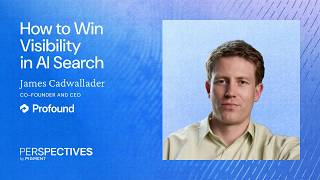
James Cadwallader, CEO of Profound, explains how AI search is replacing Google's link-click model. Companies need machine-focused content and strong FAQ pages to gain visibility in AI answers. Profound tracks ROI through bot visits and helped a major bank fix misinformation that appeared in LLM results.
Chapters
Hi everyone, I am thrilled to be joined today by James, the founder and CEO of Profound. Welcome, James.
Hi, bonjour, Elena.
Thank you so much for being with us. So, James, you have an incredible career. You are a second-time founder, you didn't go to university, You have built one of the companies that today is absolutely smashing it in the AI world, Profound. You will explain to us why you are actually smashing it. And obviously we talk a lot about how AI is going to change the world, but I think your company sits at the center of what is one of the biggest shifts today in internet history, how people actually search for information. So for decades, as you all know, search meant asking a question, then you click on a link and you access a website. And obviously that is all changing today with LLMs. You've called this, I'm going to quote you on that, the biggest platform shift in internet history, and I would love to start there. So perhaps my first question for you would be, when did you realize that AI would completely change the way search works? And what do you think is the biggest thing that most companies still misunderstand about that today?
Yeah. All right. Kicking off with a big question. I think myself and my co-founder Dylan. Yeah, he was previously a software engineer at Uber. And I guess I've had a winding past, always starting my own businesses. We met at an accelerator called South Park Commons, actually here in New York, despite South Park Commons originating from SF. And yet back then, you know, we were exploring lots of ideas that we were interested in. Like weirdly, we were exploring lithium mining as an example. Was something that we were quite interested in working on, but we were using Perplexity nonstop at the beginning of 2024. And it's very hard to remember because AI timelines in particular move so fast. But back at the beginning of 2024, ChatGPT wasn't web-connected. So if you asked ChatGPT a question, you would get that response, you know, as of my last training data. And it was essentially only able to give you a snapshot of the internet based on when it was trained, which is not very useful for search because a lot of search, you know, requires freshness, it requires real-time information. It's not very helpful if it's like having— it's like being able to speak to the smartest person in the world, but they only know what's going on in the world as of 3 months ago. Lexity really changed this when they had the insight that you can use the large language model, not necessarily to answer the user's question directly, but synthesize from the web. So why don't we, you know, find Perplexity— the insight is essentially, why don't we send crawlers to all of the web, grab the information off the websites just like a human would, and then allow the LLM to construct a net new answer that attributes sources and citations. The thing that was crazy back in 2024 is that what occurred to us very early on was that there's an excellent book called The Seven Powers of Business. And one of the, the seven powers is counterpositioning. And it's a true counterpositioning or like an innovator's dilemma for Google Search. In that if you think about a search engine that is Google, that is one of the biggest outcomes in the history of software, the Google search engine, and it prints money is a cash cow is the money printer that has, you know, birthed one of the biggest companies in history. And that money printer has two inputs or like two functions, links and clicks. That's the way it works. Google organizes the links. When you click on the links, the sponsored ones at the top, you get paid because the user's clicking. But in this new world, you know, the perplexity gave us the first glimpse into— you just talk to the internet, and it talks back to you. There's no need for links, there's no need for websites. You just ask the internet a question, and it gives you an answer. That's a very meandering, long way to answer a simple question, but I think when we realized what that meant, we were all in. The weird thing is just that it didn't feel like everyone else was talking about it back in the early 2024. It was only towards the end of 2024 where it felt like the world started to catch up a bit.
Yeah, that's, that's absolutely true. And do you think there are still things that companies do not understand today that they don't, don't see coming? Cause I think obviously we are still at the very beginning of what search is going to become. So what's your opinion on that? Anything to share on that?
I think people are probably underestimating the magnitude of this platform shift. I think this is a streaming to CDs moment where eventually all information retrieval will go through the channels of AI answers. Meaning you won't click links, you won't go to websites. That's the future that I believe in. I think our grandchildren will find this idea of a list of blue links very peculiar. Of course, there'll be a long tail. I mean, you know, there's still people that use CDs today. So it's not to say that, you know, links and websites are going to go, you know, become obsolete overnight. But I think people aren't truly wrapping their heads around the, you know, what it means when you just talk to the internet and it talks back to you.
Yeah, that makes sense. And I would like to go perhaps a step further from that because obviously today all platforms, you take Gemini, you take Anthropic, you take OpenAI, they are all obviously adding agentic workflows to their platform and their capabilities. And now obviously we are able to book a flight or shop online, etc. And so I think that's gonna even evolve the approach to search even more. What do you think is the next layer in that agentic revolution? Anything you would like to share on that?
Yeah, I mean, an interesting provocation is, okay, I would usually share my screen, but let's just use our imagination. Think, you know, picture in your head what a ChatGPT response looks like. You can picture it, right? It's like a white background. And a wall of text. And now if you picture what the first website looked like, it was a white background and a wall of text with a few links. I think you can use the future usually rhymes with the past. And I think what we're going to see is an AI answer. When ChatGPT or Gemini gives you a response, it's generative. Hence the name, and it is generating a new webpage in real time for Eleanor. And what we're going to see in the future is generative UI. So you'll see it won't just be a wall of boring text, it's going to be images, videos, it's going to be, you know, components that are built in, spun up in real time to allow you to navigate, retrieve, transact exactly how you want to in that moment.
This is, yeah, I think it's just going to be completely insane. And I know you are obviously today serving some of the best companies in the world. We are also with Pigment, a very proud customer of Profound. And I think, uh, one thing I would love to hear also today is if you think about that picture that you just described, that I think is insane and it's going to, like, I think we can't even imagine to what extent that's going to go. Concretely today, with the technologies that we have today and what we see emerging with agents, etc., what are some concrete advice you could give to companies? So to give you an example, for instance, if you were to scan a website today of a company, of one of your prospects or customers, I know you keep increasing your forecast given the number of customers you sign every month. Wondering what are some of the common red flags you see? That you advise the company not to do if they want to increase their visibility in this new world?
I mean, I think the, the most tractable is on page. So creating content on your.com. There's all kinds of other things you could do. You know, you could focus on Reddit content or you could do traditional PR, or you could focus on YouTube content. It's super prevalent in Gemini, for example. But I think the lowest hanging fruit for like 95% of brands out there is just creating content. And I think the thing that I really push back at, the sentiment that I really push back on, is this idea of we're trying to manipulate AI or poison the models. That's absolutely not what the purpose— that if you believe that, I think you are like, your head's in the wrong direction. I think, think about it like this. There are about 10 billion prompts a week, roughly, probably more frankly, now at this point, maybe 10 to 15 billion questions a week, going through these answer engines. When there's commercial intent, you know, when I'm asking questions to ChatGPT about a business or a product, about 80% of the time, ChatGPT will use the web for that answer. Because it understands, you know, classifies the type of question as, hey, this is something I should use the web for, because it requires some you know, nascency in the response. So it has to get the information from somewhere. So we're not trying to poison the models, you're just trying to give AI enough information so that it can thoughtfully answer questions about your business, your category, your products. And I think people need to— marketers, I should say, need to get more comfortable with creating more content and content really aimed at machines, not humans. We say marketing for machines. And understanding that, yeah, you are going to need to create maybe hundreds of thousands of pieces of content aimed to be consumed by bots, not humans. And that's okay. And I would also push back, it doesn't need to be some spooky shadow version of your website that's all in markdown language. I think it will just be pages. On your.com that aren't, they're probably not super prevalent. You probably don't have them all put, you know, linked in your header on your homepage, but yeah, they exist and they're there for bots to be able to get the information that they need to get in real time.
I see. And you, I know you are a very hands-on founder. I have seen you on our own prospect calls actually. So I know you are probably one of the person I was the most impressed with, like really, you know, giving advice yourself to your customers and prospects. I was wondering, are there specific changes that you've seen that can produce this disproportionate jump in AI visibility for your customers? I don't know if there are a couple of concrete tips that you could share with the audience.
For sure. Yeah. I mean, shameless plug, but it's kind of important context. So Profound is a platform where you can understand how you show up in these, these models through lots of different datasets we're able to pull and essentially triangulate an understanding of like, okay, directionally, this is how you're showing up in ChatGPT. And directionally, this is how you're showing up in Gemini, and all of the other models across different topics and vectors that we're interested in. But more importantly, we now have agents that can carry out the work that will actually, you know, run workflows or agentic workflows and do the work for you in real time, or at least help you do the work. So as an example, and an answer to your question, you know, we have, you know, you can totally customize the agentic workflows that you build on our platform. But we have some sort of straight out of the box templates as well. And one of the out of the box templates we have is FAQ generator. So an interesting quirk of these answer engines is what we've noticed through sending millions of prompts and looking at millions of answers is that FAQs are very useful to platforms like ChatGPT or Gemini when they're trying to answer questions about your business. Because there's a structure to an FAQ, which is it essentially contains the prompts and gives the answer as well. So the models are okay, perfect. That is definitely the answer to a question that I'm trying to respond to. So you're basically doing the legwork for the models with an FAQ. So what we've seen is upwards of a 20% lift in page citation when you append FAQs to the bottom of the page. But it's kind of laborious to do that. It's quite boring. You know, it's not super creative work. So what we built now is this genetic workflow where you can upload a knowledge base of your product or your brand or your company, anything sort of like you create a ground truth. And then this agent that we've built go scrape the page, reference it against the Google People Also Ask questions to build a spread of queries. We run it through a query funnel algorithm that we've built. And net-net, the long and short of it is you can create high-quality, and I emphasize the word high-quality, FAQ pages in high volume, which is pretty cool. We see double-digit percentage citation lift there, which is cool.
That's an amazing tip. Thank you so much for sharing that. I hope I will make sure my team is on it too with your team. That's great.
We should do that. We have, we should.
Absolutely. I will be on it now. That's great. And I think it's a good segue into a question. So as you probably know, at Pigment, one of our main customers is the CFO. And what does CFO care about? They care about ROI. And I'm sure it's the same with other C-levels. We talk all day long to the board, to COMEX, to the CEO, et cetera. And the CMOs today are probably being asked a lot about what is the new ROI in this new world. So obviously there was a shift, as you mentioned, from clicks to website traffic to conversion, and the fact that now you don't click on anything, so it's hard to measure. I am actually myself a Google alumni, so I know very well what you were talking about earlier. So I am wondering, how should companies think about ROI in this new world?
I mean, it's a great question. I think the, you know, the measures are changing and the way in which you measure ROI is changing. Accordingly. You're correct in that in a world where humans don't click, well, what is the measure of success? What matters here? So, you know, there's different ways to do this. There's not one— I don't have a silver bullet answer to the question. But I think one very powerful feature that we have is CDN integration. So for example, we integrate in with the Pigment CDN. And we're able to then access your network logs or at least get visibility into your network logs. And what that means is when I ask ChatGPT, or let's say, a consumer in, you know, Atlanta asks a question about Pigman to ChatGPT, when ChatGPT is sending an agent to your website to gather that information, ChatGPT leaves a footprint, a network log in real time that can be directly attributed to a citation. So in theory, it's almost like you're measuring bot visits now, but a very specific bot because there's different kinds of bot, you know, for the last 26 years, we've kind of a bot has been a bot. But that's, you know, a user agent visit that's visiting your page in real time to provide a citation to answer a question for a user is much higher value than just a mindless indexer that's just you know, pinging your page to index it. So we're able to delineate bot visits and attribute which— if you're creating thousands of pieces of content, is that content successful? How many bots, how many user agent bots have visited that page over the last 7 days? The second is we can actually track human referral traffic from those pages as well, which is like, you know, the most obvious one. But quite often we think that's like a slightly skewed metric in that, like, speaking for myself, I don't know if you're the same, Eleanor, but I don't tend to click out of ChatGPT that often. I don't click the citations. And we've run a survey recently, and a lot of people will do the discovery in ChatGPT, back out, and then go and, you know, transact through Google or Amazon or something like that. And then there's kind of the old-fashioned things, which are honestly depressingly effective. Like, just if you, especially if you have a B2B product, you know, having a how did you hear about us form and making sure that you have AI platforms like ChatGPT listed as an option. We've had several customers who have just added ChatGPT or AI as an AI search as an option in the how did you hear about us, and they're able to attribute hundreds of thousands of dollars worth of ROI just by adding it as a bullet, you know, as a checkbox. So yeah, but we see, you know, we've had customers who are driving millions of dollars in new business through AI search. I mean, there's, I can't name names, but there's customers that we have and I'm talking these businesses are $10 billion plus businesses where ChatGPT now accounts for upwards of 10% of their referral traffic.
Insane. Insane. Wow. Great to hear. If, so we spoke about the ROI for companies, but now if you think about the economic model of internet, if traffic is no longer the main currency. How do you see this economic model evolving then? And do you have also a vision for what it could look like in a few years from now?
Well, I think traffic still matters. I just think it's who is changing. We spend a lot of time poring over our, you know, visits from agents right now. And it's quite, I wouldn't say scary, that's dramatic, but it's quite mind-blowing to me. I'd say the vast majority of customers we speak to aren't paying any attention to delineating user— like, which bots are visiting their pages and why. Most, most companies that we work with are still just, you know, a bot is a bot. It's just a bot. But from my perspective, when that specific user agent pings our web page, What that means is that somewhere on planet Earth, on the other side of a screen somewhere, there's a human being that asked a question that triggered that agent to visit our page. So it's like a proxy for a human visitor.
Yeah. So are you, I imagine on that, you are going to keep developing a lot of tools and a lot of things to really help people understand. I'm curious to hear from where you are today with Profound, What is your vision for the company? Like, what are the next— I don't know if there are new products, new features that you are thinking and envisioning shaping in the next 2, 3 years to build the massive business you have started to build here?
Yeah, I mean, I'm personally— this is a selfish take, but I am the most self-actualized that I've ever been. This is like the most fun and the hardest thing I've ever done, but it's the most fun I've ever had in my days, the more interesting, the than they've ever been. It's like everything is turned up to 10 out of 10. And yeah, I, the thing that I'm most scared of is that stopping. And I would like to build a business that I could work on until I die. I guess with that as context, the vision for me is can we build a workbench for marketers? I think And let me explain. I think marketing tech traditionally has sucked. It's actually been very hard to build a good outcome in marketing tech. But what I hang on to is that things are different now because of large language models and generative AI, meaning I don't see a future where marketers or marketing teams create marketing without using AI. So I don't see how that future exists. And they're going to need a place where they do that. I think there's an opportunity to build, as I say, the workbench or a platform where marketers create marketing in this new era of superintelligence. And maybe we can do for the marketing org what Salesforce did for the sales org and build a business that is relied on by hundreds of thousands of people. That speaks to one of the biggest TAMs in, you know, capitalism. So yeah, I want to build the place where marketers do the work.
I love it. I love it. That's, that's such a big vision. And, and I do think there is a space here for the next, to your point, AI version of Salesforce for marketing. And, and that goes way, way, way beyond the issue of search. And actually, that's a question I had for you that is more like, I think, related to marketing in general and your brand that goes into, so as a CEO, I am obviously obsessed about my brand and about the reputation and the trust of the company in the market. And I think in this new world, because of what we know, because of LLM hallucinations that are obviously, you know, reducing by the day, but still they can happen. I believe there are a lot of C-level executives that can be worried about the brand damage that might happen without them being aware of it. I am wondering, how do you help today marketers and companies combat that? Are there specific things that you do? Have you seen also perhaps some horror stories and you don't need to name names, but like, what can you do to make sure that your brand with this new world is in a safe place?
Yeah. I mean, yeah, we work with now 10% of the Fortune 500 users of Profound. Which is cool. Yeah, it's been fast and ferocious. And it's a real privilege to serve so many awesome brands. We work with a lot of companies in the finance and fintech space. Yeah, I won't, I won't name names. But as a very anecdotal example, there was, yeah, we're talking like a huge bank was getting this result pulled through. And you could see it in Profound. So it was coming, we were noticing it in our platform. Where it was saying it was basically some confusion. The models were getting confused and speaking incorrectly about their FDIC insurance. And that team used Profound to dig in and start to understand, you know, where, where is the model getting that information from? Because it's not correct. I think actually the way the reality is, it was correct at some point in time. And yeah, the long and short of it is they managed to find this culprit. It was one article, you know, there's thousands of sources that typically inform like a spread of answers, but it was this one article by a third-party publication that was basically giving the models incorrect information. And yeah, the TL;DR is that the team then reached out to that publication and said, hey, like, you know, that's actually out of date. Can you update that, this information? And the publication thankfully was happy to oblige and updated the information. And like 3 days later, that, that we saw zero occurrences of that mention.
That's tough when it happens. They were lucky, I guess. Situations are not always that easy, but I am, yeah, I'm confident that you will keep helping companies make sure that, that their brand is, is in a safe place. I see that already with us. So we, we spoke a lot about you and your vision and, and what you're building for, for, for the marketing team. I'm curious to know, so we saw a big revolution last year for everything in the legal world, in support, in medicine. There are a couple of areas also for the enterprise beyond legal and support that really lived a fundamental breakthrough. Obviously software engineers and a couple of other functions, marketing being one, being heavily disrupted with everything, content creation, for instance. Wondering what are the other trends that you are excited about for the enterprise? What are you closely monitoring, following, and what's next, I think, in terms of like AI automation for a company?
I think ads will be very interesting. Obviously, OpenAI is just, you know, opening up beta testing now. There's no self-serve functionality, but I'm pretty bullish on ads. I think generative advertising in a conversational interface. You know, synthesized by LLMs that have tons of context and tons of understanding of the end user, I think will be new and powerful. And people are actually kind of less excited than they should be. So that's, that's definitely one that we have an eye on and are interested in. I think right now there's not a ton to be done there. I think, you know, it's kind of, you're almost just waiting for the apple to drop off the tree to see where it lands. I think another one would be generative video. I think that's really, you know, coming along leaps and bounds. And yeah, I guess generative visuals. You know, generally speaking, we've recently been using Higgsfield AI to generate an out-of-home campaign that we're about to run. So like a billboard campaign. And it's amazing. It's like, it's perfect. And we didn't have to spend hundreds of thousands of dollars on photoshoots. And we didn't have to wait 3 weeks, we could do it in 2, we could do the creative in a day or 2. So yeah, I think this stuff's really going to change the way that marketers do their work.
Yeah, we see that too at Pigment, the level of efficiency and the magic powers we are getting these days. It's just, was not even possible probably like a year ago. So you are touching base now on things you do internally at Profound, and obviously you are a true AI native company. That, as we said, has experienced tremendous growth. So I'm wondering, with your teams today, how do you think about their own efficiency and adopting AI across the company? And what approach do you take with that? So what I mean by that is that, is it something that you encourage and that is part of the culture? Is it something that you also bake into the performance management process of your team? How are you thinking about that in general? And what could be some recommendation for anyone listening to the podcast today?
Yeah, I mean, it's very native to us in that we were kind of born, you know, by we, I mean the business Profound was born in this era of the internet. And yeah, things that I think we've done well is we've hired more junior people who again are just very native and we kind of like index for people with high agency, high curiosity, people that want to tinker. And you know, all of our engineers use Cursor and Claude Code. Yep. Like we, that's that, but that's not even like a big deal. Like sometimes people ask us that and it's just, yeah, the, it's just table stakes. That's the most, yeah, it's like saying, do you use Google Sheets or something? I'd probably stay true to ChatGPT. I switched to Gemini a bit. I've tried Claude Cowork. I haven't really got into it a ton. We have a great application that we use internally called Dust. I don't even know how I describe what Dust does. You'd have to check it out. But basically, we pull together all of our data sources. And we have Dust plugged in on Slack, and it creates a conversational way for any team to kind of access, you know, an internal knowledge base very easily. So the sale, you know, if it's the sales team, they'll say, hey, Dust, can you tell me all the automotive brands that we've had conversations with in the last 3 days, and you know, what they're looking for. And you can, you can really query the kind of the combined knowledge of the business in a very efficient way with a product like Dassault. So they've built a great product.
Yeah, they are friends of the French ecosystem, as you probably know. Oh, I didn't know that.
Are they French? Yeah, they're French. Nice. Good companies coming out of France. Yeah.
So now, um, speaking about your culture, so I know you founded multiple companies. You started with a gold business. You've done a lot of incredible things in your life. So I think one thing that seems clear is that you hire very, very well. You just described some of the profiles of the people you are hiring today in the AI era. I am also wondering how today do you build a culture at Profound that is comfortable moving and changing so quickly? What do you do? What are the processes that you put in place to make sure that everybody is ready to move at the speed at which you need them to move?
I try not to put too many processes in place, probably, is the response. I try to resist the urge to put processes in place at all. I don't know. It's not a very useful answer, but I tend to think building culture is more of a spiritual challenge than it is an engineering challenge. And I think, you know, there's a Chinese proverb which says a fish rots from the head or a fish stinks from the head. And I think it really is top down with that stuff. And I love Amp It Up, the book by Frank Slootman. I think it's my duty to go into the office with high energy. And, you know, get people to do things and to take risks. I think velocity of decision-making is probably the defining function of success. That's not, you know, original to me. I think that's like an Elonism at some point, or, you know, I think it's just common known law in startups, that decision velocity. So how quickly can you make decisions? And yeah, I tend to think, you know, if you hire super smart, super ambitious people, they can kind of figure out most things. It doesn't, you know, if you've got someone who's very intelligent and ambitious, you know, fiery, they will probably figure out how to, you know, manage people if they need to manage people, or they'll probably figure out how to set up some very specific business process because they're intelligent and they're ambitious. So they'll they'll figure it out.
That's, yeah, I cannot agree more. To add to that, so on hiring, I know, well, your, your CRO, I think you have someone incredible in place that is very seasoned actually. You also mentioned earlier that you have been hiring some very junior talent that are super smart and curious and ambitious. So wondering what are, compared to your other companies and given your level of experience, what are the things you've learned about hiring that you perhaps haven't shared yet? Because obviously you have done very well this combination of junior talent, super seasoned leaders. Yeah. What are the biggest things you've learned here about hiring?
Yeah, I think, you know, I'm not demurring when I say I don't think we have it figured out and I'm, you know, call me paranoid or superstitious or one of the two, but I am very hesitant to kind of like celebrate our success in hiring when we're only 18 months old and I think, yeah, again, I would lean more towards like a spiritual journey or a spiritual challenge than an engineering challenge. I think there's no rules, there's no framework. I mean, maybe to be, you know, to provide an interesting anecdote, one of our early investors is Keith Rabois, who's, you know, part of the PayPal Mafia with Peter Thiel and Elon Musk. And, you know, he really is an incredible mind. And we spent time with Keith, myself and Dylan, and, you know, having these conversations with him about how to build out our leadership team. Keith gave great advice, which was, you know, just do what's right for you. Don't follow any playbooks. Don't listen to VCs. No one knows. Just do, you know, it different. It will be very unique to your business. And I think that gave us confidence to kind of go with our gut in terms of building out that team. Our head of engineering is 24, which is wild. But then, yeah, as you, you're right to say, our SVP of revenue, Mark, is like arguably one of the most experienced sales leaders in the world right now, or tenured. He built his last company to, from, I think, $4 million to over quarter of a billion in revenue and he's managed hundreds of people. So I think it's not being dogmatic in your views and having like neuroplasticity and flexibility to know when you should break the rules or when you should stay true to them. And I think, yeah, just having a humility in an understanding that we might get it wrong and that it's a really hard thing to do.
Yeah, and I love that concept of the spiritual journey when it comes to, to hiring and values and processes. Beyond what you described around not listening to VCs, really trying to find your own ways and your own ways of building a profound team perspective, is there another decision that you're very glad you've made early that you think has helped you today build this success, this massive success?
Yeah, I mean, and again, it's interesting because we've since broken a rule that I also believe, you know, the two things can be true that I— when— let me explain. When we first began, I was dogmatic with a capital D that we had to be all in person in New York City. There was no two ways about it. You know, I would actually say to Dylan, my co-founder, is even if Ilya Sutskever himself wanted to work at Profound, if he wouldn't do it in New York, we wouldn't hire him because we needed people to be in person. And I think in the early days of building, I mean, we're still in the early days, but I think particularly in those kind of true zero-to-one days, it was just invaluable being in person. And it's created this kind of bedrock of culture in the company. That has carried through today. So today we now have offices in SF, in London, Buenos Aires, and New York. But because the New York bedrock is so strong, you know, I think our culture is maybe one of the best products that we built. And I think the culture is a function of us being elbow to elbow in the trenches, you know, 15 hours a day, 6 days a week. You spend so much time with these people. And yeah, it's crazy. Like, the amount of decision-making that has happened over water cooler conversations or someone just shouting across the room is quite mind-blowing. It's scary sometimes where you're like, holy cow, if we weren't in person, there's no way that conversation would have happened. So yeah, now we're breaking that rule. And it's, you know, we have teams in different places. So it's trying to navigate that as well.
Yeah, I'm sure. I mean, given the growth that you're having, you will have new challenges coming every year. But yeah, I agree with you that the in-office culture for what you described is absolutely precious. And I do believe, like, for instance, for us, what we've tried to do is, even given we have also multiple offices, is how often can you bring people together to create this side conversation that truly makes the company. So I'm totally with you there. Okay. Now, quickfire questions, if that works with you, to wrap up the interview. So what is the one AI software that you couldn't live without? Of course, we remove ChatGPT, et cetera. What is the one software today that you couldn't live without?
I would go and say, I mean, I was going to say ChatGPT, honestly, but let me give you, I would probably say DUST. To give them a second shot. I'd say dust has been very valuable for our business. Love it.
If you were not building companies, which you have been doing for your entire life, what would you be doing?
I'd be unemployed.
You'd be unemployed. Interesting. Interesting. So you spoke about the book of Frank Slootman that I agree is a fantastic book that I would recommend to everyone and pick up. Is there another book or a thinker that has influenced you a lot into how you build your products?
I think biographies, generally speaking, are very useful for entrepreneurs and founders. I, you know, especially when I had a bit more time, but even now when I'm on a flight or something, I will listen to David Senra Founders Podcast where he summarizes biographies. He's, you know, shameless plug, he's an angel investor in our company as well, which is a real honor. But yeah, I think Founders Podcast is awesome. So I think just being able to learn from other people's stories is better than, you know, a business book or a strategy book. I think just being able to read stories about other founders is very, very cool.
Yeah, I love that podcast. I absolutely love that podcast. I heard you talk about, uh, Jensen on The Way It Works, and, uh, I agree with you that, uh, I also find work relaxing, and it's a non-valuable podcast. Cool. Last one is a recommendation in the same vein for a CEO or C-level exec. Is there a book or resource you would recommend to learn more about AI? So not about company building, but specifically about AI.
I'm going to go ahead and say X or Twitter, which is kind of annoying. It's like you have to wade through lots of shit in order to get some golden nuggets. But, you know, if you want— I think that's the truth, right? If you want to stay abreast of what is going on, you— and, you know, most people ask, this isn't even very valuable advice. But I do tend to think the most obvious is probably the most true. And yeah, just being on Twitter and following the right people. And that, unfortunately, that's where a lot of my kind of— that's how you stay, stay with the zeitgeist, right?
Yeah, I agree. I listened to Marc Andreessen the other day. I don't know if you listened to this podcast that was released a couple of days ago where he said, for me, it's either Twitter or almost like, you know, any book, but like old books, biography, exactly what you said, because it feels like the in-between, you know, reading newspaper, et cetera, is always almost too late. And then really, if you want to be at the— and also not necessarily translated the right way, like you really want to hear directly from the AI thinkers. And I think the That's very true, actually. Yeah. Well, James, it's been fantastic. Cannot thank you more for having been on the podcast with me today and massive congrats for the incredible success. I know it's just the beginning for you, so I cannot be more excited for the future for Profound. And for those who haven't checked that company, please do so. It is a groundbreaking company for all of you if you want to think about everything search and marketing. And beyond. As you have heard, James has an amazing vision, so I encourage you all to look at that.
Thank you so much, James. Thanks for having me. I appreciate it.
More from James
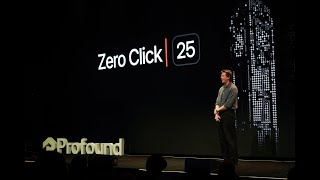
Welcome to Zero Click London 2025 - By Profound Co-founder and CEO James Cadwallader
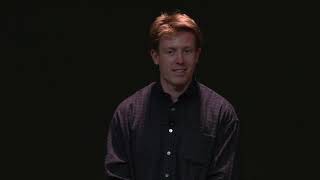
Zero Click by Profound | New York | 2025 | James Cadwallader (CEO & Co-Founder, Profound)