A Round Table Discussion— Early Fears We Had When We Started Our Land Investing Business
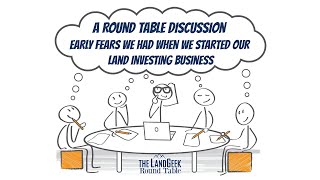
Five land investors recall what scared them most starting out: running out of money, picking the wrong county, pricing offers wrong, and leaving their jobs. They share what actually went wrong and what they'd do differently.
Chapters
Hey, it's Mark Podolski, the land geek with your favorite niche real estate website, www.thelandgeek.com. and on this week's roundtable, we have almost all the usual suspects. We've got the technician, Eric Peterson. Eric, how are you?
I'm good.
Good to see you. We've got Dude Buddy, the Nightcap OG Scott Bossman. Scott, how are you?
I'm doing great, Mark.
Thanks, Scott.
I like that haircut, actually.
Oh, thanks.
Yeah. Did you. Did you do that yourself, Aaron? Do that? Who did that?
No, I went down the road here, and the boys were giving me a hard time on Nightcap last week. They told me I looked like Johnny Lawrence from Cobra Kai, so.
Oh, wow.
I can throw my headband on if you want. Yeah.
What's the. What's the Cobra Kai phrase?
Strike first. Strike first.
Strike hard, no mercy.
Strike first. Strike hard, no mercy. Well, speaking of striking hard. Striking versus no mercy. We've got the most feared woman in the country, the terrorist hunter, Mimi Schmidt. Mimi, how are you?
Great.
How are you, Mark?
I'm great. I'm great. And of course, I love it when you call me Big Pop. Tate Litchfield. Tate, how are you?
I'm doing well. Excited to be on today's show.
Awesome. And of course, you know you love them. The Brain, the Professor, Scott Todd from Scott Todd.net landmodo.com learn anything about anything. Investor ninjas.com Scott Todd. How are you?
Mark, is it too early in the podcast to, like, to mock Tate? Like, I don't.
I don't know if it's ever too early to mock me. I feel like you should just get it out, and then we can start the podcast and we come back to it, if you want.
It was like, wow, I'm really excited to be here. Thank you.
I got something else on my mind. I'm trying to. Oh, yeah, yeah.
Oh, yeah. See, now. Now he's got it on his mind.
Like, why not?
Yeah, you should just own it. Like, I'm not excited to be here. I'm just here because I'll do it. But I'm doing a big land deal right now, and this is a huge distraction. And we'll see you guys.
Yeah, listen.
Okay, here's the truth. I'm buying a big lot of big bunch of lots, and I just negotiated 10% off that purchase price. So I'm doing the math, and I'm like, hey, guess who's going to lunch today? Like, this is good. And dinner today. So feeling good. That's.
That's why.
Scott. Sorry.
Well, I mean, I just thought, I was just wondering, like, are you working on slack tips of the week or something? Just saying, like, I don't know. Okay, I'm doing great.
Let's get on, let's get on.
Let's just segue into our topic, which I think is one of the more popular topics. And it's one that I never sort of tire of talking about because it's so relatable. It's our newbie fears. When we first start the land business and we're sort of, you know, as Seth Godin would say, we're dancing on the edge of failure and we feel most alive. What for you, Scott Bossman, were those early, early fears where, you know, it was this combination of excitement and, you know, fear, like, is this thing going to even work and then doing it?
Yeah, I mean, I had a ton of fears early on. Early on. Number one, do I have enough time to do this? Do I have enough money? Am I gonna run out of money? And then once I'm in the thick of this, like, okay, I have this accepted offer. I don't even know how to buy this property. So there are all these fears along the way. So self doubt, I think is the biggest one for me early on. Was I gonna be able to do it? Am I gonna run out of money? That was always an issue early on. But I followed Scott Todd's advice. Follow the recipe, he says, and you're not going to run out of money. And he was exactly right. And then one other thing I guess I would touch on is there are all these preconceived notions out there about what makes a good property. And I really had to get to the point where I put my faith in the numbers more than what I thought a good property was. So if I can find comps in the area and I can be confident in the fact that I'm buying this property for 25, $0.30 on the dollar, I'm not going to lose money on it. Even if it is out in the middle of the desert. I need to get over those preconceived fears that, you know, the market is still there and somebody's gonna end up buying a piece of land that maybe I wouldn't want.
Yeah. So I think those are really common fears, I think, and we'll pull the group. Probably the biggest one is, you know, either losing money or running out of money. Tate, do you relate to those fears at all?
Yeah, I mean, I think anybody who's building their own Business has those same fears. It's natural. You know, we spend so much time trying to accumulate this nest egg of money and then to go and buy vacant land that we've never seen, that we've never, you know, maybe in a state that we've never even been to. It's scary. And it takes a lot of trust to just say, you know what, the numbers make sense, the comps are true. I believe what I'm being taught. And if you feel that way, then, you know, at some point you have to dive in. And we always say, you gotta dive in headfirst. Right? You gotta commit to this. This is not a, you know, put your toe in and get, you know, used to the water temperature. You're all in. And you know, the other fear that goes hand in hand with that is, what if I mail to a piece of property and I. I do my due diligence and it turns out I don't want to buy this property. And so I think people are often afraid of making offers on a piece of property and then not purchasing that land. And I hear this all the time. It's like, well, I made an offer. It's like, yeah, but it's not binding. Just like the seller of that property can choose to sell to someone else or change their mind altogether. Your offer is just an offer. That's it. So there's nothing that forces you to actually purchase that property. And part of the learning process and the learning curve here is you're going to make offers that are too high. You're going to offer to buy land that maybe you don't want to, maybe the comps are not in the right price range or the market's not hot out there. You mailed to an HOA or a POA and you change your mind, that's okay. You don't have to do this. You can walk away from it. So I think that goes hand in hand there too.
Yeah, no, absolutely. I remember early on being very afraid of due diligence mistakes and thinking, oh my gosh, what if I buy in a flood zone? Or what if I buy in an area that's a super fun site? And I really quickly realized, like, this is all in my head. Like, it's really not something that's in reality because we weren't buying in New Jersey or Pennsylvania or these industrial states, you know, Ohio, you know, the southwest Northwest, they didn't have that. So, you know, on epa.gov like, okay, that's, that's not a real fear. And all of a Sudden you start realizing there's not a whole lot of real fears here as you go through due diligence. But that being said, I did have real anxiety about it in the beginning, just fear of the unknown. And there wasn't, you know, I didn't have a group like this that, you know, could calm me down where, you know, Mimi could say, oh, Mark, don't worry. This. I've done this a thousand times now. You're just fine in that area. And, you know, if there's anything that comes up on in this, you can cure it. It's very easy, it's very cheap, very quick to do. Which leads us to Mimi Schmidt. Mimi, what were your early fears? Because you're coming from a really intense job, corporate America, and now you're going very outside of your comfort zone into entrepreneurship.
Well, I agree so far with Eric and Tate and what they've said, but there's so many things, right, like new county choice. I see a lot of folks that come into coaching that are not sure of their county. Right. And I still see people that pick counties that are not on your secret list that you've already tested as tried and true, which always kind of shocks me.
But.
And I try to get them back on the path to look at your list. But county choice is always an issue. Offer prices, right? They'll say, oh, my gosh, I've sent out all these offers and I'm not getting their response. Well, how do you manage that? Are you getting 5% response rate? Are you buying 1%? If not, then you need to raise your prices. You don't have to go all in and mail 2,000 letters at a time. You can stagger them, stagger the pricing, stagger the dates, you send them out so that you can respond more adequately instead of spending a lot of money.
Right.
And then deed issues, I see a lot of people get very worried about deed formatting and deed issues. If it's not a husband and wife, if it's two brothers, or if there's a probate issue or if it's a trust. What's the wording supposed to be? And the easy solution for that is just go get a rocket lawyer account and run it through them. So lots of anxiety around these topics. But easy, easy solutions.
Yeah, yeah. Eric Peterson, the technician, you know, can you. Do you. Can you remember rewinding the tape and dealing with any of these newbie fears?
Yeah, I mean, I think that it really just comes down to a fear of the unknown. Right. So we were getting into something as, you know, land investors that we've probably never experienced before, we've never had to do county research, send out direct mail, you know, and the list goes on market, on Craigslist, et cetera, et cetera. So there's all these steps that can be just overwhelming, to be honest. And you know, if you, if you get bogged down in trying to.
I.
Guess, overcome that fear in all those different areas, you're going to spend all your time getting nowhere. So, you know, that's, that's why we teach. Just do the next thing. If that's, you know, the very first thing to get the list, well, go do that, overcome that fear and then move on to the next one because there's going to be another one, you know, and I honestly think that's the best way to take it. You know, just one bite at a time and you'll get through it. If you consistently work on it, if you use the resources available to you, whether that's the toolkit, the community, flight school, coaching, et cetera, all those resources are there to help. But yeah, I mean, if I look back to when I started, I think some of my fears led me to not follow the recipe. So, for example, you know, I bought property early on in the state that I lived in because I was scared that if I bought property hundreds of miles away from me and something went wrong, how am I going to get there to solve the problem? Well, I quickly learned that that was a mistake buying land that was close to me because it was not the type of land that sells really quickly. So when I went back and followed the model, overcame that fear and let go of it, then I could buy property that I could sell much faster.
Right, Right. This is a question that I'm going to give to Scott Todd because it's unique, but it also applies to Scott Bossman, Mimi and Eric. Unfortunately, Tate, you never really had a real job. So it took me 18 months to replace my full time investment banking income and then quit my job. It took Scott Todd 17 months in three days. Scott, do you remember the fear of losing the benefits? You know, losing, you know, health insurance, the 401k, the security of every two weeks, magically getting that paycheck and being like, okay, I'm really doing this. I'm really going in on my own business and there is no safety net.
Yeah, it's scary, right? Like, it's scary having that leash. What's the leash? The leash is the corporate gig, the money every two weeks.
Right.
It's scary. The benefits it's the. You're on your own. You know, Guess what? If the company hits a rough spot, like, I don't know, Covid comes up, well, you're going to get some commission or some compensation for a while until they decide to lay you off. But in the beginning, it's like the corporate gig smooths out the speed bumps, right? Like, they take on more of the risk, if you will. The company takes on the risk until the point where they dump you. And then they say, like, you're on your own. So the risk is really, you're going to face it either way. But, Margot, I'm going to pull Michael Zaino here and go to a quote about fear. Okay?
You're so wicked smart about this.
Well, see, I was reading this today and I was thinking about fear. I read this line and I thought, wow, this is good. I even. I even did a move out of Tim Ferriss and I, like, put it in the cop in the front of the book here. Like, I'm like, I'm going to come back to that one day. Literally. I know it'd just be a couple hours later, but check this out. Fear is the doubter, the coward, the one with the bad attitude, the one unwilling to take a chance for something better than something better that lived inside each and every one of us. Fear was desperately trying to save itself in this life and death struggle. So basically, the author was talking about how he was getting these little voices in his ear that were telling him things, and he's like, these things just don't exist. It's the fears, right? Like, it's the fear trying to save its life. Because the fear knows that the minute that you achieve this thing and you squash that little voice in your head, the fear is dead. So the fear pushes back hard on each of us. And I think that what everybody talked about here, the fears that they all face, or the fears that we see people starting to face, the reality is, is that there's a lot of unknowns that we don't. We just don't know. One of the fears that I know I had too was I'm going to. And you kind of touched on a due diligence mistake, but it was one that, like, oh, man, I'm going to miss something. I'm going to get stuck with this thing forever. I got to tell you something, and this is true story. There was something I missed. And this kind of pulls from Eric's, too. I bought a piece of property, and what I didn't know was that the Neighbor to the property or we believe. We can't. We can't accuse a neighbor. We believe that the neighbor went in on this rural property and he took. With a. With like a scoop, if you will. Like, he's an earth mover. He scooped the dirt out in front of the property of my property and the neighboring property. We believe that he dumped all this dirt onto his property. So now in front of my property, I literally have like a six foot wide moat that's like ten feet deep, okay? And it's underwater. It's a moat. You can't get to my property. So when I found this out, I'm like, oh, man. Now this is a Property I paid 2,500 for not knowing that. That it was a moat or had a moat. I sold it to a guy. The guy goes out, looks at it. He's like, I can't get to the property. There's a moat in front of it. We're like, oh, crap. Well, what did we do? Well, we lowered the price to $4,500. This guy calls up and he's like, I want it. He was local. He went out, he looked at it, he saw the moat. He bought said property, he paid it off. Right? This is a property. In my mind. I'm like, I'm never going to sell this thing. Funny story. True story. I'm talking to Mike Zano last week. Mike tells me about this property, and I'm like, I know this guy.
He doesn't.
Mike doesn't even know about the moat. I'm like, I know this guy. How do you know this guy? He's like, oh, I sent him a letter. He's going to sell me his property. He's going to take a loss on the property. I'm like, wow, wow. You're gonna buy the property with the moat? Mike's like, what? What? What?
I'm like, oh, the moat.
Let me tell you about the moat. So the reality is, is that, oh, by the way, Mike was gonna pay way more than I paid for it.
But anyway.
Make a long story short. I sold the property, right? Like, and you've sold properties that you look at afterwards. You're like, who's ever gonna buy this thing? Geez. And the reality is, is that someone will buy the property. It comes down to patience. Don't let that little voice in your head say, see, I told you I was right. You're gonna be stuck with this moat property forever. Because then we freeze and we don't take action and seize what we want.
No I love it. Scott Bossman, how did you handle it when, when you had that day and you're like, I'm, I'm kind of cutting down here. I'm gonna come in when I want to.
Oh, that. I still get goosebumps thinking about it. It was almost two years ago. I mean, when I'm handing in my work badge and they're revoking all computer access and no more work emails and all that stuff. And I did have COBRA for six months, so that was kind of nice. But, you know, as you said, all those things go away and then come Monday, I'm on my own. It was, it was a big change for me. Uh, so there was doubt or there was fear. Yes, I would say. But that, that fear, just like in the land business, that just propelled me to action. Cause I'm, I'm, I'm the type of person where I'm not gonna, I'm not gonna sit back and not take action if I know, you know, my livelihood and my family's livelihood depends on it.
Yeah. How about you, Mimi? Do you remember that day?
So exciting. I'll never forget that day. I worked for so, so hard for so long for that day. Was it scary?
Yeah.
But so worth it.
Yeah. Yeah. Eric, how about you?
I don't know if it's, if it's fair for me to comment on. I mean, the transition for me was just kind of from one thing to another. I mean, freelancing. I was working from home, already doing that. I mean, I did have a pool of clients that I was relying on for income, but ultimately, you know, to switch to land and make that my full time thing, you know, it didn't, it didn't feel vastly different. I didn't have to stop going to an office or something. So, you know, I mean, it was still great to be able to rely on the land business for my income rather than anything else. But. Yeah, probably not quite the same story as everyone else there.
Yeah. And I think, you know, for Tate, I wonder for you, Tate, if you had a different fear, which would be the fear of tremendous success. You're so young, your friends are working the 9 to 5. They're kind of in that part in their career where their jobs just suck. Like everyone's jobs in the beginning, their 20s suck. And now here you are, you know, living sort of this, you know, crazy lifestyle, you know, working when you want, you know, where you want, with whom you want. Cycling, growing your family, you know, living the dream. Was there any fear or doubt? Like, oh, My gosh, I'm lapping everyone in my life. They're not going to relate to me. Maybe I should tap it down. You know, maybe I shouldn't be so successful just so I'm not so different than everyone.
No, that was never a fear.
I think for some people it is, like, because you're leaving your comfort zone of that group.
For sure.
I definitely left my comfort zone. And, you know, I was now entering a world where very few people could even relate or understand what I was doing. But, you know, I had a good mentor, right? You as my mentor, and you're like, do not take your foot off the gas. Whatever you do, do not slow down. Do not slow down. Do not. You know, so I kind of had that echoing the back of my mind. But I think my fear came with, like, wow, I've had tremendous success. Is it gonna run out? And then what? I've spent the last X number of years building my own business. Is anybody ever gonna employ me? They're gonna look at me and say, wait a second, you have zero real life experience. I'm gonna say, no, no, no. I ran my own business to the ground. You know, that's.
That.
That's what I was thinking they were gonna say to me. And I overcame that, and I realized that I've developed a set of skills that are very, very unusual and in high demand. And it doesn't matter what's happening in the world or the economy. I know how to buy and sell an asset and sell it very well, and I know how to have other people do it for me. So once I overcame that, it was like, bring it on, let's keep sprinting, because I'm not getting tired. Because now I know how to have other people carry the load for me. And that was kind of the big wake up moment for me.
Yeah, no, absolutely. I think you get to that point, I think everyone on. On the. On our, you know, in our group and our, you know, the coaches, like, even if I stripped all your wealth away, I took everything away from you. There's this inner core confidence that you guys would come back in six months because, because of that skill set, you just know how to do things other people don't know how to do, whether it's in this niche or something else. There is this mentality now, like, you know, if I could do it here, I could probably do it anywhere else in my life, take it all away. But you can't take away these skills. And that's a really sort of peaceful place to live. And really helps dissolve all those fears, knowing that it took me a long time to get to that point, actually. But I think I'm there. You know, I talk about how I could be homeless in Newport beach and know exactly what I would do. So, Tate, you'd come with me too. We, you know, just, we'd figure this out.
We got it. I'm not worried. I'm not worried.
We'd come back fast. Well, I thought this is a really, really interesting, you know, topic and it's always great to kind of go over it again. And of course, because he missed last week's roundtable podcast, we're going to go to the dude buddy, the Nightcap OG for his tip of the week. A website, a resource, a book, something actionable for the auto passive income listeners to go improve their businesses, improve their lives. But before you give that tip of the week, I do want to just remind the listeners that today's podcast is sponsored by flight school. Learn how the next 16 weeks can literally transform your life. Get out of solo economic dependency. Start building that passive income machine. Start building that side hustle. Get even $2,000 a month of passive income for the rest of your life can give you peace of mind for the rest of your life. Go up that mountain with Scott Todd. He's done it thousands of times. You'll go up there quickly, safely, efficiently. Learn more. Go to thelandgeek.com training Ask the Dude buddy, Scott Bossman, or the Zen master, Mike Zano. What is Mark's crazy guarantee? You're telling me this isn't going to cost me anything? No, it's not going to cost you anything. You're going to make back that tuition? 180 days or less, guaranteed. You literally have nothing to lose. Everything to gain. Thelandgeek.com forward/training. Scott Bossman, what's your tip of the week?
All right, I'm reading two books in tandem right now that really complement each other well. I'm reading one and listening to the other one. So the one I'm listening to is Personality Isn't Permanent by Benjamin Hardy. He's a great blogger on Medium. And the other one I am reading right now is Limitless by Jim Quick. I don't know if you guys, maybe that's been recommended before on the podcast. I'm not sure. But Limitless is really great because it's all about kind of our unlimited potential and purpose in life and how even as we continue to get older, our brains mature. They're always growing neurons and there Are all these different strategies that you can employ to become smarter over time and to push your boundaries physiologically and psychologically. So, and then the Benjamin Hardy's book talks a lot about, you know, having a purpose driven life and what that looks like. So those two books. And case in point here, I think I'm going to give, you know, when Scott Todd in the last couple weeks has given us all these touchy feely tips of the week. Like two weeks ago he says we need to start journaling. And then today he's given quotes of the week. Like, that shows that he's limitless. Like, he's changing and growing, which I love.
I love it.
I don't even know what to say to that. That's like, trust me, I can still break out the mini bat when needed.
He's growing soft is what it means.
Not growing soft in the old days, man.
I think you're getting a little softer, Scott. Look, you're getting wiser, you're getting softer. You're, you know, look, even. Even with all your success, you're still evolving.
It'd be a compliment to Mike Zano to see you using those quotes.
Don't tell Zaino I did that because then you'll be like, ah, come on. See, we cannot let Zaino know this.
Oh, he like, like he's gonna mess with you. He's so scared. Anyways, don't mess with Scott Todd. You never know what's gonna happen. The phone will ring. You think it's one person, it's another person. That's. I. By the way, again, I want to apologize to Massachusetts. So that was a great tip of the week. I actually have that. The Benjamin Hardy book. I'm about to get Limitless. I started it and for whatever reason, I, you know, I was in Colorado and I went to another book, but I'm going to come back to it now. Personality isn't permanent. So the. His other book was great, which was another recommendation of yours. What was that first one? It was great.
Willpower doesn't work.
Willpower doesn't work. Yeah. So I want to thank the listeners. I just want to remind you, please give us three little favors so that Eric Peterson will continue going on the roundtable. All you have to do is subscribe, rate, review the podcast, send us a screenshot of that review. To support TheLangic.com we're going to send you for free the $97 wholetailing course, how to double your money, 30 days or less. All right, ready to do this? 1, 2, 3, let freedom ring. Not bad. Not bad. So the obligatory. The obligatory question is, do any of us care about Labor Day? Like, it was Labor Day weekend. I didn't even know. Is it. Is it like, for us, like, is it a thing? Or is it just like, are we aware of it? Yes, you're aware of it, Mimi.
I went to the beach. It was great.
Nice. Was. Were you Covid safe on the beach?
Yes, we. Social distance. It was nice. So, you know, it wasn't as rowdy because there aren't as many people, but it was fun still being out by the water. Lots of dolphins in the water and good food. Good company.
In Virginia?
No, Delaware. Bethany Beach, Rehoboths area. Delaware.
Cool.
Yeah, it was cool.
Wow, I'm really shocked right now.
Why?
I'm not sure I've ever met anybody who's ever been to Delaware. You know, there's nothing.
Don't you just form corporations in Delaware? Yes, people actually live there.
The property taxes are super low for private taxes because the corporations pay so much because there's so many companies that have incorporated there. Wow, great place for a beach house.
Cool. They have utilities there and all that.
There's that water.
It's not like the water in Saint John, that's for sure. But the health care is better if you hurt yourself.
Ah, of course, of course. Eric, how about you?
No, we didn't do much. Kids obviously didn't have school, so they both boys went out to friend's house is for the afternoon. But other than that just kind of took it easy.
Did you give him the passive income lecture? Like, look, boys, this is why I don't celebrate Labor Day, because I don't labor. And this is what you need to do so you don't have to labor. No, I did not. No. Scott Bossman, how about you?
Oh, we had a relaxing day. I labored at home. I did some yard work. But I did make a comment to my son the night before. I'm like, you know, Ben, tomorrow's Labor Day. Like, I used to be so excited for this holiday, and now it's just like any other day because I'm at home with you. So kind of a cool realization.
That's cool. Tate, how about you?
No, it was just like a normal weekend for us. I mean, I'm kind of on the three day weekend kick right now and like, trying to maximize that so it doesn't really matter whether it's Friday or Saturday. I don't need. Like, I woke up this morning, I looked at my watch and it said September 5th on it. And I was like, oh, it's the 5th. It's actually September 8th. So, I mean, I'm like totally behind on all of this stuff, so.
No, yeah, that's. Yeah. I don't even know what to say to that. It's just.
That's like a passive problem. Like, it's just. There's no excuse for that. I'm just. I'm. Everyone's worst fears as far as like, oh, we're going to get this new generation, they're going to build passive income and then they vote on top of it. Yeah, you guys should be scared.
Scott. Ty, were you flying the. The. Almost. It's like brand new now. The plane. It's like a brand new plane.
Actually, I did. I did go fly yesterday. I flew up about what would have been a four hour drive. I flew. It was like about an hour and a half and then an hour and a half back, so needed to go pick up my daughter up there. She is visiting some friends for the weekend. So. Yeah, not bad.
Not bad. I mentioned to somebody that I want to take sailing lessons, and one of my buddies like sailing lessons. That's boring. Why don't you take a powerboat lesson? Like, be a man. So I thought I'd just throw that out to you. Scott. Todd, should I even learn to sail or should I just drive a powerboat?
You know what, man? Driving a powerboat to me is kind of like. I mean, it gets kind of old, you know, like, okay, you're going somewhere, but where are you going? Like, I don't know. Sailings has like a mystery to it in a way. You know, it's. It's grabbing the winds and managing the winds and managing the stuff that's outside your control. A powerboat, you're just like, I'm gonna go here. You know, like, you just go wherever you want. It's like to me, it's like caveman style versus the, you know, the sail, which is more natural.
Right. It's like shooting a gun versus martial arts. Right. One sort of a. Oh, Tate. Oh, no. I shouldn't bring up guns in front of Tate. Never mind. It's a bad analogy. They're both skills. I'm. Tate, I apologize. I know it takes a lot of skill to fire a weapon well, but one is a little bit more just finesse, right?
No, I agree with Scott on this one. Like, I mean, learning how to use mother nature to get you where you want to go. That's cool.
And that is cool. Okay.
That seems hard. So I still think you should go with the sailing lessons because from what I know about sailing is you're not going to learn how to do it in a week or even two weeks. It's going to take you a lot of time on the water, and that's cool. It's a cool skill.
Yeah.
Especially if you live in, you know, Arizona.
Yeah. I've been watching a lot of Wedding Crashers and Stepbrothers, those scenes where they're on the water. Sailing hasn't really helped me at all. Just.
Yeah.
And they gave me a little.
You got to consider the source.
Yeah. That's true. Yeah. That's a good point.
All right.
Well, thanks, everybody, and we'll see everybody next week.
More from Mark





How to find funding partners: How to Scale Land Without Using Your Own Capital


