Avoid these 3 crucial mistakes when buying land in 2026
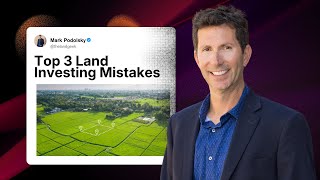
A Jan 13, 2026 YouTube livestream hosted by Mark J. Podolsky with Scott Bossman, Mike Zano and John Burnett discussing common beginner mistakes in raw‑land investing and how to avoid them. Key lessons: don’t let fear/analysis paralysis stop you from taking imperfect action; focus on fundamentals (list acquisition, pricing, mailing, repeatable rural subdivisions) before buying fancy tools; choose counties/subdivisions where other investors are active and where lots have access, build potential and low taxes; simple pricing heuristic (divide recent retail comps by ~3–4 to set offers) and expected mailing benchmarks (target ~3–5% response, ~0.5–1% purchase conversion); due diligence priority: confirm legal owner/title and check back taxes and access; maintain continuous deal flow (don’t stop mailing after a single buy); pick up the phone for acquisitions/sales; and use community/coaching (flight school, Nightcap) to accelerate learning.
Questions this video answers
January 13, 2026.
Mark J. Podolsky, Scott Bossman, Mike Zano, John Burnett.
Set offers by taking recent retail comps and dividing by about 3–4 (e.g., $10,000 retail → $2,500–$3,300 offer).
Typical mailing benchmarks mentioned: ~3–5% response rate and ~0.5–1% purchase conversion.
Confirm the legal owner can convey title, check for back taxes, and verify legal/physical access and basic build/recreation potential.
Chapters
I once dined on steak with a candle soft glow. But the bill left my savings despairingly low. Now wisdom has taught me so simple, so grand. Eat baloney, buy land. Eat baloney, buy land. Play the fork for the deed in your hand. Skip the filling, let the sandwiches stand. Your fortune will grow when you buy your own land.
Are we pumped up or what? Hey, guys. Good to see you again. Land Geek community. If you've been thinking about getting started in land investing, but you haven't pulled the trigger yet, this episode is for you. Tonight, we're breaking down strategy. How to get started, but also how to avoid mistakes that stop people from getting started and making money and building the time freedom that they came here for. So these are mistakes we're going to try to avoid. They're early decisions that feel small but have big consequences. So avoid just one of these mistakes, and you're going to move faster. Ignore the mistakes, and you're going to stall. So let's get into it. First of all, intros. My name is Scott Bossman. I've been a land investor for over a decade. Joined here tonight by, as always, Mike the Zen master Zano. Breathing the mailing. Breathe out the marketing. How's it going tonight, buddy?
It's going great. I'm happy to be here. Thank you all.
Man, what do you got? A pinot noir. That is very classic.
Very, very good. I don't know what to do when they do that at restaurants. I'm so. I'm like. I'm just so. Unless, you know, they gotta pretend.
Oh, my God.
Take it back.
Think about it.
On my lower right, we have John Burnett, Handsome Rob. Eight is enough. Burnett. John, how are you tonight?
I'm doing great. I got my spin drift. Not nearly as classy as Mike, but I'm working on it. I mean, it's a little classy. It's real fruit juice.
It's real frigid. Is that what it's called?
It's real preachers.
A real fruit juice.
Yeah.
I thought you said it's real frigid, which. Oh, yeah, it is probably that as well.
There's frigid and fruit juice.
Very good. Good to see you, sir. And as always, we're joined by the myth, the man, the legend himself, the Godfather. Mark Podolski, the Land Geek is here.
Good evening, fellas. I am drinking a very fancy concoction of lemonade. Lmnt Element. Stay salty, my friends. Stay salty.
My kids on salt water a little bit. So I made my own elemente.
It was.
It Was very exciting, but nice. Yeah. So I. My kids are. They're not that into it right now.
I prefer my salt via potato chips. That's just fine.
Yeah.
One potato. Absolutely.
Thanks, everybody.
Comments, by the way. I mean, I feel like we should just start the. The pod with a big group hug for Don Thrasher. Is that wrong? If that's wrong, I don't want to be right. Bring it in, Don Thrasher.
And if you're not a hugger yet, you will be when you meet Mark. It's just. It just happens. There aren't many people that turn down Mark Podolski's hugs.
Well, there was that one boot camp. Remember, Mark, where you started, like, at the end of the camp, you. You started hugging one and hugging the next one. He reached a critical point. We had to hug everybody.
I had to hug everybody. It was. It was. I mean, there's awkward and then there's. What happened there that was memorable was a certain point.
There's no going back.
There's no going back. There's no going back.
Oh, man. Well, thanks, everybody for the. For the energy in the chat. It's fun to see all of you making comments before we even get on the air, so. But we should probably get down to it. So tonight, we're talking mistakes. We're talking mistakes in land investing. As you're first starting out in the business, there are bad, bad things we want to avoid. Right. So maybe not bad, bad things, because really there are not.
Really.
There are not terrible things that happen in this business, even if you do make a mistake. Because we all make mistakes. But I hate to put Mike on the spot, but I think I'm going to. But Mike, if you're just starting out in this business and you've decided to take action.
Yes.
What. What is. What is one of. What's a common mistake that people make in the beginning that maybe prevents. Maybe stops them. Stops them straight in their tracks? Like, they make a mistake, they don't get any traction, and they're done. They just decide they're dumb.
I think. You ready for this? I think the biggest mistake you can make the bidding is worrying about making a mistake. Because the reality here is that we follow such a margin of safety. If you just do nothing other than follow the numbers. It's mathematical how we look at these properties. Then you'll never put yourself in a situation where you will buy something that you know that you won't be able to sell, because we buy everything with instant equity. So I think that the. The fear but that's okay. Put that aside. But the fear of making a mistake is your biggest mistake, because we're all going to make mistakes. I think we fail forward. Mark used to tell me, create a new problem and solve it. That was the mantra I had. And I love that. I tell people all the time, over and over again, new problem, good problem. That's what Mark would say. New problem, good problem. Because that's how we move forward in this business. So I think the biggest mistake you can beat make is worrying so much about making a mistake that you do nothing.
I love it. I love it. And you're very right. And also, just the thought of making a mistake prevents people from taking action.
Right.
I mean, just thinking that this isn't going to work.
Right.
There's no way this can work out. This sounds goofy. I'm not gonna do this.
Right.
Yeah, that's a mistake. Right there in itself is letting your anxiety prevent you from taking imperfect action. And for a lot of people, it's difficult to take imperfect action.
Right, Right.
You're doing something that's completely outside of your comfort zone. So I love that. What about you, John Burnett, somebody who's just getting started in the land business? What is a major mistake that sometimes people make that that pulls them off the track?
Yeah, man. I feel like Mike's answer was so good. It's just going to be lame in comparison. But I will say so my answer. I think that Mike's answer is more important than mine. It was actually the thing that. That impacted me the most because I just tended towards worrying and got that pit in my gut each time I came to the new stat. But, you know, you got to learn by doing, and you start by doing imperfectly. And then as you go, you pick it up, you get better and better and better. And so I think that's really, really important. What I was going to say was I think people have a big temptation to work in their backyard. And depending on your backyard, that could be a big mistake. Right. It's important to work in a county that's going to work really well with the model, and you don't have to be afraid. I mean, I. I live in Idaho. I do deals, and I've done deals in over a dozen states. Right. And I've done deals as far away as Florida, which is literally as far away as you can possibly be from Idaho in the United States. Right. So don't be afraid. I, you know, to. To branch outside of your backyard and do deals where the numbers make sense. So Wow.
I love that. You know, I. I never work in my backyard because Lara has had a W2 in 10 years, and she does all the yard work, so I'm never in the backyard or the front yard or the side yard.
Oh, man, I love it. I'm trying to be fancy over here.
We go get a running banner now. Scott, nice job.
We got a running banner for. For the community. Throw in the chat. Type in. Type in the word county if. Oh, that's not what it's supposed to say, but type county if this is the part you overthink most or do us another solid. Type. Whatever word is the thing that you're struggling with.
Right.
Or just any word.
Any word. What is it that you overthink most in the land business? And we are here to help. Tonight, I'm going to fix that typo I made. But, Mark Podolski, I'd like to hear from you.
Yeah, I love the. The comment Matthew Bright just made. First time joining live. I love the podcast. Big shout out to John for setting me up with the starter kit today.
Thank you. I told him I'd be venmoing him $20 after the show, so.
I love it. I love it. I. Okay, so I love what you guys have said as far as, like, big newbie mistakes. And I'm. I'm gonna tell a quick story. Is that cool?
Yes.
So I'm not sure if he's the winningest coach of all time in college athletics, but he might be. And Mike and I aren't huge sports guys, but I know the story about John Wooden. Mike, have you heard of a coach named John Wooden?
I have not.
Okay, so he. He was the coach at UCLA, and I want to say he. They won, like, 12 championships in a row.
Wow.
Like something crazy.
Yeah.
And you've heard of a guy named.
Kareem Abdul Jabbar that I. Skyhook. I know that skyhook.
Okay, so. So Kareem Abdul Jabbar, before kids, Kareem Abdul Jabbar, he was Lu Alcinder, and he went to ucla. Oh, and played for John Wooden. And John Wooden was famous for starting practice the same way every practice. And these are. These are top, you know, recruits in the country. So you come in and you think, you know, you're gonna go and you're gonna learn some kind of fancy play, Right?
Yeah.
In college basketball. You know what Coach Wooden does with these guys? No, guys, here's how you tie your shoes and put on your socks properly. So here's how you put on Your socks, and here's how you tie your shoes. So he started with the fundamentals, the simplest fundamentals, and then from there he built championship teams. And so I think oftentimes a big mistake I see newbies making is they go and they start really trying to go past the fundamentals of what we do is simply mailing and marketing. Don't get fancy in the beginning. You don't need to have a fancy website and you don't need to hire a bunch of VAs and you don't need a bunch of tools and you don't need, you know, Claude Opus 4.5 and ChatGPT 5.2 and running. Certain agents just get the fundamentals down and then from there, build upon that. So I think because we're adults and we have all this experience, have beginner's mind, as Mike would say, being the Zen master, and, and start as a beginner. Have no expectations of yourself. You know, a big win. Matthew Bright is, is betting on yourself and just starting and going through that first module and just following that recipe and doing each step at a time and thinking, okay, today I'm going to learn how to tie my shoes.
Yeah.
Tomorrow I'm going to learn how to bounce the ball and just go through the fundamentals one step at a time. That's. That's my new answer.
You know what I love about that is I feel like the times I get overwhelmed when I go back to the basics brings me a sense of calm. So if you're not thinking too far, like you are thinking about just the fundamentals and doing them, doing them well, you can go deep into that and it can bring you a sense of calm, I believe, and focus.
Yeah, absolutely. There's so much FOMO out there. I need to learn this, I need to do that. I need to hire this person. I need to get this tool. No, you don't. No, you don't.
Yeah.
You just need to get a list.
Yeah.
Price the list, mail the list.
That's it.
Start there. Yeah.
It's like information overload. We were talking on. We just had the webinar. We were talking about. I don't know if you were on at that point, but we were saying, like, I tell people all the time, you can go on YouTube and you can find five experts will tell you five different ways to do the same thing. It's overwhelmed. We get overwhelmed with information. Right. So we need to follow a proven path and stick to it with people. You know, that's why I say what I love about what You've been doing. Was it 25 years more now? I mean, how many.
25 years?
Yeah. And so. And here's the funny thing. You're still doing the same thing. You haven't.
No, we, we just closed on a, on a deal. We bought 135 lots yesterday. I love this business.
Yeah. Same model, same niche, same thing. That's crazy. I see people out there, they teach this today, that tomorrow, the next thing, the next day. They want to educate, they want to teach. That's nice. But I love the fact that, you know, we've been doing this a long time with the three of us, but you've been doing it so much longer, and the fact that you're still doing it, I think speaks volumes, you know, still actively today.
If I could find something better, I would. I think we have the.
Don't tell anybody.
It's the best thing.
A lot of people don't know. People think when they come here, oh, how many people said it's such. We had 250 people at a, we have an annual conference across the country. How small of a niche is that? The 250 people? I mean, that's, it's a good amount of people, but for everybody across the United States or even the country could come to this, we had 250. It's such a small niche.
It's such a small niche. It's such a boring niche. You know, like, if you're single, you're not picking up anybody at the bar, telling them, I'm a land investor.
Right.
I buy raw land. Do you improve it? Nope, Nope.
You subdivide it?
No.
You entitle it?
Nope.
Nope. I make a cash flow, though. Like a rental home.
Yeah, I, I, I would. I have a story along those lines. I was not trying to pick up anybody at the bar, but I was being social at the bar on New Year's Eve, and I spoke to this gentleman. He had to been in his, probably in his 80s, and he's, he's a very successful real estate investor. And he asked me what I did, and I said, I buy and sell land. And he's like, you're the first person that's ever told me that in my life. And we had a nice conversation about it. He's in his 80s. All he's done is ever done. All he's ever done is homes. Right, Homes. Multifamily, flips, whatever. And I'm the first land investor he's ever met. This is crazy. But we started talking about it. He's like, you know what, you're onto something that's, it's really smart and, you know, he might be, might be a partner with some funds later on. Right.
Wow.
So there's a nice connection to make it the bar. But it just goes to show you how rare this is.
Said you were the most handsome land investories I've met too.
Oh, yeah, yeah, for sure. Thank you.
Thank you.
Until he meets John.
Yeah.
It's all bets off.
While we're on the, while we're on the topic, we were talking counties. Let's, let's, let's answer a question here. I think it's Nam. Maybe it's Nam. No name.
Webinar.
Amazon Webinar.
Yeah.
Okay, nice. So Mike Zano.
Yes.
How do you pick Mike? Mark's got this great secret county list, right. Don't tell anybody. How do you pick from the crazy long county list? And how do you decide what to offer Mike?
Yeah, first of all, very valuable. If you could find out where these deals are being done. That is stepping one, like literally, that is step one. So, Mark, that's pretty cool that you allow people to have that list. Number two, I would say depends on how much capital Nan is that how much capital you have? You look at that list, you start to do some research, go to land sites, look at the counties on that list and see what the properties are selling for. You divide that by four. Do you have that much capital available? Can you buy one of those properties more? Could you buy maybe two or three? If not, maybe look for another one where you can buy. So I think a lot of it, once you know the area, you got to start dialing into your price point based on your budget. So I think that's probably the next clue that I would give you. And this is, I always say it, you're an investigative reporter. There are land deals being done out there every day by the four of us and by many other people. You need to find out where, how much we buy them for and how we sell them. Like that's your. That's what you have to find out. So. But take it in a step by step progression. Number one, where is it happening? But number two, which one are you going to focus in on? So that's going to come down to your budget. So I'd start looking in that manner.
Awesome. Thank you for that. Hopefully that was helpful, man. Let me see what other questions or comments we have here. A comment from BMK Property Solutions. Everybody always looks at them with googly eyes when they tell Them. We're all still getting the googly eyes too. Like I always tell everybody, my mom still gives me googly eyes. Ten years later, she's still nervous that I quit my job five years ago. It's just how it is. Very good, Very good. Well, let's talk some other mistakes. What are some other mistakes that people might make in the beginning of their journey? And John, if you have one at the top of your head, feel free. But. But I do have one as well.
Okay. I guess one that comes to mind is like, I remember when we were starting land investing, Scott Todd, he would always talk about, gotta have landitis, right? Like this. Like, you're so excited, you're so pumped, and you're like, I'm gonna buy land. I'm gonna buy all the land. I want it all now. And you can kind of make, you want to make sure that you, you're buying within the model, right? You're buying 25, 35 cents on the dollar. But the other thing, I think that if you, like, some people get really excited, I'm going to buy all the land. And they buy like 10 properties all in one subdivision. Right. That are kind of the same one to another. Right. And that works if you want to wholesale some of those off. But really, when you think about having 10 properties all in the same subdivision with similar features, it's like going into the mill or going into the grocery store. And the grocery store has 10 gallons of dairy Gold milk. Right? It's great that they have a backlog, but it's a single product. And so if you, if you buy too much of the same product, it could take a while to clear it out. And so I think it's good to have a little bit of backlog, but to focus on diversity and not, not spend all of your money on just one product type.
Awesome. That's, that's great advice. I think that, you know, a lot of us, when we get into that, gotta have landitis stage too, John. Right? Like, we're so badly looking for a win. The first property that comes across our desk is the one we're gonna buy. We have a tendency to overpay as well sometimes, Right. We want that first property. So that's a, that's a mistake that a lot of people make as well. Like you, like you had mentioned, now.
We know what kind of milky drinks.
Right?
Yeah, only whole. That's great.
Very good. Well, I thought of, I thought of a mistake that I've actually come across here a few times recently. You know, Mike, you and John and I have the. Have. We're fortunate to have a lot of calls with people who are interested in starting the business and contemplating whether or not they want to do this. I've spoken to a number of people lately who I think a mistake that can be made sometimes is waiting for the right time. I don't know if you guys hear this, but I hear people who, they've been thinking about this for a year or they've been thinking about it for a couple years and they've actually learned a lot and, and they've watched a lot of podcasts and they're really familiar with the model and they know this model is right for them and they're spending all of this time, like, getting ready, but they never take the productive action.
Right?
So I think that's another thing to just. I would encourage everybody to think about is if you've been in that information gathering mode for a really long time, you can get stuck there. You can get an analysis paralysis. You can learn about every single land investing model out there. And there are different ones. Ours is different because we focus on the micro deal kind of, but then there's macro deals and there's entitlements and there's this, that, and the other thing, you can get stuck there, and you can get stuck there for months and months and months, right? So I just encourage people to think, okay, there's this line, right? And the, the information gathering phase is on this, this side of the line, right? The action occurs on the other side of the line. And to cross the line, you have to make a decision. What is my decision going to be? Am I going to start doing this right? And you need to commit to yourself. And it's scary because you got to commit to yourself before the results are there, right? But that's how everything is. So for everybody on the call, this is a great motivational video for me. I've recommended it for a long time. Look up Steve Harvey on YouTube and just type in Jump, Steve Harvey. After every Family Feud episode, he does, like this little epilogue. And he's a pastor, I think. So he gets out in front of the crowd and he does this little mini sermon and he talks about jumping. He talks about, like, crossing the line and jumping. Even though you're fearful, even though you don't know what's coming, you need to make that. You need to make that decision. You need to take that action in order to get on the path to success.
That's so ironic because I was gonna go with, I Feel like we're playing Family Feud here. And like, okay, I'm gonna go with asking about people who don't know the business for advice about the business, if you should do it or not, Bert, and see what's on the board. Because I think a lot of people do that, right? Isn't that true? They're like, you know, I know I'm thinking about doing this, but I'm, you know, then they go and ask people that. And this niche is so tight and so unique that. Can you imagine just asking the. Oh, yeah. I think about investing in raw land on a cell phone. People be like, that sounds crazy. You shouldn't do that, Bob. Like, okay, I won't do that. That sounds great. But no, go to people that are actually doing it. Like, what I love about what we have is a community of people that are doing the same thing. In fact, when people work with us, one of the benefits is they can come four nights a week. They can immerse themselves in a mastermind environment where people are all surrounded by people with the same goals to build a successful business with time freedom. There's only a few of us that work with Mark, and we've all successfully retired ourselves, our spouses, like, so, you know, this is the environment you want to be in. This is the group you want to surround yourself with. It's. It's so true. And people often say, Mike, you. You have, you know, all this land. You know, why. Why are you doing all this stuff with Marcus? Are you kidding me? This is how I stay close to my mastermind. These are the people that help me go from glass ceiling to glass. I'm like, oh, I think I've done it. And then I. I hear what they're doing. I'm like, oh, my God. I'm so happy where I am, but I'm so humbled by the people in front of me. So you got to have that group of people that can help you elevate. So don't go out to the normal folk that usually hang around with in your circle. Nothing wrong with them. Sure, they're beautiful people, but they're not looking to build something like you are. Go to the people that have already built it or attempting to build it and circle around them so you can start to grow.
That's great. I love that.
I concur.
The first concurrent. We've had some in the comments, too.
I have. I have a cacao drink on its way. I'll have to wait for that.
You know, there's this old, old Cliche by Jim Rohn. Old saying. I'm just curious, like, do you guys still think this is applicable today?
Yeah.
You're the average of the five people you hang out with the most. Yeah, I. I do.
I do.
And I think that for some people, that. That part's hard, too. It's like, you've got to transform everything.
Yeah.
And if I'm gonna start hanging out with, you know, the four of us. Well, you're gonna transform. We're gonna make you think bigger. We're gonna have you do things outside your comfort zone. And, you know, we're not watching Netflix. We're not watching sports.
We're.
We're going out and we're doing deals. We're deal junkies. And, yeah, you'll. You'll just see the world very differently in this community, but you will leave something in some people behind that are threatened by your growth, and it's.
It.
It can be uncomfortable.
So true. You know, and it's nice about the current world we live in that, you know, because if I was just. If there was no Internet like this and that, how would I find another land investor? Like, literally, like how. Like the fact that we can connect this way is what has really made the opportunity even more real for many people. Right. Because now weakening and, you know, part of your mastermind could literally just not trying to pat us all on the shoulder. But we've all done. I mean, Mark's done. I don't know, it's probably close to 10,000 deals now.
We.
But we've all done collectively thousands of deals. You come here on Tuesday nights, just hang out, Use this as a place to rejuvenate to. To reinvigorate yourself, to get excited, to get motivated. Ask questions like, surround yourself with these types of things that can really help you.
Yeah, absolutely. Oh, I've got a mistake, by the way. Unless John has one.
No, you. You do your mistake.
I've got. I've got one that's. That's like an oldie but a goodie.
All right.
Okay.
You know what it is? I'm gonna buy this property, and then I'm gonna stop mailing, and I'm gonna stop buying until I sell this property. The one in, one out. And next thing you know is you saw the property and you've stopped your deal flow. Because you're doing the mailing. It can take six to eight weeks to get that next deal. So never, never stop your deal flow. That is a big mistake. You don't want to be a chicken company. With no chicken. Was that KFC in like London a few years ago? Ran out of chicken.
Chicken. This become a very expensive soda machine.
Yeah, yeah, exactly.
Mashed potatoes only.
I did a potato diet once Mark, back in the day. I don't know why. I read somewhere back in the elite early 90s, late night, I, I only.
I don't know why you didn't do that.
It's like the carnivore diet.
Yeah, that's all I ate. And it was like it was a starch diet. Maybe I don't know what it was called but you know there's one, there's a diet out there, you know, search YouTube.
Now Mike, were you in last diet.
On the potatoes or was it just like, you're just like boiling and eating.
I was eating all kinds of potatoes, boiled, mashed, everything. I'm not, I'm not on a diet right now. I realized something, I had an epiphany and I don't know if you guys would agree with this epiphany. I know that, you know, I think what happens is people need to sort of do something to get out of their comfort zones. Right? But what I need to do is be consistent on the things that bring success. And I know that I'm, I am being consistent so I'm not looking to do anything radical to change it up. I'm just looking to be more consistent. So I just like, no, I'm not giving up this, not giving up that. I'm just going to continue to be consistent. I'm going to continue to go step by step. So I really don't have a diet right now. I just sort of moderate. Moderate? Is that the word?
I, I, I, I'm, I'm actually doing a caloric deficit now with chat gbt. I created a custom GPT. So I'm like, okay, I want this much protein and this many calories, okay. And so I just log it and then it's like what's the next meal? And then it'll tell me, okay. You know, it's a lot of non fat Greek yogurt and shrimp because it's like high in protein but low calorie. But yeah, I like seafood diet. I see food and eat it.
So how many calories?
1900 and 170 grams of protein.
Whoa, now that's impressive now. So it tells you, hey Mark, go have a yogurt.
Yeah, yeah, it'll say okay based on where you're at. Like let's say that I eat, you know, some eggs in the morning.
Right.
It's like, okay, that was like, egg whites are really good and vegetables are really good. They're like, okay, for lunch you should do like ahi, like a poke bowl, like these, like all these low calorie, high protein types of food. Lean chicken. But I'm like, hey, I want to have a steak tonight. Like, okay, if you're a steak, no problem. But like, you're going easy up until this point, like, so kind of like you can budget. I know Catherine Hollingsworth is like, you're a lot of fun, Mark.
I know we're being steered back to the topic by Jason Holland. I, I appreciate that, Jason. We do digest. We, we digress.
We do, we should be called.
But, but we have fun, don't we? I mean, it's very low key, very informal, you know, But I think Jason's.
Got a good, he's got a good question, though.
All right, what, let's see. Oh, okay, here we go. How do we select the best counties to focus on? John Burnett?
Oh, me. So the things that you, you're looking for, one thing is repeatability, right? So one of the things that we focus on in this model is we want area like we focus largely on, on large rural subdivisions. When you focus on a large rural subdivision, you might have thousands of properties that are very similar to one another. And what that means is that when you market to acquire these properties, you can actually send an offer letter. You, because you have comps that are actually comparable, you can have a pretty good gauge of what the retail value of that property is, and then you can back calculate what you want to offer to get the margins that you want. So repeatability is really key. So I'm looking for areas that have rural subdivisions, and I'm generally looking for areas where ideally, you know, I talk about there are three things that I typically want, right? So one of those is access. Right. I want there to be legal access and actual physical access to the property, a dirt road or something like that. I want there to be ideally some recreational potential on the property. It's not critical, but it's nice to have because that's a great selling point if somebody can camp on the property. And then the third piece is the ability to build, right? So if somebody can build, you know, off grid is fine. If they can recreate, and if it has access, that's a really sellable product for me. And then the other part is. So that's, that's kind of what I look for. And I, the, the big thing that I probably should have mentioned first is you want to go where you're seeing other people seeing success, right? So don't try to reinvent the wheel. Don't go to an area where you don't see anybody selling anything or, you know, you want to go to an area where other people are actually doing deals. You know, we talk about how, like if you to, if you go to the lake and you're going fishing, you want to go to where the fish are biting, you don't want to just, you know, just cast, just anywhere, right?
So I love that. John. So you told us what's, what the great steps are to find a good area. And what I would say is that sometimes we see people make mistakes when they don't laser focus in on an area. And maybe they, maybe they mail too many different areas within that county all at once, right? So your approach is much better because we're isolating a spot that's hot, right? And we're picking a subdivision that has all these platted out land parcels. And it's easier to find data for those small areas within a really large county. It's easier to mail to that area knowing what you need to offer for a property in that small area rather than going all over the place within that county. So that would be something that I would just say to Jason that we see sometimes people making mistakes with, with mailing and trying to acquire property. They're kind of all over the county. So I would really laser focus in on an area like John described where you can find the data, where it has great access and some really good usability and you're going to have more success there with deal flow, I think. Awesome. Catherine earlier did say, where did her mistake go? She was talking about due diligence. And I think we should talk about that for a minute because every once in a while we do make mistakes with our due diligence or people make mistakes with their due diligence. So, Mike, talk a little bit about that. And what mistakes do you see or what do we want to make sure that people avoid when they're purchasing a property with their, with their good due diligence?
You know, first of all, I mean, I think the due diligence typically does start at the very beginning when you're choosing an area to mail, since we tend to mail areas that are a cluster of properties of the same size, shape and use. So when you do, when you analyze that area, you're already uncovering some basic fundamentals. You're probably going there because you know that there's access to most properties there, there's good use to the properties there, Taxes are low and annual taxes. So all the things that make a good. So then when someone comes across and you have a property to buy, well, you want to double check, is there any back taxes owed on this property and if so, how much? That's really important. And then, you know, basically after that, you really want to make sure you're talking to the person that actually owns the property many a time. If you're in this business long enough, you're gonna hear all the time, oh, yeah, my uncle passed. I've been paying the taxes. I'd like to sell it to you. That's great. County thanks you. We appreciate the taxes you're paying, but you probably don't have the ability to sell it to us. Right? So we want to make sure that we're talking to the actual person that can convey title. So that's probably the two biggest ones right out of the gate. Now, if you, you do want to double check that there's access to the property and then double check what you checked initially that there's a use for those properties. But I would say, you know, are you talking to the person that, you know, owns the. Owns the property and what do the taxes look like? I don't typically go too deep into all the due diligence until I have like an accepted offer. If you just have a. Discussions, a price first. Because nothing worse than I have people when they talk about, hey, I got this big deal, all these properties and they're doing all this work, I'm like, did you come to any sort of agreement on a price yet? Because if you didn't, you're doing a lot of wasted work. Get to a number, agree upon that number, do your research, and if you have to adjust it, you can come back with facts. Oh, listen, I really wish I could buy it at that price, but, you know, I just found out X, Y and Z. Or maybe you got a good deal, but don't do too much work until you actually uncover if you've got an invalid seller on the line that actually will sell to you at the price that you're asking.
That's a, That's a great point, Mike. I think that's a big mistake newbies make. As well as they start doing due diligence on the list. They have a deal yet, but they want to start doing due diligence on the actual list. It's a lot of waste of time.
That's what's you know, I. I think what's great about a model with the. With the fact that we use the blind opera brush rather than neutral letter. Like, we just. We're dialing right in. We have a specific range we need to be in. And then if someone agrees to that. Okay, now we'll go deep, and we'll see if we can find anything. You know, we're really looking to find if there's anything wrong. Like, we're searching, like, there's got to be something wrong. You find nothing wrong. Great. We can move forward.
Yeah. I love that. We don't want to be in the appraisal business. No.
And that's what many people do when they do the opposite of your method, Mark, with a. With a. A neutral letter. You know, we were saying that in the last webinar, like, I'll be like, yeah, Mark, how much you like to give me. I have no intention of selling, but I'd love to know what my property's worth. You should just become a free valuation guy. Right. Not a way you want to spend your time.
Exactly. You know, John's got 12 kids. He doesn't have time and.
No time.
No time.
Great advice from all. Great advice. Comment from Charles Jones. Is his dry January just turned into mostly dry January. I mean. Well, I'm glad you did it with us, Charles.
Yeah.
Yeah.
Moderation.
You know, that's. That's optimistic thinking, for sure.
You're only gonna have a drink on Tuesday night during the nightcap. That's your.
That's it.
Keep yourself safe.
Mostly dry January. Love it. We have some other questions coming in. Let's talk. Let's talk. Maybe one more mistake. I'd like to say one, because I think this is a huge mistake that a lot of people make, and that is not picking up the telephone for potential to. To call potential sellers, but also to call buyers. I think there's kind of this, especially nowadays, there's this barrier to talking on the phone, and I think it's whether it's because we've just gotten out of the habit of talking on the phone. Like, my kids don't want to talk on the phone. Right. People don't want to talk on the phone anymore. They want to be. They want to do everything, you know, centered around text messages and emails and whatnot. But I really do believe that property acquisitions occur on the phone, and sales occur on the phone a majority of the time. So if you have that. If you have that barrier, try to get over that, because you're going to do A lot more deals and you know, you never know what you're going to discover on a phone conversation with some of these people because they may divulge something to you on the phone that they don't divulge over text or email. Like maybe they own a lot more property. And because of the relationship that you establish with that person on the phone, they get to know you like you, trust you, they're going to be more apt to sell you more land. Right. Or they're going to be more apt to buy more land from you when you develop a good relationship with people. So I'd say that that's a mistake. I commonly see that I would recommend everybody try to focus on the acquisition side and the sales side when you're first becoming a new land investor.
Really good.
And I think to say, to add to that, don't be afraid to get on the phone. Some people feel like, right, what am I going to. Just be yourself. That's all you have to be is just be yourself. And if you're new to the business, embrace it. Hey, just guess what? I'm excited. You're the first property that I'm buying. And so we're going to kind of going to go through this and I might make mistakes, but I promise I'll keep you good communication and I'll, and I'll promise I'll follow through whatever I say. And I hope that once this goes well, if somebody else ever has questions, I can maybe refer them back to you and you could tell them what a great job I did. Right. Just be yourself. You don't have to be anything other than who you are.
I love it.
Be yourself. You don't have to be anything other than who you are.
Yeah. What sings that song?
Yeah, that's, that's nirvana.
Yeah, that's what I was thinking when I said that.
Yeah. Come as you are.
Mike, what you said at a coaching live a while ago, we did a, a, a circle just around sales and I, and somebody asked me for advice and the advice I gave was don't try. What was it? Don't try to not be yourself. No, it was a great double negative.
Well, that's a true statement though. That's, that's.
Yeah, yeah. I mean we, we joke, but it is true. I mean no one's gonna out competing you on being you. So, you know, and so often people want to emulate, you know, Mike, like I even tried the Boston accent. It doesn't work. You have to be.
You know, when you did the. We were Somewhere. And you did a live call. You did. I don't know where that was, but at some point.
That was boot camp.
You took a live call, right?
I took a live call in front of the group. Was I buying land or selling land?
I don't remember.
Like, it was crazy because, like, it was a live call. No one knew it was gonna happen.
It was awesome. Yeah. Oh, man, you nailed it.
Hey, Mark, remember that time you were Mike Zano for Halloween?
That was awesome, too.
Oh, man. We should all be Mike Zano one night. We'll just surprise them. We'll all be like.
Exactly.
We won't tell them when, but. But it may happen.
Oh, by the way, I've got another mistake, if any. If you guys care, please. Or. Or John, do you have one? I feel like I'm talking too much.
No, you go. I'll do my mistake later.
No, no, you go. You go.
Oh, well. So my thought was just. I guess it. I mean, I guess it's just the same thing, like, consistency, like, having, like, one thing that was really helpful for me was, like, having a schedule for doing this. Right? So if you think about it, if you're. If your goal was to get in shape and have a regular habit of going to the gym and somebody was like, when do you go to the gym? And you just said, I don't know, Whenever. Right. Like, the likelihood of you actually seeing success isn't. Is not very good. But if you said, yeah, every morning I wake up a few. Five o', clock, I go to the gym or after work, I go to the gym. At this particular time. Like, for Valerie and I, when we jumped into this, we had a specific schedule that we operated on, and it was great. Like, we did well within that schedule. Outside of that schedule, we didn't feel guilty about not doing land. We had that time effectively blocked. And I think that was really helpful for us to. To build and grow.
Yeah, that's. That's way better than mine. I'm glad you took it.
Way better.
That's not a mistake. That's success.
Well, don't not do that again.
Is that a double negative? Don't not do. Don't not budget time. Yeah, dude. Dude, buddy. I think a big mistake's a land snob. And when I say that, it's that you don't like the land.
Yep.
It's price. Right. But for whatever reason, you don't like it. And you're like, well, if I don't like it, someone else is gonna like it. And that's Being a land snob. Like, I don't eat McDonald's, but a billion people love them. I buy a McDonald's franchise. Absolutely.
You know. You know, Mark, I've even been a. I've. I've been a land slot slob. I've been a land snob. I've been in land snob after I acquired a property. Do you guys ever get those properties that are kind of like add ons, like, you know, like you're basically buying one, getting one free almost from somebody because they've got a great property in one area, but they have this other one over here that they just want to get rid of.
We had a name. What was the theme?
I can't remember.
We had a name for that. Wasn't the $1 Skittle. That was with the back.
I can't remember. But, but you acquire this property and you're like, yeah, I'm just not really excited about that property. I'm just gonna let it sit in my inventory for a year because I don't think it's gonna sell or whatever. And then you finally get around to marketing it and it sells in a week. Like, you can be a land stop that way too. So, like, it, it, it's just kind of interesting how these things, they keep popping up here and there and everywhere. And it really just comes down to, you know, if you have a property in your inventory, they all sell. Market the thing.
Right.
People love owning land. And somebody's going to buy it. Somebody's gonna buy it whether or not you think it's gonna sell or not. Just how it is.
Yeah.
So, yeah, land slobber.
Like we've all, we've all bought property from land slobs too.
Yeah, we have. Yes, we have. Is this Don? I don't, I don't know if this is Don or not. Yeah.
Is that Don's Don't?
I don't know. I just haven't seen his name pop up. Oh, no, that's not Don. Never mind. I always forget who BMK Property Solutions is. And now I feel bad because I forget every episode and he tells me every episode and then I forget again. But I'm 50 now, right? My, my brain's not as good. Oh, it's Brad. Brad, the many. One of many Brads that we have. Brad says that listening to us has made him stop being a land stop. So that's, that's what we want. That's for everyone.
I once, I had somebody say once like that there were certain properties and they had Their make me buy this offer. And I think that that's, like, a great mentality, right? Like, I was. My acquisitions manager, he was like, I don't even know if we want this. And I'm like, I definitely want it at the right price. You know, like, there are very few things, as long as it's got clear title. Right. That I will not buy because somebody will get it.
Exactly.
Absolutely.
Awesome. Well, we're coming up with. We got five minutes left. Brenda, we do see your questions. We're just getting a lot of questions. So I guess what are the three biggest mistakes? Well, if you go back and watch, we actually talked about probably five or six mistakes in the land business. Some center around county research, due diligence, being a land snob, being too much in your head, not taking action. Right. So go back and. Go back and take a listen. Hopefully it'll be helpful for you. But she doesn't. Owner.
Trying to do this on your own.
Oh, a land loner.
That's landlord.
That's.
And I was like, I'm a land loner.
You know what? You know what's hard about the land. You know what's hard about the land loaner thing is, like, even if you do bootstrap this and you do a deal, like, do you know if it's not just luck.
Right?
Like, if you just. If you just push through and you get a deal done and you get a deal and it happens, like, was it just lucky or was it. Was it true? Versus. I think if you have someone that you're relying on to help teach you how to do this, you just have their experience to help guide you to know that, yes, you did everything right, and every step you took in this process was right, and the money you made was. Was great. And it's a true legit land deal.
I think, to that point, too. Like, one of the things that I did early on, because we talked about, like, Mike talked, but Mike gave. I think Mike gave the best advice out of all the advice. Hurtful.
Yes.
Right.
But you don't want to be too much in your head. Right? You got to do something. And. And I. I am definitely the type of person that can be in my head too much. So also, can we all just acknowledge that Mark Podolski has the loudest water bottle in the history of all water bottles?
You know, I just. I did a podcast this afternoon, and I'm thinking, oh, my gosh, I've.
It read.
Ruined it.
I hope they have good editing. I apologize. It's like, I'M putting the water bottle right on the mic. I apologize. I'm gonna dehydrate.
Put it on your. On your right side.
Can you hear it now?
But anyways.
Yeah, I'm trying to drag my.
Oh, yeah. So, like, one of the things I did is I just, like, I asked all of the questions. Anytime that there was doubt, anytime there was worry, right? Then I would always just escalate it to somebody who is active and successful. Right. And so I lean, like, really heavily on my coaches, and it was great. And as I did that, I gained a lot of confidence in what I was doing, and I stopped asking the same questions over and over again. I asked new questions, and then I just. I learned and I grew. So I think it's important to, you know, to stand on other people's shoulders.
I love that. That's probably a really great way to end the episode.
Well, I think Mike should end it since he's had the best answer. Not that we're competing for the best answer.
I mean, the best advice.
The best advice.
I already gave it, so I don't know. I think that that was stand on the shoulders of giants success.
Stand on the shoulder of Mike Zano, you know? Yeah, that's what it is.
Yeah.
He'll carry you through.
How great, though.
I'm going to physical therapy now. It's great. Yeah.
But all joking aside, like, for free, you can come on Nightcap and get validation in the community. And just with us, like, you know, and ask.
Yeah. I tell people all the time you have a free resource. We'll answer any questions you have. Come on and check it out. Make it part of your accountability routine.
Let's do two more nuts and bolts questions for people, because I feel bad we didn't answer Brenda's offer answer question. So I'm gonna answer a question quick. So, Brenda, your question was, how do you determine the amount to offer? So there's a process, but basically what we do is we find an area that we want to mail, and we'll do a market analysis to determine what is land selling for in that area. And depending on the area, we divide. So let's say a part of one acre parcel that are selling for $10,000. All we do is divide by four or divide by three, kind of depending on the area. And that's our offer. 2500 bucks, 3300 bucks going out to that area. And we kind of know if we're in the right area with our pricing. If we get a 3 to 5% response rate. And, you know, maybe half to 1% purchase rate. So that's a quick answer on that one. And then let's give Jason Holland a little help real quick, Mike, with his mailings, and then we'll call it a night.
Ready?
Jason sent out 500 letters so far. He has one deal out of it. Is that a normal response rate? And how do you increase your response rate?
Well, the reality is not every mail and nails knocks out of the park. Consistent mailing does. But there's some variables we don't know to really answer this. How long has he been sending those letters out? One deal out of it. Do you send them all to one area? What did his pricing look like? But you know what happens, though, is this is where the market starts to talk to you. So you say, okay, 500 is one deal. Well, perhaps you need to adjust your offer price at this point. You haven't dialed into that market yet. So it's like you're calibrating. Who's that? The word. That sounds like a nice word.
That was a big word.
Calibrating your mailing. Right. And it's like you're like, click, click, click, click, and you're trying to get it right. And it's like you go too far in one direction. You get way too many accepted office, and that's a problem because you're overpaying. You go too far on the other direction, you're getting one deal or no deals, right. You can all kind of like click it in the right way. So stock, just send out, change your offer price up a little bit. You know, that's assuming you're in one area and you mailed everybody the same offer. But this is literally the market talking to you. So how do you increase your response rate? Listen to what the market's telling you when you make your adjustment, but not crazy incremental.
Is Jason in flight school?
I don't think so.
Okay, well, when Jason, if you're in flight school, you schedule this one on one coaching call. And this is where we actually calibrate with you.
Yeah.
And we analyze your market, and we kind of help you maximize that first mailing. Because we. We know the market.
Yeah, yeah. That's what's key about week two of flight school. When they run into Knock the maraca.
Yeah, That's awesome. But it's with a Y, not an I.
Why?
Oh, man, I had to. Forget it. I was just gonna. Yeah, that's it.
Forget it. Forget about it.
Forget about it.
No, but I was gonna say that week two they run into Tate Litchfield. And I tell people, if you're ever going to meet an A player in this game, he may be one of the A players. Like, this is the guy you want to meet when you started in mail, because he's going to help you dial it in. So that's one of the advantages of flight school.
Awesome. Well, thanks, everybody. For a night.
That'S the new nickname. I love it. Like, that is so good. Next week with water bottles.
For. For those who are new to land investing and you want to learn more, go to thelandgeek.com go to thelandgeek.Com training and book a call with us. We'll be happy to talk with you about where you are in your investing journey. Maybe you started, maybe you haven't, and we'd be happy to help steer you on the right path to doing that and avoiding some of these mistakes that we talked about tonight. Thank you, everybody, for joining us. Mike, I will always stand on your.
Shoulders, and I will let you.
Good night, everybody. We'll talk to you later.
That was my favorite pot.
More from Mark





How to find funding partners: How to Scale Land Without Using Your Own Capital


