Five Years Into His Land Journey, Jim Lala Gives Back as a Coach
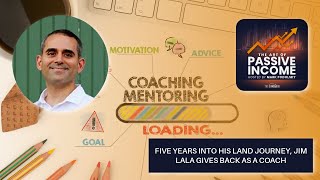
A recorded interview (YouTube podcast) in which Mark J. Podolsky interviews Jim Lala about his five-year land‑investing journey (began 2018). Jim describes starting from a 2017 bitcoin side hustle, enrolling in Scott Todd’s Flight School in March 2018, making his first land sale in August 2018, then scaling via coaching (2019 onward). He discusses customer service (70+ five‑star Google reviews), passive income milestones (progressing through $5k → $10k → $15k → $20k/month), operational lessons (mailing, marketing, outsourcing, pipeline management), risk profile (very few losses), and a favorite deal bought for ~$4,000 and sold on payments (~$32k total with $500/month). He also recommends the Jocko Podcast and points listeners to lands4u.com and Flight School (landgeek.com/forward/training).
Questions this video answers
2018 ("Since 2018, so just past five years.")
March 2018
August 2018
70+ five star Google reviews
Bought for about $4,000; sold on monthly payments for about $32,000 total (payments of $500/month for two years noted).
Chapters
Hey, it's Mark Podolski, the land geek with favorite niche real estate website, thelandgeek.com and on this week's Art of Passive Income podcast, it is my great privilege and pleasure to introduce to you our latest and greatest land geek coach. He's coming from. How many years you've been land investing Now, Jim?
Since 2018, so just past five years.
So it's five years of land investing part time. He's now getting to the point where he's going to be able to. He's already replaced his income at his, at his job, his Fortune 500 company and start join the retired club. But he's going to be giving back and is our latest and greatest land coach, Jim Lala from lands4u.com welcome.
Thank you. It's so good to be here. And you know, when I look back five years ago, I didn't think I'd ever be here, you know, joining as a coach, but I remember where I was when I got the text from you that, you know, was basically inviting me to be a coach. And I was like, holy crap. Like, I showed the phone to my wife and she was like, oh, my God, it's amazing. Like, such, such a great journey. It's been such, it's been such a great learning process. The whole business of land investing has changed me in so many ways. And when I started out, I knew that entrepreneurship would be for me. And over the five years of just going through the setbacks, the frustrations, all those things have made me so much stronger and they made me so much better. And I've learned to, you know, breathe, take a, you know, know that tomorrow's gonna come and tomorrow's a new day and the mistakes teach you. And so over the years, I've learned so much. I've become such a better professional and it's made me so much better in so many ways. So this model has been just such a boon to me and my family. So, yeah, thank you for having me.
Yeah, of course. So let's just rewind the tape. I know we've, we had a podcast a while back, but for those who are just now discovering the podcast, walk. Walk us through your journey.
Yeah. So it, it's so funny. It all started back in 2017. And in 2017, I was working at my, the same job that I have now, and a buddy of mine had tipped me off to this kind of side hustle or this kind of quirk where you could make money with, with bitcoin, basically acting as sort of A market maker, you know, buying and selling on the exchange and then buying and selling with people face to face. And there was a spread there, and you could capture that spread. And it was absolutely amazing because for the first time since probably fifth grade, I had something that I like to do. I was great at it. People loved working with me. I loved working with people. It just hit all those, you know, all those points. You know that. That phrase, icky guy, that Japanese phrase. Yeah, yeah. So. So what.
What is that?
It's like the intersection of. Do you know what that is?
The.
Can you explain it?
I. Yeah, yeah. Icky guy. I actually, you know, I don't want to butcher it. I'm just going to look it up real fast here. It is a. An interesting Japanese concept that. That basically is like, it's your life purpose. It's like defining your personal meaning of life in relation to your talents and your passions and what you can give to the wider world. So it's. It's a really. It's a. It's a very deep, meaningful concept that we all should be looking for. Our ikigai.
Yeah, exactly. And I heard that phrase from you, I think, one of the boot camps. And literally this little bitcoin business that I set up, which was me and my cell phone, it basically did all those things. It worked with my talents, you know, in finance and, you know, I have some talents in marketing and sales, and it helped me with that. It was a passion of mine to talk to people about bitcoin. And it was so much fun and it was so rewarding. And so that business was phenomenal. So that was during 2017, and then the market peaked around very late 2017, and I knew that that business was not really sustainable. And so I paid all my taxes in April of 2018, and. And I knew I had to find something else. But that experience taught me that entrepreneurship is, for me, the W2 job. The white collar, you know, world isn't for me because I did not like that work. It just didn't inspire me. It didn't play to my strengths.
Yeah.
And entrepreneurship did, to the nth degree. And so I knew that. I took the funds that I made from that bitcoin business and I said, all right, I gotta find something else, because I'm not. I'm not turning back now. Like, entrepreneurship is for me. I just gotta find, like a. A business that I can roll my funds into, and then I'm gonna do something on the side. Like, this is for me. So this is in, like, late 2017, early 2018. And that's when I listened to the side Hustle Nation podcast, and I saw. I heard this interview with Mark Podolski, and I think you had done more than one. So I'm like, let me listen to some other podcasts this guy did. And, you know, it's, It's. It's like, I'm here now with you. You know, Mark's a genuine guy, super smart guy, super humble guy. Just the warmest guy. No, yeah, it's completely what you see is what you get. And based on that, I was like, all right, let me. So I set up a call and then I, I went, you know, I. I had someone walk me through kind of all the details of it, and then I said, all right, so let me enroll in flight school. So I enrolled in flight school with Scott Todd in March of 2018. And. Yeah, haven't looked back since.
Yeah, no. And then. So then after flight school, you did go into one on one coaching. What was that like for you?
Yeah. So, so basically what. What happened was I'll. I'll start with flight school. Flight school was great. I kept using the videos even after I graduated because Scott Todd's an amazing teacher. And as an aside, he is probably one of the, like, funniest guys out there. I mean, he is so he has such, like, dad humor, and his mannerisms are so funny in these flight school videos. It's just amazing. And my wife just shakes her head because we went through flight school together. And I'm like, this guy's amazing. He's so, you know, he's such a, like, goofball, but at the same time, he's like, just insanely smart, like, super smart guy. And so I went through flight school. I didn't get my first sale until August of 2018. So it was a long time. It was a lot of, you know, I was definitely questioning it, but at the same time, I was like, well, I'm not looking back. I've, you know, burned my ship, so to speak. This business is for me. I'm going to make it work no matter what it takes. So I did that. I got my sales in, you know, first couple sales in August, and then things started rolling right after that. And then at the end of the year, I was like, yeah, I definitely want to keep going. I want to accelerate this. So then I signed up for a year of coaching. So 2019, I worked with Tate Litchfield to, you know, help scale the business. And it was good. There were challenges with, you know, working a W2 job, so trying to balance that. But the year of coaching helped build the foundation for 2020. And for a lot of people, 2020 was, I think, one of the best years for everybody. I mean, people were home because of coronavirus and people, I think, had lots of, you know, stimulus money and people were staying home and people wanted to socially distance. So 2020 was obviously a great year for I think everybody in the land business. 2021 was also. And so, yeah, that's when things really took off, was 2020 and 2021. And I still am in a. I did another support through the Lange called boardroom, where I had a little cohort of coaching graduates. And we're still in touch to this day. We meet every couple of months, we talk about what's working, what's not working, we kick ideas around. So that's very valuable. And yeah, 2022 was good. And yeah, 2023 has been good, it's been steady. And yeah, just looking to refine the process every day get better, get sharper. And it's this everyday improvement that I love so much. You know, it's also just. Yeah, Kaizen, exactly. Yeah. It's also just such a great time to be alive in terms of being an entrepreneur, being a land investor, because there's so many podcasts. Obviously there's the Lane Geek podcast, but there's, you know, the pebble podcast, there's, you know, Seth Williams podcast. There's so many land podcasts that you can dive into and educate yourself and just even podcasts in general. You know, One of my favorites is the Jocko podcast as well. Personal favorite of mine, Jocko William. Yeah, I was telling my wife, if you listen to the Jocko podcast, at least 150 episodes mean that that podcast goes so deep into some of the darkest things of human nature that it, it acts like a vaccination against, you know, whatever bad news is going on now. It's like nothing compared to, you know, what war atrocities people have had to deal with, you know, in times past. So, yeah, it's. Podcasts are amazing and coaching was phenomenal for me. It helped me and I love this business and I'm. And I'm excited to, to work with you and, and the coaching students.
Yeah, yeah. You've done a few flight school group calls.
Yeah, it's. It's so weird because one, it's. I've literally never hosted a group zoom chat, so that was, There was some, there's some technical issues. Last week, the first time I was holding it and then, yeah, I mean, you know, you do get nervous when people are looking to you to answer their serious questions.
It's.
It's definitely an interesting experience. But, you know, you can look at it like you're scared of it, or, you know, you feel the imposter syndrome, or you can say, yeah, this is going to make me better. It's going to force me to learn more. I'm going to take it on, head on and use it to make me better. So I welcome that challenge. And, you know, if there's stuff I don't know, I'm going to ask and I'm going to get back to people. But at the same time, it's like, yeah, I mean, I've been doing this for five years now. Most of the stuff I have seen before, and at the end of the.
Day.
It all comes down to, like you said, you know, mailing and marketing. And it's like an MMA fight, right? There's striking and there's grappling, and you, you know, kind of all the problems that we have in the business are a function of either mailing or marketing, and it's tuning those things. It's like, just to give another example, in jiu jitsu, they say there's no. There's no such thing as a black belt move, but there's moves that are done at a black belt level. So. Right, the same, you know, Tate, Mark, Scott, Todd, all male, the same. You know, they're all using mail to send their offer letters out, but you know, how they price it, how they do county research, how they do due diligence, how their teams function, are all kind of at a black belt level. And that's what we're all kind of striving to do, is to really dial these things in and get better over time.
No, absolutely, absolutely. So you're sort of famous for your amazing customer service. So you'll be doing deals and then you'll send me a screenshot. Like, look at the testimonial I got from this person. What are you doing at a black belt level for your customers?
What I do is I just try and treat people the way I like to be treated. It's literally as simple as that. I absolutely hate when I email someone or I call someone, I never hear back, because there are times when it's like people are trying to give you their money, call them back, email them back, and just taking care of people, making sure that they know that, you know, they're investing money to buy something over the Internet that's in a different state. Yeah, they're, they're going to have fear, they're going to have apprehension. So I want to make sure that they know that I'm looking out for them. I'm going to take good care of them. And in return I do ask them that they, you know, put in a good word or leave a good review for me. And so yeah, it's funny, I do share a lot of these five star reviews with Mark because when I was growing up I didn't always get, you know, straight A's, I didn't always get the best performance reviews at work. But it's amazing because my, you know, when it comes to serving the customers, I have, you know, 70 plus five star Google reviews and I am proud of that because it's an area where, you know, I really worked hard to take care of people and they've kind of recognized me for that. So it feels good to get those five star reviews and to rack them up and then of course to share them with you. So yeah, man, that's, I guess that's what I'm doing at a black belt level or at least I attempt to.
No. And I love seeing it. It's so inspiring. So speaking of inspiring, can we talk a little bit about your passive income?
Yeah, yeah. I mean, what do you want to know?
So it's the number because you've been doing it part time for five years. You have a full time job.
Yeah.
You're married, you have a, you have, you had, I mean when I met you, you're, you know, your wife was pregnant.
Yeah, right. Yeah, she was. Yep. At the first boot camp.
Yeah. So, so you're, you know, you're going through what's the most difficult stages of life? Raising a family, working a full time job and a, a part time side hustle of this land business.
Right, right. Yeah.
So it's, it's been a lot of ups and downs. I know where you hit these sort of barriers. Like I remember when you hit 5,000amonth passive income and then it was tough to get to 10,000amonth and then you're at 15,000amonth and now you hit that 20,000amonth barrier and going through that and each part of the business it's, it requires something more from you. Can you talk a little bit about as you hit those barriers, you hit those walls, what it takes to get to the next level?
Yeah, it just takes, you know, at the same, it's kind of two things. So it's not like it Takes anything dramatically different, but it does take continuous improvement day by day. So even if, you know, when I hit those certain passive income numbers, I did pause for a second, say, okay, what's working? And I'd say, okay, I've hit this number. Let me unlock some more kind of spending. Now I can spend more on, you know, this type of ad. I can feel comfortable hiring, you know, this type of person. And so I, at the same time, though, I don't change up too much. The funny thing is, the more you kind of scale up, you know, the more problems you have, but then the more problems you have, the more solutions you find. And the more solutions you find, that allows you to do more. So in a way, you know, problems are your friend and you, you know, you only get strength from dealing with those problems. So you really got to welcome those problems. You sometimes have to really dial it up so that there is some chaos and there is some things breaking. And you know, when things break, that's, that can be a very good sign because that tells you what you need to fix so that you can grow more. So I think one of the biggest things I've learned is just to be calm. There's no land emergencies. No one's gonna, you know, say that, oh, the toilet's backed up, you need to fix it at three in the morning. There's none of those types of emergencies. But yeah, it's just been steady growth, methodical, you know, and, and that's what I also want to do now that I'm going to be doing it full time, is zoom out a little bit and be a little bit more strategic and try and outsource. Outsource more and just be even more surgical about, okay, what am I spending my time on? What can I drop? Because there are times when I still find myself doing things that I shouldn't be doing. And so now I'm getting very good at writing down, okay, what am I doing? What can I outsource? And it's a never ending battle. And I think that's what's so cool about this business is you can use it to get better as an investor and then you can also use it to apply it to other areas of your life. So for example, my wife and I, we hire a VA from upwork to just help us with, you know, if we have things, you know, our daughter has some, some things that we, we need to give her a little bit more attention on. So we have a VA who can help us find resources, who can do a lot of Those legwork and those chores for us. And so those same principles that come from being a land investor also apply to your personal life. So, yeah, I'm, I'm super excited to do land full time, be a coach, because I'm going to extract as much value as I can from the journey and enjoy it and learn from all the setbacks and celebrate the wins.
Yeah, absolutely. So knowing what you know now, and if I'm a newbie listening to you and you've gone through this five year journey, is there something that you would have done differently?
I mean, I would have done a couple things differently. I would have, I would have done, I've. Lately I've started to do bigger deals, so I would do some more bigger deals, whereas before I shied away from those. And the second thing is I would have mailed a lot more, had a lot more offers. And even now I still have to, still have to get better at managing the kind of the pipeline. I should be mailing a lot more, doing a lot more due diligence. But it's almost like I'm hesitant to turn that dial up because my time is kind of compressed right now. So that's a challenge I have to do. I have to figure out a way to manage it so that I feel comfortable really turning that dial up and having, you know, 20 parcels and, you know, due diligence at one time. 20, you know, that are just coming in the front door, 20 that are out to be signed. You know what I mean?
Yeah.
And the analogy is like, if you have a store which has, you know, just one floor versus a department store with, you know, five floors, obviously one's going to have much more business.
Right.
And so you don't want to just be a, a small shop. You want to be a thriving enterprise where there's constantly customers coming in and out buying things. The cash register is always ringing. So it, I would say that, yeah, don't be afraid to definitely turn up the volume on the mail and, you know, be aggressive. So that, that's something I'm still working on, but it's something I should have done more of, I would say, when I started.
Yeah, I mean, we talk about this all the time in coaching meetings. That, and I really do believe this, that 80% of coaching is mental. 20% of it is the how to just the nuts and bolts of creating a process or outsourcing or delegating the county research piece of it. You get a lot of those fundamentals in flight school. But when you go into coaching and you start scaling, you have to learn how to get out of your own way. And it's very difficult mentally, I think, to make that transition.
Yeah, it is. Because at the same time, like, there would be times when I would say, look at all these things I accomplish. I would tell my wife, yeah, I mean, I accomplish all these things. And then at the same time, that is killing you because you should not be doing necessarily all those things. You should only be doing the things that only you can do or only that you need to do. So, you know, working hard, you gotta, you gotta be. It takes a lot of attention to make sure you're not just working hard, but you're working as smart as possible. So, yeah, I mean, I'm someone who loves to, you know, grind, work hard, you know, pride myself on that, showing up every day. But at the same time, you know, as you grow up in this business, you have to realize, like, yeah, you don't want to be doing everything yourself. You don't want to be working this hard. You want to spend your time trying to, you know, intelligently outsource as much as possible and try and view your business as something that someone else could buy where there's no key man risk from you being in the pilot's chair, being the only one who can, you know, fly this machine. So that's something that, you know, I still have to improve upon, but I think everybody does at the same time. And it's one of the cool things about our business. It forces you to think creatively and challenge yourself.
No, absolutely. I mean, there is no top of the land investing mountain. You just keep climbing. There is no top, but you can certainly be climbing and then enjoy base camp for a while and then absolutely, you know, look at the view and see how far you've climbed and then go to the next, the next peak.
Yeah, absolutely.
Yeah.
There's days when, you know, I might have had a bad day at work. And at the same time I'll look and see that, you know, $500, a thousand dollars, you know, more than a thousand dollars has come in from a sale I made, you know, 18 months ago. And I'm. And I'm thankful for that, you know, 20, 20, 2021, 2019, me, because he's the one that made the sale, worked hard, and now one of the kind of reframes I have is I'm looking to take care of the 2024 me, the 2025 me, you know, I'm working hard now to take care of that guy. So that guy in the future has a much easier path. He's got other things to worry about, doesn't have to worry about, you know, where his income's coming from.
Yeah. And you know, this whole model is about solving not just your money problems, but also your time problems. And I think your big challenge is going to be going from working this part time gig now it's full time and all this energy that's pent up that's been going through the W2 job is going to go all to your business and it's going to be really exciting to watch as you, as you hockey stick up your business.
Yeah, I'm really excited to, to take that on. And I also have to guard my time because I do get shiny object syndrome. And I'm like, oh, wow, what about this? What about that? And it's like, no, I'm trying to come up with a list of literally the only things that I do are, you know, the land, business, coaching, and that's it. You know, you know, when I hit, you know, 50,000amonth, you know, then I'll try something else. But you know, for right now, no, I, I gotta grow this and focus on it and you know, make sure that it's in, it's well maintained and get it where I want to get it before I start, you know, trying different ventures. But yeah, I mean it. Shiny object syndrome is totally real. And I'm sure there's people who look at our business and are just, they get shiny object syndrome for what we're doing so.
Right.
Yeah, it's one of those things that never goes away is being, you know, the grass is always greener or, you know, it's funny you, you mentioned that. One of the things that I struggle with so bad is what is it called? It's called not imposter syndrome. What is it called when you see other people posting their wins and you're like, oh my gosh, everybody's having success but me. What does that.
I mean, that's comparison.
Yeah, comparison. Yeah.
Yeah. Comparison is the thief of happiness.
Yeah, you, you said that, I think at every boot camp. And it's absolutely so true. It's. And no matter how, how well I do, I could have the best day. And then if you see the wrong thing, it's like, oh my God, that, that is completely my kryptonite. And so I just refuse to, you know, read that stuff. And for me it's like real bad. Like, even when I hear other people talking about wins, I'm like, oh, My gosh. Like, I'm just a complete failure. Like, so then at the same time, if people saw me that say, oh, my gosh, you're, you know, you're a coach. You must have it all figured out. And it's like, no, I. It's just. That's how we all are, you know, we always think someone's got it easier and.
Yeah.
It's just so funny, like, to see things. I'm like, oh, when I hit this number, everything will be solved. And then, you know, you just get new challenges and you just have to enjoy the journey and know that these challenges kind of never go away. You just learn to adapt to them.
A little bit better. Yeah, absolutely. I always like to say, it never gets easier. You just get stronger.
Exactly.
Yeah, yeah, yeah. And it's like a video game now. You're going up the next level, and it's going to have its new challenges. But can you enjoy the game of it as you level up?
Right. Yeah.
And as long as you don't die in the process. Right. It should be a fun game. And when I say die, I mean make some kind of crazy move where you're out of the game. And I think that's the great thing about the land business, too, is we're making our money on the buy. I've never lost money on a land deal. If you've lost money on a land deal.
I've lost money, I think, on a total of three, but they were like 500, $500 and a thousand dollars. And then some of the wins have been just insane, like, crazy wins.
So.
Yeah, I mean, the. The big wins outweigh the very, very, very. I mean, it's less than one loss a year, you know.
Yeah.
And that loss happened, I think, my first or second year when I was, you know, still figuring things out.
So that's crazy. Yeah. So, I mean, so it's very hard to get kicked out of the game.
Yeah.
Where if you're doing multifamily, it's easy maybe to go bk. Right. Right.
Yeah.
Bigger deals, you're going to debt, you've got investors. It's very complex. You've got all these macroeconomic conditions and microeconomic conditions you can't control.
Yeah. And then you're absolutely right. This business is in such a. It's really in kind of a sweet spot because when you started, there was probably a ton of stuff that was, you know, still manual, so maybe you had to mail in some deeds every once in a while. Maybe not everything was online, but now we're kind of in this sweet spot where there's still enough things are. There's still enough friction in the process that you can't easily just, you know. No, no. You know, you do need to get people to sign documents, which is a thing.
Right.
And, you know, you still need to do due diligence. So it's. It's not like we're in a place where things are completely AI automated, where a robot can do everything. You still need a human in there to guide things, to handhold things. But at the same time, these tools that we have now just with our cell phones are incredible. I mean, we can do so much research on our phone. We can process payments easily. We can do due diligence easily. We have the help of virtual assistants. So it really is an incredible business model in terms of right place, right time, having all these amazing tools that can do so much heavy lifting, whereas before, it would have been harder. So at the same time, that brings in competition, but at the same time, you got to stay ahead of that, and you got to always be up in your game.
Yeah, absolutely. Well, all right, Jim. So before I go, we go to tip of the week. I'm gonna ask you one last question. Tell us a story about your favorite deal.
Favorite deal. Okay, so then there's nothing, like, too fancy about this one, but I think I bought it for. I bought it for about 4,000, and I sold it for about 32 on monthly payments. So this 500 bucks a month a guy paid for two years, and then he just completely ghosted me. Just stopped returning calls, emails, nothing.
Wow. So he's 12,000 in on this deal?
Yeah, I think it was maybe. Yeah, yeah, it was about 12,000 in and then just completely stopped. So I got to resell it again, and now I'm getting 500 bucks a month again on this same property. And it's been just such a reliable payer. It's just been fantastic. And there's nothing, like, magical about that, but it's just like, wow, what a good example of how well things. Things can work. You know, I found this property, and. Great property. When I mailed it, I didn't realize that it had, you know, power poles right there. And I've gotten so many offer letters for people trying to buy it from me, and it's just been such a good property that just every month drops in, you know, 500 bucks, and it's those little wins that, you know, add up, and, you know, you don't need too many of those. Until it starts to make a difference. So that's one of my favorite ones. Just those quiet, solid, take it to the bank deals that, that I love.
I love it. All right, well, your mentorship has been phenomenal. I'm so excited for you to give back to the community, inspire the community, help them not just with the nuts and bolts of how to grow and scale a land business with the coaching, but also the mental game of it as well and having that equanimity during the ups and downs and being in the challenges of being an entrepreneur. And a lot of people that you'll be working with will be in a similar situation as you where they'll be in a full time job, they'll be growing a family and still looking to carve out time to grow their passive income as a side hustle. So I, I couldn't be more excited for the people that are working, that are going to work with you and, and see how, how you enjoy giving back and it's going to be a win, win for sure. So, so thank you. But now, Absolutely.
I'm looking forward to it.
Yeah. But now we're going to ask you for one more gem of wisdom. Your tip of the week. A website, a resource of books, something else actionable for the art of passive income listeners to go through their businesses, improve their lives. What have you got?
So for me, it's got to be the Jocko podcast, because I mentioned that earlier, but that podcast, I've just noticed over the years I've been listening to it, it's literally changed the way I view things. And the podcast, the, the podcast that he does are sometimes so dark that it just gives you such perspective. And if you hear these stories of people that have done brave things, heroic things they suffered with, just things that are unimaginably more difficult than what we have to deal with, it really does start to change you and it's really made an impression on me and that's something that I love to listen to and it, it over time has made a difference in my attitude and my mindset. So, yeah, Jocko podcast, 100% awesome.
Awesome. Well, I'll, I'll. I have listened to him, but I have, I'm not regularly. So I'll have to revisit Jocko in his very deep, intimidating voice. And he's very direct and I am in a cave and it's four in the morning and I'm preparing for my enemy.
Yeah, absolutely. He's, he brings it.
He brings it, but he's, he's Also the real deal. I mean this guy is just an extraordinary warrior. And, and then just, you know, his, his book, Extreme Ownership. Those stories are incredible. And, and just his attitude that when something bad happens, he just says good, yeah, good. And it's just, just a. Yeah, that's a great tip of the week.
Yeah, it's, it's not, what's the phrase? It's simple, not easy. So he does a lot of simple things that are not easy. You know, waking up early, you know, reading. I mean he has so many, he's written so many books, he has so many business ventures. He's ringing every drop out of life that you possibly can. And that's absolutely, you know, the right way to live your life.
Yeah, absolutely. So before we go to my tip of the week, I just want to remind the listeners we are sponsored by flight school this week. You're like surprised. What? Flight school? What's that? Yeah, Flight school is a 16 week adventure going up the mound of land, investing quickly, safely, efficiently with Scott Todd as your Sherpa is where Jim Lala had and oh, I know what you're thinking. I might build up, you know. Yeah, I'm going to create all this passive income. But what about the tuition? Well, the tuition ain't going to cost you nothing. Guaranteed you're going to make it back 180 days or less. Just show us your work, Learn more. Go to landgeek.com forward/training thelandgeek.com forward/training so my tip of the week, I've got two. The first one is check out Jim's website lands4you.com lands4u.com and then after you check out Jim's website, I was lucky enough to hear BJ Fogg, Stanford professor, behavioral design guy speak and I got his book Tiny Habits which was the number one Amazon business book of I believe 2020. So check out Tiny Habits by BJ Fogg. All right Jim, are we good?
We're good. You know, it's so funny you mentioned tiny habits. I have a habit tracker. I use it daily and it, it does make a difference. It reminds me of what I need to be focusing on and again it's, it's the whole kind of culture you built of self improvement and building your business and this business that we have that you, you teach us the model, it really can bring out the best in you and help you in all facets of your life. So thanks for being a part of my life and I'm excited to work more closely with you and the students starting in September. Well, starting now, but going full time in, in September.
Always full time September. Awesome. Awesome. Yeah. Well, I want to thank the listeners, remind you that the only way I'm going to be able to wrangle Jim back onto the podcast if you do little three little favors. Follow rate, review the podcast, send a screenshot of that review, support thelangic.com I'm gonna send you for free assigned a copy of Dirt Rich. Jim, you ready to do this?
Ready to do it?
1, 2, 3.
Let's let freedom freedom ring.
All right. Thanks, brother. Thanks, everybody.
Thank you. Thanks for listening to the Art of Passive Income podcast. Are you ready to learn how you can start building a passive income without renters, rehabs, renovations or rodents? Schedule a free consultation@thelandgeek.com training let freedom ring.
More from Mark





How to find funding partners: How to Scale Land Without Using Your Own Capital


