How Are You Setting Goals For 2022 And Communicating Them To Your Team?
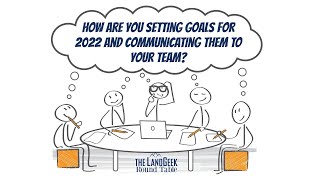
Mark J. Podolsky hosts a roundtable on setting 2022 goals with Eric Peterson, Scott Bossman, Tate Litchfield, Taria Harris, and Scott Todd. They break down annual targets into quarterly plans and specific actions like ads and mailings, track metrics in spreadsheets, and tie bonuses to sales staff performance. Tate pushes increasing property inventory; Scott Todd starts with a 3 to 5 year vision first.
Chapters
Hey, it's Mark Podolski, the land geek with your favorite niche real estate website, thelandgeek.com and on this week's roundtable, we have almost all the usual suspects. We've got the technician, Eric Peterson. Eric, how are you?
I'm good.
Good to see you. We've got the Dude Buddy Nightcap OG Scott Bossman Scott Howard.
Things great Snowy here in Onalaska, Wisconsin.
I've read about snow, I've seen it on tv, have not experienced it in quite some time. And my partner in crime, who's not experiencing any snow, I love it when you call me Big Papa Tate Litchfield Tate, how are you?
Happy, man. It's a good day to be a land investor, honestly. Woke up, had a nice bike ride, didn't set an alarm.
Wow.
Didn't set an alarm today.
I haven't set an alarm since I got an Uler in years or at least a year and a half.
It kind of goes along with our topic today, right? Like setting goals set.
Yeah, exactly, exactly. But I think if you're looking for a gift, get yourself like, like the. The Uler or the. What is it? Sleep8.com. We've got putting in the reps. Treea Harris Trea, how are you?
I'm well.
How are you guys?
It's good to see you. And last but not least, Brain the professor, your flight school sherpa, Scott Todd from scotttodd.net, landmodo.com learn anything about anything. Investorninjas.com, scott Todd, how are you?
Hey, Mark, how are you?
I'm great. I'm great. We're going to do a topic I know that is near and dear, I think, to everyone's hearts, but Tate had mentioned it. Goal setting for 2022. I can't believe how fast 2021 has been. But now it's time to get serious about setting goals. And I think instead of asking what your goals are going to be for 2020 too, because we're all going to have probably different goals, I think it'd be more interesting a topic like how do you set your goals? What types of systems or processes do you and your team use? So I know he loves going first. When Mike Zano's not here, let's just pick on Dude Buddy the Nightcap OG Scott Bossman Scott, when you're setting your goals for 2022, how do you do it and how do you communicate those to the team?
Right. So hopefully can't hear my dog barking. So I have kind of an interesting system that, that I go through about this time every year. I go back and consult kind of this master spreadsheet that I have, and it's not only for business, but it's for personal life as well. Keep track of assets, liabilities, keep track of the business, any assets and liabilities within the business, the enterprise value business, that type of thing. When it comes down to the business level, you know, how many mailings did we do monthly on average, you know, what's our monthly passive income, that type of thing. And it's kind of a neat thing because I look at where we were a year ago and it shows me how far we've grown and that helps me set goals for the future. And that's something I kind of took away from the clinic. I always used to do that with my patients. I'd say to them, you know what, let's see how far you've come compared to when you started. Oh, that's great. So that's kind of a philosophy I've always utilized and I continue to do that in my personal life and business. Personal things I keep track of are, you know, what's my body weight, what's my bmi, how many hours or how many minutes did I work out this year, that type of thing, how many books did I read, that type of thing. So, so I kind of have this master spreadsheet that I consult yearly. I enter the data, I compare, you know, compare and contrast and see how much we've grown. And that helps me set goals for the, for the following year.
I love it. I love it. And man, you've just been on fire this year with, with, with those spokes on the wheel in your life, especially with health so good on you. And again, comparison is the thief of happiness. So I don't try to compare myself to Scott Bossman in order to increase my self esteem. The technician, Eric Peterson. Eric, how do you communicate your goals and do you have a system?
Yeah, I mean, first of all, I think some of what Scott described there in terms of kind of looking at the past and what you've done over the previous 12 months is really important. So in order to do that, keeping metrics along the way becomes a key part of that. So that you're not, you know, reaching December and going, all right, now I got to look at the entire year and figure out how many mailings we sent or how many sales we made or what have you. If you're keeping those metrics along the way, it gives you a nice tool to be able to check in on that stuff. But you know, just, just like we teach our students, we operate with, with the 12 week year philosophy. So we look at it essentially a quarter at a time and we set goals according to that. So one of the consistent goals that we're always setting is, is sales goals in the land business. So, you know, I typically set those goals based on our past performance, but then I have to communicate those to a sales manager and I have to think about how can I get a sales manager or another VA in line with my desires. You know, if I want to sell 20% more properties or 50% more properties or whatever, like I can communicate that to my salesperson. But if I don't give them any type of incentive in order to help me achieve that, it's less likely to happen. So we'll put a bonus structure in place based on the 12 week year plan of achieving a certain amount of sales or a certain amount of, you know, purchases or different things like that in the business to try to keep us on track to achieve certain goals through the year, one quarter at a time or 12 weeks at a time. That's how we like to look at it.
Yeah, the 12 week year is such a powerful way to do it because it just compresses it and it does put that built in intensity with it. And I know our coaching clients really love it and it helps them make adjustments so much faster and reevaluate their goals. Taria, put in the reps. Harris, how do you think about your goals for 2022 and then how do you communicate those to your team?
So I apologize, I have a four month old here with me. So you might hear him, my nephew. So if you hear him, ignore him. So we do something very similar. We look at how we did last year. One, it's a motivator for us. If we can look back and see progress. It just makes us feel better about what we're actually doing. So we look back over the last year. How well did we do? Where did we reach goals we set? Where did we reach goals that we set? Why didn't we reach those goals? And then we put together where we want to be in a year, but then we break it down based on the 12 weeks. So if I want to have my sales goal as you know, X and how many per quarter does that mean? And then we, we back it all the way down to within. How many ads do we need to post and how many, you know, we, so we, we go that granular the same as we Teach our coaching clients. Like, if you have goals and we're setting up your goals, how do we actually reach them? And we put in steps in order to do that. We like to write out our goals so that we see them. Previously, we. I would do, like, vision boards and things like that. We haven't gone that far with our land business, but we do like to write them out so that we can actually see them and view them. And as we're reaching them, we like to kind of check off. Okay, yes, we hit this goal. So it's also another motivator for us as well.
I love that there's no better feeling or there's very few better feelings than checking something off. Isn't it even just like when I go to Costco, just check off. I got eggs. It just feels good.
It's productive, right?
Productive. It's productive. Big Papa Tate, Litchfield. How do you set goals?
We do pretty much what everybody else discussed here. We're looking at the past. To help us set goals or predict the future. One of the goals that we're going to focus on real heavy, is buying more property. I want to buy more property in 2022 than I ever have before. Whether that means I'm buying from other investors, whether it means I'm doing more mailing, I want to increase our property holdings. And I want to do it by a lot, because I've realized that there's a direct correlation between sales and inventory. And so I know that one way to help my team sell more property is to own more property, control more assets. And so that's one of our main goals that I'm going to be focusing on. I know that everything else falls into place for us, at least in our team and our system, when we have a full list of inventory on the shelves, the way that we're going to do it, we're going to go to places where we've had success, we're going to repeat it. Pretty simple. I'm not. Not reinventing anything over here.
I love it. I love it. And last but not least, Scott Todd, how you setting goals?
You know, Mark, one of the things I do that's a little bit different is instead of necessarily starting off with what I want to accomplish, like next year or in the next 12 months, what I like to do is I like to start to think about, like, okay, well, what does my life look like? What do I want it to look like?
Right?
Like, what are the big things that I want to happen in my life? And it's not Just next year. It's ever like ever, ever. Okay, so let's just say that, I mean you can pick it, you can pick weight, you can pick net worth, you can pick relationships, all of those things that you might want to pick. And what I'll do is I'll start to sit down and think, okay, like three to five years from now, what do I want that to look like? And then what I will do is I don't necessarily have a specific goal that says next year I will achieve X. It's more of I'm working for those bigger things and I'm not necessarily worried about whether it gets accomplished next year or not. What I'm looking at is the bigger picture down the field a little bit. And the reason I'm trying to do that is because that bigger picture stuff will drive me more than a goal for next year or next quarter. And the problem with the goal for next year next quarter is this. If I get behind, then you get deflated, you get defeated as opposed to, you'll always, with the right time horizon, you'll always achieve those goals. So I like to think about the bigger picture and start working towards those bigger things. They always talk about smart goals, specific, measurable, actionable, realistic, realistic with a time. You know, the thing is, is like that time doesn't have to be one year. In a corporate environment they tell you make your smart goals for next year so you can get evaluated. Yeah, that doesn't work too well when you run your own company. I don't think so. I like to think of the bigger picture and the longer term, longer term piece. And you'll be amazed. I mean, if you go down that path, you'll be amazed at how farther along you are at getting that goal quicker than doing it year by year and going well, I want to do that in five years. Why not this year?
Why not now?
Do it now.
Yeah, I love that philosophy and I've actually started to adopt something similar where I'll talk to the team, like, look, we're going to set goals and our time horizon is 20 years. 20 years, okay. Takes all the pressure off. And in that sense it also, I know that it's not going to take probably 20 years if we want to 10x the business. And then Scott, while we were talking, I was looking at this diagram that I'm going to share with the community when I'm doing my digest, which is the six spokes of a wheel. Right. Think of a wheel and if one of those spokes is missing, well, the Wheel continue to roll. Okay. It might be a little bumpy. Two spokesman. Yeah, still a little bumpy. But three spokes, that thing's not going to roll real well. Tate, you know, understands from cycling. So I'm looking at, you know, body like my health. Right. Do I have to have a six pack like Scott Bossman? No, but I want to be healthy. Right. Mind, Do I want to have a calm mind, a clear mind? For sure. Love in our lives. Absolutely. Or love relationships. One of the spokes in here that we don't talk enough about is play. How much play are we getting? And then of course money, because money is important. Absolutely. And the last is our work. Are we purpose at work? Do we feel like we're growing as a person at work? Um, and are we achieving our work goals, those types of things. And so for me, I'm looking at all those, those spokes and like 2021, it was all great, right? It all, it all sort of was, was kind of came together for me, but can't take that for granted. Want to set really good goals for 2022 as well and think about the things that money can't buy, which is, you know, can't buy me a calm mind, can't buy me a fit body, and it certainly can't buy me a house full of love. So these are like the three major goals. And then of course, as we talk to the team, that 20 year time horizon and accomplishing the goals and what that needs to support the business and then I'm just there to support it. So I thought this is really helpful and valuable way for people to think about goals. Goal setting. You can do everything from the 12 week year all the way to a really long time horizon or a hybrid approach as well. They're all effective. I think the one thing that you probably wouldn't want to do is not have any goals because whatever is not measured is not managed. So have something for sure. Just a little shout out to our sponsor today, which is flight school. Learn how the next 16 weeks can transform your life. Go to Lanceek.com training schedule, a call and learn more how to start building that passive income for 2022. And of course we're going to go to tip of the week, a website, a resource, a book, something actionable for the auto passive income listeners to go improve their businesses, improve their lives. Dude, buddy. Scott Bossman, what do you got?
I voluntarily took one for the team here because I have a book that really applies to what we're talking about. It's called the Gap and the Gain by Benjamin Hardy. And what it talks about is measuring your progress in life in the gain instead of the gap. So many of us think about the gap in all of our failures, all of the, you know, if something negative happens to you during the day, we focus on that and you're in the gap. Right. Well, you need to spin it. And there. There's actually a psychological term for this, too. I think it's called cognitive flexing or cognitive flexibility, something like that, where you take a negative event and you spin it. But you can do that really, with any. Any event in your life, whether, you know, whether it's family or work or a job change or anything like that. But they also talk about how to set your goals in relation to where you were compared to where you want to be. And when you look at progress in that way, you're in the gain. So when I look at where I was a year ago in my business, my health, that type of thing, and see how much growth I've experienced over the last year, I'm in the gain. And then I can use the. My current mindset to help set goals for the future. So it's a great book. I would appreciate. I would recommend it.
I love it. Benjamin Hardy, he's got how who, not how gap in the game. There's, like, two other books you recommended to me. That guy's on fire.
He's great. Yeah. Willpower Doesn't Work. Is good.
Willpower Doesn't Work. There's another one that I read. Anyways, he's got a bunch of really good books. Anyways, I want to thank the listeners. Remind them the only way that Scott Bossman is going to continue to recommend great books to us is if you do us three favors. Follow rate, review the podcast, send us a screenshot of that review. Supporthelandgeek.com I'm going to send you a signed copy of Dirt Rich, which right now has a value of 1.2 million crypto dollars, according to the latest finance exchange that I've been checking. So there you go, Scott, you're wondering.
No, never heard of the crypto dollar, but all right.
I guess it's one you just made up.
I made it up. Why not? Fine.
You could have said, like, dogecoin or something. I mean.
I didn't want to lose the listeners.
He's part of a Shibu Inu kind of guy.
The minute that you said 1.2 billion or a million, whatever you said, you lost them. Okay, like, seriously, you lost them. But that said, you do whatever you want to do. It's your show.
You know what? I'm gonna. I'm gonna reframe that comment, and instead of being hurt by it, I'm gonna say, I am really grateful that I get to spend that time with all of you, even if once in a while I get insulted.
There's no insulting.
I'm just perplexed by the currency, that's all.
It's fine. It's fine. We get to do this. I'm grateful.
Yeah, shut it down, because I have a brisket on the fire right now.
That hurt. All right, let's do this. 1, 2, 3.
Let's let freedom ring go.
Enjoy that brisket, Scott. Todd. Go enjoy.
Thanks for listening to the Art of Passive Income podcast. Are you ready to learn how you can start building a passive income without renters, rehabs, renovations, or rodents? Schedule a free consultation@thelandgeek.com forward slash training. Let freedom Ring.
More from Mark





How to find funding partners: How to Scale Land Without Using Your Own Capital


