How To Build A Massive Audience And Be Successful With Content Marketing
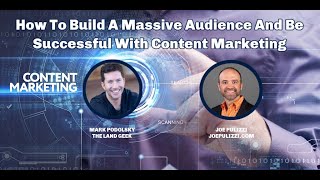
Joe Pulizzi explains why most content marketing fails: people try too many platforms instead of owning email, skip the niche, and quit before consistency pays off. He recommends picking one or two channels, finding your content tilt, and committing to the work.
Questions this video answers
December 2, 2021.
May 2021.
A lifetime achievement award from the Content Council (2014).
The novel The Will to Die was awarded Best Suspense Book of 2020 by the National Indie Excellence Awards.
Over 35 states.
Chapters
Hey, it's Mark Podolski, the land geek with your favorite niche real estate website, thelandgeek.com and on this week's podcast, I'm gonna put on my anchorman voice. He's a big deal. But before we talk to our guest, I'd be remiss if I didn't properly introduce my co host. You know him, you love him. The brain, the professor, your flight school sherpa. Scott Todd from scotttod.net landmodo.com learn anything about anything. Investor ninjas.com Scott Todd how are you Mark?
I'm great. How are you?
A little intimidated. A little intimidated? I'll be honest.
Why?
Why are you intimidated?
Because today's guest is Joe Pulitzi who if you're not familiar with is the Amazon best selling author of Content Inc. Killing Marketing and Epic Content Marketing which was named a must read business book by Fortune magazine. His novel the Will to Die was awarded best Suspense Book of 2020 by the National Indie Excellence Awards. Joe's latest version of Content Inc. Will be released in May of this year, 2021. He's founded four companies including the Content Marketing Institute and his newest launch, the tilt. In 2014, he received a lifetime achievement award by the Content Council. His podcast series, this Old Marketing, which is with Robert Rose, has millions of downloads from over 150 countries. His foundation, you know you're a big deal when you have a foundation. The Orange Effect delivers speech therapy and technology services to children in over 35 states. Joe Polizi, welcome.
Mark, I can't believe you got through that whole thing without, I mean a pro approach the whole way, my friend. Thank you. I would have just stopped you. We could have just forgot about the whole intro stuff. But know it's all good.
No, I'm, I'm, I'm happy to do it. So Joe, let's just rewind the tape.
Sure.
And how did you become passionate about marketing and specifically content marketing?
I mean I. So take it back, take it back 20 years. I started in publishing, worked for a large business to business publisher and as luck would have it, I was fell into an apartment called Penton Custom Media. And basically what we did, instead of selling advertising, instead of selling what normal media companies do, we were in charge of helping them tell better stories. So we would do things at the time, custom print magazines that led into blog programs, webinar programs, whatever. And I fell in love with the idea of, well, instead of interrupting your customers with advertising and sponsorship, why don't you just start telling Better stories, create better information, and start building an audience around that. So I had the pleasure of doing that for seven years and then got the entrepreneurial itch and launched what became content marketing institute 2007. And the whole idea was to focus on how do we teach businesses of all sizes how they can tell their own stories instead of things like advertising, create an audience, and then monetize that audience multiple ways. And that's what I've been doing for 20 years now, and all the books and podcasts and everything, and probably now excites me more than anything because there are no barriers to entry anymore. Anyone can publish anything for either free or very little amount of money. And if they consistently deliver value to a niche audience over time, you can actually build a sustainable, scalable business. And that's what I love about what's going on right now in 2021, because anything is possible if you have the grit and patience to do it.
I love it. The grit and patience to do it.
Scott.
Todd, what are your thoughts?
You know, I was just kind of curious, Joe. Like, you know, when you start to think about, like, content marketing, it's so easy to just, you know, in the beginning, like to come up with some ideas, right? But to do this on a sustainable, consistent basis, how do you do it? How do you continue to produce content that's relevant to that niche?
Well, you know, it's a great question, Scott. I think the most important thing is what a lot of companies do is they start off so broad and they say, I want to reach engineers. And I will tell them, well, you're never going to do that because engineers is way too big. There's millions of them all over the place. I said, what can you focus on an audience niche where you can be the leading informational expert in the world. And once you figure that out, like we did, we said, okay, we're going to target marketing professionals that deal with exclusively content in larger organizations over generally $1 billion in size. Well, once I get that audience down, I can say, well, what are their pain points? What keeps them up at night? And we would set up things like listing posts, and you guys are used to this, but you say, okay, well, three, do I listen on Twitter and Facebook and can I do surveys to them? And can I call them up on the phone and talk to them or send emails? And I want to list all those pain points and what they're dealing with every day? And then from those pain points, that's where your content comes from. And honestly, once you get to Know your audience really well. You can easily. I mean, I could write down right now 50 different questions that they're dealing with and how I can answer that through content, whatever that content platform might be. It could be, it started out as Content Marketing Institute, as a blog. It could be a podcast like this one, could be an event series, could be a magazine, could be a YouTube series, whatever. But then you take those challenges that you are going to create information from, and then you focus on being great in just one platform. And that's the other thing that everyone fails at, Scott. It's just they're like, oh, they want to boil the ocean with their content and send it everywhere. Which is fine if you, if you're at the New York Times, if you're Huffington Post, but if you have limited resources and you're an entrepreneur, you want to just focus on being great at one, build an audience there. And then once you build a minimum viable audience, then you can expand that to other areas.
Yeah, Scott and I were just having this conversation about Clubhouse. Like, I don't know if I. Why don't we jump over to Clubhouse now? It's like the whole thing, I know, it's.
It's crazy. And that's just taken off. And I, I did my first little clubhouse thing on Saturday just to see how it was. And I can see there's an opportunity. And actually, anyone listening here, there's a first mover opportunity there because there's whatever, what, six, seven million people there now. It's growing like crazy, but still a small number if you think about social media. But in that case, let's say that you were an entrepreneur and you're like, okay, well, I'm targeting venture capital companies. Well, great, there's venture capital companies, there's an audience on there. You might have to decide, well, maybe that mediocre Twitter channel I've been doing, or that horrible YouTube channel, or the terrible Facebook group I have, maybe that just needs to stop. And I will put my content energy into Clubhouse. So that's. Or make the decision that you're not going to do Clubhouse at all and focus on being better at Twitter. Whatever the case is, I'm all about less is more. Focus on one or two key channels to be great at and just forget the rest instead of doing mediocre C minus content in 10 different channels.
Yeah, I love it. Joe, where were you when I started Land Geek?
It's tough though, isn't it? I mean, that's. If you, if you talk to most entrepreneurs that are starting this thing and you do. And we all deal with entrepreneurs. They're like, oh, my God, this is so overwhelming. What am I gonna do? And I gotta do this Facebook thing and Twitter and LinkedIn and God help us all. Do I have to do TikTok too? And do I have to. Should I do an email newsletter and a podcast or two podcasts? And I'm just like, slow down. No. First of all, it's not about you, it's about your audience. So let's focus on that for a long time and get you, like, where can you be that leading resource for the audience? And then just focus on one thing. And people will ask, well, how do I pick? And usually I start out with, well, what you're. What are you good at? I mean, if you're really good, you've got a radio voice. Like, we're all talking here now. Maybe it is a podcast. If you really like to write, maybe it's an email newsletter. If you like design, maybe it's Instagram and you're going to do infographics. Those are the types of things that you figure out what you have a skill and desire to do and then you can figure out what that platform is.
I love it. Scott.
Todd, one of the things that we see a lot happen is you can call it shiny object syndrome with a platform, right? So as an example, just the other day someone was saying to me, you know, oh, well, so. And so, well, he's building this audience and he's doing it over on TikTok and he's got, you know, like a million views over there. And so I'm going to go over there because he's having success over there. And, you know, like you said, like, they may not have had success somewhere else, like Instagram or Twitter or Facebook, whatever. So then all of a sudden somebody else is having success on another platform doing what they're doing. Should I now pick up and emulate that? Or like, how do I pick the channel? And I know you just kind of talked about it. Is it radio or, you know, podcast or whatever? But with the social media channels, it's so easy to chase it. And like, I like what you said. Pick one, master that one, and then like, move on.
So let's say it's. It's early days. I mean, if for. I mean, I remember my friend Jordan Lapley. He was the, he did the evolution of dance on YouTube. He was early. He was. I was one of the number one videos for a while. He got first mover advantage. It really worked for him. And great. Now a lot of people followed that and fell on their faces and didn't do anything because they have to figure out the YouTube algorithm. What I think the most important thing, if you're an entrepreneur, you have to realize that you've got a hierarchy set for subscriber relationships you could have with your audience. So at the very bottom, like the least valuable thing that you could do is starting a Facebook group because you don't own those connections. Facebook does, doesn't mean that it couldn't be valuable for you. But you got to remember that's at the bottom. You have Facebook, you have YouTube, you have LinkedIn. That's all rented land. You guys know all about land. This is where you're renting land on other people's platforms. So if you rent land from somebody, you have to go to own at some point. So you have to move up the scale, up the hierarchy and hopefully get to email at some point where you have an opt in relationship, you have their email and you can talk one to one with them. But sometimes it's better to start where the audience is. So go back to your original question. Where's your audience at? If you're targeting middle aged, middle income people in North Dakota, they might not be on TikTok, they might, they, they've never heard of Clubhouse. So we're not going to start anything there because our audience isn't there. So figure out where is your audience at first of all. So if you're going to target Gen Z, you're not talking Facebook, they're not on Facebook. They think Facebook is for boomers. So they're not going on Facebook at all. So those are the types of things we want to look at. I think it's really important though when you get in and you make a decision. So let's go with YouTube. A lot of people have had success on YouTube. You got to remember you can build a million subscribers on YouTube and have a hundred thousand views, but at the end of the day, you don't own one of those subscribers, you don't control any of those algorithms. So great, you've been able to build this on YouTube. What are you going to do and transition over to so you have more control over that data. And that's where my favorite, I'm an old time guy, but my favorite and still today, if you said what's my number one choice to do something is an email newsletter. But again, email newsletter's tough because there's no audience there. You have to do a lot of work to get people to sign up to an email newsletter. So that's where you might start on a social channel, build your following, and then have that opt in that call to action. Go to an email newsletter.
Mark. It's funny because I was talking to someone the other day and they were telling me that they had, like, one. I think they said that they had like a 1.2 or 1.3 million subscribers on YouTube. And it sounds fascinating, right? Like, wow. And then they said, yeah, I've been working hard to get them to get their email addresses, giving lead magnets and all the other stuff. Right. Stuff that we do. And I said, well, how many people do you have on your email list? And they're like, well, we got like 100,000 people. Okay. So it just kind of shows you that just because you have 1.2 million subscribers doesn't mean that that translate translates over to, you know, email. And then, as Joe said, you're at the, the mercy of the. Whether it's the algorithm or the platform. The platform. I mean, look, we all know, like, if the platform doesn't like something that you said, you could be gone. I mean, there's, there's, there's proof of that. Okay, so you could just have your entire account wiped away with like 60 million Twitter followers is gone.
That's right. No, it's a great point. That's why you have to just remember. And that's why I said, there's nothing wrong with social media, but it's not your media. It's somebody else's media. It's that. It's Twitter's, it's Facebook's, it's whatever. So you just have to keep that in mind. And, you know, you're the product, you are the product onto it because it's. Since it's free, you are absolutely the product. So what do you have to do? If you're thinking like an entrepreneur, a media entrepreneur, content entrepreneur, you're gonna have to focus like that YouTube example that you said. Now, if they've got 1.2 million subscribers and they've transitioned that into a hundred thousand email subscribers, that's fantastic, right? That you can monetize 100,000, especially B2B company in eight different ways. You can make it through affiliate revenue, paid sponsorships, paid subscribers. You could launch your own products, you could launch your own consulting services. Lots of different ways to generate revenue off of that. So that's why, you know, step number one, if we talk about the Content Inc. Methodology, is you got to build that audience. And once you build a loyal email following, you can create all sorts of revenue. So we say, don't get stuck on, oh, my God, I'm not making money yet, because what you want to do is, oh, do I have a loyal audience yet? Substantial enough, which generally tends to be about 10,000 emails if you're a B2B company, tends to be 50,000, 100,000 if you're a consumer company. And then you have enough that you can actually get a fair percentage of those to convert over and buy something that you offer. But I would say audience first and then products is a heck of a lot easier than going products, not having the right product fit and then just figuring out all that didn't work just to build the audience. And if the audience, if you're loyal, if they trust you and they're a loyal audience, they will absolutely tell you what they want to buy from you, and then you can go ahead and create that. It's just a lot of people don't do it that way, but it's just a lot easier.
Right? This reminds me of the Kevin Kelly. A thousand loyal fans. Yeah, a thousand true fans.
Do you.
Do you believe in that? Or do you think It's. You need 10,000 true fans?
You start with one, you go to 100. You know, you work on that. You're still always working, working it out. I mean, I don't know why. I'm sure you, when you two started the podcast, you were pros. But when I started my podcast, I was terrible. And I may still be terrible, but I'm not as terrible as I used to be. So you just kind of work on it. You're always working on the craft of your content creation, and you start where you start. So when you get that one audience at 10, you get 100 listeners. That's great. You're really. That's wonderful. Then you keep working on. You get to a thousand. I started after I left Content Marketing Institute, I restarted a newsletter, and it took me a year and a half to get to a really hard work to get to 10,000 email subscribers. And I had a. I have a pretty good Twitter following. I already had a different base, so it took a long time. But I love every one of those subscribers and I love getting a 40% open rate on those emails because I know they care about it. They email me back. So, yeah, Kevin Kelly's right. It doesn't matter. I don't know what that number is that. I call it a minimum viable audience that you can actually generate Some scalable revenue off of it. You start with what you start with and then move from there. You always want to generate revenue as quickly as possible, but sometimes you want to wait and say, I'm just going to focus on being great for this audience. And once I'm great for it and they start loving what I'm delivering, the opportunities for revenue will, will be right in front of me. It just sometimes we said patience and grit at the start. Sometimes it's tough to wait. That's the toughest thing. Most people give up before they get to that point. And it takes 12 months to 24 months really to start moving on this business model. And some people aren't willing to wait that long.
Yeah, no, it's so true. You know, Scott and I talk about this all the time. So Joe, what's some of the worst advice you see or hear given in content marketing?
Well, we talked a lot about it. One is that they say, well, in the social media age you don't have to be consistent. That's absolutely not true. Number one thing is you're going to deliver, deliver consistently. And that means if you have an E newsletter, weekly E newsletter, you send it out on the same day at the same time every week and you don't stop because once you stop, you've broke that promise with that audience and now they've probably gone, you're going to lose some people, they're going to leave. So that's the one thing. The second thing is I hear it all the time. I have to be everywhere my customers are at online. Well, that's the biggest crock I've ever heard in my life. That is not true. You absolutely should choose. And strategy is all about saying no to things. So when we go in, and in my past I usually did content audits for really large billion dollar companies that had all kinds of, they were doing content everywhere and we would go in, we do a content audit, which is basically what are they doing? Who are they targeting? What's the state of the content marketing business? And we never, and I've been on 50 of these engagements and we never had them create more content than we're creating. We always had them create less. And that's the big thing that a lot of people don't get. They think they have to create more. It's actually have to create less, better, more targeted. So we would go in and we'd say, look, you have to kill these, these 10 channels. You have to kill that E newsletter. Why are you even doing that? E newsletter like, did somebody come up with that three years ago? Like, like, get rid of that. That's not doing anything. You're just spamming people all the time. You've got seven YouTube channels out there that are doing absolutely nothing that you're distributing. Whenever you get like, you'll see some. I'm sure you see this. They have a YouTube channel and they'll upload three videos in the same day and then nothing for months. Well, that doesn't do anything. That'd be like getting your newspaper and them sending you three full copies of the newspaper on one day and never showing up again. It doesn't. It makes no sense. But that's how we do content because we don't understand how Media 101 works. So it's the consistency. And the last thing I would add, and we call this the content tilt is whatever. When people start their content journey, they think, okay, I know what I'm good at, I know what my skill or expertise is. And then we focus on the audience, what's their pain point? And that coming together, the intersection of that is what we call the sweet spoil sweet spot. That start step one. But nobody goes to step two, which is the content tilt. And that's. How do I find an area of differentiation on the web with all this content that I actually have the possibility to break through all this clutter? Nobody does that. I'll give you a really good example. Type in cloud computing in Google and what you will see is you'll see Microsoft and Oracle and Salesforce and Amazon and they have all their cloud computing sites. And I guarantee you, you can take the content and move it from one to another and you'd never be able to tell that it's any different because it's not. It's all the same stuff. And when it's all the same stuff, nobody cares. So what you want to figure out is what's that area of content differentiation? So that could be. We talked about audience before. How can you really refine on that audience niche? Or maybe you have an amazing personality like Joe Rogan does with the Joe Rogan experience. And he's a comedian and he's got just a great take on everything. He's really, really well read. That's what he brings to the table. So figure out what that differentiation area is for us. I mean, ours was calling it content marketing. You know, before we started in 2007, nobody used the term content marketing and we decided use Google Trends. I used some other tools. I talked to a lot of chief marketing officers out there. And I realized marketers aren't going to pay attention to this stuff unless you call it something marketing. It used to be called custom publishing. And when I'd go in and sell custom publishing projects and I'd say custom publishing, the CMOs are already asleep before they're like, publishing, that's boring. We don't do that. But if you say marketing, like search marketing, direct marketing, social media marketing, then they're like, oh, I must, I need to do that. I'm a marketer. So we just changed the term and everything took off from there. So sometimes it's changing that term. HubSpot did a really good job. They called it inbound marketing. And HubSpot's whole program took off from just being the experts in inbound marketing. They created an event called Inbound. So figuring out what that differentiation area is, you should spend weeks and months and sometimes it takes a while to figure that out, depending on who your audience is. But that's really, really critical.
I love it. Scott. Todd, your thoughts?
One of the things that Joe mentioned was he talked about, like, the consistency, right? Like showing up all the time. And I've just kind of been thinking about that since he said it. You know, he basically gave the example. If you, if you posted like 3, 3 posts in one day and then you don't, you don't go, you go missing for weeks, well then you let them down. And I'm just kind of curious, like, you know, there, there is kind of some, some mindsets that says, man, when I get someone on my list, because like, you, you work for these people, right? Like, you work to get the name.
Sure.
And then people are always afraid of, like, oh, well, I'm gonna, if I email them too much, well, then they're gonna unsubscribe. And I would just love to know, like, okay, can you email your list too much? I mean, is it too much to email the list every day? I mean, people do it. Should it be once a week? Or what kind of consistency should I put in there? And then two, what's your opinion when people unsubscribe?
So the first part is I would answer if it's all. If you're always sending something relevant and valuable, they will never get tired of it. If you send something valuable to your subscriber every day, that it's going to help them get a better job, live a better life, make money, whatever, whatever they're doing, they're going to love it, they're going to open it every day. And we've seen this work with email newsletters like Morning Brew and the Hustle that have gone from zero to millions of subscribers. They are daily newsletters. They work really, really well because every day you open it up and it's valuable to that readership. So that's really important. Now, is daily too much, like, for me and my audience? Absolutely. I don't think that. So I would look at, okay, maybe two times a week, maybe Tuesday and Thursday is the right way to go. But what I would do is say start with something as infrequent as you can with the resources you have to be great. So let's say that you want to do an email newsletter. And Scott, you're working on this email newsletter and you're like, well, what should be the frequency of that? And I'll say, what with the resources you have, what can you be absolutely the best in the industry at? And you'd say, well, I could probably do weekly or every other week and be the best and have the time and make the time that this email newsletter is the best. I'm like, okay, that's where we're going to start. So we start every other week. And then you can always get more frequent as you add more resources to it. It's very hard to go from like a daily to a weekly to every other week because you've lost them. So with an email newsletter, monthly is absolutely the minimum frequency. If you do court, you can't do quarterly email. They'll forget about, they'll forget that they even subscribe to it. Even monthly is stretching it. I would say every other week. You have to at least do something every other week consistently. I love weeklies are my favorite. And then you're seeing the dailies as well. So I would always say, if you are on the content audit team, you look at that piece of content on a regular basis, you say, well, is this really valuable to our audience? Are we trying. Are we kicking in too many sales pitches in here? That's not, not going to work. Are we doing too many links and then abstracts out? That's making them work too hard, like ask. Those types of things can never ever be too frequent if it's valuable. And that's, I think that's the challenge, Scott, because what people realize when they look at that, they're saying, yeah, art needs E newsletters. Terrible. Like it already. And I'll, I'll go when I, when I'll do these audits, I think the worst thing I see, like they'll be doing okay with YouTube and they'll do okay on social. The worst content in any organization is the email newsletter, which I don't understand because it's the most important in my opinion. So I would say right now, look at that email newsletter, do an audit and what are you doing wrong? Like I see all these short abstract link, short abstract link, short abstract. Well that, that's Pat. That was, that's two years ago. Model. The model today is people want to stay in their E newsletter. They don't want to have to click through anything, get what they get and go. So that might change tomorrow, but right now that's where we're at. So I think it's just understanding that the audience just wants to get better. They just want to make more money and your sole job is to accomplish and solve those pain points they have.
Well, I can tell you right now, I'm just in a shame spiral right now, Joe, because I'm not doing it personally.
Nobody does, Mark. That's the thing. And that's why, I mean I have to remind myself of these things. Like because sometimes what I'll do is I'll be putting my E newsletter together. I'm like, okay, I got my new book coming out so I want to lead with something. So I'll lead with something about the new book and then I'll try to make it relevant and I'll go down and then I read it and I'm like, this is self serving crap. Like I know I can't do that because I am absolutely going to have people unsubscribe. I even forgot about your other question, Scott. You will know right off the bat you should be looking at your unsubscribes because you'll know when you start throwing out content that does either content that doesn't work or inconsistency. I've seen subscribes happen when somebody will move from sending on a Tuesday to a Thursday and people don't anticipate that that shocks their system. It's like, okay, I don't like it there. Get rid of them or how did I get on that list? They look at it as a different subscription. Like why is it coming a different day? All kinds of things that get into the behavior of engaging in content. So I look at all my unsubscribes. It's almost like you feel good about your subscriptions but you feel even worse about your unsubscribes. Like, oh, what did I do wrong? So you know, you figure out sometimes, even if you can if you put in the feedback about while I unsubscribed and look at that, that's really important feedback because they will tell you see enough value, or they'll even say, oh, it comes too often to me. But that means that they didn't see enough value.
Right, Right. Well, Joe, this, the mentorship has been invaluable for this podcast, but we're at that point now where we're going to ask you for your tip of the week, a website, a resource, a book, something else actionable for the art of passive income listeners to go improve their businesses, improve their lives.
What have you got? Well, I'll throw out a couple books because as an online guy, I try to stay off online as much as possible. So the book that I use as an entrepreneur that helped me through all sorts of issues was Think and Grow Rich by Napoleon Hill. And the big lesson in that is writing down your goals and reviewing those goals on a regular basis. That's my. That's my secret. That's not a secret to success in entrepreneurship is I write down my goals. I have five or six main goals for every year that I look at, and I review them every day. And when you review them in the morning, you do different things based on those goals. So that one and then a new book. So that was written in, I think in 1937. So it's low, old. It's very chauvinistic. Go to today's book and I, I'll tell you what, I was so surprised, guys. I had low expectations on this book, but it was Green lights by Matthew McConaughey. I really thought, I don't know if you guys have read it. I'm like, I have it on my list. Yeah. I said, there's no way this could be a good book. It's gotta be trash. And I read it, and believe it or not, what he did wrote down his goals on a regular basis and reviewed them. Same thing as the. I mean, and if you. It's funny because you see, he wrote down his thing in 1992, and one goal is to win best win an Oscar for best actor. And you see him writing that before he took his first role in anything. And it's just like, that's the kind of thing as an entrepreneur. By the way, great lessons. I learned a lot about myself reading, reading that book. So think and Grow Rich. Napoleon Hill, green lights, Matthew McConaughey. And the real, the focus of that is goal setting. Goal reading is really key.
Goal setting, goal reading. Before we get To Scott Todd's tip of the week. Just have to give a shout out to our sponsor, which is flight school. Learn how the next 16 weeks can literally transform your life. Start building that passive income machine with Scott Todd taking you personally up that mountain of land investing. He's done it thousands of times. Do it quickly, safely, efficiently. Oh, that tuition, you're going to make it back guaranteed. 180 days or less. Just show us your work. That's how confident we are. Learn more. Go tolandgeek.com training thelandgeek.com training get on a free consultation and find out if this niche is right for you. Scott Todd, what's your tip of the week?
Mark? Sometimes you just need a quick resource to go check things out. Whether it's a quote of the day or side of the day, whatever. Sometimes you need something. Check out this website. I've kind of gotten some value out of this in the last couple days. It's called the reference desk, refdesk.com and what's cool is, you know, they have like a side of the day. They also have like a fun fact, thought of the day, books of the month. But you can go in here, you can get headline news, money, stats. It's kind of like this all in place. It's kind of a jumbled mess, but I like it.
You know what it, it reminds me of 1987 when you go on.
Yeah, right.
You know, yeah, it's, it is just a breath of interwebs. Nostalgia.
Yeah, right. I mean, like, but like, if you look over it, you know, you get headline, ap, headline news on the right side, some featured resources in the center, you know, and today's birthday. I mean, today was William Harrison's birthday in 1773. Who knew?
Look at this. Thought of the day. In three words, I can sum up everything I've learned about life. It goes on Robert Frost. You know what? This isn't so bad.
You know what?
Once you get through the shock of the horrible gooey.
Yeah, yeah. Here's what it shows you. Two things. One, it shows you that beauty doesn't necessarily matter. When you add value. That's the most important part. Joe will, Joe will agree with that. So you don't, you don't have to be beautiful if you're adding value to the world. And then the other thing too, Mark, is if anybody's ever in a pinch for a tip of the week, we have it right here. They just got to go to this website. So if any of the land geek coaches are like Struggling.
I got it.
I got them.
Where's the tip of the week? I'm looking at it.
Oh, March. This is our little secret. Like when the coaches are struggling, all we have to do is come here to this little link. We either have a side of the day, a fact of the day, or a thought of the day or book of the month. Like it's all right here for us, brought to us by this website.
All right, well this is fine, but my tip of the week is actually going to change your Life, which is JoPolizzi.com no one can spell Pulizzi, let alone pronounce it. I will have a link to go there, check out Joe's newsletter, the books and honestly, like if you're, if you're after listening to this podcast, like, well, I don't, you know, okay, I understand, like I have to deliver great value, but what does that actually mean? Like where do I find these ideas? Joe's got you covered. Every aspect of marketing. He has you covered. So again, go to joepolizzi.com and really take your marketing. And when I say your marketing, I'm talking to myself actually. I'm gonna just go there every day and take my marketing to the next level. For those of you that have been getting my emails about five times a week, I apologize that if they haven't delivered enough value. But now I'm refocused, remotivated to do it the Joe Pulitzi way. Less is more, more quality and left less self serving crap. There you go.
Although we'll see on Clubhouse this week. Right? Right.
As soon as the podcast is done. Scott and I are jumping on who wants to talk about Joe Pulitzi?
Do as I say. Do as I say, not as I do. I'm going on every platform from here on out.
Exactly. Joe, are we good?
Yeah, absolutely. That was fantastic. The one thing I would say is if people don't want to go to joepolizzi.com just I just wrote a free book called Corona Marketing and I give 13 tips on how to come out of this recession from a marketing standpoint a little bit better than you went started. So go to coronamarketingbook.com it's absolutely free and I think you'll get something. And a lot of the stuff we talked about, focus, the content, audit, some of these things we talked about on the podcast, I go through those step by step.
Corona marketing book.com book book.com I have to get it before Scott. Todd, that's all I can. So not a problem. Scott, Todd, are we good?
We're good, Mark.
Well, I want to thank the listeners and just remind them the only way, the only way we're going to get the quality of guests like a Joe Pulitzi from JoePolitzi.com is if you do us three little favors. You got to subscribe, rate, review the podcast, send us a screenshot of that review to support support thelandgeek.com we're going to send you the $97 wholetailing course how to double your money 30 days or less for free. So please do that again. Joe, thank you so much. Thanks for the free book. Coronamarketingbook.com really appreciate it. And here we go. Scott, you ready?
Let's go.
One, two, three. Let freedom ring. Not bad. Joe's like, I knew they were ending like this. I don't know. Thanks, everybody.
Awesome. Thanks, guys. It's good. Thanks. Thanks for listening to the Art of passive income podcast. Start your journey at www.thelandgate.com and www.scotttard.net. rate and review the podcast and email supporthelandgeek.com your screenshot for a free passive income launch kit.
More from Mark



How to find funding partners: How to Scale Land Without Using Your Own Capital




