How To Build Financial Freedom With Privatized Banking?
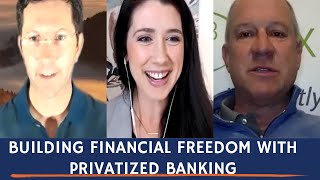
A podcast episode hosted by Mark J. Podolsky with co-host Scott Todd, featuring guests Rachel Marshall and Bruce Wayner from TheMoneyAdvantage.com discussing privatized banking (the Infinite Banking Concept). They explain using specially designed whole-life insurance policies to "store" capital that continues to compound while allowing policy loans (so you can borrow without interrupting compounding), describe contract features (paid-up additions rider, base premium design, MOD rules), discuss flexibility and risks (options to skip premiums by reducing death benefit, backfilling contributions, not a get-rich-quick scheme), and advise it suits disciplined savers/wealth creators. Episode ends with practical tips and resources (Richest Man in Babylon; Strategic Coach/Dan Sullivan; cloudconvert.com) and sponsor/outro notes.
Chapters
Hey, it's Mark Podolski, the land geek with your favorite niche real estate website, www.thelandgeek.com. and on this week's podcast, I'm really excited because we don't have one guest, we have two guests. So, dear listener, you get two for the price of one. But before we talk to our guests, I'd be remiss if I didn't properly introduce my co host. You know him, you love him. The brain, the professor. Your flights go sherpa. Scott Todd from Scott Todd.net landmodo.com learn anything about anything. Investor ninjas.com Scott Todd. How are you, Mark? I'm great.
How are you?
I'm a little intimidated. It's not usual we get two guests. Usually we're the ones intimidating. Right.
You know, it's because we can tag team.
But now they've got, they're like down.
Here, if I have to tap you in or you have to tap me in, whatever, just let me know.
Yeah, yeah. So our guests today are Rachel Marshall and Bruce Wayner from TheMoneyAdvantage.com if you're not familiar with Rachel and Bruce, they're big deals, trust me. However, we're going to get right into it. Instead of going through their big, long, impressive bios, they specialize in privatized banking, cash flow strategies, all the goodness that we need to build wealth because we want to solve not only just our money problems, but our time problems. Bruce, Rachel, Rachel, Bruce, welcome. Let's just, let's just skip the pleasantries. So, Rachel, I'm gonna start with you. Tell us your background. How did you even get into all this?
That is an amazing question. And Bruce and I's path certainly crossed at some point, so we'll lead to that point. So I, in about 8th grade read Robert Kiyosaki's rich dad, poor dad. My parents said, hey, this is a book that you need to read and figure out how you want to handle this in your life. And really interesting introduction to me having this idea that someday I want to own a business, I want to own real estate, and I want to make money work for me. I want to have cash flow. And I'm sure that your listeners are probably in that same vein of saying, how do I have cash flow? How do I create this time and money freedom? So fast forward, my husband, I have been married for five or so years. We have a baby on the way. We said, I'm going to take a break, back from my job. I'm going to be a stay at home, Mom, I'll have all this time in the world. Let's start our business now. This is a great idea. And it ended up being not an ideal timing, but I'm so thankful we started when we did. We started a health insurance business which landed us over into really helping business owners in this position of saying, what do they need for health insurance? But we found this much deeper need that they had, this need for understanding their cash flow. I remember specifically sitting down with a business owner in his garage. He had a lot of inventory. There was tires and conveyor belts. And he was showing me his QuickBooks and saying, I have no idea what's going on here and I need help. And I remember being in that position, realizing that there was so much more than health insurance that was needed for people. They needed a good cash flow system, they needed a place to store cash. And as I was on my own wealth creation journey, I was finding answers for myself and finding answers for our clients. And so that kind of over several steps led me to meeting Bruce. And Bruce, I'll let you take it from there with your backstory.
Oh wow. Rachel is an amazing communicator. So for her to stop right now is probably doing your listeners of this service. Mark, I'm much older and my story goes way back into the 60s, which many of your listeners can't probably comprehend. But you know, I can remember laying.
On the floor as a year old.
Watching the moon landing and think that.
This is the most amazing thing. I mean people don't realize, you know, we're talking about having a COVID vaccine really, really quickly and how amazing that might be. But back then, I mean you're, you're talking about limited technology getting know, onto the moon 265,000 miles away and then coming back and having basically the technology that is in a Casio watch. I mean it's like it was, it was, it was a really big deal. And as a six year old I could tell it was a really big deal. And it kind of spurred me into a life of trying to find out about science. And along the way my father was a business owner and I saw the, the embargo in the 70s just crushed my father because he owned a service station and you know, looking at his endeavor, trying to figure out, you know, why did, you know, why are these business owners being killed like this and you know, who's actually to blame. And it really influenced me in my high school years to understand that, you know, Nixon took us off the gold standard and we had Massive inflation. And then Carter didn't do anything to help it. And then Reagan came along, and the 401k came along in 1979. And, you know, I was going. I was getting into college to become a dentist. That's where my biology career was going to take me. But I got. I was also playing college football, and I suddenly got enamored with maybe being a college coach. And I quickly was enamored by that after one year of college coaching. And I said, well, now what am I going to do? Do I want to become a dentist? No, I'm going to become a teacher, an educator. So I did that, and I actually was recruited by a company called Franklin Life Insurance, who was actually recruiting teachers and coaches to have an educational platform about money to their former students and players. And that went really well until I actually drove myself personally into a health crisis. And I got out of it for a while, and I'll skip the middle story, but I got back into it in 2007 with some of the people that were in that original organization in the 80s after 17 years in education, and what they said is what they need now. What we need nowadays is an educational platform so people can sift through the marketing and sales platform. And so we actually did that as an organization here in St. Louis, E3 Consultants Group. We actually decided that what the industry needs is a financial educational platform. And we threw it out to the nation and said, who wants to join us? And Rachel and Lucas actually were some of the people that joined us, and we developed this really good relationship. And then about four years ago, Lucas calls me up and says, hey, you want to do a podcast? You know, and so we just kind of developed our entrepreneurial spirit from then, from there, more and more people reaching out. We knew when we were getting calls from Brazil and Perth, Australia and Switzerland that this is something that is needed throughout the world, not just the United States. And so that inspires us every day to continue our crusade to actually educate people so that they can become their best financial consultant. They. You should become your best financial consultant through education, not relying on people telling.
You what to do.
Scott Todd, what are your thoughts?
You know, many, many, many moons ago, Mark, I, I went down the path and actually got my series 7, series 9 financial advisor stuff and worked for. Worked for an investment firm for a very short period of time. It just wasn't my cup of tea. Right. Like, I enjoyed the money aspect of it. I enjoyed it. But I'll tell you what, it is amazing kind of what you learn when you go through that process of getting that Series seven or whatever, that it's amazing how much information there is out there and opportunities, investment opportunities, etc. You know, and like, you know something like when you know something about it because you're helping people make financial decisions about it, it's kind of scary, right? Like it's kind of scary how many people just take financial management and advocate it to somebody else. Here you manage all my money for me. And in some aspects, Wall Street's done a great job of convincing us that, look, you don't know what you're doing. Give it to us, we know better than you. And why, why would they do that? Well, because they make a lot of money off of that, right? And so, you know, I do believe that, you know, like money management is really something that for the people that just advocate it and just let it be, well, then you're going to get mediocre. But the people that are in there like learning about it themselves, teaching themselves about it and looking like what we do in terms of helping people one, create money. But look at ways that they can take their money and deploy it somewhere that's smarter than, let's say, Wall Street. I think that people like that long term have a much better success or wealth growth mindset than someone that just says just dump the money into 401k and yeah, let them deal with it. And then it's woe is me, right? Like, oh my 401k is down because so and so is the President. No, your 401k is down because you're not managing your money. Let's be honest, that's what it comes down to.
Boy, Scott, it's almost like we talked in advance so you could hype, hype up the proper things. You know, I always say that, you know, what financial institutions want is they want to get your money away from.
You in a systematic way.
They want to hold it for as long of a period of time as possible and then they want to trickle it back to you and as little as bit as possible along the way. And it's actually a system that's actually better for them than it is for you, as Scott has already said, because they can make a lot of money off of it. What they don't want. And I find this out, I found this out from both ends because I'm an insurance producer and a financial advisor. Is they much like our politics, trying to keep the red and the blue separate so they don't work together, the insurance industry and the Equity industry and investment industry actually want to fight against each other all the time and say, you know, oh, don't put your money into equities. The stock market's terrible. And the equities people say, oh, don't put your money into life insurance. That's a terrible investment. So they want this kind of contention between each other. What we do at the Money Advantage through our collaboration with E3 Consultants Group and our many strategic partners is we say what you really need to look at is a family office model and figure out what the rich people do because you ought to be emulating them. Well, rich people tend to not just give their money up to somebody else without knowing what's happening. They tend to use alternative investments. And an alternative investment would be anything outside the stock market, just like what you guys do at the Land Geek. It would also include private placements such as real estate investment trusts, strategic wireless lending programs, oil and gas programs, buying your own business, buying turnkey rental properties, buying notes, you know, whatever it is outside the stock market. Most financial advisors, they don't want to set up a team collaborative environment like that because they're afraid their compensation is going to go away. They just want to get this assets under management and just deal with that. Most insurance people don't have the wherewithal to actually either have the licenses or have people in their collaborative group that have the licenses so that they can build the best possible integrated resource network for their clients. And I always say it's like any other teamwork situation. The reason most people do it is because it's hard. Well, usually things that are worth it doing are hard. You guys know that from your own ventures.
So that's what we have attempted to.
Do for the last 25 years. And then Rachel and I have used our E3 Consultants Group collaborative team to build what we believe is a really good story. Using an alternative place to store money while you're waiting for these alternative investments. And that is our privatized banking systems that we use. So, boy, Scott, you hit that on the head. And thank you for verifying that for us.
Oh, Bruce, come on. Does Scott Todd need more ego stroking?
Scott, please listen, a couple things. One, we didn't talk in advance because we don't do that on this podcast or just set the record. Right? We don't do that prep work in advance. So that's, that's legit. But then here's the other thing too, and Mark and I, we all banter back and forth about this all the time, right? Okay. So Insurance by itself is not a great investment, right? Like, I go and I buy the insurance. The money sitting there, oh, it's making what, 3, 4, 5%? I don't know, it's making something. Okay, and what if, I mean, I'm going to get the best bang for my buck by going out and now Bar. Okay, so here, let me phrase this out. Insurance. And I think you kind of hit on a. Bruce. Insurance is good for. It beats the bank, right? So if I got the cash sitting in the bank earning zero, I might as well go put it in insurance so that it's earning something, but it's not a great investment. And like I'm just throwing this out there.
That's.
Yeah, yeah.
Okay, so.
And it's actually not an investment at all. Go ahead.
That I got to deploy this money, right? Like, and if I don't deploy it, am I really messing up by letting it sit there in the insurance? And my whole frame of mind here is that if it's sitting in the bank earning zero, I'd rather just sit in an insurance company earning 3, 4, 5%, something greater. So that when I do want to go and use it for something, whether I want to buy a car, a house, or use it for an investment purpose now, now I can go leverage it, but it's still continuing to grow for me. Am I on the right track here, Mark? And I like, who's got.
No, you're. You're on the right track. I'm going to actually back up one step from this. Unless Mark, you want to say something here.
No, Rachel, it's fine. No, let's stroke Scott a little more because Scott's of course, always right. You know what, let's. Okay, I'm going to mute you, Scott, Rachel Marshall, tell us in your own words because Scott Todd, I think has lobbed it for you. What is privatized banking?
That's awesome. Well, first, what's really interesting about this whole idea that we're talking about here is that it takes a certain mindset to think one way about your financial life. And I was alluding to this at the beginning that if somebody is of the mindset that I want to be a wealth creator, I want to own businesses, I want to own real estate, I want to figure out cash flow. I want to be in a position of buying cash flowing assets like land, like real estate, like businesses that are going to produce an income for me. I'm all of a sudden I'm completely outside of the norm of American society. Let's Just be honest. Most of the time, most people are kind of just going through the motions of saying, okay, well, I have a job and now I need to figure out how to protect this money that I've made, and I need to grow it a little bit. But the difference is that if you're starting from a position of being a wealth creator, you're not just thinking about how to manage the money you already have. You're thinking about, how do I go out and get new money, how do I create money in the first place? Which then comes from this perspective of saying, I need to create value for other people, I need to figure out how to be in control and I need to create cash flow. So I don't know if I'm articulating that well, but we need to be wealth creators, not just managers of the money we've already made. And so if I'm thinking as a wealth creator now, I want to be in the position of the most control possible, which means how do I not only make a lot of money, because a lot of people make a lot of money and then they lose a lot of money or they spend a lot of money and they're not any better than a person who barely makes anything and still spends it all. Really, what we want to do is establish that money and be in a position of saying, how do I create true wealth with this? Which means, how do I not only have a flourishing life and really thriving in all aspects of my life, but how do I make this something that's sustainable and continuing to move forward and produce its own money, get my money working for me? So the idea of using specifically privatized banking is not an investment. There's two separate sides of money. One is storing cash. The other is investing or putting money somewhere at risk where it has a maybe higher potential to grow, but. But you also have the potential for loss. So when we're talking about storing money, we all have a need to store money. That's where most people are using a bank. Or maybe they're saying, hey, let me store money in a CD or let me put money in a money market account. But they're thinking, I need this money to be there for me. The purpose of storing money is not to just make it grow and never be able to touch it again. It's saying, what if I need this for an emergency? What if I need this for an opportunity? What if the perfect real estate deal comes across my radar and I want to invest right now because I have the cash? So having cash that you're storing is different than just investing money. You need to be able to access that money, it needs to be safe, it's not going to drop in value, and it needs to be liquid and available. And that's what privatized banking does. Because not only is it money you're putting into a life insurance policy that has safety, it has liquidity, you can access and use that money, but it's also growing. And when you borrow against your capital, you don't reset the compounding. And that is a lot of words that makes probably sense to some few, but not a lot of sense to most people. So really what's happening is if you put your money in a bank, you put it in, you take it out. When you pay cash, you put more money in, you take it out. If you pay cash with a life insurance policy, you're putting your money in, and that is allowing you the opportunity to have a loan, a guaranteed access to a loan that you use the life insurance company's money that they put a lien against your policy, but you are not taking out your money. So your money is keeping, keeping, is continuing to grow with dividends and interest. It's growing and growing and growing even while you're using it somewhere else. And that's the power of being able to use this, this super boring, super conservative, super long range tool to store cash as a wealth creation tool.
All right, that makes a lot of sense. But now I'm going to give Bruce a tough question. All right, Bruce, so I get Rachel, like I'm all in on Rachel's privatized banking. Okay? It makes sense to me. I get the cash flow, I've got the money earning compounding because I'm borrowing from myself, but that money still stays compounding. I'm all in. But Scott Todd is sick of me and he fires me for my own podcast. And now my own cash flow takes a hit and that next month I've got to pay back my own loan. What happens if I can't pay it back? Because is that contract just going to go away? What risk am I taking with my own personal cash flow?
You're really challenging me as an educator to do this over a podcast. So I appreciate the challenge. So with every contract, there's a base amount of insurance, usually a term rider, that we are using to satisfy the U.S. treasury's modified endowment contract rules that they put in place in 1985, 86, right in the middle of the 80s, so that your contracts continue to grow tax free.
I always Tell people if the United.
States government put some restrictions on it.
It probably means it was better for.
You than it was for the government. So they had to put some restrictions on it. And then the last part of it is something called the paid up additions rider. And the paid up additions rider is the way that we can actually accelerate the cash value in the contract.
This isn't magic, Mark.
You know, it's not like it's some kind of loophole in the contracts. These are actually designed like this by the. By the insurance companies.
And by law of every state, you have to.
The insurance companies have to allow for an unfettered loan provision against the capital. So people ask that all the time. Well, why would insurance companies do this? Well, because it's the law. They have to allow this to happen. So what happens in these contracts? Yes, they are contracts. So there are guaranteed minimums, and then there's highly probable dividend payouts. So what happens in these contracts? So it's unilateral. So there are some changes you can make within the contract. You personally, you could say, I don't want to pay the premium anymore. What can I do? Well, the first thing you could do is you could actually surrender that year's dividend payment to actually pay some of the premium. The second thing you could do is you could actually surrender some of your cash value to actually pay some of your premium that year. The last thing you could do is you could actually surrender some of the death benefit. You simply call up the insurance company or actually, we would do it for you. We would call up the insurance company and says, hey, Mark can't make his payment. How much lower can we make the death benefit this year to actually make it equivalent to what his payment would have been. And he just wants to skip this year's payment.
And they'll tell us, oh, well, you got to lower it by this amount.
So we just say, okay, by contract. That's what Mark wants to do for this year. He doesn't want to pay in. He just wants to lower his death benefit. Now, the reason that's the last thing we would want to do is because by contract, once you do it, you.
Can'T build that back up. You can't tell them, oh, I want.
To pay that back and go back up. It's a partial reduction of the death benefit. Other things you can do the way we actually build them, as you say, okay, let's say you have a $20,000 total overall premium. We generally build them in a situation where we're looking for a 30 to 40% base contract. So in a 20,000, that would be about $6,000 plus a little bit for a term. So we would build that the minimum amount would be about 6,600 if your total was 20,000. So that actually gives you flexibility to only put 6,600 in that.
Meaning.
Meaning, just to clarify, so he's talking about this much base premium, about 30 to 40%. The rest is the paid up additions, which is not a requirement.
Payment requirement, not a requirement.
And so the great thing about it is though, Mark, you had a. You lost your job or whatever, you had a. This happens with real estate all the time. Matter of fact, I just did it with one of my contracts. I just sold one of my rental properties because the HOA came down on short term rentals, which I was using for Airbnb. So I sold that property. I have six of these contracts, four of them that are very, very active, but I don't fill them up every year. So I took the proceeds and actually use it to that. Now you can actually backfill what you did not put in from years before. So you can actually do that to make it very, very flexible. The more you backfill, the more then you have the flexibility going forward. Because you could say, well, I already put more in earlier this year, I don't want to put as much in. Just take some of that money I put in earlier and use it as my premiums going forward. So there's a tremendous amount of flexibility. I didn't make this up. I didn't learn this myself. I'm actually a certified Nelson Nash Institute practitioner. Nelson Nash is the founder of the infinite banking concept, or privatized banking concept. Nelson came up with this epiphany in the early 80s when I was just talking about how interest rates just spiked and he owned a commercial building and he had a floating rate loan. And all of a sudden it went from like 6% up to 20%. And so he realized, oh, I need to pay this off. And he went to his life insurance contract, borrowed the money at a much reduced rate than the rate that the commercial real estate was doing, paid it off, and then took the money he was paying for the commercial real estate loan and started paying his own loan back into his, into his policy knowing that it was flexible. He didn't have to pay it back if he didn't want to, or if he couldn't, he could catch up later because all they would do is if he were to die with that loan on that contract, they would just reduce the death benefit to his heirs into the future. So the flexibility of design is what's important to make sure you're working with, you know, a person that really understands all aspects of the contract, but more importantly, all aspects of what you're trying to accomplish.
Okay, so go ahead.
Well, I just want to say, Rachel, because we're running short on time before we get to the tip of the week. I just wanted to ask you because Bruce just really kind of, you know, shut me down in a very Scott Todd esque way with the flexibility. Who is this not for?
Oh, great question. Privatized banking is not for somebody who doesn't want to create true wealth. Not for somebody who is out of control with their spending habits and doesn't have good established savings habits already in place. That's probably the number one, I would say. Bruce, do you have anything you to add to that?
It's not a get rich quick scheme. And unfortunately, way too many people in our industry are saying, hey, yeah, put this in and then just borrow against it right away within 30 days and.
Put it into another investment.
And I say, I tell those people, we're not telling you you should leave it in forever, but you ought to really capitalize this for two or three years. You don't have to, but you really should have that mindset anyway that you're going to do this. Same way, Mark, that you would have an investor that says, I need to save up for a down payment on some real estate or land. I can't just go and say, well, I don't really have all the money I need. Just give me the money for this and then I'll just buy this land or real estate and I'll make all kinds of money. So it really needs to be somebody with the right mindset that this is not a get quick rich scheme. Just like real estate isn't really. I mean, with real estate you're looking.
At a situation where you start out slow, you're building, you're building and building and then you're taking off, you know, with your cash flow, after you pay down some of your leverage and so on, so forth into the future and after the appreciation happens on all your. So it's a very, very similar. I always compare life insurance contracts and the way they work to real estate because it is, it is an asset. It is an asset. It's an appreciating asset that you can borrow against. What's that sound like? That sounds like real estate to me.
Exactly.
Yeah. So, and if you enhance it by putting more money into it. Just like if you enhance real estate by putting more money into it, guess what happens? It appreciates in value even more. It's very similar to if you understand real estate, you understand a whole life insurance contract.
Oh, also, it's not for somebody who just wants to hand their money over to somebody else and say, you grow my money for me. I don't want anything to do with it. I just want to trust the system and trust someone else. And I don't want to take that ownership because really when you put in place a privatized banking policy, you are saying I am going to control this capital. And therefore then it's growing inside the policy. Now I have the responsibility and the ownership to be able to say now what am I going to put this into so that I can do two things with the same money at the same time and I can continue to grow and accelerate time and money freedom. So it's really for the person who wants that responsibility and not for the person who wants to get rid of that responsibility.
Well, great. This is a very heady topic. We can go way deeper into this. Unfortunately we are time constrained. However, we are at that point. Now because your mentorship has been so great, we're going to ask you for your tip of the week. A website, a resource, a book, something else actionable for the auto passive income listeners to go improve their businesses, improve their lives. Rachel Marshall, what do you got?
I would say go read the book the Richest man in Babylon. Possibly a book your listeners are already familiar with. Super easy read. It's kind of written like old English, but I love that it is very foundational financial principles. And it starts with set thy purse to fattening. Now granted that's very old English, King Jamesish sounding, but it's this idea of paying yourself first. And if you are building that foundational savings habit, you're really going to set yourself head and shoulders above anything. Any other strategy that's a principle that's really focusing in on what financial principles do I want in place in my life. Because after you have a principle, then you can start building out a strategy to accomplish your goals and then you can look at the tactics or the financial products. You don't start with products. If you start with a product, you're just looking for what's the flashiest thing that has the best bells and whistles. Really. You want to know how, what strategy are you trying to accomplish? And before that, what principles are in place in your financial life that are guiding you like a rudder. And that is where the book richest man in Babylon really can start laying that foundation of principles for you.
All right, great. Bruce. I mean, I don't want to leave you out. Do you want. Do you want to just jump on her tip of the week or do you have your own?
I appreciate that.
No, my own is to consume everything you possibly can consume from Dan Sullivan at Strategic Coach. And that is because Dan's. Dan's whole mindset is about you. Really?
Never.
You want to set your life up so that you're in a business setting, Whether it's as an employee or as a business owner or investor. You want to set your whole life up that it is where you're taking your own unique ability. So you never need to retire. Because as Dan says, if you look up the word retire, it means take out a service so you're no longer useful. So, Strategic Coach from Dan Sullivan. I would consume as much stuff as you can. And then for your entrepreneurs out there, his 10 times multiplier mindset podcast with Joe Polish is very, very, very valuable for people.
Yeah, Joe Pollux lives out here. Genius Network. So before we get to Scott Todd's tip of the week, I do have to give a shout out to our sponsor, flight school. Learn how the next 16 weeks can literally transform your life. Go up the mountain of land, investing quickly, safely, efficiently with your flight school Sherpa, Scott Todd, who's done it thousands of times. Your tuition in flight school ain't gonna cost you nothing because you're gonna make that money back. 180 days or less, guaranteed. Learn more. Go to the landgeek.com training thelandgeek.com forward/training Scott Todd. What's your tip of the week?
All right, mine is very simple. Here it is. A lot of times you get, like this PDF document and, like, you got to make some edits to it, okay? So, you know, if you don't have a PDF editor on your computer, no worries. Go to a little website called cloudconvert.com upload your file comes back down as a doc file. You can edit to your heart's content and, like, be done with it. But, like, if you're trying to, like, I see people all the time, especially with little tools like that, they spend hours trying to do something, trying to get something right. Just. Just go do something simple, easy button, cloud.
By the way, it's not just for PDFs, it's for, like a thousand different.
Conversions I use the most.
Yeah, yeah, for sure. Well, I just want to thank the listeners, remind them that the only way we're going to get the quality of guests like Rachel Marshall, Bruce Wayner from TheMoneyAdvantage.com is if you do us three little favors. You got to subscribe, got a rate. We got to review the podcast. Send us a screenshot of that review. To support thelandgeek.com we're going to send you for free the $97 wholetailing course, how to double your money, 30 days or less. And by the way, I even forgot my own tip of the week, which of course is Learn more. Please. Start, you know, figuring out your cash flow. Start building wealth. Start learning about the miracle of compound interest and how all this can take effect, how you can benefit from this as long as you're responsible. Get on a call with Rachel and Bruce. Learn more. The Money Advantage the is my tip of the week. The money advantage dot com. I have a link to it. Go do it. And Scott, we ready to do this?
Let's go.
1, 2, 3, let freedom ring. Not bad. Thanks, everybody.
More from Mark





How to find funding partners: How to Scale Land Without Using Your Own Capital


