How to Create Surefire Systems to Improve Your Business with Expert Dave Jenyns
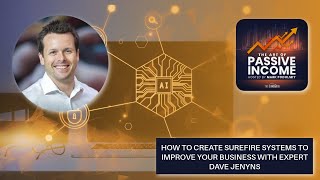
Dave Jenyns explains Systemology, a seven-step method to capture and scale business systems. Most businesses jump straight to software without documenting processes first, which creates tech debt. His approach starts with defining and extracting what you actually do, then organizing it before automating.
Questions this video answers
Seven steps.
Systemology.
Michael E. Gerber.
Systems Champion.
The Critical Client Flow (one-page linear map of target audience → primary product/service → stages: attention → inquiry → sale → invoice → onboarding → delivery → repeat).
Chapters
Hey, it's Mark Podolski, the land geek with your favorite niche real estate website, thelandgeek.com and on this week's Art of Passive Income podcast, I have Dave Jennings, whom, if you're not familiar with this, a experienced entrepreneur who sold the Melbourne cricket ground in his early 20s and founded Melbourne SEO Services. He systematized himself out of that business in 2016 and founded Systemology, which is so geeky that it's just. It just makes my heart sing. To help business owners implement systems to scale their business. Today, he supports a growing community of certified systemologists, delivers workshops, keynote addresses, hosts a podcast, and is on a mission to free business owners worldwide from daily operations. And, you know, I always talk about we can always make more money, we can't get more time. And the last thing I want anyone to do in the land business is create another job for themselves. Dave Jennings, welcome.
Pleasure. Thank you for the intro. I've been looking forward to this episode.
Yeah, yeah. So let's talk about the book Systemology. It's to create time, reduce errors, and scale your profits with proven business systems. Why did you write it?
I wrote it for myself. It was the book I wish I had. I read the E Myth, which is a book by a guy called Michael Gerber, and he talked a lot about building a business that doesn't work without you, or works without you, rather. And I got bitten by the bug. But then I was kind of stuck. I was like, oh, how do you do this? What is the action steps? How do you implement this? And then I went on a journey with my digital agency and I got stuck, stuck in the operations for probably 10 years too long. And then we found out we were pregnant. And I thought, oh, I don't want to be that dad who's always too busy. I need to figure this stuff out. And then I just went deep into systemizing the business. I recruited a lady or promoted her from inside the company up to CEO. And then over the course of about 12 months, we really worked to systemize and remove myself from the day to day operations so that she could run it. And then I, I took a year off. And in that time off, that's kind of really when I thought, what, what do I really want to do? And then I thought, you know what, the steps that I just went through here, I want to bottle that and I want to share it with other business owners. And that was the birth of Systemology.
Wow. So you've got a company, you're overwhelmed, and you're looking to create systems to get yourself out of it. And then you do. So if someone's listening to this, what do you think is for them the first thing that they should try to systematize?
Yeah, we have a little exercise. So in systemology it's seven steps and the first one we call define and it answers that question. It's like, where do you start of all the things you could systemize? And I've got a tool I call the Critical Client Flow. It's really easy though. I mean you don't even need the book to do it. Just a one page will do this. You just get a one page out. You in the top left hand corner write out who's your target audience and what's the primary product or service that you sell to them and then you map the linear journey. Now there's a couple of rules. The rules are you don't use more than a few words in each box to describe each thing and you only capture what you're currently doing, not what you would like to be doing. And then you literally just go, how do I grab this person's attention? How do I handle an incoming inquiry, how do I sell them, how do I invoice them, how do I onboard them, how do I deliver my product or service and then how do I get them to come back? And you start off by just doing a very high level mind map and then you ask the question, which bits are you actively avoiding or which bits would break if you got 10 times as many clients and that really helps you then narrow your focus in on a particular area. So it's all about thinking, well, how does the business make money, how do we figure out what are the key pieces and then which bits are the bits that really create frustration for the business owner.
Awesome. So first we define and then, then we assign. What does that mean to assign?
Sign has a lot to do with thinking about where does the knowledge currently exist? Now I know in a lot of land businesses we've got sort of solopreneurs in there and there's some that have small teams around them. If you've got a small team around you, sometimes the knowledge of how to do one of those steps that we identified in step number one or stage number one, someone else already knows how to do so and the knowledge is just trapped in their head. So it's a matter of figuring out, oh well, Jenny knows how to handle that incoming inquiry, well, let's ask her what she does and capture what she does. And again, it's all about Capturing what you're currently doing, not what you would like to be doing. And that becomes the new baseline. So assign is about figuring out who has the knowledge.
Who has the knowledge. Excellent. Now in your third chapter, extract, you say creating systems should always be a two person job. Why do you say that and what does it mean to extract?
So extract then is getting the IP out of the heads of the individual and oftentimes the business owner. Or if you've got a small team, your best team members are busiest. So if you put on their to do list, hey, you need to document systems. Or sometimes business owners don't even like systems and processes. They don't see themselves as a detail person. So oftentimes they're the worst people to be documenting. So the secret here is to make it a two person job. As in we have one person who's the knowledgeable worker who knows how to do the thing, and then we have a second person who records them doing the thing in the moment. So maybe it's Jenny answering the phone and we get our iPhone out and we record her making that call. Or when an invoice is issued out by Sally, we open up a loom recording and record her doing the thing. And then the second person, that documenter, is the person then that watches the video and then pulls out the key steps from. So that second stage, once you figure out who knows it, how to do it, the assigned stage, then in step number three, we pair that with effectively a documenter to make that whole process really easy for them.
Okay, that makes so much sense to me. And typically what we'd like to teach, and you could correct me about this, is that, for example, if I'm creating a process or a system, I'll use loom, or I might use Zoom and I'll go through the steps of what I'm doing and then I'll transcribe it and then maybe I'll hire someone on Fiverr as a technical writer to write out the steps of what I just did. And is that in that sense then is that second person then that technical writer, that documenter to create?
Okay, Sometimes as you start to grow and depending on the size of the team, that technical writer can fulfill a couple of different functions. We call sometimes that person in slightly larger teams where it makes sense, you get a systems champion and the systems champion might do the technical writing. They might also organize the systems. They also put it under everybody's nose in team meetings and constantly remind people and really actively champion it forward. So sometimes it's that role. But that first step that you talked about is most definitely the way to. Way to go.
Okay, excellent. And then our fourth step is organize.
Yeah.
So why, so you say in the book, Software will never be the holy grail to business systemization. Now there's AI now and software. Why do you say that?
A lot of people think when they're thinking about systemizing their business, that getting a piece of software is going to magically solve all of their system woes and everything is going to run like a dream and run on autopilot. But the reality is that the system is, or the software rather is just a piece of the puzzle. So we do need to think about where things are going to be organized. And that's stage four. So once we've extracted everything, where is this going to live? How do we make it easy for your team to find when they need it? You know, little things like getting a QR code that can be scanned on your phone that would jump directly to the system and you could stick that QR code on wherever it's going to be needed. If you're taking out a truck, if you're meeting with a particular client or like, again, it's all about how do we make this easy for you and your team to find the system and the process in the moment and how is that organized? And also potentially paired with some sort of project management tool. So you might use something like Asana or Trello or Basecamp or ClickUp. I mean, there's tons of them. But when tasks are assigned, if you can have a link to the system at the point at which that task is assigned, then that's gold standard.
I love it. I love it. And so why is it, what do most people do wrong when they try to automate their workflows? What do you see out there?
Most of the time they jump straight to the automation. And I always talk about do human automation first, as in get someone to do it, capture what's currently working and then try and automate it. And a great example is you look at someone like McDonald's, even Google, Google's probably a great example. Google, they're a very high tech company and when they are updating their algorithm, they don't jump straight to programming something in. They first come up with a hypothesis, they test it, they get huge human reviewers, they look at the results and then they make a decision. Was this good? Yes, this was good. Then they write it into code. So where a lot of people go wrong is they jump straight to the code when first you want to get in there and, and use what I call human automation.
Yeah. You know, it's so funny, I was just having this conversation with a buddy of mine and I've got a hodgepodge of software for all the businesses and he'd say, you know, with all these different systems, it's just a mess. What's your take on that? Where maybe I'm using Basecamp for project management, I'm using Sam Cart for checkout links, and I'm using Airtable for database management and automations and all that, and they're all great at what they do, but it's a lot of different systems.
It starts off. Oftentimes it's like building Frankenstein. You add a little bit here, your business grows, and then you say, I need this problem solved. And then you add something else. So it's very common. Unless sometimes if you might have built a business before and you know, what done looks like and what you're building towards, it's easier to make the right choices up front because you've seen where it'll grow. But if you don't have that visibility, you can either, you know, you talk to a cloud consultant or someone like that who can help you with tech stack setup. Oftentimes it's once you've built up almost like a significant amount of technical debt. If it becomes obvious to you, you know, I've added this tool, that tool, this tool, that tool doesn't talk to that. I have to use Zapier for that. And you kind of just duct taping everything together, then you might get to a point where you're like, you know what, it might makes sense to relook at my tech stack. Think about, where am I going? But it's always really painful, like moving tech, especially shopping carts and email support systems and project management. Like it is painful. So you just want to make sure you measure twice and cut once.
Sure, sure. Well, I'm glad I asked that question. I mean, we have like a thousand zaps.
Yes.
Yeah, we love Zapier. What other major problems do you see entrepreneurs getting into as they go into the, the phase of getting ready to scale? I think you just put your, your, your finger on, on, on one of them, which is a hodgepodge of systems and the duct taping together as you grow and all of a sudden you wake up, you're like, oh my gosh, this thing is just a monster. And we have this huge technical debt where, what else do you see along those lines?
Another one. And it's in stage number five of systemology that we talk about and this idea of integration, getting the team on board, oftentimes where a lot of business owners go wrong is they're talking about creating systems and processes and getting things documented and organized. And it's so that we can improve our bottom line. And so that go on a holiday and I can have large amounts of money deposited into my bank account with little or no work from me, with no oversight like the business owner is pitching it from, well, what's the benefit to them? As opposed to really thinking what's the benefit for the team member? And helping the team member to understand that streamlined processes makes their job easier. It enables them to take holidays and not have the business owner or on the phone every two minutes saying, oh, where did you save that document? Oh, do you mind if I know you're on holiday, but can you call that client? Because I just, you've got that relationship. Like letting the team member know systems and processes will help them disconnect and be able to come back and hit the ground running. You can also let them know that it helps them move up in your organization. The way that team members move up in your organization is by delegating lower skilled tasks down to lower cost labor. And that frees them up to do higher value work, which makes them more valuable to the business. So it's all about helping the team to understand the benefits to them. That's. I definitely see a big one where a lot go wrong. And you know, it all centers around this idea of building a systems culture.
I love that. I love that. And so what do you say? Building a systems culture. Can you talk more about that?
Yeah. So that has to do with reaching the point of saying, this is how we do things here. Oftentimes when you first introduce systems and processes, especially if you've got an existing team, there's a level of resistance. It's like, hey, I've always done it this way, why do I need to change? And that hurdle that you have to overcome at the start is actually the most challenging. And we want to reach the point where once you get over that hump and you really develop a systems driven culture where the team knows that, oh, yep, that's just how we do things here. I look for this process. We, when I get assigned that task, it has a system link attached to it. When something goes wrong, it's not my fault. The first thing that we always look at is did I follow the process and is it the system's fault? And we try and make sure that it's mentioned and discussed in team meetings as new processes are developed and shared across the organization. So there's a whole range of these little things. I recently read a book, probably I might be the last person to have read it, but James Clear's Atomic Habits. And he talks about this idea of building evidence. And really that's what I'm talking about. We're building evidence that the company is a systems driven company. So that the team goes, ah, well, yeah, that's of course, that's, that's how we do it here.
I love that. And you call it in the book Systems Thinking Culture. Build a systems thinking Culture. So now we're at the chapter where I think everyone listening wants to get to this point. And it's not like flipping a switch there. It's, it's like how would you, what metaphor would you say? What to get from the define to the scale?
Yeah, I often think about it as like people do the define and they do the critical client flow thing exercise and then they systemize that and then they just expect everything to magically fall into place and they systemize their business. But there's actually a point that you want to get to. We call it minimum viable systems. And it happens at this stage six that we're talking about, which is scale. And it's where you identify the minimum systems required to run your business and it's the other ones outside of what you identified in that first exercise of the systems that are required to grow and scale your company. Things like recruitment and onboarding and some finance systems and maybe some management systems systems. And there's a handful of systems like we always, all the way through this, we are applying the 8020 rule here. What's the 20% of the systems that deliver the bulk of the result? We identify those and we need to get those systemized. And when you get to that point, it's that minimum viable systems, it's like a turning point. It's really when the culture in the organization starts to change because you have systems and systems touch all aspects of the business. And that's, that's really what we kind of gun towards. And then, you know, to link it back to the metaphor I'm trying to think of, like that's the point where the floodgates open. Like because you've really, you've got enough of a solid foundation, just onesies and twosies, a little system here, a little system there is not going to change the world. It's that compound effect of all of These systems getting layered on top of each other.
Yeah, it's so true. So why do you say sending your best team members, team members on vacation is one of the smartest things you can do?
It's a great way to then identify what breaks. So when you reach that scale stage, I mean, you can start with the business owner and then some of your key leadership team members, depending on, you know, the size of the organization. But if the person goes away on holidays and they're dark for two weeks and then they look at, well, what fires arose or what happened while they were away and do a debrief on the way back, it makes it much easier to figure out which holes need to be plugged. And that helps you to really shore up that scale stage.
Ah, I love that. I love it. So after you get to the scale stage, the final stage is optimize. So one of the highlights is you say why trying to imitate McDonald's is hurting your system's development. What does that mean?
Yeah, well, a lot of people, when you say think of a systemized business, they think of McDonald's. That's you know, the classic everything systemized down to micro granular detail. Like, and business owners, they falsely think when they think about systemizing their business that they should systemize like McDonald's. When they don't recognize that McDonald's has been systemizing for 60 years, that they're building a hamburger business, which is probably very different from your business, and trying to compete at that level and systemize how they are today is kind of like you're trying to compete in the Olympics and you're going up against an elite athlete who's been training all of their life. And here you are a couch potato with weak systems muscles and you're trying to perform at that level. What you want to think about is you go back in time, think about, well, how did McDonald's get started? And I remember watching the movie the Founder and right at the start of that movie, it tells about the McDonald's story and Ray Kroc. And there's a scene where they go out onto a basketball court, they get some chalk out and they chalk out the store and they put the fryer here and the thick shake machine here and the drive through window here and oh no, no, let's move the counter here. And that's how raw systems are at the start. Systems and processes as you're figuring stuff out. So design systems the way that, you know, McDonald's did back when it got started. Don't think about systemizing like McDonald's is today. And part of the, I think magic with systemology is one of the things that we do, which is a bit counterintuitive. We leave optimization until last because a lot of what happens and it creates a bit of a stumbling block. A business owner might get started on the systems and processes and they try and design things the way that they would like to be, which means it ends up bottlenecking at them. They are trying to get it just perfect. They try and go, oh, I want this new piece of software. And then it just. Oftentimes the biggest wins in business happen by just figuring out what's currently working and then making it consistent and bringing everybody up to that standard. And that's the base level. And that's really what the first six stages of systemology is about. Then when we get to stage number seven, optimize, that's when we start to put a dashboard in place and then we can go to work on the systems. But systemology is not process improvement. Systemology is first process capture. And we're going from I have nothing to I have at least a baseline in place now.
I love it, I love it. And so we've got the baseline now. We're, we're scaling. Where do you see the future with technology, with AI? There's, you know, inexpensive virtual assistants globally. We've, we've access to global talent. What, what do you.
Yeah, forecast. I definitely think a lot about this because we have our consultants who work with business owners. I try and think about skating to where the puck is not or where it's going to be, rather than where it is right now. So I'm trying to think about how does this all change? And the more that I think about it, systems and processes, really, they're just recipes to get things done. And just recently we have seen the changes with ChatGPT, where they've introduced AI that has the plugins now, LinkedIn, so it talks to other software and things like that. So you can now ask the AI to go do something and then it can link into these plugins and then it might go off and book your holiday through Expedia or something like that. So we know that that's, you know, version number one. So at some point you're going to be able to ask the AI, hey, I want you to go do this for me. And then it's just going to go off and do it. So I see the systems and the processes that we create today potentially are going to be the recipes that we feed the machines to do the things that we want. So again, it's important to first do the human automation think through this before we give it to the robot. And I think the groundwork that we lay with systemology. Yeah. Will be the inputs for the robot bots to execute large chunks of your business.
Yeah. I mean, even just on the. The extract stage, for example, I can imagine that we could just say to chat GPT, write out this process. Yeah, yeah, go ahead.
Well, at the moment, you go to it and you use the terminology earlier you tell it. I want you to imagine that you're a technical writer and you take transcripts of videos that document process and you simplify it down into everyday language that someone can follow. And you have clear steps and bullet points that support the information under that. You create a prompt like that and then it's a great version number one. It'll still need some polishing by your systems champion or your technical writer afterwards, but it speeds up that process significantly.
Yeah. I was, I was listening to a podcast with Kevin Kelly and he said, right now, at this stage of Chat GPT, it's like an intern, where an intern can do the work, but you wouldn't release it out in the wild. Someone would need to review the intern's work and polish it. And he was saying, it's not going to take anyone's job, it's just going to make their jobs a little bit easier. If you do you. Is that something you agree with?
I agree. I think for the top performers, it's going to turn them into super weapons. Because still, what needs to happen is someone needs to be able to know good from bad output and then be able to ask the questions to refine that output and then potentially even add their own spinning. But if you don't know and you're not a highly skilled team member who knows what the output should look like, then if it's off the mark, you're not really able to take advantage of this intern that can punch things out for you really quickly. So it's, it's. Yeah, I think it's important for skilled team members to keep skilling up and it will only make them more and more productive. And that, that's the key. I don't see it as a replacement just yet. Maybe some things will fall away, but certain roles for the right team members, it's. Yeah, it's just like an accelerator for them.
So. Yeah, I love that analysis. But I'm thinking about you now, personally. So what do you see your role as CEO, if everything is off your plate and you have nothing but time.
Yes. Well, the main thing I do these days we actually have a CEO and she runs the day to day operations of Systemology. My role these days is to really champion the brand, to get the word out, to do the podcasts, to do the original thought. So I'm working on my next book called Systems Champion and that then if Systemology was written for the business owner, Systems Champion is written for the systems champion that's going to execute in the business. So that's the type of work where I add the most value. And really that's what a lot of business owners should be thinking about is what are their highest value tasks, things that they enjoy, that uses their unique abilities, and how do we create as much space for you to be able to work on those and be able to step in and out of the operations and that way the business, rather than you being an employee of a business you own, you really want the business to be able to work for you. And that's that real hard transition that a lot of people, business owners, struggle to get the business working for them. Yeah.
Did you have a struggle with that when you were going through it?
Definitely. With the digital agency. I mean, it took me 10 years and a lot of frustration because that business, I always thought, well, this business is different. Like I've been involved in a lot of businesses along the time and some of which we'd put some great systems in. But when I got to the digital agency, I thought, this business is different. You know, it's a creative agency. How can I put systems in place? My team aren't going to follow them anyway. I thought Google's algorithm updates all the time, so what's the point of putting a system in place? It's just going to get outdated. Like there are all, there's all this baggage that I had around why that business was different. And it wasn't until I really stepped back and said, no, look, I know people can do this. I've seen them build agencies that work without them and that scale beyond them. I need to retest some of these assumptions that I had reached. And it was challenging, but I had a vision for what I wanted. I had a deadline because we had a baby arriving and I just needed to get to work. So I kind of got really forced into action.
Well, thank you for sharing that and Dave, your mentorship has been invaluable this podcast, but we're now at that point where I'm going to put you on the spot one last time and ask you for your tip of the week. A website, a resource, another book besides Atomic Habits for the art of passive income listeners to go prove their businesses improve their lives. What have you got?
I'm going to suggest the original, which is the E. Myth by Michael E. Gerber. It just builds up the why so well. Like, it helps you to understand why systems and processes are so important and potentially what's possible for you. So it's definitely a, a great read and you can grab it on Amazon.
Yeah, that's a classic read. I, I read that, gosh, maybe 20 years ago. I mean, it's, it's, it's, it's. But it's a, it's classic. And I think there's now the the E. Myth revisited. So he did, he did update it and he actually writes the forward, I think, to your book. Is that right?
100. I was very fortunate with just a series of events. I talk about it in the book. I mean, he was almost like the Oprah of my industry as I started getting the systemology business off the ground and through a series of really fortunate events, almost like the universe just opened up and laid a huge opportunity on my lap. And then I got a chance to work really closely with him to help him launch his last book in the E. Myth series. And I learned a lot from Michael going through that. And he ended up writing the forward to the book. And it's funny, I one bit of advice he gave me and it always really stuck with me. He was like, dave, don't let the business owners off the hook. They've got to do the work. Yeah. You just got to get down to it. Got to do the right work, but you got to do it.
Yeah. Yeah. It's such good advice. So my tip of the week is learn more about Dave and go to systemology and we'll have a link in the show. Notes. Today's podcast is sponsored by flight School. Speaking of systems, learn the systems. Start creating passive income without any renters, rehabs, renovations or rodents. Go up that mountain quickly, safely, efficiently, with Scott Todd as your Sherpa. And I know you're thinking, what about that tuition? It's not going to cost you nothing, guaranteed. You're going to make back that money 180 days or less. Just show us your work. Learn more. Go to landgate.com forward/training thelandgeek.com forward/training Dave Jennings Are we good?
We are good, yeah. Love the episode.
Well, I want to thank the listeners and remind you that the only way. The only way I'm get the quality guests like a Dave Jennings if you do three little favors. Follow rate Review the podcast. Send us a screenshot of that review support at the land geek.com I actually have a crazy system that Dave's going to love where it then goes into my air table and then I go to my local shipwright and I sign the book and it gets shipped from the shipping store and you'll get a free sign book from Dirt Rich for just taking one second and leaving us a review and sending a screenshot of that review to support at the land geek.com I can see Dave's thinking about. He's like, I think I could make that process better, but we'll talk about Dave. How would you improve the process?
No, I was actually thinking both of them. Like you had two really rock solid closes there. I, I liked both. I think whatever's easiest for the, the listener that's you always want to think simplicity scales. So it's about kind of. Yeah. Just revisiting those steps and who knows, maybe even chatting with some of the listeners and saying how could we make this easier and see if they've got any suggestions. Yeah.
Because I'd say that process isn't so easy. A screenshot. Then you got an email and then you get the book. There's probably a easier way to deliver that value.
You need some sort of receipt forwarding, some sort of. Because you need a proof of purchase.
Well, I just want them to, to send a screen. I just want them to review the podcast.
Yes. Oh, sorry. Yes.
Yeah, because I'm going to send them the book for free.
The thing is, you're going to still need their contact details, so contact too.
I mean it's, it's not, I'm not making it that easy for the listener.
Yes. Yeah, well, it's pretty easy.
I reckon it's pretty easy. I mean, if you want a free. Assigned free book, it's not that difficult.
Yeah.
But that being said, I don't send out that many free books because people review the podcast.
Look the other way.
So something's wrong.
You could. Well, maybe it's the offer. Maybe we need to stack the value. Maybe, maybe I need to send you a box of systemology books for this episode and anyone who does this, they get two books. Maybe. Let's do that.
Let's do that.
The value.
We're going to stack the value. Send us a screenshot of the, of your review of this podcast. Mention in the review Systemology and then you're going to get two free books. How's that?
Rock and roll. Yeah. There we go. You'll be flooded.
Dave, that's super generous. So. So thank you. And thank you for supporting the podcast Let Freedom Ring. Thanks, everybody.
Thanks for listening to the Art of Passive Income podcast. Are you ready to learn how you can start building building a passive income without renters, rehabs, renovations, or rodents? Schedule a free consultation at thelandgeek. Com training. Let Freedom Ring.
More from Mark





How to find funding partners: How to Scale Land Without Using Your Own Capital


