How To Effectively Navigate Your Life To Avoid Burnout
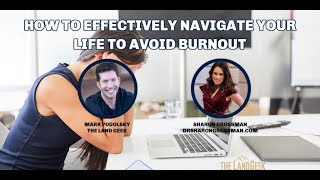
Dr. Sharon Grossman explains burnout as chronic stress that shows up as exhaustion, cynicism, and dropped performance. She says stress lives in your thoughts, not your circumstances, and offers concrete fixes: reframe how you think, narrow your focus, schedule your work, find accountability.
Questions this video answers
January 6, 2022.
Dr. Sharon Grossman — author of 'The 7E Solution to Burnout'.
7eSolution/7E burnout challenge and drsharongrossman.com (discussed as book, digital workbook and a free 7-day online course).
onlinecertifiedmail.com.
thelandgeek.com (Flight School training/program).
Chapters
Hey, it's Mark Podolski at the Land Geek with your favorite niche real estate website, thelandgeek.com and on this week's podcast, I'm really, really excited because it's somebody that's gonna really help Scott and I with something that I think, maybe not me so much, but Scott I think has been suffering with for a long time. We don't talk about enough. It's burnout. But before we talk, but before we talk to our guest, I'd be remiss. I improperly introduced my co host. You know him, you love him. The brain, the professor, your flight school sherpa. Scott Todd from Scott Todd.net landmodo.com learn anything about anything. Investor ninjas.com Scott Todd, are you excited?
I am, but I'm not burnt out. So, you know, let's just get into the details and I think at the end of this podcast we'll just turn it back around and we'll see who really the burnt out person is, you know.
Well, let's talk to our. Before I even get into that, because denial is not just a river in Egypt. Our guest is Dr. Sharon Grossman, the author, the best selling author, the international bestselling author of the 7e Solution to Burnout. She is an emotional intelligence expert. She holds a doctorate degree in psychology, has extensive training in cognitive behavioral therapy and 20 years of experience helping her clients take back control of their lives. Scott and I are spinning out of control. This is going to be a phenomenal podcast. Dr. Sharon, how are you?
I'm doing great. Super excited to be here with you guys. Loving it already.
Thank you. Thank you so much for being here. So let's just rewind the tape and talk about a little bit. What made you want to be. Because when it comes to therapy, what was it about burnout specifically that made you say, oh, this is a problem, I want to be the person to solve it?
Well, kind of interesting the way that it all fell on my lap, but basically I reverse engineered my whole recipe for how I want to be in the world in terms of my business. And what I came to realize was the people that I enjoy working with the most are these super high achievers. And then I thought, well, what are they struggling with? And one of the things that I found is that they're struggling with burnout. And so I started to dig into this topic. One of the things I found, which I thought was really interesting is that even though we toss this term around, we toss like anxiety and stress and burnout, we Kind of have all these terms in our mind. We don't necessarily know what it means. And so I'd be talking to some of my clients, and because I'd done the research and I knew what burnout actually is, I would then say, oh, it sounds like you're burned out. And then they'd be like, oh, yeah. And so what I found was happening is, like, when it's happening in the moment, people often don't have the knowledge that it's happening to them. And one of the things, as a therapist that I can share with you is that we always look for diagnoses not so that you can, like, have it, but so that we know what treatment to go to. Right. And the other thing that was happening is that people who had burned out and kind of recovered years later would be reflecting back on their experience and be like, now I understand that what was happening then is that I was burning out.
Makes sense. Scott. Todd.
All right, well, what are the signs that I'm burnt out? You know, Mark. Mark's, like, so adamant that I'm burnt out. Let's see how many of these get checked off, because I disagree 100%.
Well, we're not targeting you, per se, but Mark is.
Mark is. But, you know, that's not an unco.
So maybe that's why he's burning out. Mark.
You know, look, I'm burnt out.
We got to be clear here. I am not burnt out.
Is it possible he's burnt out and doesn't know it?
Everything is possible.
Or is it. Or is it that Mark is burnt out and he's projecting it on me?
That's very much a possibility as well.
Projections.
So let's talk about this. So really, the way the burnout shows up first and foremost for people is with mental exhaustion, and that's really different from feeling physically exhausted. So it's not like when you go out and you run a marathon and you're just so spent that if I said, hey, do you want to go for a walk? You'd be like, you know what? I can't move. Like, I just need to sit. I need to breathe. Like, I'm done. Like, I just need to sleep. Right. Mental exhaustion is, like, when I think about work, I can't focus. I just can't be productive. Like, I. It's so much harder for me. It's kind of like an uphill battle. But when I go home from work and then my friends call me and they're like, hey, do you want to go out, or do you Want to do this. All of a sudden I find, like, I have all this energy because I'm not focusing in on work. So there's this, like, mental block that is draining us. When we think about this one thing that we are in burnout territory for. And then when we kind of pivot and we focus on something else, all of a sudden we have that energy. So that's how. That's super different. And that's the first thing that shows up.
Okay, so just based on Scott.
Last.
Night, he's like, how many podcasts do we have today? And I'm like, we've got two. And he goes, oh, no. Right? And it's like this long grown. Like, is it. Is it possible? But he shows up, he's in a good mood. He's got the energy for the podcast. How will we know if you know? He's super responsible and he loves it, but how do we know he's burnt out? It's just like, what you're saying, like, so later today he's not going to be able to function cognitively. Is that with work?
Well, so what we. What we find is that it feels, like, really heavy when you have to think about, let's say, work is the thing that's stressing you out or that is burning you out. It's that it feels really stressful. It's taking this mental toll on you. And that's where we see people having a harder time because it drains your energy. So if we're thinking about it as an energy management issue, then we're noticing that it's just less. You feel less energized, less excited. It's just kind of like, oh, I got to go to work, that sort of thing. Then what happens next kind of step is our attitude starts to change. We become really cynical about work. And so that's really interesting, too. You start to notice, kind of like, I got to go to work. I'd rather sit in bed. You know, that sort of thing is happening. And then lastly, we see that our performance starts to decline. And so one of the things that I noticed, because I work with a lot of super high achievers, their whole identity is shaped around production. And so when they can't produce as much, it starts to really take a toll on their whole inner game, Right? Because a lot of them associate their worth with their productivity. And so now they think, like, there's something wrong with me. I used to be able to do this, and now I can't. I don't know what's going on and life just feels really hard. So those are the typical signs that we see. And I think it's a little bit different for everybody. There's also a little bit of a gender discrepancy, some people say. I think it shows up, you know, if you think about burnout as a spectrum, then, you know, you could be somewhere on that spectrum. And, um, different. Different people have actually different models for it where they start to show how it can. Like some people have a 12 step model. They show like it goes from, you know, if you start to read this, it can be really depressing because some of it gets like really dark and then it says, then you get really depressed and then you get suicidal and then, you know, like all the lights go out kind of a thing. I don't typically describe it in that way, but I think these three symptoms of the mental exhaustion, the cynicism and the reduction in your performance, those are what research has shown has been like three big flags.
So, Scott, except for the reduction in performance, do you feel like her words are like a weighted blanket around you? Do you feel like finally someone understands you and you're just bathed in empathy?
More projection, Mark, more projection. You know, I am truly aware of my surroundings and I know what's happening here. The projection. And oftentimes, Mark, I do have to worry. My question for the burnout coach here is, how is burnout? Or maybe I should phrase this a different way. Does chronic fatigue or acute fatigue, does that kind of mirror into burnout? Do I achieve those fatigues because I'm burnt out? Or could my acute. Or could a person's acute or chronic fatigue be driven by the burnt out? Does that make sense?
Yeah, I think that's a really interesting question, actually. So from my understanding, and I'm not a big expert in chronic fatigue, but from my understanding, a lot of the stuff that we experience can be kind of psychosomatic because I've worked with a couple of people that have had that. And I think therefore it could be that the psychological piece, in terms of how you think about work or your life and your stressors, that can contribute to you physically having more malfunctioning, if you will, in the body, right? So when you start to experience some of these things, it could be a psychological issue. And then I guess the flip side you're asking is whether if you have chronic fatigue, if that can contribute to burnout and I guess.
Or is the chronic fatigue a result of the burnout? I guess.
Is chronic fatigue a result of burnout? I don't know. That's an interesting question. I don't typically see that, but I guess it's possible. Right. I think there is that mind, body connection. And so all kinds of things can happen. And like I said, burnout can show up differently for different people. Um, but certainly if we're for saying that chronic fatigue has a mental component to it, then it's kind of like what came first, the chicken or the egg. Right. And I think bottom line is you want to look at what are your thoughts when you think about work, because that's going to contribute to how you feel, and how you feel is going to manifest in your body in some way, shape or form. And ultimately, that's actually one of the biggest solutions to burnout is to. If you can understand what your thought process is that's leading you to feeling burned out, then you can also reverse engineer the results and get yourself out of that problem.
Yeah. And see, that's what I'm always looking for in Mark is I'm looking to see his fatigue level, whether it's chronic acute, to tell me if he's on track for burned out or not. So I. It's good to know that I might be on the right course there, mark.
Okay, so, Dr. Sheeran, that's clearly transfers. Nevertheless, we've identified now Scott Todd's symptoms of burnout. How do we help him? How do we solve it?
So one of the things that I like to explain is when we experience burnout, we often look outside of ourselves for the cause. So we'll say, oh, it's because of my job, it's because of my boss, it's because of all the things that lie outside there in the world. And really, if you look at what burnout is, burnout is chronic stress that builds over time. And if you look at what stress is, stress is really about perception. So when you are in a situation and you perceive it to be more than what you can handle, then you're going to feel stressed out about it. And so if you go to work every single day and you think like, oh, this is so hard. This is too much for me, and you think about, like, all the people that are listening into the show and, like, the kind of lives that they lead. Right. We all have a lot of quote, unquote stress, and that is from all these demands that we're facing, not just in our jobs, but then we go home, and then we have our kids and we got our spouse, and we've got our health conditions and we got our extended family. Like, there's all this stuff in our money issues, right? The stock market's going up and down, and we're like, oh, my God, I'm gonna lose all my money. So, you know, then we got an epidemic on top of it. So we've got, like, all the stress. And if the way that we think about those external events isn't aligned with how we want to feel, then we get into trouble. And that's where I find a lot of people actually haven't had this training of how to manage their mind. And that's why the stress, you know, we perceive things as, quote, unquote, stressful, and that identification or that interpretation of those events builds over time, and that's how burnout happens.
I see, I see. So. So Scott's waking up and he's blaming the podcast partner on his stress. But in reality, it's just the way he's interpreting it. It's not. I'm not really causing it.
Well, so, like, you've been picking on him since the beginning of the show. If he interpreted that as, oh, my God, I, like, this guy's so bothering me, and I feel so bullied. And it reminds me of when I was a kid and, like, all these kids are picking on me in school, that's gonna feel really stressful. But if he sees it as like, oh, this guy is so funny, and he's trying to make all these jokes and, like, I'm laughing because I know that he's not really serious, then he's not going to feel stressed out by it. And I know, I see those eyebrows. You're about to counter that.
Yeah, listen. And if the FAA is listening to this, like, I'm not stressed out. I have no stress in my life. I'm not burnt out. Like the faa, Please. Like, Mark is completely joking here.
I am totally joking. Faa. He's no stress. If anything, I am projecting. He's the opposite of stress. We all want to be Scott Todd. I just want to say that so that everyone knows Dr. Sheeran is right. It was all just for entertainment purposes. There you go. And nevertheless, though, I do think it is helpful, in all seriousness, though we have identified it, we know how it feels. But then. So it's the interpretation then, in our minds of external events. So how do we reinterpret or reframe the events so that we don't feel so stressed out? We don't get to that point of burnout.
Yeah, that's a really important question to be asking. So one of the things to Note is, how do you feel when you think about your circumstances in the way that you're thinking about them? And then ask yourself the question, how do I want to feel? So one of the things I've been asking of my clients a lot, let's say we're talking about, like, something that's stressful in their job or even like the coronavirus. I'll say, well, given the fact that we are in an epidemic, given the fact that you have this circumstance in your job, how do you want to feel? And they'll say, I want to feel calm, I want to feel safe, I want to feel happy. And then I'll say, what do you need to think in order to feel that way? So you kind of reverse engineer your thought process. And then when they come up with the alternative thought, I asked them, when you think that new thought, how do you feel? And they're like, well, yeah, I feel calm now. So it's like, we don't necessarily have to change the circumstance because oftentimes, if not the majority of the time, we actually have no control over the circumstance. So rather than spinning our wheels and trying to focus on the things that we have no control over, we want to focus in on the thing that we have control over, which is our mind. And so by asking these really powerful questions, you can really shift your thinking and as a result, change the way that you feel so you get out of that place of stress and burnout.
Scott Todd, what do you think?
You know, I think oftentimes some people, there are a lot of people that have that burnout, right. To me, when I hear someone say, like, oh, today's Sunday and I'm dreading going back to work tomorrow, you might want to blame the job or the company or blame something else, but the reality is that you just might be burned out on the whole thing. And it doesn't necessarily mean that you have to pick up and quit your job and go to another job, because the next job is going to have the same problem that you have at this job, which is you're just burned out. So if, to me, if you're somebody that is experiencing those Sunday blues, you know, I mean, to some extent, Mark, it could be you just haven't found the true path that you were meant to be on. Or it could be that, you know, like me, like when I worked in the corporate gig, I was that high performing person. I wanted to be that high performing person. But then when you start to dread things, you're like, something's not right here. What is it could be that you didn't find your path, or it could just be that you're burnt out. Because I know that I did love my job. And so if, if you are that type of person that you love your job or did love the job and you love the game and the, the whole experience, well then maybe you should start to look at this path of being burnt out as opposed to I got to go find another job. Because you're just going to repeat the same thing the next place, solve the problem here, and if it is your job, then move in.
Yeah. And to that point I always say you take yourself wherever you go. So there's people who like to job hop, kind of like relationship hopping. And it's like if you're always seeing the problem in the job or in the other person, then, you know, realize that you're the common denominator.
Right, right. So, you know, I'm listening to this and let's say I've got a big team and I'm noticing one of my key members seems burnt out. Or I'm a parent and I'll give an example. Like my daughters. It was finals week and she was starting a new job and she got her first traffic ticket. She had to go to traffic school. And like, you got to do this and she's overwhelmed, she's crying. It's finals week, I'm starting a job I don't want to do. Just pay the ticket, dad. And you know, of course, being the not empathetic father I am like, no, you can do this, you can do all of it. Right? No, life is hard. Let's go. You can do all three, we'll make time for it. Probably not the best response. What would be a good response when you notice somebody overwhelmed or in burnt out mode to help them through that transition?
Well, with overwhelm, the one thing that I like to teach is that it's just that you're thinking about too many things at once or you're thinking about one thing that is like this massive project, let's say this massive thing, and because of the scope of it, you feel overwhelmed. And so what I invite people to do is to just narrow down the focus and say, like, yes, I have this big thing to do, but I really only have to focus on this right now. And when you can bring that focus down to just that one thing, then all of a sudden you're not having to figure all of it out because that's when you shut down. And then you can't do it anyway, so you might as well just focus in on a small bit and then you're able to like really recalibrate. So if she's thinking about like all the things you want to ask her, like what do you need to focus on first? Like let's prioritize, right? And even if it's like I have an exam, what do you need to study? When maybe there's a calendar that you create, maybe there's like, what do you, what are you going to do today? Right? When are you going to do that? And that's one of the things that I also really do with my clients is I try to create that accountability because people will say, oh, I'll get to it, but that's really not specific. And then we never actually do. Then we have this to do list that is never ending and then we feel really overwhelmed and then we feel like we're not good enough. You know, it starts getting into the whole self worth conversation and I'm like, let's just, let's just like decide ahead of time when are you going to do this? Right? So you, you actually have that peace of mind because you know this project or this task is going to get done Wednesday at 2. Done. Like I don't have to carry around the to do list because I know exactly when I'm going to get to it.
Yeah, no, it's great. It's great and it's such good advice.
But.
And your mentorship has been fantastic. This podcast, Dr. Sharon. But now we're at that point where we're going to ask you for your tip of the week. A website, a resource, a book, something else actionable for the auto passive income listeners to go improve their businesses, improve their lives. What do you got?
Awesome. Well, you mentioned, since we're on the topic of burnout, you mentioned my book in the beginning. So I want to mention that burnout, as we said, is something that we often don't recognize in ourselves. And so if you recognize burnout in someone else, I want to invite you to purchase the book for your colleague, for your friend, for your family member. And I've created an incentive program for people to do so so that they can really help one another. And so if you go to 7ec solution.com you will find out all the bonuses that you can get as a result of purchasing the book and bulk for your colleagues and otherwise. And in addition to that, everything that is in the book. And there's, there's like a digital workbook so you can coach yourself through Burnout. There's also a free online course that I'm going to include with this and that is really a seven day challenge. So if you want to take yourself on the challenge to really kind of see what all of these seven E's are about, you can sign up at.
7E Burnout Challenge calm7e.burnout challenge.com that is really generous. Really generous. And yeah, I'm down. I mean, Scott, you know what's coming in the mail next week?
Yes. To your mailbox.
So before we get to Scott Todd's tip of the week, I do have to give a shout out to our sponsor, which is flight school. Learn how the next 16 weeks can literally transform your life. Start building that passive income together as a group with Scott Todd as your Sherpa. He's going to take you up that mountain of land, investing quickly, safely, efficiently. Oh, yeah, that flight school tuition ain't going to cost you nothing. Guaranteed you're going to make it back 180 days or less. Just show us your work. You're going to make it back in terms or cash schedule call, learn more. Go tolandgeek.com training and figure out if this model resonates with you or not. Thelandgeek.com Training Scott Todd, what's your tip of the week?
Mark? Sometimes we need to send certified mail, certified letters, et cetera. And it's always kind of a pain to go do that. I recently discovered that sending a FedEx is not the same as sending a certified mail, even if they signed for it, because the court system recognizes certified mail is one thing and FedEx is another. So make sure that if you need a certified letter, you do it. But check this out. Instead of having to run down to the bank or to the post office and figure all that stuff out, you can send it all online using a service like onlinecertifiedmail.com it's cool. You upload your PDF, you tell it where it's going, it sends it certified mail, you get updates along the way, and then when it's delivered, bam, you see it's delivered on their dashboard. I don't know, man. It's pretty, pretty good. I think it costs you like a buck over the normal price. Maybe a buck 50 over the normal price. To me, it was worth it, not having to worry about that little green piece of paper that goes on the bottom of it.
No, that's a great tip. I used to send out certified mail all the time before geek pay when a borrower was late. So yeah, we can Always make more money. We can't get more time. This is fantastic. So my tip of the week for all of you that are exhausted. You want to go from exhausted to extraordinary. You want to transform anxiety, maximize productivity and shift your mindset in 15 minutes a day. All you need to do is go to drsharingrossman.com learn more. She's got a podcast. She's got the book, she's got the quiz. She's got webinars. There is no excuse for you ever to be burnt out again. It has been solved. You can just see in 30 minutes how Scott Todd went from super burnt out in the beginning of this podcast. He's totally relaxed now. He's been transformed. Just power of Dr. Sharon Grossman's presence alone. So do that. Dr. Sharon, are we good?
We are so good. Thank you guys. It's been so fun.
Scott Todd, are we good?
We're great, Mark. We're really great.
He's so transformed.
He's so transformed. Well, I want to thank the listeners, remind them, look, the only way, the only way we're going to the quality of guests like a doctor Sharon Grossman is if you do us three simple favors. Follow us Rate Review the podcast. Send us a screenshot of that review. Supportlangeek.com we're going to send you for free the $97 wholetailing course how to double your money 30 days or less. Please do it. It really helps. Alright, Scott, you ready?
I am.
Let's do this. One, two, three. Let freedom, freedom ring. Yeah. Dr. Sharon's like, I knew you guys are gonna end like that. I don't know.
So now she, now she understands why you're burnt out.
Yeah, she, right. You can see it clearly. I'm not the one burnt out, right? Like, could you just tell like when you first got on, like, okay, these guys that they're gonna be a handful.
You got the clouds on the background.
So, ah.
There it is.
I'm grounded on earth. And you? I don't know.
That's right. That's right. Overcompensating. All right, thanks everybody. Thanks for listening to the Art of Passive Income podcast.
Start your journey at www.thelandgate.com and www.scotttodd.net. rate and review the podcast and email.
Support@The landgeek.com your screenshot for a free.
Passive income launch kit.
More from Mark





How to find funding partners: How to Scale Land Without Using Your Own Capital


