How to Engage in Subject To Real Estate Deals with William Tingle
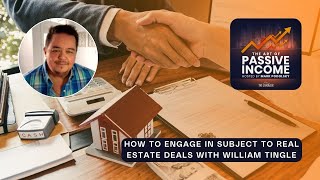
A podcast interview (Art of Passive Income) where Mark J. Podolsky interviews William Tingle, creator of sub2deals.com, about the 'subject to' (sub2) creative real estate investing strategy. Tingle explains sub2 as taking over existing mortgage payments and receiving the deed, discusses advantages (no bank qualifying, low upfront capital, potential for strong cash flow via note spreads), risks (due-on-sale clause, bad deals, insurance and payment handling), lead generation and deal qualification practices, markets suited for sub2, managing notes (self-servicing vs. servicers), and resources (sub2tv.com, williamtingle.com). The interview includes practical tips for new investors and Tingle's tip-of-the-week directing listeners to free YouTube training.
Chapters
Hey, it's Mark Podolski. Land Geek is your favorite niche real estate website. The landgeek.com and on this week's Art of Passive Income podcast, I am so excited to introduce to you William Tingle. He is the creator of sub2deals.com and if you don't know what a sub2 deal is, you're about to find out. And that's a website specializing in products and training for creative finance investors for over 20 years. He is the recognized expert in the creative real estate investing technique known as subject to. He is the most sought after creative finance coach specializing in this subject on the planet. William Tingle, I'm delighted to see you brother. How are you?
Hey Mark. I'm great man. It's great to be here today, really.
Okay, let's just, let's just rewind the tape first of all. And how did you get into real estate? And what brought you to sub 2? And what the heck is sub 2? This is a three part question, no pressure.
Well, you know, I think what brought me to real estate was what brings a lot of people to real estate. I had a job that I hated and didn't, didn't see myself getting ahead and just wanted something better for my family. And I bought a Carlton Sheets infomercial late night product off of TV at 2 o' clock in the morning and just read the course and started doing what he said and I started buying houses and so that's how I got into real estate. Now how I got to sub 2 was a little bit different. What I learned and you know, real estate is, it's a process. Learning it is a process and first you learn about what it is and it can create wealth for you, it can create cash flow for you. But once you get it, get started, you realize unless you've got a, a, you know, an endless supply of cash, you're going to need to borrow some money. And most banks, if you have decent credit, will give you a little bit of money for a little while. And what you start learning is that, and it varies depending on how much money you've got, how long you've been established, which credit score is 8 to 12, loans to buy property generally. And I did the math and I said, well, gee, if each house gives me, let's just say $400 a month cash flow and I buy and I'm maxed out at 12, that's $4,800 a month, that's not going to create the lifestyle that I want to have. I've got to find A way to buy more. So I went through several different methods. I went through lease options, sandwich lease options, where you don't own it, but you control it. I did a few of those, didn't really like that. And then I heard about something called subject to. And you know, back then we didn't have Facebook and social media and YouTube, so everything was in late night chat room, AOL and stuff like that. So you, you see somebody talk about something, you type a question, you wait, it may be 10 minutes and maybe an hour before somebody answers it. I learned all I could about that. And what I Learned about Subject 2 was it's just taking over payments on existing financing. So let's say, for example, Bob has a house. Bob got married, he bought a house, and now he's getting a divorce. And he can't make the house payment with just one income, so he needs to sell it. And he's only owned a little while. He doesn't have a lot of equity. It's in good shape, but he just wants to get rid of it. Well, if it would make money as a rental or something, I can wrap with seller financing because the payment's good. It's two and a half, 3% interest. And I can wrap that note at 8% or whatever the current market rate is. I can create 5, 600 bucks a month cash flow. Just take over the payments on Bob's mortgage. He gives me a deed, he walks away. And I can buy as many dang houses as I want to because there's always people in foreclosure, getting a divorce, moving across the country, always in some sort of turmoil. So that supply is endless. So that's what sub2 is. And that's why I started buying that way, because I can buy as many houses as I want. I never have to get bank qualifying. A lot of times don't need a down payment. My credit score doesn't matter. It's just great.
It sounds incredibly great.
It is.
So you get an infinite supply of, of deal float because you have an infinite supply of money. Where, where is the hard in this business?
The hard. The hard, it's just like any, it's just like any form of real estate investing out there. It's finding the leads, finding the properties. That's the digging part. The rest of it's just con. If, if I know where all the Bobs are in the world, all I have to do is reach out to those guys and say, hey, Bob, I understand you need to sell your house, what's going on? And they tell you about it and you go, listen, you. You owe full price on your house. I can't buy it at a typical investor, $0.70 on the dollar deal. But I tell you what, I may have a way I can help you. What if I made the payments for you until I could sell the house at some point in the future? And I'm telling you, if you're talking to the right person, they're going to say, that sounds great. What do we do next? And it's just finding enough of those people to do that. And I've been able for the first 10, 15 years I did this, I regularly found three to five people a month that would say yes, because I looked very hard for those people. I was always out looking for a deal, gotten a little older the last 10, 15 years. And I look to buy 10 or 15 houses a year. That's about it. That's pretty easy to do.
That's pretty easy. So 10 to 15 houses a year will really move the needle. And to buy 10 houses or 15 houses a year, how much deal flow do you need a month? So, like in my business, I got to make about 100 offers to get one deal. What do you have to do?
Well, see, I do things a little bit differently than most investors do, Mark. I don't make a lot of offers. I get myself in front of a lot of people with issues, and I have conversations with them. And my question to them is always after they've told me their story. Okay, Bob, I hear what you're saying. You can't make the payments. You need to sell this house. What do you need to get out of this thing? And most of the time, what they're going to tell me is I just need to get rid of it.
Right?
Okay. I already know from my conversation that the house is worth 200. Through my conversation, I've learned that he owes 190. I understand that his payment is $1,200 a month. It's 3% fixed. He's two years into the loan. I have all those facts already know if he says, I just want to get rid of it, or even if he said, william, if I can just get moving money, if I could just get $5,000 for a truck and a new place and whatever, any of those things work for me, this is a great deal. And when he says to me, I just need to get out of this thing, I say, okay. So what I hear you saying, Bob, is that if you could just walk away from this property with a couple of thousand Dollars in your pocket to get started somewhere else. That would be a solution for you. And he said, absolutely. Then I just bought the contracts. He told me what my offer is. I don't have to make an offer. That's how I do things.
I love it. I love it. Now, I know back in the day there was this little thing called due on sale clause. Is that still a thing?
It's still out there. It has been since the 80s when interest rates were so high.
Could you sort of explain to people what due on sale clause means and how that impacts you?
The do won't sell clause is a little paragraph in most everybody's mortgage out there right now. And it started up in the 80s when interest rates were 18% and people were just taking over existing mortgages and not refinancing or not buying with new loans. And the bank said, it's costing us a lot of money. What can we do about it? So they put a little thing in there called the due on sale. And what the due on sale says is that if you transfer any interest in that property without the approval of the bank, the bank can, at their option, read it, it's in there at their option, decide to call a loan due in full at that time. And what I have found over the years is that banks are well aware of the cost of foreclosure and they don't want to own real estate. It's in there at their option. And I've been doing this for 25 years and I've never had a loan called. Now we do a couple of things to, to make sure that doesn't happen. Handling insurance properly is one of them. And of course, obvious making the dang payments on time is another one.
Right, Right.
Yeah, but. But banks don't want to own that property.
So it's a nothing burger clause, basically.
Now, do loans get called to. Yeah, they do. If you're stupid and you don't make payments and you don't have insurance properly and you don't do some other things, can they get called to? You bet. But it's a very, very low percentage. I bet you've heard, Mark, that if you get in your car and take a trip within three miles of your house, you can be in an accident.
That's true.
But you still get in your car every day and you go and you do. And the important thing is to have a plan. Have a plan if it happens. Have access to bank financing, have access to private funds. Just have a conversation with the bank. Okay, Okay. I took over Bob's payments because he couldn't make them and you guys were going to get the house back. What do you need me to do? Do you need me to formally assume this loan and maybe they'll raise the interest rate and who knows? But there are solutions. It's not the big boogeyman everybody makes it out to be.
Amazing. Amazing.
Who.
Who shouldn't do sub 2?
Gosh, I can't imagine anybody that wouldn't. If I've got the opportunity, even if I intend to flip a property, if it's got financing on it, the seller will let me take over the payments on it while I'm doing a rehab and flip it, man. I'm sub two and all day. Yeah, sure.
Wow. What's the worst advice you see or hear given in sub 2 strategies?
The absolute worst advice is that if a seller will give you a deed, you should take it. Any deal is a great deal if it's sub two, because that's not true. If that house doesn't have equity, if it won't cash flow, if you can't flip it right now and make some money. A big thing I see a lot now is people will come into these Facebook groups and they'll ask the question, I found a seller that'll deed me their property. I can take over the payments on it. But market rent for this house is 1800, and the PITI, principal, interest, taxes, insurance payment is 2,400. Should I take it? And there'll be people all, oh, yeah, man, you're getting a deed, you're getting a free house. Take it. That's not true. You know, it's got you. You got to have a plan B. And for me, plan B is a rental. I'm not a landlord guy. I like to sell things with seller financing. But I want to know that if the worst happened, if the market tank, if that property lost a lot of value, that I can still rent it out and at least break even.
Right.
So that's some bad. That's some bad information. All deals aren't deals, even if they're subtitles.
Okay, okay, that's. That's, that's good to know. And if you're just getting started, what's. What's something that a newbie should really look out for?
Going back to bad deals. Yeah, bad deals. You know, make sure that you know how to analyze a deal properly. That's so important. And a lot of people fall short on that, especially new people. How to really analyze that deal. This is what I tell my students Certainty is the word. You know, I worked in the restaurant industry for 20 years before I got into restaurant. And you know how especially us guys are. We'll walk into the kitchen if we're hungry, open the refrigerator. Refrigerator. See that Chinese food that's been in there for three days, Open it up, sniff. That's okay, I'll eat it. In the restaurant industry, we used to say if there is a question, there is no question. And I'm that way about deals.
Okay.
If. If it's uncertain, it's going to be a money maker for me. I deal in probabilities. I deal in certainties, not possibles.
So, yeah, Derek Sivers has that phrase, if it's not a hell yeah, it's a no.
Yeah.
Does the Same apply to sub 2?
Yep, for sure it does for me. I've been doing this 25 years and I've never lost money on a deal I don't intend to.
That's incredible. So when did you start teaching sub 2?
You know, I got started teaching almost by accident. I. I was very successful in the first couple of years. And every time I'd go to an event or anything, people would just cry. How'd you do it? How'd you do it? And email me and ask me a bunch of questions. And some of my friends that were in the education business said you should just write a course. So after I've been investing for three or four years, I actually wrote a course on Sub two and that's how I got started teaching.
Amazing. Amazing. So now you have, you have a podcast as well? I was on your podcast. What is your podcast typically about?
Usually it's about some form of creative finance, but it can be about anything that's, you know, popular or things that people are interested in and things like that. But we typically talk about some form of creative finance, something that's out of the norm other than just buying something for cash and, and either rehabbing it or something like that.
Yeah. So I imagine if the economy is going down and interest rates are going up, this is a good time to be in sub 2. Because the, the best deals are going to be people who are distressed and they just need to get out of this mortgage payment. Am I thinking about this correctly or am I wrong?
Yeah. I mean, people are always in trouble. Right now with the economy like it is, there are more people that can't afford their houses or, you know, finance is the main cause of divorce. So that, sadly, I mean, there's a lot more divorces. But when you can Take over payments on a property that has a 3% loan. We, even with little equity, like let's go back to Bob's house. It's worth 200. He owes 190. If he has a 3% mortgage and his pit has 1200amonth, I can sell that house for 209. Just, you know, just a hair above right. Market value is I can get 20,000 down. I can sell it, wrap the note at 7%, collect 5 to $600 a month in cash flow. My buyer's payment is about what rent would be, eighteen hundred dollars a month. And I can make money off of a no equity deal over three or four years, I'll make 50, 60 thousand dollars off of that house doing it like the bank does, largely just the spread, 3% to 7 or 8%.
Yeah. Do you use software to manage your notes?
I don't. I use an Excel spreadsheet and we service all our own notes. You know, some people like to use a. More a servicer to handle all those, but it's pretty easy. Me, I've, I've got a twelve hundred dollars a month payment that goes to bank of America for Bob.
Right.
And I've got an eighteen hundred dollar a month payment coming in to one of my LLCs.
Right.
And all I have to do is put that money in the bank account that's assigned to it and write that check or make that, you know, online transaction to Bob's bank of America. It's really a pretty simple process. You can handle 50 of those, no sweat. And it'll take you a couple hours a month to, you know, to reconcile it. It's not that hard.
Now, can you do this from anywhere in the country or should you work in your local market?
You, you know, right now we work in our local market. We've been here for two years. But for several years I lived out of the country and I did stuff here in the US So is it easy to do it remotely with all of the, the online stuff you've got now, people, boots on the ground, services, things like that? Yeah, it's, it's pretty simple to do it long distance. You can do it from anywhere.
So you can do it from anywhere. You can go into any market. And do you find that there's certain markets that are better than other markets or because of the, the market's so big? I mean, think about it. Just divorce. 50% of people are getting divorced.
Right?
That's, that alone is not even talking about people who lose their jobs. Other types of Distress. That's just a massive market.
Yeah. When you can do it anywhere. And, and obviously people buy and sell houses in the highest price market in the country, which of course is Hawaii. People buy and sell houses there every day. But the best markets I've found are just lower. Not lower income necessarily, but just the more stable markets where the houses are more affordable, it's easier to sell them more quickly where there's good job growth, low crime, things like that. Just places where you'd want to live.
Right, Right. Do you use a website like bestplaces.net.
And that's the one we recommend best places. Sure.
Bestplaces.net Fantastic. Well, William, this has been fascinating. What. What should I have asked you? I didn't ask you.
Gosh, I, I don't know. I mean, I. I've got an answer for your question later about. On the Best Tip of the Day. That's probably. I don't want to use it now. As far as how to learn more about this, there's. There's a lot of sub 2 stuff out on now. Yeah, but. But I would just say this, you know, vet who you, who you learn from, make sure they've been around for a while, they've been in the game for a bit because, you know, trends go up and down, things happen. But yeah, it's, it's great. And, and I really enjoy doing it and teaching it because it's, It'll change your life. I mean, you don't have to have the best credit and everybody that doesn't have good credit, it's not because they don't pay their bills or they're a bad person. Things happen in life. Sure. Y. Medical. You know, medical. I think I read somewhere the other day that medical debt is, is the number one cause of bankruptcy in the country. What do you do if you.
Yeah, absolutely. It is. Yeah, it's. Yeah.
So that's not the reason, but you can have the worst credit in the world. My sellers don't care. They don't ask about my credit. They're looking for a solution. So when I sit down with them and I'm sincere and wanting to help and I ask them what they need and they say, I just need this problem gone. Can you help me? And we say, sure, we can. We can do that.
I love it. I love it. Well, William, your mentorship has been invaluable, but we are now at that point in the podcast where I'm going to ask you for your tip of the week, a website, a resource A book, something else actionable for the art of passive income listeners to go improve their businesses, improve their lives. But before I do, I have to give a shout out to our sponsor, which is flight school. Learn how the next 16 weeks can transform your life. Start building that passive income without any renters, rehabs, renovations or rodents. And I know you're thinking, what about the tuition? It ain't going to cost you nothing. Guaranteed you're going to make it back 180 days or less. Just show us you did the work. Learn more. Go to landgeek.com forward slash training the land geek.com forward slash training schedule A free call with one of our land investing experts and see if this model resonates with you. William Tangle, what is your tip of the week?
My tip of the week I'm going to share with everybody today is if you want to learn more about sub 2. If you want to learn more about creative finance is to go visit us at our YouTube channel, which is sub2tv.com it's su b, the number two tv.com I teach there thousands and thousands of hours and it's all everyone's favorite price, absolutely free. In fact, you can watch my podcast with Mark here. There we had a great podcast. Mark shared a lot of stuff with us about land investing. So I would say that would be my tip of the week.
I love it. Sub2tv.com we will have a link to that YouTube show in our show notes. But as good as a tip as that is, my tip's even better because my tip is william tingle.com and on that website you're going to get the podcast. You're going to see where you get coaching, you can see where you can book a consultation, you're going to see where you can download the ultimate guide to creative finance. 12 Houses to Freedom, Blueprint 77 Critical Success Tips for the New Investor, the ultimate sub two guidebook. It's all there@williamtingle.com so as good as the YouTube TV training is, this is just your one stop shop for all the goodness that is William Tingle and Sub two training. William Tingle, you are a delight. Thank you so much.
Well, thanks so much for having me, Mark. I hope everyone's as excited about checking out our YouTube and our website as you seem to be. So I hope everybody's at exception.
I don't, I don't know why they wouldn't be. I don't know why they wouldn't be. So yeah, fantastic. And so I want to thank the listeners. I want to remind you, the only way I'm going to get William Tingle to come back and do a deeper dive in the sub 2 is if you do three little favors. You got to follow rate. Review the podcast. Send a screenshot of that review support at the land geek.com to send you for free signed copy of Dirt Rich. And even if you have Dirt Rich, let me know. I'll send you a signed copy of Dirt Rich too. And if you have Dirt Rich too, don't worry about it. Do it for yourself selfishly, because we're going to get better guests. Guests like William Tingle. See our reviews and they say, oh, should I do that podcast? Should I do that podcast? They wanted to go on the podcast that have the most best reviews. So do it for yourself selfishly, and have my undying gratitude that goes along with it. William, are we good?
Oh, we're great. I appreciate you having me today.
Thanks everybody and let Freedom Ring.
Thanks for listening to the Art of Passive Income podcast. Are you ready to learn how you can start building a passive income without renters, rehabs, renovations or rodents? Schedule a free contract consultation@thelandgeek.com training let freedom ring.
More from Mark





How to find funding partners: How to Scale Land Without Using Your Own Capital


