How To Get Motivated Leads For Your Real Estate Business
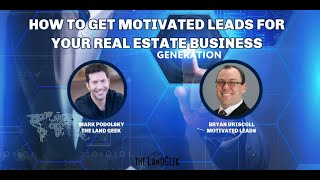
A podcast episode (YouTube) hosted by Mark J. Podolsky with Scott Todd and guest Brian Driscoll (digital marketer & real estate investor) about generating motivated real-estate seller leads. Brian explains three primary channels (Facebook ads, Google PPC, and SEO), emphasizes accurate tracking (Facebook pixel) and speedy lead follow-up, and gives practical benchmarks (ballpark cost-per-lead, close rates, and recommended ad budgets). The conversation also covers testing creative/targeting, building funnels/CRMs, the long-term value of SEO, and common mistakes (no pixel, boosting vanity metrics).
Questions this video answers
November 18, 2021.
Approximately $50–$80 per qualified lead (varies by market and season).
Around $150–$200 per lead in higher-cost markets (example: California).
About 9% (roughly 1 in 11 leads closes).
Approximately $880 per closed deal (80 × 11 ≈ 880).
Chapters
Hey, it's Mark Podolski, the land geek with your favorite niche real estate website, thelandgeek.com and on this week's podcast, we have someone who is going to help us make it rain, get more leads. To quote Glengarry Glen Ross, it's all about the leads. But before we talk to our guests, I'd be remiss if I didn't properly introduce my co hosts. You know him, you love them. The brain, the professor, your flight school Sherpa. Scott Todd from scotttodd.net landmodo.com learn anything about anything. Investor ninjas.com Scott Todd how are you, Mark?
I'm great. How are you?
Pulse is still normal. Respiration is fine. Our guest today is Brian Driscoll. And Brian, give everybody your quick bio view.
Yeah, sure. So I'm a digital marketer. I've been in the business for like 15 years. But I'm also a real estate investor. So I do a lot of buy and hold. I buy places, fix them up, and then rent them out. So I hold those and yeah, I have a lot of success generating leads for real estate investors. They're looking to connect with people that distressed properties.
So you basically scratched your own itch. Essentially you're a real estate investor. You needed leads and you got so good at it, you created a company that helps others get motivated leads. Is that correct?
Exactly. Yep.
Okay, great. So let's just rewind the tape. And what were you doing before you got into real estate?
Yeah, so I bet I got a Digital Marketing. Like 15 years ago, I was on, I don't know if you guys know, warrior forum. I originally was like poking around on that forum, just learning. Bought a $49 course on how to do WordPress and all that kind of stuff. Then one of my buddies, he was selling blades on ebay. I'm like, hey, dude, let's just stick a WordPress set up and see what happens. Put that up. He started selling and started crushing. I'm like, wait a minute, I can do this for other people. So like 10 years forward, I'm doing this for multi, like national and international companies, big E commerce, things like that and dealing a little bit like the corporate kind of world, like it's different, you know? And then I'm also trying to buy real estate. So I stuck up a little website in Pittsburgh just like a carrot site and started doing the market and I'm crushing it. I'm like, you know what, let's, let's offer this to other investors. I like dealing with investors anyways, they're cool people like down to earth. So yeah, we just came back, back around and started doing local marketing.
Interesting, interesting. Scott Todd, what are your thoughts?
I know the Warrior forum forums, it's definitely a great place to start. I'd like to know more about kind of what you're doing with kind of the websites to generate the traffic. You talked about the motivated sellers. Let's. Or motivate leads. Let's talk about that.
Yeah, so, so what, what I'm doing originally we're targeting. So we have. For people that don't know too. You have normal people that want to sell their house on emls, then you have motivated sellers. We call them motivated sellers. They're people that have like hoarder houses, distressed properties, inherited homes. So that's what we target. We target the people that can't list on the market. They want to sell quick and can and they weren't looking for a convenient sale. Then in exchange they're going to give you a lower price on it just for the convenience. But what we found works is Facebook ads, Google pay per click and SEO. So there's three different types of marketing there and we mainly optimize and push people's website out, we push their brand out and it's very direct, direct messaging to get the right audience. And that's mainly what we do though is those three different types of marketing.
Interesting.
How do you find, how do I find like the home, the distressed homeowners with Facebook ads? You know, am I marketing everybody and just hoping that the numbers work or how do I find those people?
Okay, yeah. So here's how it works on Facebook. Facebook actually just changed and it's gonna change more. I don't know if you guys heard like the Apple update, they're gonna start pulling cookies and like not letting you track as much data. But also in the real estate sector, about six to eight months ago they started pulling back. So we can't even target people based on age, sex. We even zip code. So what you have to do on Facebook, it's really important on the messaging and the ads you're doing because we do have to go broader. We have to show to a 15 mile radius minimum around a city. We have to show from everyone from age 18 to 65 plus we have to show to male and female so we can't limit that to older people that would have equity, things like that. So the way we do it is the messages extremely direct. So it's like we buy houses or we're look, we're cash home buyers or if you want to sell your house fast. And then once people click that, I don't know if you guys know there's two different ways to do Facebook ads. There's one is Facebook lead forms, and then the other is people click it and go to a website. We choose to send them to a website because we want to pre qualify them out also and show them. Okay, number one, we're investors. Read what's on our website. If you're still interested, then you can fill out a form. If not, that kind of pre qualifies them out. Unless you're a realtor, want those types of leads also. So that's kind of the process there. And then we just found you have to be super direct. And then also what we're doing is we're like, Facebook has a Facebook pixel, the code you put on the website, which allows us to track data. So if someone comes to the website and does not fill out a form, it allows us to show ads back in front of those people. Same as if you're looking at shoes on Amazon and then you don't buy them, and then they're following you around. So we kind of build a funnel there too, based on people that have shown intent and didn't convert. That makes sense.
Yeah, makes sense. Makes sense. So, Brian, let's do some math.
Sure.
Who doesn't love math?
Love it.
Okay, so I'm a new investor, and I'm looking to do exactly what you do. I want motivated leads. How do I know how much I should pay to for a lead to know what my ROI is on this paid advertising?
That's a good question. So in every city, in every different area, the cost per leads gonna be different. Like, I know in Pittsburgh, I'm getting leads depending on the time of year, like 50 to 80 bucks. And that's a qualified lead. They filled out like 15 questions. I got guys in California, they're like 150 to $200 a week, but the houses are more expensive. And it also depends on what your strategy is. Are you flipping? Are you wholesaling? If you're wholesaling, how much are you getting? 5 grand a deal or 20 grand a deal. But on the lead cost, there's really no way to, like, I can ballpark people. I can't predict what your cost per lead is until we see how the market engages with a campaign when we put it up for you. But I do know roughly 50 to 80 bucks across the nation is where we're at. So even 80 bucks, and we have about a 9% close rate. So say one out of 11. That's what $880 per deal is. What we're caught, what we're spending, you know, but. But it's going to be different for everybody because it depends on your close rate, too. Depends on how fast you answer the phone. Like it's a game of speed. A lot of different variables there.
Interesting.
So you. You said that. Okay, it's. It's. Let's say it's $80 ballpark to get a lead. A lead is not a conversion, and a lead is not a purchase.
Correct.
And then it's basically one out of like a 9% close rate. So you said that your cost to close a deal. 880. 1.
Like 880, something like that.
880. And, you know, that's a lot of people. And I'm just coming this from the land investing side. Right. It's different from the house side because if I were to go into deploy, you know, $50 for a lead, I mean, my mailing cost and my can. My. My close rate for a mailed Property is about $80 all in. And so now if I go and I just do that. $80 for a lead, for example, and I'm now spending $800 to get a piece of land. You know, unless it's an expensive piece of land, you know, the numbers don't really work. And I think that that's one of the things that we should talk about is the math behind it. And I think that's where you're going to Mark. Right?
No, no, absolutely. Absolutely. So. So, Brian, do you want to talk a little bit more on that and expand on that?
Yeah, sure. So say, for example, land, stuff like that. The $80 we're getting is on a home. So say, for example, like, I'll buy one of the deals we're just doing. I get $100,000 property. I put like 40k into it, praise it 215. So I got a lot of wiggle room. $800 turns into a lot of money. But on. On your case, if you're only dealing with land and say $5,000, something like that, like a lot lower cost. You'd have to look and we'd have to run the numbers. Most likely, what I do is do a test in the area. Say, okay, let's stick a test up. Let's see what we can get leads for. Let's see if it even makes sense on Facebook. Sometimes. It might make sense on Google pay per click, although Google tends to be a little bit higher. And we would test the market and see what happened and if it. And if it makes sense at economically for you, you know what I mean? And then also there's another thing. You can do Facebook lead forms, which are real cheap if you like grinding, because we'll get you a lot of lower quality leads, but you might get leads for like five bucks.
Okay, so if you get a good filtering system, let's say you have an inexpensive virtual assistant, that might make more sense to pay five bucks for a lead. And then you got to know your conversion rate. So if you've got a 10%, 9% conversion rate, then the math could be more compelling, right?
Yeah, you'd be lucky to get 9, 10% on the Facebook lead form. But if the cost is cheap enough, I don't know, we'd have to test. That's basically what it comes down to.
And really what. This is all a test. You have to test a lot of things when you start doing paid traffic, right? So how do you go about it? How do you think about systematically? These are the variables. I'm going to test and then isolate. Okay, this one works. And then go to the next variable. How do you think about that?
Yeah, you know what? It's actually funny. We do a lot of that. So I have, we do everything for our clients. And a lot of guys, a lot of agencies will test. They test, all do all their tests on the client's money. We have a. We have a big brand that we just do testing on nationally. We just throw up different ads all the time, different headlines, stuff like that. We push it out to the whole nation, and we're looking at, okay, which ad converts, which headline converts, which ad text converts, what gets us cheaper cost per lead. And then once we find a winner ad, then we give it to our clients. We just push it over. Okay, here's another concept that we can push out for clients. And we're constantly, every week testing new stuff. But yeah, you got to look at images, you got to look at your messaging, you have to look at your ad text, the engagement, all that kind of stuff. And then mainly it comes down to what's the cost per lead on that specific image with the headline combo and.
The targeting as well, Correct?
Yeah, targeting. But with the real estate, it's kind of tougher because we have to go broad. So it's, it's super important on the creative. You know, we can't target as, like, if I was selling shoes, I could target 70 or 45 year old females that like Oprah Winfrey or whatever, you know.
Right, right. Scott Tyler, your thoughts?
No, I mean I think that it really comes back down to the numbers. You've got to know your numbers and you've got to really be able to kind of get in there and understand where you're going with that. And I think it all comes back down to systems too.
Right.
You know, you can go target whoever you want, but the whole thing is how do you find the individual land, the individual landowners on Facebook? It's like a scavenger hunt almost. So it sounds fun, sounds kind of cool. But better know those numbers otherwise you're gonna be spending a lot of money.
Yeah, and you know what, A little on that too. Facebook's algorithm is extremely smart. So once say we have a website, we're looking to buy land, we buy land. We're cash, cash buyers. We buy land, we send people to this website, we target broad and we put the Facebook pixel on the website and we have an event that will trigger when someone hits the thank you page. Once we get enough people to go through that website and say, hey, I want to sell my land. Facebook's algorithm is smart enough to just because they don't tell us the demographics and all the data on people anymore, they're still using it. And what they do is they will take that data and show your ad to very similar people that converted if you have the tracking set up properly. So their algorithm will start showing ads to specific people once they learn the type of people that are trying to sell land or whatever. You know what I mean?
No, absolutely. Let's talk about if I go to you and I won't let Scott Todd, because we're competing and I go to you and say, hey look, Scott's going to go all organic, I'm going to do paid traffic, I'm going to hire you, do these ads for me or give me these best converting ads. What's going to make me a good client or what's going to make me a bad client? How am I going to make this a great investment for myself? And what things should I look out for to be either I have unrealistic expectations. Maybe I don't have the ad budget, maybe I don't have the processes in place to convert. What types of things make you want to pull your hair out when you have a client?
Yeah, sure. So you hit a couple of them right there. So number one thing, we're looking at with clients, we're looking to work with seasoned investors, guys that number one can handle leads. But also if they can, they like, it's a game of speed with all this stuff. Like if someone hits you up and wants to sell land or even sell property, whatever first person that usually gets back to them with a reasonable offer gets it. So a lot of guys, I was working with, one guy, he said, he said, yeah, the leads are no good. He's like, I call everybody, everyone back every Friday. Like, what do you mean you call them every Friday? He's like, I got two hours blocked on Friday and I call all my leads for the week. Like, dude, you can, you have to call them within like two minutes when they submit the form. So different things like that. Second, budget. You have to have enough budget to, to put out, put on enough ads and get enough people going through your website for Facebook to learn even who you're trying to get in front of stuff like that.
When you say enough budget, give me a range.
Normally we recommend like 50 bucks a day, 1500 bucks a month per platform. So if you're doing Facebook ads, it'd be 1500 bucks.
Okay.
And then once you dial in on, here's our cost per lead, like once we figure out what the winners are, then you can choose to scale. But if you're only, if you're doing less than that, it takes too long. And then clients are like, we're not getting enough leads and it just becomes a problem, you know? So I'd say budget 50 bucks a day. And our good clients are just running. They have good systems on the back end. They have a good CRM. They have a lot of these. A lot of people that I've seen are most successful will have the lead comes in, it goes into a CRM, automatically sends a text message that will book an appointment for them. They don't even need to call them. It'll send an email. And then if the people don't book an appointment, will automatically follow up with them, follow up with the lead also so that they don't have to manually do it. Because, because people forget. Like, even me, I'm gonna forget to call people. But if I have a system in place that, hey, this person didn't book an appointment, seven days later we're texting them and shooting them an email. Then three months later, they're getting a deal from someone that came in today and they didn't because of the follow up process. You know, so those are, those things make good clients and make good relationships.
Scott, Todd, you're nodding Your head.
I mean, I think it all comes back down to systems.
Right.
You know the, you build the systems and let the systems do some of the work for you. And systems are not like built overnight, they're built over time.
Right.
And ultimately I think that when you have those systems in place and you, you, it's able to kind of relieve, to serve as a relief valve. You let the systems work, but then you let the people work on the stuff that's really core to the business 100%.
So Brian, let's shift a little bit into SEO or search engine optimization.
Sure.
When I say SEO, what does that mean to you and what is your strategy to optimize it?
Okay, so with SEO, what that is, that's ranking. In a free section of Google, someone types in sell my house fast. We want to rank in the top so we can get the results in the space of like selling real estate, like motivated sellers, even selling land land. It's a very low search niche. It's not like, like say there's a difference even with intent. If someone types in sell my house versus sell my house fast, it's two different audiences and two different intentions on what they're looking for. Sell my house just normal is looking for like a MLS agent or whatever, stuff like that. So on the SEO side what we're doing is we're trying to optimize a website, meaning we're trying to make sure all the content unique, it's relevant and when someone lands on a page that's actually answering their question or what they were looking for when they were searching Google. So we do, we optimize the website and then also you want to do off page link building, which helps build the website's authority as well. But SEO has a very high return. It's just super slow, very slow process.
It's a long term investment.
It is. You know what, SEO is kind of like owning a house versus paid, like renting. Because once you pull your ad spend back, your traffic completely disappears. SEO, you're building a solid foundation. Once you're ranking, you're not paying to be there anymore.
Interesting, interesting. Just to expand on, when you say optimizing the website, you're not doing what we call keyword stuffing. You're actually providing useful, relevant information. And Google likes that, is that correct?
Exactly. Yeah. Back in the day we used to be able to just stick keywords on a page and you'd rank the same with Facebook, their algorithm and they're so smart. Now what you're trying to do is you're trying to make relevant content that like the search engines primary purpose is when someone searches, they want the number one page, the most relevant page that's going to answer that person's question or what they're looking for to be number one. So what we're trying to do is make really awesome content that's going to answer and give that person what they're looking for. And then if we do a good job at it, we get rewarded and we get the rankings. If your keyword stuff and giving garbage content like people come to your site, it just doesn't make sense for them. It gives no value. So you're going to want to stay away from all that kind of stuff.
Okay, Scott? Todd?
You know, it's funny because on Lanmodo I look at what people write for, like headlines, for example, and you know the headline. When someone's looking at an ad, for example, they're looking at the picture and the headline. And it's amazing how many times people try to stuff keywords into a headline or into somewhere. And one it sound when you read it, it doesn't sound natural. Okay. Like it doesn't sound like something that you would read. And it's amazing how many people think, well, I'm just going to stuff all this stuff into here. And as opposed to just adding value for a human, they're trying to write this thing for a computer and the computer saying it's all about the human. So, you know, it's refreshing to hear what you're saying is that just deliver the best content you can deliver and it will rise. You don't have to be smooth, fancy or elegant in it. Just write content that people need or want in their lives and you'll be there.
Yeah, 100%.
So Brian, what should we have asked you that we didn't ask you regarding getting motivated leads.
So motivated leads. Well, which should you ask that I didn't. That's a good question. I would say, like a lot of the mistakes I see people making, that that would be a good one. Like the mistakes I see people. If you guys want to do this on your own, number one, if you want to do Facebook ads, for example, make sure you have a Facebook pixel on your website. I see a lot of people come to me and they're like, hey, I spent a lot of money on Facebook, nothing's converting. And I look at their website, you don't even have a pixel. Number two, make sure you have the tracking on your website also what the tracking is, it's A code that you put after whatever action you want people to take. So if you want them to fill out a form, you would put this code on a thank you page that allows Facebook to know, okay, that person just completed a step. Let's track, like, what they're like and see if we can get more of those. Also, a lot of people spend a lot of money boosting posts. I don't see a lot of benefit in that. One really important thing is with, say, Google and Facebook on the paid side, whatever you tell them to get you is what they're going to get. So a lot of guys will run ads for awareness or link clicks or likes on their page or engagement. If you tell Facebook, hey, I want people to click, I want link clicks, they're gonna get a whole bunch of people to click your ad and that's it. Or if you say, hey, I want to get engagement, you're gonna get a lot of engagement on your post, but that's it. Or like, we usually target conversions. We want people to convert, which means we'll get way lower clicks. But Facebook's algorithm is gonna put our ads in front of people that are likely to convert versus, like the vanity stuff like page likes.
Right.
That's one thing I see a lot of people spending money on. I'm like, that's cool. I mean, if it makes you feel good. But they're gonna, they know Facebook knows who will like a post and do nothing else or who will watch a video and they'll put your ad specifically in front of those people. So, so go, go after what you want. You don't have to beat around the voice. Like, if you're looking for leads or conversions, optimize for that. You don't have to do video views and hope people will click through.
Fantastic. Fantastic. Scott. Todd.
I think it's good, Mark.
Well, Brian, your mentorship has been invaluable. But now we're at that point in the podcast. We're going to put you on the spot one more time. We're going to ask you for your tip of the week. A website, a resource, a book, something else actionable for the auto passive income listeners to go improve their businesses, improve their lives. What do you got?
What I have for you here. I have lived by this and it's made me a lot of money and avoided a lot of situations. It's a book, the Richest man in Babylon. And there's one page in that book, the Five Laws of Gold. I recommend everybody read that and implement it. It saves you from Gambling, wasting your money, getting involved with wrong people. It's literally five. It's one page of the whole book. Made me so much money and avoided so many gambles and, like, bad situations.
All right, give us the five.
Okay. Off the top of my head, okay, it's save 10% of your money.
Okay.
Don't try to get unrealistic gains.
Okay.
Don't get involved with hucksters. If you're partnering up with anybody, make sure they have experience or you have experience with that and then the fifth one. That's a good question. Put me on a spot here.
I know.
I may have to get back Joe now, but mainly what it's saying is save your money. Invest it. Invest it in normal things, too. Not like, get rich quick stuff and don't be gambling with your money. If you're partnering up with anybody, make sure that, like, if you're getting into real estate, if you got a lot of money, you're like, I want to get into real estate. Make sure if you're partnering up with someone, they have the experience to back it up so you can fund it.
But.
But you're not getting involved with just two guys coming together, like, hey, let's do real estate. And then you just lose your money because you're buying bad deals or whatever, you know.
Exactly. Exactly. Well, this is great. This is great. Before we get to Scott Todd's tip of the week, I've got to talk about my sponsor, which is flight school. Learn how the next 16 weeks can literally transform your life. Go up the mountain of land investing with Scott Todd as your Sherpa. He's done this thousands of times. He will take you up that mountain quickly, safely and, and efficiently. And by the way, we guarantee that the tuition investment you make in flight school, you are going to make back 180 days or less. So it ain't going to cost you nothing. Learn more. Go to thelandgeek.com training schedule a free consultation. Call thelandgeek.com training all right, Scott Todd, what's your tip of the week mark?
I know you are all on the NFT bandwagon.
I am, I am.
All right, check out this website. It is the NFT of the day. For those of you that don't know what NFT is, it's non fungal tokens.
Non fungible tokens.
Non fungible tokens. Sorry. You can buy unique things with it. It's yours.
It's digital.
Like, if you want to. I don't know if I want to sell this particular image of me right here, then I could possibly sell it and you could own it. I don't know how much money you get for it, but you can sell images, digital images to check this website out, Mark. It's give you a daily dose of stuff that you can invest in or buy.
This is very cool. I'm more interested in selling NFTs than buying them, but very cool.
This might, this might give you some inspiration.
It'll definitely give me some inspiration. Just see what the market is. Still in the research phase of it. I'm still not completely certain. Sold on it as something that has legs. Right. Like this could be sort of a flash in the pan type thing and people look back on this like I can't believe I did this. Right.
I can't believe I bought the first tweet ever for two point whatever, a million dollars.
Right, Right. Or this might be the future where like buying art. There's only one original piece of art that's signed by the artist. If we could buy a fractional share. I think Mark Cuban did a thing on Clubhouse talking about how fractional ownership will most likely be regulated out. The future of that is tenuous as well. When we start talking about regulation and all this stuff. Anyways, I digress, but that's a cool little site. But look, you know what, Scott? That's gonna cost you money. You know what my site's gonna do? You know my tip of the week's gonna do. It's gonna make you money and more importantly, it's gonna get you leads. It's about the leads, the motivated leads. So my tip of the week is learn more about Brian and what he's doing over at motivated-leads.com we will have a link to the site and clearly after listening to Brian, he knows what he's talking about. So check it out. Brian Driscoll, Are we good?
We're good, man. Yeah. This is a good time.
Awesome, Scott. Todd, are we good?
We're good, Mark.
All right. Well, I'm thankful the listeners remind them the only way, the only way we're going to get the quality of guests like a Brian Driscoll from motivated-leads.com is if you do three things. You got to follow us. You got us. Then rate and review the podcast. Follow, rate, review. Send us a screenshot of that review to supportlandgeek.com we're going to send you the wholetailing course, how to double your money 30 days or less for free. So please do that. All right, let's do this 1 2, 3. Let freedom ring. All right. Brian's like, oh, I didn't know they were getting like that. All right, thanks everybody. Thanks for listening to the Art of Passive Income Podcast. Start your journey at www.thelandgate.com and www.scotttob.net. read and review the podcast and email support. Thelandgeek.com your screenshot for a free Passive income launch.
More from Mark





How to find funding partners: How to Scale Land Without Using Your Own Capital


