How to Maximize Your Passive Income Streams with Antonio Rivodo, CEO of Rivx
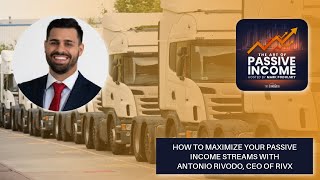
YouTube interview (Art of Passive Income) with Antonio Rivodo, CEO of Rivx, explaining Rivx's "trucking automation" service: a done-for-you property-management-style offering that buys/places/maintains trucks, sources drivers and loads, and operates trucks on behalf of investors. The conversation covers why investors (often real-estate investors) might diversify into trucking, typical economics (gross monthly revenues, expenses, management fee), risks (breakdowns, driver quality, cargo claims), expected returns (stated average 18–40% annually with outliers), capital requirements, onboarding process, and promotional events/resources.
Questions this video answers
8% management fee.
18% to 40% per year (average range stated).
62% year-to-year return for one client (example cited).
Client's engine blew; repair cost ~$12,000 and profitability dropped to about 8%.
Approximately $1,300 up to $6,000 net profit per month (worst-to-better cases).
Chapters
Hey, it's Mark Podolski, the land geek with your favorite niche real estate website, thelangik.com and on this week's Art of Passive Income podcast, I have the CEO of RivX. Now it's Antonio Revoto. You're like, wait, what is Rivex? Well, first of all, let me talk about Antonio. So Antonio has eight plus years of business experience as an entrepreneur. He handles the marketing lead generation, is an automation expert. But what Rivex does is they provide passive income opportunities with a done for you business model in the trucking and logistics industry. Antonio, welcome.
Thank you brother. Thank you, thank you, thank you for that intro.
So Antonio, what's trucking automation?
Ah, trucking automation, man. It's actually a new, unique and hot way of just getting into the trucking industry without having to have all the know how and the, and the knowledge and the relationships and, and the just the groundwork that you got to do to go out and really build a trucking business. So it's a pretty unique concept that, you know, wasn't originated by me, but definitely perfected by me. So you know, about two years ago I was actually referring clients to another automation company based out of Orlando. And you know, I was very intrigued when I heard of the concept trucking automation. I was like, dude, what is this? How does it work? You know, what are we doing here? And when I ended up going ahead and referring my clients to that business, I was kind of just like immersing myself in the trucking industry at that point. I ended up finding out that company was just kind of screwing over the clients that I was going ahead and stunning tourism. So you know, in that moment, I'm a 20, 25 year old kid that just, you know, is trying to build his way into a hedge fund space or private equity space and just building relationship with investors that I didn't want to go down that way. I didn't want to go down as the person that made a referral and to a bad investment. That's the first way I started and that's the last imprint I was going to have with those investors. So you know, I took it as a personal responsibility to go ahead and just, you know, come out of pocket, you know, put the entire business structure together for my clients and then, you know, really just build a trucking business from scratch and just really go ahead and just do this business for them and just take all the learning lessons from the beginning and just go ahead and rebuild this and just do the right thing. In my opinion. So that's how this really started. But trucking automation as a whole, what we do for our clients is we go ahead and we help you secure a truck. We have you secure a trainer, a driver, all the documentation you need for your truck. We basically get you road ready. Then once we get you road ready, we onboard you to our logistics company and then we'll manage your truck and your operation for you on the day to day basis. Okay, Think of this as a property management firm, but for trucks.
A property management firm, but for trucks. Okay, so let's walk through a case study. I want to go, I want to be in the trucking industry, but I've never driven a truck.
But why?
Well, let's just start with why do I want to be in the truck industry? Why do I want to be in logistics?
Well, it's not a matter of logistics in a sense, it's more of a, you know, what are you doing to diversify your portfolio? What are you doing to go ahead and leverage your money? You know, are you only in real estate? Are you only in stocks? You know, everything, everything yields over a turn, you know, but it's a matter of, it's not this or that, it's a matter of like, why don't we try all of it, why don't we do a little bit of everything? Okay, so the majority of my clients are real estate investors. Maybe because I come from a real estate background. I do resident for over five years. You know, in that career in real estate, my job was to go ahead and, you know, talk to my investors, ask them, what are you guys looking for? They'll tell me, they'll give me their criteria. I go out and market for those properties, I talk to the distressed homeowners, I put the entire deal together, I go ahead and help secure the financing for my investors. And then boom, put the deal on the plate, deal gets closed, move on to the next deal. And then if they needed me to, I'll find the property management firm and get it done for them, or they can go ahead and manage that property and on a day to day basis for them as well. So I come from a very tailored background in the real estate industry. Now what that told me was that the majority of investors, what they want to do is just want to put their money to work. They want to go ahead and put their money to work with the least amount of hassle as possible. And basically that's what I did here in the trucking industry. I created a program where we can go ahead and Put a truck on the road. You know, we can go ahead and put the entire business model together, and then we can manage it for these investors. And at the end of every month, you know, we. We send them a piano with the entire breakdown of the results that we created for them for the last 30 days. And then we send them to the. To their. Direct, to their bank account, the net profits of their truck. You know, basically creating mailbox money. And what that kind of opened up was, you know, helped investors understand that there's alternative investments that they can start looking for and not just solely depend on real estate or stocks or. Or whatever is out there right now. You know, it's just an opportunity that yields a great return. Yes, it's a little bit more high risk. Yes, it's a little bit more, you know, left field, but it's still a great return that you're seeing. You know, your money can easily make you an extra 18 to 40% a year.
Okay, so. So you get an 18 to 40% return. I assume we're getting depreciation of the truck.
Of course.
What is the risk is.
The risk is that your truck could break down. And that's just the real. That. That's just. That's just me being 100% transparent. The real is that you truck and break down, you know, some of the cash flow that you've generated. Maybe you can be on pace to make 35%, you know, in a year, but a breakdown could cost you a couple thousand, and it takes you from 35% down to 21%. Maybe that's an awesome.
Yeah, but Antonio knows no one's going to get mad at you. 21%.
And that's what. I'm here to educate people.
Okay, so let's. What's been the best return that you've seen for someone, and what's been the worst return you've seen in the past? Let's just say 12 months. Sure.
So actually, I just closed out one of my clients reports where year to year return, he made 62%.
Wow. And why did he have such a good return?
Truck didn't break down that much. It was very. It was very well maintained. Is that a case for everybody? No, absolutely not. I'm going to be 100% transparent and say, no, that's not the case for everybody. That's why I said that the average would be anywhere from 18 to 40%. Because that's a realistic term. That's a realistic number. Worst case scenario was I had a client that was on pace to do about 31%. But then her engine blew and it cost her, you know, an extra $12,000 to fix that engine. And it took her from, you know, what was going to be her percentage, about 30 something. 30 plus percent down to about 8% profitability. Okay, that's, that's a unique circumstance. I don't buy trucks where that happens. Can, can that happen? Yes. I'm going to say yes because it did happen. But will that happen? Will that be a commonality? No.
Okay, so do I have to be an accredited investor?
No, you don't, because you're not in that. You're not making an investment in me. You're making an investment in your own trucking business. You're just hiring me as a trucking operator to go ahead and manage your operations for you.
And so as a trucking. As a trucking operator, is there risk with the driver? Isn't there risk with the loads? I mean, for sure, yeah.
So, I mean, there's risks of your load can go bad and you get a claim. How often does that happen? Maybe once or twice a year. And I'm talking about in a fleet of 100 plus trucks like ours, that doesn't really. Like one or two times a year isn't really that big of a situation. It's kind of like your truck, you know, engine blowing. It's kind of happening. Yes, it can happen, but will it happen? Most likely not. Drivers, you know, obviously, you know, drivers are part of the biggest, probably the biggest risk inside of a truck because that quality of driver will determine the kind of profitability and the kind of sustainability of your truck. But, you know, we do a very good, thorough background check on all of our drivers. You know, we don't hire drivers that have less than two years of experience. We don't hire drivers that, that have bad connotations on their license. We don't hire drivers that have ever been in any accidents, like anything fatal. You know, maybe a bumper, bumper hit here and there. Yeah, we'll take you, but you know, if it's something major, we won't take that driver. You know, we're here, we're doing our due diligence to go ahead and put the best kind of jobs behind all these, all these trucks.
Okay, so as an investor, I get the benefit of depreciation on the truck?
Yeah, as an, as a. Yeah, go ahead. Sorry. I'm sorry for interrupting. But as an investor, you're getting a bunch of benefits. You're getting the benefits of writing off. Well, this year it Just changed. Now you only get 90% of the entire purchase price of your truck. You're also getting an elite team to go ahead and manage your operations for you. You know, you have people that have nine to 15 years of experience in the trucking and logistics industry on or team. Just because you're part of this big fleet, you gain access to the kind of clientele that, that works with us just because, you know, we have the size of the fleet that we have. You know, the biggest reason why carriers are, why these small carriers are struggling and why they come and knock on our door every week is because they understand the reality of what their situation looks like, which is, you know, these big shippers, you know, the people that are actually paying high profitability loads, they don't want to work with hundreds of carriers that have one to four trucks, one to 12, one to 20 trucks, they want to work with five carriers that have 100 plus trucks. And that's what they're looking for. So by coming up, by coming under our team, you know, you gain access to these clients, you gain access to these, these type of shippers without having to pay these insane broker fees that these brokers are charging. And you know, there's so many benefits to working with us. You get access to our fuel cards, you get access to our factoring, you get access to our relationships, you get access to our mechanics, you get access to our yards, you get access to our services. You know, there's so many tools that we give, you know, all of our clients, owner operators that want to come aboard Rivex, you know, that just puts you in a position to win, you know, and especially in a season right now where, you know, winning is so essential, winning is so imperative for this industry because these brokers are, and I'm not trying to shoot shots out here, but these brokers are really squeezing out these carriers because they want to like line up their pockets. And I'm all fair. You know, everybody's here to make money, but, you know, it needs to be a fair game. And you know, coming from someone that doesn't have, you know, all these years of experience in trucking, I'm coming from a business background and I'm just trying to reshape that identity, reshape the, the fact that like, you know, we can't all win. So why not everybody come under one roof? Let's collaborate together. Let's build one major corporation and let's go after those shippers where we can all put ourselves in position to win.
So what is the management fee for you to manage my truck, 8%. So you take 8%. So walk me through a typical monthly P and L. Sure.
So our P and Ls get. First things first, you're going to see a breakdown of every single load that was acquired for the month. So you'll have a gross revenue of anywhere between 24,000 to 30,000, depending how many days it was on the road. Okay. Then in the breakdown, you're also going to have what we paid for fuel, what we paid for the driver, who was your driver, what was the average rate per mile we achieved for every single load. Then on the left side, you're going to have monthly expenses like your trainer, your insurance, your yard cost, your. Any maintenance, things that we had over the road. What else, what else am I missing? Gps. GPS for your trailer. Bookkeeping. If you hire our bookkeepers to go ahead and manage the books for you on a monthly basis. And then on the other side, you're going to have our 8% that we charge. Our 8% is our management fee. You know, a lot of people charge 8% just for dispatch and just to book you a load. No, 8%, you get my entire infrastructure. Okay. I mean, I'm very competitive. I'm, I'm probably more than competitive in the industry. And I did it on purpose. I did it so that people won't understand, like, hey, I'm really trying to build something here. I'm really trying to build something where we can all win, you know, with new markets, with new market conditions need to be adjustments. And a lot of these people are making the adjustments because they don't want to make less money. But instead of, you know, making the adjustment, finding another way to make money, they're just going ahead and squeezing out their carriers as much as possible. So I did that on purpose, but you're going to see my 8%. You're going to see my factoring the factoring fee that we charge to go ahead and bring in the cash flow through the business every single month. And then you'll see your net profits at the bottom. You know, net profits, Net profits can vary anywhere from. On a worst, worst case scenario, make anywhere between 1300, 1500 bucks in a month.
Okay, so now, so my gross revenue is 30,000.
Yeah.
And my net is.
Your net Prof. Is from $1300 up to $6000. The variable, the variables in your net profit will be maintenance days on the road. That's it.
Okay. And how much is a typical truck?
Trucks can vary anywhere between 60 to 80,000.
So 60 to 80,000. I was thinking they would be in the hundreds of thousands. I'm thinking big trucks.
So we're talking about. So we are talking about the same trucks. But thing about me, I don't buy 20, 20 to 20, 23 trucks. There's no need. You don't need, you don't, you don't need to buy a 22, 2023 truck, nor one. They're overvalued. Number two, they have the same risk on the road. Right. Have the exact. They have the exact same risk on the road. If you get a 20, 18, 2019, 2020 truck, you know, you put it on the road and you do routine maintenance, it's going to perform the exact same way as that 20 to 2023 truck, except I paid one third of the price that you paid. Okay, so when it comes down to profitability, at the end of every single month, who's here profitable?
Yeah, absolutely. But how long, how many. How, how long my truck be on the road before it's unprofitable?
Correct. Great question. So it'll be about three to five years. Three to five years for your truck to be on the road performing, it maintained very well, which we do have our own mechanics, our own yard. We have routine checks on all of our trucks after 11,000 miles, you know, we, we maintain our trucks as well as we can. The only way that, you know, something can really go wrong is like, if something happens that no one could predict it.
Okay, so my, so my investment with you is 60 to 80,000.
So. No, your actual investment with me is 85,000.
My invest $85,000. So I get a truck and I get a business that's going to yield me about 1200 to 3000amonth. Is that right?
$12,000 to $6,000 a month.
$1200 to $6,000 a month.$1200 to $6,000 a month. And so when we do our numbers, we're looking at 8% to 40% return. Is that correct?
An 18% to 40% return.
Oh, 18% return to the 40% return.
But.
And so 18% is if something went wrong with the truck.
Correct? Correct.
And what am I, what do I ask you? I should be asking you.
When do I. How fast can I get started?
So no, so that's why, I mean, if I do want to get started, what would that process look like?
So very simple. If you were, if you were to want it like you were, like, looking to get more information. It's very simple. All you got to do is just go ahead and book a call with our team. Team. Our team will go ahead and give you breakdowns. So every single month, I turn in our new P Ls to our sales team so that they can show Those live updated P Ls to anybody who is interested. Because I'm not trying to sell you on a piano that I got a year and a half ago, you know, I'm trying to go ahead and let you know what's the reality of trucking today, you know, and. And what are we actually performing at? What are the actual results we're creating today? So what they're going to do is they're going to walk you through that. They're going to show you exactly, you know, what are deliverable. What are we doing for you? Who's. Who's your point of contact for every single part of the business? How do you manage the relationship? You know, what's the process of. What's your role as the investor or the client inside of our company? You know, and then you'll also see how do you receive payments. Then you'll see the breakdown of the payments. Then you'll see exactly how it gets. Everything gets laid out for you. And then after you see all of that and you say, hey, look, let's go, I'm interested. Then we'll send you a contract where everything is contractual. Everything is. You can see all of our obligations, you can see everything on paper of what we're responsible for, what we're not responsible for, what are the liabilities, what are not the liabilities. And then, boom, once you sign that agreement, we begin your onboarding process and the magic begins.
So who is this business for? Who's this business not for?
This business is not for the individual who is honestly, like, has, you know, all their. You're gonna get all the money in your bank account and just like literally throw it at this project, praying to God that this works. No, this is a business. This is someone who has capital in the bank and is just looking to diversify a bit, you know, is looking to go ahead and just build another stream of income that they don't really have to touch, they don't really have to look at. But, you know, that can be profitable. You know, I have clients that vary. I have clients that, you know, use their 401k I appliance. I use just savings that they've had for the last 15, 20 years. We have clients that are lawyers, attorneys. We have clients that are doctors. We have clients that are business owners. We have clients that are just foreign investors. We have clients that just want to get into the trucking industry. We have fleet owners, people that own three to 20 trucks that just want to onboard their entire fleet with us for us to manage and just take their day to day business and convert it into a passive income asset. We get all kinds of clients.
Okay, so what keeps you up at three in the morning about the trucking industry?
Nothing. My team is built for that.
There's nothing, there's, there's no rest that, that are worries.
I don't keep, I don't keep. I don't manage the day to day operations. I have a fully equipped staff that can manage the business 24 7. They are on the phones whenever needed at all times. As far as like news about the industry, don't get wrong. I'm a student to the game. I'm consistently educating myself on the updates on fuel, on the updates on rates, on the updates on brokerage, on the updates on, you know, where the market is shifting to. But let's be real for a second. You know, the trucking industry is not going anywhere. You know, this is, it's the backbone of the United States. 70% of the goods in the United States has traveled through transportation and logistics. And the trucking industry goes down. We got bigger issues.
So there's not a supply demand issue. As far as I buy a truck and now I can't get any loads up.
Put it this way, I could put 10,000 trucks on the road and I wouldn't even make a dent in the need of this industry.
Yeah, and then what about because the need is so high until we get automated trucks? Yeah, I think the driver risk is, is an issue, isn't it?
Oh, I never, to be, to be honest with you, it's, it's really not. If you hire the right drivers, people with experience, people that have great driving records, like, they're right, you, you mitigate your risk, you know, as much as possible. But let's be real, there's risk in everything we do. You know, you can get a rental property right now, put a wrong, put the wrong tenant in there and wake up to a disaster. You know, anything has risks, but. And there's no risk, there's no return.
All right, so Antonio, this has been very enlightening. And what does Rivex mean?
So Rubix is, is kind of personal. You know, the reason why I created the brand is because I always wanted Rivex to stand for, you know, Revoto, meaning me. Everything that I enjoy Everything that I envision, every dream that I have, and then X is the multiplier, meaning everything that I touch will multiply.
Everything you touch will play. I love that. So, Antonio, we're at that point now in the podcast, and your mentorship about this industry has been fantastic. But I want to ask you another question, which is what is your tip of the week? A website, a resource, a book, something that's actionable for the autopsy listeners to go improve their businesses, improve their lives. What do you got? Sure.
Yeah. So two things. I'm going to give you two tips, all right? Number one is go to our social Media, visit Rubik's automation.com and don't even book a call. Just go look at the videos that I post for our audience and community every single day and find out, you know, that there's value there. There's. There's business knowledge, there's trucking knowledge, there's, you know, information that can help you. All right? And then once you're ready, once you understand the value that we provide as a company, then I want you to go book a call and find out what we do here at Revit, because the worst thing that you can do is be uneducated about what we do. And I would just want to make sure that everybody goes and gets educated, understand what we do, get your questions answered, and this is for you. Great. If it's not for you, still, great. Welcome to the rebex community. All right, and then number two, I'm right now about to go ahead and do an event July6 to July 7 out here in South Florida called Minions and Trucking. There'd be a live event out here in South Florida. And I want to make sure you, you know, anybody who's interested, go to our social media and inquire about it. You know, go ahead and find out for yourself what we're doing here, the guest speakers we're bringing, and if you're interested in trucking, that's a great place for you to start. All right.
Very cool. Very cool. Well, my tip of the week before I give it is it's going to be really interesting, but I do want to talk about our sponsor, which is Flight School. Learn how the next 16 weeks can transform your life. Go up that mountain of land, investing quickly, safely, and efficiently. Don't have to deal with renters, rehabs, renovations, or rodents. And have Scott Todd, who's done it thousands of times, teach you. So go up that mountain with him, taking you there, and start building that passive income with no Headaches. Learn more. Go to the lanky.com forward slash training thelantic.com training and I know you're thinking, what about the flight school tuition? It ain't going to cost you nothing. Guaranteed you're going to make back that investment. 180 days or less. Just show us your work. So my tip of the week, I actually because Antonio talked about Rivx, so go to R I V X co as well. But I'm going to give another tip. So I have a very big problem with checking email and it's been a problem for a long time getting these dopamine hits. So check out this app called Clearspace for the iPhone. Clear space. It will allow you to take a deep breath before you open an app. You can't just reflexively check email or social media. It'll have you do a breathing exercise. It'll give you a little quote and then you can only check it so many times a day. It limits your time on it. So it just allows you to be more intentional with your time, your attention, your relationship with your phone. Check out Clearspace, the app. Antonio, are we good?
Yes, sir. All right.
I want to thank the listeners, remind you the only way I'm gonna get the quality of guests like an Antonio Revoto, if you do three little favors. Follow rate Review the podcast Send a screenshot of your review supportlantic.com I'm gonna send you a signed copy of Dirt Rich. All right, thanks, everybody.
Awesome.
Let's Freedom ring. Thanks, Antonio.
Appreciate it.
Thanks for listening to the Art of Passive Income podcast. Are you ready to learn how you can start building a passive income without renters, rehabs, renovations or rodents? Schedule a free consultation@thelandgeek.com training let freedom ring.
More from Mark





How to find funding partners: How to Scale Land Without Using Your Own Capital


