In What Ways Are People Overcomplicating The Land Business?
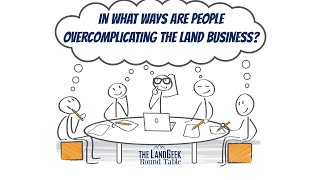
Roundtable podcast hosted by Tarea Harris with Scott Bossman, Eric Peterson, and Tate Litchfield discussing how land investing is often overcomplicated. Panel emphasizes focusing on fundamentals—buying land (direct mail, lead generation) and selling land (marketing)—and warns against ‘shiny object’ syndrome, premature automation, and building bespoke software before needs justify it. Includes a tip-of-the-week recommending Derek Sivers’ article and a sponsor plug for Flight School.
Chapters
Hello, everyone. It's Tarea Harris hosting this week's roundtable podcast. And on this week's podcast, we have a few of the normal crew members we're missing. Obviously the Land Geek himself. Therefore, you're stuck with me today. But we also have Scott Bossman. How are you, Scott?
Great, Terea. I'm excited for this podcast. Your hosting debut.
Exactly, exactly. Have Eric Peterson. How are you, sir?
I am doing good. It's a little wet here in Tennessee today, but, you know, all is well.
Happy to be here.
Excellent. We're getting a little aftermath here in Atlanta, too. Raining extremely hard off and on. Stay dry. And what about you, Mr. Litchfield? No rain for you?
No, actually, we did have a little rain this morning, just enough to wet the windshield, but, you know, probably cost like, 50 car accidents or something like that because we don't drive well in the rain. So. Yeah, it is what it is. But things are going well. We're staying busy. Too busy. But, you know, I'm not going to complain about it, because nobody really cares.
Exactly. And it could be the opposite, right? Where things are extremely slow. So busy is good. That means you're over there making a.
Lot of money trying.
So this week, I thought it would be good to kind of just go around and talk about kind of what you're seeing. You guys typically keep your finger on the pulse of what's going on in the land geek community. So, Tate, let's start with you. Like, what are some things you've been noticing either in office hours, some of your coaching clients, or just kind of hearing, you know, things talked about in the community as a whole?
All right, well, this is a good topic. And so the topic I want to present to the roundtable today is what are you seeing that people are doing to overcomplicate a rather simple business? And it can be in anything. Right. If you look at our business, I always say it's really just two parts. Part A, part B. You've got to buy land and you've got to sell land. But for some reason, I don't know if it's individuals, backgrounds, or just their need to add complexity or VAs or tools or resources to this process when they're not needed. We like to make work. And so what I want to talk about with the coaches and everybody on the call here today is what are you seeing people do that over complicates a simple thing? It might be simple as, you know, I see somebody. This is a topic that came up the other day. They had three People working their deal of the week for three different people going in to send in an email. Three people, they were like, tate, what do you do? And I'm like, well, my entire process costs me about one to two hours a month. And it's done by one person on one day.
That's it.
Plain and simple, for the entire month. And they were just kind of blown away. So I don't know. That's what I want to talk about is how are people overcomplicating something that doesn't need to be.
So I think that's a good way. I think that's a great topic. Scott Bossman, have you seen over complications in the business?
Yeah, for sure. So I think this is very easy to do, right? There's so much lingo out there about all of these new geeky tools. CRMs, Airtable, there's Facebook CRMs now that can go right into your chat function. There's CRMs that plug into your Google Drive. I mean, it's one thing after another after another. Like Mike Zano, I wish he was on this podcast because he's notorious for picking a new tool every week.
Oh, he loves technology.
Dude, you got to try this new email tool. And initially when I met Mike Zano, I'm like, oh, that looks really awesome, Mike. And then a week later he changes his mind on me. So now there's like a six month Zano litmus test for me. If he's doing it for six months, then I'll consider it. But anyway, I think there are a lot of ways to get distracted in this business. And I hear very consistently, Scott Bossman, what CRM are you using? There's so many out there to choose from. This is just one example. I know you guys will have more. And what I told people is, you know what, my first two years in this business, I sold a lot of land. Do you know what CRM? I had a notebook next to my computer. It said hot at the top and the next page said warm. And I kept track of leads in a notebook. You don't need to have all this stuff outsourced initially. What you need to do is exactly what Tate said. You need to buy land. How do you buy land? You mail, you need to sell end. How do you sell land? You market. Those are the two things you need to be focusing on in this business as you're growing it now. When you get to the point three to five years down the road where you have a well oiled machine and you have a little bit more time in the business to perfect some of these processes, by all means. But what you need to really focus on in the beginning is those two key things. If you're going to spend time during your day, spend it on those two areas. The rest of the stuff will fall in. But try to avoid shiny object syndrome and keep it simple.
So by keeping it simple, are you suggesting that you allow a problem to present itself and then you find a solution for it, rather than going out trying to find solutions to problems that don't even exist yet? Right. You don't. You don't have any leads. You don't have any leads yet. Why are you spending a week on trying to, you know, set up a CRM? Is that accurate?
That's very accurate, yes. Take it as it comes. Establish those systems when needed. You know, Matt Forbes is notorious for this. He says it all the time on Nightcap. I failed in this part of the business, he says. I tried to build everything first. And his productivity with acquiring land and selling land suffered as a result of that. And if he had to do it all over again, he'd go back and stick to the fundamentals more initially and then build a system. So, yes, that's definitely. I agree with that.
Awesome. Awesome. Mr. Peterson, care to weigh in? Sure.
So I think that among my students and among those kind of getting started in the land business, we see it all the time, right? I mean, it's so easy to be distracted from the fundamentals, especially when we're out there as coaches and land investors and we're talking about technology, we're talking about automations, we're talking about this type of tool or that type of tool. You know, when I think, when people hear that, they're like, well, if Tate's using that, I've got to use it too. Or if Tate's doing this, I've got to do that too. But what is often forgotten is all the years in front of that person that they've been in this land business perfecting their business prior to getting to whatever, build that automation or, you know, test this new tool like Scott was talking about, et cetera. And I think, you know, we tend to get hung up on these things, like, oh, I should have, you know, a certain number of automations in my business, or this thing should be automated. When the reality is, like, if the rest of your business isn't running smoothly, like, in terms of automation, a lot of those things can just be outsourced. And that's a temporary solution. I mean, it doesn't have to be. But it can be a temporary solution until you're at a point where you've got extra time that you can spend to build that automation that's going to take a lead from airtable and move it into follow up boss or whatever that might be. Right. But it's so easy for all of us to get caught up in these little details of, hey, I heard someone's doing this, I need to do it too. But the fundamentals are so much more important. If you're not buying land and if you're not selling land, that's where you have to focus first. All your efforts need to be there. Forget about the tools, use pen and paper, use whatever you have to to get the job done until you can find time to build systems around it. Right. I mean, we kind of talk about that all the time in this business is like you can kind of take this business as it comes. In other words, we teach you to mail and to get a list.
Right.
So that's all you need to know to get started. And once it comes time to buy a property, well, you're going to learn something about deeds, you're going to learn how to draft a deed, what has to happen from the seller and so on. But you don't need to know how to sell yet. Like, one step at a time.
Right. The term that comes to mind a lot to me is like, you can't see the forest for the trees. Right. So the big picture is mail. The big picture is, first, acquire land. The second step is, now we need to market. But when we focus so much on how we're going to do this. Well, I need this account at Facebook and I need 15 accounts and hold on, do you have one Facebook account? Right. We have to start somewhere. So I wholeheartedly agree. Tate, want to weigh in?
Yeah. I mean, there's a lot of good things that we've talked about. One of the more comical ones that I've seen come up recently is somebody who's trying to develop their own version of LG Pass. And like, at the end of the day, why? There's so many other things to focus on that actually will make you money. Why are you trying to do that?
Why?
And I asked this all the time. They said, well, I want it to do something that it doesn't do. Well, tell us, tell me what you want LG Pass to have that it doesn't, and I'll pay our developer to add it. We're very aware that LGPass, as well as any software, is a Constant work in progress. But it seems silly to go out there and develop something on your own, right? And if you don't believe me, ask for the story on Geek Pay. Right? Like, the reason Mark created Geek Pay was because he got tired of paying somebody else to do this for him. And it's been a good move for him, but I don't know, eight months into it, I don't know if he would have told you that this was a smart decision. I think he got to a point where it was like, well, I've spent so much money, I am so committed that I just got to hope that one day this will be profitable. And, you know, it's a great thing. And I love Geek Pay. It's built by a land investor for himself, and he happened to open it up to the world, and so that's really cool, and I'm grateful for it. But, man, focus on what makes you money. At the end of the day, if you're doing something and you cannot answer the question of, did this make me money? And if the answer isn't a yes, a definitive yes, you wasted your time, plain and simple. That's how I live my business model, right? Like, does this make me money? If the answer is no, you know what does make me money? Training somebody to do this for me so I never have to look at it again. That makes me money. But doing this job over and over, day in and day out, does not make me money. So don't spend your time working on something that doesn't make you money. Spend your time working on a software that already exists. It's crazy talk.
And I love technology. I absolutely love technology. I love automating. I love it. But in the beginning, for both Landon and I, it was a matter of understanding the business and not getting bogged down in little things like, I want to create my own CRM or I want to create my own. And there was someone who tried to create their own CRM, I think, in our community before. So there's some really brilliant people in the community. But like Tate said, if it's not making you any money, if it's not helping your business progress in that moment, then you're kind of wasting your time. Any other tips you guys want to give?
Oh, I want to hear yours. The big one.
So I think one of the biggest ones I think I am running across is marketing on Facebook, right? So when I started off marketing on Facebook, I bought a $300 laptop from, I don't even know, some Walmart or somewhere, and I had about four or five browsers on it and I had a different account set up on each one of those browsers. And that's how I started off my Facebook marketing. Now I think people are, I need AWS and I need pies and you know, I need all these systems on the back end and what's a proxy? And you know, how do I set this up and my PI's run and it's running slow and how do I speed it up? And it just becomes just this cycle of. Have you posted anything on Facebook this week or are you still bogged down and trying to get the technology to work? So even on office hours I encourage like the flight school office hours, hey, start basic, start small, get a laptop, get a spare laptop that you're not using. Pull all your information off of it. All your VA will need access to. Once you hire a VA for your Facebook marketing, all they're going to need access to is a browser. Just give them access to a browser. You don't have to build your own systems on the back end. You can get there in time, but don't continue to waste time, money, energy into something that may not even provide extra dividends later on. So that's kind of the bigger thing I think I'm seeing is people are getting too far ahead of the technology or their technical abilities and spending a lot of time having to troubleshoot and work through how to even make the systems work.
I like it.
Cool.
Good job, Tria.
Well, thank you so much. I was hoping not to do a really good job because I don't know if I want to do this again. But we have to make the land geek proud.
We just got to let the listeners decide. Should we replace Mark Podolsky with Terea Harris? That's the question that we need to ask.
Absolutely not. That's not even a question.
And if you never get to hear from Mark.
Exactly. They have to hear from Mark.
All right, well, it's good to have Terea as our stand in backup. Right? Like anytime we need this. No, no, no, she can handle it.
She's the alternate. She's. Yeah, she's.
Rock paper, plan B. No, listen, I can't do this.
Rock paper.
There's a reason I didn't do it. Every week you do it. I didn't get asked to do this. So I mean, I took that personal. Right. And that's okay. You know, Mark, when you're listening to this, I think you made a wise decision in going with Terea.
And we all know Scott And I already wanted. We never got asked again. So there's a reason for that.
You guys were great. That was our lowest view or listen count podcast ever released.
We had like 50% unsubscribes after that one.
So that was a great one. I listened to it. It was really good. I like it. I'm not trying to replace Mark, though. He's much better at it. Well, we have happily come to a part of the podcast where someone other than me gets to give a tip of the week. But before we get to the tip of the week, I do want to thank our sponsor, flight school. Flight school. I can attest to how wonderful flight school was just for my husband and I. It was 16 weeks of step by step instructions of how to set up your business. And it, it set us on our way. Mark is so confident that this program is life changing and it will help catapult your land investing business that he guarantees that you'll make your money back for tuition in 18, 180 days or less. So you just have to show your work and he will stand by that commitment. So, Mr. Tate, I think you are giving us a tip of the week today.
All right.
Yes. Actually, this is coming in from Chris Merkling. He actually sent this to me along with everybody else. And it's actually an article. It's written by a guy named Derek Sivers. And the article is titled six Things I Wish I Knew. I Wish I Knew the Dark Day one I started. So he goes through and it's a little bit of an older article, but I've read through it and I loved it. And like step number one is focus, disconnect, and don't be distracted. Step two, don't accept others. Don't accept their speed limit. So move at your own pace. Step three, nobody will teach you anything. You have to teach yourself, right? Learn from your heroes, not theirs. Don't get stuck in the past. And finally, when done, be valuable. And so we're going to link to this article. I'd encourage everybody to find five or so minutes to take a listen to it and read through it and enjoy it. Because I found it very, very inspiring. And one of the things that stood out to me was this concept of don't accept their speed limit, meaning you can go as fast or as slow as you want to. There's no such thing as an artificial deadline. The goal with land and what we are building is to build a business that creates passive income. Does that mean that this needs to replace your W2 job? No, it doesn't that's okay. We work with people all the time who love their day job and they simply want to supplement their family's income or supplement a way to retire. Right. That's great. We work with other people who say, you know what? I don't ever want to have a real job. Help me out. Great. We can help you do that. So don't accept other people's speed limits. Move at your own pace, dictate to your own actions. But there's something beautiful that happens when you take all of that responsibility and place it on your own shoulders. So it's an awesome article. Thank you, Chris, for sending this in. And we wanted to extend the invitation to every one of our other listeners out there. If you've got a great tip of the week, please help Terea out. You know, send it to her. She appreciates it. Right. And just like, you know, you do that, you know she's gonna pay it forward. Maybe next time you see her bootcamp, she'll give you some insider knowledge on something she knows, who knows? But help her out. I promise, you know, we'll be friendly. Occasionally, we like to give Terea a hard time. But, Chris, I got nothing bad to say about this. This is an awesome, awesome article, and I thoroughly enjoyed reading it. So thank you.
Hey, that was amazing. So if you are getting people to, you know, push me to be the podcast leader, I would say you should become the tip of the weird.
I think that was really, really good. That is not going to happen ever. Just so you know. So, I mean, you can. You can even ask. We can have a vote on it.
Yes.
Regardless. This isn't a democracy. It's not happening. I don't care what the election is. I don't care what the polls are, what the results say. It ain't happened. Like, it's just not gonna happen. I paid my dues. Thank you for the kind offer. You got a better chance of getting, you know, Eric Peterson or, you know, Mike Zaino to do it, but it ain't happening here.
So I'm sure we're gonna let the people speak for themselves and the amazing job you just did with that tip of the week.
I don't care what the people think. I don't care if they vote. It makes no difference. Don't even send me the results.
It will be publicized on lamodo, some of the nice website.
You know, they've tried to shame me into doing things in the past, Terea, but you gotta understand, I'm just like a millennial who doesn't care. It's like, I don't care. I literally don't care. That's fine. I'm glad. That's what they want. Guess what? It ain't happening. I don't care. So you guys can try again, but.
We'Ll keep trying to. We'll wear you down. We'll wear you down. Persistency. Persistency. Well, we would like for everyone to do us a favor and so that Mark doesn't, you know, fire me. We want you to go in and rate the podcast, review the podcast and send a screenshot of your review to support the landgeek.com and Mark will send you a signed copy of his book.
Dirt Rich and Terea. Right now, you're supposed to. You're supposed to enter the joke about this being worth something like $2.3 million.
Don't forget that with inflation, I think it was 3.2. At this point, the book is definitely worth 3.2 signature. It goes up. Yeah, Inflation. Everything's going up. Everything's going up. Anything else? Am I missing anything else? Did I forget anything?
I think we got three wheel on the head.
Okay, three words coming up. And we're getting.
We have our three words. Okay, we ready? One, two, three. Let freedom ring. Yay. Okay.
We did it.
Yes. We did it. We did it.
All right, everybody, show Terea some love in the comments.
And more difficult.
She nailed this. She did her best job.
That was more difficult than Mark makes it look for sure.
She did have a week to prepare. Now, Eric and I, I mean, we were put on the spot that day. Mark's like, can't do it. Here you go, Scott.
I don't think we would have been any better. I'm sorry.
No, not at all. Not at all. It was all good.
You guys were great. You guys were great. I had a great topic. So this. This was. This worked. It worked.
I missed the banter from the fellas today. You know, Scott, Todd, Mark are here. We're too. We're too amicable with each other.
Yeah, there was no, like, combative. And the tip was really good, so we couldn't rag Tate Right. And no one's brought up barbecue, you know, with Eric. So it's been a pretty quiet podcast.
Pretty barbecue in the rain.
Yeah.
I won't say I don't do it, but it's tough.
Soggy ribs.
You got to keep them dry. Umbrellas.
That's okay. So do you have like a. A pit or you have like, a green egg or a Traeger? What do you barbecue on?
Yeah, I have, I just have a, I have a Weber grill, and then I've got a, like a Weber charcoal grill, and then I've got a Traeger, so.
Nice. Nice. We have a Traeger. We like it. It's pretty cool.
Awesome.
Easier.
Easier to manage. The green egg is really complicated. Like, open this and this can't be slid too much. And yeah, the Traeger, I can put it on a temp and leave it. Yeah, I'm good to go. I'm good to go. Well, I appreciate you guys joining, and I will see you all again next week.
Awesome.
Thanks for.
Thanks for listening to the Art of Passive Income podcast. Start your journey at www.thelandgate.com and www.scotttodd.net. rate and review the podcast and email supporthelandgeek.com your screenshot for a free Passive Income launch kit.
More from Mark





How to find funding partners: How to Scale Land Without Using Your Own Capital


