Is It Wrong To Mark Up Discounted Purchases To Make A Profit?
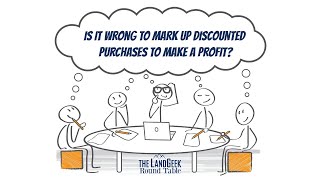
Mark J. Podolsky and four land investors debate whether buying properties at 25-30% discounts and reselling for profit is unethical. They argue it's fair because they handle taxes, liability, marketing, and owner financing. Sellers get relief from unwanted properties; buyers get affordable land with long-term payment options.
Chapters
Hey, it's Mark Ponosa. Get the land geek with your favorite niche real estate website, www.thelandgeek.com. and on this week's roundtable, we have almost all the usual suspects. We got the dude buddy, the nightcap OG Scott Bossman. Scott, how are you?
I'm great, Mark. Happy Movember.
Happy Movember. What is Movember?
No shave, November.
Shave.
No shave, November. All right, I'm starting now. I shaved this morning. I didn't know. How about the technician? The scruffy Eric Peterson. Eric, how are you?
I'm good. Happy to be here today.
Good to see you. I love it when you call me Big Papa. Tate. Litchfield. Tate, how are you?
Doing well. Really well. Excited to be here.
Good to see you. And last but not least, we've got the brain, the professor, your flight school Sherpa, Scott. Todd. Scott todd.netlandmodo.com Learn anything about anything. Investor ninjas.com Scott Todd. How are you, Mark?
I'm great.
How are you?
Pulse is still normal. Respiration is fine. I'm excited about our topic today. So, Scott Bossman, what's our topic?
So this is an. This topic is in regard to a post that was in the Facebook group here a couple weeks ago, and someone was alluding to the possibility that land investors, the way we send out offers at a deep discount, 25 cents on the dollar, could likely be very insulting to many property owners. And are we being bottom feeders? Are we taking advantage of people who own these properties? And, you know, should that make us not sleep well at night? I don't know, Mark, do you sleep well at night? And I guess we're talking about, you know, what's, you know, My son has even said it to me. It's kind of interesting. He's like, dad, you're kind of like a. Like a slumlord for land. That's what it feels like. And I had to convince him. I, like, had to have a conversation with him. You know what? We actually help a lot of people when we purchase from them at a deep discount. So let's talk about that. So anyway, that's the topic.
I sleep great. And I sleep great not just because my ethics and morals are in a good spot, but I also use an uler, which is like a chili pad that keeps me at like 67 all night. I have these glass, like these ultraviolet glasses I wear. So at 9 o', clock, it blocks out the ultraviolet rays from the TV as well.
Wait, is the bedjet done? Are we done with the bedjet.
No, I graduated from the bedjet because it's got too cold. Now it's called the Uler.
We can't go into the sleep cycle. We can't now. How do you sleep at, Mark?
Anyways, I'm a sleep nerd. I read why We Sleep by Matthew Walker, so don't get me started. I sleep great. But let's just really get to the topic at hand, which is, is it wrong to buy anything? Whether it's raw land, I don't know, any item, 25, 30 cents on the dollar, mark it up and make a profit. Ergo, is capitalism immoral? Tay, Litchfield. Should we be looking at maybe a socialist or communist type of economy? Although I guess that's not really the economy. But no, capitalism Dead.
No, capitalism is not dead. The American dream is alive. What I would argue, Mark, is that when we buy properties, people often fail to recognize the hidden fees associated with making those properties available to the public. You simply can't afford to go out and pay retail price or even 10% off retail and offer the low, irresistible monthly payments that you do and owner finance these properties without a credit check, could you? Why? What are the fees associated with what you do? Well, first of all, we have to run due diligence. We have to have a title search done. We have a team, we have marketing expense, we have recording fees, and the list goes on and on and on and on. So, yes, we are making money. We're making good money. And I have not, you know, had a bad night's sleep because of what we do for a long time. Because I understand that everything. This is the. This is the way the world works. Anywhere you go, when you buy something. You think, that pair of nikes really cost $100? No. Bet you those are being made for under $10 a pair, but yet you still pay 100 bucks for them. Does that mean Nike's wrong? Maybe. But they might be doing some things that aren't as ethical as we are.
We should ask Scott's son. Is Nike wrong? But I bet his son would be like, no, Dad, I love the shoes. So it's really about not seeing the transfer of value, right? Because like Tate said, it does take a lot of work to acquire the property, number one, and then to go through due diligence and then, of course, to market and sell the property. But where's the exchange of value? So the first exchange of value is this asset that. That we send out, that offer letter to. That's quote, unquote, a lowball offer. Well, no one's putting a gun to their head. They don't have to accept it. Why do they accept it? If it were so easy to sell the property on their own, they would. But it's not. That's the first transfer of value is you're helping me get rid of something. I got to pay property taxes towards every single year that I'm not using. So that's the first transfer value. The second transfer value is who benefits from property taxes being collected?
County.
The county. What do the counties do with those property taxes?
Improve.
Maintain roads, roads, schools, hospitals.
Oh, I don't know. Scott's son, do you. Are you in favor of better hospitals and schools and roads? Do you have any problem with that?
This is the exact conversation we had. You know, he just needed some. He needs some further perspective on it. You know, this is back when he didn't understand the business quite as well. And after a discussion about it, hey, you know, we may be buying at a discount, but I received thank you letters from people who, you know, we have assisted in buying their land. This thing, this. This property has been a burden to them for a really long time. Guess what? We're doing them a favor. We're doing the county favor. We're doing us a favor. I'm doing you a favor. Right. Favors going around.
Right.
And the other transfer values, when the person that buys it from us is getting in this asset that lasts forever, that's affordable, it's like a car payment.
Right.
And it lasts forever. Unlike Tate's Nikes, which might last six months to a year, you got to go buy more. So. But look, obviously I'm passionate about this, but maybe Eric Peterson has a different opinion. Eric, what do you think?
Yeah.
So, first of all, it's been quite a long time since I've actually talked with the seller personally, but I was just thinking back to when I was doing that, and I can remember easily a handful of very heartfelt stories and thank yous from people. I was buying land from numerous occasions where people just. They were so happy that I wanted to buy their land and take it off their. Their responsibilities, basically. You know, there's. There are people out there that they don't want their land, but they can't fathom the idea of not paying the taxes. So they continue to do it, and it's a burden, but there's no way they're not going to pay their taxes, because that's just who they are. They're gonna pay their bills and be responsible for what they have. So by coming in and being willing to buy their property, it's a way for them to take something off their books and get a little relief from that. So, you know, now that I have an intake manager, I mean, I'll hear those stories kind of secondhand or I'll see a thank you come through after we've completed a transaction. But I don't get as much of that personal conversation around it, but I know it's still there. And you know, I would say that it's true that probably everybody we buy from, they're not as thankful. I mean, some people are going to be more thankful than others, but the reality is we are making this extremely easy for them to sell their property. A lot of the property we're buying, generally realtors aren't interested in helping with. And if they are, that might sit on the MLS or wherever for years potentially because the realtor is not going to pay a lot of attention to it to get it sold. Like they would say a house. So again, we're providing value in the sense that we're willing to give cash to today or within a very short due diligence period for that property and get it in their pocket. On the other hand, once we own that property, we're generally not getting our cash back right away. So we have to pay a lower dollar amount for the property because we're going to sell it on terms it might take us a year to regain our capital. And yes, we're going to profit in the long run, but that's doing business, right? I mean, everybody that owns a business owns a business to be profitable. So I don't have any problem with what we're doing whatsoever.
Yeah, dude, buddy. Scott Bossman, do you agree with the technician or should we all just start a non profit and not even pay ourselves and just do things for the, the good of mankind?
No, I agree with him 100%. I think, you know, there are some fears when you first get into this business. I remember having some conversations early on with people about oh my gosh, are they gonna be offended? And you know, oh, that, that hate mail I got killed me. That voicemail I got from the angry guy makes me feel not so good about myself. But then there's the flip side of things. Exactly like Eric was talking about. Exactly like you were talking about. We're providing a service to people, we're providing a service to the county and we're making it easy on folks to get rid of something that, that they don't want anymore. And it does Bring peace of mind to some folks. So, so, yes, I obviously agree with everyone. I think over time, you become more accustomed to the business and the interactions that occur. If you. Somebody's not happy about your offer, like you said, they don't have to take it, move on.
Yeah, no, absolutely, Scott. Todd, I know you're probably not a good person to ask about this because I know you really have a hard time justifying profit capitalism and are constantly talking about, you know, moving to Cuba.
Not sure that's fake news. Complete fake news, man. Moving to Cuba. I mean, like, here's, here's the thing. The, the offer really is not meant for everybody. And that's okay. You know, like if, if, you know, if you don't like the offer that I'm offering for the land, it's okay. Maybe, maybe someone else will come along and offer something higher. No problem. That's fine with me. I know what I'm willing to pay. And I always go back to the example of, imagine for a minute that I decided I was going to sell my cell phone. It could be a new phone, an old phone. It's going to be worth different values to different people. And that's the way that the world works. It's a market. And ultimately what happens is, I mean, think of the stock market. Sometimes I don't like the price of the stock. Maybe I paid $100 for the stock, but the market's bearing $30. That's just the way that it is. But you see, the thing is, is that I can't control that. No one can control. All I know is as a buyer of land, this is what I'm willing to pay, and it might change tomorrow. I mean, there's properties that I'm buying right now that I mailed to originally. When I started the business. You know, in 2014, I offered $700. Today, I'm making offers on those properties for 4,000 in this area. But the price has gone up. This is the way that it is. And guess what? Some people, they didn't want to sell it at 4, at 700, but guess what? They want to sell it at 5 or 4,000. Maybe they asked 5,000. It's just the way that it is, and so move on. But you're right. I've gotten letters from people that thank me for helping them solve a problem. Some people didn't even pay anything for this land. Some they got it from grandpa, Grandma, dad, someone. It fell into their lap. The most moving story for me was the lady that, that called me up and wanted to thank me after she got the check. And she basically said, hey, I want to thank you. Because of this transaction, I can now pay for my medicine for the next six months.
Wow.
Now she's not upset with me. Now she tried to negotiate, but I'm like, this is what it's worth to me. I was honest with her and we moved on. She's happy at the end of the day. And that's just the way that it is.
Now.
The service, we're not just like moving deeds around here. We are providing a service to somebody. Well, what's the service we're providing when we go to sell this property? The services is that we're offering people the opportunity to finance the property. They can go to the bank, they don't have to buy it from me. Okay. And land, by the way, isn't that easy to sell. It's easy to sell on the owner financing. But the lady that wanted to sell me her land, she probably did try to sell it some other way. It wasn't easy because of the lack of the owner financing. The owner financing is what streamlines that. So what am I bringing to the table? It's not that I'm just taking some piece of land that I haven't done anything with. I brought it to market. Don't forget that it wasn't on the market. I brought it to market. I added value by bringing it to the market. And I'm adding enormous value by holding the note for somebody who can't go get a bank loan for whatever reason, I'm holding that note for them. And as a result, I get paid to do that piece. Sometimes it's great, sometimes it's not as good. It's just the way that it is. But everything comes with a price, right?
Right. I mean, if you want to live in the United States and you want to, you know, buy things and maybe not, I mean, I guess you could be a survivalist or a prepper and be completely self sufficient, then, you know, you have that right to do that. But in an economy like this and you're adding value, you know, we are taking some risk. We are putting out money. It may not seem like we're taking risks because we're buying the asset, 25, 30 cents on the dollar. But there is some risk and in so doing, we should make a profit. Tate.
Well, I was going to say the other thing is if you're not comfortable, if one of the things holding you back from getting into the land business is, oh, I don't Want to be the one making those low ball offers. That doesn't necessarily mean that this business isn't for you. You can still acquire land using other methods, right? I mean, you can buy it wholesale. Yeah, you're going to pay more for it, but that's okay. There's nothing wrong with that. If you're happy with the terms, then go ahead. Right. So I mean, I've worked with so many people now, like everybody else that just said thank you, thank you for buying this. And it goes with the sales side as well. Like people who buy this land. I regularly will get emails or voicemails from people saying, you know, you've made my dreams come true. I never thought with my credit, with my history that I'd be able to own 40 acres. And yet here I am on my new property. It's cool. So sure, there's always going to be some people who think that, you know, maybe we're doing something, you know, taking advantage of other people. But the reality is we deal with big boys and big girls and nobody's forced to sell anything or buy anything. And if this isn't right for them, that's okay.
Yeah, I mean, absolutely. It's, you know, it's almost when you really look at it, you look at all the other things that we can buy in the marketplace, it's just kind of a silly thing. So you're taking advantage someone, I mean, you know, is Starbucks taking advantage of my old caffeine habit?
Right.
I got addicted to this substance and they, they charge five bucks for a cup of coffee. Are they taking advantage of me? No, absolutely not. I'd pay $10 for that caffeine high. So $5 is a good deal, which is why I buy it, which is why we do anything because the value we receive is worth more than what we're paying for it. So otherwise we wouldn't be in business and I wouldn't been able to do this for the last 20 years. So it's, I think the, you know, the root, root cause of that is somebody that is uncomfortable with just their own money issues and that's, and then they're kind of projecting it out because you could do that on with any company or enterprise. Right. But in the day you have to be okay with, you know, creating value. And when you create value, getting money and if you're not, I don't know what you do. Maybe you join a non profit and then I guess you feel badly about your paycheck every two weeks. I don't know what you Do. But it's an issue you got to kind of get over in life, because it's just. It's just life. I don't know, Scott. Todd, help me here.
I'm.
I'm rambling.
I mean, I think you summed it up, right? Like, it's. It's. This is a win. This is a win. Win for everybody. It's a win for the person that wants to get rid of their land. You're not forcing anybody to do something that they don't want to do. And there is a misconception. There's a misconception that it says, oh, well, they don't know what the land is worth. That's not true. Okay, like that. You could tell yourself that, but that's not true. Because we all do research before we go to sell something. I wonder what I could get for this. People go look, but then they try other avenues. Okay? They try to go the real route. Like Tate said, it's gonna sit in the MLS forever. Remember? Look at how much you're gonna sell the land for. Let's say it's $10,000. What's the realtor commission on a $10,000 sale in Florida? It's 6%. 6% of $10,000 is $600. Now, remember, the realtors got to share that with the broker. So the realtors are not going to get 600. The real is going to get 300. And if another realtor comes into the deal, then they're not going to get 300 because they got to split it. They're going to get 150. And most realtors are going to say, it's not worth my time to even put it in the mls, let alone market it or do anything with it. It's a hope and a prayer. It's like a Hail Mary. I'm just gonna put on the MLS and be done with it. And they sit there for years and years hoping that someone comes along because the realtors not marketing it. And then they give up. They're like, no one's ever gonna buy this thing. It's a junk property. And their mind is a junk property. Here you come riding in with an offer, cash offer. They're like, this looks pretty good. They want to get rid of it. And then you help someone else. So you're winning, the seller's winning, and your ultimate buyer is winning, too.
Yeah. Well said. Well spoken. Well, I thought this is a great topic. And now we are at that point in the podcast where we're going to.
Ask.
Someone, oh, for the tip of the week, a website, a book, something actionable for the art of passive income listeners to go improve their businesses, improve their lives. Before we do that, I do have to shout. Give a shout out to our sponsor this week, flight school. Learn how the next 16 weeks can literally change your life. Start building that passive. Go through that 16 weeks with your flight school sherpa, Scott Todd, who's done it thousands of times. Go up the mountain of land, investing quickly, safely, efficiently. Oh, by the way, the tuition, I mean, this isn't very capitalist, but the tuition is going to cost you anything because you're going to make back that money. 180 days or less, guaranteed. Learn more. Go to thelandgeek.com training thelandgeek training and start solving your money problems and your time problems and start building that passive income machine. All right, so it looks like Scott Todd's got the tip of the week.
I think you just did it though. The tip of the week was flight school. No, I'm kidding. Look.
At the tape.
To me, this is a pretty cool deal. I know that some people like Loom. If you're not familiar with Loom. Loom is a Chrome plugin that will allow you to record your screen, make training videos or whatever. Loom, okay, Loom is cool, but I think Loom is free. But then if you don't use the free, like if you want HD quality or better quality so that people can actually see your screen as opposed to like all this fuzzy stuff. It's like $10 a month or something for Loom. And I use a lot of video in my business. Okay, I'm doing training videos, whatever. And for a long time I didn't want to use Loom because I was using Zoom. I have a Zoom account and you can do videos in Zoom for free too. By the way, I also use Fleek Fleek IO for other training videos. But lately for these quick videos, I just want to share my screen with and not make something long term. I just want to show a VA something. I have a Vimeo account and Vimeo came out with a Chrome plugin that basically does what Loom does. And what I really like about the Vimeo plugin is that one, you hit the play or the record, it records your screen, whatever. It obviously it puts it right into your Vimeo account. It shares with you the link right there on the screen. You take it in the way I used to have to do things, I would record it in Zoom on my computer, upload it to either Dropbox and share the link that way or go and put it in my Vimeo account. This is just streamlined and smooth. So if you're struggling like to. How do I make some of these screen sharing videos, etc. You can get a Vimeo account for next to nothing. Go check out the Vimeo Recorder is what it's called and like I've been using it the last week. I love it.
Wow. Scott Bossman, what do you think?
I like that idea. I use Loom currently, but definitely worth giving a try.
Eric Peterson.
I too have a Vimeo account, so I'll definitely check it out.
Tate, you like this?
Yeah, I think it's cool. Does it cost anything?
Scott?
It's free you said, right?
A Vimeo account. I don't know what those cost, but I know it's cheap. They start off with cheap.
I think they're free, aren't they? Isn't Vimeo like.
I think they offer like a, I.
Don'T know, free version and then paid.
I like it. I think it makes sense. I think that's a question that a lot of people struggle with. Is okay, I've made all these videos, where do I store them?
Yeah, see like they.
That's pretty awesome.
Yeah, so like they have a. They have what they call the plus account. The plus account is $7 a month and that gives you the ability to upload five gigs a week. Think about that one for a minute. Five gigs a week of upload, That's a lot. Oh, wait. They also have a Vimeo BASIC at the top of their pricing screen. It looks like the Vimeo BASIC is free. So you can start buy a plan for 30 days or get started with Vimeo Basic. So they do have a BASIC program, but I don't know like what the limitation is. You have to go to Vimeo and go to their pricing page and look at it.
Isn't Loom free though? Is Loom no longer free?
Well, it's free, but if you want like. So it's free for like standard recording, like SD recording. And if you're trying to do something, it's all blurry in my opinion. And like people are like, I can't see what your screen's doing. You're pointing to this thing, but it's not that clear. So if you want HD recording, then you have to have an account for like $9 a month or something.
Oh, okay. Well, you know, I teed it up for Scott, Tate and Eric and I guess I'll be the one to say the problem. Scott, with you and Loom is that it's on a Surface. So you're. It's probably clear as day.
Day.
Because us Mac users have no problems with Loom and. But they were too kind to point out the obvious. Anyways, I thought this was a great podcast.
Also, I'm ignoring that. But if you're on the. If you're on the Loom Starter account, okay, which is the free account, your. Your video can only be five minutes long. So then it's a five minute long video. But if you upgrade to their business account, you get unlimited. Unlimited. Oh, on the free one, you only get a hundred videos too. On the business one, you get unlimited recording time. Yeah. So, you know, if you look at the pricing, well, Vimeo is going to give you more because it's actually video storage as well. And you know, you know what, Mark, Here, hold on a second. Let me, Let me just do this. I'm happy to put in my AirPods right now. And I know that your AirPods don't work with your Mac because of the Bluetooth problem or something, but I hear you just fine. So on my Surface. So have a good day, sir.
Okay, so I'm a trifle deaf in my left ear. I heard Scott saying something about Bluetooth. I don't know exactly what he said, but I want to thank the listeners for putting up with our shenanigans and remind them that the only way that we're going to get Eric Peterson to continue coming here every week is if you do three little favors. You got to subscribe, got to rate, you got to review the podcast. Send us a screenshot of that review to supportlandelandgeek.com we're going to send you the wholetailing course that's normally $97 for free, so please do that. All right, we ready to do this? 1, 2, 3. Let freedom ring. By the time this comes out, we will hopefully be a country that's more united than we were today. I don't know.
Hopefully we have a result.
Yeah, we have a result.
Hopefully we have a president.
We have a president. Yeah.
Not. I will rise to the occasion.
Scott Todd.
On my own land. I have 640 acres out in the middle of nowhere. I will be the President of Scotland.
I'd throw Jeff Detmer's name in the hat for that, too. He's already got. He already has the title. He's used to it.
Yeah, he's got experience, actually.
So in. In my. In Florida, they have the. I don't know. I don't Know any other state that have these things? But in Florida, there is. There is a developer program for real estate developers, a program that basically allows them to develop communities and, like, not have to outlay a boatload of money. They're called community development districts, CDDs. And the community development district allows, like a developer, real estate developer, to go acquire the land. You acquire the land, and then what you do is you go to the. To the state of Florida, you go, hey, listen, we want to form a CDD here. And they make you a quasi government entity. So you get like this quasi government entity where you actually have, like that. The board oversees the quasi government entity, but that entity is allowed to go borrow money as a municipal bond, if you will. So the entity is allowed to go borrow money. Now what's the money for? The money is to go in and to put in the roads and the infrastructure and all this stuff. So the developers, they love CDDs because they buy the land, doesn't cover the land cost. Okay, that's, that's for the real estate transaction. But all the community areas and the roads and the power lines and the sewer, that all gets put in by the developer at the expense of the community. Well, the way that it's set up is that the developer gets to get all five seats on the board. In the beginning, like, it's, it's, it's. Here's. You're the developer, you're the major landowner. It's all yours. And they run it for a while, but then as more and more residents start to come in, you get developer handoff. So the developers are in there until certain amount of stages are hit and they give up a few seats, and then they give up the whole board. Well, in the year 2000. In the year 2000, I decided to run for the CDD board, right? Like, and the cool thing about it is that it's not like a little local thing, like, hey, neighborhood, vote for me. You're on the ballot. You're on the elected ballot, like, of the county. So you got to go register with the county to be on the ballot. So here I go. I'll be bopping down there to county register to be on the ballot for the CDD board. And the year 2000, like when George W. Bush and Al Gore were, like, duking it out. Oh, yeah, I'm on the ballot with these guys, like, in my area, but I was, like, uncontested, so I won by default.
Are you the one that created the hanging chad?
No, no, but check this out, man. I wish I could find. I have to go through my records, but somewhere in here is a certificate from the state of Florida that says, the honorable Scott Todd. So, like, I get the certificate. I'm like, honey, you have to refer to me as the honorable now, your honor. Like, you know, I'm like, should I drive into the community? And everybody calls me your honor. But my question is, like, does that honorable continue for the rest of my life? Like. Like a vice President or President?
Mr. Vice President.
President. That's right. I think it's the way it is, man.
Supreme court justice.
Yeah, yeah.
Now Scott has an addition to his nickname.
Yeah, yeah. Honorable.
The honorable boys.
That is so pretentious. I'm not even gonna do it.
So pretentious.
So honorable. Just refer to me as your honor, that's all. We'll just call it even.
All right, Whatever. All right. Thanks, guys.
See ya.
I'm honored, your honor.
More from Mark



How to find funding partners: How to Scale Land Without Using Your Own Capital




