Land Investing Surprises! Efficiency, Ability, And Complications with Land Investing
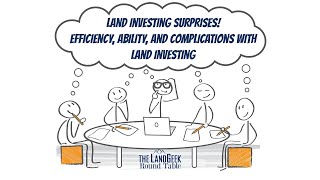
A roundtable episode of the Art of Passive Income / The Land Geek podcast hosted by Mark J. Podolsky (June 29, 2021 upload) featuring panelists Mike Zaino, Scott Bossman, Eric Peterson, Tate Litchfield and Scott Todd. The group discusses surprising aspects of land investing: accessibility for newcomers, market inefficiencies and high margins, how the business can scale and become simpler/easier once operators follow a repeatable recipe, unexpected free or near-free property opportunities, and customer guarantees. The episode also includes sponsor mention (Flight School), a bootcamp promo, and short tips of the week.
Chapters
Hey, it's Mark Pedosol. Get lagging geek with your favorite niche real estate website, thelangeek.com and on this week's roundtable podcast, we have almost all the usual suspects. We've got the Zen master, Mike Zano. Breathe in the mailing, throughout the marketing. Mike, how are you?
I'm doing really, I'm doing great. Thank you for asking.
Good to see you. We've got the dude, buddy nightcap, OG Scott Bossman. Scott, how are you?
I am excellent. Happy to be here.
Excellent, excellent. We've got Eric Peterson, who's on a mission, the technician. Eric, how are you?
I'm good, Mark.
Good to see you. I love it when you call me Big Papa Tate Litchfield. Tate, how are things in Vegas?
Top man. We're hot.
You know, I love waking up to that echo show 10 and seeing excessive heat warning.
Right, I know what you mean. Like 117 here today.
One hundred and seventeen. And last but not least, you know him, you love him. The brain, the professor, your flight school Sherpa, Scott Todd from Scott Todd.net landmodo.com Learn anything about anything. Investor ninjas.com Scott Todd, how are things?
They're good, Mark.
How are you?
I'm great. I have no topic today. We're gonna do the roundtable ramble and just see what comes of it. Kind of like a Seinfeld episode. Today's roundtable is about nothing, but yet I'm sure there'll be some value that, you know, arises from a roundtable with no agenda. That being said, as I was speaking, I thought of a question. So just start with Mike. When you first started, or even today, what was the most surprising thing you found or discovered about the lamb business that you didn't even think was a thing?
Oh, wow. Well, I guess what comes to mind is the biggest surprise is that I could actually do it. Firefighter for 20 plus years, no prior business experience. You know, I. I'm just surprised at what I've accomplished and what I can. It really blows my mind when I think about it, you know, the fact that, you know, I've never run a business, never had any formal training running a business, never was involved in any type of anything other than just firefighting for the last 20 plus years. So the biggest surprise to me was, I mean, I believe the model. I know a close friend of mine was doing the business, so I believed it worked. But he had been a real estate agent at some times, and he's just sort of one of those always kind of successful in certain things. Like, well, maybe that's what it. I didn't know that I could do it. So to me, that's the biggest surprise that I've. The success I've had and what I've been able to accomplish. So I think that points to the fact that really anybody can do this business. Honestly, if you follow the recipe, as we always talk about, and I guess I would close with that. You say the podcast about nothing, but in some ways you think about nothing. It's the potential for everything. So this really. This business has the potential to really explode into anything. And you want you to get any direction and you can really grow it. And you don't have to have prior experience running a business or you don't have to know anything about real estate. You don't have to really know much about anything. I mean, you'll be able to use a little bit of computer skills. So that's the biggest surprise that I could actually do it.
That was really profound, what you said. Actually, it's like a Zen cone. I felt very at peace after you said that.
What is Zen? Shinyakta. I think they call it emptiness. That's the right way to pronounce it, but it's emptiness. It's potential. It's not empty.
It's not empty. It's potential. It has infinite possibilities.
Yeah.
I like that, dude. Buddy. Scott Bossman, what was the most surprising thing to you or has the most surprising thing?
A few things, I guess, thinking of the mechanics of the business. Six years ago, when I was working as a pt, I never would have guessed that I could just buy and sell a piece of property on my computer in the middle of an afternoon, all within an hour. I'm going to buy the property, sell the property, and with today's technology, be able to do that, not ever having seen the property with a couple hours of research or less. So the mechanics of it are kind of amazing to me. And the fact that this business scales to the point where, you know, to put things in perspective, I never dreamed I'd be able to work in my land business. Probably a tenth of what I worked as a PT with a salary, that is much more than what I made as a pt. So the fact that this is a business that can scale, you know, it takes. Mark, you say this all the time, and I think it varies per person. It can be three to five years to where you want to get this, right? To where you want to get it. Some people go faster. There are some rock stars. But listen, My PT education was three years. Right. So I educated my land, myself in land for three years and look what happened. I have a business that has scaled, that has allowed me to benefit with time, more time, location, freedom, more financial security. So I guess for me that was, that's huge because I never really thought outside the box. I just come from a family that always trades their, you know, people trade their time for money and there aren't really many entrepreneurs in my family. So that I guess those, those couple things were most surprising for me.
Yeah, that's a lot to unpack there. But it's, it is, you know, to just put it succinctly, it is life changing. And I think that on so many different levels of the, of the spoke, of the wheel of your life, it's not just financial, it's not just physical, it's not just, it's spiritual as well. It's, it's everything. Because when you are not trading dollars for, you know, hours for dollars, you have that time to move, move up Maslow's hierarchy needs into self actualization and, and do things in life that you may never have had time to do and, and you know, explore those things and, and deep in those relationships, it's, it's mind boggling. So that's. Yeah. And I'm sure when you first started your family was like, no, that's not what we do.
Oh yeah, they all looked at me like it was nuts.
Yeah. Yeah, that's risky. The technician Eric Peterson. What was most surprising to you?
You know, I really identify with Mike's comment. To start off, I think that myself included and probably many others in our community feel the same way if they've had any level of success in this business. Not everybody comes in feeling like this is the perfect fit for them and being able to accomplish it is.
Rewarding.
And it feels great. But I think more recently and from a different perspective, what has surprised me is just, I mean, we talk about it all the time, but how inefficient the land market truly is. And I think at least in our business, we're seeing that now more than ever from the standpoint of, I mean, I don't want to say we can go out and ask anything for the properties that we have for sale, but it almost feels that way that we are, we're just completely defining the market on the amount that we want to get for a particular property and we're able to get it because of the demand in the marketplace right now. So that's just, I guess, a Surprise for me at this point in the business.
Yeah, I love that. It's so true. And I remember when I first started, I remember saying to a buddy, at the end of the day, you know, I'm coming from an investment banking background because the margins were, to me, unsustainable. And I'm like, oh, at the end of the day, this is a 30% gross margin business. That's what I thought. That was 20 years ago. The margins have only increased since then. And you would think, well, there's more people doing this. There's more quote, unquote competition. Not really. Not really. Just feels that way. If there's competition, then the margins would decrease, not stay the same or increase. That doesn't make any economic sense. So it just goes to show how big the market is and how few people are really doing it. Tate. I love it when you call me Big Papa Litchfield. What was surprising to you?
One of the things that I found kind of surprising was that some people out there on rare occasions are willing to give you their land for free.
Like that.
That was pretty wild. The first time I had somebody give me property for, you know, a dollar or I had to take over the back taxes or something like that, I was. Blew my mind. I thought, wow, can you imagine owning something and wanting to get rid of it so bad that you give it away? Like, this isn't. This isn't like a broken down computer screen. This isn't an old treadmill that doesn't work. This is an asset. And it goes to Eric's point, right? It's such an inefficient marketplace that they knew it had value, obviously, but they just didn't know how to use it and how to get rid of it or how to make it cash flow for them. So that was a shocker. The other thing that really surprised me, and I'm thinking, like, early, early on, was that not only did people want this because, but if you bought in the right area, there was a line of people that wanted it. That was shocking. You're buying land sometimes in the middle of nowhere. I remember at a boot camp, somebody said, don't buy land. You need a helicopter to access. And I thought, well, the price is right. I'm buying it. Like, you know, like there were people lined up to get that stuff from me. And I thought, I'm sad, I'm hooked. Like, I think back to my first time. I had a terms deal go through and I knew my life was changed. I could never go back. So that was. That Was a big, you know, aha moment. And to realize that there is a very big demand for this land. And at the end of the day, it's not like any given land investor has 2,000 lots in inventory. We have a handful and we're always buying more. But there is a bigger demand sometimes than what's available. So it's a cool market to be in. I don't know, I've always been shocked by that. More than one people want what I have available, regardless of how desolate and remote it might be.
Yeah, I mean, I learned that the hard way, but there is a pig for every barn. Um, it's. It's. Yeah. Everything you're saying resonates with me and Scott. Todd, last but not least, what do you find or what have you found the most surprising in the land business? Your land business?
Yeah, all.
All of the above.
And I think that the most surprising piece for me is. And this is going to sound, it's going to sound strange, but how easy it is. Okay. And it's. And what I mean by that is the land business in general is very easy. The difficult part is right here in your brain, this area. Okay? So the ease of this business, it's simple. The complexity comes because we try to make it more complex than what it really is. I was talking to this guy the.
Other day.
He'S telling me that he's a building developer. And he was telling me, I'm like, oh man, that sounds crazy. Like, you know, that sounds a real estate developer. I'm like, that sounds crazy. He's like, no, it's very simple. He goes, I only work in about a 10 block area in my town. I work in this 10 block area. I drive around, I think about what's missing and then I go and I feel the need. And I said, that's it. And he's like, that's it.
Okay.
So he goes, it's simple to be a real estate developer. Well, I think it's simple to be a land investor. The hard part is getting out of your way and fighting to keep it simple. Because I mean, everybody wants to tell you something. Oh, use this, use that, do this, do that. Dude, look, it does not need to be that complex. Keep it simple and you will benefit from the simplicity more than someone who's trying to make it complex.
Yeah, I love that. And when we talk about the business, I do like to say, you know, it's not easy, it's simple. But in a way it is easy. It's just that it's really bad to say publicly because for some people, it's not easy. It might just be more accurate to say it's easy for us for whatever reason. But I would say that eventually, because we've seen this with enough of our flight school and coaching clients, once they get out of their own way and just follow the recipe, it becomes so easy and it's amazing to watch them scale. So I can't go on another person's podcast and be like, this is the easiest business model ever, because it's, it's not, it's just the simplest one. But Scott Todd, does that make sense?
It does make sense.
Yeah. Yeah. So I, if you're listening to this and you're struggling, it's not easy. Nothing worth doing is really easy. But that being said, it will get easier for sure. It just might be super easy for Scott Todd, which is surprising.
I think the difference is that at the end of the day, what makes this simple is that you're buying something and selling it. That's all you're doing. I mean, in the easiest, since you're buying something for one price and selling it for another price. Where the complexity comes in is you're also starting a business in the, in the other, other component of it. So, you know, you, you have to just separate, like, what is it that you're fighting to keep? And it's the simplicity. You got it. You got to fight to keep it simple, your business simple. And I've had so many people tell me, oh, I, man, looking back, I tried to make this thing hard and, and harder than what it really was. Just follow the recipe, mail until you can buy something, buy it, and then market the heck out of it until you sell it and rinse and repeat and keep it going. But I think that where people get into trouble is that they try to scale too fast. Okay? They, they want that passive income to replace their, their, their own wages almost immediately. And in fact, if they take that long term approach, like Scott Bosman said, you know, he went to school for three years to learn how to do his other job. If you just go to school in this for three years, you'd be amazed at what you can create. And it may not take you three years.
No, it's so true. I'd say for me that the most surprising thing there's been, like everything you guys have said has been a surprise to me actually. And I relate to all of it. Um, although I would say, like, you know, for Mike, my, my background, I had no real estate background, but I would say that I was probably delusionally overconfident. For whatever reason, I thought, oh, you know, there's no way. I can't. This won't work for me. Like, I just. I just never had that doubt because I just. I had success, like, pretty quick at that first auction, so I never had doubt really creep in. Even after the Great Recession, I still knew this is a solid model, and I love doing it. Mark just needs to figure out his own stuff and lower his personal overhead because we're in a market cycle. But I think what's surprising to me today is, number one, the joy that the business still brings me to be doing something for 21 years now, and yet I still look forward to it every day. There's still something new to learn. Business is endless. Learning is endless. The growth opportunities are endless. Yeah, I mean, the technical pieces may stay the same as far as, you know, the way that we're buying and selling, but even that can change. But, like, you know, how many times can I talk about, you know, different deeds, right? That may not change so much, some of the technical things or, you know, how to record a deed, but there's so many different ways to work this business, enjoy this business, grow the business, scale the business. And for me, it's kind of a surprise. I don't think I ever thought that it would just be endlessly interesting to me, if that makes sense. So, you know, this is not such a ramble. Tate, what's on your mind? What else can we ramble about?
I was just thinking, like, you know, that kind of ties into fun. Like, you enjoy what you do, and that's half the battle in life. Right? Enjoy is a challenge in a way. And this business can be as difficult or as demanding as you want it to be. And that is the challenge, right, Is to find that happy medium. You want to take the Scott Todd approach and work never. Go ahead. Or you could take the approach that a lot of us like to take, which is, I like it. I like doing certain things, and I'm not giving it up. I can. I know how, but I'm not, because it's me, and I like it. And that's a cool position to be in. So, yeah, it's a fun line of work. I wake up in the. The morning when I do work, and I say, let's do this. Like, this is something I enjoy. You know, I don't. I don't view it as a chore and blessed. I think at the end of the day, we're Just blessed by the land business.
I couldn't agree more. I couldn't agree more. Well, we're at that point in the podcast where we're going to ask someone for a tip of the week. A website, a resource, a book, something else actionable for the auto passive income listeners to go improve their businesses, improve their lives. Say whatever you want to say. However, before we go to that, I want to just give a shout out to our sponsor this week, which of course is flight school. Learn how going through a 16 week program with Scott Todd as your Sherpa can literally start changing your life. Build that passive income quickly, safely, efficiently, with Scott Todd, who's done it thousands of times. And that tuition for flight school. Yeah, it ain't going to cost you nothing. We guarantee you're gonna make that money back in 180 days or less. Just show us your work. So no worries. And it looks like we had two people that wanted. You disagree with that Tip of the week.
I saw it. I saw you guys.
Boston was last. You guys square. We did the nose goes. And you guys lost. I mean, you can't. This is. This is not a new rule. This is something that's been around since the, you know, did this.
Like, what's this?
I don't need to hear no evil, speak no evil, like, see no evil. But it clearly was not a nose go. So you guys both lost. I mean, it's. It's not my rules, but I do have to enforce them.
All right, I think the only fair way to really solve this. We're on zoom. I'm gonna count it down. Let's just see who starts. One, two, three, throw. Because rock, paper, scissors solved it.
What?
No, we're doing the wrong.
What are we doing?
Okay, so it's 1, 2, 3, throw.
Are we all throwing?
No, no, no.
Just. No, Just the two Scots. Okay. One, two, three, throw. Oh, yeah, they. They tied. Paper, paper. Go again. One, three, two, three, throw. Paper, paper. This is incredible.
Did you see Scott Todd? He kind of delayed that a little bit. He's.
Oh, the judges. All right, Scott Todd, what is your tip of the week? A website or resource? A book, Something else actionable.
All right, you're working hard. You're working hard every day. Working hard for the money to do this. Do yourself right every morning. Go eat yourself a donut and enjoy life. And I'm out.
A donut. Tip of the week to eat a donut every morning.
Yeah, it's been spoken.
All right, I'm gonna have a tip of the week. I don't love that. Tip of the week. I'm gonna have a business tip of the week. I want everyone this week to review their guarantee. If your guarantee does not not make you a little nervous, it's not. It's a. It's a meek, weak guarantee. You can steal my guarantee. Okay. My, my land clients, when they buy a piece of property, we guarantee they're going to love that property. And if for whatever reason they don't love it, then we're going to either exchange for property they do love or refund them. That's up to 90 days. We have a 365 day exchange guarantee. So if they can't even get out there in 90 days, I'll exchange it in 365 days. So it's very simple. Happy customers guaranteed. So if your refund is like 30 days, not good enough. If it's 45 days, it's probably not good enough. Maybe make it irresistible, take away all the risk. And I mean, honestly, I can't. A very, very few people take us up on that refund. I would say less than 0.01%. It's really rare. Mike Zane, was the last time you had to give a refund? I.
Nothing in short term memory. So it's been a while that.
There you go. Scott Bossman, Refund.
It's been a number of months, actually.
Yeah, there you go.
Three, four months ago. I gave back a down payment and one monthly payment. I kept the document.
All right, Eric, how about you?
I had one last month, but that was the first one in probably about six months.
All right, Tate?
I don't know.
Not in recent memory. Scott, Todd.
I can't think of the last time we used it. In fact, what we tend to use it more is from a customer. That's annoying. We kind of leverage that piece and we'll say, look, you don't seem very happy. We'll plant the seed. Why don't we, why don't we just refund you and then, you know, you can go find something that you really want. And so we use it as a way of firing the customer, but make.
It think it's their idea.
All right. Awesome. Awesome. Well, if you guys are getting value from the podcast, imagine how much value you would get to be in the room with all of us. With Scott Todd, Tate Litchfield, Mike Zano, Eric Peterson, Scott Bossman, Toria Harris. Because we're all going to be in Sin City, baby. Vegas in August. Go to the landgeek.com bootcamp and be in the room where it happens. Two and a half days of land investing immersion. I promise on Sunday you're going to walk out of that room pumped. Everything clear. We won't end boot camp until all those questions are answered. And so much happens in the hallways. Just the networking alone. It's worth coming to go tolandgeek.com Boot Camp we are. We only have limited spots, so take your spot now before you get shut out. Because you know that's people have been stuck in their home for what, over a year now. Everyone wants to get out. It's going to be crazy. So book now and. And don't miss out.
Well.
I thought this was great. Also, I want to thank the listeners. Remind them the only way that you know I'm going to continue to be able to make bad jokes is if you do us three little favors. Got a follow rate? Review the podcast. Send us a screenshot of that review. Support the Langeek.com we're going to send you for free the $97 whole tailing course. Are we ready to do this? 1, 2, 3. Let.
Let.
Not bad, not bad. Tate was like, huh? It's a different energy without Tree, isn't it?
I miss her.
I miss her Tree. And Landon, if you're listening, we miss you guys. And Landon. Get well. All right. Tate's giving me that look like low blood sugar.
Yep. It's time.
Thank you, buddy. Thanks, everybody.
Thank you.
Thanks for listening to the Art of Passive Income podcast. Start your journey at www.theland gate.com com and www.scotttog. net Rate and Review the podcast and email support at thelandgeek.
Com. Your screenshot for a free passive income launch.
K.
More from Mark





How to find funding partners: How to Scale Land Without Using Your Own Capital


