Land Investing Tip: What to Do When a Property Takes Longer to Sell
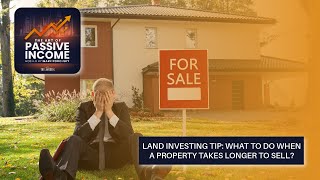
This content was created by Mark J. Podolsky. This content was uploaded by Mark J. Podolsky. This is a YouTube video titled "Land Investing Tip: What to Do When a Property Takes Longer to Sell" created on June 25, 2024. It features a roundtable podcast discussion with Mark J. Podolsky, Eric Peterson, and Tate Litchfield. They discuss strategies for land investors when a property takes longer to sell than expected, emphasizing patience, multiple exit strategies, and realistic expectations in the land investing business.
Chapters
Hey, it's Mark Podolski at the Land Geek with the cheap real estate website, the landgeek.com and on this week's roundtable podcast, we get the two OGs got Eric the Technician Peterson. Eric, how are you?
Hey, Mark. I'm good.
Good to see you. And of course, I love it when you call me Big Papa Tate Litchfield Tate, how are things?
I'm good.
Good.
Very good.
Well, we're skipping the pleasantries today. We're going right into it, and we're going to a really interesting topic, which is you buy a piece of raw land, 25, 30, 35 cents the dollar, and then it sits, and it sits and it sits, and you get frustrated, and you market here and you market there and you get leads and you do everything we tell you to do, and it still doesn't sell. What do you do? Your expectation is, when you go through the training, oh, I should sell this in 30 days or less. But then it takes 60 days, and then you're at 90 days, and you've changed your pricing, you've changed your headline, you've done everything we've told you to do, and it's still not selling. Eric Peterson, this is quite the conundrum. Your property is sitting. It's not selling. You know, you've made your money on the buy. What do you do?
I mean, it must be trash, right? Like, if you can't sell it, nobody wants it. Like, you made a mistake. I don't know.
Like, what.
What are you doing?
You.
You can just did it to. To me.
Yeah, yeah, one of us just.
Yeah, we'll take it off your hands.
I'll take the trash. It's fine. It's. It's all think that you said something really important and that is that. That you bought this property for $0.25 on the dollar. Now, assuming that you've done your research correctly, you've done your comping correctly, and that is true, you have options, number one. And what are those options? Well, you know, continue to market it and wait till you can find that buyer. Is. Is one option. That might also mean there's some price adjustment. You're trying some different things with the numbers to see if you can reach people that have an interest in buying this property. But we have other exit strategies when we buy, right? So those would look like, well, hey, we could wholesale this property. You can wholesale it to me, wholesale it to Tate, whatever, or another land investor, for that matter. Right? Like someone that works in that area. If I think that when we talk about wholesale, something that I've seen pretty commonly in my students is the fact that they think that it should just come easily, automatically. Like, hey, I got a wholesale property. Oh, it sold, you know, like, no problem.
But.
Yeah, the reality is it's the same thing as selling retail. Like, it takes time and effort. You have to go out and market this wholesale property to find the right buyer that might be going out to the land, selling websites and mining that. The investors that work in that area, reaching out to them individually, saying, hey, you know, I've got a property or properties in this area that aren't working for me, but I see that you're working here. You know, would you be interested in buying these?
Right.
So there's other options, too, but that's. I'll stop there and leave some room for tape.
Well, yeah, I mean, I liked what you said. You've got options, you know, you're eventually going to make money. I'm just curious, before we go to tape, have you ever been stuck with a piece of raw land you cannot sell?
No, I have not in all these years.
How many years? Nine years?
Yeah, like nine or 10 years. We've never been stuck with one that's been sitting around for. For 10 years. Now. Sometimes we might buy a property and it might sit around for six months, 12 months. I mean, I'm sure there's been some that have sat around for longer. But again, the reality is, if you're buying the property right, you have options. You can choose to let it sit in inventory and wait to sell it retail, or you can make a decision to do something else. Now, if you're early on in this business, you. You may not be in a position where you're willing to have that capital tied up, so you better find another exit strategy with that property.
Yeah, that's a fantastic answer. I feel badly for Tate that now he has to follow.
You don't, surely?
I don't feel. I don't feel that badly.
No, I mean, I say don't feel bad, and that goes to the person who bought the property and it didn't sell fast enough to. Because the reality is, if the property is not moving, I think. I think there's this reaction that we as land investors have because we rely so heavily on other people, other VAs, to do a lot of the work for us. And if things aren't moving the way we want them to, I think you do have to look in the mirror and say, what am I doing wrong? Why isn't that. If the other People are selling out here. I believe in extreme ownership. Right. I've got a willing right now where it should have been sold and it's not. And I have been messaging my team nonstop to get this thing moved and we're going to sell it. But with that extreme ownership, I do think you need to set realistic timelines. There is some seasonality that we see and it's not always that way. But there will be times in your business where you buy a property and it's snowed in, or it's the middle of summertime and if you don't have a big enough buyer's list or if you're a new investor, you have to buy this property knowing that I bought it. Right. Whether it sells today, tomorrow, three months from now, or maybe even a year from now, do I have the patience to see this through? Am I a long term land investor? If this isn't a game to you, if this is for real, if you're running a real business, then you should have that attitude, that mindset, that CEO mentality that says, I bought an asset for 20 cents on the dollar. I know I can't get the same asset at this price in a year, so why would I give it away today?
Yeah, Yeah, I think, I think that's. I think you just hit your. I think you put the, the nail. What is it? Hit the nail on the head. I don't, I can't even tell you the cliche anymore. Hit the nail on the head. I think what it is is the, the fact that it's just everything. I don't care what, what business it is. Doesn't matter. The business, every business takes longer than you want. Every single thing. I think every success in life takes longer than you want. And you know how I know this? Because I've been doing the same thing for 24 years and I'm still not satisfied in the sense that we keep raising the bar. So we were talking yesterday and you're like, yeah, we sold 18 properties this week. And you were like, but why didn't we sell 20? Like, right?
Yeah.
I mean, sounds like I'm not grateful, but it's not.
What?
It's not. But it's just like, okay, we're just not. I mean, I think it's a human condition. We're not satisfied. But if I was starting out and I have this assumption like, okay, I should sell 18 properties in a week, that's unrealistic. But any assumption I have is unrealistic. It should just be, I can buy assets 25, 35 cents on the dollar. I can, there's, there's things that I can control. I, I can control my effort. I can control these controllables, but everything else is outside of my control, essentially. Right. But I know that they will all sell in time. It's, it's just, I mean, we keep saying it over and over again on a long enough timeline. Everyone becomes wealthy in this business. It's just, how long can you do it for? I don't know. What do you think, Eric? I feel like I'm talking too much.
I mean, it's, I think in the end this is a, it's a common issue that a new investor is going to face. Sometimes you're going to get lucky and you're going to sell one fast, and other times you're going to buy one and you're going to struggle to sell it. That's just part of being a land investor. But like Tate was saying, it's also kind of part of being a business owner. Things, they don't always go as planned. So having those multiple exit strategies is one opportunity that you have in front of you that can give you maybe a different way to pivot and try something different. But also just having the right mindset when you're coming into this business that while you, you might hear of someone having quick success or slow success for that matter, but just because someone else is doing that doesn't mean that you're going to have the same result. So come in with expectations that, you know, like what you see in your business is very likely to be different from what somebody else has seen in their business. There's just way too many outside factors that are out of your control that are going to have an impact on, on what you see.
No, 100. I mean, and this is just like with every everything, like you'll hear these sort of stories about someone who, who built a business to like 100 million in four years and you're like, what, how do they do that 100 million in four years? Or I mean, to your point, like, I don't know what their profit is, number one. And number two, I don't know how long it's sustainable. Like you hear about, I mean, there's booms in their bust. I'm really more impressed with the company that stays in business for a long, long time. Like PNC Bank, I'm impressed with. They've been around since like 1864. That's impressive. Like they're doing something right. Those are, those are the businesses and what are they doing? Like, what's. Like the infinite game? Like, can. What if you. What if the game was just. Can you stay in business and sustain this forever and have. And build this machine that your generations can take over? Like, what if that was the metric instead of, I need to sell this property in 90 days? I don't know. We got five more minutes. But what do you think?
Yeah, I think I was watching a movie the other day, and in it there was a line that I. It's kind of stuck out to me, and it said, find an excuse to succeed. And I think that rings true in this situation because you're going to buy properties that you thought would sell faster or you thought they'd sell more for. And it's. You want to study those results. You want to. You want to focus and try to interpret where you were off slightly. And sometimes you're off only because you're not patient. Right. And so you need to be just patient in this business. And with enough time in the game, you realize that it doesn't matter if I sell it this year because I own it.
Right.
And it's like, you know, no one's getting mad at you. It's just taking up space in the garage.
Now I have. I mean, there's nothing here. Right. Like, I got.
Yeah.
Coming to the. To the virtual mailbox. It doesn't even come to my house.
Right.
Like, when I think about these properties that I have dumped over the years just because I wanted them off the books, if I had the opportunity to go back in time, I would. I'd tell myself, look, take a deep breath. You're good. There's no. There's no fire here. Take a deep breath. And sometimes I sold the property because I had to write other reasons. But if I could go back and just tell myself to think big picture, I think I'd be better off. My passive would be greater. I'd have, you know, more stories to share.
Exactly. Well, I think it's a really good reminder for people to, you know, be. Be aggressive in their actions and. Or be impatient, I should say, with their. Their actions, but patient with their results. It's just a good reminder. And don't set these false expectations about when a piece of property should sell. Just because Eric sells it in 20 days doesn't mean that you'll sell yours in 20 days. But to Eric's point, and I asked Tate the same question. You ever been stuck with these property?
I mean. No.
They all sell. It's just a matter of time. Just Be patient. We were talking about a slow moving county yesterday. And now those same properties that we were paying 500 for, 750 for a thousand dollars for, we're buying for three grand and we're selling for nine. I mean, it's insane. Insane. But anyways, I remember it's crazy. I know. We're at that point now. We're gonna ask for the tip of the week. A website, a resource, a book, some of those actionable for the art of passing income listeners to go improve their businesses, improve their lives. I actually have.
Oh, because I was gonna say hit, hit rewind on this podcast and listen to it again. That's. That was going to be my tip of the week.
That's a good thing.
I was gonna say you're gonna need to get Kirk on the phone or.
Something because I know, I know I'm gonna box Kirk. So my tip of the week is for those of you who are getting a little older, there's a great book and it's called Strength to Strength by Arthur C. Brooks, because we all peak depending on what we're doing at a certain age. And it doesn't matter if you're an athlete, if you're a musician, if your knowledge work, your fluid intelligence starts to diminish at some point, but then your crystallized intelligence begins to grow. And so the book kind of walks you through the depressing beginning and the very optimistic ending of all this. And so it's a really nice read, a really great reminder. And strength to strength, it's my tip of the week. All right, let's do this. One, two, three. Let freedom ring. Thanks, everybody.
Thanks for listening to the Art of Passive Income podcast. Are you ready to learn how you can start start building a passive income without renters, rehabs, renovations or rodents. Schedule a free consultation at thelandgeek. Com Training. Let freedom ring.
More from Mark





How to find funding partners: How to Scale Land Without Using Your Own Capital


