Learn How To Create Value In Your Business And Life With Josh Patrick
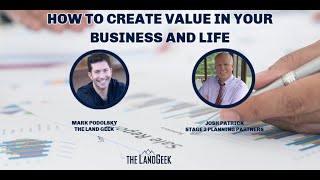
Josh Patrick helps blue-collar business owners create value by delegating work, documenting systems, and hiring for values. He points out that 80-85% of acquisitions are non-accretive, and emphasizes building a strong culture before trying to sell.
Questions this video answers
44
23 years
80–85%
The Sale Ready Company (available at www.salereadycompany.com; listed price mentioned: $7.95)
Chapters
Hey, it's Mark Podolski, the Latin geek with your favorite niche real estate website, the landladyk.com and on this week's podcast, we've got a tremendous guest who's going to help us build real wealth in lots of different ways. And my co host, Scott Todd is off today, most likely flying. So it's just me flying solo. So I'm going to get right into our guest, Josh Patrick from Stage two planning. Com. If you're not familiar with Josh, he is a specialist in creating business value. He works in private business wealth management. He does business succession planning. His passion in life is helping private business owners create extraordinary value with their businesses and lives. He's a certified financial planner. He's a financial transitionist. He knows how to help you get the most value from your business, both from personal experience and he sold his successful 90 employee business and from helping countless others do the same. He's also a former blogger for the New York Times. He shared his tips for preparing for the future in his book A Fable About Creating a Personally and Economically Sustainable Business. He's taught over 200 seminars for hundreds of companies over the past 35 years. Josh Patrick, welcome.
Thanks so much, Mark. A pleasure being here.
So Josh, what made you wake up one day? You sold your company. You're like, you know what, I'll help other people. You'd have to do anything.
Well, that's not quite true. I had to make a living. I was 44 when I sold my company. I didn't quite have enough money in the bank to say, okay, I'm going to hang it up. Not that I would want to anyhow, It's a long story. I'll make it short. When I sold my company, I looked at three options and going into the wealth management world was the best of the three options. So I went down that road, worked for a national company for a year and a half, realized I really can't be an employee for anybody, open my own wealth management firm up and the folks I know the best are blue collar private business owners. And that's what I've been specializing with for the last 23 years.
So why blue collar private business owners?
Well, for one thing, I know that world really, really well because that's where I come from. What was your business? My business was a food service and vending company. We had people working cafeterias, did catering, filled vending machines, made sandwiches for vending machines, ran cafeterias. So we did all sorts of stuff that our frontline workers were all blue collar workers. And blue collar companies, all companies are pretty much the same. You have to put a stake in the sand someplace. Who do you serve? And if I say I serve all private business owners, that's not believable. When I say I serve blue collar business owners, it becomes more believable. If I was to say I serve blue collar manufacturers and that make screws, then I would really be specific about I was doing. But it took me a lot to get down to just blue collar business owners because I actually like working across the board and there's no similarity between them where I can add real value very easily.
So what is it that you see as the biggest challenge to these private business owners and what then, how do you then help them get, you know, solve that. That problem or that challenge?
Yeah. The most important thing you can do as a business owner to become economically and personally sustainable in your business is to learn how to become operationally free from your business, which means you're no longer involved in the day to day operations. When you. And the skill that you need to learn to become operationally free is to become a delegating ninja. Now, delegating, I had somebody the other day say to me, oh, I delegate, I tell people what to do and then I go back three months later and it's not done. That's not delegating, that's abdicating. Delegating is you make an assignment, you inspect to make sure that assignment has been done properly and then you accept the assignment that you've given somebody. Otherwise known as eia Expect inspect acceptance. It was taught to me by my first mentor. I've used it for over 40 years and it's a really, really effective way of saying, am I being good at delegating or not? Now what the person described to me the other day is being delegated as abdicating. Now the other side of that is being a micromanager where you make the assignment and then 10 minutes later you're going and looking over the person's shoulder to see how they're doing. So there's a. The reason it's so hard to learn is that getting that balance right is really, really difficult. And you need systems to make sure you follow through or you're going to forget and then you're going to be abdicated or you're not going to have a system of when to follow through and you're going to go too soon and you're going to really annoy the person you've delegated to. But if you can learn that Skill. And you can learn to tolerate mistakes in your company, learn to learn from them. And you can understand that mistakes are learning experiences. And you get to build trust with the people you're working with. You're going to have a great company that rewards you in some really interesting ways.
I couldn't agree more. I mean, this is what we teach in our, in our actual coaching program is how to get out of your business. We take a full year to do it. And Josh, it's so hard. I mean, for me personally, I remember having coffee with my mentor and I was working my lamb business and I was all proud of it and I told him, what do you think of my business? He's like, stop. He's like, don't insult me. He's like, don't call yourself a business or an entrepreneur. You got yourself a nice job. Marc, what are you talking about? He's like, if you die tomorrow, what's going to happen to your family? What happens to so called business? He's like, you're doing everything. And he was right. And then step by step, and it took years to get to the point where I was completely out of the business. Because if he wasn't making me do it, I did it all kicking and screaming. Josh. I thought no one could do sales better than me. I thought no one could do due diligence better than me. I thought no one would care as much as me. I was wrong. But I had to learn the hard way. So now we help other people accelerate. How do you help these business owners see the error of my ways?
Well, first of all, we have to find out if they want to see the error of your ways. And it may not be an error. There are lots and lots of businesses where there is not going to be a next generation of business. It dies when the business owner decides to move on. And there's nothing inherently wrong with that as long as you understand that's your strategy. Now, if your strategy is, I want to sell my company, I want to get value out of it, the more you can do to get your company to be what we call sale ready, which is a topic in my second book, is the. Is what you want to be doing. Because the truth is, if you want to have a business that lasts past you, nobody wants you. They want your systems, they want your management team, they want your cash flow. They want. They don't want you because you're a pain in the neck. Now, they may tell you they want you, but that's one of the great lies of mergers. And acquisitions. The buyers lie, the sellers lie, and the buyer's biggest lie is, hey, Mr. Business Owner or Ms. Business Owner, we love your business and we love you as part of that business. And we have no interest in buying your business unless you come along for the ride. I call that the great lie in M and A. They don't want you.
I worked in private equity and we had a saying around the office. Buyers are liars and sellers are worse.
Yes, that's true. And the thing with, I mean, private equity is a great example of that. They know when they come in, they buy a firm for their platform that they may sign a two, three or even a five year employment agreement with the owner. They factor the vast majority of that into the purchase price because they're pretty sure they're going to be firing that founder or that owner within the first year. They own the company because they don't know how to be employees. Now their, their management team knows how to be employees because they are employees. If there's good systems, then they think they don't need the owner because they're going to bring all the strategic to the, to the table. But the truth is they need the owner. They just don't realize it. And they're going to make the same mistake over and over and over and over again. There's going to be a clash between styles where the owner is going to say, we don't need all this overhead expense. And the private equity group is going to say, oh yes you do. We need to know what you're doing and how to control you. And that's basically the way of the world. Now if you've not made yourself operationally irrelevant, there's a whole bunch of buyers that have no interest in taking your company over. You've really, either you have a sale that's going to be made to somebody who's leaving corporate America and wants to get into their own business. That's one way that could happen. Or you're going to be selling to your managers and they don't need you either. Or you're going to be selling to a competitor and frankly, they don't want your strategic self because they're going to merge your company into their company and your company is going to adopt their values, not the other way around, except in some very rare instances.
So I can imagine that when you're discussing this with your, your business owners and they aren't, they have not gotten to the point where they're operationally irrelevant. This is a hard pill for them to Swallow. They, they're so used to being the person and having that, the illusion of control. How do you help them mentally get over that hurdle?
Well, I kind of call this the fake it till you make it thing. And I love this thing with mindset. I have, I have mindset folks on my podcast a fair amount and I always ask them the same question. I say, what's more important, action or mindset? And mostly they'll say mindset, but sometimes they'll say action and sometimes they'll say, which is my belief is it depends. So in that particular case, the mindset will usually follow the action of becoming a good delegator. I can talk to you about mindset all day long. You're going to say, oh, my mindset is perfectly right. Now what mostly happens when I talk to people about delegation, they say, oh, I tried that, it didn't work. And I come back and say, well, no, it works. You didn't do it. Right, right, right. And then we get into a little bit of a conversation about what they, what do I mean by that? Because people don't like being told what they're doing is, is wrong. So I just say, look, here's, here's the deal. If you want to become personally sustainable, in other words, you want to love going to work every day, you can't be involved in the day to day for 30 years, you're going to get bored, you're going to get tired, and you're going to get burned out. Now, if I can help you make that switch to become operationally free from your business, now you have choice on how you spend your time and whether you transition your business or, or you don't transition your business. If you're operationally free from your business, guess what? There's no real reason you're ever going to have to sell your business because you're completely controlling how you spend your time. You're only going to do things in your unique ability area because you've built a team around you who's going to do all the stuff you're crummy at. But first you got to figure out what you're crummy at and you got to be able to let that go. Not very hard to do, by the way.
It's not hard to do. And you know, these are things that we talk about all the time, we call them swim lanes, where you look at what you're doing, identify what you hate doing the most, what do you hate doing second most, and then start finding the people that will do this better than you create the system, create the process, document it, stress test it. You know, can a sixth grader understand what you just wrote? And all these things, as well as with software and. And automation. So, Josh, what's the worst advice you see or hear given in the area of building a big business?
I'm not sure this has a lot to do with building a big business. But there's a consultant running around that I'm aware of who tells her clients that customer advisory boards are a waste of time.
Customer advisory boards are a waste of time. Why is that such bad advice?
Because the best advice you're ever going to get is by forming a customer advisory board where you bring in 6, 7, 8 of your customers and you help ask them to help you make your business better. Now you got to go. There's a methodology of running those meetings and doing them correctly. But anybody that tells me that a customer advisory board doesn't create value has no idea how to run a customer advisory board. So instead of her saying, gee, maybe I should learn how to do a customer advisory board, she goes around telling her clients, don't do it. Now, this is a problem with most advisors. If advisors are not good at something or don't understand something, they will often push their clients away instead of them learning enough about it to either say, hey, this is something I want to make into a core competency, or this is something I need to know about and have in my Rolodex people who can help solve that particular problem. Now, I'm really good at doing customer advisory boards, but I don't run them professionally. I do have somebody in my Rolodex who does, and he's darn good at it. So why would I bring a six skill to the party when I can get a 9.5 skill to come to the park?
Exactly. Exactly. As far as we were talking earlier about unique ability, let's say that with your help, I get to the point where I'm operationally irrelevant, and I say to you, I start complaining, you say, josh, I don't want to play golf all day. I still want to have my hands in the business. And you say, well, Mark, every time you put your hands in the business, you are a bottleneck.
That might be true, that might not be true.
Or let's just say in this case, it is true. Because, you know, I'm taking a. I'm taking. I'm. I'm doing sort of the micromanaging thing.
I'm.
I'm slowing the processor system down where Just so I can feel productive.
Right.
How do I. How do I really identify my unique ability once I get to that point?
You're pretty well it. Many people are good at figuring out what their unique ability is. It's what they like to do and, and it's an activity they do where they never get tired. That's your unique ability. That's how you know it's a unique ability. If you're doing something and after an hour you're exhausted, you need to delegate that because you're not very good at it. You're just fighting your way through. But if you work on something and you've been working on it for four hours and it feels like 10 minutes, that's your unique ability. That's what you should be spending your time doing. Now. I know some people have done a really good job of making themselves operationally irrelevant, but they still call on the top 10 customers the company has. But they have a team that services the company. They don't service the company, they just schmooze the company.
They don't service the company, they just schmooze the company. I love that. I love what you just said too. It's what you love to do. And if it feels like drudgery, take it off your plate right now.
My father used to do what he did to fill up his times. Would do mindless stuff like he would stamp all the labels for our sandwiches because he couldn't figure out what else to do right. Or he would take the money to the bank because he couldn't figure out what else to do. So some people do that. I mean, it's not especially wrong. He had done a good job of basically not doing a lot with day to day operations in the business. He'd go see the larger clients once in a while. We had a service team that went and did the service. If there was a problem, the supervisor would take it first and then it would get escalated. If it was a really big one, then he or I would get involved in it. He first and then I bought him out. Then it became me. So the truth is, whatever your unique ability is, you're going to know just by saying, I love doing this, I never get tired. And sometimes that doesn't work. And then you need something from the outside to say, you know, in my observation of you, this is what you're really good at and this is how you should spend your time. And when somebody does that, most of the time I say, oh yeah, that's right. It is what I'm good at. And this is why I should spend my time at. And boy, do I love that.
Yeah, yeah, absolutely. So as it comes down to building and getting to that next level, and let's say I want to shortcut it, maybe I want to acquire my competitor. One plus one could equal three so often, Josh, we see these acquisitions, they don't work.
80 to 85% of acquisitions are non accretive.
They're not accretive. Now define accretive.
Non accretive means they don't add value for the buyer.
They don't add value for the buyer. Absolutely. So that 15% that do work, what are the elements that you see? This is why it worked.
Similar systems in similar culture. More culture than systems.
More culture than systems.
Yeah. And if you take or a complete takeover, a culture, you watch the way Cisco acquires a company. Cisco Systems, they don't screw around with letting you keep what you had in the past. The day they acquire your company, they Cisco ize you, you adopt their systems, you do what they do, you bring their colors in, Everything becomes Cisco overnight, and what you had disappears. Okay, that's a hard way for a lot of people to sell businesses, but that's. They're very successful at integrating their acquisitions.
Interesting, interesting.
Way more. Way more so than the other fangs.
How important is culture?
In my opinion, values. Without values, you don't have a business. And the reason is values set the tone for what you're going to do. Values set the tone for how you're going to do it and why you're going to do it. You need to have your values explicitly stated and every place that you possibly can. And you, as a private business owner, need to be talking about your values at least once a day, if not three or four times a day. When I come up and I say I'm going to introduce values into a company, I always tell the owner it's going to take them a year to two years before anybody believes them. And I said, if you're not talking about your values 3, 4, 5 times a week, they're not there. And not only do you have to talk about your values, you have to have a clarifying statement around that value for what it means, and you have to have supporting statements that support that value. So you might say, you know, you're the expert at your job. That could be a value, that could be a supporting statement for personal responsibility. So now the definition is we don't blame, we don't justify. But if I'm going to say you're the expert at your job, you can't be an expert at your job unless you're personally responsible. So that becomes a pillar around supporting that particular value. And it takes years to put that stuff together. They don't just appear overnight. You have to kind of let them organically appear and you wait for it when they appear, then you add that to what you're doing. But the, the easier it is that you can make it all the stakeholders understand what your values are. The easier it is for a customer to know whether you're the right company, the easier it is for your employees to know this is the right place for me to work. If your values matched, you're not going to have a problem with employee turnover or as much as other people. Assuming you can hire reasonably well and you hire for values, you don't hire for skill. Now, too many employers, they hire for skill and they don't even talk about values. And that's a real mistake in my opinion.
Right, right. Yeah. I couldn't agree more with everything you're saying. It reminds me of a book I recently read by Simon Sinek, the Infinite Game. And it's really all about values. And he goes to these case studies and he's like, Wells Fargo had a great mission statement, nobody followed it.
Simon Sinek has done some really interesting stuff. One of his book is Owners Eat Last. What a great statement. What a great statement that is. Owners should eat last. Your own job, the job of a manager is to make the job easier for the direct reports. If I'm at the top of that pyramid, I'm really at the bottom of the pyramid, meaning that I really need to turn that pyramid upside down. And my job is to make the people who report to me's job easier. And my second job is to drive those people crazy, making sure they do it for their people. And we go down the line until we get to the person who actually is delivering the service. If I can make their job easier, they're going to be happier and they're going to serve our customers better.
I love it. I love it. Well, Josh Patrick, your mentorship has been invaluable on this podcast. But now I'm going to ask you for one more nugget of wisdom. What is your tip of the week? A website, a resource, A book, Something else actionable for the art of passive income listeners to go improve their businesses, improve their lives. What do you got?
Well, my friends in the Aardvark family have written another book. It's called the Sale Ready Company. So what we're doing is we are taking the Aardvark family. We went forward five years. The owner, John, is now getting ready or thinking about transferring his business. So the question comes, who's he going to transfer it to? How's he going to transfer it? Does he have enough money to retire? What's he going to do after he retires? And we tackle all these issues in the book. It's called the Sale Ready Company. I'll hold it up for the people who are watching this.
Okay. The Sale Ready Company.
And it's really easy to get. If you go to www.salereadycompany.com, you can buy the book for $7.95 and you get eight or nine bonuses, which will tell you exactly what you need to do to implement the stories in the book.
Oh, I'm getting it. Do I get a podcast discount, Josh?
Yes.
Fantastic. I actually, I'm just joking about that.
But.
But I would personally pay extra for a signed copy. And the only reason I ask is because when I get a signed copy, I show it off to my kids. I'm like, look, I'm a big deal. The authors signed the book and they're so impressed. So I would love to do that. My tip of the week is also learn more about Josh Patrick and what he's doing and go to stage two, planning.com and stage in the number two. There is a wealth of information on there and if you need to see values, there's values all over that website as well. Just examples. And I don't know about you, I'm sure you feel the same way I do. I just feel smarter after listening to Josh Patrick. And so, Josh, are we good? Thank you so much.
We are. This was really fun. Thanks so much, Mark. Appreciate it.
I want to thank the listeners as well. And just remind you, the only way I'm going to get the quality guests like a Josh Patrick from, you know, sale ready, sale ready company saleready company.com stage two plan.com is if you do me three little, little favors. Follow the podcast rate, review the podcast, send a screenshot of that review to support helandgeek.com and I'm going to send you a copy of my book Dirt Rich, signed as well. And it really helps because, look, a guy like Josh Patrick is not going to come on this podcast if we don't have a lot of reviews. He's just like, oh, auto, passive income, okay, They've got fewer views. I got better things to do. I'm going to go to entrepreneurial fire. So please do that. It really, really helps. Also, today's podcast is sponsored by Flight School. Learn more. Go to landgeek.com forward/training. See how we can help you build Passive income without renters, rehabs, renovations or rodents. Josh Patrick, you don't know what I'm doing, but I'm going to do it anyways. 1, 2, 3. Let freedom ring.
Okay. All right.
Thanks, Josh.
Thanks for Sounds good. Thanks.
Thanks for listening to the Art of Passive Income Podcast. Start your journey at www.thelandgate.com and www.scotttodd.net. rate and review the podcast and email supporthelandgeek.com your screenshot for a free Passive Income launch kit.
More from Mark



How to find funding partners: How to Scale Land Without Using Your Own Capital




