Learn How To Cultivate Grit In Your Organization And Personal Life
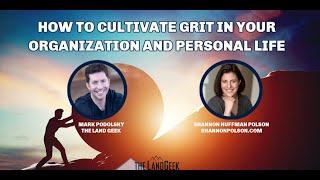
Podcast episode (hosts Mark J. Podolsky and Scott Todd) interviewing Shannon Huffman Poulson (author, former Apache helicopter pilot, founder of the Grit Institute) about grit, resilience, and leadership. Shannon defines grit as dogged determination plus passion and perseverance for long-term goals; recounts a formative military anecdote (first time on an Apache) and frames grit around three phases—Commit (own your story), Learn (present engagement, active listening, team building), and Launch (audacious risk-taking). She emphasizes "grounded optimism" (never lose faith you will prevail while acknowledging present brutal realities), advises against constant, unsustainable grit (need for rest/sprint–rest cycles), and recommends daily practices: gratitude journaling (3 things), recording acts of kindness, reframing problems, and a stress-as-enhancing-performance mindset. Episode closes with resources (ShannonPolson.com, The Grit Factor book, Tiller Money, Brian Doyle's A Long River of Song) and hosts' tips.
Chapters
Hey, it's Mark Podolski, the land geek with your favorite niche real estate website, thelandgeek.com and on this week's podcast, I'm gonna have to put on my anchorman voice. She's a big deal. But before we talk to our guests, I'd be remiss if I didn't properly introduce my co hosts. You know him, you love him. Scott Todd from scotttodd.net landmodo.com learn anything about anything. Investor ninjas.com Scott Todd how are you? Mark?
I'm great. How are you?
I'm great. I'm great. Today's guest is a little intimidating, I'll be honest. She is author, keynote speaker, optimist, creative badass. Shannon Huffman Poulson, the author of the Grit, Courage, Resilience and Leadership and the most male dominated organization in the world and the founder of the Grit Institute, a leadership consultancy committed to whole leader development in a focus on grit and resilience. She is one of the first women to fly the Apache helicopter in the US army leading line units on three continents. She combines her passion and firsthand experience and study of leadership and grit to deliver world class keynotes and training to companies and organizations like Microsoft. Scott Todd on Leadership and Grit after serving for a decade in the Armed Services, Ms. Polson earned her MBA at the Tuck School at Dartmouth and led outstanding teams in the court world at of course Microsoft. And let's face it, she cheats. She lives in Washington State, so whatever. Shannon Huffman Poulson, welcome.
Thanks, Mark. Thanks, Scott. It's great to be with both of you.
So Shannon, let's just get right into it. We'll just skip the pleasantries. Okay. How do you define grit?
I have thought of grit as a dog determination in the face of difficult circumstances, which is absolutely what everybody has been through in this past year. The other more scholarly definition is passion and perseverance towards a very long term goal. A combination of those two, I think is really the sweet spot.
Okay. And so if we rewind the tape and we look back at your experience in the most male dominated organization in the world, kind of tell us a story that really illustrates for us how you use grit to survive in this, I can imagine would be almost sort of a hostile corporate culture, if you will.
And I always like to caveat this by saying that I worked with some of the best people that I will ever know in my life and also some of the worst. But so there's a pretty good bell curve in an organization that's as large as the US military. But first, maybe I'll take you out on the flight line since Scott's a fellow pilot. Which is the very first time that I walked out towards the Apache helicopter, which is the helicopter that I was going to fly. I was trained in the Huey, I was trained in the oh, 58. That was the first year of flight school. So this is the advanced aircraft transition. And I remember that very first day that I walked out onto the flight line in lower Alabama. It's a winter day, winter morning, the sun isn't quite up and I walked out on the flight line and I had chills going up and down my spine, but they had very little to do with the temperature because I walked out on that flight line and I saw this 58 foot long aircraft crouching there looking like this enormous praying Mantis. It's 18ft across, it's 12ft high. It's powered by two 1850 horsepower jet engines. On its nose hangs three different sight systems that see in day and night in adverse conditions. On its wings hangs any combination of the 2.75-inch fully rocket and the anti tank Hellfire missile. Walked out on the tarmac towards this aircraft, the most technologically advanced aircraft helicopter in the world. And I thought, who am I to fly this thing? I mean, I was an English major in college and right there on the tarmac in that moment I had to make a decision. And this is really the foundation of grit. It's what I talk about in the grit factor. The foundation is owning your own story. I had to decide to be better than any of the doubts that I was feeling, than any of the doubts that I had heard expressed around me about why women think they need to fly this thing anyway. Because who was I not to fly this aircraft? So I walked up to that aircraft, put one foot up onto the wheel, the other foot up on the forward avionics bay and opened that all glass cockpit, began the run up procedure, taxied out towards takeoff. And then I like to ask people who are not pilots, Scott will know the punchline which way you take off in the Apache helicopter. And people will say up. But of course, in the Apache, like in any other aircraft, you turn the nose to face the wind and when you use it the right way, the resistance will help you to rise. So maybe that's a good setup for the rest of our conversation this morning.
I couldn't think of a better setup. Scott, Ty, what are your thoughts?
Oh, good.
I mean I did get the answer right, but you know, one of the things that Shannon said that I thought was really, really cool. And I think that a lot of people miss this. A lot of times is you look at somebody doing something and you go, oh, man, they have it all together. They got it, they got it. And I'm not saying that they don't, but in the beginning, they didn't have it all together. In the, in the beginning, we all have this, the same thing. We have the little voice in our ear who's whispering to us, saying, who are you to do this? What makes you think you can do this? Don't do this.
It's.
We all have that internal fear for everything. I mean, everything. We always do. And then what happens is the people that look like they have it together, well, they're the people that listen to the, to the little voice, basically ignored it, did it anyway, and then have gotten better and better and better over time. So, you know, you, you really have to understand when you have that self doubt, the only way to power through the self doubt is to keep going and that the self doubt goes away.
You know, Scott, it's so interesting because so few people bring that up in particular, but it's so true. And I think anytime you take on something that's risky, something that is a stretch goal, something that's a stretch assignment or a way to contribute in a really meaningful way, you know, most of the world is uncomfortable and doesn't want to sit with that discomfort, and they'll say, oh, you know, who do you think you are really? And you'll ask yourself that as well. And you're absolutely right. Right. You've got to. It doesn't mean not to take intelligent advice, of course, but it does mean to keep doggedly. And that's what I like, that doggedness. You keep doggedly moving towards that goal. And there's got to be some blinders to some degree to shut out that, that voice, whether it's in your own head or someone else's, right? But keep doggedly focusing on that goal.
So, Shannon, I want to shift to your kids for a second because Scott and I are both parents. I have three, he has two, you have too. And so when kids are really young and they've got this beginner's mind, they seem like they can take on anything, right? You know, they fall, they get up, right? Like we all learn to walk. It wasn't like as a parent, the kid's crawling, they start walking, they fall down, like, oh, I guess they're never going to walk, right? We don't ever give up on that. But then something happens as we get older and somehow things shift and we get that first hard math problem and suddenly we have to find some reservoir of grit. So how do you sort of help people and parents, leaders cultivate grit in their children and also in their organizations?
One of the best ways to talk about this, I think, is to say that when you do hard things, you get better at doing hard things. And so we will say, Polson boy, is do hard things. Right. I have an 11 year old right now who wanted this summer and now has been reluctantly put off till next summer. And I still have no idea how we're going to make this happen. Wants to hike the entire Pacific crest trail. He's 11 and he is truly training for it. But you get there, to the place where both you articulate this goal. I don't know if he'll be successful or if we'll be able to do it. We'll see. That'll be a learning experience in and of itself. But you get to that place by doing hard, hard things. And he's, for the last three summers, since he was nine, done a hike where it's 13 miles in, up into the mountains, a 13 mile peak summit, and then 13 miles back out on the third day. And he's a Nordic skier and he's a mountain biker and we do a lot of outdoor type. So I would say by doing hard things you get better at doing hard things. And then you also have those metaphors to draw upon when you get to the math problem and you say, hey, remember how hard it was when you were, you were, you were still two miles short of where you needed to be and the weather was coming in and how hard that was. Let's apply that to the math problem. Now. It's on a direct application. But, but kids get that, you know, it's a hard thing. You push through and then you remember what that feels like. So doing hard things makes you better at doing hard things. Helping children see, and this is Carol Dweck's work of course at Stanford, that their brain is actually developing as they're pushing themselves and their neurons are connecting as they're learning and teaching them what is happening in their brains helps them to continue to apply themselves in a meaningful way. Now I will tell you, we have plenty of struggles every single day. The kids are 8 and 11 and they're full on. But I do think it's helpful to keep that in mind. And we do, we do push ourselves to do hard things right now, today he's going to go out and do a triathlon that is only meant for the older kids to do on the ski team because he wants to push himself, because Folsom boys do hard things. So I think those are the types of things that you can use as metaphors, Whether it's in music or sports or academics, whatever, their strength is to pull over to an area where they may not be as strong. And the exact same thing is true for adults.
Scott Todd.
One of the things that I, I also just picked up on here, and I think it's pretty cool, and I was just thinking about this for use with virtual assistants or even employees, if you have them, is notice the kind of the sacred word that Shannon used or the sacred words that she used there. Polson Boys do hard things, right? Like, you can tell that that is a family motto. That's kind of something that's ingrained in their family. And the same thing could be applied to a company. Hey, we got. We just. We deliver the best. Or it's that. It's the, it's the words, it's the rituals that you continue to use. And that also forms the way that you think. Because if her family line was, pull some boys, we give up quick, well, then that's what she's going to get, right? You know, that's what you're going to get. But notice, notice how she was using that. And I was just thinking about, even with team members, employees, or VAs is, it's that same mindset. It's the same mantra. You keep saying the same mantra. Soon, soon, whether they believe it or not, they will believe it, because that's just what we do. And then the culture begins to take over and form.
And, you know, it's interesting, Scott, that you say that, because there's, there's two components to that. There's one piece with parenting which is less true with a company, I think, because the concern is letting these children grow up to be the people that they should be is that you don't impose an identity on them. But it is important to impose values and character traits, right? To impose, to teach, to develop those and to develop those within their identity does mean saying, this is what we do as this family. I don't care what this other family does. That's great. This is what we do. We are readers. We, we take care of people. We're courageous. We have the three Cs. We're courageous, we are compassionate, and we are curious. And so those are the. We are right. That Is that ownership? You're absolutely right. A company should do the exact same thing. This is what we stand for. These are our values. These are our core principles. This is who we are. And just even articulating that is incredibly powerful.
I'll tell you what, you got a little side business here, Shannon. It's for our teenagers. I'm sending them to Pulse and Camp this summer.
Hey, I've got online Pulse and Camp, and I can do it in person. So.
Is that right?
Let me know.
I'll send these kids there.
I'd love it.
I'm saying that tongue in cheek, but I really mean it. And I go on other podcasts, and we're talking about. What Scott and I do is a hard thing. We are land investors, but we also teach people how to buy and sell raw land. Scott runs flight school, which is what it's called, which is this group training. And people ask me, what is the one thing that people. What skill set do people need to be successful? What's the difference between someone who's successful and not successful in the land business? I always say the same thing. And it's grit. That's it.
I love that.
That is the. Is it right? It's the one thing. So how do we get more of it? How do we do it?
Yeah, yeah. No. And so this is a great entree because, of course, my book the Grit Factor, came out last fall from a Harvard Business Review press. And it came out because people were asking me that and because a young leader asked me to mentor her as she began the same process that I had gone through. And I thought, you know, I have my own experience, which is. Which is great. It's one data point. How can I scale what I offer to her and then scale the people to whom this is offered? I've been in the military. I've been in the corporate world. I know what works between the two. And so I started to look at it from the standpoint of grit, because I've always thought that that was the most important factor to whatever success that I've had, and I absolutely believe it is. I'm not sure I have quite as much grace, but at least I have some grit. And so I went back, though, to go beyond my own story and interviewed leaders in the vanguards of their fields. They happened to be women. They happened to be military. They all faced a double crucible. Both the challenges of what the military threw at them, which, of course, even in combat, they're fighter pilots, they're general officers. Across the services, there's a submariner, there's a combat rescue swimmer, an Army Ranger. Right. This incredible cohort. So what gave them that grit? Right? What allowed them to do what it is that they did? And every single one of them is different, but it really breaks out into three primary tiers. And this is what the book lays out. This is also what the training at the Grit Institute lays out. I can do that in person or online. And that is really this commit phase, which is owning your story, drilling down to core purpose. It's learning, which is a deep engagement in the present, and that means building your team, learning how to be an active listener, which turns out to be the most strategic leadership skill you can build, and then ultimately building those skills of grit and resilience, which has a lot to do with the mindset of both growth mindset as well as what I like to call ground grounded optimism, which I could talk about all day. And then the last piece is launch, launching, looking towards the future with audacity. We talked about that at the beginning, right? Risk taking, being willing to really push yourself, being willing to face fear and failure with authenticity and with audacity. So those were those key core characteristics. It really looked at grit. It turned out the grit was more holistic, part of the fabric of the character of these leaders. And the grit factor tells you exactly how to do it. From the stories to the research to.
The tactical exercises, there's a lot to unpack there. So I'm just going to pick the one thing that you said you could talk about all day, which is grounded optimism. What does that mean?
Yeah, well, so the anecdote I'd love to give you, and I'll just tell it very briefly, but this is one that is in the Jim Collins business classic, good to great, and it's Admiral James Stockdale, who's a Navy pilot in Vietnam, shot down, flying low over the trees, and he was held in the Hanoi Hilton for almost eight years. He had his legs broken twice. He was tortured mercilessly. He was in solitary confinement for half of that time. He had no idea if or when he would ever be released. And when he was released, they asked him, what's the difference? What's the difference between those who lived and those who died? They said, it's easy. The optimist died. They were the ones who said, well, surely we'll be out by April. And April came and went and nothing changed, or, surely the war will be over by September. And September came and went and nothing changed, and they died of a broken heart. So Stockdale says now he was a stoic, so he couldn't admit to optimism, because it turns out optimism is the key here, right? Stockdale says that you must never, ever lose faith that you will ultimately prevail in the end, which is faith that you can never afford to lose, balanced with the brutal realities of what you're facing in the present. And it's what I like to call grounded optimism. And it turns out that there are three separate studies of Vietnam prisoners of war, and the key factor to their success in every single independent study was optimism. So it's a grounded optimism. It's not being a Pollyanna, but it's grounded optimism. And I truly believe, just like Emerson said, that nothing great was ever accomplished without enthusiasm. And the same is true for optimism.
Scott. Todd, what are you thinking?
I. I'm just kind of blown away, man. Like, I don't know. I agree. I think that. I think that when. When you combine that grounded optimism with the fact that it's grit, I think you have a kind of a potential. I don't say deadly combination, but a potential killer combination. Because, Mark, I know people that, like, do the land business, and they went through flight school years ago. There's a couple of people that I could think of offhand, and, you know, I looked at their situation at that time, just where they were, and I'm like, I don't know if they're gonna make it or not, you know? And then years later, they're still doing it. They're still killing. They're silently killing it. I guess is what I should say is, because they haven't lost faith that they can do it, and they're still doing it, and they're pulling it together. And it may not be on my time frame, or maybe it's not even on their own time frame, because time frames are artificial anyway. But the mere fact that they believe that they can do it and they're out there doing it, and they continue to build their passive income. I looked at one the other day. Someone's name came across my desk the other day, and I'm like, wow, they're still doing it, man. They're still doing it. And it's like, good for them, because I do think that they've got the grit, They've got the grounded optimism that, look, whether this thing takes 6 months, 12 months, 12 years, whatever, I'm going to do it, and I'm not going to stop. I think that they're feeding off of that success. You don't need to be an overnight success. In fact, know the story behind overnight successes. Right. It only takes 20 years to make an overnight success.
That's exactly right. I love that. That's fantastic. Sticking with it is a very large part of the equation.
So, Shannon, let's sort of invert it, right? Because there's. I mean, look, there's all these sort of buzzwords in the corporate world, right? You know, authenticity, or what's the big. I think right now we're sort of in that authenticity mantra.
Right.
Is sort of like the big thing in the corporate world. Like, you know, show up, be your authentic self. Which, look, let's face it, may not be the best advice at some point. Right.
Like, I think of it. I think of it slightly differently, but, yes, that is what people are saying. I don't.
Right, right. Like, yeah, I think some people take the Brene Brown thing and took it a little too far, maybe. So my question is, what's the worst advice you see or hear given in this area of expertise of grit and resilience and grounded optimism and being better every day?
Yeah, I mean, that's a great question. It is a. I think the concept of grit sometimes gets a bad rap because people assume that it means going all out all the time, that there's never a break. And the reality is, what I like to tell people, and this has been especially important after this past year, and all of us, all of us are dealing with the mental health ramifications and families and in colleagues and in business partners, in employees. And the reality is grit is critical to your success, but it is not a sustainable operating mode. So how about that? The grit woman's telling you so that you can't do grit all the time. You can't do grit all the time. You have to find ways to take breaks. You have to find ways to take care of yourself and to take care of other people. And so that's particularly important after this last year where it's been very hard to turn business off. Right. If you're online all the time, if you're lucky enough to have kept your job, you're probably working more than you were before. And that's tough, especially with all of the other pieces that are part of this, with the very real fears of health for our families and for ourselves and economics, you know, and political stability and social stability, and. And so you've got to be able to balance that well put boundaries on your work and really be able to take time off and do things that. That. That nourish you and feed you and build you back up so that you can go back into it again. So I think that's the biggest thing is grit is not 100% all the time. Grit is not a sustainable mode, but it is a critical mode.
I love that. I love that. And you know, so many people burn out when they don't need to. It's, you know, I think of working especially in the way we work today, which is more information based. You know, it's sprint and then rest. Sprint and then rest. Do you like, do you like that?
I like it. I mean, it's how you work out, right? It's how people build muscle. It's how you build academic prowess. It's the same thing. You've got to take those breaks and really let the learning really take effect. And also rest the body, rest the mind, rest the soul and the spirit.
Right, right, right. So what things do you do on a daily basis to build up your grit muscles, if you will, like, walk us through, like a typical Shannon Huffman post in the day?
I don't have a typical one. I have two kids and they're at home right now. So everything is quite atypical, I will say. But you know, some of the things. And I had to give myself this advice. This is important. And Scott, this goes back to your point of people assume you have it all together and if you're speaking to them, you've got it all figured out. And the reality is, like, in the fall, I had a book launch. I was building a business and I was going all out all the time, and I literally almost collapsed right before Christmas. I had slept for 48 hours. My husband thought I had Covid and I did not. I was just exhausted. So the reality is you have to remind yourself of these things all the time, especially if you're like, probably all of your listeners are and like you are, which is that you're very execution oriented and success oriented. And so what I've tried to start to do now is to take more time out to drink less wine. That might have sounded sad in the fall. I actually feel much better for it right now to take walks outside. I mean, there's great studies on this if you want the scientific proof for it. But if you can just go with how it feels. We live out against some forest service and dnr and it's beautiful. And going out and listening to the birds and just having kind of that time to let yourself wake up and get into the world by walking and making sure there's time to exercise and Time to spend time with family. And I think blocking out those times and saying the computer's off at 5 or 6 or whatever time you're done with your last meeting. And I'm not turning it on before 9 or 8 or whatever your. Whatever your boundaries are, setting those boundaries and making sure you're spending time where things matter the most. And that has been a lesson for me as well.
Fantastic. Scott. Todd.
The Wall Street Journal the other day put an article up that said we're working from home remotely. The problem is we don't know when to stop. And it's because it's so easy. I was talking to my neighbor the other day. He was telling me that the one thing he loves working from home, the one thing he hates is he. He doesn't know how to stop. He'll go downstairs, eat dinner, and then he's just migrates back to his office. And the mere fact that, you know, you work in an office where the office begins to clear out and everybody goes home and it's okay, well, then that becomes the norm. You're like, I can. I can check out mentally, I can go home now. And there's no requirement for even. There's no real requirement for me to even think about this until tomorrow. Because if I didn't respond overnight, someone's gonna be like, oh, well, you know, life got in the way. Whatever. He's off work, it's after hours. But, man, when you work from home, you gotta set the. You gotta set the schedule, because otherwise you will just be there. And I'm guilty of it. I'm guilty of it.
Use this to take home, right? Use the little journal that you have to write in to take home. Because it turns out your brain works differently and better when you write things down. So if you have ideas about work after dinner, you can scribble them down, but you don't open the computers. I mean, that's the problem, right? Is it. It's never off, it never sleeps. And I think the studies are showing that we're working three hours more a day, especially if we're in the technology industries. And that's just not a sustainable solution either. Nor does it take care of relationships which sustain you or take care of health which sustains you. So, yeah, it's a. It's a tricky thing to navigate, for sure.
Yeah. No, and I think what you're doing is the superpower, our time, and it is the thing, because the rate of change of what we're experiencing as Homo sapiens on this planet is Unprecedented. I mean, it's just we're like. I mean, think about it from 2000 to 2020, the. All the changes that we've experienced. Because if you look back and like, let's say, like when I was born, like in the 70s to 2020 or 2000, not that much of a change, we'd wake up, maybe we'd read in the newspaper, go and do your thing. It wasn't that different day to day. Now, what's the first thing we do when we wake up? Check our phone. We're immediately getting stimulated. Not Scott Todd, because he doesn't have a phone addiction, but most of us who are.
Yeah, you've got to keep them out of your room. I mean, we keep ours in the mudroom because otherwise that's what we would do. And we don't want to do that. But to do that, we have to have that physical separation for ourselves.
So what kinds of things can we. What kind of mindset can we develop or what things should we say to ourselves? When I want to get into that Shannon Huffman Poulson mindset, I'm going to steal it, by the way. I'm not even going to give you credit. We do hard things in this family. But as a land coach, what other things can we do to sort of give people a little bit more shot of grit, a little more shot of resilience?
Well, first of all, I stole it from another family, from another Apache pilot's family, actually, so we can all steal it. That's great. We all should be doing hard things. So there you go. I've seen others with it as well. So, yeah, it turns out that grit is. It's a very easy thing to attribute to people that look like they have it all together or to say, well, of course that's something that somebody in the military has, or a military pilot or a big mountain climber. But it turns out grit is innate to every single one of us. And the science is really clear that it supports this and it supports that we can build grit and build resilience. So the grit factor is all about it, looking at it from a much more holistic perspective. So I would, of course, reference you back to both these stories as well as the lessons learned on the exercises of the grit factor. But very specifically, there are a few small practices that you can do, and they're very small, but they require like anything else. Just like Scott brought up earlier, the people that stick with something, right, are the people that ultimately prevail. And this is the case here as well. These are small practices are going to sound just a little bit Oprah like, but they actually are part of the Army's Master Resilience Training program, and they come from University of Pennsylvania's Positive Psychology Training program. So they're very much based in science and in reality. And one of those is in your journal that you write, hopefully and not type. You write down at the end of each day three things that you're grateful for. And I know you've all heard about this. It's been on the COVID of every lifestyle magazine out there. But it is actually a critical practice in building resilience and not only writing down what you're grateful for every single day, but also writing down kindnesses that you showed. And if you do those two things, there's a direct correlation to having better resilience, having more resilience. So that's actually pretty cool. And it's a relatively easy thing to do. It's a couple of minutes, but you just have to do it, and you have to be consistent. The second thing you can do is to reframe your problems. And it's actually called reframing. Right? And that is to say, like, if you say, gosh, I can just never do this, I mean, what are we going to do? The savings account is depleted and, you know, I lost my job. And you reframe the problem, literally restate the problem. I now have the opportunity to do X. I now have the opportunity to go back to school or to apply for a different job that's going to give me a different kind of experience. So when I come back into my field, I'll be able to apply that in a different way. And literally, restating has a profound impact on how your psyche internalizes the challenge. And then finally, I'll go back to what is really this growth mindset idea from Carol Dweck. But it's not just the growth mindset. There's some great stuff that has been developed in research since then as well. There's actually something on the stress mindset. Again, not sustainable, but important. There was a study done at Stanford last year, just published a little bit earlier than this time last year, looking at Navy Steels going into the BUDS training program. Incredibly challenging program, Right? And you hear people all the time saying, gosh, I'm just so stressed out, I can't do anything. And we've talked about how stress is crippling. Well, those Navy SEALs that entered buds with the belief that stress could enhance their performance saw a significantly higher graduation rate, performed better on discrete and measurable tasks and actually had 60% fewer negative peer evals, which is to say they were better team players. So at the end of the day, how you look at the challenge, even if it's something kind of amorphous like, gosh, it's such a stressful time, look at it in a more positive light now. Again, you can't sustain it forever. But say, listen, stress can enhance performance. I know it can enhance performance. How can I use this to come out the other side better? How am I going to come out the other side stronger and better and better able to take on new challenges and go in new directions? So those would be the things that I would look at is gratitude, reframing, and then really taking that mindset that when you go through hard times, even if you're totally stressed, that it can enhance your performance. And simply that change in perspective can completely change how you show up in the world.
Wow, that's a lot of wisdom right there. Thank you. But now we're at that point in the podcast. We going to ask you for one more tip of the week, a website, another resource, something else actionable for the art of passive income listeners to go improve their businesses, improve their lives. Your mentorship has been really invaluable and I'm going to even reframe. Like, instead of being intimidated, I get to interview you. And now I'm a smarter, more resilient person because of it. So thank you and thank you for your service.
Absolutely. It's an honor, as you know. Yeah, I would say I'm going to say two things. The first is keeping track of what's going on every day in a journal that you write in is really, really helpful. And keeping track of finances. I'm going to put out a quick shout out to Tiller Money, which is my husband's fintech company. But it's an outstanding way to look at your finances every single day and to be able to know what your status is every single day. And you have complet complete control over how it's pivoted. It's held in the cloud. You can share it among multiple people and having that visibility into it is super critical. But the second thing, and this is going to be unusual, probably I'm going to share with you the book that I'm reading right now at night. It's a series of essays by a guy named Brian Doyle. This is going to be your least directly related bit of advice, I'm guessing on your podcast. It's called A Long river of Song. And the reason I'm recommending it is, is because the most important thing in anything that you do and the most important key to your success is people. It always has to do with people. And Brian Doyle will connect you to the most human part of yourself in a way that will literally bring tears to your eyes. It'll make you laugh. It'll make you cry. And if you're not taking time out to connect to that human part of yourself and others, success is a really hard thing to find, both whether it's financial success or whether it's really what matters the most. So go read Brian Doyle's A Long river of Song. Unfortunately, he's passed on, but it's well worth your time.
Wow. One long river of Song notes on wonder. Is that right?
Yeah.
Is that it?
Brian Doyle.
Brian Doyle. Fantastic. Well, you know, before we get to Scott Todd's tip of the week, I do have to give a shout out to our sponsor, which is flight school. Learn how to like. 16 weeks can literally transform your life. Go up that mountain of land, investing with some grit and some resilience with Scott Todd taking you up as your Sherpa. Quickly, safely, and efficiently start building that passive income without renters, rehabs, renovations, or rodents. And by the way, that flight school tuition ain't gonna cost you nothing. We guarantee it. You're gonna make back that money 180 days or less. Just show us your work and you're gonna make it back in cash or terms. Learn more. Go to landgeek.com. Training all right, Scott Todd, what's your tip of the week mark?
You know who Bobby is?
Bobby.
Bobby, check out Bobby App Co. Oh, no. You keep track of all of those subscriptions that you sign up for, man. Netflix, your 1Password, whatever it is, you add it to here. That way you never forget a subscription. You can add categories in here, and then you know what? You can cost cut very quickly.
Keep track of your good insights and your fixed cost manager subscriptions get notified when Bill is due. Yeah, but how is this any different than, like, True Bill.
Which.
Which I used.
I don't even know what True Bill is. So that's how it's different.
So, okay, so, so True Bill does the same thing, and they give you notifications. But what truebill will do is let's say they'll look at your Verizonville and they'll say, hey, you're overpaying for Verizon. We're going to go ahead and negotiate on your behalf. And whatever we Save you. We're going to take 50% of the savings and that's how they make money. It's not a bad deal, Right?
That's pretty good, right?
See, not a total waste of Shannon Poulsen's time to be here, right?
This, this is fabulous. I love it. It's also, we have every single day, we look at our Tiller Money feed and we say, oh my gosh, we didn't cancel that subscription. So it sounds like that could go hand in hand with Bobby. I think they should get together.
Yeah, yeah. And we got to check out Tiller Money. We'll have a link to Tiller Money as well as the one Long river book. And of course, you know, my tip of the week, which looks, no offense, guys, very good tips of the week. Mine's going to really be the one that really moves the needle in everyone's Life. Go to ShannonPolson.com and certainly get the Grit Factor book. Check out Shannon's articles, essays. She has the Institute, the Little Book of Grit, the Road Ahead, the Way the Wild Gets Inside. There's a ton in here, so check it out. We'll have a link to it. And Shannon Huffman Poulson, are we good, Mark?
Scott, it's an absolute pleasure to be with you. Thank you so much.
Thank you, Scott. Todd, are we good?
We're good, Mark.
Well, look, I want to thank the listeners and just remind them the only way, the only way we're going to get the quality of guests like a Shannon Huffman Poulson is if you do just three little favors. You got to follow the podcast, rate the podcast, review it, send us a screenshot of that review. To support thelandgeek.com we're going to send you the $97 wholetailing course for free. Please do it. It really helps and we appreciate it. Alright, let's do this. One, two, three. Let freedom ring.
It's pretty good, Mark. We did good.
Whatever. Shannon's like, if I knew they were going to end like that.
Well done, right?
Well done, right?
Yeah. By the way, Shannon, I can imagine, like just your neighbors, how intimidated are they? Like, oh, wait, you flew Apache helicopters. Like I could imagine, like, you know, someone's out in their, you know, their front yard and they're doing something they think is hard. You're like, really? You think that's hard, huh?
Well, you know, it's interesting because we live on 20 acres, so we're on these huge parcels out where we are, which you'll appreciate as land investors and our neighbors. We have neighbors as one example of many who are 70 and 80 years old and they can crush me skiing. It is this, like, place where people come, these athletes come to retire, and when they retire, they just amp up the volume. So it is, it is pretty spectacular. So they're, they're, they're pretty good at the hard thing. Thing. It's very inspiring. My kids are in college. I hope to follow in their footsteps.
Very cool. Very cool. Well, well, thanks again. Thanks, everybody. Thanks for listening to the Art of Passive Income Podcast. Start your journey at www.thelandgate.com and www.www.scotttodd.net. rate and review the podcast and email support. The landgeek.com your screenshot for a free Passive Income launch kit.
More from Mark





How to find funding partners: How to Scale Land Without Using Your Own Capital


