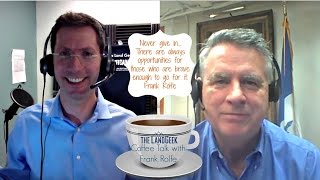
A short Coffee Talk interview where Mark J. Podolsky interviews investor Frank Rolfe. Frank recounts his path from billboards to mobile home parks, explains that he sold assets at the market peak and resumed buying during downturns (notably beginning in 2010), and emphasizes an opportunistic approach to recessions using examples from Conrad Hilton, J. Paul Getty, and other opportunistic buyers. The conversation ends with where to find more about Frank (creuniversity.com) and Mark (thelandgeek.com).
Questions this video answers
creuniversity.com (and by googling his name).
thelandgeek.com.
2010.
Chapters
Hey, it's Mark Podolski, The Land Geek. Thelandgeek.com and on today's Coffee Talk, I have the eighth largest owner of mobile home parks in the world, Frank Rolfe. Frank, how are you doing?
Great, Mark, how are you doing?
Let's have a virtual cup of coffee together. Even though I know.
Sure, let's do it. Let's do that. I've got my little glass here as well, so let's do it.
Frank has no vices, but Frank's had an amazing story. He started out in the billboard business, sold that for millions, got into mobile home parks, and at the height of the market, sold off all his mobile home parks. And then what happened?
Frank started buying them again. Mark, watch till the bottom fell out. 2010, we were in the Great Depression. I started buying them back.
Okay, so I want to talk a little bit about that model because we were talking about it on the podcast the Life of Conrad Hilton. And because the audio went out, we didn't get to the real crux, the real moral of the story. So let's rewind the tape a little bit. Tell us a little bit about Conrad Hilton and then the moral of the story.
Yeah, the quick synopsis is Hilton was a guy. He built a chain of hotels. He lost them in the Depression. Rather than give up, he took over managing the hotels. He had a plan to get them back. He ultimately raised money, bought them back still in the Depression for a penny on what he paid, rode them up, kept buying, but never forgot his key motto, which was never build another hotel. Wait till the Depression and buy them for a penny on the buck. So whenever America had a recession or depression, Hilton would be the buyer who would step in and buy the big hotels. So I guess the key item for me, my big lesson learned from that is when times are tough, don't crumple, don't curl up in a ball. Don't go in the fetal position. That's the time you take whatever ammunition and weapons you have left and you go on the attack. So that's never give in. Because although at a macro level, the recession depression is very depressing, there's always opportunity in those depressions to those who are brave enough to go out and try and buy stuff and build stuff, Right? And then if you can do that, and then you ride out of the Depression, that's the best way to make money. I'll tell you one other deal, Mark. Not a Hilton, but there was a guy in Dallas during Dallas's big depression in the 80s. And I'm blanking on his name right now, actually. But he was the guy who owned the Dallas Mavericks.
Okay? Before Cuban.
Before Cuban. And not pro. Before pro. The original guy, blanket on his name, he's not well known, but what this guy did was his mom had a company called Home Interiors and Gifts, and they make brass unicorns and junk. And so when the Dallas economy collapsed, they were selling office buildings. And I know this sounds insane, but I was there. If you had a high rise building with three floors out of 20 occupied, they would sell that building based on the income of those three floors, times the rent. And let's say the rent back there was 10 bucks a foot.
Right?
Right. So you buy a high rise building that cost $100 million for 10 million bucks.
Oh, my gosh.
Everyone else was running for the hills, terrified of real estate. This crazy guy went out and leveraged his mom's company and started buying these office buildings. And people said to him, you're crazy. Oh, my God, you're nuts. You're going to lose everything. You lose a whole brass unicorn. What are you doing? And he would say, I don't think it can get any worse than this. I mean, if you have a 20 story building with three floors occupied at 10 bucks a foot, and when they built the building, they budgeted all floors occupied at 25 bucks a foot. So originally, though, it didn't look smart. He barely met getting by, and then the market turned and in fact, he was dead on. The buildings went back to full occupancy at 25 bucks a foot and he made a freaking killing. And he bought the Mavericks the same way. Right. He bought the Mavericks for nothing. Before the NBA was hot. He sold The Mavericks for $100 million to Perot Jr. I mean, this guy is just. He was a fundamental genius. And yet no one ever talks about this guy. And I cannot even remember his name. I think his first name was Don. But at any rate, the moral of the story is depressions can be great if you know what you're doing. I mean, I love depressions myself, because depressions, that's what breaks up the playing field and makes opportunity. Right. I mean, if we didn't have depressions, there would be no opportunity in real estate or anything. Right?
Right.
In fact, if you read a lot of biographies like I do, you know, and again, I'm blanking on this guy. Help me out here, Mark. The guy that built the big museum out in Malibu, helped me out. He was the richest man in America at one time. He was an oil guy, help me out here. Help me out. What's that? I know. I do too. And I can't think of the guy's name. Gosh darn it.
Is it Getty?
Getty? J. Paul Getty. If you read J. Paul Getty's book, Getty loved recessions and depressions because he said when you have a depression, it forces you to go back through your business and jettison everything that's meaningless. That's stupid. That's a waste of time. It refocuses you. He thought that every businessman should have a recession depression at least once a decade. Almost like taking a shower to wash away all the stupid so that you can focus your business on what's profitable. So I guess, yes, I guess my coffee table concept is that even though we're in a depression now, although it's supposedly better, I'm not sure it is. But that's what don't be afraid of depression. Be excited about them. Be afraid of when things are good.
That's when you start selling Franklin. Where can we learn more about you?
Sure. You bet. Marc. To find more about me, you can go to creuniversity.com that's my hobby business where I teach people about real estate. Or you can just Google in my name and find me almost anywhere. I've been doing this long enough. I'm not hard to find. It's bottom line.
I'll have a link to you. Frank Rolf, thanks so much. And know Learn more about me thelanegeek.com Frank, thanks for having a virtual cup of coffee with me.
Bet Mark, it's quite delicious.
All right, fantastic. We'll see you everybody next time.