Reasons Why It Is Important To Prioritize Your Financial Security
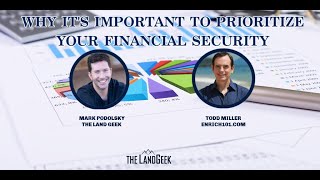
Todd Miller, author of Enrich, explains how he built financial independence through predictable cash flow instead of chasing gains. He moved from expensive mistakes with derivatives to a diversified strategy: single-family rentals, multifamily properties, private credit, and muni bonds. His framework focuses on creating wealth in time, money, and meaning.
Chapters
Hey, it's Mark Pudolski, the land geek with your favorite niche real estate website, thelandgeek.com and on this week's podcast we have one of those guests that we all sort of aspire to. He's gone through the lows. He's then come out the other side of it and he's created a life for himself that I would say Scott and I are going to be very envious of and I'm very excited to speak to our guests. But before we talk to our guests, our guest, I'd be remiss if I didn't properly introduce my co host. You know him, you love him. The brain, the professor, your flight school sherpa. Scott Todd from scotttodd.net landmodo.com learn anything about anything. Investor ninjas.com Scott Todd how are you?
Mark I'm great. How are you?
I'm great. But guess what? What? We're going to learn something. You know what GameStop stimulus checks and salary increases all have in common?
Gamestop stimulus checks and salary increases? No, but I think we're going to find out.
You know what? Our guest Todd Miller, the best selling author of Enrich, says that these all provide the wrong types of financial security. Promoting capital gains rather than Scott Todd, what we would argue is one of our favorite words, cash flow. Capital gains. Nice. In the short term, they don't produce the long term financial stability of reliable cash flow. So years ago, Todd decided to stop relying on his paycheck and engineered independent income streams that allowed him to quit his job and live the life he wanted. He stopped banking on situational gains like a pay raise or fast bump in the markets and rejected conventional retirement advice like the 4% rule, which rests on a negative scarcity mindset. And now he's on a mission to help others flip the script for themselves. Todd Miller, welcome. How are you?
Thank you, Mark. Great to be here and great to connect with you guys today.
So Todd, let's just rewind the tape and kind of walk us through some of your challenges and how you had this epiphany like, oh wait, cash flow is going to help me reach my goals.
Sure. So I guess by way of introduction, I have an entertainment industry background and it was an entertaining career. But I wanted more out of life than just a big and successful profession. And so I guess that shapes my life view. For many years while working for a major Hollywood studio, my career was rocking, my life was rocking, and financial security never even crossed my mind until I was handicapped by financial Insecurity by my inability to walk away from a very cushy but soul sucking job. And that catalyzed actually a number of financial epiphanies when I realized that financial security is foundational. Most people think of financial security as the end goal, as the fruit of a long professional arc that oftentimes we just have to endure to get through. And at the end of that arc, hopefully there will be a little pot. And what I realized is that to actually live life on your terms, to have optionality, it is important to prioritize financial security and to accelerate it. And implicitly, Most people take 40 years to achieve some level of financial security. And what I realized is why take 40 years? And once I actually realized the importance of, of having enriching cash flows, which are passive, recurring, predictable, diversified, tax efficient, I was able to fast track my financial freedom within five years. And that gave me the optionality to decide whether or not to continue to work. And so it's really, I think that for professionals, we often get sucked into this mindset of we take forever to build financial security. We confuse a paycheck, especially a cushy paycheck, with financial security. But in 2021, there's no job security, which means to build your financial security upon your profession and is actually a very risky strategy. And so that's when I recognized that regardless of how well or not career and life is going, it's just so important to accelerate financial security as quickly as one can and to prioritize that. And that inherently means structuring cash flows, overdoing what most people like to do, which is to chase capital gains, which is buying low and trying to sell high. And the problem with the capital gain approach is that it's situational and it's unpredictable. Maybe you'll get your timing right and maybe you won't. Maybe you'll create wealth and maybe you won't. But whether or not you succeed in capital gains doesn't create, even when you succeed, financial security because there's no predictability, because it's all dependent upon timing. The that was the epiphany when I realized that it's just so important to accelerate this financial security through layering various passive income streams. I then prioritized that and really hustled to put those streams into place so that work for me became a choice and not an obligation. And I think that's something that everybody aspires to. And once I had that optionality, then I could choose when and how to work and where to live and So I now call, you know, the most beautiful beach in the world in Thailand home. And that's my primary home.
Yeah, I mean, you were really preaching to the choir here with Scott, Todd, myself. But I'd love to get Scott's thoughts.
Well, I would just say that. I mean, I have a couple thoughts, one of which is that, Mark, this is why when someone asks me, hey, why aren't you only doing cash flips? Because we know people who have followed our recipe in learning this business, and then they turn around and they're like, I only want to deal with cash flips. Well, the cash flips are great until they're not great anymore.
Right.
And this goes to the whole mindset of, okay, I'm gonna flip this thing. I'm gonna make a lot of money right now, and I'm gonna go do it again. I'm gonna go do it again until the market changes. Right. And then when the market changes, which it will. The market will change when the market changes. And then you haven't built the income streams, you're really gonna be in a house of pain. I mean, you know that firsthand from your own experience. And, you know, I think that one of the things that I've always wanted to do and I try to do is I try to do exactly what Todd's talking about, which is to create. I'm gonna steal. I'm gonna steal a headline from. From. I can't. I just want to blank on the guy's name. I'm gonna steal a book headline, which is. Create more. Robert Allen. Robert Allen's book. Create multiple streams of income. Multiple streams of income. Right. And the thing is, is that the more streams of income that you can have, and it's not just about. And I think a lot of people confuse this, because a lot of people think, oh, well, I have to have, like, different industries or different businesses providing streams to me. And I think that's a mistake. What I think is, how many of these streams can you have coming for Todd? For example, he's a. He's an author. How many books can he write that's going to bring a stream back to him? He does other investments, I'm sure that bring other streams to him. Him. But the businesses don't have to be separate. And that's what I like about the business that you and I work in. And the ones that we teach is we create how to create multiple streams of income. Because when the market tanks or goes astray, I'm going to have notes that are still paying off, I'm going to have these things that are still coming in, these sources of income.
Yeah, I mean, I think, look, right now in American culture we're at this really weird moment where there's so much speculative frenzy. And you see that with the meme stocks, you see that with crypto, you see that with NFTs. And for someone who's been through many market dislocations, I just scratch my head and ask myself, what are people thinking or not thinking? For me, I'm a pretty simple guy and I like to stick to the fundamentals. And the fundamentals for me is that when I make an investment, I am just buying quality cash flow. And I buy that asset with the expectation that I will own it forever. And by focusing on the cash accrual from that asset, any appreciation that occurs, that's just bonus. But it's really on the underlying cash flow stream. And I like to, I actually do webinars around the world to professionals. And the best analogy for building enduring financial security that I can think of is an Aztec temple. And if you guys have been to Central America and if you've seen those majestic temples, I mean they're built to stand the test of time and they've been around for centuries. Architecturally, they have strong foundations that support multiple layers. Well, that's exactly how you build financial security as well. Multiple layers. With that strong foundation. It's so important, and this is one of the lessons that I've learned. It's so important that when you're trying to achieve financial independence, that none of your strategies or deals or investments, that they're really based on optimism and on perfection because perfection rarely happens. And the problem with the valuations right now in today's market is that many valuations, especially stocks, are priced to perfection. And that is dangerous. So to give you an example of why this is dangerous, I engineered this fast track to achieve financial independence within five years. And I exited the workforce on a full time basis just over two years ago. And literally the morning after I left my office and my job and my career for the last time, I received a note to say from one of my private equity investments that they're cashing out. And 12 hours into my retirement, literally a major source of cash flow was torpedoed. Now it was a high class problem because it was a great investment and the managers, the asset managers felt that it was a good time to transact and to trade. I made money on the investment, but for a guy dependent on cash flow, I realized 12 hours into my retirement that this important source of cash would disappear in 60 days. Luckily, my cash flows were sufficiently diversified so that I could withstand that major shock. And a couple months after that, then the pandemic basically unraveled the whole planet. And so it's so important for true financial security to be able to engineer these passive cash flows in such a way that they truly can stand the test of time and that they are stress tested.
I love it. Todd, what have you learned from maybe your biggest failure? Let's start there before we get into where you invest for cash flow.
Sure. So for many years, I thought I was doing everything right, and I never really focused on, I guess, the final. The financial side of my life. I was very focused on my work and a lot of interest outside of work. I was somehow saving more than I was earning. And so every year, my net worth was growing. But in terms of actually having a financial plan, having a strategy, and being deliberate about how to put all that to productive work, I outsourced it. And I really made some stupid investments back in the day. And so for many years, I used an expensive private banker. And back in the day, the private banks were all pushing these derivative notes. They're $100,000 a pop, and it's the equivalent of going to Vegas and betting on black or red. The problem is, I never won any of those bets. And after one such loss, I had this really, really testy discussion with my banker because I was just tired of expensive and just wrong banker advice. And he said, todd, Todd, Todd, if you really want to create wealth, there are three ways to do it. Real estate, your career, or private equity. And that's when I realized that actually, this whole approach of using bankers and stockbrokers and outsourcing, that it's never going to create any wealth. And in fact, it's probably detrimental to my financial security. And so, rather than outsourcing the whole strategy, I took control, I took ownership, and I created a strategy. I created a plan, and then I executed against that plan. But it was a very decisive and deliberate mind shift away from saying, I'm going to let others take care of it, to saying, no, this is my life, my financial future, and no one understands my situation better than I do. Now, I outsource the execution of that strategy to specialists, but the strategy itself, which encompasses multiple asset classes and tactics, that is mine, and that's unique to me. And I take full control and ownership. And I would encourage any professional, regardless of how successful and how busy that they are or are, not to take control and take ownership. If they really prioritize creating financial security.
Scott, Todd, Mark, I mean, I can't. I mean, you know, that's the thing is a lot of times people will, you know, basically dump their financial management over to one of these professionals. They don't want any involvement in it, and then they're not happy with the results. And the thing is, if you think about the wealthy, the wealthy have family offices, right? The wealthy has a family office whose whole goal is to continue to invest the money. And these family offices, they're the ones that are kind of making the family decisions on what they're going to do. And in a way that's the way that I think about my own investments is that even though I don't have the net worth to qualify, I guess, for a technical family office, there's nothing wrong with running your own family office and managing your own money, as Todd's saying. And doesn't mean that you have to do it all, but you need to have a strategy behind it of what we're going to do and how we're going to keep the money moving. Otherwise, you just might as well just hand over the keys to the car to the teenager and hope it doesn't wreck.
Absolutely, yeah.
What I love about Todd's strategy is just the total clarity of it and the intentionality of it. And so often we get distracted with what other people are doing. And when I was younger, I mean, Scott, Todd, you guys remember the dot com bubble? And I had friends making at that time hundreds of thousands of dollars in the stock market. And I'm sitting from the sideline like, this just looks like gambling to me. And they're like, oh, it's a new time. This is new. Because I actually was interested in companies in intrinsic value. I'm like, this doesn't seem like there's any intrinsic value. Oh, no, no, no, you're missing out. And then sure enough, there was a bust. And we see these cycles again and again and again. Where to Todd's point? Well, maybe the strategy is all wrong. This focus on working, working, working, saving, saving, saving, investing, literally just keeps breeding more financial insecurity because it could all go away tomorrow. You have no control versus cash flowing types of assets, like what Scott and I do with raw land in real estate. So, Todd, let's get to the $100 million question. What cash flowing assets do you acquire and why?
Sure. So like I've mentioned, my strategy is to invest in passive income streams. And using that Aztec metaphor, I actually have multiple layers and each of those layers would have multiple independent tickers or assets. So at a base layer, I invest in single family homes. And right now I have a concentrated portfolio in two locations, one in Southern California, the other in Kentucky. Both have interesting dynamics and are very good rental markets that provides a certain base. I outsource the management of all those single families to professionals because I put a premium on passivity and I want to limit the amount of time that I have to dedicate to get involved with any one of the properties. And so if you think of those single family homes as a long term layer in that Aztec Temple, I then layer on top of that some private equity investments and that is mostly multifamily as well as some medical office, some very specialized medical office. Again, those kinds of private equity assets, they're tax advantaged and they cash flow extremely well. I then layer on top of that private credit, and those really are short term loans, mostly real estate focused, but not. And I have three different investments in the private credit space. And then for absolute liquidity and diversification, I invest also in the public markets and in my taxable account. Most of that investing is in closed in muni bonds, national muni bond funds. Because you know, I'm very tax sensitive and I love being able to earn tax free income, you know, as well as to just have the, the liquidity if in fact I need it because I am so real estate biased. It is important to have some liquid assets in the event that there's a pothole somewhere or there's an opportunity somewhere. And so that's how I have layered my sort of temple of financial freedom, if you will, with a lot of underlying assets in each of those layers. Collectively, all those layers and assets, they spin off cash every month. And that enables me to basically live the life that I want. And I haven't looked back since walking away from my, from a professional stature almost two years ago. And it's been a great ride.
So why write the book Enrich? Tell us about that.
So if you take a step back, There are really three life stages that we go through. We spend 20, 24 years learning. We then spend a very big chunk of our lives earning for most people 40 years. And then in the last segment of our lives at least, most people aspire to return. So learn, earn, return. And I wrote Enrich to basically it's my way of trying to give back and to be productive. Now that I am not working, it's still very important for me to be intellectually engaged. It's very important for me to continue to meet and interact with smart people such as you guys. And being able to either write this book or contribute to Fast Company or Newsweek on work life issues. That's my way of just trying to share both some of the wisdom as well as just some of the pain that I have endured in my own professional and financial journey. It's writing a book like this, you actually don't make money on it. And so it's just truly my way of trying to give back. And I have no expectations to make money. In fact, I joke about the book that it was such a big time commitment that if in fact there were a profit motive to just would not have been a worthwhile endeavor. And I think it's important that we all try to give back in some way. And so sharing my experience is one way that I try to do that.
Yeah, I mean, I wish we could do another podcast just on the enrich method which narrow reach ignite. But I really love the whole premise of the book, which is create wealth and time, money and meaning. And again, this is really what Scott and I preach all day long, is we don't want to just solve our money problems, we want to solve our time problems. And then with that time, we get to move up Maslow's hierarchy of needs into self actualization and really figure out what our big purpose is, our big why. So, Todd, this has been tremendous mentorship, but now we're at that point in the podcast where we're going to ask you for your tip of the week. A website, a resource, another book, something else actionable for the art of passive income listeners to go improve their businesses, improve their lives. What have you got?
Sure. So my tip of the week is to act intentionally to create your financial security and to do what, according to Charles Schwab, 75% of Americans do not do, which is to make a financial plan. And once you make that plan, once you take ownership of that plan, to then wake up each day and to ask yourself, what can I do this day to help advance and to actualize that financial plan? And if you act with such intention, you can thank me later because the results are profound and enabled me, for example, to fast track my financial freedom. And they can do the same for anyone. But it's just a question of acting intentionally and taking control. And I would say that particularly in this climate, when there's a raging pandemic that continues to upend lives and livelihoods and lifestyles that many people feel like they've lost control over their lives, over their careers, over their financial futures. And by acting intentionally, on a daily, on a weekly basis, that empowers you to restore and recover that sense of control. And the silver lining is the more in control that you are, the happier and more satisfied in life that you are. So there are numerous dividends to acting daily with intentionality and taking control.
I love it. I love it. Before we get to Scott Todd's tip of the week, I do have to give a shout out to our sponsor, which is flight school. Learn how the next 16 weeks can literally transform your life. Start building that passive income without renters, rehabs, renovations or rodents with Scott Todd as your Sherpa. He's done it thousands of times. He's going to take you up that mountain of land, investing mastery, quick, quickly, safely, efficiently. Oh, yeah, that flight school tuition ain't going to cost nothing. We guarantee it. You're going to make back that money 180 days or less. Just show us your work. Learn more. Go tolandgeek.com training thelandgeek.com training Scott Todd, what's your tip of the week, Mark?
It's a simple but great tip, I think, and that is, look, everybody that's probably listening to this is on a journey. They're on a journey to conquer a major goal. It's very simple. And Todd himself wrote an incredible piece in Newsweek. I'm going to put the link in the chat here so you can see it, but also we'll put that in the show notes. Basically, you want to conquer a major goal? Well, then think big, act small, take action and follow the steps in that article and you will achieve it.
I love it. I love it. Well, if we're going to talk about Todd a little more, my tip of the week is enrich101.com create wealth and time, money and meaning. Learn the enrich way of just creating more control time in your life. What are the essential ingredients that's going to make your life delicious? Prioritize your priorities, all these things. So check out enrich101.com and get the book. Enrich, Audible, Kindle, paperback, hardcover, it's all there. And when you go on there, you'll see he's been featured in a few interesting media places like, oh, I don't know, Forbes, USA Today, Fast Company, Newsweek. But congratulations, Todd, on finally being on a prestigious media outlet, the Art of Passive Income podcast.
Guys, I am so happy to be here to talk about this whole notion of cash flow and passive income and to really, I salute you and applaud you for the good work that you do with this podcast in helping people to achieve their financial aspirations. So thank you both.
Thank you. Todd, are we good? We're good. We're good, Scott. Todd, are we good?
We're good, Mark.
I want to thank the listeners and just remind them the only way we're getting the quality of guests like a Todd Miller from enrich101.com is if you do us three favors. You got to follow us. Rate, review the podcast. Send a screenshot of that review to supportthelandgeek.com I'm going to send you a signed copy of Dirt Rich, which right now on the secondary market has a value of $2.2 million. Okay, I'm just joking about the secondary market. You'll get the signed copy for sure, so please do that. It really helps us. And, you know, guests like Todd Miller do look at those reviews, and we don't have any reviews. They're going to go on a different podcast. So it is mutually beneficial. So please do that. All right, are we ready to do this? 1, 2, 3. Let.
Let freedom ring ring.
Not bad. Thanks, everybody. Thanks for listening to the Art of Passive Income podcast. Start your journey at www.thelandgeek.com and www.scotttod.
Net.
Rate and review the podcast and email support at thelandgeek.
Com. Your screenshot for a free Passive Income launch kit.
More from Mark





How to find funding partners: How to Scale Land Without Using Your Own Capital


