Reduce Your Taxes, Protect Your Wealth and Keep More of Your Money
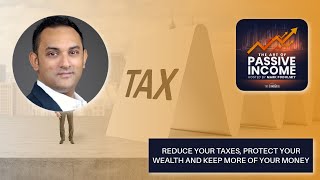
Podcast episode (Art of Passive Income) in which Mark J. Podolsky interviews Casey Chohan (founder of Together CFO) about reducing taxes and protecting wealth. Casey explains that their firm focuses on first-generation wealth, re-engineering complex trust-based strategies used by the ultra-wealthy for clients unable to maintain a family office. Key actionable points: they saved a client over $12 million in taxes in year one; if annual tax liability exceeds $200,000 it typically makes sense to explore trust/entity structures; trusts are used with LLC ownership (trusts can own LLCs; trusts generally cannot directly own S or C corporations); preference for multi-member LLC taxed as a partnership; use multiple specialized trusts to establish substance and intent; document expenses electronically; the firm provides resources (top 50 loopholes PDF, tax calculator, free mini-course) via togethercfo.com and a school community (school.com/tax referenced). The episode emphasizes structures (durable) over loopholes (transient).
Chapters
Hey, it's Mark Podolski, the Land Geek with favorite niche real estate website, the land geek.com and on this week's Art of Passive Income podcast. I am so excited because I don't know about you, but I'm a little worried about 83,000 new IRS agents and the fact that our taxes are going up. And our guest today is all about helping you keep more of your money, protect your wealth, reduce your taxes. It's Casey Chohan and he's the founder of Together cfo, a tax advisory, accounting and tax preparation firm based in la. His financial strategies have been the best kept secret of the elite. He's an expert on tax strategy and helps high net worth families protect their wealth and and reduce their taxes. And how did this happen? Because after a client came to him with a $20 million tax burden, Casey pushed himself to find better alternatives and began to learn and understand the secret tax strategies of the elite. Since then, his goal has been to provide education, resources to bridge the gap for first generational wealth, helping solve their pain points of overpaying taxes. Casey is a writer for Forbes magazine and a professional speaker who's been featured in Entrepreneur Magazine, NBC, Yahoo Finance, Fox News. He has spoken at many events and he also like the Money Show. And he's also a resident tax expert for Sam Oven's Quantum Mastermind. I actually know Sam Oven. Not personally, but I know of him. He's. He's a big deal. He's been interviewed on numerous cable networks, podcasts, publications. Finally, Casey, you're on a reputable podcast, a prestigious podcast.
I made it. Finally made it.
Welcome, welcome. So Casey, why, why tax efficiency and why are you helping these business owners?
Fell into it, to be totally honest with you. My background is all in accounting and finance from a management accounting standpoint, which may sound boring, but it just means you're helping the business understand the numbers and what's really going on so you can make better business decisions. And then through growing my own CFO services company, we encountered a huge problem with one of our clients, a good problem. We helped him scale from 5 million a year in revenue to 10 million a month in revenue. And this created a huge tax burden for him. He then punched me in the face and really got me uncomfortable with trying to figure out how to save him a lot of money on taxes. We all know billionaires don't pay any tax. They openly come out and say it. Their leaked tax returns also say it. Whether we're looking at Donald Trump or whether we're looking at the other billionaires like Elon Musk, Warren Buffett, Bill Gates, Bloomberg and so on, when they've had their tax returns leaked and reviewed and their true tax rate is all below 5%. So we know that the billionaires aren't paying any tax, but nobody tells you how they're not paying any tax. That's really the secret sauce. And it's all wrapped up in trusts. So the way that they do it is use a series of complex trusts. And that's ultimately what family officers use as well. And we figured that out and re engineered it back to first generation because you've got to remember a lot of these elite people are multi generational wealth or old money.
Right.
We focus on new money. So first generational wealth because they do not know or do not have a five million dollar a year family office that they can use to reduce their tax liability. So that's really where we came in. We helped our client save over $12 million in taxes in year one and quickly realized that we can make a bigger impact in the tax savings niche compared to the c, the fractional CFO services niche. So that's kind of how we got into it.
I love it. I love it. So let's talk a little bit about the trusts and what kind of business is really at a point where it makes sense for them.
So generally speaking, I would say if your tax liability is over $200,000 per year, it makes sense to start exploring this. If your tax liability is below $200,000 a year, then there's plenty of loopholes that you can use and other things that you can do. You don't need to go spending a lot of money creating this because it's not cheap, it's not for everybody. So if you're below $200,000 in taxes, look at the loopholes, make sure you're using all of them. And we've got the top 50 loopholes that we have as a free PDF giveaway that we can give away to everyone. And if you're above 200k, that's really when it starts to make sense.
Okay, excellent. So let's just talk about the people under 200k right now. What are your five favorite loopholes that everyone listening to this podcast could, could use right away?
Well, the problem with loopholes is they're changing all the time. Right? So, and then they get risky as well. So loopholes are more risky than having a structure in place. But just to answer your question, the top five would be the. I'm going to give you the most underused ones as well that people should be using. Home office deduction. Augusta loophole where you're renting your house back, hiring your kids, if you have any kids, buying a car and depreciating it again. That's a sliding scale and it is moving at all times. So right now it's 80%. Last year it was 100. Next year it's going to be 60. So this is the issue with loopholes is that at a low level they're okay, but the more income you start creating, they become less and less effective. And then the fifth one, we can go with R and D credits for movies. Now that's a unusual one that not many people will know of, but you can invest in movies and get credits or just R and D credits in general. There you go. I gave you 6 then R and D credits.
I love it, I love it. So let's say I've got a buddies in LA making a movie. I could invest in the movie.
Correct.
And what do I get as a credit then? I mean it's just, it's a one for one credit.
It's not one for one, but it, but it's pretty high. It's like most of these credits, they don't run one for one but you get a good percentage of your money back. So a lot of, a lot of people are using that one. And I say that because we're in LA here. It's the movie industry, it's everywhere. So the, the, the, the movie credits actually one of the better loopholes.
It's so funny because my, my buddy and, and mentor actually is a movie producer and he lives in Scottsdale and he is like a vc. So if you come to him with a package, a good script and you've got a director, maybe some talent associated with it, he'll be your first dollar in. And he's doing it because he's, you know, he sold this company for hundreds of millions. So he's doing it literally for the tax savings. And he thinks it's just a lot of fun.
It's definitely a lot of fun, especially at that level.
It's kind of brilliant. So now let's talk about the people that are paying over 200,000 in taxes per year. What do they need to do as a first step?
They need to look at their entity structure. How are they set up? Like if you're set up in a C corp or an S corp, there's going to be some movement needed. An LLC is the best way to get into A trust because you can change the membership. And a trust can own an llc. A trust can't own an S Corp or a C Corp. So there's got to be an additional level in there. But really it comes back to the ownership structure. How are you structured? How are the assets owned? And you shouldn't really have any assets in your own name. It should all be in trusts or in llc. So at least you get an extra level of protection. Right. We want to make sure, especially as the net worth increases, that all the assets are fully protected at all times.
So all the assets are in the trust, essentially. And I now I would assume this is an irrevocable trust, one that you cannot change, as opposed to a revocable trust. Is that correct?
Correct. Yeah. So irrevocability is a huge component and people often misunderstand it. So the irrevocability doesn't mean that the trustee can't change the conditions of the contract. If it's written that way. It means the grantor, the person who created the trust, cannot change anything to do with the trust. So it's a small nuance, but it's really important.
Okay, so what is the small nuance? What's the difference between the trustee and the grantor?
So we don't ever want to create alter ego. Alter ego is where the same person is, is the creator or the grantor and the trustee. We don't want that. We want separation. So let's just say it was your trust, Mark. Then you would be the trustee, and maybe a sibling or a parent would be the creator or the grantor of the trust, and the irrevocability would be on them. So let's just say it's your brother. He will not be able to change anything to do with the trust, but you as the trustee can.
Ah, I see, I see. And so then the assets all go into the trust. But then where do the tax savings come in? Because it's not real clear.
So the tax savings would be within the trust. So the, the difference between a simple trust and a complex trust is. Now what we're getting into the difference on. With a simple trust, you have to distribute everything at the end of the year. So whatever net profit is left over, it's passed on to the beneficiaries.
I see.
With a complex trust, that's not the case. You can accumulate corpus within the complex trust and then invest that corpus as well. And that's the main difference between a simple living trust and a complex trust.
Okay, fantastic. And so as far as estate planning is concerned, I know there's some issues with the laws changing. Can you speak a little bit about that?
Yeah. Well, the laws are changing all the time and statutory law specifically is different in each state. So if you pick statutory law as your jurisdiction, you've got to be different in each state and it changes all the time compared to common law, which changes by Supreme Court cases. So it's a lot harder to change common law because you've got to go all the way up to the Supreme Court and set a precedent versus statutory law, which is different in each state. And it can change on a whim like that. So it's all about the jurisdiction that you choose.
Okay. Okay. So what's some of the worst advice you see or hear given to your, your business owner clients?
The worst advice? Oh, we see a whole host of this. So it usually starts with the entity structure. People are advised to use a C Corp or an S Corp because they get certain deductions to use a C Corp. The only good reason to use a C corp is if you're looking to raise a lot of funds from a lot of people because you're going to pay double taxation on a C Corp. There's not a lot of benefits other than you raising a lot of money from a lot of people. And you need that entity structure for your cap table. That's one bad bit of advice if that situation doesn't suit. The second is an S Corp. So many people get pushed into an S Corp just because of a payroll deduction that they don't get in an llc, but they don't see the knock on consequences of. I'll give you an example. So a really close friend of mine, he's worth a couple hundred million dollars and he owns a lot of real estate free and clear, but it's all owned in S corpse. So if we were to change the structure, it would trigger a taxable event. And he's had these assets, this real estate in these S Corps for so many years that his property tax basis is really, really low. So if we converted it, it would trigger a higher property tax for him. So the bad advice that he got was to put it all into S Corps. If he put them into LLCs, we would have been able to save him millions of dollars a year on his taxes.
Wow. Wow.
So entity structure, although it sounds really simple, it plays a huge role the higher up the net worth goes. Now, there is ways around certain things, whether you're using a holding company or management company or some Barrier in between. But generally speaking, a multi member LLC taxed as a partnership is going to be the best way forward.
A multi member LLC taxed as a partnership is the best way forward, in my opinion. Okay. And so, so often I'll, I'll see a, a CPA firm, you know, give advice, but then when it comes to an audit, you've got to go and hire tax attorneys.
Yeah.
So what is, you know, if someone's hiring you and then they get an audit, what is the expense for the audit and what does that entail? And should we even be afraid of an audit?
If you've got nothing to hide, you shouldn't be afraid of an audit. But the problem is the person doing the audit is always going to poke around to find their win.
Right.
So regardless of if you've got anything to hide or not, they're still going to have to go back with something because the IRS is just a collection agency.
Right, Right.
So should you be afraid? No. If you've got your ducks in a row. And I totally agree with you, it's so frustrating to see, hey, you file my taxes. You know, you're the expert, so why do I need to go over here to fix the problem that you've created? So the way around that is we're a full service firm. Not only do we create the trusts, we administer them, do the bookkeeping and we do the tax filing. We also do the audit defense. If it ever came down to it, we would defend it at our own cost, no additional cost to the client because it's, I don't think it's right for us to put that back on the client if we create the problem. Even if we didn't create the problem, we're still filing the taxes. We're supposed to be the experts. And just the way that I feel about life and be nickels and dimed, I don't want to do that in my own business because it annoys me as an individual. So I designed the company as my as from my own thoughts. Right. I want to be my own first client. And it's like, no, I hate nickel and diamond. I'm not going to do that. And I want to be all encompassing so we're closer to a family office in the way that we do things compared to like a regular CPA firm.
Okay, fantastic. And then, Casey, I know for my own just tax planning, it's a pain to document every little thing, every trip and every meeting and every, every meal, but documentation is so important. What, what advice do you Give your clients to, to make the documentation as simple and pain free as possible.
Keep electronically. Like if you're at a meal, just take a picture of the receipt. You don't need to carry the receipt and put it in a shoebox and look at it once a year. Just take a picture of it. It doesn't mean that we'll need it. We know where the restaurant is, we know what time it was swiped, if it ever came down to it. But if you've got the picture and it's uploaded into a cloud automatically, which is very easy to do on certain apps, then you don't have to worry about it anymore. If it ever came down to an audit, we can say, hey, show us the receipt. How many people was it for? Did you write the name of the people on the back of the receipt or do you remember who was at the dinner? Do we have an agenda for it? Because we need all these things in place to make sure that we're not abusing the trusts or co mingling funds or going over any gray areas. We don't need to do that with the power of the trusts. So we'll just code it accordingly. Keep the backup if we need it, but do it at that point in time. Don't try and recreate it three months later or nine months later. You're going to have real problems trying to remember who you're at dinner with.
Right, right. And then as far as you're saying trusts. So are you recommending multiple trusts?
Yes. So two of the biggest things that the IRS come after people for is substance over form and intent and purpose. So if you can't clearly show that your trust has clear substance and then clear intent, then the IRS can easily come knocking and try and penetrate that trust. So it's really, really important to have one for business, one for family, one for charity, asset hold, multiple asset hold interests. So whatever activities you're doing to be very specific and intentional about them.
Ah, very interesting, very interesting. And it's. So when, when somebody, what would be the next step then? As far as somebody who's, who's interested in this, let's say they've got a, a tax liability over 200,000 a year. How would they go about learning more?
So on our website we have a whole dossier of information together. CFO.com we've got a free tax savings calculator in the top right hand corner that you can go plug in your numbers and see where you're at, whether that's capital gains, whether that's Annual tax savings. Then we have a free school community as well. So we have a community group with a lot of advisors in there that give you the latest and greatest tips and just a community of proactive people. It's all about being proactive rather than reactive. On our website, we have multiple videos on education as well. And then we do live webinars too, and in person events as well. So whether you're local in LA and I speak all over the country as well, I'll be in Scottsdale. You mentioned Scottsdale. I'm in Scottsdale later this week speaking at an event out there. So yeah, so there's a whole host of different information to get. Whether you'd like to watch a pre recorded webinar, which we have on our website already, attend a live webinar where we can do a lot of Q A and really get into specific questions, or meet us in in person as well.
Awesome. Awesome. Well, if you need some restaurant recommendations while you're here, I'm. I'm happy to. Yes.
We've got stick 48 booked, so that's the only one that we've got booked in for. Oh, yeah, no, it's quarter four in Beverly Hills. It's 44 in Arizona.
Yeah, yeah, yeah. You'll love it. That's. That's a big meal for sure.
I've been there many times. It's a great place.
That's great. Okay, so I digress. So now, Kasey, when it comes to taxes, it's such a complex area. There's so much to talk about. But what should I have asked you that I didn't ask you?
What should you have asked me that you didn't ask me? You covered quite a lot actually. Let's talk about. Transferring wealth. So everything that we talk about, it sounds sexy from a tax savings perspective, but what it really is is advanced estate planning. So it is all about creating your lasting legacy so you can pass it on to your future generations. And if you set it up correctly, you can do it completely tax free. Because changing a trustee does not trigger a taxable event. So if you set it up correct at the first generation, let's say yourself as an example, then when you want to pass that over to a spouse or children or whoever your heirs are, you can do that by changing a trustee or adding a new trustee on, and that doesn't trigger a taxable event. So you can circumvent the $11.5 million gift tax limit right now by adding a child in as a trustee. And they have Full power and control over the assets of that trust.
Excellent. But what if they're a child?
Then you wouldn't do that until they're ready. Right. So you, as the main trustee, would kind of educate them. And the way I describe it to my clients is that usually the children will start as beneficiaries, so the trust will provide for them up until a point at which they become of age and then they'll graduate into becoming a successor trustee and then a co trustee and then the main trustee. And that's all dictated and determined by yourself.
Excellent. Excellent. Well, Casey, this has just been a fascinating interview and it's one that I'm so glad to have because I say this all the time. For most business owners, their biggest expense is taxes and they don't realize it. And it's worth the time and investment in education to lower the taxes legally. And you know, the joke between tax evasion and tax Avoidance is what, 20 years? Right?
Yeah, that's, that's true.
Right. But, but the, the IRS does set things in place so that they do motivate the taxpayer to do certain things to lower their taxes. So they're, they're on your side essentially, in, in certain ways.
Well, they are and they aren't. They give you the playbook. But the playbook is 80,000 pages long. Right. Who's going to read it play by play?
Right. Well, I'm thinking like, let's say like a solar. Right. If, if, or, or energy plays right now where the government's saying, hey, if you do this, we're going to give you a tax break.
Yeah. So that's. Again, it's loopholes versus structures. Right. Loopholes will come and go. They'll ebb and weave and kind of go up and down and in and out, but structures will stay there forever. It's kind of like building a house. If you build a foundation on a house on rock versus on sand, you know, it's going to be wobbly on sand and it's going to crack and be unsettled. But if you build it on rock, it's a solid foundation. You can build a house or a hotel or whatever you wish on that.
Excellent. Excellent. Well, this has been fantastic, but we are now at that point, Kasey, where I'm going to put you on the spot again and ask you for your tip of the week. A website, a resource, a book, something else actionable for the art of passive income listeners to go improve their businesses, improve their lives. What have you got?
All right, so go to school.com tax. That is our free tax savings community. And within that, we have two or three great gifts for you. We have the top 50 tax loopholes that you should be using. That's as simple as downloading the PDF and sending it to your CPA to see how many things he or she has missed.
Wait, the second.com forward slash tax.
Yes.
Okay, I'm getting a four or four.
Error and I can, I can send you the link. So you can put the link at the bottom for everyone.
But I'll put the, I'll put the link for sure.
Yeah. So within that school community, you're going to get access to the top 50 loopholes that everybody should be using, regardless of how much all it will you pay in taxes. The second thing is a free mini course on taxes and how they work and how to be efficient with them. And then the third thing is a free tax calculator where you can see how much you've been overpaying on tax. And if you would like to then stop overpaying, it's totally up to you to set up a call with my team and we'll take it from there.
Fantastic. Fantastic. Well, my tip of the week is learn more about Casey chohan@together cfo.com together cfo.com and I do have to just quickly give a shout out to our sponsor, which is flight school. Learn how the next 16 weeks and transform your life. Go up that mountain of land, investing safely, quickly, efficiently with Scott Todd is your Sherpa who's done it thousands of times. You're going to start generating passive income. It's going to be taxable, but KC is going to help you lower that tax liability, so don't worry about it. But anyways, learn more. Good. Land Geek.com forward slash training the Land Geek.com forward slash training. I know you're thinking, oh, wait, what about the tuition? It's not going to cost you anything. Guaranteed you're going to make it back 180 days or less. Just show us your work. The land geek.com forward slash training. I also want to thank the listeners. Remind you the only way I'm gonna get the quality of guests like a Casey chohan from together cfo.com if you do three little favors, follow rate, review the podcast, send a screenshot of that, review supportlangic.com I'm gonna send you a signed copy of Dirt Rich as a thank you and be on the lookout for Dirt Rich too. Coming out soon. All right, Casey, are we good?
Fantastic. Thanks, Mark.
Thank you and to the listeners. Let Freedom Ring. Thanks everybody.
Thanks for listening to the Art of Passive Income podcast. Are you ready to learn how you can start building a passive income without renters, rehabs, renovations or rodents? Schedule a free consultation@thelandgeek.com training let freedom ring.
More from Mark





How to find funding partners: How to Scale Land Without Using Your Own Capital


