ROUND TABLE—Creating Systems—It's Time To Eliminate, Automate, And Delegate.
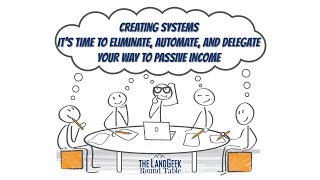
A Land Geek roundtable (host Mark J. Podolsky) with Eric Peterson, Tate Litchfield, Nat Bruno, and Scott Todd discussing how to create business systems by eliminating, automating, and delegating tasks. Panelists share practical examples (Zapier zaps, Fancy Hands, Lob, Airtable, LG Pass), criteria for hiring VAs, ways to avoid shiny-object syndrome, maintaining habits/motivation in summer, and end with individual "tip of the week" tool/book recommendations.
Chapters
Hey, it's Mark Podolski, the Land Geek, with your favorite niche real estate website, www.thelandgeek.com. and for this week's roundtable, we've got Landopia.com CEO Eric Chatnot Pro Peterson. Eric, how are you?
I'm good, thank you.
We got Tate Litchfield, the man the myth is soon to be a daddy. From frontierpropertiesusa.com we have a new member on the panel, Nat Bruno. Hashtag vanlife.com Nat Bruno, living the dream.
Yep.
I want to be outside playing, but I'm here with you guys.
See, I'm surprised he's not doing this while he's, like, you know, parasailing. And last but certainly not least, you may have heard of him. Landmodo.com Scott Todd.net and most importantly, if you're not automating your Craigslist postings, posting domination.com TheLandgeek and your Facebook postings. Scott Todd, how are you? Mark? I'm great.
How are you?
I'm good. I'm good. By the way, Geek Pay is stable. I don't know. Is everybody using Geek Pay and enjoying it?
Yep, loving it.
It's really gotten to a point where we're getting our support dialed in. It's pretty stable. So we're gonna start ramping that bad boy up and then do another big feature addition. So if you want to learn more about Geek Pay, go to GeekPay IE and we'll get you a demo. Well, let's start the roundtable. We got a few topics. The first topic I think we should talk about, especially because Nat's on, and he's kind of a geeky guy. And if you're going to live like Nat Bruno, Nat kind of just fill in the panel, how you live.
So I live in a van. I travel from state to state, wherever I want to live. Basically, I just pop in, park literally on the side of the street sometimes, and sometimes set up shop, or other times having fun in a new city, outside, surfing, skiing, you name it, and I'm out there.
So Nat, through Land Investing, has his passive income exceed his fixed expenses. He's totally free. But to be able to do what he does, it's really important to have systems in place so, you know, it's not like turning on a light switch. So I want to ask Eric Peterson, when you first created your first system, what was it like? Like, what was that process like for you? Eric?
It's a lot of work. You know, it's oftentimes, you know, I think we find ourselves just saying, well, you know, this task is only going to take a couple minutes. I'll just take care of it myself, you know where. Because if you're going to create a process for it, it might take you a couple hours. And then you got to train someone to do that and make sure they're doing it the way you want it done. But the reality is, once you create that process, it just makes your life so much easier to be able to pass that off to somebody and, you know, if they don't work out, pass it off to the next person and, you know, just kind of overseed that process.
Yeah. Tate Litchfield, how about you?
You know, pretty much the same thing. I'll just reiterate what Eric said. You got to spend some time working on it, making sure that your system is bulletproof. Then once it's bulletproof, you pass it on to a va. If that VA doesn't end up working out, you can just simply forward those same instructions onto somebody new, and that will tell you right away if you're bulletproof or not, because they can either complete the task or they won't be able to. And if they need further clarification, then you've got work to do. So, in my opinion, outsourcing system is the ultimate test to see if it actually is efficient or not.
Yeah, absolutely. Absolutely. Nat Bruno, how about you?
So I go very much by Ari Mizel's Automate first, if you can, and then outsource. But I ultimately shoot and then aim, or fire then aim, basically. So I write the system and I send it off to a va. It is not bulletproof. It is not. It's pretty rough, typically. And then I let them kind of poke holes on it. So when they come back with questions, I improve and fix the system and then hopefully it becomes bulletproof. But ultimately, it's. It's an ongoing process for me now.
How much time do you spend in Zapier?
Oh, I love it. Easily. My favorite software that I pay for, hands down, I have 20 or 25 different zaps, I think right now.
What's your favorite zap?
Some of them that I just created, I absolutely love, is when a lead comes in. Oftentimes they'll hit my email box from Craigslist from somebody calling in or texting. It'll go to my email box or Land Watch, for example, and I have an automatic zap that just send that email to a zapier email address, and then a whole bunch of things happen. Throws it in my CRM throws it in mailchimp for an email newsletter and then it also sends it off to a VA to call them back and contact them via email and phone.
I love that. Scott. Todd, I think Nat Bruno might have just dropped the zapier mic on you.
Maybe. I don't. I don't know. Like, so who do you have calling the. Who do you have calling making the calls for you?
So I use on demand service, Fancy Hands. Okay. All right.
So you give them a script to call to use and.
Yep. So it automatically pops into a spreadsheet and then they call off of that spreadsheet. And sometimes it'll be one lead or some. Sometimes be multiple leads that they'll call.
Nice. I would say, Mark, I'd say that, you know, Nat talked about Ari Myzel's kind of strategy to automate first and then to delegate. And I take one additional step before that, and that's to eliminate. Right. Like, I'm always looking to see what can I eliminate. Every single thing. It's amazing. Like, even though you're building your own business, you. You create crap that you just to.
Do it because you do it.
And that's how, in a large company, that's how stuff just gets started. Because, well, somebody did it once and then it continued on. So before I try to automate it, I do look to see can I eliminate this first? And if I can't, then I will automate it. And if I don't know how to automate it today, or if I can't figure out how to automate it, then I will give it to a va. I'll delegate that out. So my strategy is eliminate automate, delegate, and then if I can't figure out how to do a piece of that, then I'll just drop all the way back to the delegate piece and then I'll work backwards trying to figure out how I can automate it or I can eliminate it.
Scott, give us an example of a task you eliminated recently.
Ah, come on, Mark. Let's see. So I had. So what I did was for my salespeople, we had a. We had a. Well, I guess this is more of the automate piece, but it also goes to the eliminate too. So what would happen is they would create. I had like this Google sheet created and they would go in and they write down all their sales.
Okay.
And then what would happen is I would go in there when it came time to pay, and then I would issue the check and it would pay it. Okay. But that meant that I had to go in there and kind of, you know, do something with it. Right? And I had to check it and everything. So what I did was I created. I created some automation that says, hey, when someone is paying their bill, put it into an air table. You know, that tip of the week from a few weeks ago, so that that spreadsheet gets populated automatically through automation. Okay. And then what it would mean is I don't have to go in there and I don't have to go look at it. And then what I did was I basically said, pay through lob.
Okay.
So then when I hit. When I hit the button to pay on airtable, it issues a check to lob. And then when it issues that check to lob, it's just one less thing.
I have to do.
I don't have to print out the check anymore.
I love that. I love that Tate and I have been using LOB for a while to do that.
Yeah, yeah.
Paying property taxes and. And all that good stuff. Eric.
Well, you know, we have to. I gotta stop you. In LG Pass, which is what we use to automate our businesses, the developers are actually working on a LoB payment so that you hit the button, boop. Pay the bill, and it will issue a payment to your seller through lob.
I love it. How about property taxes?
That might be the next one. But for now, we're starting off with pay the seller.
I love it. That's so. It's so good. LG Pass is amazing, and it's so simple to use. Eric Peterson, how do you actually, like, stop, step back and be like, okay, I'm gonna create a system now, right? It's like. Like I have a hard time of just stopping. Like, I'm gonna go, go, go, go, go, and then I get it done. I'm like, wait a second. That just took me five minutes. And that five minutes I could probably eliminate if I just took, you know, an hour to go step by step and then create a system. But it takes effort to actually step back and stop. How do you do it, Eric?
I think one of the easiest ways is to, you know, kind of address your biggest pain point, you know, in the moment. So, you know, if this week or today or whatever, you know, your biggest pain point is, you know, x start building the process for that so that you can, you know, find a way to get that done. That's. That's probably the biggest way I've done it so far is just to address those things that I'm just sick of doing. You know, I don't want to do it anymore or I don't have the time to keep up with it, for example.
Yeah. How about you, Tate? What do you do?
Comes down to time. I mean, time's so valuable right now, and, you know, once it starts eating into my time and it's a skill that I recognize can be outsourced, it's gone. It's off the plate immediately. Because I'd rather have time to, you know, do whatever. Maybe it's just watch more TV or something, but I'd rather have more free time than sit there and do certain aspects of the business. I want to ride my bike a lot, so.
Yeah.
Or maybe it'll be hang out with my kids soon. So anytime I can create time, that's when it gets, you know, systematized and outsourced.
Nat, considering that, you know, you're doing all these crazy lifestyle adventures, how do you, you know, how do you find the time to even create systems?
I think it's been kind of beaten into me over the years. I hate doing things twice. I. Anytime I constantly find myself doing something more than once, I say I need to automate or outsource this immediately, or like Scott said, eliminate it completely. So I'm always asking myself, how can I create a system around this to remove it from. Remove me from the task?
I love it.
Scott. Todd, before we go on to the next panel discussion, I just want to ask you, what is your criteria for when you think of VA's just not working out? You create the system, and then you train them, and then you say, okay, it's not working out. What's your criteria for that?
Well, like, if you. If you only have one va, it will be hard for you to even understand this, but, you know, you should. You should have more than one, and then you should. You should have at least two for every job. One, because it will bulletproof you in case they decide to pick up and move to a part of the Philippines that doesn't have Internet connection because they're. Their grandparents are ill. And then all of a sudden, they come back, you know, 12 days later. All the time while you're wondering if they got washed out to sea in a tsunami.
Right?
That really happened to me, by the way. It's documented in a periscope. But the guy did come back. He didn't get washed out to see, which is a good thing, because he is my favorite va. But you should have more than one. And then what's happening is it's always a test, right? Like every. Every Assignment is a test. How long did this take? And I'm always telling, I'm always telling VAs, like asking them, like, how long did it take you to do that? Oh, it took me 35 minutes.
No, no, no.
I need this done in 30 minutes.
Right.
Like it's. Managing VA's is. Is not like a passive activity. You've got to keep asking, you got to keep prodding them. How long did it take you? Okay, I want this done in 30 minutes. Can you do it in 30 minutes? Or if not, how can you get to 30 minutes? And if your standard on a particular task is 30 minutes, they continue to take more than that. Well, then you have either your process is flawed, but now you're comparing two VA side by side. Because if one VA can do it in a 30 minute standard and the other's taken 40 minutes, well, then you know that it's a VA and not the process.
Right? Right. And, you know, I would be remiss if I didn't plug our own VA program, vas.thelandgeek.com where we're taking our own existing processes, training the vascular so you don't have to. But it is right now in beta.
That was really smooth, Mark.
Was that nice?
Yeah.
Abs always be selling. But let's move on to a favorite topic of ours. Shiny object syndrome.
Right?
We all listen to podcasts, we all read blog posts, and, you know, if you like, if you're like me and you had, you know, let's say a tough sales day, right? Maybe FBA by Amazon is better, right? Or maybe, you know, ATM investing is better or assisted living, right? It doesn't, I don't know. But it's always something might. It's just the grass is always greener syndrome, right? Eric Peterson, how do you stay focused and stay away from the shiny object syndrome? I feel like Stephen A. Smith right now from espn.
You know, part of it is I don't listen to a lot of other stuff to be distracted like that. And, you know, I try to focus my reading, my listening, all those things kind of around land investing in some, you know, shape or form, whether that's, you know, building business or sales or, you know, strictly just land investing. So that's, that's one way I do it. And then the other way is, you know, when something does catch my attention like that, I try to, you know, logically assess the situation. You know, consider that if I invest that same amount of time into land investing, which I already know how to do, and I know how to Be successful at it, you know, is it really worth it? And, you know, just try to keep a level head about it and not be distracted.
So, Tate Litchfield, how about you?
Ah, this is a tough one. You know, I guess it comes back to, I know what I know and I know how to buy and sell raw land. Even though the other options sound really exciting and really interesting, I don't know how to do those. And so part of me doesn't want to take on a job of learning how to do that other stuff. And the other part of me says, well, why fix it if it's not broken? Land is good. The market's strong, people are buying, the phone's ringing. Why do I want to take on another set of responsibilities? So for me, it's all about just, you know, I have to constantly kind of take a step back and say, listen, I got it pretty good. I'm in the right place right now. I don't want to. I don't want to get rid of this or leave this behind me. So for me, it's just that constant reminder.
Alright, Nat Bruno, you're on a double black diamond in Banff and you're about to go down. And before you go down, you read a blog post. You need multiple streams of income, right?
Well, I say, what do you do?
How do you avoid it?
I say, yes, you may be right, but I'm only focusing on one thing. I put a lot of constraints in my daily life and it may end up sounding restrictive, but actually, the constraints inevitably set you free. So I did run three businesses at once, and it was unbelievably stressful. So now I say I can only have one business at one time. So the One Thing by Gary Keller is a great example of that. What is the one thing that I can do right now that will make everything else either easier or unnecessary? So that for me is land investing. And I am not focusing any, any of my time on any other businesses or any other opportunities until it is up and running, completely automated, like you say, 90% without me.
Yeah, I mean, we do have a compelling argument. In fact, we even created a podcast called the Best Passive Income Model Podcast. So which makes the argument every single podcast. Scott. Todd, I know you have shiny object syndrome, Scott. Probably just like, as we were talking, like, started like a drone business.
I did not. I did not. Right?
I try.
I try to be very. Cause like, when you listen, when you listen to anybody talk, they. They all say, you know, multiple streams of income, right? And then what happens is, you Get. You get the plates spinning the way that you want them to, and then, you know, you feel like, okay, I can take on more. I can go do more. And I think that what happens is, I think it's just human nature to kind of want to test the waters a little bit, you know, let me test the water over here or let me see. Because if you don't, like, if you're not open to new experiences, well, then you'll never be like. Like, nat out being able to be out on the road, because you'd be like, no, this is. This is my world. This is what I live in. This is what I know. And then you become the person who's. Who's doing that same job for the next 40 years.
Right.
And that's. That's. So what I like to do is I like to kind of explore other things. But what I do is I really try to explore something with the mindset of, is there something here that I can take and bring back to my business to make it even stronger? So I think it's okay to, like, look. Look at other things, but with the mindset that I've got to keep this core business running. And at the same time, is there things that I can do that I can enhance when I'm already doing my land business?
Yeah, absolutely. Absolutely. All right, well, that brings us to our third and final topic, because it is the dog days of summer. And I don't know about you, but my pool looks really good sometimes. And, you know, and you wake up, the kids are. They don't have to get up. And, you know, they do have to get up, but they get up later, and, like, you want to sleep in. Your kind of routine gets messed with. And then it's like, I really want to work today.
Yeah.
Yeah. I mean, I'm taking July off, but I'm sort of like a, you know, the exception, I think. Like, you know, we all can't be Nat Bruno, but Eric Peterson. How do you stay motivated? The dog days of summer?
You know, I think for me, it's. It's a matter of having established habits and routines that I, you know, just am set in doing. So, you know, I just always come back to that. And, you know, if I don't feel like working for the day, it's kind of like, well, you know, you've got to do these things today. And, you know, that's what's going to keep the business moving, keep it running. And whether you feel like it or not, that's just part of the, you know, day to day, I guess. But that's, that's how I do it. Just have a routine and stick with it.
So, yeah, the power of habits. Someone should write a book about that. Oh, wait, Charles Duhigg did. Tate Litchfield. How you staying motivated?
You know, for me, it's habit, but at the same point it's. I live a pretty awesome lifestyle right now and I know that if I stop doing those basic things, my lifestyle would change. And so I guess there's a little bit of fear in there. For me, I don't want to have a change right in lifestyle. It's good. I want to maintain this. I want to keep getting, you know, if anything, I want it to get better. The only way to do that is to keep working hard. And so that motivation keeps me going. And the other thing is I take a lot of vacations already. You know, I'm always on the road. Maybe not as much as Nat, but I try to travel as much as I can. And so those little breaks that I get to take periodically really help me come back to work afterwards really energized and really motivated. And, you know, I take those vacations very seriously. And when I'm on vacation, I'm on vacation, you know.
Yeah, I mean, the five of us, I think, are in that 3W category. We're working when we want, where we want and with whom we want. Is that true, Eric Peterson? Are you, are you at that 3W stage?
Mostly.
I mean, I still do have a full time job, but you know, the land investing stuff, I would say that that fits.
Okay, when are you going to quit that job? Or do you want to quit that job?
No, it's in the works. Probably January. I'll be transitioning out of it, so.
All right. How do you feel about that?
Good and bad. I mean, I work from home in everything I do, so, you know, that part's the same, but the part that can be a little bit worrisome is just not having, you know, someone else paying a salary for me anymore and just being responsible for it on my own. So, you know, I believe I can do it, but at the same time, it's a little nerve wracking to step out there and be solely, you know, relying on that.
Well, Scott Todd did it. Yeah, he'll, he'll, he'll motivate you, you know, crazy. Wait, sky, you're on mute.
Sorry. I'll do a Facebook live from the boat.
There you go. Nat Bruno, how do you avoid shiny object syndrome?
How do I avoid shiny object syndrome. Honestly, it is staying focused, staying motivated. Like you said, I oftentimes will book or schedule out a big vacation like the ski trip, ski road trip or going to Europe for a month way in advance. So I know that I'm working towards something. My very first business, I was working 50 hour week and I booked a month in Europe. So I knew I had to systemize my business to the point where I could disappear for a month. And I was able to. And I was working five hours a week by the time Europe showed up. And the only call that I ever got or email when I was in Europe was, hey, where do you want your paycheck deposited? So that long term vacation, or positive incentive, if you will, really, really motivates me.
Yeah. Does anybody follow like Grant Cardone or Gary Vaynerchuk and be like, well, you know, and have that should syndrome? Like, these guys are working so hard and so consistently hard. It seems like they never take a break. I would almost argue that they're unhealthy in that sense, but you can't argue with their results. But Nat, can you argue with the results? Because you question everything.
Yeah. So it's funny, I just watched a video by Gary V. Yesterday. He's talking about regrets and he's like, the one thing I do not want is regrets. For him, it probably would be. He didn't say specifically what he would regret, but if he didn't own the jets, he might regret that. The New York Jets. Whereas me, I would regret it if I work too much. If I was constantly working 50 hour weeks, I would regret that very much though.
Me too.
Tate.
No, I 100% agree with that. I think there's more to life than that. So that's why this is the best passive income model there is. You know, like you don't have to work 50 hours a week. You could sit down and you can hammer out a couple hours in the evenings and within a few, you know, within a year or so, you're. If you do things right and you listen to your coaches and the community and you attend the seminars and boot camp, you can live the lifestyle that you want. I think, don't you say something to the extent of, if you, you know, focus now for the next three years, you can live how everybody else wants to live. Forever or something like that.
Yeah, yeah. If you, yeah. If you'll do for the next three to five years what other people won't do, you'll be able to live the rest of your life, whether the way other people can't.
Yeah.
Be able to do what other people can't do. Yeah, it's, it's true. I mean, I, you know, I say this a lot, but I think it's true. If you work in a focused hour a day in this business, a focused hour a day, which means you're not checking email, you're not going on social media. You just put your head down and do the two things you really need to do in this business to move forward, the mailing and marketing. Let's say, let's get a system done. It will move the needle. Scott, is that a realistic assessment time?
Yeah, I think so. I think that, you know, when I started, you know, and even today, Mark, I still spend about two hours a day on my business. But there's more to it than what I'm, you know, in, in terms of land. There's more to it because I'm just trying to do things right and it's work that I might enjoy. It's tinkering.
Right.
Like today I spend most of my time like on Zapier or you know, trying to figure out is there a better way. I play with tools because I have to have all these tips of the week. So, you know, I'm always playing with applications. I'm trying to become a better me. And so that's where my two hours a day comes in. And even when I was working my full time job, I still spent two to three hours a day building my business. And I did it in a very focused manner. I think that's what it comes down to is being extremely focused.
Yeah. Well, speaking of tips of the week, we get now to go to Eric Peterson's favorite part of this podcast and ask him for his tip of the week. A website, a resource, a book, something actionable. Where the art of passive income listeners should go right now, Eric, and improve their businesses, improve their lives. What have you got today?
It's going to be a book. I am in the process of listening to the book. It's called your one word by Evan Carmichael.
Your One Word.
And he basically, you know, the whole book is about finding your one word for your life, your business, you know, and building that out into everything you do and that people will buy into that, they'll follow you and, you know, kind of support you in that, in that sense. So it's, it's an interesting book, huh?
Very cool. You know, the 22 minimal laws of marketing. Talk about that, having that, you know, owning that word in that category. So I think That's. That's a really great book. I think, you know, Scott and I have actually talked about it. Like, our one word is freedom. Right? Like, we want to own that word. Eric, what's your word?
I'm still working on it. I've been kind of mulling over some ideas, but I haven't. I haven't landed on my one word yet. So I'm still. Still working through it.
Well, look, if you want to borrow ours, let us know.
All right.
That's a great. That's a great tip of the week. Tate Litchfield, are you ready for your tip of the week?
Yeah.
Yeah.
I'm glad to go ahead of Scott again, because I'm sure he's going to claim that I stole his tip once again. But I have actually this week, I was playing around on Saturday, and I didn't have my computer with me, and I was trying to create a new actual process. And I do a little mind map, and I'm trying to come up with and give some background information on an effective way to pay for taxes on properties. And so I was thinking of how to do this and pen and paper. And then basically I decided I needed to come up with some sort of swim lane. And swim lane and automate it. So I was looking through the App Store and I came across an app called Mindly M I N D L Y. And it's a really cool free app. You can basically download it and make kind of like a bubble chart. And it basically says, step one is do this, and that'll branch out to this and then that. So it's basically kind of a way to create a process, like Process street, but on your cell phone. So been using it for a few days now. I like it because I can export the files. I can share it, I can print them.
I don't know.
I just kind of find it a cool tool, actually.
All right, I'm check out Mindly M I N D L. Yeah, it's really cool.
It's got a free version, but I would recommend they have a purchased version you can get for like, seven bucks or something like that. And it's. It's nice. I like it. So I give it a thumbs up. And it's. And it's cool because sometimes you want to think about your business when you're not in front of the computer or you're up at night laying in bed. And it's a great way to jot down some ideas and some processes.
Very cool. Very cool. Nat. Bruno, what's your tip of the week.
So you guys know that I'm ambitiously lazy and I hate doing the repetitive tasks over and over again and particularly typing the same things over and over again. So I recommend phrase express.com. oh.
Is this on the App Store?
It's on iOS, it's on Android, it's on Mac, it's on Windows, and Mark, it's free.
Oh my gosh, my second favorite word.
Yeah, buddy. So it will insert a text snippet for you into whatever program you want. So a lot of people have heard of like canned responses, but it only works within Gmail. This will work in any window within your computer or your phone. So an example that I use often is when I have notaries that I need to schedule to see if they can close for me in a certain location. I have to email five or six of them sometimes. So instead of writing out five individual emails, I just simply press few keys on my laptop and a pre written email just pops out right into Gmail and is sent to the notary.
Wow.
It saves me boatloads of time.
I love it now. Okay, iPad app, iPhone app. I'm getting this now. Okay, so this is what I do. I go into settings and keyboards on iOS and I create a bunch of shortcuts there. But it only works in like mail, right? It doesn't work in every. It doesn't work everywhere. So yeah, this is awesome. I'm definitely getting this right now. And then for my computer, what I use is a text expander, which is also, I think, you know, I think it's five bucks on the app store. But it saves so much time.
What's the cost on this?
This is free.
So there's a free mode. It looks like it costs money, but there is a. If you go to download mode that you can download.
I love it. What Scott, what are you using for a text expander?
I use. What's this called? A text.
Yeah, that's. Yeah, that's what I use. A text. I love a text. In almost every application on the Mac it works great. But iOS this is a really good solution. I'm sure there's an Android version, I would assume for the three people that.
Use Android, that's me.
Uh. Oh.
Oh shit.
I'm a Windows guy. I'm a hacker at heart. I can't handle Mac.
Mark, Mark. Eject.
Where's the ejection?
Look, I literally have no idea how he got on this roundtable. Now that's crazy.
All right, well, surprising we can even see him.
Yeah, Zing.
So my. Wait, Scott, what's your tip of the week?
Oh, you want to.
Go ahead.
You're so excited. Go ahead.
No, you can go. You can go.
Okay, Mark, listen, I got a book, okay? The book is by Michael Hyatt. If you don't know who Michael Hyatt is, he's a blogger. He's also former CEO of a book publishing company. The book is called Living a proven plan to stop drifting and to get the life that you want.
Okay.
And basically, you know, this book is really about, you know, kind of everything that we've talked about, like even on this podcast today, which is, you know, you can, if you want to be like a Grant Cardone and, you know, work 70, 80 hours a week. And that's your why? Well, then, great. No problem.
If you.
If you just want a simple life, no problem. It's your life. You should plan it the way that you want to get the life that you want. And Living Forward is a great book to help you do that.
All right? And it's on audible too, so even better. I love it. So my tip of the week is going to be pretty interesting. Pretty interesting. I think we'll see what Eric Peterson has to say about is. Cyclops.I o. Check out cyclops. Cyclops IO one click. Video conferencing with screen share on steroids with the physical whiteboard app. No download, no login. Up to eight people. This is a tremendous way to create systems. It's quick and secure. It's screen sharing on steroids. You can broadcast the physical whiteboard chatbots. Real time audio transcription. No more taking notes for them. Email or post transcript to Slack. Your meeting gets indexed and becomes searchable. Oh, and by the way, it's free. Did I just drop the mic? Cyclops IO.
Well, Mark, if it's free, how is it going to be? How are they going to sustain it? How is it livable?
Come on, Mark, that is my policy. And I'm sure they will monetize it soon.
Well, it remains to be tested.
They could just go away tomorrow. Mark.
I agree, they could, they could. But I have a feeling they have a really good. They have a good solution here. People will see it.
Oh, look, it's gone already. The website's already gone.
What?
No, it's not.
I mean, if you're willing to risk it and host our next roundtable on it, then we can give an actual feedback on it. But until then, it's just a good look at Eric.
Eric's not saying a word. You know, he wants to Mark, but, you know, he's letting Tate and I carry heavy weight here.
Eric, go ahead, let let loose. It's a great tip.
Stand up for yourself, Eric. Stand up for yourself. Give it to him.
I've got no comments. I'm not going to tear down anyone else's tip of the week. They're all.
High road, Mark.
High road. You know what? I respect it. When we go low with our tips of the week, he goes high. But Nat Bruno has not chimed in yet. So, Nat, Cyclops IO, what do you think?
Definitely, Definitely interesting. I got a question for you. Why is it named Cyclops?
I don't know.
I can guess.
Got him.
I have no idea. But I do think that there is something here and that Zoom could be in trouble if Cyclops can gains traction.
True, true.
So Scott's got the same kind of thing as Zoom us, but it's got the different price point. You know, Slack start out is free now. You know, they'll have a free meal model. They're just getting users. Right.
I think I like. I don't think it's a bad. I don't think it's bad. I think it's a good tip of the week. We gotta mess with it. I do like the. I do like the. How I do the physical whiteboard. That'd be. That's kind of cool. See, it's just a whiteboard, like an online whiteboard.
I don't know.
I gotta play with it. We'll tinker.
Whiteboard, enhance content using computer vision. Draw and add text markups. Take snapshot, email or post to Slack it also. So you can broadcast your physical whiteboard.
I might have to start messing with this and stay up to like 2 o' clock in the morning and let you know tomorrow and then use it for my tip of the week next week. That might happen. Okay. No guarantee, but, you know, at least I'll be able to say, like, this is how I used it, Mark.
Fast, easy, secure in an open platform. I don't know.
Have you used it, Mark?
No.
No.
Not yet.
Okay.
Not yet.
All right.
I will tell you though, Eric, Mark was extremely excited about this, this tip of the week. He actually voxed me. Like, I don't know. What day was it, Mario?
Like last week? Yeah.
Like, he was like, I got this one.
No one can claim it.
It's mine. It's good, right?
Yeah, it's good, it's good, it's good, it's good. So I think I've really stepped up my tips of the weeks. So.
Gotten better, Mark?
I've got. I'm getting better. You know, it's very hard. So I want to thank.
Really hard.
Well, I want to thank all the listeners. And please, if you're enjoying these roundtable podcasts, just do us a little favor. Subscribe, rate and review the podcast. And there's a screenshot of the review to support@thelandgeek.com it really helps. So I want to thank Nat Bruno, Eric Peterson, Tate Litchfield, Scott Todd for joining us on the roundtable. And should we try to do it, Scott, or.
Let's go, Mark.
You guys ready?
Yep.
Ready.
One, two, three. Let freedom ring. Wow. Speaking of freedom. Ringing Scottsdale boot camp is full, but Orlando is filling up fast. We're halfway full for an October boot camp. So if you want to get to the Orlando room, go to the landgeek.com Boot Camp and register now. All right. Also, if you want to learn more about flight school, the toolkit, any of the training, go to the landgeek.com training. Thanks, everybody, and we'll see you all next week. Thanks, guys.
More from Mark





How to find funding partners: How to Scale Land Without Using Your Own Capital


