ROUND TABLE—Setting goals for 2018—Finding Balance So You Can Live In The Moment
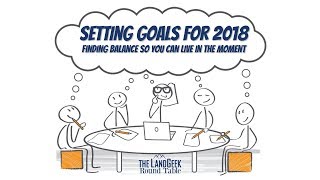
Mark J. Podolsky leads Eric Peterson, Aaron, Mike Zaino, and Scott Todd in a roundtable on setting 2018 goals. They discuss the 12-week year system and how to chase ambitious targets without missing what's happening now.
Chapters
Hey, it's Mark Podolski, the Land Geek with your favorite niche real estate website, www.thelandgeek.com and today's roundtable podcast post Christmas, by the way. So Merry Christmas, everybody. We've got the unbelievably calm, serene Eric, no nickname, Paris Peterson. Eric, how are you?
I'm good. Merry Christmas. It's good to be back.
Yeah, yeah, it's, it's great. It's great. We've got the Bearland Aaron joining us again. Another treat. Bearland Aaron, how are you?
Doing well. Merry Christmas to everyone.
Merry Christmas. The Zen master. Breathe in the mailing, breathe out the marketing. Mike Zaino. Mike, what's good, man?
Everything. Everything's good.
And then last but not least, Six Sigma Scott Todd from scotttod.net landmodo.com and most importantly, if you're not automating your Craigslist and your Facebook postings, posting domination.com forward/the land geek Scott Todd. How are you, Mark?
I'm great.
How are you? I'm great. You know, I'm, I'm excited for 2018.
Because it's now like 2018 is here now.
It's coming, but the new tax laws are here. So if you don't have a company and you can't take advantage if you're, if you're W2 right now, you're not seeing any of these tax benefits. So you've got to get your side hustle on which you know. And then, Scott, you got that accounting course coming out.
Yeah, and I was actually. Thanks for leading into my tip of the day, man. January 20th, the 2018 edition for our 2018 update for the accounting for land investors. It's updated for 2018. Some old stuff from 2017, some new stuff for 2018. And you can learn more about that@scotttodd.net accounting I'm excited.
I'm excited about that. So we're going to talk about this episode as we wrap up 2017. Goal setting for 2018. So, Eric, why don't we start with you? How do you set your goals for the year?
Well, I guess, you know, I try and operate on the 12 week year system. So every quarter is essentially a year, but looking at 2018 as a whole as well. You know, I kind of look at both of those aspects when I'm considering my goals and kind of ramping up through the year.
Okay. Okay. Barelyn. Aaron, how about you?
Well, we also use the 12 week year system. I'm kind of somebody who is not very good at systems like that my wife barely and Melissa is much better at it. But each, you know, each period I try it again and even if we don't get through a program like that, it helps tremendously to have a roadmap because it definitely keeps you on track to an extent. So I mean, I think a lot of times we can get into an issue of trying to do too much, too many goals. So going into 2018, I've just kind of decided that I'm going to make sure that I get this completed and I am just doing one main goal so I don't get myself distracted by, you know, other goals and that sort of thing. So we are like getting one main goal that we're going to go full force on and make sure it happens for 28. Well actually like Eric said, for the first quarter of 2018, so.
So really it's four big goals for the year.
It is four big goals for the year.
So broken down into quarters.
I like broken down into quarters using the 12 week year system.
Yeah, right. Mike, what about you?
Well, I think similar, I think we, you know, we all love these 12 week year, the micro goals. We have a macro goal. I think we had some kind of front loaded at the end of this year. We did. I think I've told you about 4,000 mailings. So we have a ton of properties coming in right now which is setting the stage for this coming year. So we met with our team of people that which I think we've. One thing that we did really well in 2017 as we closed down look back is really employed some good people, some part of our team and we're really ready to move forward in 2018. So to get ready for that we've, you know, we've had some kind of end of the year brief meetings and just talked about the goals. But it's good to have that macro goal for the year but also those micro processes that are going to make it happen. So that's extremely important and I think that, you know, just really we're excited to get kicking off but you know, in terms of the goals. Yeah, I mean I think that's where we're just hitting upon the key topics. You know, you've got to have a macro goal for what you want to do for the year, but you need to bring break it down into micro components and then enjoy the process step by step. This is something that is going to have it moment to moment. So enjoy that process. What we're doing, we're getting ready to really enjoy the Process of a new year with a whole bunch of new properties, our inventory is going to be jacked. It's going to be really fun.
I love it. I love it. Scott, Todd, how about you?
I reverse engineer everything. So I start off with the big goal of what I want to do in the year and I start backing back down into it. So for example, if I wanted to make a certain number of sales in the year, I know I have to buy like that many properties or more. So then I just start doing my math backwards if I'm gonna. Well, let's see. In 2017, at last count, we sold 225 properties this year. So if I'm gonna do that again in 2018, I know I need to start buying X number of properties per month. And in order to do that, I have to mail a certain amount. And so you just start backing into it to, to achieve the goals that you want. It could be sales, it can be passive income. Maybe you want to have $10,000 a month in passive income by the end of the year.
Great.
Divide by, divide by 52. You know how many sales you need to have and you know how many properties you need to buy. So start buying them, start mailing.
I love it. I love it. How many of you get, you know, your, your spouses involved with your goal setting? Is it, is it a solitary activity? Is it a team activity? Eric, do you, is it, is it you or do you get everyone involved?
No, it's, it's pretty much just me. My wife, I don't get her too involved in the business. It's not really her expertise. So, you know, I tell her what's going on and how things are progressing, but she doesn't get real involved in the, in the day to day or even the goal setting. So. So yeah, that's kind of how we work.
Yeah, I'm kind of the same way. And then my wife asked me questions like, why don't we do this together? Be fun. Bear line. Aaron, how about you?
Well, I would say for us it's definitely a combination of both for a couple reasons. One is obviously we're, you know, two individual people. We have some individual goals and that's a personal thing. We're both co owners in Bear Land, so we have some mutual goals that we talk about and set as far as that go. But also within the business, we are segmented. You know, she does a certain part of it, I do another part of it. So we would have some business goals that are also individual goals for the business. Because of our respective parts. So that's kind of how that would work.
Okay. Mike, how about you?
Well, in terms of what we just discussed for the goals of next year, that was not involved in Laura, but I think I've been pretty vocal. She's built her own business model, which I thought was better, so it's completely all her. And so she has her own goals. She's sold several properties already. She's buying a bunch more. So it's really. She's having a great time with her own goal setting in her own area. So as far as what's going on with what I just mentioned earlier, with meeting with our team, that's completely separate. I just. I found it. It is. You know, I found it better to kind of set her on her own because it's such an empowering business to build this model from basically. Essentially nothing. Right? You build something from nothing and all this. And all this. She's such a great process. So, no, she's not involved in my goal setting per se, but she's getting involved in her own, and so that's going well.
All right, great. Great Scott. How about you?
No, not really.
I kind of just make. Make the goals and go to it, and I run the business. So off it is when you guys.
Are setting your goals. Like, I know for me, like, when I have to do, like, several drafts of goals, because sometimes I'll think, oh, I want to, like, you know, I got, like, Grant Cardone on one shoulder, and then I've got, like, Leo Babuda on the other shoulder who's like, you know, keep it very simple. Like, don't even set goals. Right? Like, just live in the moment. And, like. And then I've got Grant Cardone kind of like 10 exit, right? And so, like, I'm like. I have, like, this internal conflict of the goals aren't high enough or, you know, just do my best, right? Don't stress out about it. Goals aren't high enough. Just do my best. Don't stress out. Because it kind of takes the joy out of it in a way. So what makes, like, for me, it's like. It's almost like this feeling of, okay, once I write it down, it feels. It doesn't feel too unrealistic, but it doesn't. It's also exciting. Like, even if I don't hit it, if I get half there, I'm pretty excited about it in a way. So it's like, will it kind of keep me excited and motivated? It has to be big enough to do that. But it also has to be not to the point where, like, I'm gonna beat myself up if I don't hit it. You know what I mean? I mean, Eric, do you have the same kind of conflict with the actual, like, okay, what is my goal going to be? And how do I write this down and, like, commit to it?
Yeah, I do. I mean, I think for me, oftentimes when I'm setting goals, I tend to probably not set them big enough. You know, I. I guess I kind of. It's not that I feel like I can accomplish it, but a lot of times it's just like, you know, you start to think about numbers and different goals along the way, and it's easy to look at, you know, say 10xing or 5x or 3x or, you know, whatever you want to do it. To look at that and say, man, that's just so much bigger than I did this last year. Like, is it really possible for me to do? Um, so I certainly have an aspect of that. Um, and I try to find a kind of healthy balance in there that. That seems like it's going to take some serious work to achieve. However, it doesn't seem so big that it just is impractical and doesn't feel possible. So I try to find that balance.
Yeah, I like it. How about you, Bearland? Aaron?
Kind of there's this duality of accomplishing being able to accomplish the goal and having it challenging enough and yet having it, you know, big enough to be significant. So you do get that energy and that excitement over accomplishing your goals. I kind of think it depends on where you're at in your life and so forth, because there's a lot of people that have that syndrome of keeping what they want to accomplish in their head and not writing it down. So. And we know from books and, you know, a lot of people that when you do that, you often won't accomplish it because I guess it's a dream and not a goal. So I think the most important thing is, you know, writing it down, getting it into a place that you can review it often, whatever that means to you. But if you're maybe newer to setting goals, you don't need to 10x it. Make it something that you can accomplish with some effort that is more than just, you know, a day's worth of doing something. You know, make it just big enough and kind of get some momentum there, get some goals going that you can accomplish and start to get that feeling. Then you can worry about 10xing them and that sort of thing or whatever. If you're somebody that is very goal oriented, has been doing this in a lot, you know, a long time, then you kind of know where you're at. You know, if you, you know, you know, when you write down your goals, you get them out of your head. You're like, you know, you know, if it's going to be a challenge or if you need to make it bigger, that sort of thing. So it kind of depends on where you're at in your station in life, I think, on what goals and how you need to approach that. But I think the key, absolute key to it is getting them written down where you can review them in whatever way that works best for you. Because otherwise they're not a goal, they're a dream.
I like it. How about you, Mike?
Yeah, I think goal setting is interesting. I mean, what's like a million dollar, billion dollar. It's a huge industry, right? People talking about this. But I think it's important to realize a couple of things. One, that it's like cause and effect, right? So it's not so much about making up these lofty, you know, the way we want things to be. Realizing that if you do this, if you mail this, then this will happen, right? This many mailings, it's just a cause and effect process. If you just do something, then something else is going to happen. In fact, by doing nothing, you're still creating something, right? So you just have to take the correct. I think it can be a little bit almost scary with this business in the sense of how big it can get and how good it can be, because. And that can kind of. I know for me, it's like all of a sudden things start happening and you realize you're on track to do something like bigger than you thought maybe initially possible. And it can be a little overwhelming on the good side, I guess, right? To realize how big this business truly can be and how simple it can be as well. Once you employ like the delegation and the automation and the software, it's pretty scary. But I final thing, it's like what you were saying, Mark, and I do agree with that. It's like this whole idea of setting this goal but then living in the now, right? So it's like, oh, no, I don't want to do that. My mind always. And I liken it to the fact when I go out to eat, I walk into a restaurant, I always immediately scan the area, I sit down, so I face the door, all these things. And if I were to talk to someone which I had, they're like, well, you're paranoid. Well, I'm not. Because what I do is, I do that and then I sit down and enjoy my meal and I forget about it. Because if something were to happen, I already have it all preplanned out. So I think goal setting, the same way you make this huge goal set for yourself that you're going to accomplish, but then you live in the now, you know, it's there and you readjust it. You know, you go into a new environment, you readjust it. But you, you know, so kind of. I can kind of agree with what you said. You know, you need to be present in the moment to make this all enjoyable and to make it happen, but you need to have that larger vision as well.
Right?
Right.
How about you, Scott?
You know, Mark, I think that one of the things that people kind of confuse when it comes to kind of goal setting is that you don't have to do it all yourself either. Right. Like a CEO of a company, when they plan their 2018, they're not saying that, well, I'm going to achieve, you know, Jeff Bezos, for example, isn't saying, I'm going to achieve this. You know, me personally, he's building, he's got a team, he's kind of got that vision going. So for like an errand, for example, you know, where he was saying that, you know, man, I've got my notes, I got, I've got it written down. You know, that's great to have it written down, but essentially you, I think you have to kind of come. Come at it from the perspective of a business owner. You know, write down the business plan. What is the goals for the year? I like to write them down. And then who's going to do the work? Because I can tell you it's probably not going to be me. You know, like, man, I want to do what you're saying. Like, just live in the moment. Like, did we achieve the goal? You know, let me check. At the end of the year, did we achieve the goal? Why not? What happened? Of course you can't do that. You got to check in more frequently. But, man, don't, don't, don't conceptualize this as like, okay, I'm gonna put it in paper. It means I have to do it.
I like that. And I really like my, my compass worksheet sort of methodology where, you know, I have it right next to me and I've got my, you know, my word goal for the year. And then I, you know, I put it on the week and then I've got my most important goals and it's usually like five or six and these are like the big, big goals for that quarter. But then I've got the weekly most important tasks and usually that's like five or six things for the week and just, you know, that's what's going to move the needle. And then I've got the 10x goals that kind of like really get me excited, right? So I kind of have it all right there. I can look at it and, you know, it kind of gets the heart pumping a little bit. You're excited, it's, it's concrete. And then it also allows me to kind of just not ever waste a moment with decision fatigue. Because if I have, if I'm looking at my calendar and I've got a break and I think to myself, what should I do right now? I can just go to my compass worksheet and it's just like, oh, that's what I need to get done. And it's just, it's just right there. So it really helps that for me as well. Well, guys, that, that was fast. Podcast. Let's just get to the tips, shall we? What a way to end 2017. And of course, the tip of the week. A website, a resource, a book, something actionable for the art of passive income. Listeners go right now. Improve their businesses, improve their lives. And I'd be remiss if I didn't mention that today's podcast is sponsored by what will be next year, the most successful SaaS in the universe, geek pay.IO. because let's face it, it's creating so much value. The only set it and forget it system of getting paid on an automated basis. It does the amortization, it does all the notifications, it automates everything. Can always make more money. But can you get more time? Absolutely not. Sign up today. GeekPay IE get your first note for free. All right, Bear, Lynn, Aaron, we're going to start with you. Your final tip of the week for 2017. What do you got?
I'm going to hit you with another bear themed tip. This one's called bear writer.com and what it is, it's a notes type application. It's for iPhone, iPad and Mac. And it kind of expands quite a bit on what Apple's done as far as, you know, the little notes program. And I know we have plenty of notes programs that we use in the business. Like Evernote is great. And this isn't really, this isn't something to replace that, but it's kind of that, you know, top of mind. I want to jot something real quick in my phone so I don't forget it with some. With links and, you know, some good searchability and that sort of thing. Not that it's a product that is necessarily so different than everything else, but it's pretty elegant and it's free. They do have a pro version that's actually pretty darn cheap, too, but it was pretty nice. I'm. I'm testing it out right now. Thought I'd share it. It's called Bear Writer dot com.
Are you sure? So that just bear, well, beautiful notes and prose.
Yeah, that's it. Bear.
Bear. It looks nice. You know who would like this is Eric Peterson.
Yeah, because it's got an advanced markup editor with programming language. Not that he's a programmer, but I see that. Yeah.
No, because he like, he likes design, and this is like, well designed. Cool. All right. That's a. That's a great tip, Eric Peterson. Your final tip for 2017, which means it's the last time that we get to try to throw you off your game.
Oh, man.
At least for the year. If you got 2018 to look forward.
To.
That'S a lot more tips I got to think about. But today's tip is going to be a Mac app called Daisy Disc. I will put the URL in the chat here. There's a free trial. It's $10 to buy. I think you can get it in the App Store, but basically it's just a tool that analyzes your hard disk, looks at all your files, shows you where you know you're using a lot of space. This is particularly useful if you're running out of hard drive space. You can run this app and it'll show you your largest files. You can drag some to. To the trash to throw them away. And, you know, it, it offers all that functionality there for kind of cleaning up your drive. It's got a nice visual interface and that's it.
Now, do you like this better than Clean My Mac?
I don't know Clean My Mac, but.
I don't know.
I know Hazel, for example, you know, you can automate some stuff with that, and that's, that's good for certain as well. This is more like, you know, you're in a crunch. You're. You're running out of space on your hard disk and you just need to clean some stuff off. This is a quick way to define maybe what's taking the largest amount of space on your drive and start to delete some of that.
Okay, so check out Clean my Mac, Eric, because that's what I'm using and see if you like it as much or. I don't even know how much I paid for Clean my Mac. This might be less money. Oh, clean my. Where is it?
I'm looking at it here. It's cleanmymac.com yeah.
But good tip, good tip. I mean, pretty safe, pretty basic, but you know, it's okay.
What can you say?
I mean, you just said it.
You know, it's like Scott Todd recommending Panera bread for lunch. You know, it'll feed you.
Hey, Eric, don't feel bad. I actually had a similar one that I was keeping in my pocket for down the road.
So.
I guess it's good that you brought it up first.
Zen master Mike Zana. What's your tip of the week?
My final tip of the week.
Final tip of the year. Wow.
Well, it's got to be something my kung fu teacher told me. This is one time he told me the problem is your brain. And at first I never understood what he meant by that until basically I would have a hard time learning certain concepts, techniques. And he kept saying, the problem is your brain. The reality is, it's true. We have a tendency to overthink things, right? We take things and make them too complicated. And the same thing happens with this business. We have the five plates, as Scott calls them. This business model is fairly simple once you wrap your head around it and the automation and whatnot. So I guess just to realize that, don't overthink it. You know, you have to do so many mailings like Scott said. You can reverse engineer the process, do that, keep it simple and don't over complicate things. The business model can be simple and efficient if you make it that way. So the problem is your brain.
All right. Love it. I love it. Scott Todd, final tip of the year.
Mark, do you know about Ryan?
Oh, yeah, I do know about Ryan. He was on Saturday Night live.
Ryan, the six year old Ryan who makes 11 or who made $11 million on YouTube playing with his toys. Okay, he didn't really make $11 million. His parents made $11 million. You know, but here's Ryan. He's out there and basically something as simple as we would all love to do, which is just play with our toys. Ryan. Ryan has amassed just a huge following. Kids from all over the planet, like, have become friends with Ryan through YouTube. And I just want to show like as you start to think about 2018. As you start thinking about your goals for 2018, just think like, it doesn't have to be complex. And Mark, you say all the time like land is a simple business model. Doesn't make that it's simple, but it's a simple model. It's not complex. And I think sometimes when we're trying to get out of our nine to five jobs, when we're trying to get the freedom that we want, we think that things have to be complex because. Well, because as humans, we want it to be complex so that it justifies our time. Lean into 2018. Just do something simple, commit to it, have fun with it. And who knows, man, you could, you could have an $11 million cash flow coming to you simply by playing with your toys.
Yeah, I love it. I love it. My final tip of the year is going to be here's a way to actually set goals, right? Because sometimes we get stuck like, well, what's a good, how do we even do this? So it's a little, it's a Little site. Stunning. Motivation.com 11-effective goal setting or goal setting templates for you. Goal setting templates. Right. Good. Eric Peterson.
I'm looking at it now.
All right, So I do want to remind everybody that if you do want more passive income and you do want to let freedom ring for 2018, you know, incorporate. Don't just take the knowledge, right, that we're kind of giving every week. Execute, execute, execute. As Scott Todd loves to say at boot camp, move your feet, move your feet. You should be moving, right? You should be doing something every single day. Kaizen. Continual improvement. And if you're not, let us help you go to thelandgeek.com training and we can really sort of help get you motivated for 2018. Get a plan set up for you, whether it's with the toolkit, flight school, or even one on one coaching, right? So this is the year because let's face it, like, even if you just get $1,000 a month for the rest of your life in passive income, that's it. That'll move the needle, right? And that would be a huge ROI on any type of training that you go with. And that's really, really low, by the way. So that's going to be my tip of the week is commit to taking massive action for 2018 in a way that actually supports your major. Why? In life, your purpose in life, right? We're not meant to wake up at 9 and go get back, get off of work at 5. Spend a couple hours, you know, eating, and then, you know, zone out on Netflix like a zombie and go to bed. Right? There's a lot more to life. And to find out what all those things that life has to offer, you have to have time to think about it, to experience it. And unfortunately for most people, they're caught in this trap and this vicious circle, if you will, of. Of, you know, money, money, money, and then somehow I'm gonna, you know, be able to do what I want in life and just doesn't happen. So this is your way for 2018. Set a plan to have your passive income exceed your fixed expenses and work because you want to, not because you have to. I want to wish everyone a happy, healthy New Year. I want to thank everyone for supporting the lanke community for 2017. We've got lots of great things in the queue for 2018, and you guys ready to do this? Let's go, Mark. One, two, three. Let free. Thanks, everybody.
More from Mark





How to find funding partners: How to Scale Land Without Using Your Own Capital


