ROUND TABLE—Success Takes Time—Getting Rid Of Artificial Deadlines
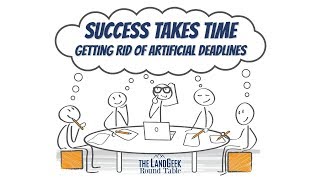
Mark Podolsky and six real-estate investors discuss why artificial deadlines sabotage business growth. Replacing your income takes months to years, not weeks. They share daily rituals and accountability systems that actually work.
Chapters
Hey, it's Mark Podolski, the Land Geek, with your favorite niche real estate website, www.thelandgeek.com. and on this week's roundtable, we're trying a new thing. We're going live in the official Land Geek group just for a little bit, but we've got some feedback, and people want the pretentious hard stop at 30 minutes, just like Tate says, hey, look, I got a hard stop. So if you don't know what that is. Anyways, so we're not going to go around and introduce everybody. I'll just do a quick introduction as we go around, and let's just kind of get into it, because we don't have a lot of time. So today's topic is an interesting topic. Scott Todd, you want to talk about it?
Yeah. Basically, it's about time to succeed. You know, I think that a lot of people kind of look at people who are having success and they hear it.
They.
They hear the model, they hear all about it, and they think, oh, this is easy. I got this. It's almost like one of my favorite Reddit subreddits is Hold My Beer. I got this. And it's almost like, here, I got this. I'll be right back. Let me go earn $10,000 a month passive income. I'll be right back to you. And the reality is that you're starting a business. This is no different than starting a major endeavor. It takes a lot of work. It takes a lot of work to. To get the mailings out, to build the systems, to get the marketing going, to get the sales going. It's a lot of work to build a company. It's not just like, hey, I'm going to go buy. I'm going to give some of my money, and they're going to manage it for me, and then they're going to send me a check through passive income every single month. It's literally, you're building a business. I think a lot of people kind of get disconnected with that, with that fact, because it's hard to build a business. And so let's talk about, like, some of the struggles of that we've all encountered in building that business, because it's not just like, here, I'm gonna throw some money in, it's gonna come back out at 10,000amonth.
Right, Right. I mean, it's so true. I've got my own sort of take on it, but I'd love to hear what the. I love it when you call me Big Papa. Tate Litchfield has To say, Tate, you.
Know, this is a great topic. It's something we could spend multiple roundtables talking about. But one of the biggest issues that I see people have is, you know, they buy these properties and they think, okay, time to sell it. And when it doesn't sell immediately or within the first two days, two weeks, they get really frustrated and they get depressed and they start to think the system doesn't work. And it's, you know, Mark's out there getting all the deals and there's. Scott's not leaving anything left for anyone else. But the reality is there is a lot that goes into moving property and a lot that people don't recognize. So by putting these artificial deadlines on yourself to make X amount of money in X amount of time, you really, you start the countdown clock before you're ready. Like Scott just said, hours and hours and hours go into building this. And Scott and I were talking last week and we were actually talking about this topic, and Scott, you know, replaced his income in 17 months and three days or something like that. And most people assume, oh, he did it working a couple hours here and there. And the reality is Scott was burning the midnight oil, right? He was up all hours of the night. He was working on his automation, he was working on his systems. He was doing so much more than most people even have an idea of. And that's what it takes to build a successful business. Right. It's not something that happens overnight. The fact that he did it in 17 months, maybe that's an anomaly. But the reality is he worked really, really hard and spent a lot of time working on every part of his business to get it to where it is today.
Right? Right. Yeah, absolutely. Absolutely. And, you know, not that, you know, you know, comparison is the thief of happiness. So when you say 17 months in three days, it took me 18 months. So he beat me.
He did beat you.
I don't have to think about it, but even if it was, like, not even close, right? I'm still working when I want, where I want and with whom I want. And if that's the goal, then who cares how long it takes? If we take the conventional wisdom, you go to a financial planner, say, hey, look, I want to work when I want, where I want, with whom I want, and I'm going to need this much money to essentially. Because what you're saying is I'm going to retire, right? If you want to hit that goal. And they say, okay, well, look, how much money do you need? And for a lot of people it's like, you know, millions of dollars. Well, you got to start saving to do that, and then there's no guarantee. Now you got to invest. Right. I mean, it's. It could take 20 years. Right? So in this business, it doesn't take 20 years. I think a really good example of this, we're gonna get the bare line, Aaron. But let's just skip to the terrorist hunter, Mimi Schmidt. And Mimi, kind of tell your story.
Well, I think the first time I talked to you, you told me to replace your nut. It's gonna take you three years. And I thought, oh, no, no, no, I'm really good with data. I'm gonna be able to get this done super fast, just like you guys said. And I don't really even feel like I'm there yet. I think it's a three year point. I'll really feel like I've gotten where originally I thought I would be. Right. I'm still on the journey. But it does, it takes time. I see so many folks that we go to our boot camps with, they. I love the saying they put a period on it instead of a semicolon. We don't get frustrated and give up. Put the three years into it. You were right, Mark.
Right, Right. Yeah. So, I mean, but even if it took, let's say, five years, Right. So what now? The rest of your life? How long's your commute?
It's a lot better than it used to be. My commute now? Yeah, it's nothing. Oh, my gosh, it's so, so worthwhile. So worth. I remember how burnt out I would get. Oh, gosh, I was just fumbling around. I was so tired. I was so burnt out. Working all day, commuting and coming home and working on the business at night. But it pays off in the long run if you just have patience, if you just keep going at it.
Right. But what if you said, like, hey, you know, it should only take me 24 months? You would have quit. You create this artificial thing in your head and say, oh, well, you know, took Scott 17 months in three days. Mark, 18 months. I'll give myself 24 months. Right. I got a bigger, more important job than both of them. So 24 months seems reasonable. Right. And then it doesn't happen. So it's just in your head. I'd love to hear Bareland Aaron's take on this.
Well, you know, we go through this a lot, Bear land. Melissa and I, we've talked about it. And sometimes, you know, you really do feel like you should maybe be further ahead than you are. But there's, you know, also some things that you can't control, like the people that you deal with. And what I mean by that is, you know, some time ago we had a good portion of our note portfolio go away between, you know, we had some nice new ones that decided for various reasons that they wanted to exercise their 90 day money back guarantee and they fell off. And at the exact same time, you know, we had some regular churn of just people defaulting and you know, our note full portfolio got a pretty big setback, you know, so you know, you can get frustrated in that and you think, well, we were, you know, to this point, so it was looking okay. Then all of a sudden we're, you know, we're back, you know, some amount of time in where we were and now we gotta rebuild that. And those things happen in business, you know, they tell you that a lot. When you start a business, you shouldn't even expect to be profitable. This is a lot of other businesses, not so much ours. But you know, in three to, three to five years is when you, you know, you should expect to be fully profitable. You know, so you need to plan for your living according to that when you start a business. So, you know, our business is a little nicer because you can, you can achieve some things faster than some normal like brick and mortar kind of service businesses, that sort of thing.
But.
But yeah, you can't control some things. So you know that artificial time horizon like Mark said, if you to put 24 months on it, like if Mimi would have, then it's game over. Right? Well, that's artificial. You just, if, if you know it will work and you see the path to make it work, if that path winds a little bit and it takes you a little bit longer, then okay, because you know, you're, you need to be looking at a long term goal, 10 years down the road of where you want to be. And it might not happen in 18 months, it might happen in two years, three years, five years. But you know, isn't that still better than working for the man for the next 10 years?
Right, right. It always surprises me and maybe it's just my own sort of, you know, way to be self deprecating, but I always think to myself, like when someone says, hey, I closed a deal and now I proved myself, this actually works. I'm like, really like, look at me, I've been doing this, like I'm no genius, right? Like I can do it. Isn't that proof enough? Like you know, maybe Scott is a genius, but, you know, let's just pick on, you know, Eric. Right? Bright guy, but come on, you know, be careful.
Mother's listening.
And I'd like to now formally apologize to Mrs. Peterson again for making a very rude joke about Eric. But. But, you know, it's not funny. But in. But all seriousness, like, it's just interesting to me, like, if, you know, one person can do it, why can't you do it? And I think that was Scott Todd's attitude going in was he's like, well, this guy can do it. These people can do it. Like, there's enough evidence out there that the model works. And it always surprised me, like, well, you know, maybe it works for them, but won't work for me. Like, really won't work for you. Like, you know why? Like, of course it works. You just. Is it easy? No. But what is. So let's just skip over to Jeanne, because she is a current coaching client and she is living through the pain right now. So, Jeanne.
Yes. I love this topic. Just like Tate said. You know what I've learned this last year is when you get to a new level, you're dealing with a new devil. And what I mean by that is, I'm reading this really good book. I don't know if you guys have read it, but it's. You're a badass, and it's amazing. I was on the airplane a couple days ago, and the flight attendant said, that's an amazing book. I'm only halfway through, but it talks about when you're starting something new, that you're going to get attacked. And that could be physically, mentally, emotionally, and financially. I think I got them all this last year. And then after reading the book or getting partway through, I'm realizing, hey, I'm doing something exciting. Because when you got this much stuff coming at you, you're doing something really powerful. And that's how I view it. And it does work. You just keep chugging along and you just keep doing the best you can. And. And it happens.
Yeah, yeah. You know, Sandy Marrera loves that book. She was telling us about that book, and then she's like, I'm reading the financial badass book. So she's got two of them, and in the mindset I think is great. So, yeah, I think what you said is really important. Like, it's almost like the only way to really fail at anything is just to quit.
I totally agree. Because after everything I've been through this last year, I'm like, you Know what? I'm overcoming everything. And it's like, you just got to get back up the next day. You just keep getting back up, and you keep getting back up. Whatever's out there in the universe is going to leave you alone because you just keep getting back up again.
Yeah. I mean, even. Even for me, with Geek Pay, there's been so many times I'm like, this is not fun. I want to quit. Right. And. And, you know, I'm paying the developers and I'm paying here, paying there. It's just like expenses out, no revenue in. And I kind of just took my own advice, like, you know, why don't I just give this three years? If it's not profitable in three years, I can't make this thing work in three years. Then I can really take a hard, cold, hard look at it from a business perspective. But after a year, I'm going to quit because it's hard. Like, that's insane. I mean, so I didn't. And now Geek Pays, doing just fine. I mean, you know, it's. It might not be profitable yet, but it will be probably in another year. So, you know, I feel it just like everyone else. Maybe not in land, but in other parts of my life. So, yeah, I mean, you know, Mr. Wonderful kind of talks about this on Shark Tank. Give yourself three years, and then if you're not profitable, maybe it really isn't for you. Right. I think that's fair. What do you think, Eric Peterson?
So, I mean, I think that first of all, you know, setting goals for yourself and your progress is important, but when you miss those goals for whatever reason, you know, I mean, looking back and maybe trying to determine what happened, useful. But I mean, it really just comes down to persistence. Right. I mean, you just have to keep working at it, and if you are willing to do that, you're gonna get there eventually. It may not be as fast as Scott did or, you know, somebody else, but if you follow the recipe, if you just keep plugging away at it, you're gonna have some progress over time. It just may not be, you know, quite as easy as you may have anticipated it to be, because obviously there's a lot of steps and there's a lot of things to do along the way.
Yeah, yeah. I mean, I would almost make the argument that if it's. If you're getting, you know, a lot of success right at the beginning, you're probably not going to appreciate the success. Right. That money is going to come in, it's going to go out just as easily as it came in. It's almost like the universe wants you to, to really pay your dues at anything in life before you can, you know, really kind of get there. And if it comes too easy, it's like, you know, then there's something wrong, it's not sustainable, or you won't appreciate it. You're more likely to, like, sabotage your own success because it came too easy. It's like, it's an interesting dynamic. Scott. Todd, what's your thoughts?
No, I think the same way. I think that, Mark, one of the things that you talk about at boot camp is in, you know, Randy Pausch talked about the walls. The universe puts walls out there, right, to see who will overcome them. And look, the universe, in my opinion, the universe puts up a lot of, a lot of fight. Jeanne just talked about it from the book. There's been times in my journey where I went like a whole month without a sale and then powered through. It just kept showing up. And I always like to say, like, only focus on the things that you can control. If you can't control things, like, you can't control who's going to accept your offer. You can't control when they're going to mail it back. You can't control whether they actually going to sell you the land or not. You can't control if someone's going to buy the property. But you can sure as heck put yourself in good situations by mailing and marketing so that you, you stand a chance of winning as opposed to not doing anything. So focus on things that you can control. And eventually the universe will be like, let him go because he's on a mission and he passed. He overcame the wall. But there's always going to be that thing because you're going to get hit by another wall eventually. It's just a matter of time. And then it's just like, okay, did he overcome it? Did he learn his lesson last time? No, he did.
Great.
Let's let them keep moving forward.
Yeah, yeah. There's. There's a great book by Carol Dweck called Growth Mindset. Has anybody read this book on the roundtable? Scott, you've read it? No. So Carol Dweck is a Harvard, I think she's Harvard psychologist. She got this, you know, these famous studies about, you know, children. And so the children have either a fixed mindset, right, where they say, hey, I'm not good at math, and no matter what I do, I'm not gonna be good at math versus kids that have a growth mindset. Say, you know, I'm not good at linear equations, and as a result, I need to work harder and longer and more focused on linear equations, and eventually I'll get better at solving linear equations versus the child that just says, hey, I'm bad at math. Right? And that's a fixed mindset. And so this applies to every area in our life where we say, oh, I'm just not good at this, right? Well, no, it's not that you're not good at it. That's a fixed mindset. It's actually, you've got to get really micro with it. I'm not comfortable with calling up a stranger and telling them that the property costs this much and asking them, how much do you put down? As a result, I need to call my coach and practice doing that until I'm comfortable with it. That's a growth mindset, knowing that eventually I'll get better at it versus that fixed mindset that just says, hey, I'm not good at sales. Right? And so it's really an interesting book, and it applies to everywhere in life, really. You see, the kids that have a growth mindset, they work like, 10 times harder than the kids with a fixed mindset on any problem that they have, right? Whether it's a musical instrument, whether it's a sport, whether it's something that they're struggling with in school because they know, like, oh, I just need to work harder at. They have a growth mindset. And what's interesting is that when you tell somebody you're really smart or you're really talented, you're really strong, they want to keep that identity. And as a result, when they do struggle with something, they're less resilient because now their identity is getting messed with. Oh, now they're seeing something, oh, I'm not smart at this. And so they're saying, well, this. That can't be right. My parents been telling me, I'm so smart now, I'm not, that this isn't coming easily to me. And so they quit more easily because they don't want to do that. Tate Litchfield. I kind of talked a lot there. What are your thoughts?
I like it. I think it's 100% true. I mean, you know, you're gonna get success if that's what you're after and that's what you're willing to work for. I think it takes a lot of work. And people who put these artificial deadlines on themselves are setting them up, setting themselves up for failure in a certain sense. I mean, don't get me wrong. Goals are important. Your goals should be hard. You shouldn't always reach them, but they should be goals that motivate you to do better, to be better, to work harder. Right. I rarely meet my goals, but I set them to be higher than what I probably am comfortable achieving on purpose. So I don't know, for anybody who's out there just, you know, struggling along, know that we've all been there and that we're still all there in different. Different points or different parts of our business and keep on keeping on. There is a light at the end of the tunnel.
Yeah, absolutely. Mimi, what's. What would be your advice with one of your coaching clients saying, hey, I'm just not good at marketing.
Practice. Practice. I mean, my very first sale where I sold three properties, I had a script that I had practiced. And I mean, that script, I only used it one time. The feel felt found. Right. But I had to get comfortable with it. And I used to. I'm kind of an introvert, and now I love calling people and talking to them. So you just have to push yourself outside your comfort zone, and then it'll become your comfort zone. Just have to practice.
Yeah, absolutely. Beryl and Erin, how about for you? How do you kind of, you know, step back and sort of re. Energize yourself when. When the inevitable tough times happen?
It's tough sometimes, but you. It's kind of that thing you talked about even last week with free throws, you know, or, you know, if you're not hit, you know, you're not scoring, you know, you need to then go work on free throws until you break the slump or whatever like that, you know, and it's just a matter of pushing through, get people around you that are encouraging. You know, I love being on this call with you guys because, you know, if I'm going through a bad spot, I get to hang out with my friends that are doing the land business, and I get re. Energized, so that's helpful, too. So sometimes my wife and I'll have meetings and we'll discuss how to get to a certain point, and when you're done, you're kind of excited and energized, and it can propel. So those are some ways that we look at it.
Yeah. Yeah. I know for me, like, if I'm having, like, a tough day or like, let's say, like, you know, two notes fall out, I'll go back and I'll read, like, Angela's Ashes, Right. Like, I need somebody who's really suffering. Like, you know, like, these are really first world problems. Oh, no. Now I gotta resell Property, make another 300 to a thousand percent, right? And do all that on an automated basis. Like, not so bad, right? I mean, you know, the big scheme of things, like, even from a business perspective, right? It's not like I lost my job, I lost a note. I didn't lose my job. Now I got to go, you know, on LinkedIn and start sending out resumes and going on interviews and, you know, dealing with rejection and all this. Like, big deal. Like, that's the worst thing. It's like, I gotta resell piece of property. Or I got a piece of property that isn't taking up any inventory. It's a piece of paper. I gotta sell it, like, wholesale to Eric. Big deal. He'll buy it. So, Jeanne, what's your take on all this?
I love it. In fact, at Nightcap Nightcap, Scott posted the Daily Rituals, and my husband and I have sat down and we've read it together, and we're starting to create daily rituals. And one thing that we started doing, instead of saying we should do this, we say we must do this. So this is what needs to be accomplished this day. And so even today, before this podcast, I said, I must put an ad out there today on ebay, because I'm really liking ebay. That's kind of my thing right now. Because I like to. Or I know, I know, I know in your book, you say the same thing, but I'll branch off.
Look, it works for you. Like, why am I. Why am I judging?
Kate's trying to get me, you know, to move on, and I need to do that. But I said to myself, I must get this posted before the podcast. So I have a lot of things that now I'm starting to say not should, but I must, because my brain operates better when I say that. So I've been getting a lot done.
Yeah, yeah, I know, I know. For me, for my daily rituals, I'd like my five streaks that I like to do. Like on that Streaks app that I think maybe it was Scott recommended or Eric. Certainly not Bearline Aaron, because it's a really good app. And see that? See that little jab?
I see that.
Yeah. And I want to personally apologize to Bearline Aaron for that jab. Uncalled for. Anyway. And then it just kind of keeps me focused. Like, okay, you know, like, one of my big things now is just meditating and not breaking that streak. So, like, I'm 227 days straight on meditating, and I'm really proud of it, and I don't want to lose that streak. So even for ads, right, to make five ads, like, you just don't go to bed until that's done. And I know now that there's so much momentum, there's no way I'm going to go a day, even on vacation. You know, my wife's like, hey, let's go do this. Like, can I just do this for 10 minutes? She's like, sure, no worries. So I get her done. Eric Peterson, how about you? How do you. How do you keep focused?
I think just kind of falling back on the systems and processes you build along the way, right? So if you're not making sales, you know, not giving up on your, you know, daily ritual of placing ads or, you know, things like that, so it's just continuing to follow through and knowing that the result will come just like Scott was talking about.
Awesome. Well, let's give Scott Todd the last word on this as far as time to success and getting rid of those artificial deadlines in your head and. And just. Let's just clear out the mental trash, the lie that we tell ourselves, right, Scott?
I would just say, look, just work your plan and reset as you need to, reset the timelines as you need to. If you want $10,000 a month of passive income, you first got to believe it's possible, and it's possible for you. And then you just have to understand it may not be on the same time horizon as everybody else. It may take you five years, it may take you a year. It all depends. But the one thing that will not change is if you give up on that goal and start all over again somewhere else, doing something else, you'll be back at zero all over again. So just keep working.
Yeah. And that reminds me, I was telling Tate before the podcast because it's so hot here. I haven't gone to my bike rides for a while, and today I got back on that bike and I'm sweaty and sore, and it was so hard to get back, and it's almost. I almost sort of equate, you know, doing this business with working out, right? And the fact that in the moment it may not be fun, but afterwards you feel great and then you get the benefits of it, right? Like, if you start working out, you won't see any benefits or, like three months, right? It's just pain, pain, pain. And all of a sudden, like, oh, my gosh, look at that. I feel better. I look better. Whatever it is. Right. But it took 90 days. And if you miss some point in that point, it's so much harder to get going again. It's the same thing with business. And you want to keep that momentum going and you almost want to embrace the suck and do that. Now. One of the things that I would say that really is helpful is accountability and having that personal trainer at the gym that you're accountable to, so you have a specific time you're going to get your workout done. They're there guiding you, making sure you got the proper form. And that leads us to our way of doing that, which is flight school. So today's podcast is sponsored by Flight School. If you want to learn more about how to go up that mountain with the guy who's going to take you up that mountain, Scott Todd, schedule, call with our team and learn more about it. Go to thelandgeek.com training, talk to Mike Zaino or Scott Bossman and learn more about flight school. Alright, well, I thought today's podcast was great and we've only got another minute left. So I would say that if you're listening to this, I hope you're getting value out of it. All I would say is as an action step, write down your goals and get rid of the artificial timelines. Because whether it happens in 18 months, 17 months and 3 days, 36 months, like Mimi, once your passive income exceeds your fixed expenses, game over. Right now you got a new problem. Like what kind of almost all of us have, which is now I'm going to do with my time. And that's a good problem to have. So are we good tat? Are we good?
I loved it.
Very good.
We good? Good one, Mimi.
Yeah.
Eric.
Yep.
Scott, all good.
Jeannie.
I like the 30 minutes. That's good.
All right. See, I'm kind of like for those of you who are older, like the McLaughlin Group, right? Like I'm like McLaughlin and Eric is like Jack Jarmond. Jack Jamond. I have to do that. All right, you're wrong. Right. Eric Peterson, what's the key to getting rid of artificial deadlines? You're wrong. And again, I would apologize, Mrs. Peterson. All right, are we doing ready to do this? One, two, three. Pretty good. All right, well, I guess no bonus talk because then we're going over our 30.
Well, they can hang up. We can keep talking though.
They can hang up though. Yeah, that's true. All right.
Jeanne, is your Facebook still deleted?
Oh, man.
Uh oh.
You know, that is accountability. Oh my gosh. Okay. When I get off, there is no, thank you, Scott.
And there's no explaining it. It's either yes or no. There's no, like, well, I was on a plane and had to. No, it's either yes or no.
Shit.
She was banning herself.
Oh, my God.
That the taste of flight school, Jeanne.
If it makes you feel any better, I am checking, like, Facebook and email like a serious drug addict. Like, it's bad.
You gotta sell those tires.
I gotta sell the tires. Been sitting in the Garage Mahal forever.
So, Mark, Mark, there's no joy. Comes from Facebook, man. Read a book.
Like, put it on.
Like, the only reason you're doing is because you're bored.
Right?
So go. Go open up the Kindle app instead. I almost fell for the. I almost fell for the Tate Litchfield trick. The other day, he sent. He sent a link to Florida, man, Reddit.
It was good one, though.
Almost clicked on it, and I'm like, a headline tells me all I need to know. It was a great one, though.
I did the same thing, Scott. I didn't expect you to read it.
But it was good.
A Florida man died trying to microwave a microwave.
Scott.
Those are your people.
I mean, I'm just saying.
That's relevant news.
Hey, you never hear about that in Amish country.
Don't have electricity.
My own subreddit. People who can't handle Vegas.
Oh, my God, Send it my way.
I'd love it.
Right? Hey, are you. Are you guys. Welcome to Orlando, by the way.
Yes.
Far for you, But, Mimi, that's like. You can walk to Orlando.
Yes.
So you're gonna be there? Bear line. Aaron, are you gonna be there?
I'm planning on it.
All right. I know Eric's gonna be there.
Yep.
It's worth going to Orlando just to pat Eric on the back and say, we're in your team, Eric. Like, we got your back, man. Mark can be so cruel. All right, well, I'm gonna go have a delightful lunch with. With the Mrs. And. Yeah. See everybody later. Thanks, everybody.
See you.
More from Mark





How to find funding partners: How to Scale Land Without Using Your Own Capital


