Setting Your Land Investing Business Goals
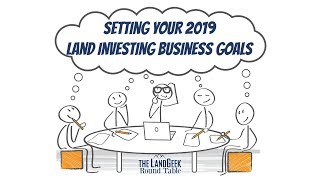
Roundtable podcast led by Mark J. Podolsky (The Land Geek) recorded Dec 19, 2018, with Mimi Schmidt, Eric Peterson, Mike Zaino, Aaron Williams, Tate Litchfield and Scott Todd. The group discusses how they plan and prepare their land-investing businesses for 2019: reflecting on the past year, setting attainable-but-ambitious goals (10x vs realistic), quarterly/12-week goal models, hedging marketing roles, and tracking KPIs (mailings, ads, leads-to-sales ratios). Practical recommendations include reverse-engineering passive-income targets, focusing on daily/weekly leading metrics (mail volume, ads posted, leads generated), cross-training marketing roles, and using visual KPI dashboards. Announcements: a San Antonio bootcamp in January and promoted Flight School/training; Scott Todd reports ~250–275 deals year-to-date.
Questions this video answers
January 10th or 13th (bootcamp dates announced).
landgeek.combootcamp (as read in transcript).
Over 250 deals so far, likely close to 275 (Scott Todd estimate).
Chapters
Hey, it's Mark Podolski, the Land Geek. Their favorite niche real estate website, www.thelandgeek.com. and on this week's Roundtable podcast, we've got the usual suspects. We've got the most dangerous woman in the world, Mimi the Terrace Schmidt. Mimi, how are you?
Great. You?
Great, great. We've got Eric the Technician Peterson. What's up, Eric?
How you doing, Mark? Did you just call Mimi a terrorist or a terrorist hunter?
Did I call her terrorist? You did.
I'm gonna have to start watching myself. Removing myself.
Terrorist hunter. Don't forget that word.
It's key. Hunter.
That is key.
Thank you, Eric.
Okay, Mimi the Terrorist Hunter Schmidt. There you go. Eric the Technician. See? And only the technician would find that. So thank you for that. You get the Zen master. Breathe in the mailing, breathe out the marketing. Mike Dano. What's up, Mike?
How you doing?
Good, good. We got the Bear Land. Aaron Williams. Hey, how are you, man? Doing great, great, great. And we love it when we call him Big Papa Tate Litchfield. What's up, Tate?
Oh, not much. Just hanging in here.
And of course, last but not least, you know you love him. The brain. The Professor Scott Todd. Scotttodd.net landmodo.com and most importantly, automating your Craigslist and your Facebook postings. Postingdomination.com TheLandgeekscott how are you, Mark? I'm great.
How are you?
I'm set for San Antonio. Has everybody made their plans for San Antonio? Yeah, we're all going to be there for boot camp. If you've not made your plans yet for January 10th or 13th for the boot camp, land investing immersion for two and a half days, go to landgeek.combootcamp and meet us all in person. I promise you, you'll walk out of there Sunday. All the land investing clouds in your head completely dissipated. Everything clear, ready to go. So we've got a really interesting topic for this week's podcast, and it's getting ready for 2019. Let's just start with the Zen Master to keep us all balanced. How are you going to get ready for 2019 with your business?
Well, what I like to do is this is a great time of year. You kind of reflect back. So first thing is a little bit of reflection. There's a few people that I have, you know, like, mentors, like, and you go have it like this good time. You have a meeting with them, things that you maybe have, you know, set for goals. And how have those goals materialized? And why have they Materialized. Why have they not. Did you fall short? Why did you fall short and then just start to project forward? So I think it's a great time, you know, to just kind of evaluate how the year was and then how you're going to, you know, account for your wins and then be honest about the losses. Right. I don't want to say that natively, but the things that maybe you didn't accomplish and why, you know, But I think it's always good to strive, you know, you know, for more than maybe you think is really possible. Right. Because if you come up short, you still really, you know, had a great year. So that whole process, I think it's a fun time right now.
Yeah, I love it. I love it. The technician Eric Peterson. I assume you're getting technical with it. Multiple calendars, matrixes, KPI indicators.
No, I mean, I think a lot of what Mike said. Right. So reflecting on the, on the previous year, you know, looking at the goals that were set at the beginning of the year and, you know, how did you. How did you do on achieving those and what improvements can you make next year to help you achieve those goals and start thinking about the goals for next year as well? So, yeah, I mean, I don't know that it's. It's so much, you know, doing something drastically different as, as much as it is just looking at the business overall, looking for areas to improve, to make better. Maybe there's some systems that you haven't created yet that you want to build in the coming year, you know, make those a part of your goals as you go forward.
I love it. I love it. Bearland Aaron.
Well, I think next year is a year of getting rid of some struggles or just problem areas. So the planning for next year is about, you know, streamlining some things, getting some processes off the desk, so to speak, you know, to VAS and that sort of thing. And then also some points that, you know, are maybe not running as smooth, you know, some like, maybe some advertising stuff that isn't working like I want it to. So next year is the year to get that dialed in, to really get that working right, and then shoot forward.
I love it. The Terrorist Hunter Mimi Schmidt, what about you?
So I agree you need to take a look at your actual versus your plan and why you fell short. Right. In that whole Kaizen agile continuous improvement. What can you do to make sure you don't fall into some of those traps again? I've noticed that I have grit to the point that I think it's a bit of a negative because I get so determined to make a county work. Well, if this size property isn't going to work, then I'll try a different size property. Or if this area isn't working, I'll try a different area. Because I'm just. I'm so determined to make it work. And you know what? Maybe I just need to ditch it. Maybe I just need to ditch that county. So as I'm scaling up my business, I want to at least quarterly take a look at least quarterly at a different county, send a mail a mailer out and see how it goes. So that's one thing I definitely want to do. And I want to make sure that I hedge myself on my marketing side, too. I'm finding that the technology changes so frequently that I definitely want to make sure that I have two people in those marketing roles. So if I, like, recently I had to fire my ad copywriter, right? So now I'm in this lull because I have to hire and train a new one. So I have to work on making sure I have a plan A and a plan B for a lot of those marketing roles. And then, much like in coaching, when you go through that strategy call and you set your goal, and then you break it down into how you're going to get there. If I want to have, let's say, 100 deals, how many ads a week am I going to have to send out? And then to be able to send out 100 ads a week, how many people do I need to hire? Right. What's my stick rate? Do I need to improve my stick rate? How am I going to manage that? So those are the things that I'm thinking about right now for where I am in my journey, in my business. So December is a good time to come up with those big strategic plans, because you don't need your laptop to sit around and think strategically about where you want to go. Right? You can be driving to the mall and just be thinking, what isn't working? Right? And what do I need to fix? Right? You just need some time eventually to get it down on paper. Good luck.
No, I think it's great. And that makes me think of the big papa Tate Litchfield. Because, you know, being a cyclist, I am assuming that the entire time he's cycling, he's thinking about nothing else except how to improve his business. Tate, is that true? Is that meditative for you?
I wouldn't say I spend the whole time thinking about it, but I definitely spend a large portion of the day when I ride Thinking about what I'm going to do that day, thinking about some of our coaching students, how I can help them, what changes they need to be made. But recently, I have spent a little bit of time focusing on 2019 and the changes that we're going to be making. In reality, maybe this isn't the best answer, but we're not going to change much. We had a pretty successful year, and we're getting close to hitting our goals. We're not going to hit all of our goals, but we're close enough to where they can roll over, maybe be extended a little bit. And I think they're realistic. If we fall short, we're still landing on the clouds. So for us, we're going to keep mailing, we're going to keep marketing, we're going to keep buying land, and we're going to keep selling land. Like Mimi said, I know which areas, you know, work, and I am going to spend some time trying new counties and some new. Some new approaches. But for the most part, I continue doing what we know works best and focus on growing.
I love it. I love it. Scott. Todd, what are you planning for 2019? Wait, Scott, you're on mute. Okay.
No, I would say that much like Tate said I would. I'm not really going to change a lot. I'm just going to keep. I'm just going to keep going at what I'm doing and keeping my mailings up and keeping my marketing up. Right. You know, there's. There's always ways that you can improve, basically. You know, I guess you get to the point, it's like the. The Mexican fisherman, right? You know, you get to the point where it's like, you know, are you happy and are you good? Do you have the passive income that you want? And if so, you can always add more to passive income, but you don't have to. And so we're just going to keep doing what we did this year. And I do think that anybody that's sitting listening to this today, you should really sit down. I mean, like, this is what I did when I went out of my corporate gig about this time of the year. I sat down, I pulled a whiteboard in front of me, a big whiteboard. I start off by saying, this is the amount of passive income that I want one year from now. And then I divided it by my average note, which. My average note at the time was about $170 a month. So I just started doing the math backwards, right? You know, if I need this amount of money, passive income, and My average is, let's say 175 notes. And this is how many notes I need at the end of next year. And if I need to get to that number, then I need to buy this amount of properties because 75% are going to go to terms, 25% is going to go to cash. That's my numbers. You know, all of these things, you start to build it backwards, you start to build that model backward, reverse engineering it, and then you come down to how many you got a mail. So you can literally reverse engineer your goals and you just say, listen, if I got a mail 200 a week or 100 a week to get what I want to get, then I'm gonna go do that. I'm not gonna deviate from that. And I'm just going to focus on the things that we talk about the most, which is mailing and marketing. Those are the things that you can control. You can control how many offer letters you're mailing every week and how many ads you're posting every day that drive X amount of leads, that drive x amount of sales.
Yeah, I love it. I want to, I want to just ask the Zen master the counter argument where, you know, some people say, well, I don't set any goals and I just want to be present and, you know, do the best I can for that day and whatever happens, happens and just kind of, you know, let it go. What do you think about that, Mike? You're on mute, by the way. Okay.
I think it's awesome. I think it ties into. If I, if I was going to give my tip, hey, this is kind of exactly what I was. What I've been thinking about exactly what you said. And I think it's a kind of a really simple answer. I think like when you do what Scott's talking about, you basically got to sit still and you got to think about it, right? You got to, you got to do the process, you got to do the math. You got to put this all together. But then when you take action, you have to quiet the mind and just follow through with it. It's not the time to start second guessing things. And I think that by focusing on the actions that that's what begins to quiet your mind. So he defines already when he starts sit still and he thinks about this with his calculator or whatever puts it all together, you have this plan developed. But then when you take action, I think the action really does quite. I mean, the way that you can is to bring that comms you fully dial into whatever Action is you're doing, right? So he reverse engineers it. He has now what he has to do day to day. And when he's doing those day to day tasks, he's not all of a sudden thinking about that macro goal again because that's going to take your mind out of the present, right? So I think the way to. You can still do both. You can set this macro goal, but then you dial into the basics day to day and just that's going to bring you the calm and the focus, right? I've done that time and time again. We probably all have. You get a little overwhelmed on something and you just start focusing on our business. It could be just doing intake, just sitting there on LGPass, right? And just clicking through and doing the notes on intake. You could literally calm yourself down if that's all you were doing and doing nothing else. If you're building an ad, you could literally build an ad and you could literally create common presence by just building an ad. The way to do that is not to think about, you know, something else, like about doing intake when you're building the ad or this. You just. If we focus on these and there's only five steps, right? So we only have a few things we have to focus on. So I think you can have both. I think you can have your cake.
And eat it too. Mark. I love it. I love it. Mimi, what do you think about that? Is Mike just being a slacker or do you think he's got some, some validity there?
No, I think consistency is awesome. Right? He talked about just doing the same, knocking it out every day, sticking to the basics. So think that consistency works? As long as he has the. Knows the direction he wants to go.
Then yeah, yeah, yeah. I mean, Eric, do you ever set your goals for the year and kind of look at them and be like, yeah, you know, I want to do a deal a day, right? Let's say 365 deals. But you really in your heart feel like, oh, that's not really realistic. But I'm going to set it anyways because I just read, you know, the 10x rule and I want to 10x it. Do you find that to be motivating, demotivating or are you neutral about it? What's your feeling about it?
For me, I have to feel like the goal is attainable. If, if I set it so high that I just, I feel like there's no way I'm going to do. Doesn't motivate me anymore. So there's kind of a Good balance, I guess of, you know, I think I can do this and then maybe a little bit more and that works for me. But you know, I know I remember specifically when I started in coaching, we talked about some pretty big numbers to achieve and I just said, you know, that sounds like it's way too much. I don't see how it's possible. And we ended up scaling those numbers back to what I felt was a little more realistic. It still pushed me and it was helpful, but I felt like if I said it so high that I was uncomfortable with it, that it wouldn't work for me. And I think that, you know, it's different for everybody. For some people that works and it makes a lot of sense, but for me it didn't.
Yeah, I mean, Scott Todd made me think of you. When you set your goals, what's your feeling on it?
Well, I do think, I think that, look, I think that, you know, you could, you could take the exact formula that I just said and then come up with your numbers and then 10 exit, like a Grant Cardone would say 10 exit. And I think that what, I think that what Grant Cardone is saying is in fact a real thing. If you 10x your goals, if you want to have, you know, $10,000 of passive income, well, why stop at 10,000? Why not go to $100,000? So 10 exit. And then all of a sudden, you know, you, you might say, well, man, I'm not going to go from 0 to $100,000 of passive income this year. And he's right, you might not. But you know what? If you're deliberately working on that task every single day, $100,000 passive income sure as heck is going to be more motivating to you than a $10,000 passive income. Okay, now for some people it could be demotivating, like, oh, I'm never going to get there. But if you realize that it's not necessarily, does it have to be a one year plan, but your overall goals could be multi year plans. Now all of a sudden you can have a 2019 goal. Then you can also have like, man, I'm not going to stop until I have $100,000 of passive income. Because what happens is, you know what happens, Mark and I, and I kind of alluded to it too, you get to some number and you become fat and happy, okay? And then you're like just going to cruise now and you know, if you have a hundred thousand. My passive income is not $100,000. It's obviously some percentage of that. However, that said, if I, if I'm dedicated and driven, like, I will not stop until I have $100,000 of passive income. It may take me five years, 10.
Years to get there.
Who knows what it will take? But you'll keep working diligently to get to it as opposed to, yeah, I've achieved the goal. I'm good, I'm happy.
Yeah, absolutely bareline. Aaron, you know, I want to ask you about the reticular activation piece of it. And by that, Scott and I had a woman on the podcast, her name was Dana Wild, and she wrote a book about affirmations. And it basically, it activates this thing in your brain where like, let's say you're looking to buy a new car and all of a sudden you start seeing that car everywhere. Now, where before you never saw it, you never noticed it, now it's everywhere. And the same thing can be said about opportunities, right? You kind of put that goal in your head, hey, I'm going to, you know, acquire a hundred properties in this county this year. And all of a sudden you start seeing, oh, there's a bulk seller here, there's a bulk seller there. You start seeing it. Do you think that's a thing or is this too woo woo for you? Aaron Williams? You're on mute, buddy.
Yeah, no, it's definitely a thing. And in fact, a couple weeks ago, Mike gave a tip about a book and it was the, let's see, the Science of Getting Rich, you know, and I've listened to that one several times. And this guy, you know, he talks about that you basically claim your goal, you know, like it's already happened and that you're just waiting to receive it kind of deal. Well, he talks a little bit about, you know, the universe is providing it and that sort of thing. And I don't know, you know, I'm not going to get into metaphysics, but the fact is, is that once you've told yourself something is true, you know, your brain, the reticular activating system, it works on that, it looks for that. And if there's a incongruity over whether it is in fact a reality that is in front of you or not, it doesn't like that dissonance. So it creates situations or looks for situations subconsciously that can bring that into congruity. Is that a word? And, you know, make those two things jive. What, what you're saying is true and what you're saying is true. So, yeah, your brain will definitely, you'll see that you'll see that red Jeep, you know, or you'll see that. That. That thing in your business that is the key to making X, Y, or Z happens. So, yeah, definitely a thing.
Definitely a thing.
Yeah. I mean, for me, like, I know that I expect to grow in some way in some business every single year, almost in the same way that it's like a business placebo effect, right? Like, the economy can be up, it can be down. It doesn't matter. Like, I expect it's going to grow, and therefore it grows because I expect it to. In the same way, I'll. You know, when I get a cold and I go and take that little fizzy thing at Walgreens that you drop in your water, I expect my cold to go away, and it goes away. Now, clearly, the science of it. There is no science. It's a placebo effect. I just expect it to work. I know it doesn't really, you know, there's nothing magical in there. It just. I expect it. Okay, now my cold's gonna be shortened, and it does. Tate, what do you do as far as, you know, your expectation of your goals, setting your goals, and then are there any points in time where you don't feel like it's believable enough and then you might pivot with it? That's a long question. I'm sorry.
Yeah, I know. That's a tricky one. I think goals should be. I think they should be hard. I think they should be somewhat attainable, though. I like the 10x mentality because I think it sets you in the right head space to think I can do anything I put my mind out to, whether it's sell one property a day or have the best, most successful year of my life. I like that mentality, and I like aiming big. But I kind of get a little bit discouraged if I set a goal and it's to sell, you know, one a day, and I'm not even close to that number. So for me, I want to be realistic with my goals, but I want them to be difficult to obtain.
I don't know.
What was your other question? What do I do if I get discouraged?
Yeah, I mean, do you pivot? Then, like, you say, okay, I want to do a deal a day. Like, oh, wait, maybe I want to do a deal every other day?
Well, I mean, that's.
You know, you feel your energy going down because you're not hitting this goal. That is obviously a tough goal to hit.
Yeah, definitely, I pivot. Or honestly, I don't really set goals for the Entire year. I use the 12 week year model. So I set goals four times a year and I kind of look at them and say, how am I doing for this period, this 12 week process or this 12 week segment? I think that allows me to kind of get laser focused or surgical with what I can achieve and how much time I want to set aside to achieving those goals. And that helps me a lot. But I do think that if you're being too hard on yourself and you're not having the results you want, you should pivot. Because the goal here is to make your life better, be more successful. And if a lack of success is causing you to go into kind of a depression or a slump or enter the dip, then you got to reevaluate.
Yeah, absolutely. And the Zen Master emailed me this weekend a KPI, which stands for Key Performance Indicator Dashboard Software. And I haven't really delved into it because it was from Mike and I don't really take anything he sends me. Seriously. Just kidding, Mike. But I am going to look into it because I do think that there are some, you know, key performance metrics that we can utilize in our business. Right. And so Zen Master Mike, what do you think are the KPIs for the land investing business that we can control every single day that you want to measure?
So I thought that was interesting because I, you know, you always hear about leading and lagging and all this stuff and you know, there's some things that, you know, there's a lot, there's a lot of awesome things out there and I don't always, you know, understand everything. Right. So I never really pay attention to that stuff. Right. And then I kind of find out that, you know, the, they're talking about lagging. Those are things that are the result of something and the leading is the thing that creates it. So, you know, obviously if we look at sales, like that's the lag, like that's something that we've created.
Right.
But then what are the key things that would create that? So we can look then at the marketing, then we can dig into how many ads we post per day. You can start to look at the micro components and how many of those we talk about all the time. How many leads you need before you get a sale, how many ads you have to post. So I think those type of things, if you can focus on those, I guess the word is metrics then. And you do those and you focus on those. Just like again when we talked about when Scott was saying identify the goal, these are the things will bring it about. So now you have to focus on those, because if you don't focus on those, then the result won't happen. So. Yeah. And so that software had some graphs, which is kind of cool. Like it's just an Excel sheet, but someone was able to adapt it and put some. So it's a visual. I think you have visual. It's kind of a. It's pretty cool. And actually, I'll be honest with you, got me thinking about is this is Scott Todd, because he's always talking about numbers and this and that, and it's one of my weaknesses, I'll be honest, is I don't really focus on. And starting here, he always talks about it. So I started digging into looking at people and how they. I found a cool video of Grant Cardone. He looks at his bank accounts every day. And it just thought me really. It really inspired me. So this spiraled me down this cool process. So, yeah, I think it's really cool. Look at these performance indicators and, and then, you know, which ones we can really. Where are we. Where are we not performing?
Right?
Because we're not getting it. So if you did one a day and you didn't get that one a day, why, like, that should be positive, not negative. It's like, what could I do different? Because it is possible. Like, if you look at all of us together here as a group and how much land we're going to sell this year and next year, that means there's that many customers out there, right? You could put 10 more of us on here. There's that many customers on here. They're all available to us individually. So how come we're not getting them? Like, so it should be positive, not negative. I think, you know, it's like you.
Could put a hundred thousand more people on here, right?
So that should be positive. So that means there's that many people that will buy land from me. Why am I not getting them? That shouldn't be negative. It should be like, what can I do different? So I think it's positive.
Yeah, absolutely. And when I say KPI, I think it was Scott Todd that mentioned the legendary investor in Silicon Valley, John Doerr at Kleiner Perkins, who actually wrote a book about how he manages his business through just key performance indicators. Scott, was that you?
I did mention something like that. You know, essentially, you know, if you have the right metrics, you can, you can do a lot of things. You know, like, you can. The problem with metrics, a lot of times that are looking Backwards. They're, you know, they're lagging indicators, as Mike just mentioned, they're lagging. But if you have the right ones and you have things that can predict success, well, then you can use those as leading. I would challenge you that mailing and marketing, how many you're putting out there today is in fact a leading indicator. Because if you're putting out zero, well, I can pretty much assure you that your response rate will be zero and you won't have any land to buy. Or same thing with the marketing. If you're not putting ads out there, no one's going to come and knock on your door and say, hey, I hear you have land. Oh, I take that back. You might get a letter offering to buy your land, but you're not going to get what you want out of it. You've got to be. You got to do mailing and the marketing. So if you're counting, like for me, I'm counting the mailings. How many mailings am I mailing a month? Because that's going to lead to my forward success and the same thing with my ads. But it's not just the ads, because you can put out there, you know, 3,000 ads a day, and they're just junk. What you need to be tracking is your leads that you're generating or what percentage of your. What percentage of your ads are generating leads. So it's really about choosing the right numbers to help you predict the future results.
Yeah, absolutely. And if you're in your car right now listening to this and you're stuck in traffic on your morning commute to work, to a job that you just can't stand, or maybe, you know you like it, whatever, or you're on your way home and you're stuck in traffic and you know, you can't wait to pick up an alcohol beverage when you get home just to relax, then you need to actually make some type of change to get out of what I call solo economic dependency, which means if you're not working, you're not making any money. And honestly, the best way to do that is to take action. And the best way to take action is to find the person that can shortcut it for you and actually make you execute in real time. And actually, we've created it. Flight school. If you want to learn more about flight school and really want to accelerate for 2019 and start building your passive income goals for 2019, you know you got to do it. And the way to do that is get a call with the Zed Master Mike Zano or the nightcap meister, Scott Bossman. Go to thelandgeek.com training scroll to scroll down and schedule a call. Today's podcast is sponsored by flight school. Oh, and by the way, your Sherpa has done how many deals this year, Scott Todd?
Let's see, We've done over 250 deals so far this year and we'll probably be close to 275 is what I'm guessing.
So if you've done 274 or less, you can learn something from this guy. Just go to Langeek.com training I want to thank everyone for being on the roundtable. I thought this was a really informative call. We're getting ready for 2019. I'm so excited to hopefully see everybody in January in boot camp. And of course we will be back next week for the roundtable. But I know we're going to be missing the week of Christmas for sure. And I'm sure Danielle have something for us then. But you know, again, the only way that we're going to continue to get the terrorist hunter on and you know, the technician on the bear land, Aaron on the Zen master, the big papa, and of course the professor in the brain is if they get some positive feedback from you that you're actually enjoying and getting value out of the roundtable podcasts. Send us a screenshot of your of your review. So you got to subscribe, rate and review the podcast. Send us a screenshot. Supportelandgeek.com we're going to thank you by sending you the $97 passive income launch kit course for free. So please do that. Alright, I know Scott Todd's got a pretentious hard stop. So Here we go. 1, 2, 3, let's freedom. Ring, ring. Not bad, Mark.
Half of everybody's on mute.
Look at everybody. Eric's on mute, Aaron's on you. It's just you and Tate. That's a bunch of crap.
I caught it. I was like, oh, this is gonna be a solo.
That by design maybe. I think you guys hosed us there.
Maryland Egger hasn't said it since 1974.
And it still hasn't come through yet.
It doesn't come through. Like we're still waiting. All right, I'm jumping on the peloton now.
I gotta, I gotta beat Scott Todd's man. I just did 10 minutes. I'm dying.
Not even sweating.
You did it in your everyday clothes.
It was a 10 minute quick ride, man.
I know what I got. I'm going to introduce you to some high quality bib shorts. Scott, they're going to change your life.
My butt is hurting right now.
Like, I'm going to send you a link. Get the credit card out, because these aren't cheap. Your Netherlands will thank you later.
He could be wearing them right now. We only see the top half.
This is true. Hopefully he is wearing them.
They have some memory foam right over here. What I've done is I put a pillow in my pants, and that still didn't help.
You need to get some proper cycling attire.
All right, send me the link. Send me the link, but don't send it to Mark.
I feel like it's appropriate to be like, TMI from the office. Like, Michael Scott, tmi.
No, no, no, no. The world needs to know about this. It makes cycling better.
Okay, I will tell you. I went on a leadership trip when I was at Hertz, and one of the events that you could choose, because you could choose, like, activity. We're in Italy. You could choose activities. Well, I chose bike riding because I do enjoy bike riding. So we were gonna ride through Tuscany, and it was supposed to be, like, this beautiful ride. And knowing that I was gonna ride a lot, I did buy some. I bought some biking shorts, but these were not the ones. These were, like, the loose ones. But it had, like. It did have, like. I don't know, like, it had padding in the. Like, the shorts there. And what happened was we left the hotel that morning, and I found out that I was in the group because I chose. I chose beginner, but they put me in intermediate. And in that group, there was six of us. There was myself and my wife, which my wife had just got done having pneumonia, so she. She was not gonna do well. It was the CEO and his wife who had made multiple trips around the globe to ride the Their. You know, to ride in, like, you know, like, actual events. Okay. And then there was another guy and his wife. And so as we're in the bus going, like, I'm just. I'm just like, oh, my gosh. Like, this is gonna be a freaking train wreck. And they're talking to the other. The CEO and the other couple are talking about, oh, yeah, I've done a century bike ride. And I'm like. Like, I don't even know what that is. Apparently, it's when you go, like, a hundred kilometers, 100 miles. I don't know what it is. It's like a hundred or something. And I'm like, oh, yeah, we've done two century bike rides. And, oh, that's cool. Where'd you do it? Blah, blah. And I'm sitting in the back, like, yeah. I just ride my bike around the neighborhood, and my. Well, then they start laughing. They start laughing at the people who go riding in their bike shorts with underwear on. All the chafing that's gonna happen. And I'm like, wearing underwear here.
Okay.
Where the bikes are. And I'm like, yeah, where's the restroom? So I go into this. It's actually, like, at this little place in Italy. I go in. In there. I, like, take off my pants. I take off my underwear, pull my pants back up. I'm taking my underwear. I'm, like, shoving it so people just don't see that I'm carrying my underwear. Now, I didn't want to be the. The goon all the way all over Italy, and I'm putting it in a little saddle bag and everything. So when we got to the end of the ride, I'm like, damn, Now I gotta hide my freaking underwear. Like, hey, where's the bathroom? So I'm going to the bathroom, putting back on my underwear. I mean, like, I was so just stressed out. Just hiding underwear.
That's funny.
Yeah.
And Mark recorded the whole thing.
Yeah. So. All right, so next. Next podcast, we got to talk about possibly reintroducing the competition, but there are some wrinkles with it. But we'll talk about it. All right, well, maybe we can.
Maybe we can involve more of the community, too. Set your own goal and what percent are you at for your own goal and have a race that way.
Yeah, absolutely.
You don't talk numbers. You talk percentages.
Yes. Make your goal public, and then what percentage are you at? Or something. And then more people can race.
Maybe I should have the. The LG Pass developers put in a 2019 goal module where you put in your. And then, like, the little doo, doo, doo, doo, doo, doo, doo. The guy you stand on the leaderboard.
Yeah.
Image of your goal.
Cool.
Yeah.
I have to get. I have to go do something now.
We'll gamify it. All right, well, thanks, everybody, and see everyone next week. Bye. See ya.
More from Mark





How to find funding partners: How to Scale Land Without Using Your Own Capital


