Student Spotlight: Stuart and Lisa Lyon
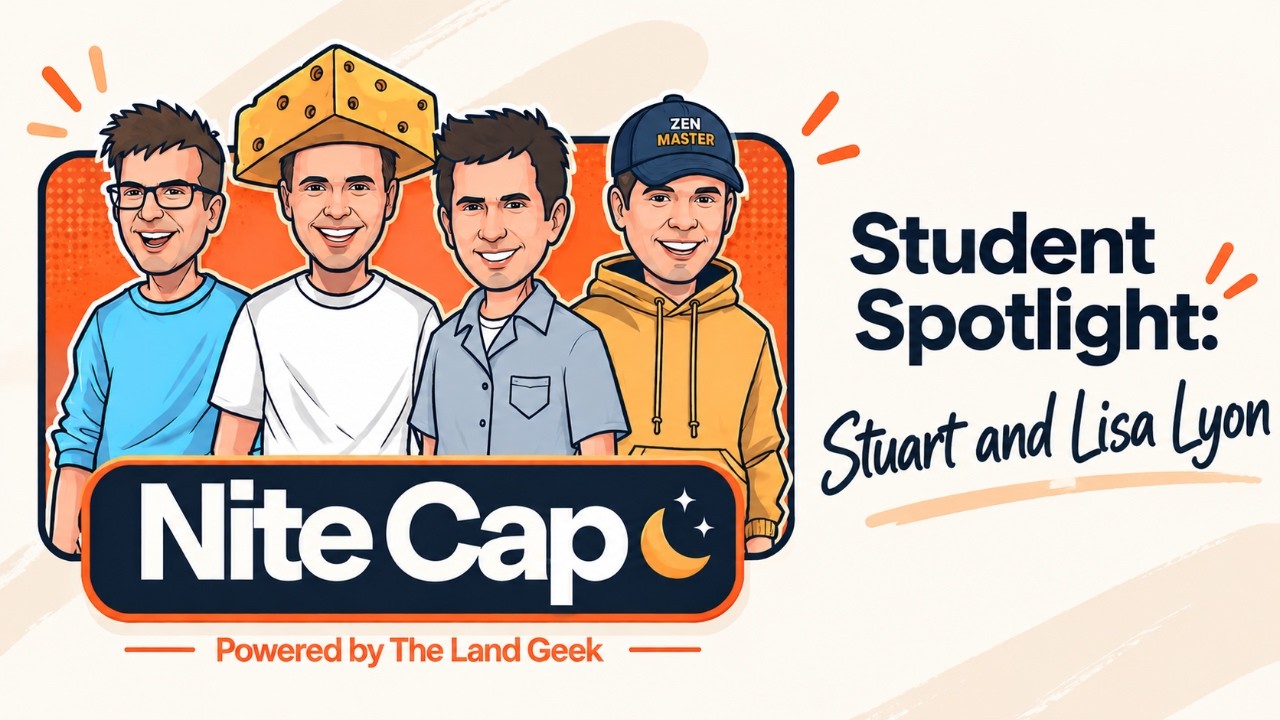
In this Land Geek Nightcap episode, host Scott Todd, along with panelists John Burnett, Mike Zano, and founder Mark J. Podolsky, spotlight husband‑and‑wife team Stuart and Lisa Lyon, who have transitioned from full‑time W‑2 jobs into a growing vacant‑land investing business. The conversation traces the Lyons’ background – a medical‑practice operations specialist and a digital‑marketing professional – and their motivation to achieve time and financial freedom for their four‑child family. They recount how they entered the Land Geek ecosystem through the Dirt‑Rich Starter Kit, a boot‑camp in Las Vegas, and the subsequent Flight School coaching, detailing their first three‑property purchase, the challenges of paperwork, and the shift from “paying with time” to investing in knowledge. Throughout, they emphasize the importance of the community, the “recipe” of mailing and marketing, and customizing templates to fit their voice. The duo also discuss how their roles evolved (Lisa handling sales, Stuart handling acquisitions), how they manage couple dynamics by checking ego at the door, and the personal growth they’ve experienced – confidence, reduced comparison, and a deeper focus on long‑term goals. They share insights on ROI of coaching, portfolio expansion across multiple counties, and practical advice for newcomers, while the panel adds light‑hearted banter, nicknames, and references to the Land Geek culture.
Chapters
1, 2, 3, 4. I once dined on steak with a candle's soft glow, but the bill left my savings despairingly low. Now wisdom has taught me, so simple, so grand, Eat baloney, buy land. Eat baloney, buy land. Trade the fork for the deed in your hand. Skip the filling, let the sandwiches stand. Your fortune will grow when you buy your own land.
Hey everybody, cheers. Welcome to another edition of the Land Geek Nightcap. Tonight we're doing one of our— one of my favorite things. Uh, we're putting a spotlight on a couple Land Geek students who are actually doing the work. They're closing the deals, they're building a business. And, uh, what I love about these episodes is, you know, uh, we're talking land, uh, but, you know, we talk land till we're blue in the face, but there's something kind of powerful about hearing from people who were, who were sitting on the sidelines not that long ago wondering if this whole thing actually works. So tonight we're going to hear from a husband and wife team, uh, Stuart and Lisa Lyon. We're going to bring them on in a minute, but let's do some intros first. In the upper right, we have John, Handsome Rob, 8 Is Enough Burnett. John, good to see you.
Good to be seen. It's good to be here. Oh, look at this, I got my, uh, My I heart dirt. My favorite piece.
Where did you get that?
Sorry, it's just for Mark's favorite people. But
yeah, Mike, did you happen to pick your gift bag up at the at the hotel?
I do have one. You're right.
Oh, okay. All right. Just trying to stir the pot a little bit. Okay. And in the lower in the lower left, the pot stirrer. Breathe in the mailing. Breathe out the marketing. Mike Zen Zen Master Zano. How's it going, buddy?
It's going great. Nice to see you all.
Good to see you.
My mic working?
It is, except when you brush it against your clothing and stuff, we get this little feedback. So just keep, keep a, keep this, keep a handle on it.
I got it.
And then, uh, the man who started this whole LAN geek movement, uh, in the lower right here, the guy that has helped a lot of people Discover financial freedom, financial security, time freedom. Mark the Land Geek, the Godfather. Good evening, fellas.
Great to be here. I, I'm, I'm so excited, uh, for Stuart and Lisa. Not that I don't love seeing you jamooks, right? This is always my, my favorite kind of podcast.
Yeah, this is, this is fun. I, I thought before we bring Stuart and Lisa on, I, I want to throw something out at you guys, so We've worked with a lot of students over the years. Uh, some jump into the business and start doing deals, some kind of get stuck, uh, and take a little while to get things up and running. But, uh, there are some common themes amongst, uh, people who are in our programs, people who are going through coaching. So I thought maybe we could each just list one thing, one characteristic or trait. that our one-on-one coaching clients have before we bring them on. How's that sound?
I like it.
I love it.
John, go ahead.
They're amazing.
Awesome. Yes, they're amazing.
I mean, they are amazing. But I would say, I would say commitment would be a big one.
Oh, good one. Glad you didn't take mine.
Although I like— yes, we all— they They have to be committed. And we'll talk about that with, with Stu and Lisa here in a minute. So I love that. Mark, what's your one word for someone who is going through our coaching program, a characteristic that they all have?
One word?
He just changed it, Mark, didn't he? I didn't hear the one word.
I know, I didn't hear the one word. I mean, I could say grit. But I think I'm gonna steal somebody's, but I, I'd rather say— can I say it too? Like a deep why, but that's why it's 2 words.
No, I like it.
You put a hyphen in between and it's allowed.
Yeah, but it's like having a deep why the same as commitment?
I don't know.
It's different.
I mean, I think they're tied to each other.
Why drives the commitment? Yeah,
they're both legs of the same stool.
Well, I think, and I think grit is also the third leg of that stool.
Yes,
of why commitment and grit.
So, oh, all right. Well, we don't need a good stool.
We don't know.
Well, you know, you got to fill out the, the whole stool now.
Like, oh, we need one more leg.
One more leg.
You know, if I wasn't one word, I was to say that they all value time freedom as the ultimate wealth. But if you look up one word, I would say alignment. And if I had to describe it, it's the fact that, you know, who they are is aligning with what they're doing, right? They're actually taking actions in the direction that's going to produce the future self that they're looking for. So they're in alignment.
Look at that. We just created the 4-legged coaching stool.
Wait, dude, buddy, you got to do like the 5th leg. Yeah, the 5th leg.
How about the back of the chair?
The back of the chair? Back of the chair?
Okay, back of the chair. Okay. Okay, well, we say this word a lot. Consistency, right? I mean, that's kind of commitment. But I mean, you've got to be— I don't know, is that, is that allowed? Say no. Can I say consistency? Or is that redundant?
Say whatever you want. I mean, you're making the rules up. It went from telling the phrase to one word. I think you could say anything that starts with a C, and you got it.
All right. Okay, I got it. Yeah, you got to be consistent. And Yeah, I think I love the grit term too, because grit just means you're kind of in it for the long term. So that's another thing I think that our coaching clients realize is that when they get into this, this is a long haul, right? It's not—
it doesn't happen overnight. About your son's team, and they kind of embodied something you had said about grit. Was that you telling me, Scott? I thought you had said that.
Well, you, you love your little acronyms, Mike.
Get ready, it's tough.
Yeah, right. And what I was telling you is that my son has kind of adopted that with his team, because they say They say the word grit a lot in the college locker room. The coaches say it, and Sam brought that up to his team, so now it's kind of a thing on the team.
So kind of like— I, I mean, I created the Ted Lasso moment.
I think you did, yeah.
Can they just put grit, get ready, it's tough, above the window and the coach slaps it when he goes by and then writes Zano underneath it just because?
I'm gonna make this sign. I'm gonna make this sign. All right, well, without further ado, let's, uh, let's bring on our special guests Stuart and Lisa Lyon, adding them to the stage. See if their camera's on. I'll give a little intro as they're— oh, can you guys hear us?
Hold on. Yeah, can you?
Yeah, yeah, no, we gotcha.
I don't know what happened with the camera, but—
We're imagining your faces and they're beautiful.
I appreciate that. I probably look better that way, John. Thank you.
I just realized that I'm in the middle. I feel so important.
You are in the middle. You're looking down at your Brady Bunch children. Yeah, guys, maybe I would maybe recommend just exiting and coming back in once and see if that— see if that works.
We'll be right back.
OK, sounds good. All right, awesome.
Beauty of StreamYard.
Yes, it's not a bad platform though. I like it.
Yeah, it's fun.
It is.
Yeah, it's wonderful. Every time it doesn't hide your faces. Every other time it's great.
Every time.
Well, I could do a brief intro for them, or at least tell the audience who they are. So, so Stuart and Lisa are from Vancouver, Washington. Stu spends his professional life helping medical practices run better businesses. So he's all about kind of operations efficiency and solving problems. And then Lisa is in digital marketing and advertising. So she, she understands how to get eyeballs on products, which is pretty cool. So I think it's gonna be fun to chat with them here in a minute. And I love here in the comments, Scott Elliott. Here we go. Here they are.
Beautiful faces. Look at that.
Ooh, look at you guys changed rooms.
That was the problem. Well, yeah, we forgot we had the room that looked like we were—
We needed something that looked more like a nightcap.
Yeah,
so
I remember this from on coaching calls when you guys were back in flight school. Yeah, I always gave you a hard time because it felt like you guys were at the bar. Yeah, during our— during—
well, we're trying. As we said, we did in honor of Mike, we did open a bottle of wine. We're making sure to have a little appropriate vino.
Cheers to you.
Cheers.
Uh, did Scott Elliott just just give you guys your nickname here?
Whoa, look at that.
Or is this new to me? Is this new to you guys?
That is new.
Roaring Lions.
I love it though.
Well, that's actually one of the coolest nicknames I have heard in a long time. Roaring Lions. I'm a bit jelly, as my daughter would say. A bit jelly.
If you guys ever start a band, that's your name.
That's it. Yes.
The funny part is we do have We do have a pub and smokehouse in our backyard, which is called the Lounging Lion.
Oh, oh.
And, uh, yeah, we at one point— we— Lisa may have led this effort that we were going to try and get it rated on Yelp, but then we realized that people would start showing up through the side gate. We opted not to.
That's funny.
You gotta be careful. Gotta be careful with that. Uh, awesome, guys. Well, thank you for joining us tonight. We love, uh, putting the spotlight on our students. So, uh, if, if you would, just to kind of start us off, tell us a little bit about yourselves. Uh, I already told the audience what you guys, uh, do, uh, briefly, but, uh, you know, tell us about yourselves and what you guys do and what got you into land investing in the first place.
I guess I'm going first. Okay, so yeah, marketing most of my career. Big corporate America, eventually moved to the ad agency side. Mom of 4, probably my favorite job next to being a grandmother. That's my— that's, that's a special place. One, we have a 6-and-a-half-year-old grandson, so we're not keeping up with Mike. He's way ahead of us. But I have 4 kids, like, we're, you know, We're holding out on that one.
Yeah,
uh, land business, you know, honestly, Stuart, uh, kind of dragged me along a little bit. He, you know, read Mark's first book and then gave it to me to read, and then we signed up for the toolkit and we went to a, uh, what were they called? Uh, boot camp.
Boot camp.
In Las Vegas, and I was terrified. Like, you put us into small groups and we had to practice sales calls. And we ran around that little hotel, like, trying to buy land from whoever you told us.
And it was amazing. It was the best thing ever.
Oh my gosh. And we couldn't work together. We were never on the same team, which I love that, by the way. I always think that's smart. But yeah, and then I don't know, it was just like, This room is good. The people are good. And we did proof of concept. And here we are in coaching.
I think the funniest thing, the funniest thing about that boot camp— well, there are multiple funny things, and Mark will know this, and you'll all remember it— was that it was at the Platinum, and the Platinum turned out to not be
what
it should have been.
It was less than Platinum.
It was less than Platinum. It was a little more lead, a little more lead. But across the corner on the other side is There's a power pole. This is very glamorous. There's a power pole, and that's the site where Tupac was killed.
Oh, right.
There was a tiny shrine of bottle caps and empty bottles and things that were there.
Stu, is this the one— I'm curious, you would remember if at the end— is this the one where Mark hugged everyone? You'd know because you would have gotten a hug.
That wasn't— that was in Arizona.
But that wasn't there?
No. Yeah, I don't know, the grounds for filing any suit
at
all.
And he crossed over the threshold and he had to hug everybody.
That's amazing.
What is that threshold, Mark? Is it like 10 people? You hit the number and it was like— it was never stopping.
What was the point, Mark, where you were doing that and you were like, what have I done?
You don't actually want to hug anyone. It was actually Landon's first, uh, as a coach boot camp as a coach.
Oh, okay.
Yeah, it was. This is
The funny thing in the
day,
the funny thing too was when we were all in the groups trying to figure out how to buy land. In my group, somebody said, hey, there's this new thing called ChatGPT, could we do something with that? Little did we know.
Yeah.
Wow. All right, Stu, you're up.
Oh Lord. Um, yeah, drug her along. Uh, she's a willing victim. Um, have always been looking For what, what, what are we gonna do, uh, for something different? We'd looked at multiple different things— mobile home parks, this, that, and everything. Um, we did buy the toolkit, we did buy our first properties with the toolkit, and suddenly realized, oh my gosh, what have we gotten ourselves into? We now own properties in another state. We should probably get some more information on how to do this thing. Um, but yeah, it was amazing. It went and met a whole bunch of people. Uh, lots of people we're still friends with and got involved with the community because it's like, yeah, these are, these are people who want everybody to succeed. It was a different mindset than anything else we'd ever seen. It's like, yeah, this is a community that actually wants to support each other as opposed to some cutthroat other, other situation that we've seen before. So that's why we're here.
Well, that's, I mean, that's amazing. So, so you're here because you, it sounds like you had great exposure to the community early on, which I think we can all agree our community is the best. It is. It's very abundant-minded, and people are so willing to help and teach and guide and pull along. Mike, what's the smile on your face for? You're waiting for me to say it, aren't you?
No, you always catch me smiling. I was just looking— every so often I peek at the comments and— oh, okay, I saw some great comments for questions later. But then Maddie said she liked my microphone. So I was like, yeah,
nice.
Every so often I peek at the comments because Scott doesn't always bring up all the comments. So sometimes there's some good ones in there, and I gotta like— if I don't look at him, I don't get to see him. Sorry. But anyway, that's why I was smiling.
I wonder if everyone likes the feedback from your mic. Oh,
ouch.
I like the feedback from his mic. Uh, but, but that, but that, uh, that boot camp— was that the boot camp after COVID, like 2021, 2022?
Wow,
that's a while back.
That's about— yeah.
I think, I think if, if you were to use the old story of the tortoise and the hare, we are the tortoise. We, we, we bought the toolkit and we started and we're like, we're gonna figure this out because we are stubborn. Um, so we did that and that's how we, you know, the— it tells you what to do, mail and market and do this and do that. And we did it and we bought property and everything. And then we realized that it's like, you know what, We'd like to be a little more like the hare, which is why we went to the boot camp to learn and then realize the benefits of moving on. So yeah, but, but we've definitely taken gaps between what we've done. And I think in retrospect, we would have accelerated our pathway. But, you know, it is what it is.
We're all on our own path. Yeah.
Yeah, for sure. Well, uh, so let's, let's talk a little bit about your journey then. So I mean, you guys been in this a while, you, you kind of took the DIY approach initially. Were you able to find a deal, uh, able to get a deal done on your own? Uh, how long did it take to get the first deal? What did that look like?
I think so. We started mailing, we picked a county, uh, we did the research, we did everything, you know, that it tells you, and we started mailing and All of a sudden got a response, and I would— and I was terrified because all of a sudden it's like, I've got 179 pages of documentation here, but I'm not exactly sure how to talk to this person. But, but it was good because, uh, we talked, and it was a gentleman who the family had owned these properties for a long time, yada yada, blah blah blah. But we ended up buying 3 properties, uh, that were But in the same, very much in the same area, 2 together and one just over across the way. And we bought that and then we got it done. We followed directions, we didn't screw it up, but we did everything probably the slowest way possible. You know, we mailed things by snail mail. You know, we didn't use DocuSign or anything like that. And then we bought them and we looked at each other and it was like, okay, well, what do we do now? I guess we gotta sell these things. Um, and I think generally we realized through that process it was awesome because we, we were— we had enough information to buy and probably to figure out how to sell. But we realized that it's like, if we're serious about this, we need to move on in our, in our educational journey. We need to move into something else because you— Um, I— we are old enough with 4 adult children and everything, that you've definitely learned that you can, you can, you can pay with time, or you can, you can pay people who know how to do it and get yourself there a lot faster. So we initially started paying with time, and we realized it was cheaper to pay, to pay for knowledge.
Right,
right.
Yeah,
that kind of lines up. But, you know, I always think of like our Dirt Rich Starter Kit or the toolkit is like the deliverable is like you can get a deal, right? You're gonna be able to buy a piece But the flight school is more about, hey, how do you turn this into a business, right? So it starts to involve other components. It sounds like that's what you're describing.
100%. Like, yeah, I mean, the starter kit gave us what we needed to get out there and get started. But, but we realized that, like, if we want to scale and make this what we want to move on, we have to keep going. We have to keep going. And it was, it was, I mean, it was just patently obvious. Do you want to?
Yeah, I was just going to say, just to add on to that, and our story is we did buy those 3 properties. We didn't do a lot with them in the beginning. We just— I don't know, Stuart and I get a little stuck. We're both in advertising, so we overthink everything, and we think we know how to do everything better. And we definitely went down that path. Like, we went out of the system, and I'm telling you, I tell everybody, just stick with the system. Like, don't overthink it. You're not smarter than the collective group, and, and it all works. So we signed up for flight school. We did sell one of those properties during flight school, and then we got an opportunity to buy another land business, which is a unique opportunity. I would do it all over again. It's a fast way to build inventory. It's exciting. Scott, Scott helped us through that process. It's nerve-wracking. But in all of that, like, the amount of knowledge that's learned and just the fact that you're willing to kind of hold our hands through the whole thing. So people get nervous and I hear a lot of people ask about proof of concept. Are you making your money back? All of those questions, like, is it worth it? Absolutely. 100%. I know we tried to circumvent the system and I'm like, no, what do the videos say? What do they tell us at that coaching meeting? What is the group doing? Like, we don't really move forward now without asking questions of the group and the community when it's something new or we don't know. We get, we get kind of the answers and we've not been misled.
Yeah. We're, if, if you're on here listening right now, wherever you are on the journey, when you hear Scott Todd in the video say, just follow the recipe, just follow the recipe. It doesn't need any more cumin. It doesn't need a shot of whiskey. Well, you can do that yourself, but it doesn't, it doesn't You need the other ingredient. Just follow the recipe and then you'll figure it out.
I'm curious too, because like I always think about like when you follow the recipe, it's like if you're building a house, there are certain things that you're always going to do, right? This is how you frame. This is how you, you know, this is how you do sheetrock. This is like there are certain things that you always follow the recipe, but at the same time, houses might look different. So they all follow the same recipe, but then they can kind of look a little bit different. So I'm curious, you know, with you two both in advertising, Like, have you found that that's helped you in any particular ways that as you built your business, or is there anything that's kind of been a little unique flair for how you've done things?
I think part of it is making some of the material your own. So, you know, you guys give a lot of great templates, but also, you know, just making sure that they're in your voice. The offer letter that goes out, you know, we put a logo on it. Don't waste time on a logo. We are in advertising. We have people that just do stuff for us that are so kind, and they— we haven't paid for any of these. Let someone build a website for us because that's what we do in our advertising agency. So we have some unique, like, uh, things at our fingertips that we feel very fortunate about. So I think the biggest thing was just finding our own voice, you know, making sure, like, when we send something out, it's not Mark, it's us. Um, but Mark gives such the, like, such a great foundation, um, because I hear your voice and the contracts and, and the offer letters and all of that. And, and it's like, it's good, right? It's better than chat in the way that it's like, Mark made this work, I'm gonna make it work too. But you can make some tweaks to all of that. Um, and I think with anything, when you have your own business, you do find those little places that, you know, I, I do it this way, this is how I follow up with our leads. Or, you know, whatever it might be, how Stuart talks. He does all of our acquisitions, so how he talks to those that we're acquiring land from.
Yeah, I think I just— I'll give you my slightly different perspective because if you look, if you talk about it from a marketing advertising side, Lisa's on the ad agency side and I'm on the private company side. So my company, we work in healthcare and we work with small practices and we help them be successful. So I think if you— the benefit of that to me is like I have had to talk to people and listen to their aspirations and kind of what they want to achieve and do that. And you start to realize that people have— everybody has their own dream. And I know this might sound kind of corny, But it's like, we have— we work with a lot of medical practices, and I've heard a lot of different stories, and everybody's got their own version of what they want to— where they want to get to and what they want to do. And when you start doing the land business, when you talk to a seller or a buyer, everybody's got their, their own why and their own thing that they're trying to do. So I think that talking to all these people over the years, for me, has made it just easier to kind of slow down a little bit and listen, and listen to the sellers and the buyers. You know, whenever I stumble into doing the sales thing, which Lisa doesn't want me to do, but, you know, it's just like, it's like just everybody's got their own story and everybody's got their own why they want to go where they want to go. So just listen to them.
You know, so many great takeaways there. And one of them I think of, you know, you said, you know, You mentioned logos and websites. You know, it's so easy when you start a new business to get overly excited. I think everybody naturally does this and starts thinking about all those fun things like, we should get t-shirts, we should get hats, the logo, the website. But really it comes down to just the fundamentals. And you talk about the recipe, and I would hear in my head, like, Mark, you say you could screw everything up, but if you mail and you market, you're going to do pretty good, right? But you can get so caught up in all these other things that you might not mail and you might not market. It's like so weird how they can grab our attention because they're bright and shiny and they look like fun, but they're not the core principles that bring deals.
Well, and I'll say about the website too, and I know you guys kind of quote unquote preach this, is it's really not the most important thing. And I rarely send anyone to our website. I'll create some landing pages and we're experimenting with those. But at the end of the day, it's like, it's a commerce That gets the business moving, right? So it's that person-to-person. And I've had people say, like, were you good at sales before you started this? I'm like, I just, I like people. Like, I like to know people's stories. So, you know, as long as you take the attention off of you and put it on the person on the other end of the phone, why do you want to buy this land? What do you want to do with it? You know, what are you trying to achieve? Like, that, that people want to talk about themselves. So.
Yeah. What, What Mike just said, and I hear this slightly differently in my head, but because what I— because of hearing Mike talk, I hear that you have to mail and mock it. That's what I hear. You gotta mock it. So that's, uh, it's, it's the truth, and it's easy to get distracted by those things, but you just gotta, you know, go back to that fundamental. And, and it always makes me just think of the Red Sox. Thank you, Mike. Go Sox! There's always next year.
Oh, man.
I don't even know what season it is.
Yeah, he's not a big sports guy from Boston. It's okay. Yeah. Well, so you've said a couple of cool things here. Like, number one, Stu's a better listener. Do you see that in your marriage, Lisa? And then Lisa's better at sales.
This call is going to end and I'm going to get in trouble. Thanks, Scott.
But Stu, you said something earlier that I want to backtrack on. So you You said something along the lines of, we need to do this so we can get what we want. But I don't think we really talked about yet what you guys want from this whole thing. So can you talk a little bit about, you know, the whole reason for doing this in the first place?
Yeah, I mean, I guess the— boy, this is gonna sound like, like an Oliver Twist or a sad story or something like, you know, Lisa and I both came from We both came from downtrodden, poor families. We both grew up in probably, I would say, lower middle class upbringings and everything. And we have 4 kids and we have, you know, invested ourselves into them a ton. And they are functional, great human beings. And I know that sounds like I'm just a dad talking about it, but, but they're out there, they're doing the thing. You know, we have 2 in the military, we have 2 who went to school, we have one who's in grad school, and we're super proud of them.
Wow.
But the— so we invested, invested, invested in them. But now it's like we've gotten to the point, it's like, you know what, this is our time, and we, we want our time to be our time. We both have good W-2 jobs that we are working our way out of, and the land business is, is our way to move out of that. And, you know, we talked a little bit about the people who we've encountered in the land business. And that's such a welcome, like, breath of fresh air, to be honest, from so many other groups that you work with, from the people who are just willing to give. And I don't even know who's— I mean, I saw Scott on there, uh, who, you know, gave us our new nickname. Thank you, uh, very much, uh, for that. Uh, but, you know, hung out with him at the Dirt Rich Summit. Great guy. You know, I can't, I can't tell you anybody in the community who's a bad person. And It's like the ability to be part of that while you're building the engine that gives you your time and financial freedom to go do your things. I mean, I'm not looking to be a Kardashian. I don't have the figure, but I want to be able to do what I want to do. I mean, we love to hike, we love to kayak, we love to do all these different things, and the freedom to just go do those things is what we are working towards, and that's what this business is giving us, the pathway to get there. Please feel free to contradict me.
Everything that he said. Yeah, it is, it is fun to be— I know, like, you know, John, you are able— well, most of you, John and Scott, you're able to spend all this time with your kids. You started the business long before we did. Um, I didn't even know you could buy vacant land when we were raising our kids, but We're thankful now. It's like we do love to travel and we don't want to work until we're 70 and we're tired of building someone else's business. And, you know, the give on that is you think that you're going to get something back out of it. At the end of the day, it's corporate America and we're not going to get anything back out of it. So they're going to sell businesses and we're not going to see any of that money. Not that it's all about money, but you I mean, those of you that are working the W-2s, it's a grind, man. And you're, you're not doing it for yourself. You're doing it for someone else. And I don't want to climb a corporate ladder. I don't care about that anymore. That was back in my late 20s and early 30s. So I just, I want the freedom. I want to be able to say, hey, let's pack the travel trailer up. Let's take an extra long weekend trip and let's go see our friends in Florida, you know, and know that we have a business that's sustainable and running. And I think that is Definitely one of the key points. I'm just going to do a quick pitch on the coaching side of it is, is that is why we're in coaching is that we can build a business that's sustainable. If we go on vacation, we're still making deals. That's what you're all doing quite successfully. So we're just, we're following the path and it's exciting for us. Less and less time at that W-2.
Those are always the most meaningful sales to me. Like, I've had those where I've been at the playground with my kids and I get a ding on my phone and it's a down payment, or—
Yeah,
so great.
Yeah, or, you know, it's just, it's amazing. Or going on a trip and, you know, you're taking this time off and things are still moving. It's amazing, right?
Yeah.
Do you— I'm gonna ask a question, Mark. Do you still do the red pill ceremony? Does that still happen? I haven't, I haven't watched.
Okay. So hopefully Jeff Shaw is on this call because I saw him in the comments, but I have a red pill call with Jeff, uh, on Thursday. It was supposed to be on Wednesday. I just had one today with, uh, Reagan. So yes, I love them.
I will, I, I guess I asked the question because, so we did that with you and we did the call and we did everything. And for me, the red pill was like slow acting. It was like time release. Thank you, Morpheus. Thank you, Morpheus. But it was, it was like, we get into it and, you know, we had a bunch of goofy, you know, family stuff that happened and slowed us down at the beginning of coaching and everything. But the more you get into it and the more you do things, it's, um, I mean, to quote one of Mark's friends, you know, you just do the next right thing. And the more you do that, the more the red pill sets in and you start to see more and more of the potential and everything and where you want to go. So it's still— uh-oh, Scott needs a red pill.
Scott,
you
gotta book it. What? That's awesome.
You gotta book it, Scott. Gotta book it. Yeah.
Can't help you if you don't book it, Scott.
Every day. I know you guys brought this up earlier is, yeah, we do it every day. And I know Mark will be like, oh, land's kind of boring. You know, like, you're just, you're doing all this stuff and you love all the AI and you're, you know, you have a very, you know, your business is doing what your business is doing. And I love that. It's aspirational for sure. And, and it's It's funny because we still get to compare what land— like doing land every day to doing our W-2 every day. And we're both just like, shit, I gotta, I gotta get some W-2 work done. Way more fun. Yeah, stop. Do that job and pay the bills right now. So yeah, and, and it's good though. It's fun. It's— we have a good time doing it together. Too, so that that makes it enjoyable.
That's amazing. That's amazing. I mean, do you do you guys find it boring now? Because remember, I've been doing this 26 years.
Are you asking us?
No, that's asking asking the Jamooks.
Oh, the Jamooks.
Oh oh.
I think like it's interesting because I. Basically, I delegate the boring— the things that I don't find enjoyable are the things that I generally don't do, right? You know, occasionally I might dip in and, you know, we'll review our marketing and see, you know, and there's some things that sometimes you have to do regardless. But a lot of what I do is just like, I don't know, I just walk around and vibe code all day. So I get to work on my business and that's fun. So like, you know, I built task management software for my team with, you know, it was really easy. And now I'm just rebuilding our website and stuff. And it's just kind of like, it's the kind of a thing where like, you know, everybody's different and there are things that certain people enjoy and other things that other people enjoy. And so, you know, as your business grows, it just kind of, you start getting more concentrated on what it is that you like.
I was actually, I was just thinking about this today, Mark. It's funny you bring this up because I was just in my kitchen and talking to my granddaughter Ava, who we're raising. And, you know, she was just talking about, we were talking about careers and what she might do. And, you know, I said, hey, like, who knows, like, maybe you'll be a healthcare worker for 20 years, and they all hit a burnout point at some You know, I'm kind of convinced that everybody, all healthcare workers, hit a burnout point at 20 years. And then, you know, maybe you could kind of roll over to the land business because she's like, are you, are you still going to do land? I'm like, yeah, you know what, I'm gonna do land forever. Like, I don't see myself stopping this. And it's because it is fun. Like, there's the deal there, there's the thrill of the chase a little bit. There's a little dopamine rush on with, with these deals that you're doing. But, but it just makes sense too. Like, for, for people that don't know a lot about this who are watching maybe for the first time, you know, it— we're buying these hard assets at a deep discount. So it just makes really good sense that I try to buy as many as I can, and then I make those assets perform for me, and the returns are crazy. So, you know, I, I see myself doing this until, you know, I can't, I guess.
So I, I don't think boring. I think it's just normal, which is like weird because in the beginning it was so unknown, you know, it was so strange. Like, I want to buy land and this and all that. And, and it's sometimes shocking to me just how normal it is. Like, yeah, this is just what we do. And how if I reflect back on, you know, first starting, it's, um, but it's probably like with anything you do in life, right? When you first start, it's so unique and different, but then after you've been doing it, becomes part of who you are. So I don't think it's boring. I I think it's just who I am now. I'm a land investor. It's kind of cool to say that.
Yeah, well, I— okay, then I'm gonna revise my answer. So certainly, I, I don't think it's— I don't think it's boring in the sense that I just think compared to, say, John vibe coding all day, like, the, the idea of buying a piece of raw land and then selling a piece of raw land, um, and doing it a billion times
Right.
And staying focused on it for that long in, in the big realm of like general sexy businesses,
right?
I think that it can be boring to an outsider, but I think like for, for all of us, it's, it's not boring. And we get a lot of, of our, of our needs met, uh, in the business. And in, into John's point, like, each one of us is different, like, because we get these little dopamine hits when we, when they do these things. I really think it's, it's like business is sort of like this incredibly spiritual exercise in a way of, of having you grow as a person, because the business, like a child, would just expose you.
Hmm.
And it's like, oh wait, this is like something that I'm being exposed, and how am I gonna handle this problem? And, and, and do it. And then you're like, okay, unless I grow, the business really doesn't grow,
right?
And yeah, that part's fantastic.
Well, and I'll say, Mark, too, just on that note, is the act of buying and selling land for you— or I mean, maybe for any of us— it's not— that isn't the part that's really exciting. It's the growth of it. And it's like we watch you and your team and where you get really excited about the business and coaching and teaching and giving that knowledge away in a way to us that's like priceless, right? So your excitement comes from just keep pushing that forward to others, and that makes it exciting. The community— I mean, you just— you've created this amazing community. We don't compete with our friends, even if our friends are in the same county. We don't even really talk about What counties you're in, it doesn't matter at the end of the day. We do, people know, but
I don't know. But I think it's funny because we were at the summit, and I don't know if Gunner's on here, but, you know, I had somebody who was trying to buy a piece of county— buy a piece of county, excuse me, buy a piece of land in the same county that Gunner was in. And the guy told me, oh, it's just a little too far. And we were talking, Gunner said, oh, I might have a piece right there. And I said, if you buy that piece, Let me know, I'll give you— I'll just, I'll pass them on to you because I can't help them, but you can help them. And, and that's, that's super fun. And the other kind of cool thing about the business is, as Lisa said, and we joke about it being boring, but, um, I think everybody wants to help somebody else in all of this. And, you know, you can help match buyers with a piece of land that they maybe thought they couldn't get and everything. But the cool thing is, as you get farther into this and you realize, as everybody on the call, the 4 of you would say, is you will run out of money at some point. And, you know, you're going to need to find other sources of funding. And you can help people by— this sounds really weird. This is the most capitalist thing I've ever said. You can help people by taking their money from them and putting it into these deals. Because we were able to help Lisa's mom because, you know, she— you know, Lisa's dad passed away recently and You know, she has money and everything, but it's— she had it in places that were earning nothing. And it's like we were able to take her money and put it into the land business and start paying her a whole bunch more interest than she was doing. So that was able to bridge the gap on her monthly so that she could retire. She's 76. Wow.
Wow.
And she still works.
And she still works even though we've done it. She's like, no, I'm gonna go. But it's like, that's a, that's a really cool thing to be able to do. I mean, we were talking about that. Our youngest happened to be home for a couple days this weekend, and we were talking about it, and he said, I think I need to change my 401 contribution. Will you guys invest it for me? You know, it's super fun.
Wow. What are some, what are some ways— like, it's interesting Like Valerie and I, we were on Mark's podcast a long time ago. And then, and when I look back at that, I'm like, oh my goodness, I'm like a completely different person. Like, I feel like I've grown a lot just going through this whole journey. Like, what are some ways that you guys feel like you've grown as you've built up your, your business?
That's a great question.
Yeah.
I'm gonna say like, I think confidence, just people say, is it hard? Is it? I'm like, no, it's not. And I think every time you do a deal or you figure out Facebook Marketplace and whatever algorithm they're running right now, like all those things just build confidence, just knowing like I can do it. And my life is no longer— my identity is no longer attached to what I do for a living. I don't even need to have that conversation. I'll talk about land, but I don't— like, I want to be with a group of friends where we're not complaining about our jobs. Mm-hmm. And I love that. I love that side of it. Um, it's very, very freeing to not be so attached because I'm just doing something over here on the side that is building something for us and is enjoyable, and we just get to invest our time into other people, our friends,
our family? Yeah, I would say— so there, I guess there's 2 things. One of the first things is that Mark said something early on in our process here, in our, you know, the journey with the LangGeek community, and it was that comparison is the thief of happiness. And I— that resonated with me a lot because I realized it's like, oh, I'm— I, I really— and I'm gonna use some cliché here again— I, I only need to run my own race. Yeah. And it's like, so stop comparing yourself because everybody's got their own bag of rocks that they're carrying. And, you know, my bag of rocks is different than anybody else's, and why am I comparing that? to them. And what I would say is that the business has made me— because we stepped into this not knowing what we were getting ourselves into, you know, necessarily. I mean, it's not like you're going in blind, but it's like, okay, what is this going to be? And it's made me step outside of my comfort zone because I have, as you can tell, I'm a wallflower. You know, I can't, you know, I don't— I don't involve people. And everything. But, but, uh, but sometimes I would— I, I guess I would, you know, rely on my outgoing personality and things and that and this and that. But in the business, it's like, okay, what's the next right thing that needs to be done? And sometimes the next right thing is you better go figure out how to use Claude to automate parts of your business. And that's not a Stuart strength, but it's become a Stuart strength Because it's the next right thing to do in your business, and it makes you accountable to that. So that's a, that's a pretty cool thing that it's pushed me to do. That's a great question, John, by the way. It's because it's made me significantly better in areas that I never would have been.
Wow, that's awesome.
That's amazing.
That's great. I feel like the Zen Master is being very quiet tonight.
Just enjoying that conversation. It's, uh, some great questions. And, um, yeah, I mean, I had the pleasure to interview them on the stage at, uh, the summit. So, you know, I want to give everybody else some time to talk to them, you know, which they did an amazing job. Uh, but there are questions, I think. And aren't there some questions in there as we're winding down the hour in the chat?
Yeah, we got a couple questions. Uh, and we have some wins. We have, we have some wins we need to celebrate. Yeah, so we've had So, so Landgrind had a cash sale, and I, I never know who Landgrind is, and I should probably know by now, so I apologize. Um, so, uh, I think it's Shannon, but it might not be Shannon. I say that every week, is it Shannon? And I never get any clarification in the chat, so I think it is Shannon, but I don't know if it's Shannon. So, uh, anyway, I don't—
I think—
Yeah, we're about to find
out. Yeah.
What's that?
Shannon's been rocking it on the cash sale.
All right, awesome. It is Shannon.
Shannon was also late because of the cash sale, so Shannon, get your priorities straight.
Yeah,
Shannon's awesome. She's from Nebraska. She's from Lincoln, Nebraska, and, uh, or from near Lincoln. I know. Uh, so go big, go Big Red. Uh, Rick Colcock had a terms sale, sounds like, and the buyer went out to the property and loved it. So congrats to Rick. And, uh, and Maddie bought 2 properties today. She bought a property wholesale and land arb today. So awesome, Maddie. Instant equity,
Maddie.
Amazing.
That's, that's, that's awesome. So, um, yeah, we'll go back and see if we have some questions here, but I think we should talk couples dynamics just for a Right? So like, you guys seem so well aligned. Is there, is there ever any conflict? Like, is one more the risk taker than the other? Do you guys ever disagree about deals? Like, is there somebody that like gets really excited about a deal and the other person's like, you know?
I'll, I'll, um, There's a— it's just, there's probably a couple answers here. I mean, number one, I think our business is absolutely polar opposite of what we thought it would be.
Yeah,
because we thought that— I mean, going into this, you would think that I would be the guy doing sales and I'm going to talk to people and do this and do that. Nope, I don't do any sales. That's her.
Yeah, I definitely thought I would be more back of the house. I sort of signed up, I believe, like, you know, I got through boot camp and I saw the model and we put it to practice and it works. I thought I would just sort of be the support role in all of it. And that's not been the case either. And I would have never expected Stuart to be our AI guy. And I did.
Wow. Okay. Thanks.
Loving it. So, but he's, he's taking that on. Do we argue about— I don't know. We, I mean, I think our biggest mistake as a couple, and I'm, it's not a mistake. I think in land we have to rethink it a little bit, but, you know, Stuart and I don't make a lot of big financial decisions before we sleep on it. So we've missed out on, you know, that great car deal or, you know, whatever, whatever kind of large Mm-hmm. expenditure there is. And we definitely slept on the— on this— these decisions we've slept on. I think that slowed us down a little bit. But no, we don't argue. But sometimes he travels for his W-2, and I'm like, I really need this for you, from you. So I definitely can go from like super sweet and, and nice to like, okay, my tolerance is running low. Like, I'm doing all this stuff and I need you to get me XYZ. But we're never like, our, our relationship isn't based on if we're not having fun, we're doing something wrong. Well, so, and I mean, if one of us gets crabby cooking dinner, it's like, uh-uh, no, no, we don't. That's just not the way this household runs. Uh, so we, you
know, we are the parents that threatened our children. It's like, if 2 of you aren't getting along, we're going to put you like in a get along shirt. We're going to get a double extra large shirt and put it on you. And you're going to have to hug it out till you figure it out.
Yeah. We used to have to— me and my sisters, we used to have to hold hands and go skipping down to the end of the road and back.
And it pretty much fixed the problem, did it not? They're like, how do you be mad after you're skipping down the road? Because you can't skip and not laugh at the same time.
I would, I would say one thing, just if, if, if there are any couples on here who are doing the business or thinking about the business, um, I would say the best thing to do Is you need to remember to check your ego at the door.
Yeah.
Because, um, you both have strengths and weaknesses. You both are going to lead in times, and you should both follow at times. And I had a crappy little trip that I had to do this last 4 or 5 days where I flew out and I came back because one of our kids was going to be here, and then I flew back down and we were talking about land texting back and forth. And I said, look, I'm— I am currently not in the business like you are. I need you to tell me what we need to do and just give me a couple tasks and I'll do the thing right now. So if you're a couple doing it, the more you can just check your ego and take your turns at being the leader and making things successful, that's how you're going to be successful.
Yeah. Yeah. And don't assume that you know what your roles are. I think I think that we sort of fell into our roles, like he said, unexpectedly. We did think that he would do more sales, and we didn't really— we didn't put the fences around it. We, we definitely let it fall more naturally as those deals started happening. So you don't really know until the deals start happening how your brain is going to process that, or your personality might pop out in a way that's That's unexpected. Um, but we also don't do a lot of overlap. So he— I mean, he does acquisition, I do sales, and there are some things that we work on together. But, you know, we talk about swim lanes all the time, and we never really want to be in the same bucket. We have videos. If he gets sick and I need to, like, buy a piece of property, I have the tools to do that. But I couldn't tell you step by step right now. Like what that looks like. I'd have to go back and look at my notes where he could rattle it off by memory. And I think that's important. I don't— we don't need to duplicate efforts. It's too much energy.
But the business is built on everything we've been taught.
Yeah.
I mean, honestly, it's like it's built on the toolkit, flight school, and coaching. I mean, you know, that's how we built it. We just have divided it up that way.
Yeah.
Well, that's awesome. Well, we do have— we have a question or two and a great comment I want to share here, but But from Steve Burris, who also needs to have his red pill call. Congratulations, Steve. Has there been an aha moment in your journey in land sales, Lisa, since you're on the phone mostly?
Speed to lead, lead to speed. Speed to lead. I say things backwards. It's a trait I got from my father. Yeah, I mean, that's really my aha moment is I, I think in the beginning I didn't understand the importance of the constant follow-up. Become Mark, channel Mark, be Mark, buy or unsubscribe, buy
or unsubscribe.
And I have been amazed at people who, you know, you send them messages for 3, 4 days in a row and then all, no, no, no, sorry, work got really busy. No, no, I definitely want to get that that property. But had you— had I just let that sit, which I had in the beginning, let those sit, I let them go. And I think you miss out on deals that way. Those are— that's like the biggest aha for me is you stop when they tell you to stop. Follow up, or you might miss people.
This has just made my, my whole night.
Coming from the woman who said, Mark, you're sending emails to like 4 different email addresses. Can you just get it down to one?
Yeah. Yeah. But yeah, I mean, I think it's, yeah, it's great. I remember saying, I think it was at the summit, like a minimum of 7 times. I'm going to revise that to 10 times now.
I
follow up when—
Ileana says 15. 15.
Yeah. But this is going to be the minimum.
We talked to, you know, talking to Joy and Bell. And, you know, Joy's like, oh, I have, I have a 12-contact follow-up process. Yeah. And, um, Steve, I, to answer your question, what was my aha moment? My aha moment was that I don't have to do it all myself.
Yeah.
That the, like, in the WhatsApp and the community and everything, it's like everybody is willing to talk to you and give you the information if you don't know it already, because eventually you're going to give them something else back. That was my aha moment, that I'm not actually alone in in this. And it's not just— I realized it was way more than my coach. It was— it's all these other people that are willing to give it. That was— that was when I was like, oh, I can do this. I can do this. I don't have to be the smartest guy in the room, you know, even though I'm not supposed to be an AI expert,
but I am
now.
I got Muse to do something for me though, so I got all excited about that. Now I've done it on all of our phones, so I get all these reports every Monday. It's very exciting.
Exciting times in the land business with all these AI tools, that's for sure.
Um,
uh, let's do one other question. Uh, let's see, where'd it go? Do you guys mind just talking about your, uh, you know, you can do this generically too, like, what does your portfolio look like since you went through flight school? So, you know, have you seen, uh, a change in the volume Uh, since going through coaching or going through flight school, or, or any other thoughts on that?
I think that, um, yes, we have. Um, our— the portfolio has changed because I, I think that we, you know, they talk about the different levers that you can pull. You know, we, uh, you know, Mike's been generous to share his story about starting with wholesale and, you know, the different things he did and all that. And I don't think we understood how pull all the levers. And I think as we've gone through this, we've learned how to pull the levers differently because it's like, okay, we have some— as Lisa said, we bought another land business. So we went from being an inch wide and a mile deep to being 7 miles wide and an inch deep, you know, to— because all of a sudden we're in, you know, 8 counties with all these properties and we have no idea what we're doing. We don't know the counties, we don't know this, we don't know that. And it's like So it may— it forced us to learn how to pull the levers too. It's like, okay, we don't want to be here. We don't really know how to sell in this county. We don't know this, we don't know that. So we're going to land arm this, we're going to wholesale this, we're going to, we're going to do these different things. So I think that changed our, our portfolio in that we, we learned how to derive, uh, both passive and cash income differently.
Yeah.
In that Yeah. And that was, that was a big deal. And even coming to Dirt Rich, uh, you know, the summit, it was like we stepped back away from that and looked at understanding the levers even more of how you can use, you know, like a percentage of your focus on buying to wholesale to fund other, you know, other acquisitions and this and that. And it was just, it's kind of a It's, I mean, it's like you're, I don't know, you're, you're, it's like you're, you're building a skyscraper and, you know, you just keep, you know, adding on another floor, adding on another floor. And, you know, as you learn and, and go up there, and, and I think that the skyscraper's got a lot bigger and a lot more attractive, uh, since we got into coaching. There's, there's glass in the windows now.
Yeah, I definitely think some, I We've got asked a few questions at, um, the summit just around our business. And does you get the money back when you pay for these coaching and flight school? And it's such a fascinating question to me. I think it's, it's the difference in, you know, how do we all value our money? And does it need to come from sales? Does it— does the knowledge, because you can push the business forward matter? And, um, my answer is yes, get the money back. But it isn't like money in the bank account back. It's money that's building my business because right now we're just putting everything back into the business because we are trying to continue to grow. And I, I think it's important to understand and know that, like, if we look at our note portfolio, yeah, we're we're going to make it all back. At the end of all those notes, we're going to make it all back. If we do nothing else today but keep the notes we have, we will make all of our money back. So, so that's, I think, part of what people want to hear. But the flip side is, is that, um, there's that, there's that value that people forget about, like the coaching and the advice and the organizing your business. And hey, this This is the next thing that you need to go do. I know you feel overwhelmed, it's a lot, but just go do like this week these 3 things. And having someone kind of with that outside perspective who's already made a very successful business for themselves give you that advice, I don't know that that is like a dollar tag for me. So I struggle when I get asked that question, do you get your money back out of it? I'm like, I don't think I could. I don't think I could necessarily. I mean, obviously we want to sell, but, but if I ended coaching and I hadn't made the coaching dollars back financially, I've still gotten it from the wealth of knowledge. This business will make us successful.
Yeah. You're building— you've built a machine.
Yeah.
You built a machine that's going to pay you back.
Yeah,
that's what it is. And, and, and that's, that's the way this business works. You're, you're building a machine for your future. And you will absolutely get it all back.
Yeah. If you're doing the work, you got to do the work.
Yeah. If you don't do the work, you're not going to get back. I mean, you got to show up.
Definitely get rid of the things you don't like to do.
You know, Mike, you actually— I'm going to— I'm going to— I'm sorry. I'm going to talk for just a second. Mike, you asked us a question on stage in Austin, and the question was, what would you sacrifice?
Yes.
What wouldn't you sacrifice? And We, we walked away and we always stay after the summit to do some planning and, you know, working on the business because everything's so fresh and so raw. And we both talked about that question and it's like, wow. And it actually became one of the cornerstones of our 12-week year going forward. It's like, what are, what are we going to sacrifice for the next 12 weeks?
It is important, right, to review, to view, because we were talking about what, what you won't sacrifice, right? And then what you will. And yeah, sometimes you give up things that, you know, that, you know, in the short term that can bring, you know, massive results in the long term. So that's— I appreciate that. Thank you.
Yeah, it was— that was super interesting. We, we have a, we have a different— we have kind of a funny thing because it's like we used to try and go out on date night, we'd go out and have a drink and do the whole thing. And now we switched that. So we'll— we go to the bar, but the bar is we go and work out, we lift weights. Good
job, guys. And
you know, you talk, you know, you talk about the business while you're doing that.
And I thought you're going to talk about the Lazy Lion. Isn't that what it's called?
Oh, the Lazy Lounging Lion. I'm gonna tear that sign down and rename it the
Roaring Lions. That's what you're gonna call it. You already got the new name.
There you go.
The new name.
Guys are such a, you know, a picture of positivity. Thank you for coming on. You guys really, you know, your enthusiasm is, uh, Very catchy.
Yeah, you guys have been awesome. Thank you so much for all of the nuggets you've shared, and and I will echo what Shannon said. Like, you are our people. So congrats for and we're so glad that you came. Thank you for joining us tonight, and and we're all very thankful to have you in our circle, in our in our land geek hive mind. We're very very thankful to have you with us.
Well, here here.
I concur.
to that.
We are super appreciative. So hold on, my wine is still pouring. I was trying to toast.
Look at that.
Did you get that on Sharper Image?
Does that even exist anymore? Sharper Image?
Oh
yeah. Oh my gosh, I remember that flying on airplanes, reading that catalog. It was like SkyMall.
Oh man, Sharper Image. All right, cheers everybody. Have a good night.
Thank you so much, you guys. We'll talk to you guys later. Thank you
Thank you guys so much. Bye-bye. Thanks.
More from Mark
Recession Stress Test: How Our Students' Land Businesses Performed in Down Markets



How to find funding partners: How to Scale Land Without Using Your Own Capital


