What Are The Four Rules To Break To Become Rich
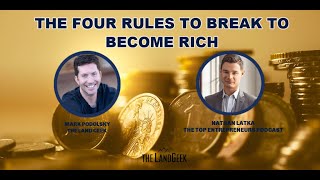
Nathan Latka, who built a software company to $10.5M from a $119 start, argues four rules to break for wealth: copy proven models instead of inventing, build systems not just chase goals, sell tools to trend-followers, and diversify income streams. He bought his first property with $40,000 down in 2014 and later deals with just $20,000.
Questions this video answers
19 years old.
$119.
$10.5 million.
More than $100,000 per month (passive income).
More than 10 million downloads.
Chapters
Hey, it's Mark Podolski, the land geek with your favorite niche real estate website, thelandgeek.com and on this week's podcast, I'm gonna put on my anchorman voice. He's a big deal, but I'd be remiss if I didn't properly introduce my co host. You know him, you love him. Scott Todd from scotttodd.net landmodo.com and learn anything about anything. Investor ninjas, the brain, the professor, the flight school sherpa. Scott Todd. How are you, Mark?
I'm great. How are you?
I'm a little intimidated by our guests. You know what I was doing when I was 21, I was drinking just in college, I was drinking chasing the coeds.
Chasing the coeds, huh?
Yeah. But our guest today just, you know, there's, you know, like, he's like a business Mozart. You know how like these guys like sort of self actualized very, very young and you're like, well, how come I didn't self actualize very young? Well, our guest I think did. Today's guest is Nathan latke from nathan latka.com. he retired at 29, but at 19, he founded a software company with $119 in his bank account. Five years later it was valued at 10.5 million. And he just realized something that few people know. You don't need lots of money or an original idea to get really rich. Now he makes more than $100,000 in passive income every month while also running his own private equity firm and hosting the top entrepreneur's podcast which has more than 10 million downloads. He also has a best selling book. This will show you how it went from college dropout to member of the new rich. And we're going to talk all about that. And Nathan Lacka, welcome.
Mark. I don't know if it's going to get much better than that. We should stop right now.
Well, we could stop right now, but we can't. I mean, Nathan, we're going to have to rewind the tape I guess a few years and just tell us how you kind of figured this out.
Well, I figured it out because I was studying architecture at Virginia Tech and learned very early on that I really liked money. And if you like money, it doesn't go with architecture because you've got to be like top 1% architect to really do well for yourself financially. So I went from flipping burgers at West End Grill in the mountains of southwest Virginia, Blacksburg, Virginia, was at Virginia Tech to eventually launching my own software company which was a form of recurring revenue. I didn't know it at the time, but I started off as an agency selling custom Facebook fan pages at 700 bucks a piece. Quickly morphed that into a recurring revenue software business that thousands of people paid $30 a month to use.
Unbelievable. So now then you morphed into real estate. Tell us a little bit about that.
Well, I felt. So I was 20, 20, 21 years old at the time. I'm 31 today. And I was concerned about my exposure to software only and said, you know what? I need to diversify into other asset classes. And so I reached out to one of the real estate agents in Blacksburg, Virginia, and said, listen, I know nothing about real estate, but if you find a good thing for me to buy, just let me know. I'll pull the trigger immediately. And so I went out and purchased this. And, guys, it wasn't fancy. It's not like a big, beautiful commercial lease. It was a crap hole. But this fraternity had rented this house for, like, tens and tens of years. And I'm going, these guys aren't going anywhere. And I like a predictable recurring stream I never have to think about. So that's how I purchased my first property on Roanoke street in Blacksburg, Virginia. It was a duplex, so there was two units, three bed, three bath on each side. There's a beautiful picture here, actually. I'm gonna Zoom in page 123 in the book, where you see the property, you see the down payment I negotiated, and you see the cash flow from the first month when I owned it.
Unbelievable. Scott, Todd, what are your thoughts?
Like, you know, one of the things that I think stops a lot of people is the whole capital thing, right? Like, everybody's starting at. I don't care how old you are. We all start at a certain place with certain limitations. And I'm just kind of curious, like, how much did you have that you could put down this property? Like, you know, like, did you have to put down the standard 20%, or what did you do? How'd you do it?
So I didn't know about this when I first started, so I'm literally now going to read to you the appraisal from February 4, 2014, that the bank gave me when we were negotiating the loan, the appraised value was $218,000. The loan amount was $166,625. So I came up with about $40,000 of my own capital to put down on this first purchase. Now, the second deal I did I only put 4, 5% down because I realized the trick was to go actually live in that unit for six to 12 months as your primary residence to decrease what you have to put down up front. And so the first deal I did had more cash. So someone listening might go, I don't have 40 grand, I can't do that. What I would tell you is just follow what I did a year after when I bought another piece of real estate and only put 5% down and only required about $20,000 worth of capital to unlock a cash flow stream that today generates three can free cash flow per month.
It's a valid point, you know, like, but how would somebody, Nathan, like you figured it out, but like, how would somebody figure out that one piece if it wasn't for someone like you to tell them, like, is there, is there something that we could unlock and say like, you did something pretty cool, you picked up the phone, you call a realtor and you're like, hey, this is what I'm looking for and whatever. I mean, I think a lot of times people are afraid to ask people for help, right? Like, hey, this is how much capital I have, what can I do with it? And kind of survey. Do you have any guidance on that?
You have to believe that you're going to be fantastically rich. So start telling people that you respect in the financial world that you're going to have a lot of money to invest, where should you put it? And they're going to start to give you ideas, but you have to say it confidently enough where they actually believe you'll have money one day to invest. Otherwise they're not going to waste their time on you. So it's. This is fake it till you make it approach, right? You have to believe you're going to have disposable income to invest in passive asset classes like real estate. Tell the world about it. Start collecting ideas, then pull the trigger when you're ready.
Nathan, you're so young. Did you have a mentor sort of helping you, guiding you? I mean, I'd imagine maybe your parents, maybe someone else who sort of inspired you to take this sort of, you know, capitalist path at such a young age?
I was 16 or 17. And like a rebellious teenager, I was rummaging through my mom's home office in our basement. My room, my where I slept was across from her. And as I was rummaging through her trash, I saw some receipts. I was curious. I'm like, what does my mom make? What does she do for a living? And he saw These receipts where she had essentially was billing out about $125 an hour. I also watched her every Sunday mow the lawn. And it would take her about four hours. And so I'm going, okay, four hours times her billable rate, which now I know is opportunity cost. Had no idea what that was back then. Was about 400 bucks to mow the lawn. And I thought I was genius. I went to her the next day and said, mom, I will mow the lawn for $200 because you can make $400 if I save you those four hours. She laughed and said, well, one, how do you know how much I make? And then I think she appreciated my approach. She ended up paying me 50 bucks to mow the lawn. So besides, the point, point being here is I watched my mom build this great company and it wasn't huge by any means, but she was, you know, selling her time for money and then eventually got into real estate as well. And so I learned from her at a very young age. Opportunity cost, passive income and capital leverage.
Yeah, I mean, you figured out really fast. So I know Scott, and I want to know, we could talk about how to be a capitalist without any capital. The floor four rules you must break to get rich. Let's just talk about those four rules.
Well, these are. So the book, first off, the book is. It really upset my publisher because it's not a book that's going to be timeless, Scott. Mark, have you guys written any books?
Yeah, we read all the time. No, no.
Have you guys written, have you composed? Have you published any books?
Yeah, yeah, I wrote Dirt Rich. I'm sure, Scott, you wrote a book, Rich.
Yeah, I wrote a book on peer to peer lending, actually. Yeah.
Oh, wow. Okay.
So timeless. Trust me.
Yeah, you're in it. But, but so like here's the thing, right? The publishing group that I worked with, you know, I was 27 when I got this book deal. I pre sold copies of the book, so I got a massive advance. It was well, you know, well above six figures. And they had to make sure that this book sold. And I said, guys, I don't want to write some timeless book that's going to be valuable 100 years from now. I want to do the opposite. I want to tell people if they don't buy it today, it's going to be useless in a year. So buy it today. Right. I wanted the urgency. And so, you know, as we were putting this book together, I said, how can I make this really urgent? And I said, well, let me just go through my Gmail inbox, my Google Drive, and just pull random Money stories. The Money adventures of Nathan latka from between 19 years old of age and 27 years old of age. And the book is a collection of strange things I tried to generate passive income. The ones that worked and the ones that failed. And then I found themes. And Mark, these are the four rules you allude to. The first theme I found was that we are told it's almost demonized if we copy somebody in school. If we copy test answers, you're expelled, right? If we copy a research paper in college, guess what? You're expelled. You're not getting a degree. It doesn't work like that in business. In fact, it's silly for you to try and launch something brand new when a competitor in your space has spent millions of dollars learning the space already. You should copy their exact product, take the money they've already learned, essentially save yourself that same heartache. And then here's the catch. Add your own twist that makes it unique. But see, most people think they have to start. Start with unique twist at the beginning, and they make up excuses of like, I'm going to do this little thing slightly different than our competitors, so that they can't say that we copied them. You have to lean into copying. So do not create something new. You have to copy aggressively.
Okay? I mean, Scott and I actually help people copy us, which leads us to our sponsor of the podcast, flight School. Learn how the next 16 weeks can transform your life. Go up the mountain of land, investing quickly, safely with Scott Todd, who's done this thousands of times as your Sherpa, and just follow Nathan's advice. Just follow his recipe. In fact, we're so cocky about it that if you do follow Scott's recipe, the investment, the tuition that you put into flight school, you're going to make back at 180 days or less, guaranteed by most people. Do it in eight weeks in terms or cash deals. Just show us your work. All right? Learn more. Schedule call. Go to landgeek.com training. Nathan, you just. You just lobbed that for me. So. So the first rule is like the Picasso thing, it's.
It. I mean, it's why you guys have so many downloads, right? You are basically saying, you know what? I have an abundance mindset about this. I know there's plenty of real estate deals to do, so that by sharing exactly how we've done it, it's not going to disable us to keep building this business because there's so much opportunity and so kudos to you guys for opening up, showing the playbook and letting people copy you in their own states or locations.
Thank you. Okay, so Scott, Todd, what are your thoughts on that first rule?
Okay, so I mean that, that is one of the things because Mark, you know my story is that I, I didn't want to work in corporate America, but I was like forced to because I couldn't figure it out. And I was always trying to come up with Nathan said his money making ideas, like I had these things flowing like I was an idea generation, like king for all these ways I could make money. But you know what, here's what happened is they always met a quick demise or dead end. You know why? Because I was trying to be unique. And when you're starting out, it's like it's rare that something is unique, right? Like it's impossible. Where I had success was copy and copy in the land business, right? Like that's where I had success in my own world. And then I did what Nathan said I put a little spin on. I mean, Tony Robbins says success leaves clues. I know what someone else who was successful did. Copy them and put in your own twist. That's what I teach too. So I mean, I agree. I think it's a good rule. What's number two?
I was going to say we all have that Apple Notes file saved in the middle of the night. When we have an idea, we wake up, we type it in there and we think it's a brand new beautiful idea. We come back to it a month later and go, we're going to leave that one in Apple Notes for a while and just stick to real estate because we know it works. So stick to what works. Add your own twist. The second rule that I really, I didn't understand until later on in life is there's a lot of folks that will tell you to focus on one goal. So this is how the ad model works in the United States. Rolex is going to spend $3 million sponsoring Federer at a tennis tournament to make consumers us desire a Rolex watch. They want us to plant that watch in our head as a goal of what to purchase. And we have the income to go purchase that thing. And it's very dangerous because a goal means your dopamine levels are going to spike and then collapse every time you hit a new goal. So you have to restart every time and figure out a new goal to go after. What's much more valuable is to invest in systems, the golden goose, and trust the fact that it's going to keep putting out golden eggs. So golden goose over golden eggs.
I love that. And again, you're really speaking our language because this is something that we talk about constantly, but we don't say it the way you do in the dopamine way. But we want to say, look, you don't want to be bulletproof in your business. The system and the process trumps everything else. And then you make your changes from there.
Scott Todd I call it the building the land buying machine. Right. I think of our business as an assembly line. I mean, I created process moto so that we could have an assembly line type of a process.
So.
So we're on the same page so far.
When you look at companies in my world, B2B SaaS, they get acquired for the most amount of money. It's always the ones that have the best systems. It's very rarely the best products.
Can you give us an example, Nathan, of a B2B SaaS that you really admire and why?
Well, I like to look at the financial event for founders. That's what I define as admiration. I don't admire raising VC capital and getting diluted. I don't admire working for for a board and losing freedom and control. I don't admire these things. I admire financial events for founders where they build wealth and they have more freedom. And so you look at a guy like Matt Rissell and how he built T sheets before Intuit acquired him two years ago for $350 million. He focused on one system, getting every new user that used tsheets to leave a review in the Intuit app store so that when the Intuit and M and A team said, who should we buy next? They saw his company, Smartsheet or sorry, tsheets at the top of their app exchange and guess what? They said, we want to buy this company because so many of our users already left five star reviews. That wasn't accidental. They built the company in the user flows to get these reviews to solidify that number one ranking. So that's an example in the B2B SaaS space of what I mean by invest in systems. Not the golden eggs, not the goals, not the outcome.
Fantastic. Fantastic. So that's. Those are two rules. So we've got number one is, you know, be like Picasso says, good artists copy, great artists steal. Number two is forget about the goals, work on the system. What is the third rule?
This third one is why the wealthy talk about hot topics to distract the masses from becoming rich. They don't. Wealthy people don't Want other rich people. It's competition. So what do they do? They propagate on cable news, Twitter, a hot topic, and everyone latches onto the hot topic without doing the underlying analysis of what's driving the hot topic. For example, one of the things that's obviously growing rapidly right now is a lot of people are investing in blockchain ether, crypto, Bitcoin, etc. So instead of launching and maybe putting a bunch of your own capital into those things because maybe you don't understand them, what if you built a piece of software that help people analyze trends over time related to bitcoin? You're selling the pickaxe to the gold miner. And so that's what's really important is when you identify a hot topic and all you have to do is go to CNN and refresh, look at the hot news today, and then say, what can I sell that's not the hot topic, but that the hot topic topic will need to survive and thrive. And that's where you can find a lot of wealth.
So pickaxes to the gold miners. Scott. Todd, what are your thoughts?
I think we're on a. I think we're on a trajectory where we are green so far. Like, I'm looking for a reason to nitpick these four rules. I'm not buying it, Mark.
I know. Isn't it terribly so young and yet so, so wise.
All right, let's see what the last one is.
I want you to, I want you to find some. I want to debate. I love a good debate. Maybe this last one will do it. Maybe this last one will do it for you. So this last one is.
I'm getting into debate mode here.
This last one, I sort of want to take you on a story. So, Mark, Scott, let's say we were on a road trip together and we're in the middle of Colorado and we're coming up on this bridge that we have to go over. And there's a sign on the bridge that says warning if winds are greater than 30 miles per hour, there's one point of failure. The bridge will likely collapse. If we sense even a slight before going over that bridge, how likely are we to actually go over that bridge knowing there's only one point of failure?
We won't go over that bridge, Mark.
Saying, screw it, we're going to go for it. What I would say is it's so silly to have a single point of failure. Engineers never build a building or a bridge with a single point of failure. It's always seven things that have to go wrong at once to destroy the architecture of the bridge. So why in most of our lives do we dedicate and have one single point of failure? Whether that's one job that we work for and relying on a pension, a 401k, or that's one business we're building, or it's one podcast we're focused on launching. This is the silliest thing you can do. And this is why many passive income streams are so important. You never want to be dependent on being really good at one skill because you have a single point to failure.
I'm going to argue, just for argument's sake, even though I don't believe my own argument. But before I do, Scott Todd, do you want to try to inject some argument or some tension here?
I would just, yeah, I would just put a little bit of an asterisk on this one because I do agree with you. I agree that it's easy to get caught in this trap where, okay, I work for a company and the old rule says, work for the company, the company will take care of you. Well, that doesn't happen, right? Like the company will get rid of you as quick, as quickly as they're done with you. And that's just the way that it is, you're gone. And then I hear the advice that you share about, hey, you know, you should look at multiple businesses. And I think that is a trap. I think that that's a trap that a lot of people fall into and only a few can execute on it. Well, and what I mean by that is a lot of times when people say, well, you should have multiple businesses or multiple streams of income, a lot of people, and I agree with you, but I think a lot of people look at that and go, oh, well, I need to be a serial entrepreneur. I need to have a landscaping business and I need to have a bar and I need to have like, you know, all of these other businesses, house cleaning business, all this stuff, and none of them work together. There's no synergies at all. And then what happens is they're out there, they're trying to create these businesses and they're not good at any of them, versus let's lay some foundations. Look, I'm gonna do the land investing business. Boom. I got the land investing business going and I'm going to build some passive income or I'm going to build multiple streams of passive income through my properties, maybe through choose some different states, whether different economies, whatever. But then the other thing, I'm going to do is I'm going to add this thing that runs parallel to this main business, and I'm going to add another parallel line like the water system. They all end up connecting to each other all these pipes, but then they all allow the water to flow. So, like, I'm thinking that's what you're saying, but that's where I got to push back a little bit.
Mark, do you agree with Scott? Are you pushing back to.
Okay, so I agree with Scott. So my first mentor or I would talk to him about all these ideas. He's like, mark, remember you were a little kid and you'd go out to the playground and you take a magnifying glass and you try to kill an ant. He's like, what happens is a lot of people take that magnifying glass and they move it around ant to ant to ant. It generates a lot of heat, but you don't ever end up killing an ant. He's like, kill an ant and focus first and then go to the next ant. Focus. So I would say I like what Scott said. I think he said it in a way more articulate way than I would have. But I 100% agree with the single point of failure idea as well. So I like the idea of multiple streams of income. I just would put Scott's spin on it, saying that there should be some synergies. You should be adding value. Personally, you should actually have. There should be something about you that you have an advantage in. Because if I go into the B2B space and I start competing with Nathan Latke, because I just heard this podcast with him, I'm not going to be as effective as I would be if I went into something where I had of an advantage, like maybe another income stream in real estate where I understand it at a deeper level based on my experience. Does that make sense?
Yeah. I mean, let me give a tactical example here, right? So with your ant example, I would just say, make sure you have a magnifying glass in both hands and try killing two ants at once. Right? So if one fails, right, you still got one. You're working on burning the. The equivalent to business. If you're listening right now and going, I'm really good at this one thing. How do I diversify? A lot of people do what Scott said. They try and launch a landscaping company when they have a jewelry business. It makes no sense. What you should do is email every customer that's paid for your jewelry business or your piece of jewelry and say, hey, what other jewelry shops do you shop at and then either go buy those jewelry shops hire their talent, create a necklace that looks similar to other ones they've purchased. So you should use whatever current list you have, customer list, affiliate list, whatever, to ask what, what other tools in our space are you using or what other things are you buying? And then go build those things to make sure you're building adjacent things to your main thing. And so I think that's sort of a healthy parallel between Scott, what you're articulating and my approach, which is you never want to depend on one thing because what happens is if you do that and then your main jewelry shops fail because maybe a global pandemic hits. Well, guess what? You built this drag and drop to redesign tool piece of software that a lot of your customers were already using, and now you can build a software business while your brick and mortar one is shut down from a pandemic.
Yeah, this has just been phenomenal mentorship, Nathan. But before we get to your tip of the week, I have one more question for you. What's the worst advice you see or hear given in your area of business expertise?
Man. Well, those, that's a tricky question because that is exactly how we wrote the. Were those four like, don't, don't focus on one thing. Don't come up with original ideas. Right. Do not follow the hot trend. Don't, don't try and hijack that trend. I'm trying to think of a unique new thing that is not or not one of the four ones a bad piece of advice. You know, I think a lot of.
Let'S, like, what's the common complaint? I'm sure you get people emailing you all the time. I've read the book, but I don't get this or this is, you know, I've done this, this and this. It didn't work for me. Something like that. I guess maybe I'm just gonna, well.
That, that happens all the time, right? But like I've, I'm so competitive that I, I, I have something that fails all the time. I just keep going, right? So like that, that's just the advice there is. Like, keep trying new things because momentum is king. It only takes one win out of a hundred tries, right. To for having be on the COVID of the paper. I think the piece of advice that I've gotten that I think is terrible advice is a lot of people think you just need a sort of a mentor or an advisee. And like a lot of these mentors, they don't do what you guys do. They're not sharing the deal of the week. Right? They're sharing some success story from 10 years ago and saying, hey, you should do it the same way. And it's terrible advice. So just be very careful with the information diet you let in that brain of yours. Make sure it's people doing urgent, timely things today, not advice of how they had success 10 years ago. That will not be relevant for you today.
Okay, that leads me to my last question then. I'm throwing you on a desert island for a year, and you get to take one book to really, really absorb, and then you're going to come out of that desert island and then keep building the way you're building. What book would you bring?
In 1982, a bunch of very, very wealthy private equity guys attacked Walt Disney. They felt that the real estate value of the Walt Disney holdings was worth more than what the company was being traded at. And they tried to basically take over the company. Walt Disney is a creative genius. And so the book Storming the Magic Kingdom is a great mix of financial literacy, green mail, stock buybacks, this sort of thing with Walt Disney fighting off these financiers with creativity to ultimately save Walt Disney company. And so Storming the Magic Kingdom is the book I would take with me. I read it at least once a year.
Storming the Magic Kingdom. You know, we've done a lot of interviews. You're the first one to bring up Storming the Magic Kingdom. And Scott Todd is a huge Walt Disney fan.
Scott, have you read it?
Never even heard of it.
It's a very. I don't know if you can even buy it anymore. It's an indie book I found in a random bookstore. The COVID art is beautiful, but it was published back in 19. 19. 84. 85, I think.
I'm buying it right now, actually.
Are you getting it right now? All right, I gotta get it. I'm getting. I'm getting Nathan's book, and I'm getting Stormy the Magic Kingdom. Fantastic. Fantastic. Well, I. Does that count as his tip of the week? I don't think so. I'm gonna keep. Let's just. Let's just work Nathan.
Why?
You know what? Why not? He's got the energy. All right, so, Nathan, we're at that point now. We're gonna ask you for one more tip of the week. A website, a resource, another book, something else actionable for the art of passive income listeners to go improve their businesses, improve their lives. What have you got?
Yeah, I would say instead of spending 24 bucks on Amazon to buy my book like this. I basically fought like heck with the publisher to put a lot of it for free up@nathan lacka.com so I encourage you guys to go to Nathan. You'll see screenshots from the early real estate deals I did. You'll see screenshots from my Stripe account on my software companies, how they make money. You'll just get a bunch of money making passive income ideas@nathanlaca.com and again, that helps you, again, save 25 bucks from buying the book at all.
All right, fantastic. Scott, Todd, what's your tip of the week?
Mark, Check out this website with Persona.com. you ever heard of this place? I have this website.
Is it Persona or Persona? Persona.
Persona. Sorry, Persona. So look, here's the deal with this website with Persona.com is you can go there, you can sign up for a free account and basically what it will do in the starter. The starter plan, which is the free one, you could basically do 500 government ID checks on people per month in order to verify the person that you're dealing with is legit. Okay. Like a real person. So, like, in our business, we don't do background checks. We don't do credit checks. Like, oftentimes. Like, how do I know that the person I'm talking to is really the person I'm talking to? Like, that's kind of weird to me sometimes. So here's a tool you can put into your tool chest to figure out. Like, man, I can just go over there and have someone do a selfie picture and it will tell me if the person. Person's legit or not. Like, that's pretty cool.
This is really cool. And this is free.
Free.
This is free.
So, you know, we.
Mark, Scott, we use Persona, by the way, I don't know if you know this, so I have a company where I let. I lend money to software founders, and you can get capital very quick. Basically, if the software founder has a customer paying 500 bucks a month, we'll give them the annual cash for the monthly thing up front. So it's. We'll give them 5k. It's a lending product. One of the quick ways that we make the checkout experience easy for the founders to get that capital is we have to do identity verification. So we use Persona in the user flow actually, to make this very quick, very simple. And identity management is key for me to be able to build $100 million of loan tape into the B2B SaaS space.
Wow. There you go. All right, well, My tip of the week is going to build. I'm going to build off of what Nathan said. Rule number two, build systems. And Scott Todd hasn't been tooting his own horn about this, but he's coming out with Processmodo.com and I'm telling you, Nathan, you've heard of what's, what's the. I use them even. What's. What is it, Scott?
Process suite or processor?
Process St. Process street. This destroys process straight. And it's incredible. If you are building a team, if you are going to ignore the dopamine hit of goals, you want to start building systems and processes, go to processmoto.com and set up an account. It is a true, as Mike Zano would say, game changer. It's a game changer.
Mike Zano is loving life and don't processes like crazy over there. And look, I, I mean Nathan gave me a golden nugget there. He's like, you know, build systems because, and I quote it right here on the T sheets sale. The best system sell companies, not the best products. Bam.
That's all you got to do.
Best systems, baby.
Yeah, but I, you know what though? I still want to be a. I still want to be a capitalist without any capital. I still want, I want to have Nathan Lacka on my, like, you know, my bookshelf and then I can look at it and then kind of like shame my kids. Like, you know what this guy did at 19.
So whatever.
Go hustle kids.
Do not flip to page 243. That is the page that when parents buy the book for their kids, the kids always spend time on page 243.
Okay, look at that tease. Look at, look at the, look at that.
He's a brilliant marketer.
Buy the book to go read what 243 says, Mark.
Yeah, it'd be great. Can I just buy. You know, there's actually a site you can buy stock in human beings. It's usually for younger kids who want to go to college. You put money in and then they come out of college and then you get a piece of their earnings. I want to buy Nathan Lacka stock. He's still young enough. Can you imagine, like the growth there?
We're looking at doing this with a company called B Roll. The problem is I can't sell it as a security without financial disclosures and a bunch of regulation. In other words, I couldn't sell stock in Latke for a cut of future revenue streams I make because then it's a security. So I need to figure out a way to price the token, the Latke token, in a way that is not tied to future income.
See, he's already thought of it. All right, well, I want to thank the listeners and remind them the only way. The only way we're getting quality guests like Nathan latka from nathan latka.com, is if you do us three little favors. You got to subscribe. Got a rate. Review the podcast. Send a screenshot of that review to support@thelandgeek.com we're going to send you the $97 wholetailing course, how to Double youe Money, 30 days or less for free. So please do it. We really appreciate it. Nathan Latke, are we good?
You guys are great. Congratulations on the success. I looked at reviews before I agree to this podcast. I do not agree to all podcasts. You guys have an amazing. Not only you guys talent, but the listeners. They're savvy, they're talented, and they're going to do big things over in 2021.
Thank you, Scott. Todd, are we good?
We're good, Mark.
All right, you guys ready to do this? One, two, three. Let freedom ring. Nathan's like, you know, if I knew you guys are gonna end like that, I don't know if I would have.
Come on, he would have been here. Trust me, he would have been here.
He's good. All right, well, Nathan, thank you again. Thanks, everybody, and hopefully we'll have you back on to talk about the next big, you know, startup or whatever else you're building. So thanks again. Thanks for listening to the Art of Passive Income podcast.
Start your journey at www.thelandgate.com and www.scotttodd.net.
Rate and review the podcast and email supportthelandgeek.com your screenshot for a free passive income launch kit.
More from Mark





How to find funding partners: How to Scale Land Without Using Your Own Capital


