What Makes A Good Client For A Virtual Assistant?
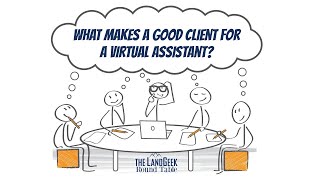
Kishan Henry and other VAs explain what makes a client easy to work with: clear communication, trust, and appreciation. They recommend using Draw.io for process diagrams and Microsoft Teams for workflows, and emphasize that VAs work best when clients give them the full picture and let them solve problems.
Chapters
Land Geek Nation. Yaman. It's Mark Podolski, the Land Geek. Their favorite niche real estate website, thelandgeek.com and on this week's podcast, it is the Jamaican podcast, the Jamaican Me Crazy podcast. We've got almost all the usual suspects. We have the technician, Eric Peterson. Eric Yaman Wangwan. Hey, Mark.
Glad to see you haven't left the beach.
Yeah. For those of you who are not watching on video, which is probably most of you, I have a beach background and I have dreads and a Jamaican hat on, so it looks amazing. Thank you, thank you. Which is the Zen master? Breathe in the mail and breathe out the marketing. Mike Zato. Mike, how are you doing?
Great. How could I not be smiling right now?
It's good to see you.
It's good to see you. I've got my breeder, my Breda. I love it when you call me Big Papa. My scuba certified buddy, Tate Litchfield. Tate, how are you?
Blessings, man.
Blessings, blessings, blessings. We've got Kishan Henry, who works for Tate and Rossi on the land geek side. The frontier side, our super extraordinary virtual assistant who lives. Kishan, where do you live?
Manchester.
Manchester.
Manchester, Jamaica.
And we just spent a week in negro Jamaica with Kishan. And last but not least, you know him, you love him, your flights go Sherpa, the brain, the professor, Scott Todd from scotttodd.net landmodo.com learn anything about anything except how to be as cool as me in Jamaica and Tate and Kishan and Ross and garrett@investor ninjas.com Scott Todd, how are you?
I have no words, none for this event. And I wasn't sure if your Jamaican accent scent was blending in with. With Mike Zaino's accent. I mean, Eric, you heard it too, right? He went a little like he was going to go for Mike Zaino and then he flipped it back over to Jamaican Scott.
Todd, move your bumble clap, man. I'm not having it.
I just.
I just wanted to make sure that Kashan understood. Like, this is your thing, Mark, that you. You. You take on these accents and you. You try to make them your own. So, you know, she shouldn't be offended or anything, right? This is just who Mark is.
I can attest to my Jamaican accent is actually spot on.
She's not offended. He's been doing this for a while. He's been doing this for seven days straight. We touched down in there and it was like, here we go. Here we go, baby.
But we actually do have a topic, so we are going to actually each have a Question about what does it take to be a good client and work with a virtual assistant like Kishan? So we want to hear from it from actually Kishan's point of view. So I know that you guys are like, I didn't know I would have to come up with a question. So I will start as you think of your question. So, Kishan, what would you say is your biggest headache working with your clients? Like, what is it like? Like, when they do X, you're like, oh, man.
Okay, I really.
I really want to say move your bubble clot, but I'm not going to.
Please stop. You know, that's not good. But my biggest headache with working with clients is when they lack communication. I am someone who really, really loves to communicate with my clients. So when I'm working with a client and I can't get in touch with that client, that is something that throws me off, and that's something that I do not like at all. So that is my biggest headache, working with clients when they lack communication.
Lacking communication. Okay, so give us an example in real, a real life example of a task that you were assigned, and you're like, oh, I need more communication.
Why do I feel like I'm in the hot seat right now?
You're not in the hot seat.
I feel like I'm in the hot seat right here.
It's not. It could be her other. It could be the other people she works with in the office are complaining to Kishan about their clients.
Okay, good.
Yeah, I'm gonna give her an easy one. I'm gonna give her an easy layup here. Okay, so Tate will. Will ask her to do something, and that involves me. And then I'm busy, and it drives her crazy. She can't get to me.
There you go. That's a perfect example.
And that makes me her favorite client.
Not really.
What.
She just said not really.
No Scott, no cry. No Scott, no cry. Wow. The truth hurts, Mike.
I guess I'm not compassionate.
So an example would be Theresa and I work very closely with Scott and Tate, so most of the time, we have to communicate together. So there are times where Theresa will communicate with Tate and I would have to communicate with Scott. Todd. And usually I could easily box, and he would reply, I would say quickly. But with Scott, hard, it takes a while, and then I have to wait. And that task is just lingering around because I can't get access to Scott talk. So that's where lack of communication comes in. And that's the headache.
Hi, Scott, would you like to send her some Tylenol or some motor.
Because.
Because I'm busy. I don't know. Like, I don't know. I'm busy, dude. Okay, let's see.
All right, see, the energy is dropped.
The energy has dropped in this room right now.
Here. Here's what I'm gonna have to do, though. I'm gonna fix it. Here's what I'm gonna do. I'm gonna fix it, and here's what I'm gonna say. Whenever you need me, just tell Teresa you need me, and tell her that she can make whatever decision she needs to make.
Okay? I think that's what I've been doing. And it works.
See.
Let'S talk about that. Because that's how, you know, you're working with somebody who is, you know, a special. A special va when they can. You can give them instructions like, hey, figure this out, right? And, yeah, communication is key, but one of the things I love about working with Keshan is that she solves my problems. Right? And if she needs help, she'll ask for. But also she's willing to say, you know what? How can I get the best or most accurate answer I can possibly find for this problem? And then I'll run it by Tate and see if he's okay with it. And that's how you work. You know, you're working with, like, the dream team. So.
That's a good point. That's a good point. I bet you the Zen master has an excellent question because he's got a virtual assistant team.
Yeah. So, you know, I had one, but this one just.
Just.
Just popped up. I think this is probably what's the best way to show appreciation to your va? You know, you really. If you enjoy what they're doing, is it. Is it a bonus? Is it. Would it be a gift? Like, that's maybe something that they would like. What would be the best way that I could. And this is. This is important for me to know, right? What's the best way I could show appreciation to my vascular.
Well, it can be whether monetary or just content words of appreciation. A lot of VAs like to know that they're actually doing really well for their clients. For example, for myself, when I'm left to make decisions, when it comes to Frontier or the Langeek, I get pretty nervous sometimes. But even though I run into things, I want to know that, okay, at the end, the end result is what he needs. And if he'll say that, Kishan, you did an awesome job, then that makes me feel appreciated. That makes me want to work for him more, and that makes me want to even push harder at my job. So word of appreciation. Sometimes it can be monetary, but I believe, having been told all the time that you're doing a great job is something that a lot of VAs really, really like to hear on a more regular basis.
All right, and so, as a side note, question. A lot of people think of Tate as intense, so he's really actually very nice and compassionate. Is that what I'm hearing?
I think Tate and I understand each other well. And because I do not feel like I have bosses, it helps a lot because we all build a type of relationship where there's understanding with that. It makes me very comfortable working for both Mark Gracie and Tate. So I think building a relationship that is very, very, very important, where the client builds a relationship with the VA so that there's a level of comfort working with the clients. And I can tell you, I can guarantee you that you'll get the best results out of your bas when they're very comfortable.
Excellent.
Excellent. All right. Well, that's really good. I was gonna ask another question, but I'll leave it at that. I don't want to poke the bear anymore. The bear being Scott Todd. I learned my lesson that a long time ago.
So I will back around you, Mike, to poke, because we have to go to the technician, Eric Peterson, and see if he's got a question for Keshe on. Sure.
So I think that a common thing that we see with our students and others in the community is how do I work with my va? Like, I understand communication is important. Without that, nothing's going to get accomplished, but I've hired a new VA to do this task. How do I train them? What's the best way, in your opinion, to for a business owner to come to a VA and train them how to do a new task that maybe they're unfamiliar with? Are there certain tools, are there certain techniques, etc.
I would say depending on the task, but I remember when I just started working for tape, I was not familiar with the land business. However, he had processes, and he had videos that would demonstrate how this task is done. And then over the years of working with them, I develop the confidence to say, okay, then I can take on this task by myself and then run it to chase. So having training material that's important to have, especially if the VA is not familiar with the task that you're giving he or she to also, again, try to develop a bond with their VA from the start. So it Will be okay to ask question, Eric, is this how it's done? Eric, can you guide me a little more? And so I think that's one of the most effective way of training a va. Allow for them to feel comfortable in a sense. Not to say that you're going to spoon feed. That's the Jamaican term, because at the end of the day, you're paying them to do the work or the service that you need to get done, but in a way where they do not feel like, okay, they're being trained in an autocratic way. So, yes, having training materials as important, having a level of understanding with your VA that is also important to know. Okay, what do you already know? What do you need to know? How can I help you to learn this? And how will you be able to execute it to the best of your ability? And so I would say those approaches were what you need to take in order to train your va. Well, that's how I was trained.
All right.
Fantastic. Fantastic. I love it when you call me Big Papa. Tate. Literature. Now, Tate, I know we've spent a week with Kishan, so you probably don't have an actual question for her, but for the sake of your coaching clients, what do you think they should know? Or what do you think would be a good question that they could ask Kishan about? What's it like working as a virtual assistant in the land business? Something that we could all benefit from.
You know, first of all, Kishan is absolutely amazing, and she's so, so talented. And we've been working long enough. And this is kind of what she alluded to. She can kind of read my mind a little bit. She knows what I'm going to say and how I'm going to react to things. And I think that that's the kind of relationship everybody should be looking to establish. And, you know, every VA is going to respond differently. You know, I know Kishan. I kind of know how to. I know how to push her and make her feel a little bit uncomfortable and get her to think outside the box a little bit. And that's what I want. I want her to try. I want her to make tweaks, and she doesn't always need my permission. And so one of the things that I would just encourage everybody listening here to to do is or implement is chat with your VAs, explain to them what the big picture is. And if they understand what the big picture is, allow them to maybe try new things. For example, you know, we work with the deal of the week, right? And we send that email out all the time. And Keshan oversees that. She came to me recently and said, hey, Tate, we're not hitting the numbers. I'm satisfied with. Here's what I'm going to do. And it was amazing because I didn't have to tell her to go out and solve these problems. She looked at it, she was reading the metrics, and she said, we can improve here. And it didn't happen overnight. Right. We made a lot of mistakes along the way, but she educated herself. She dove deep into the analytics, she dove really deep into YouTube University and learned a lot of new things. And as a result, we are reaping the rewards of that. You know, you gotta understand that your VAs are very, very talented people. And one of the things I would just encourage people to do is, you know, have them set up, have them understand what the objective is and then allow them to, you know, perfect it. Because the way that I do things might have been the best way four years ago, but technology changes and she's on the front lines. She sees this, and so I've got no issues trusting her. And so trust your VAs. Once they've earned it, trust them. And sorry to everybody out there listening to this. No, no, no. You cannot work with Keshon. I'm sorry, there's no room. She's busy and she's just not available to you. So, sorry, everybody. I know that's gonna be in the comments. I wanna work with her. Too bad. No, not happen in mine.
No way, man. Yeah, absolutely no way, man. So, Scott, Todd, hold on, hold on, hold on.
Before you come to me, I did not hear a question. Did anybody else hear a question come from Tate?
I thought Tate gave a lot of valuable information, but what's his question?
My question.
Yeah, that's the game we're playing here.
All right, all right.
And to be fair to Tate, like, we gave him about 30 seconds prep time.
My question.
My question is.
Can we just buzz him out? He has no question.
Listen, I'm out. I'm out. I'm passing, I'm passing.
I have a question.
No, Mark.
I have a question for Kishan on behalf of Tate.
No, hold on. What I realized is Scott wants to ask two questions.
I do not. No, I think I'm going to follow your lead and just give a lecture, give advice.
I have a question for Kishan, okay? In Jamaica, who do you think had better food taste, me or Tate? And by the way, I know the answer.
Can I say both? Equal taste? Because you all ate the same Thing.
The real question is, who's the better domino player?
All right, Garrett is the better domino player. In Jamaica. We just learned. Okay, I'll tell you. I'll tell you a quick Tate story. So first of all, he finds Mama's Lobster Shack next to our resort in the grill. And to say that Mama's was one of the best lobsters I've ever had is not giving Mama credit. It was phenomenal. My one complaint was it was slow cooked. It took about two hours, but it was worth it. But I would say to give Tate credit because he's a fisherman. The next day, when we went back to Mama's, Tate specifically asked mama, I want parrot fish. Sure enough, this was the most delicious fish I've ever tasted. So if anyone ever wants to rip on Tate and his epicurean like skills, you're gonna have to. You're gonna have to talk to me about it.
There's no way that was a good choice. State. I wish it was my first aguinald and it definitely won't be my last.
It was tasty, that's for sure.
It was really good.
We could have skipped Boobique island, but that was my fault.
Yeah, yeah, but with a name like that, how were we not gonna go, right?
Yeah. Yeah. So it was like a 20 minute boat ride to this. Was it even 20 minutes? It was like maybe a 10 minute boat ride to this island. And all they did was cook lobsters. So fresh lobster they had. We. We held the. The live lobster and they cooked it. I thought it was very good. Kashan was not a fan. Okay, Scott, what's your question?
All right, here's my question. A lot of times, in my experience, a lot of times, someone working with a VA for the first time, what will happen is that the. So the client basically, you know, once this task done, whatever it is, and it can be an entire project task. So let me pick on like due diligence, for example. You know, due diligence.
Some.
I say I want all my due diligence done. Great. Or, yeah, we'll just go with due diligence. And so, you know, due diligence is many different steps. Right? And as a. As somebody that you. That you're beginning to work with for the first time, you know, would you rather that some of that work get turned over in fragments or pieces? Like here, let's just do this segment first as opposed to the entire project. And you know, you got to understand my question is very vague and it's specific towards due diligence. But it's vague in the aspect of. I'm always a big believer that I should turn over work to a va or someone I'm working with kind of in pieces so that they can come up to speed a little bit to give me the patience and to give them the time that they need to kind of do the job. Do you prefer that approach or would you rather me just say, hey, here's the entire thing I want you to go do, go do this and let's just see how it works out. Which one would you prefer?
Okay. For me, I prefer to research and find things out on my own. But for other bas, I would say, for example, my co workers, I would say in pieces, in processes, allow for them to learn before because at the end of the day, you want to make sure that each part that get back to you is done to the best of their ability. You don't want to get like an entire project and it's just all a mess. So it's just work with them piece by piece until they get it so they can provide to you the best results. But for me, I like to get everything because sometimes my clients will not be available and I do not like to have work lingering around. So getting everything allows for me to go do my research and then when I come with the entire project and I'll ask my client to look over, give me the corrections and feedback that I need and then I'll make the correction. But I think taking things by stages for a lot of VAs that I would recommend that.
All right, there you go.
Scott. Todd, great question. Blessings. Blessings, Brenda. So we are now at that point in the podcast. Kishan, your mentorship has been so valuable, but we are now going to put you on the spot and ask you for your tip of the week. A website, a resource, maybe a book, something else actionable for the art of passive income listeners to go improve their businesses, improve their lives. Kishan Henry, all the way from Manchester, Jamaica. What is your tip of the week?
Okay, so I have two tip of the week rather. The first one is a free online software diagram tool that we utilize a lot in our business is Jaw IO. We use a tool to create our swim lanes and for that we use a swim lanes, basically design processes that allows for operation to run smoothly. So that is Draw IO how do I spell jaw? D R A W dot IO G.
A R W D as in David, draw a picture.
Draw.
Oh, draw a dot.
Yes. It's a free online software and we use that tool to create our Swim lanes for business processes. And the other tool that we use is Teams. It's a part of the Microsoft suite. We use it for communication with, well, internal communication, but it's also a very, very effective tool that can be used for clients as well as their bas. Because. Because you can call them, text them, and so forth. We use it instead of Zoom because it's so quick. And at the same time, we can all be talking all together too. So that is also another software that I would recommend when it comes to clients and their VAs. So get rid of that dent in the communication process.
Okay, I just got lost in Draw IO. What was the other site?
Teams. Yeah, it's a part of the Microsoft suite.
Oh, Kishan, don't make Scott Todd happy and Mike Zado happy with your. With your Microsoft Teams.
Best tip. We've had a long time. Love it.
It's very good. It's a very communication tool, and a lot of clients need that tool with their piece. Improve those communication, their relationship.
You like Teams more than Zoom?
Yes, I actually don't use Zoom at all. I haven't used Teams.
Okay, there you have it. Draw IO in teams. Well, this has been a phenomenal roundtable podcast. Kishan, thank you so much. I said it all week, but I'm gonna say it again. We appreciate you so much. You are a pleasure to work with. Tate and I and Rossi are so lucky. And the only bad thing for you is you can't work with anyone else.
I understand that very clearly.
Okay, great. Great. Eric, are we good? We're great. Mike, are we good?
Best podcast ever.
Your accent.
Good man.
Scott Todd. All right, well, I want to thank the listeners. I want to remind them that the only way Kishan will come back is if you do us three favors. You got to follow rate, review the podcast, send us a screenshot of that review. Support helangleek.com and I'll send you for free signed copy of Dirt Rich. If you want to learn more about how to build an actual business, not another job for yourself, but an actual business, I highly encourage everyone to go to landgeek.com training schedule. A free call with the Zen master or the nightcap OG dude buddy, Scott Bossman. And learn more about how Scott Todd will take you up the mountain of land, investing quickly, safely, and efficiently. The tuition ain't going to cost you nothing because we guarantee you're going to make that back. All that money, 180 days or less, just shows your work the landgeek.com trading. All right, Keshan are you ready for this?
Yes.
One, two, three. Let freedom ring.
I thought you were going to say one love.
We are saying one love.
One love. That's right. I forgot to say one love.
Thank you guys for having me.
Thank you, Kashan. Very nice to have you here.
Thanks, Kashan.
Thank you.
Bye. Bye.
See ya.
Bye. Thanks for listening to the Art of Passive Income podcast. Are you ready to learn how you you can start building a passive income without renters, rehabs, renovations or rodents. Schedule a free consultation@thelandgeek.com training let freedom ring.
More from Mark



How to find funding partners: How to Scale Land Without Using Your Own Capital




