What Makes Mobile Home Real Estate Investing Such A Great Business
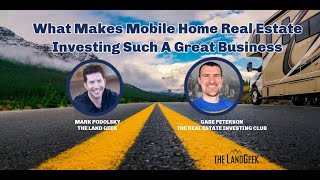
Podcast interview (hosts Mark J. Podolsky and Scott Todd) with guest Gabe Peterson (founder of Great Northwest Home Buyers; host of The Real Estate Investing Club). Gabe recounts his transition from consulting and e-commerce into real estate, moving from triplexes and flips into mobile home and RV park investing. The conversation focuses on why land-lease communities are attractive (lower structure maintenance, strong cash flow), practical sourcing channels (PPC, RVM, texting, direct mail), heavy emphasis on systematic, long-term follow-up, and use of seller financing; closing includes resource recommendations and tips-of-the-week.
Chapters
Hey, it's Mark Podolski, the land geek. Your favorite niche real estate website, thelandgeek.com and on today's podcast, I'm super excited to get some wisdom, to get some more knowledge about all types of real estate and investing classes. But I'd be remiss if I didn't properly introduce my co host, the brain, the professor, your flight school sherpa, Scott Todd from scotttodd.net lanmodo.com learn anything but anything. Investorninjas.com Scott Todd. How are you, Mark?
I'm great. How are you?
I'm good, I'm good. I'm a little annoyed at how incredible your video and audio setup has evolved. I'm like a dinosaur talking to basically someone that's time traveled. You're years ahead of everybody.
Well, thank you, Mark. But you know, if, if you want to buy my course on how to create the best video studio ever, I'll make it available to you.
I would love it. Is it on investor Ninjas?
It will be at some point.
Well, fantastic. So our guest today is Gabe Peterson from therealestateinvestingclub.com if you're not familiar with Gabe, he's the founder of of Great Northwest Home Buyers, a principled equal housing group and most importantly, the host of the real estate investing club. Gabe started out his career completely oblivious to real estate as a path. He got started as a management consultant for Fortune 500 companies and worked the cubicle life for over seven years. After working for the man, he bought his first triplex in Tacoma, Washington. And the rest is history. Gabe has extensive experience across many different asset classes and strategies. And then Gabe decided to start what you know, today as the real estate investing club, podcast and YouTube show. Gabe Peterson, welcome.
Thank you very much, Mark. And yeah, I, I, I do have to corroborate Mark's statement. Scott's video is a little bit better. So he, he did nail it. Thank you.
Yeah, yeah, you know, let's not, let's not just turn this into the whole Scott Todd show. Gabe Peterson. Let's just rewind the tape and, and kind of tell us a little bit about your cubicle life. Working as a management consultant and then what sparked your interest in getting into real estate?
Yeah, yeah, for sure. So yeah, I mean after college I graduated with degree in philosophy. I thought I was going to law school and I went, I shadowed some lawyers. I realized this is not the life for me, this is not what I want. So I didn't really have a purpose, didn't really have a direction. Graduated college and the first thing that popped up, a friend got a job at Accenture, which is this big consulting firm out there. And he said, this is a fun gig. You get to travel a lot, you get a decent amount, you know, they pay you pretty well. So I should. Sure, let's do it. I jumped on, got a job as a consultant and I worked a few years. The first year or two was good, but I really started to rag on me because I didn't like the commuting. I didn't like that you just had to be at a location for eight hours regardless of, you know, what kind of work needed to be done. And it just, over time I just really, I didn't like the job. I didn't, I didn't like working in the corporate world. So I started kind of looking for different ways to get out of that environment, get out of that as a career path. And I actually. Real estate was not the first thing that I started. I started in E commerce and digital marketing. I started my own store, brought that up to about 20,000amonth. But it turned out not to be a good fit either because again, I was just stuck behind a computer screen, you know, all alone in my room, not really doing, interacting with other people, which is what I really enjoy. But then I read Rich Dad, Poor dad, which kind of got me, got that spark going, gave me the kind of the framework to kind of go forward in real estate. And I met a few people that were having some good success in real estate, which gave me kind of a model that I could look at and be like, yeah, it does work. So then I bought that first triplex that I was talking about and I mean there's a lot of different turn, twists and turns since that point, but it eventually led me to mobile home and RV parks and that's where I am today. Wow.
I can't tell you how many people we talk to, myself included. With that Rich Dad, Poor dad book was the impetus to create passive income and get in to real estate in a big, big way. Not, not passively, but like as our full time gig. And yeah, it's just. Yeah, it's one of those mindset shift books.
Yeah, yeah, mindset is really what it is. I tell people like when they want to know how to do real estate, that's not the book to go to. But if you don't really understand, if you don't see the potential of real estate, pick it up because it is a great. It really outlines how real estate works and why it's beneficial and why it's a good path to go down. So I always recommend that book to people who are new to the space.
Yeah. Scott, Todd, what are your thoughts?
I think that Rich Dad, Poor dad clearly is kind of a game changing book. Right. I think that a lot of people who are doing real estate investing today or businesses, they all, you know, have maybe started with that Rich Dad, Poor dad book. I think that the, I think that the cool thing that he did in the book, honestly is that, you know, he outlined that there is a difference, there's a difference in mindset, there's a difference in mentality of the way that you do things. And you know, I think that really, to me, the second best or really the best book that he wrote was the second book, the Cash Flow Quadrant. The Cash Flow Quadrant, you know, as it talks about, you know, whether you're an employee or self employed. And then on the other side of the equation is the business owner and the investor. And he basically showed like the minute he showed the tax rules and the life is different on the right side of the equation versus the left side of the equation, man, I wanted to be on the right side badly, badly. And I think that, you know, you get that. And there's one line in there that I'll never forget that he, that he wrote that basically said that what makes, what makes for a business is systems. And basically what makes real estate such a great business is that it, that each individual unit or each thing is a system. Electrical system, plumbing system, the entire house is a built in system. And the minute I read that, I was like, wow, alone.
Yeah. So Gabe, let's talk about your system. So you've invested in all these different asset classes. Walk us through it and then walk us through your strategy now. Like why mobile home parks and RV investing as opposed to say, apartment buildings?
Yep. Yeah, no, I really like mobile home RV parks. So I started, the first thing I did obviously was single. Actually, it wasn't, it was small, multifamily, but you can consider triplexes, essentially single family. And from there I got into wholesaling and flipping houses. And that is, I mean, it is. You're in real estate and so if you haven't had any experience, I feel like that you can get your hands dirty there. But it is a job. It's like, it's work. You're out there, you're doing the work, you're getting the, you're marketing for properties, you're project managing all this stuff. You, you can Set up systems to do that well, but I didn't get to that point. It just kind of dragged me out. And so I was kind of thinking, what can I do that has less active components to it? Like, flipping houses is a very. It's very intensive. Like, there is a lot of work that goes into it. And I wanted to hold onto properties. I had a couple small single family duplex that I was renting out. But again, there's a lot of work that went into it because things would break, like the toilet would break or the sliding door, whatever it may be. You know, tenants call you, they have issues with the house and you got to take care of it. I didn't have a property manager. I was doing it myself. And so I dealt with all that and I really felt the issues pop up. And so then I met a friend who had taken Kevin Bupp's course. He was a big guy in mobile home parks and he kind of sold me the dream of mobile home parks. And I felt for it and I liked it and I totally agree with it. Now it's basically when you're inventing in a land lease community something like a mobile home RV park, you don't really have to deal with the structure, which is where a lot of the headaches come from. When you're talking about things like multifamily or even industrial, things like that, what you really have to deal with is just the infrastructure, what's under the ground or above, so the electrical and utilities. And that reduces the amount of stress and the amount of issues that the investor has to deal with significantly. And the cost per pad is, or the cost per unit is a lot less. So you can get more units for less money. The cash flow is great. So our cap rates usually around 8 to 12% and the management of the actual property itself is less.
I love it. I love it. Scott Todd.
All right, so Gabe, let's say I want to go invest in a mobile home park. I've always been told, like, mobile home parks, you know, if you go to like LoopNet, whatever, you're looking at the wrong place. Mail to the, to the owners. Well, if I want to go, like, I'm like an instant gratification kind of a dude, right? Like when I want to buy an investment and we buy land, when I want to buy land, I can literally mail someone an offer, they will accept that offer and probably within 30 days I could have like 5 to 10 different properties easily with, with my mailing. Now if I go mail a mobile home park and there's only what, 40 something thousand mobile home parks in America. And they're not making more. 55,000, okay. They're going down every year. They're closing more. They're not making any more of them. So now all of a sudden I got like. And competition doesn't scare me. But now you and I and everybody else is going after these 55,000 people. And like, I start to mail to them, one, how do I separate myself? And then two, like, how long is it before I have a deal?
Yeah, so that's one thing. I almost quit going down this path because it took us six or eight months before we got our first deal. And that is it can. I mean, if you don't have a light at the end of the tunnel and you're just, you know, grinding every day for six to eight months, it can be really hard. You really do. I feel like single family, you know, land. You really can just go out there and do it. With mobile home parks there, there's much more of a buildup in my experience at least, and that can be disheartening. But once you get that momentum going and momentum being like, you know, mobile home and mobile home owners, RV owners, they, you're not gonna, they're not gonna sell them the first time you talk to them. We've had one that sold 16 months after we talked to them. So that the buildup is that you just have to keep talking to these people until they're ready. And they will be ready eventually, but it's just, you just gotta keep that connection going. Shoot. What was your main question? I was, I was going down a path.
And no, it was basically about like one, how long does it take to get a deal? And then two, how, how. Like I'm. You and I are mailing. I mean, not technically, but you and I or me and 15 other of our mobile home park investors are all mailed.
Differentiate.
5,000 people. This is where, you know, like the relationship really comes in. Right? Like, you gotta connect with that or.
You'Re out Differentiation in terms of like, how. So you're asking like, how do you get the deal versus somebody else? And the reason that we're really good is that we've nailed down our marketing. We have multiple different channels that we use. And we are. My partner, Martin Doer, he. His follow up is just on point. He's great at following up with people. I'm really good at marketing. So we have a really good lead flow. So the first touch with people, we have really good lead Flow with all our different marketing sources and then we have really good follow up. And that is really what kind of makes the process work. If you don't really have a good grasp of marketing, mobile homes can be pretty hard actually. Letters aren't or direct mail isn't our best source. We do pretty well with PPC, RVMs and cold calling, but we don't do cold calling anymore just because it takes so much time. Texting work.
What is PVC in rvm, PPC is pay per click.
So those search.
Oh, pay per click. Oh yeah.
Pay per click, yeah.
Google Ads.
Google and Facebook ads. We have success with that. And then RVMS is ringless voicemail. So you know, ringless voicemail and then texting. We have done direct mail before, but it's not, it is more expensive than the other other channels. But it also like mobile home park owners, there's a lot of mom and pop owners out there. And so direct mail is a really good way to get them because they don't, they don't do ppc. They don't, you know, pick up their phone and search things. And their RVMs don't work for them a lot of the times because they're on a landline, so you can't drop a voicemail into their inbox. So yeah, direct mail is a good way if you're going for mobile home RV parks.
Okay, so I have so many questions, Gabe, but I think the first question I would have is let's get meta. Because I think the listeners could really benefit from what you define as good follow up.
Sorry, I was drinking there. So good follow up. So there's multiple ways that we do it. You have multiple touch points. For one. If someone, we reach out to them and they say, you know, they're not like, hell no, I do not want to sell right now. Then we put them in a drip. So a drip campaign, Email drip campaign. And that's just like every month I just send them a really simple email, says, hey, just checking in. You know, we're still interested in buying. No, no pressure on you right now, but whenever you are interested, go ahead and reach out. We're ready for you. And so that drip just goes every month and it goes to our masking number and that goes to our, our acquisitions manager, Martindor. And then the ones who are, who have expressed interest, they're like, you know, I am, I do want to sell. I'm ready, just not right now. Like this isn't the perfect time, but eventually I do have that interest. I have that intent, this is the direction I'm going. Then Martin puts them in in his own follow up schedule and so he'll follow up with them. Sometimes he does it every week, sometimes once a month. It just really depends on how hot the lead is. And, but they don't leave that, that follow up process until they are, they've sold like the follow up just keeps going, keeps going, keeps going until they, you know, they're out of the process or they just are really like, you know, something changes in their situation. Like, you know, we've decided to give it to our sons or we've decided to, you know, we just sold it on the open market. Something like that.
That makes sense. Scott Ty, what do you think?
I mean, follow up till they die, right? Like that's, that's right. That's the mindset. I think that's a good mindset to have.
Yep.
I think most people have a mindset where, you know, if I follow up two, three times, nothing happens. I'll just put them on the back burner. And you know, I think in land and I think certainly mobile home park investing, it's a huge mistake because there's one deal can move the needle. So don't let it go. If you've got somebody who's even slightly warm.
Yeah, exactly. If they express any interest, that is, that's where, that's what matters. So once you get that little, little intention, then you gotta grab onto that and just keep, keep following it until it turns into something.
Okay. And I have to admit when you said you do RV park investing, you know, I went immediately bleary eyed, like, convince me, convince. Scott Todd, Mobile home park investing. We get RV park investing. I don't get it at all.
Yeah. So RV parks is just incidental. Our focus is mobile home parks, but RV parks are just, most of them are mixed. And so you have, you know, 10 lots that are mobile home and then 20 lots that are RV. And so if so long as, you know, when you look at their books and you see the rent roll and you don't see a lot of turnover. If you know, some people stay in an RV space for, you know, three, four years. If we see that and it's a long term stay RV park, then we're, you know, thumbs up if it actually operates as like a campground. So people stay there for a weekend or a week and, and it's, you know, it's a no go for us because we really do, we, even if it is an RV park, we want to operate it As a mobile home park, we want it to be a long term stay. And so that's. Yeah. RV parks as themselves. If it's just an RV park, it's a campground. That's a different kind of business, a different kind of model than what we would go for because it's just a lot more intensive. But if it operates as a long term stay, then that's what we're interested in.
Okay, Scott.
Todd, you know, I think it really comes down to this morning. I think it comes down to follow up, right? Like that's a, that's a big thing and I think that you nailed it. Like a lot of people, they would follow up three, four or five times. It'd be like, they have my number. And the reality is that they're going to. I mean, everybody looks for the easy button. Okay. So like, I know everybody talks about, oh, you got to get three quotes on things. And you know, look, even getting three quotes on something is a pain. And a lot of times people will just say, oh, that's not that price. Sounds good, let's just go do it. So you need to be top of mind. So even when we go to sell land, even if they ghosted me, we still follow up with them. Even if they're not opening the emails, we still follow up with them. Because at some point in time they're going to be ready and I'm going to hit their inbox at the time in which they're ready and that's what's going to get me. The deal versus somebody who emails someone three times and they're like, they got it. They'll call me when they're ready.
Yeah. So, Gabe, walk us through the idea of I'm doing this, I'm doing well with it. And now I, I want to create this community, let's call it the real estate investing club, and provide value, you know, community networking, whatever it may be. How did you come up with that idea?
Actually, the. I. The first goal, the idea that I had was really just to connect with other investors. It wasn't. I mean, I love, you know, creating the podcast and creating content for people, but my main goal was networking. I wanted to meet other people, investors and hear their stories, hear what they're doing. And so this kind of made sense because I get to interview people, I got to talk to them, I got to, you know, make relationships. And so it started like right when Covid started. I, I'd been networking a lot before that, and then Covid started and I couldn't do it anymore. And so I was thinking, like, what can I do? And podcasting made sense. So I started up. I got, you know, a couple people to sign up, and people were super interested. They're like, yes, let's do this. And so I was like, all right, let's go. And I've loved it. I really like podcasting. I get to meet people like Mark and Scott who focus on land, something I've never done myself. And I get to learn how land investing works.
Yeah, we're the same way. I mean, it's like free mentorship.
Yeah, exactly.
Having the podcast, it's priceless, isn't it? Yep. And, you know, we've had Kevin Bup on and Frank Rolfe, and I think those are like, the two biggest guys right now in mobile home park investing. Unless I'm missing somebody.
Yeah, no, I mean, Gabe Peterson. Yeah, exactly. There you go. Coming up.
There it is. There it is. So if I'm a newbie and I'm just now thinking about what asset class I'd want to start in, given that you've been in a lot of them, what would you recommend today?
So if you don't have any experience, I would honestly go find somebody in your local market and then just work with them, because I tried to do it solo. Well, I hired a mentor, and that really helped. It was really expensive, though. It was like $10,000. And I didn't have to do that. It would have been. I think it would have made my process go a little bit faster and been cheaper because I would have been paid if I had just gone and found somebody who is flipping a ton of properties in my area and just said, hey, man, can I be a project manager for you? Can I be, you know, get on your sales team, be acquisition, something like that? So if you're just getting started out, I would recommend going networking, going to meetup groups, seeing people who are actually out there getting shit done, and then walk up to them, say, hey, how can I be of service? How can I help you? I want to learn this. This game. So just tell me, tell me what you need on your team, and I can do that. If you're talking about, like, what type of asset class that whatever really gets you going. Because there's so many different types of classes out there. I just had somebody on my podcast who does only, you know, industrial. So he only does manufacturing warehouses, essentially. So there's just tons of little small things you can go down and you really got to focus because each one, you know, it's all real estate, the fundamentals are the same, but they all. They also all are very different in terms of how you market to them, how you underwrite them, how you manage them once you purchase them, and the exit strategies. So you really have to choose one, one path to go down and then get good at that path. So, yeah, find a mentor in your area. Choose just any asset class that you're interested in. If it's storage, go down storage. If it's mobile home parks, do that. Single family, multifamily land, whatever it is, choose the path, go down there, find a mentor, and start working.
All right, Scott Todd, I think he's got it, man. I think he's got it.
He's got the formula. Well, Gabe, your mentorship has been phenomenal, this podcast. But now we're at that point where we're going to ask you for one more nugget of wisdom. Your tip of the week. A website, a resource, a book, something else actionable for the auto passive income listeners to go improve their businesses, improve their lives. What have you got?
Well, if you're interested in land, go to thelandgeek.com and other than that, I mean, there's tons of different resources out there. If you're completely new, try. I mean, rich dad, poor dad, obviously. The cash flow quadrant, good books, real estate investing club. I have a good. If you go to the website, I have a free calculator, Excel analysis sheet that you can use for underwriting. If you're unfamiliar with underwriting, download that. It'll show you the basics of how to look at a property and analyze whether it's a good deal or a bad deal. Yeah, I mean, there's tons of them. There's great podcasts out there like Mark's and my own. I don't know, there's a lot of different ways to go. So choose one that. Choose a method that works for you.
All right. And Scott Todd, before we get to your tip of the week, I just have to give a shout out to our sponsor, which is flight school. Learn how the next 16 weeks can literally transform your life. Go up that mountain of land investing with Scott Todd as your Sherpa who's done it thousands of times. Go up that mountain quickly, safely and efficiently. Start building passive income, because, let's face it, we can always make more money. We can't get more time. We're going to solve your money problems and your time problems because once that's done, you can work when you want, where you want, and with whom you want. Learn more go tolandgeek.com training we have a crazy guarantee. Just follow the recipe, show us your work. We guarantee that in 180 days or less your flight school tuition you will make back in terms or cash deals. Go to landgeek.com training schedule a call. Alright Scott Todd, what's your tip of the week?
Well Mark, you know the most challenging part of anything and probably the most challenging part of life is basically your brain. It's the whole thing about your inner voices telling you to do things or not do things. Check out this book, Winning the War in youn Mind, Change youe Thinking, Change youe Life. It's a new book, just came out and you know, it's pretty cool. It's pretty cool when you can start to see like we are living, we do live with a lot of things that we assume are true and they're not true. We've been told things or we think things and it's all stored right here. And every decision that we make is from other experiences that we had either right or wrong. This book is pretty good.
All right. I gotta tell you the book I'm loving right now, honestly, like I haven't read like I read all the time but there's very few books that like I'm like raving about. And Scott Todd, your tip on the Psychology of Money. Gabe Peterson, that book is phenomenal. That should be required reading for anyone, for everyone, whether you invest in the stock market or not. Do you agree? Scott Todd?
I agree, absolutely.
Is this book as good as the Psychology of Money?
I think it all depends on your, on where you are. Right. Because if you, I think, Mark, I think that we all have challenges that people don't realize. You know, I don't care how successful you are, the self doubt monster always wants to creep back in no matter what you're doing. It's always easy for your brain to kind of say stop, stop, stop, stop, you've gone too far or slow it down cowboy or whatever. And then you start to listen to your brain. And I think that what happens is it's the stories that we tell ourselves, it's the assumptions that we make. It's all this stuff and in fact in the first chapter of this book it's the truth to the lies that we accept as real, right? Like it's the lies that we accept as real, as real truths. And they're lies like they're little things. It could be little things that you've been told as a child about money or about whatever and you just like, okay, that's just the way that it is. I mean, a great example might say, oh, well, this political party is only for the rich. And so if that's the environment that you grew up with, well, then that's all you know. And is that the truth or is that a lie? But everything that you, you're living, your life around is based on what you've been told or what you've accepted as true. And that's what this book challenges.
I love that. I mean, and for me, like meditation, I think, really breaks through that illusion for me where every day for an hour I just watch these crazy thoughts and then I'm like, okay, these are just stories I'm telling myself. None of this is true. What is reality? What is true? And when you get to that point of enough mindfulness, there's a certain freedom there that's hard to sort of articulate. So, Gabe Peterson, I know you've been, we've been kind of riffing here, but.
No, I love it. It's Psychology of Money. I haven't heard of that one.
I'll have to check it out.
Oh, my gosh. Fantastic, fantastic. But I do have a tip of the week myself, which is everyone go to therealestateinvestingclub.com, get your education. There's books by Gabe, there's the masterclass, there's the podcast. He's on YouTube, Spotify, there's, you know, Rei Club, recommendations, there's off market lead generation services. There's so much in there in one website. So go to therealestateinvestingclub.com and learn more. And what's even cooler is that if you want to get into this asset class, I assume it's for accredited investors, but you can invest with Gabe, is that correct? Yeah.
So we are, most of our deals so far we've gotten with seller financing. We're really big on seller financing. If anybody gets into any asset class, I strongly suggest you understand seller financing and use it to your advantage. So so far we have not syndicated any deals, but we were gathering names in case we get to that point to a deal who, you know, we really want to take down. And they're not willing to do seller financing. So that is there. You guys can put your information in there if you do, do want to invest in a future deal of ours. Yeah.
All right, Fantastic. Gabe Peterson, are we good?
I'm great. Thanks for having me on the show.
Scott. Todd, are we good?
We're good, Mark.
All right. I want to thank the listeners and remind them the only way, the only way we're going to get the quality of guests like a Gabe Peterson from TheRealEstateInvestingClub.com is if you do us three little favors. Subscribe, rate, review the podcast. Send us a screenshot of your review to support@thelangeek.com we're gonna send you the $97 wholetailing course how to double your money 30 days or less for free. So please do it. Alright, 1, 2, 3. Let freedom ring. Gabe's like, oh, okay.
I love it.
All right, thanks everybody. Thanks for listening to the Art of Passive Income Podcast. Start your journey at www.thelandgate.com and www.scotttodd.net. rate and review the podcast and email supportthelandgeek.com your screenshot for a free Passive Income launch kit.
More from Mark





How to find funding partners: How to Scale Land Without Using Your Own Capital


