What You Need To Know About Multifamily Investments
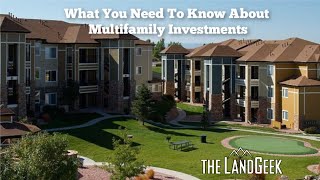
A recorded interview (YouTube/podcast) featuring Ellie Perlman (founder & CEO of Blue Lake Capital) discussing her transition from real estate attorney to multifamily investor and operator. She describes a value‑add multifamily model focused on select Sun Belt markets (Texas, Florida, Georgia), disciplined underwriting and ongoing revision of business plans, hands‑on property management, monthly P&L review, and practical tips/resources for passive investors.
Chapters
Hey, it's Mark Podolski, land geek with your favorite niche real estate website, www.thelandgeek.com. and I'm really excited for today's guest. She is a big deal in multifamily. I'd be remiss if I didn't properly introduce my co hosts. You know you love them. Scott Todd from Scott todd.net landmodo.com if you're not automating your Craigslist and your Facebook postings. Postingdomination.com thelandgeek learn anything about anything? Investor ninjas.com Scott Todd how are you, Mark? I'm great.
How are you?
I'm a little intimidated by our guest, but let's just get into it. I'll get over my, my intimidation. But our guest today is Ellie Perlman. If you don't know about Ellie, she's a former real estate lawyer. She is a multifamily Investor. She owns 2,000 doors, but she is the CEO and founder of Blue Lake, which invests in multifamily. Ellie Perlman, how are you?
I'm doing great. Hey, Mark. Hey, Scott. Really great to be here today.
Yeah, we're both very jealous that you live in Santa Monica, which obviously means that you've lost all complaining privileges. But that being said, let's just get into it and rewind the tape and let us know how you made the transition from, from real estate attorney to multifamily professional investor with 2,000 doors.
Yeah, so actually, it was not that, you know, difficult to make the decision to transition because I was a real estate lawyer and I was working with a lot of developers, a lot of investors. And I understood pretty early on that I was on the wrong side of the table, that I wanted to be my clients. And unfortunately, when I was representing them, 2007 happened and my investors lost a lot of money. And it didn't, you know, stop me from going after my dream and becoming a real estate investor. But it definitely shaped my personality, my investment personality as a very, very conservative investor. Just trying not to do make the same mistakes, you know, that my interest investors have made. But, you know, being a lawyer and then trying to shift to investment, it's kind of challenging. It could be challenging because us lawyers were trained to look at everything and see what all the things that could possibly go wrong and how we can poke holes in every investment, every opportunity. And that's kind of how I see deals today. But after I was a lawyer, I actually transitioned to property management because I wanted to be closer to the business Side to understand how it, you know, how to manage a building, how to manage tenants. And all of that was actually in Israel. And then after several years, I've moved to the States. I went to mit, got my MBA degree because I wanted to learn how to build businesses, and then transitioned after that to California, as far away from the cold because I don't like to see people skiing the streets. That was not the place that I wanted to be in. And started buying real estate and never looked back.
Wow. So, Scott, Todd, what are your thoughts?
You know, I think it's funny because we hear a lot of guests that they start off and they're like, well, I want to do this. Right. Like, we actually had a guest not too long ago that said he saw the power of real estate. So what he did is he went off and became a broker. Right. Like, so he went on the wrong side of the table. Right. Like, he went and got himself a job in real estate, which worked out well for him in the overall scheme of things. But it's funny to hear Ellie's story, too. Like, you know, she's working with these investors, and then she realized, like, I don't want to be on this side of the table. I want to be on the other side of the table. But that's a completely different skill set to be on one side of the table versus the other. Right. Like, as she just said, it's easy to look at all the things that could go wrong and, like, almost like make it too complicated as opposed to just realizing or accepting, like, there are always going to be some level of risk and you can't stamp it all out.
Yeah. What I like about Ellie's story is that she wasn't afraid to pick up the poop. Like, in every. In every business, there's always that part where it's like, there's something you don't like about it. Like the just the picking up the poop part of the business. And in multifamily, I would make the argument it's management and having to deal with, you know, the property management is the picking up the poo part. And just getting in there and dealing with that first and getting to intimately know the business, I think was a brilliant strategy that I don't think most professional investors start there. Is that right, Ellie?
Well, it actually was not a very brilliant strategy at the time. I just knew that I wanted to do something in real estate, and it wasn't clear what would be the next. So I just, you know, the. It wasn't a Very thought after, you know, kind of strategy. There was an opportunity and I just took it. There was an opportunity to immerse myself in property management, and I just took it. And a lot of people looked at me and said, you went to law school, you got masters in law, and now you're running after tenants. What's wrong in this scenario? And I said, forget about everything. You know, I know exactly where I'm going and I know I want to be in real estate. And this is, you know, that's the opportunity that I had at the time. I didn't have enough money to start buying real estate and become an investor. And I didn't care about what people, you know, thought or, you know, what. What they thought, you know, made sense. I'm never really good at walking in that path that everyone is paving, you know, for me. So that's. That's how it happened.
All right, fantastic. So, Ellie, walk us through your model.
My model, I think it starts first and foremost with choosing the right markets, which are Texas, Florida and Georgia. It can be different market for different investors. The model starts with doing a thorough research about job growth, rent growth, population growth, and the local regulations to make sure that they're not. That they're actually supporting landlords and not against them. And in addition, in addition, an appreciation factor as well. And part of the model is to keep revising our assumptions about which markets are good markets, because things change. And if you get stick to one market or not change it or not revise your assumptions, that could be challenging. So that's the first part of the model. But generally speaking, we do value add, which means that we're looking at a building that we can add value in some way, shape or form. It could be making it nicer, renovating the units or the exteriors and pushing rents, or just finding those inefficiencies and running the property in a much better, more effective way. So if we can cut utility costs, if we can basically bring skilled employees, but that are not going to cost as much and basically. Or cutting maintenance fees and costs. So this is the other part of basically adding value to a property. And that's our strategy, that's our business model.
Scott Todd, what do you think? Oh, you're on mute.
Sorry. I think that one of the things that Ellie said was so key and that is that ultimately you have to have some plan for the property, right? Like, what are you going to do to add value? Because too many times I think people buy things and they're like, well, okay, I don't want to add value. I don't want to put more money into it. I put all my money into the investment of the property, and now I got to put more money in. And I think that that's really where the wealth is created is when you have a plan, what you're going to do to make it better. And it doesn't need to be complex either. Like, Mark, one of the things that we do a lot of times to make our properties that we buy better is we offer owner financing, right? Like for the properties that we deal with, that is a trigger that will add value is owner financing. Because you're solving a problem, making it, making it, you know, pulling, pulling through something else. You're adding value in some other way, and that value is financing. But every property, you should have some idea of how you can add value. And there's things that you can do. I don't care how simple the property is, like ours land or how complex, there's always something that you can do to add value. And it could just even be better management.
Oh, absolutely. So, Ellie, that kind of leads me to the next question, which is, what's the hard part right now, today in multifamily? Is it finding the deal? Is it financing the deal? Is it creating the value add? So for us, like, it's a very simple model. We make our money when we buy the asset. 25,3 cents on the dollar, the money's not hard. There's really very little value add. But for you currently, what is it?
I don't want to give you the answer that probably everyone who buys multifamily properties are, you know, talking about, which is the challenge of finding the right deal, because most deals just don't work. I actually want to talk about a different challenge, and it's to stick to your plan. And it kind of relates to what I said earlier. If you fall in love with a certain business plan and you have it all mapped out, let's assume you found a good deal and your business plan is to renovate X amount of units, to put Y dollars in each unit, and to raise rents by certain amount, and you start executing the business plan. Many times investors are there, they fall in love with the business plan. They want to stick to it so badly. But it's really important to revise those assumptions even after you purchase the property. So we have a property in Atlanta, for instance, and we budgeted $5,000 to make the interior a bit nicer. So black appliances instead of white ones. We're putting plank Wood flooring instead of the carpet, and we paint it and we do other things to make it look nice. And then we realize that we can actually spend a lot less and get higher rents that we've underwritten the deal with. So Instead of putting 5,000, let's say we can put $3,000. And instead of getting, I'm just throwing numbers out there, but Instead of getting $150 premiums, we can get 180. We put in less money. So this is kind of an easier case. But we're not in a rush to execute everything as we plan. Exactly. We always, you know, we always revise. We always look at the deals that we're doing and asking, we're asking ourselves our assumptions, are they still valid? Is it still the right course of action? And sometimes the answer is yes, and sometimes the answer is no. And you need to pivot a little bit. There was another property we thought that it would be a good idea to add to turn part of the clubhouse into a wework like place and bring a few chairs and tables. Then we realized that the property actually needed more attention and we wanted to put that on, you know, on hold. Even though it was a great idea. But you always need to pivot. I think that's the main challenge is always ask questions. Is what I'm doing, is this the right thing to do right now? Should I stick to the plan or should I revise it? It takes more energy and time and effort. But I think that's the one challenge that we're dealing with on almost on a daily basis.
I love that answer, Scott. Todd, what are your thoughts?
You know, I think that that's, I think that's a key thing is like you, you know, like, just because you have a plan doesn't mean you have.
To stick to it.
Right. Like, look for the opportunities as they present themselves. Because you're always getting new facts and then make decisions based on what you have at the current situation. Because I think too many people, too many times people say no. This is what we said we were going to go do and we're going to go do it. Well, that's really ultimately management. Right. Like, management is the key thing there is to get the greatest return on investment. So go figure out how you can get the better return on investment and make decisions and stay fluid through the situation.
Yeah, but I think what's interesting about Ellie's mindset is there's a great book called Thinking Fast, Thinking Slow by Daniel Kahneman, who is a Nobel prize winning behavioral Economist. And basically, when you go through that book, at the end of the day, we kind of don't know anything about anything. And we're really just deluding ourselves in a lot of different areas. And so it takes a certain mental discipline to reevaluate your assumptions constantly. So, Ellie, if we go a little bit deeper into the thinking process and the reevaluation process, how do you do that? I mean, are you doing it with a partner? Are you looking at a spreadsheet? Are you going into some type of big data, big blue deep analysis with some type of algorithm? So how do you do it?
I try to keep it simple, actually. So I do work with Excel spreadsheets a lot. And each month we go over the financials and, and our property management company is sending us pretty robust reports. And we're looking line by line on the income and the expenses, P and L. And we compare what we've underwritten versus what was actually received or expensed that month. And for every line item, if there's a variation of even a dollar they need, the property management company needs to answer and say why there's a difference. And we go line by line. And sometimes if we, you know, produce higher income than what we've expected, then we pause and say, okay, that's great. I'm not going to just keep going and say, oh, wonderful, you know, you know, good for me. I'm going to say, what happened here that we actually were able to get higher income? What is the source? We go to the source and we try to understand, is it, have we increased the fees, have we increased the number of washers and dryers, or did we introduce a new service, or we're trying really to see what the source is and then make it better. And then if we see anything that on the negative side that we, you know, any one time expense or maybe, you know, payroll is higher for some reason, we try to get to the bottom of why was it us not assuming correctly or if there's anything that we can cut basically in the expenses. So we focus on where is the gap and that's where it all starts. And of course, we review the renovation schedule. We know how much we're supposed to renovate versus how much we're actually renovating, what are the basically what premiums we projected and how much we're actually getting. And if there's any variation, if we're hitting the target, we're trying to push a little bit higher, a little bit higher, it's basically get to that sweet spot. Where you're maximizing your income, not necessarily maximizing your occupancy, because if you're 100% occupied, it means that for the most part, your rents are under market. So it's finding the right quantity for the right occupancy level for the highest possible income in total. So that's the process. We just go line by line when it comes to the income and expenses and also the renovations as well, and try to find where the inefficiencies were, where are we different than what we budgeted. And even if we're meeting the target, how can we do it better? How can we still lower the cost and push income? Because some investors have the tendency of, once they hit their numbers, okay, great. Everything is great moving forward for the next month. But we always, always want to improve our operations. So we always question everything and try to do everything better.
No, I love that. Scott, I remember telling you this story. I don't know if I ever told it on the podcast, but we were kind of dipping our toe in multifamily and I have a mentor here and he kind of looked at me and it was the first deal sort of we kind of ever saw. He's like, mark, why are you seeing this deal? And you're already going after the assumption that, well, if you're not full time in this space, why are you seeing this deal? And I kind of love that question. So if you kind of keep asking why, why? Why? Along the line, you're going to become a better, more disciplined investor in everything you do. And literally it's gonna prove every sort of thing in life. Sort of having that questioning mindset. Scott. Todd, what are your thoughts?
I mean, the five whys, man. Just keep digging down till you get to the root cause. Just keep asking why. A lot of people think you have to stop at 5 why's, but you don't. You can go to 10 why's, you can stop at 3 whys till you get to the root cause of it. Keep asking why.
Yeah, absolutely. So, Ellie Perlman, of all the real estate niches, why multifamily?
Oh, for so many reasons. I think the main one is that it's a product that I understand. I was a tenant before. It's something I can relate to. It's easier to see things from my tenants perspective because I was one of them once. And you know, in addition, I really think that the demand is very strong. We see declining in home ownership, you know, rates. I see a lot of baby boomers moving to apartments and A lot of actually, because they're empty nesters. And I see a lot of millennials that want to keep, you know, they want to have options, they want to have flexibility to have a job in New York and then in San Francisco and then in Dallas. They don't want to, you know, they don't want to be bounded to one physical location. So they're pushing the basically the age of buying a house and getting married. So you have a lot of forces that are kind of moving towards increasing the demand for multifamily. And right now, financing is relatively easy if you have the net worth and the liquidity to qualify for a loan. And there's a good reason for that because demand keeps increasing, increasing. And we see it in all of our markets in Texas, Florida and Georgia, we have more and more demand for apartments. It just keeps going.
All right, well, fantastic. Well, Ellie, I think your mentorship has been invaluable, but it's now time to ask you for your tip of the week. A website, a resource, a book, something actionable where the art of passive income listeners can go improve their businesses, improve their lives, improve. What have you got?
So, one great book that I read recently, and I'm reading one book every ten days or so, but one of them was called Influence. And Influence is a great book. It talks about how you can influence people, how you can basically, you know, they're all kind of tactics and it's. It could be perceived as, you know, negatively, but it's really how to connect people and how to succeed in life and business and your personal life. You can, you know, use that information. So I highly, highly recommend reading Influence. Another book is. Is the One Thing by Gary Keller from Keller and Williams. And I've implemented that and I see some results which basically in one sentence, find out what is the most important thing that by doing it, everything else is going to be easier or unnecessary. And then block the first half of your day and do only this. Forget about emails, forget about phone calls, texting, whatever other assignment. Just focus on that and then you'll see your business grow. And that's what, you know, Keller did. And we all know where he ended up, so.
Yeah, absolutely. All right. I love it. And Influence. Is that Cialdini?
I believe so.
See the author. Yeah.
Yes. Yeah, yeah, that's great.
Yeah, that's a great book. He also wrote one more recently called Pre Suasion, which is a pretty interesting book as well. But he's pretty good about saying, hey, look, use this for good, not evil.
Yeah. Of course.
Type of thing. Scott Todd, what's your tip of the week? Mark?
I hear a lot of people, they struggle with sales, right? It's a non stop struggle with sales. And so got a good book that people should think about picking up and reading. How to be a great salesperson by Monday morning. If you want to increase your sales, read this book. It's that simple. That's the title of the book by David Cook.
Okay, Who's David Cook?
David Cook. You don't know David Cook? He's an author.
I mean, if you said Wes Schaefer, the sales whisperer, I'm like, oh, yeah, of course.
But you know, I don't remember his exact story.
David Cook.
I'm telling you, what I liked about the book was he walks you through like how to create that burning desire for your customers, right? Like that's the starting point of everything. In fact, the other day I was talking to my daughter and I was talking about the one thing that moves every needle is a burning desire. So, you know, you really have to find that why in people, why they're even talking to you, and then create that burning desire and close them. And so he kind of walks you through that piece.
All right, I'm not afraid. I'm going to check it out. And my tip of the week is learn more about multifamily and look at bluelake-capital.com we have a link to it. Bluelake-capital.com Perlman, are we good?
Yeah. The only thing that I would add is if you go to the website, you can download a free guide for every passive investor of basically walking you. It's a guide that walks you through the five most crucial components that you need to look at when you're investing passively in a deal. So check it out.
All right. Awesome. Scott Todd, are we good?
We're good, Mark.
All right. I want to thank the listeners. Just remind you the only way, the only way we're going to get the quality guests like an ellie Perlman from bluelakecapital.com is if you do us three little favors. You got to subscribe, you got to rate, you got to review the podcast. Send us a screenshot of that review to supportlandgeek. Com. We are going to send you for free the $97 passive income launch kit course as well as the latest wholesaling course, how to double your money 30 days or less. Today's podcast is sponsored by Flight school. Learn how 16 weeks can transform your life. Just go to landgeek.com training for a free strategy call to see if avoiding renters, rehabs, renovations and rodents, creating passive income without any headaches resonates with you. And have Scott Todd lead you up that mountain of land investing. All right, are we ready to do this?
We are.
1, 2, 3, let freedom ring.
Was I supposed to say that also?
No, but we appreciate the fact that you weren't just, like, what? Geeks? So that was very nice, for sure.
Well, thank you, guys.
Thank you.
More from Mark





How to find funding partners: How to Scale Land Without Using Your Own Capital


