Why You Need To Diversify Your Revenue Stream
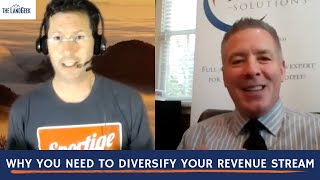
Podcast episode (Feb 18, 2021 upload) featuring Mark J. Podolsky, Scott Todd, and guest Ken Wentworth discussing business strategy for small businesses—especially fractional CFO work, passive income, revenue diversification, profitability and scaling. Key advice: develop multiple revenue streams (Ken recommends a minimum of five), focus on net margins rather than top-line growth, build passive products (courses, royalties) and prepare for economic downturns with reserves and smart scaling. The tone is conversational, advisory, and anecdotal.
Chapters
Hey, it's Mark Podolski, the land Geek. Their favorite niche real estate website, www.thelandgeek.com and today's guest is one of those people where I'm just intimidated because he's like the smartest person in the room. But I'd be remiss if I didn't properly introduce my co host. You know him, you love him. Scott Todd from scotttodd.net landmodo.com not automating your Craigslist and your Facebook postings. Postingdomination.com thelandgeek Learn anything about anything. Investorninjas.com Scott Todd how are you, Mark?
I'm great. How are you?
I'm great. I'm great. Before we talk to our guests, I just want to remind everybody, today's podcast is sponsored by Flight school. Learn how 16 weeks can literally transform your life. Have Scott Todd himself lead you up that mountain of land investing. No tenants, no termites, no toilets, no trash. A one time sale. Build up your passive income without any headaches. Learn more, just go tolandgeek.com training Today's guest is Mr. Biz himself, Ken Wentworth. If you don't know who Ken is, he has been advising businesses for more than 20 years, from Fortune 15 companies to startups and how to establish a solid financial path. He's a big deal. He's got a radio show, best selling books. Ken, what else you got? Tell us.
Honestly, I don't even remember all of it. Just trying to reach people. Yeah, the books have been good. The radio show, Mr. Biz, Radio Online course, we got all kinds of things. Trying to find different ways that we can help people, different modes. Everyone learns in different ways and everyone consumes information in different ways. So we try to have all those available for folks.
All right, great. So, Ken, let's just rewind the tape because I imagine when you were younger, you didn't wake up one day and say, you know what, I'm going to help companies be more operationally efficient, help them with their cash flow, help them expand and just make people wealthier. So how'd that happen?
You know, I think honestly it sounds a little bit cheesy, but I'm kind of just wired that way. You know, everyone's wired. I've got a cousin who's like super artistic and so she sees things through that lens. I have that lens from a business perspective. And I know I drive my wife that we affectionately call Mrs. Biz. I drive her nuts, I drive my daughters nuts because I can't turn it off. I go into a business and, you know, we'll be sitting in a restaurant waiting to be seated and I'm looking and going, why do they have the servers, you know, getting the food this way? And why do they have people sitting over here, you know? And my wife will look at me and she'll say, does, does your brain hurt? Because like, you just tell me that like makes my brain hurt. You know, I can't explain it, I'm just wired that way. I've always known even from a young age that I wanted to be involved in something in business. I just didn't know what it was. So I worked at JP Morgan Chase for, let's just call it 20 plus. We don't need to get specific dates here. Okay, 20 plus years. And decided at one point, I mean, had a great career there, had a very successful and loved it there, but just decided that I could be making a bigger impact. And how, what would that look like? So I resigned from there without even knowing what my next step was going to be. I'm like, I'll figure it out. It's that cliche of an entrepreneur that an entrepreneur will jump off a cliff and figure out how to build an airplane on the way down. That's kind of what I did. Didn't know what this was. I didn't even know what a fractional CFO was at that time because I was so engulfed my whole entire career was in the corporate world. So I had no idea. I was completely naive to more of the small business side of things, but figured it out and I absolutely love it. I mean, again, I don't work a day in my life. I absolutely love what I do. And so if anything, I have to pull the reins back to not work more because it's not work to me. It's like fun stuff to do. I'm a numbers nerd. What can I say?
No, it's fantastic. So you mentioned fractional CFO. Could you define what that means?
Yeah. So fractional CFOs. So think about a small business owner that is really good at making widgets or providing a service for their clients or customers. So they're really good at making those widgets, but they might not have the business background or financial background. So man, they're really good at creating that product, but they don't really know the business side of it. And so. And they're not large enough to need a full time cfo, but they need someone who has that expertise and so that's where they can hire me, make It a much more affordable aspect for them. Instead of hiring a full time CFO, get someone with 20 plus years experience, et cetera, et cetera. Been through those battles, wars, been there, done that, seen it and all that stuff, and bought the program and helped them, let them focus on their business. And so I can help them with the financial aspects and some key things to look at to really make sure they're being successful.
All right. Phenomenal. Phenomenal. Scott. Todd, what are your thoughts?
Marc, listen, listen. If Ken and I went to dinner or went walking through a business, we'd probably, I don't know, like people, we'd probably annoy the tar out of everybody and probably each other because I kind of did the same thing. I sit there and I'm like, you know, like, I look at all the flaws of the operation, I'm pointing them out, and my wife just goes like, why? Like I try to go through a drive through at McDonald's and I'm like, look, if they just did this and this way a lot better. And she's like, scott, every time we go through the drive thru, drive me crazy. I'm like, okay, I gotta stop. But, you know, that's the thing is like, you know, it's. It's pretty cool when you can look at a business and see like the organizational flaws in it. Okay. Like, it's pretty cool because then you can take that back and be like, okay, well, in my business or in someone else's business, I'm gonna make sure that they're not doing that. Or you bring in all of this collection of data. And you know, one of the cool things I think about that is that ultimately if you can learn how to geek out on business like that, and you know, you just observe what works in other businesses, it's pretty cool because you can take what's working somewhere else and plug it into your own business or someone else's. You just plug this in there and all of a sudden it's like, wow, let's take this. That works or doesn't work, put it into this business, and bam, the business just kind of takes off from it. And I think that's one of the cool things. And look, you don't have to have any special skill sets, I don't think. I think that you just, if you just have to be curious about how things work and just be aware of your surroundings and all of a sudden you can build a business that's pretty dang cool.
Yeah, I know, like, the two of you are like business curmudgeons. Like Larry David and Curb youb Enthusiasm. You go into a business, you're like, their marketing is average. Look at the operations.
You're not in Orlando, are you?
I'm not, no. I'm in Columbus, Ohio.
Okay. Because I was gonna tell you, like, you and I, we can meet up at the Macy's over in Orlando, and I'm sure we'll find some. Some. We'll just geek out in there all dang day.
Well, it's funny. So what I found in doing this is that so often, like, when I first started this and figured out the fractional CFO thing, I thought, to me, it's like, well, doesn't everyone know that? Doesn't everyone think that way? I think so often, regardless of whatever your level or your area of expertise is, you take for granted your own knowledge base, Right? You just assume that everyone has that knowledge, and. And they don't. Otherwise we wouldn't have people who have these specialties and expertise in different areas. Everyone would do it. And what I find so often, especially with business owners of any shape, you know, real estate, it's all sorts of law firms, they're so good at what they do, but they get tunnel vision, right? And so they have that. And depending on the type of business they have, they're wearing 12 different hats. And so some of the. In some cases, it's basic in my mind. Basic blocking and tackling a business that's getting neglected because they're running off and doing 12 other things, because that's what they have to do. They have to be very tactical during the day as opposed to being strategic. And that's one of the things that I pride myself on. I tell people this all the time. That sounds silly, but I'm strategic to a fault. I was actually going to. I was watching Scott to see if he would laugh. And I said that because I thought maybe he'd be that way, too. But. And what I mean by that is I'm always thinking, you know, five steps ahead. I'm thinking, three years out, five years out. And I say to a fault, because I do that, and in the same space, I trip over the curb that's right in front of me because I'm so focused out, you know, on the horizon of that decision we're making today. That sounds fantastic for today, but does that. Is that congruent with what we want in three years and in five years and 10 years? And I think that's, you know, one of those things that I can help a lot of Business owners, because they don't. It's difficult to see the forest through the trees sometimes when you're. When you're buried into the weeds, so to speak.
Yeah, I mean, this is a common problem. And in our niche, like, we have our coaching program and really we're trying to build this passive income machine. And the machine means that you should be able to travel around the world. And there's passive income just keeps coming in as mailbox money on an automated basis. But the problem 10 is that the cheapest person they can hire is themselves. And so it's a very, very tough sort of mental battle to let go and systematically start getting yourself out of each aspect of the business. So my question is, at what point do you see the typical entrepreneur where they say, okay, now it's time to let go, the revenue supports it, and now I feel somewhat confident I can do it, but it's going to be a leap of faith. How do you walk them through that?
Yeah, I think that's a great question because it's very important. And I will say, one of the things that I seek to have for every one of my clients as well as I went through the process and the lifecycle of my businesses is the passive income. I mean, if you don't have passive income, you're gonna be working your fingers to the bone until the day you hopefully not die, but at least till day you retire. You could obviously expedite that retirement horizon. So I've done that in my own business with passive income as well, is, you know, obviously the books are passive, but they're not. That's not very lucrative. I think a lot of people say, oh, you wrote a book and it's bestseller. Like, gosh, would you. How'd you make. You make $100,000 off that? Like, not even close. Like, there's not a lot of. Unless you're writing one of these classics, a Harry Potter series or something like that, you're not making a whole bunch of money off of books. But I created an online course, so as an extension for me for passive income. And I have different elements of that that are completely passive. People buy it, they get the videos delivered to them in a completely 100% automated fashion. So I think that every business owner, I look at this, a lot of business owners, when they start to have success, the first thing they want to do is scale, which is understandable, but you have to scale intelligently. And it also. Scaling takes so many different forms. It's not just, I want to have four more products. It's not just I want to open two more locations or I want to franchise or any of that stuff. It's also the scaling in my mind becomes diversification of different things in your business, including your revenue streams. I mean, honestly, I mean, I know a lot of people talk about this, but it's so, so critically important. You need to have in my mind a minimum, absolute minimum of five different revenue streams and it helps you. And hopefully a lot of people have seen that the unfortunate situation with the pandemic. Hopefully a lot of people have seen, gosh, if I would have developed these three other revenue streams, they could have kept going and helped subsist, I could have subsisted on those. While these pieces were affected by, you know, severely by the pandemic, those different revenue streams, especially on the passive side, really, really important. So I think as you, the biggest thing is, to answer your question going back, that is you got to get your core business, your core operations, whatever your business is in absolute well oiled, machine, tip top shape. And then as you start to think about expanding in any way, shape or form, you need to consider those options as far as diversifying your revenue stream because that'll make things so much easier. I went through that, I worked at JPMorgan Chase and, and one of the benefits of a huge company like that is it's not just an investment bank. It's not just a bank. So when things that happen in the economy that are inevitable, that impact the investment bank and the investment bank earnings go down, it's countercyclic on the retail side. So now our retail side is up. So they balance each other out, right? So you can ride the wave of the inevitable economic changes. Right. And again, people, when I say things like that, people go, oh my gosh, you're being so negative. I'm like, no, it's just a normal business cycle. You know, typically you've got a 10 year period, maybe sometimes less things are going to go up, things are come down, they're going to recover. And so that's one of the things we were able to do. You know, again, my risk management side is I started preparing a lot of my clients and this is getting off the topic of your question, but I was preparing a lot of my clients in May and June of 2019 for what I saw as the inevitable economic downturn that was coming. Now, of course, I didn't know there was pandemic coming. Although in my client's eyes I look like a genius now because we started positioning them for A downturn. And I've said I want to position them for July 1st of 2020, that we're going to start to see a downturn. So we need to make sure that our balance sheets are in good order, all that good stuff. And so then the pandemic hits, and all my clients are like, oh, my gosh, I got, you know, my, my competitors are struggling, but we're not. We're in good shape because you've helped us. And I'm like, well, I didn't see a pandemic, so don't give me too much credit. Like, I, I was looking at the inevitable economic downturn, but so critical to be thinking out along the horizons, because unfortunately, especially with this situation we're in, as you guys well know, there's a lot of businesses that aren't going to make it. I mean, it's terrible to say, but they're just not because they haven't positioned themselves. Everyone can get fat, dumb, and happy during the good times, right? But they're not preparing themselves for, you know, when things go down. And so I think that's really, really important thing to also consider as you're scaling to make sure you have the proper reserves and cushions in place. Not only that, if you have those things, you're going to sleep better at night. You're not going to worry. You're not going to be that business owner that's like, hey, I have X amount a month in mortgage payments I got to make. How am I going to do that? Or I have payroll that I have to make. How am I going to do that if my business drops off by 30% or if my tenants, all of a sudden my vacancy rate goes to 75% instead of 90%, can I make those mortgage payments? Having that strong balance sheet will alleviate a lot of that stress.
Scott? Todd?
Yeah. You know, Mark, it's funny because we're sitting here talking about passive income, which you and I are a big believer of passive income. And I heard this complaint during the pandemic from people that were saying, let's get back to work. And one of the complaints that I heard people make is, you know, it's the people with the royalties, like Hollywood, the people with the royalty deals that are telling us to stay home, but we don't have royalties, we got to get back to work. And, you know, like, that's what you and I have been teaching for a long time is it's not about the cash sale, right? Like, if you, if you've been in this community for A while the Land Gate community, you probably remember Mark's famous. Like, I, I don't want cash deals. I want terms deals. And the whole debate about it. And then there were people that were just outright livid that they wanted just cash deals. Well, the thing about cash is cash deals are fine until, guess what, until the cash dries up. And then you need the terms deals, right? Because you don't know on any given day when the economy's gonna turn. You don't know on any given day when a pandemic will come out of the blue and, like, swoop you out to sea. And where's your cash deals at that point? I mean, literally, Mark, year, a couple years ago, I'm sitting there thinking, like, okay, I want to take some of my money off the table, off of the land table, and I want to put it into a different business that's recession proof, right? So honestly, the business I was looking at deeply is a haircutting place. Because I'm thinking, like, the haircutting places, they're never gonna shut down, man. They're recession proof. And I even have the documentation from the company that says we are recession proof. Well, that's all fine and dandy until you find out that they're not pandemic proof, right? I mean, a buddy of mine owns, I think, like, 16 locations. Nothing, right? Like, they're all shut down. They're all shut down during the pandemic. So, you know, you really have to think about, like, this strategy, right? It's not necessarily about scaling fast, like Ken. It's not necessarily about adding, like, all of these multiple streams. He said five, but it's not, like, going, okay, well, I need 1, 2, 3, 4, 5 today. It's about laying the foundation smartly so that you build this business and then you build one that interconnects with it somehow. Like, maybe you deal with land and you're dealing with your rural land, and then you start to get that passive income really good. And then the next transition might be infill lots for you, but, like, you know, or maybe another state, right? Like, there's nothing wrong with it that's part of the expansion or the. Or the growth, I think, but you know, like the scale and go, oh, man, I'm gonna mail a thousand offer letters in my first week. You're being silly, okay? Like, you don't even know what you're doing yet. Slow down, slow down. Build the systems and then you'll be off to the races.
Yeah. And I say a minimum of five I mean, I myself, I have nine myself and some of those are small and developing. But I'm thinking of the future with those and I'm slowly building those up. But I think you got to have a minimum of five. But more the better as far as I'm concerned. The more the merrier, as they say. I mean, it's so, so important. And like I said, I think a lot of what I've seen, especially with the impact of the pandemic, is not only the folks that didn't develop those other additional revenue streams, especially on the passive side, as you mentioned, Scott, but things have been so good in the economy in the US at least for so long that people got accustomed to it. Well, it's going to happen again next year. Oh, it's going to happen again next year because it's been, you know, I mean, if you think about it, it's been 10 plus years since we've really had that really bad downfall. And so people got so used to, they quickly forgot how terrible it was in 08 through 10. And now it's like, well, every year is going to be this. We're going to continue growing and the stock market's going to go to 50,000. It's like, oh, holy crap guys. Well, hold on a second. If one thing history teaches you is it teaches you history like it's going to happen, it's going to go down, right? It's going to recover and likely hopefully won't be nearly as bad long term as it was 08 through 10. But people don't think about that because they think everything's just going to continue so peachy keen and they haven't prepared themselves from a risk perspective and from a revenue stream and passive income perspective as well. I think those that have are sitting back going, hey, this is actually, you know, it's terrible, but it's pretty good. Funny you mentioned that, Scott. I've got a friend of mine who owns a lot of commercial real estate and over the last three years, I just talked to him about three weeks ago now, he said over the last three years my main goal as I was buying commercial real estate was I don't want any tenants that Amazon can take out. He said he wanted not recession proof, he wanted to Amazon proof his businesses in his, you know, that were in his commercial real estate. And so he did that and then the pandemic hits. Well, guess what one of those was actually he's got several in different places, but haircutting places, right? Same thing. He's like Amazon's not taking them out, so we're good. And so here we go. It's not like you said, it's not pandemic proof.
So Ken, what is some of the worst advice you see or hear given in your area of expertise?
The biggest thing I see is that, and again, I think this applies across all businesses is people think of, they get so enamored with their top line. And by top line I mean revenue. What's coming in the door. They so enamored by that because they want to be able to say, I'm a 5 million, 7, 10, 15, 30 million dollar company. But the big thing, and obviously that's extremely important, right? But I've also seen, and I see it way too often, unfortunately, is that that growth comes at a price. And I'm not talking about the typical price. What I mean by that is if you are a $5 million company and you grow revenue wise and you grow to 10 million, you go, oh my gosh, we 100% growth, this is fantastic. But if that extra 5 million comes with 5 million in expenses, you know what that means? You've just done a whole bunch of extra work for nothing. Nothing at the end of the day ended up in your pocket. And I know that sounds really obvious to state it out loud, but that happens so often. I've got clients who I'll start working with and I call it the silent business killer. And that's products or services that you offer that are unprofitable. And I call it silent because everyone says, every client I start working with, they go, ken, why would I have a product that doesn't make money? That's silly. And almost every business I've ever worked with has at least one. And I call it silent because they just don't realize it. Right. Of course you don't think it is unprofitable, but it is. And so growing those, let's say you had a profit, a product that it was even, just break even. And in that scenario, again, you grew and you sold $5 million extra of that new product, but it cost you five minutes break even. You've just produced and gone through a whole bunch of work, you know, for nothing. You've made no money. So that scalability in all shape, forms and fashion, it has to be at the profitability level that you want it to be. And if you can't grow it at that profitability level, then you shouldn't grow it. I mean, there are times when we've gone in and looked at different things, different Revenue streams, different products, and said, we can't offer this to customers at a rate that they'll buy it. So we need to discontinue. We either need to scale back our operations or make them more efficient. And if we can't do that, we need to discontinue the product. We. For a variety of reasons. Maybe it's, you know, efficiencies, economies of scale. We just can't offer it at a competitive price. So we have to stop doing it. Like, there's no sense in creating that product and doing it if we're going to lose money on it. It just makes no sense whatsoever. But I'm telling you, all sorts of businesses. I work with a law firm, right? You wouldn't think of a law firm like that. There was a law firm that I work with, I still work with them, that have that situation, that had that situation, I should say, where they had something that they were actually losing money on. One of the things they were offering to their customer base, their client base. And again, you just wouldn't think of it. But I think those are things you really need to peel back the onion on everything you offer in your business. Again, whether it's a physical product, it's a service, it's some sort of income. You have any type of income, you got to consider in your space, in the land space. Think about it. And I know it's gonna sound really silly to you guys, but let's say you got someone who's a landlord and they go, oh, my gosh, I'm bringing in, you know, $100,000 a month in from my tenants. And I only have. My mortgage payments are only 60,000, so I'm clearing $40,000. It's like, no, guys, there's a lot more to that. What is everything else? What's the maintenance on the building? What is the reserve you're setting aside because you're gonna have to put a new roof on that building in X number of years. What about your insurance costs? What about the landscaping? What? You know, so many people. That's another thing that lends itself to that is people think on the gross margin basis as opposed to a net margin. I don't. I honestly don't care what your gross margin is, because I can make gross margin whatever I want it to be. I'll include certain things up on top that maybe should be in the bottom or vice versa. Net margin. That is what ends up in your pocket at the end of the day. That's it. That's the end all be all. Let's focus on that more so and make sure that everything's profitable in that way.
Yeah, no, it's so true. And I mean, even my own experience. A couple years ago, we had a virtual assistant business just for land investors, and it was a great service, but as a business, it was terrible. And I had all these people I had to manage and the logistics of it, and it was not highly profitable. So we just said, hey, these people are trained, and we have them create their own company. So nothing really changed for our client. I just didn't have to manage it and have to worry about the fixed overhead of it anymore. And so we just eliminate it. Now. What's interesting, Ken, is like, if, like, Scott and I will go to a party, and one of the typical questions people will ask is in there trying to, like, gauge, like, how big our businesses, like, how many employees do you have? I think the dumbest question ever.
Absolutely.
It's like, I have zero. Oh, you know.
Well, it could be in the form of.
Let's say you have several different things in your different, different aspects your business. If you look at them and look at the margins on them, sounds like just like the exact thing you did, Mark, is you might look at it and say, gosh, I've got six different businesses, six different revenue streams, and four of them, the margin, the net margins are at least 30%. Two of them, the margins are 10%. Well, geez, let me forget the 10% margin products. Let me ditch those again. Maybe you create a partnership, or in your case, you work with them, and they created their own company, so again, now they can work with. So you can still offer to your customer base. But now you take your efforts you were putting into those 10% margin products, and you build on your 30% margin products. Now all of a sudden, your company's infinitely more profitable.
Exactly, Scott, what are you gonna say?
I was gonna say, like, that that's the thing is, like, we're talking about a number of employees, right? Like, oh, Grant Cardone will tell you, like, oh, if you don't have any employees, you're not gonna have a business. Really, Grant? Like, seriously, Is that how we're judging success based on the number of employees? Like, I don't think that's a ridiculous thing. And I did like what Ken said. It's like, look at the margins. Like in flight school, Mark, in flight school, I teach yield, right? Like, I teach how to break out the calculator and calculate your yield. Why? Because if you're dealing with Properties that are giving you an annual yield of 10% or 20%. Well, that's fine if that's what you want. I want more. I want 70, 80% yield properties.
So.
Because the minute I take my money that's not producing 70 per. I'm sorry, 20%, and I put it to like 70%, all of a sudden I'm making three and a half times more money, right? Like, that's the way I'm thinking. I'm not thinking about, like, even a total dollar. Someone's like, oh, I sold a piece of property for $25,000. You know, I'm like, well, what's your yield on it? My yield's 10%.
Why?
I'd rather sell a property for $10,000 and make 100% on it, get my money back faster and go. This is a whole module in flight school that we talk about, talking about yield. And it's really amazing that I'm going to be like, Ken here. It's amazing to me that people don't understand, like, they don't know this, right? Like, they don't know, like, how they not know it. Yeah, that's the thing. That's the thing.
Well, it's the same thing. I've got. I've got a guy I talk with pretty often that he flips houses. And, you know, he and I, he was growing and growing and growing. And I said, well, what's your minimum return you'll take on a deal? Well, he was doing. What I kind of alluded to earlier is he was just growing, just to grow, essentially. And so he was taking on deals, as you mentioned, Scott, that were. Maybe they were a 10% yield deal. And it's like, well, geez, why don't you draw a line in the sand and say, I'm not going to do a deal that if I can't do it for 25% plus, I don't want the deal. Right. And start to optimize your portfolio a little bit better. Because like Scott said, I mean, that's a powerfully impactful thing that you can keep. Your influx of revenue, your revenue streams coming in could be flat, but your profitability goes through the roof. You make more money for the same amount of work, the same amount of capital out in the marketplace. I mean, it's powerful. And again, I look back at it, and I don't mean that to sound condescending. I just mean, again, it's one of those things you take for granted your knowledge base. Right. I look at it and go, gosh, why wouldn't someone think of that? But, you know, for a variety of reasons, they wouldn't. I could also talk to someone that runs a backhoe, and I try to get in and run the backhoe, and they go, oh, my gosh, you're going to tear the house down. Get out of that thing. Right. Because I don't have that skill set.
No, no, absolutely. So, Ken, we're at that point in the podcast now where we're going to put you on the spot and ask you for your tip of the week. A website, a resource, a book, something actionable for the art of passive income listeners to go improve their businesses, improve their lives. What do you got?
So my tip, and this is actually, it was actually a tough question for me because I, as with social media, everything I share Mr. Biz tip of the week. So I've got tips out the wazoo, but one of my favorite ones, and I think would definitely be applicable to your audience, is the tip is to take action. Progress, not perfection. Right? Very important. Everyone talks. You know, talks to talk, but you got to walk the walk. And the way I illustrate that is, and try to make this humorous so people remember it. And I say the road is riddled with a lot of flat squirrels who couldn't make a decision, are you going across the road or are you coming back? Which one are you doing? Commit to it and make it happen and do it. But you got to take action. Everyone tries to so often make things perfect. I don't want to do it until I do this, this and this. Start and figure it out on the way. And I'm not saying just ready, shoot, aim, Exactly. But not even 80, 20. You got an idea, and it's something you need to get to the market. When you're at 60, hit the gas pedal and get going. And you'll figure out the other 40 on the way. Because more than likely some of the assumptions that you've made along the way, getting to the 60, you're going to get in the marketplace and find out you were wrong, and you got to make changes and you got to pivot anyway. So it's take action. You got to take action to not worry, you know, make progress, not worry about perfection. And don't be a flat squirrel.
Don't be a flat squirrel. That could be the title of the podcast. Don't be a flat Squirrel. Scott Todd, what's your tip of the week?
Mark? You know, this has nothing to do with business. It's all strictly entertainment right now. It's TV Shows, right? You know, like, I know you. I think we all, like, you know, like, always talking about, what's everybody watching? Well, the one thing that I hate is going down a path on a show, and it's like, it just gets progressively worse. And you're like, why did I even commit to this thing?
Right?
Like, everybody's hating this show in season three or four or whatever. So here's the deal, man. There's this guy. His name is Ian Ray, okay? This guy's name is Ian Ray, and he created this website. And the website is tv charts.ianray.com and when you go there to tv charts.ian ray.com, you can type in any show, like, I'm just gonna do, like, Better Call Saul, right? And so it pops up, and then what it does is it will show you by series and by episode, like, the IMDb, IMDb rating for that show. So you can see, like, when I look at Better Call Saul, it's all in green, man. And green is good. It's all good. You know, it's. It's great, right? And then you can look at other shows that are just, you know, like, train wrecks, and you can see that they just fall off the. They just fall off the wagon. The writing gets bad or they jump the shark early, right? So, you know, this is. Might save you some time.
Oh, this is fantastic. I'm looking at Game of Thrones right now, 9.3. There's, like, three bad shows in the whole series.
And then it also showed. Yeah, and they're all at the end. See, it fell off the wagon. And then see, like, imagine, though, like, what. What if. What if season eight of Game of Thrones, where it's not so good, was in, like, season three and season four? You'd be like, I'm not gonna watch the show. Why? Why commit to it? It's terrible, right?
Oh, I love it. All right, well, my tip of the week is going to be, first of all, don't binge watch all Scott Todd shows because there's more productive things to do. And one of those is learn more about Mr. Biz at mrbizsolutions.com learn more about being a fractional CFO, how that can help your small business. He's got tons of content. The biz radio, the live streams, the articles, the videos, the books. Get smarter. MrBizSolutions.com Ken, are we good?
I'm fantastic. If you guys are good, I'm good. And I will definitely use Scott's tip. That's great. And by the way, I know, Mark, you said not to watch, binge watch all of Scott's shows. If you are going to do that, though, make sure you check out that resource he gave you because then you can weed out the crappy ones.
There you go. Absolutely. Scott. Todd, are we good?
We're good, Mark.
All right. I want to thank the listeners. Just remind you the only way, the only way we're going to get the quality of guests like ken Wentworth from MrBizSolutions.com is if you do us three little favors. You got to subscribe, you got to rate and review the podcast. Send us a screenshot of that review to supportlandgeek.com we're going to send you for free the latest $97 wholetailing course, how to Double youe Money, 30 days or less. So please do that. And Scott, we ready to do this?
We are, Mark.
One, two, three, Let freedom ring. See, Ken, we don't tell you we're going to do that, otherwise you probably would have showed up. All right, thanks, everybody.
More from Mark





How to find funding partners: How to Scale Land Without Using Your Own Capital


