Future of Work with AI, preparing leaders for tomorrow
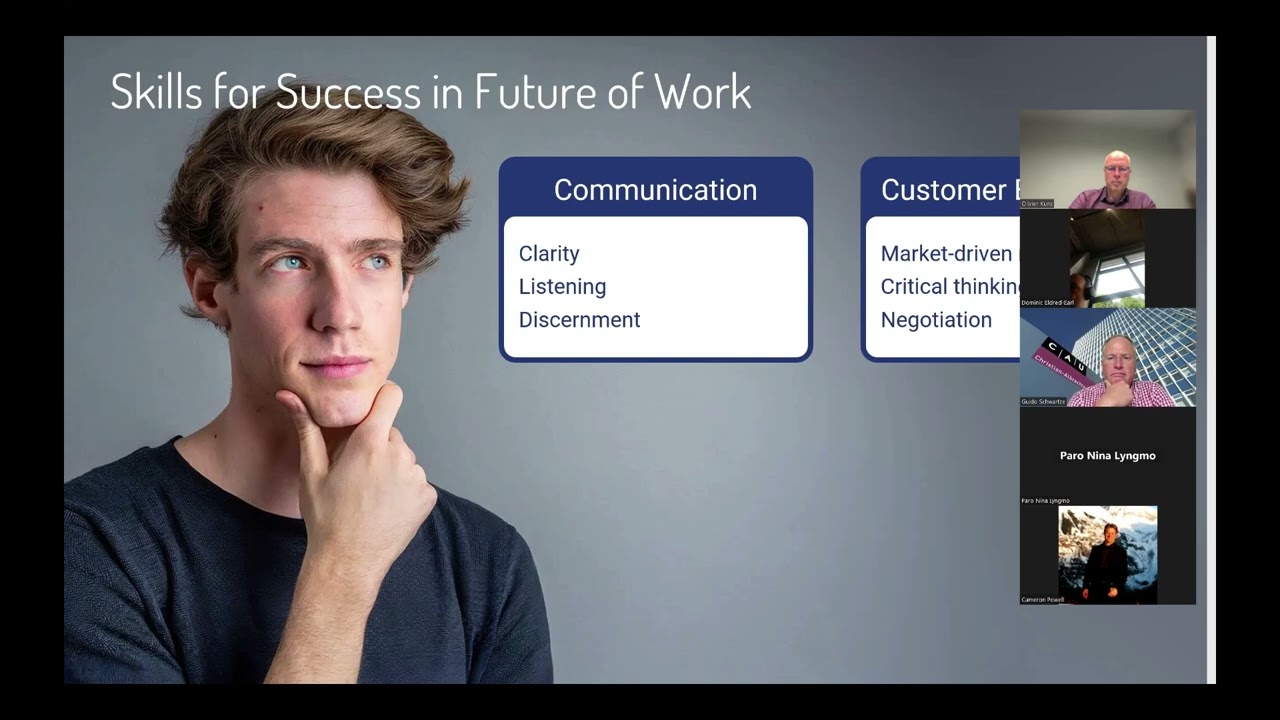
Jennifer Vessels and Thomas Anglero discuss how leaders can prepare for AI-driven change. They demo Luma Dream Machine and ChatGPT-4.0 tools, and argue that building communication, empathy, and critical thinking skills matters more than the technology itself.
Chapters
after the session. It will probably take us a day or so to get everything edited and put nicely together, but you will get a link. We encourage you very much to, to go back and review. We encourage you to share the link, and I will, in sharing screen, uh, bring up here that we are indeed on a journey into the future. This session is all about how to get ready yourself and ensure that your team is ready for very significant accelerating growth in AI and technology and what that means for us as people. So those of you that don't know me, I'm Jennifer, Jennifer Vessels. I run a global consulting company, Next Step, and I do a lot of keynotes and advisement on AI and technology and what that means. Joined by Thomas Anglero. Do you want to say just one word about yourself, Thomas?
One word. Hello, everyone. Okay, Jennifer. I'll be speaking once Jennifer's done with her presentation. Then I will be presenting for all of you as well. So Jennifer, please continue.
Excellent, excellent. So this is indeed a journey that we are taking together. I personally believe in this day and age, we as a global society are co-creating what the future looks like. And so for me and Thomas Anglero, it's a pleasure to walk through this journey with you. We encourage you to do a couple of things. One is at the end of the session to scan, and I'll bring this little QR code back up to give us some feedback on the session that will help us to continue to make these better and better. And then to register for our next step in the process, which is the 27th of August, when we'll be coming back, and some of you will be coming back from summer holidays. A lot will happen in 2 months, and we see that that will really be the time to embrace and act. So we'll give you some very tangible actions to take when we come back together in August. Today, please engage. Use the chat for questions. Feel free as we take breaks between sharing insights to raise your hand, ask questions, and please feel free to not only comment but to to argue back. We, Thomas and I, have points of view. We have experience. We are not experts. No one is an expert on AI and the future of work. We're building that expertise together. Yeah.
May I just interject?
So please.
Yeah. This is, I believe, our fourth session. Is it? This is number four, I believe, right? I believe so. Yeah. And the last three sessions went really well. Because people, all of the participants, ask so many questions either in the chat window or they just say, hey, may I ask a question? And it's been a lot of fun, right? So if the most— you want to get the most out of this, please, as I always like telling people, because I'm from New York City, go into New York mode and interrupt us, be rude and say, hey, I don't— I disagree with you, or something like that. Have some fun. This is not formal. Uh, it shouldn't be, but it is. We're sharing everything that we've learned, and, uh, please share with us, uh, your questions, share the things that you've learned, and let's enjoy this journey into the future. So with that, Jennifer, take off, let's do this.
Perfect, perfect. In the 6 months since Thomas Anglero kicked this off, I have seen a huge shift in the adoption and in the attitudes and in the mindset towards AI. When we started the journey back in November of '23, people were saying, yes, we're all in for AI. But it was a lot of lip service. A lot of people, when you really peeled it back to say, what does that mean? They were saying, it's the right words. But I don't know how, or I'm afraid, or it's a big bad wolf and I simply don't want to open that Pandora's box. And I will say, in the 6 months since then, people have started leaning in. 91% of CEOs in global corporations are stating they are putting strategy, doubling investment, and relying on AI to be the future for them. That is starting to move down into the corporations. But we do still see there is some reticence, there is some question, and there's a lot of question about how do I do it. The answer on how is Do what you're doing here. Get together with other people and explore. There isn't one right way. Figure out a problem that you're trying to solve. Talk to people. Use an AI tool. See how it works for you. Move forward. It's all about jumping in. That will prevent you and your company from being the Kodak. Or being the Nokia. And I see those two companies that we all have heard about as having two different challenges. Kodak thought they had everything perfect and they knew everything and they were right. Nokia probably thought that as well, but where Nokia missed the boat was on the market. They weren't looking at what their customers wanted. So today, as we move forward with speed into the AI journey, look internally at yourself, both your own mindset but your team. Are we leaning forward and exploring? But also look to your customers. What do my customers look for? How are they using AI? And how can I match where they're going and take them even further. So it's definitely a journey and it definitely needs a team. The interesting thing in my conversations with people, there's two camps when it comes to AI and people. One camp says AI is great and it is going to make our people that much more productive. They don't have to spend hours looking for the right picture to go on a PowerPoint. They can use DALL·E or they can use Firefly to create it in seconds. It frees our people from mundane tasks, things they probably weren't very good at doing to begin with, because after all, we as people are not good at doing tedious things over and over. So one camp says, let's let the technology do those tedious tasks, freeing our people to give good customer service, go talk to people in the market, build partnerships, do things that people do well. Another camp says, oh, AI is bad because that's going to take our jobs. Now, I often say there's no right or wrong when it comes to AI and the future of work. But I do think there— it is wrong to say AI is bad because it's going to take our jobs. Because ultimately AI can do a job. If all you do in your work can be done by AI, there's a bigger problem. You need to rethink how you approach your activities. You need to look at where you can use your creativity, your communication skills, your thinking skills, your people skills, because that's what people do best. So within your team, you need to really balance between people doing what people do well, technology doing what technology does well. And having a small intersection between, which are the technology experts that can help and guide the people in using the technology. Now, in one of our previous discussions, we brought up the idea of data scientists and prompt engineers and these technical specialists, and we had a lot of questions on people's mind of Isn't that expensive to have a team made up of technical people, especially in light of some of the recent statistics and news of huge salaries for technical experts? Yes, technical experts are expensive. However, I believe that you need very little of that technical expertise, and maybe you don't even need to hire somebody in-house Maybe that is a service. Maybe that is an outside provider that you can leverage a little bit of expertise to connect your people skills to the technology. Where you need to really think about your team and building the skills is in the human skills that in the recent studies from BCG, from Harvard, from the US Labor Board, the skills that are going to be most valuable in the future are actually made up heavily, three-quarters of which, around people skills. So for each of us, as we move away from doing those tedious mundane tasks, Let's build our skills around firstly communication. Was in a conversation yesterday in a workshop here in Norway where people ask me, so when you use ChatGPT or Copilot, how can you best get good results? My answer was You become a good communicator because working with an AI tool requires the person to be clear, to be very distinct and specific, and to treat the tool conversationally. Good example: if you went to a marketing admin or your personal admin in the past and you said, I need a picture for my PowerPoint and it needs to look like Oslo and it needs to have people. If you're that vague, they may come up with something very, very different than what you had in mind. The same with DALL·E or Firefly. You have to be very specific. I'm building a PowerPoint for this audience that is interested in these things. I need a picture that communicates this. So people need to be clear in communicating and in listening. And that's both in listening when you're in verbal dialogue, but really listening to what comes back when you use an AI tool and be discerning. Really think about what's coming back and what that's going to, to communicate. Critical thinking is a key aspect of using technology, and that's both thinking critically about what the tool provides, but also thinking critically about how this piece of work that I'm generating, thanks to some input from a tool, how that is going to really impact and be perceived by my customer. So build your communication and your customer service skills. Understand your customers and think towards the market. Avoid the Nokia problem of missing what customers were looking for. And building your communication and negotiation skills. In a world in which we rely more and more on technology for transactions, Good customer service, meaning human skills, empathy, understanding become more important than ever, and building that into negotiations to resolve issues, to avoid complaints, to move forward. And as Thomas Anglero noted, this requires a whole new way of leading. Leadership can no longer be about dictating and telling people what to do, the old style of management, as I would refer to it. Leadership in today's world moving forward is about collaboration, people understanding the members of their team Understanding what each person wants, needs, what their skills are, what their goals are, and collaborating together so that the individual's desires and values and directions are met while working together towards an aligned vision for the company. Those leaders need to be able to influence, not direct. And they must be able to build trust, which comes with empathy and good communications and critical thinking on how to move forward. So the 75% of the skills that will be needed in the future are human skills. These are the kinds of things that we can do when we release our mundane task to AI, allowing us to have the time to communicate clearly to think differently and to get to know our customers and our employees. That is then supported by having the technical skills, which can come from hiring or it can come from outsourced resources, both around artificial intelligence, but also in thinking forward because we're seeing very fast movement of augmented reality, virtual reality, sped up through artificial intelligence, all of which of course does bring more security risk. So ensuring that you have a good base of cybersecurity, IT security protocols within the company, and the expertise to keep people safe while they become stronger and better and more future-ready people in the workforce. So balancing people and technology skills is absolutely critical and becoming more so every moment. As we see across all industries, the accelerating adoption is growing momentally every day. In healthcare, whether it's speeding research into new drugs, whether it's speeding research into diagnostics, whether it's speeding and cape and providing the capabilities for doctors to provide the human care augmented by the technology. From Tesla's factory 5 years ago, which was already starting to be automated, to today, the prediction that all Tesla operations can be driven by AI, including the actual self-driving cars. That's moving us forward into the future. Integration of AI predicting environmental impacts speeds the ability of countries like Tuvalu that's already built their platform for a virtual reality country if the sea levels rise where they no longer have arable land to live on. As well as education, which is an area that I believe is probably the number one area prime for disruption and thinking differently, because we have to be able as a society to educate people through experience, through learning by doing. It no longer makes sense to put people in a room and have an instructor talk to them about a book that was written 5 years ago. That's already outdated. People need to be encouraged, supported in learning by doing, exploring, and as you're doing today, coming together in groups and debating, dialoguing, and working with, or as Some of our millennial clients have said rolling around in it because that's the way that we really truly learn. So the future is here. AI adoption is not just words to use. It needs to be daily and it needs to be in operation. And as Thomas Anglero will share in just a couple of moments, is growing faster and faster by the second. So I'm going to pause here and see what burning questions we have before we see some examples.
We have one really good question, and I'll read it out to you. Speaking about people's— so this is from Oliver Kunz. Kunz. Kunz. Excuse me.
Kunz.
Yeah, right. I'm not German. I'm sorry. Oliver, would you like to ask your question? Go ahead, Oliver. The stage is yours. Olivier, sorry, Olivier, please.
Yeah, no worries. Yeah, I was thinking about, about this 4 pillars with all these skill sets that are needed in order to be, to evolve. And, and I was thinking, okay, where is change management with that within the, this? Because I have the impression that where, where the challenge is not only to have the, the right skill set and the right habit and the right behaviors, but it's also making sure that you can keep traction with your people in the organization. And I think the pace of change— you just mentioned that the pace of change is really increasing and will dramatically increase in the future. We won't see a slowdown in the nearest future, at least. How or what's the position of change management in that with an organization? How do you see that?
I see it as extremely necessary. And from my experience, change management really, to be done right, it really has to start at the top. It really has to start with the leadership team, from the CEO, even the board, down through the organization to say, we will change. And in many cases, it does require outside expertise. It requires facilitation of a structured process. Because change is a long set of steps to go from need to change to having been changed, because it's shifting behaviors, it's shifting habits, it's shifting mindset. So the, the good news is there are organizations that have taken a leadership role in that arena. I've had the honor of working with Adobe over the last 15 years. I think they're a good example. Look, starting from the beginning, shifting internally, shifting into the market, into customers. I do see other leading corporations— Microsoft is another good example, I think Zoom even is a good example— that, that are driving forward. Where I do have concerns is the more traditional organizations in the industrial fields are more reticent to go all in. And personally, I believe that as the leadership teams reach a certain age and move into retirement and new people come into those leadership roles, those new people will be ready to jump in quickly to drive change. So for some, I think there's, there's going to be some time. And that's where I hope that there's not more Kodaks or Nokias. Guido, you have a question and you always have a point of view on these things.
Well, it's actually the organization behind me. It's the German universities that I'm looking at, which build the future leaders. And I see them especially as a monolithic block at present and not willing to change. It's very, very traditional. And if I see what we build for the future, nobody there is talking about, well, maybe talking about leadership, but nobody's leading.
Yeah.
And nobody is teaching these people that they will learn something that they need to learn again and again and again and again. So it's a never-ending story of learning. And that is not what they teach. They teach what we teach today is like the Bible. And it's not the Bible. It is the Bible because it's almost as old and as old, almost as past. So that's where I see the problem. And just today, IMD has officially given away the data of the most attractive countries in the world in terms of are we able to adapt to change, Germany comes out 64th out of 65.
Oi!
Oi!
Ai, ai, ai, ai, ai!
And this is just what I'm seeing. And I'm seeing that not in individual people, but I'm seeing that in culture. It's very deeply in culture.
Exactly. There we go. So let me deep dive into this and make it relatable from a different perspective. What is needed is personal change. Personal change is hard. The older you get, the more set in your ways you are.
Men—
I'll talk about men— the older they get in the office space, the more they feel that they earned the right to be where they are in the position that they are, you know, uh, and that they sort of become this wise person. That mindset, that culture that exists not just in Germany, is a mindset of in the corporate world and probably small, medium business as well. It is very detrimental today, extremely detrimental when it comes to the technology and the AI and the rate of change that we've been talking about. And also because of the Gen Z and then Gen Alpha. They're made of a completely different— they are, they're open, they talk, and they do what they want. They will accept the job, and the first day of the job, they'll walk in the office to look around and go, I'm out of here. Change is personal. So what you're seeing in the office is people not able to change where they are in life, and that is a type of leader you need today. So let me play with everybody's head. Who is the person that changed you the most in your life? And the short answer to that, if you want to play with that, and this could be your wife, your husband, but that's not where I'm going. The answer to that question was your grammar school teachers. They were the one who taught you, right, how to behave and what is right and wrong. And they changed you and they molded you. That type of, um, teacher is the type of people we need again in our lives, in the office space, who are able to help people in that moment of discomfort and frustration. I've been doing things this way, that way, and it doesn't work anymore. Oh, just listen to me. That's how people feel. You need a different type of leader. It's not a corporate leader. We need a different type of leader. And in this time of AI, full of, uh, philosophers, historians, people from the arts are one of the most highest, in the highest demand in the world AI because they see the world different and they're able to communicate in a much better way to lift people up. So the company that will do the best is the one that understands, as you said, Guido, The cultural change has to change, and we're gonna change the culture by introducing different people into organization, have a new type of leader. This leader doesn't come with 40 years of gas line pipe experience or whatever, you know. This person comes with 40 years of, they're anthropologists. Maybe that's what we need now. So this is where we are, and it's a very, it's a very, It's a very difficult time for a lot of people because things aren't working the way they used to and people don't know what to do anymore. But it's worked so well for the last 10, 20 years. Look at the cars I have, the boats, the yachts. Look at my position. That means nothing today. So you, you, you put your finger into something very personal because change is personal. It's not anybody's fault. It's your fault. And that's a hard message to tell an adult.
And change happens when people have a problem. Yeah, we change when the pain of staying the same is worse than the pain of change. Thomas, before too much time goes by, I would love for you to share a couple of your examples that you, uh, have promised us here.
I promised.
How people are starting to change.
Please let me know when you see my slides.
Yes, all good.
Wonderful. Okay, so what I wanted to do was I wanted to provide use cases of AI in the actual office space. Not just use cases, but I wanna explain how everyone on this call or everyone who watches this video after we put on YouTube and Spotify the recording, how you can actually benefit from AI. And when Jennifer's wonderful presentation, I didn't wanna interrupt 'cause she was on a wonderful roll. But one of the things I wanted to say was that one of the ways you could use AI or benefit from AI is you don't have to be tech savvy, just talk to it. So I'm going to show you some videos on how you actually can use ChatGPT, the latest one, 4.0, and how you could talk to it and benefit and all that. So I hope you enjoy this hands-on demo. I have 3 different videos, 3 different demos on how you actually could benefit from AI today. So let's start just having some fun right now. So first AI I wanna show you, for all of you, is I spoke in the first, the third, 3 sessions we had before this. I talked about how And the Western countries, the United States and Europe, are leading the AI revolution very much. Silicon Valley, where Jennifer is from, is leading the AI revolution, with OpenAI and Facebook, with Meta and all these LLM models that are doing incredibly well. But then I said, be careful or be aware of Asia, specifically China, who are catching up very fast. And they have caught up. So what I wanna show you then here is something a little bit different that is not on everybody's radar. Are, but it's gonna change many things. This is text to video. The name of the company is Luma. They're a Chinese company, and the program is called Dream Machine. So this is the equivalent to OpenAI Sora if you're following the AI world, a lot of hype. So Sora is not available to anybody but, that famous, who's that? Alex Kushner, Ashton Kushner. What's— I'm not very good with Hollywood names. He has his own private beta of Sora, but none of us normal mortals have access to it because we're not a Hollywood star. But us normal mortals, we, we have access to Luma. So if you go into Google and type in Luma Dream Machine, you will find a web page. And what is it? It is what you're seeing here. This is the page after I logged in. It's free, by the way. There's no cost whatsoever. So once you log in, you just type in text what type of video you wanted to create. And I created 2 videos, and I'm only going to show you one. I'm going to show you one on the bottom left. The first video I created was the one on the bottom right, and I typed in text. You can see what I wrote in text. I wrote a Norwegian man running down, and it says, call Johan. Wearing a pair of skis. And, and that's what it created. It was a horrible video. The quality wasn't that good. So then I created a second video, and this is the one I'd like to show you. Is I wrote in the text field on the top, as you see up there, type some text or add an image. I just wrote, created, I actually wrote a beautiful Norwegian woman walking down Åker Brygge. Now I'll play the video and I'll talk over it. So this is, now by the way, I put down 5 minutes. So Because I'm using the free version and they have a paid version. If I chose the paid version, it would've been done in 30 seconds. But because I'm on the free version, it put me further down the queue. So irregardless, I typed in text, a beautiful Norwegian woman walking down Akupryga, and this is the video I created. Understand what, okay, the, the video quality isn't 100% perfect. But understand what has just changed. Why is Hollywood paying attention to, uh, AI today, especially text-to-video? If you are a writer, a screenwriter, a film writer, a book writer, your book comes to life when you upload it to these text-to-video creations. The entire social media today is all about video. TikTok's about video, Instagram about video pictures. Now, if you are able to write text, you now can bring that text to life. Think about your marketing team, the cost of creating videos for your next product launch. All you need to do is take the manual or the, the description, put, upload it, and it'll create the video for you. This is where I'm going. I think this is super exciting, and I will write, I'll go back a little bit. And again, this is something that every one of you can use today. It's Luma Dream Machine. It costs nothing to play with it and is available. It's one of the few text-to-video programs, AI programs available today for everyone. Okay? And this, there's a large queue because it's free. Everybody wants to use it. But start playing. Okay? And have some fun. And if you really want to see some crazy stuff, if you have kids in your house, have them show them that. Give them a couple of minutes and you'll see some really crazy videos. But you now, everyone on this call, you now are a movie producer. Congratulations. You have a new occupation.
Okay?
I like 5% commission on all the money you make in the future. But I'm just joking. Let's go to the next one. So this next one is, is quite amazing. So this is ChatGPT-4.0, which has been out now for about 2, 2 and a half months. And The functionality that I'm about to show you in the demo has not been released, but I want to present it to you in a different way. All of us have been on way too many Teams calls and Zoom calls. I'm not going to even get into it, okay? But you as a leader, you don't scale. You cannot attend every single Teams call that you would love to be on with all your people and all your groups? It's not possible. You also would love to, after that call, if you had 15 people, 20, 30, whatever, even 5, you would love to have a one-on-one right after that call and tell that— and have a conversation with that person. Okay, did you understand the 3 deliverables that you have? Let's spend some time now to go through those 3 deliverables. Let's, let's do some creative thinking and things like that. Wouldn't that be wonderful to have that much time to attend every single group call and then have a one-on-one Would everybody from that group call right after? Welcome to ChatGPT 4.0.
Alright.
So what I'm about to show you now is this is a demo released by OpenAI, the people who create ChatGPT. Excuse me. And the subject matter, so it's a, it's a weird subject matter. They're talking about, are you, the people in the, this call are either, they're saying, who's a dog person or who's a cat person? So I, I, I didn't choose the subject. That's the video. But what I want you to do is have some patience in the beginning of the video as they talk about what they like about dogs and cats. But then when the black circle starts talking, that's ChatGPT. It's not just recording like Jennifer initiated the recording capabilities. It's not recording. It's actually running the Teams call or the Zoom call. It is a manager who is managing the call, discussing what everybody's discussed, It is the virtual version of you that could attend every one of your team's meetings, every one of your Zoom meetings, and then after that, you could have a personal meeting with everybody on the call. So with that setup, let me just play the video. Yeah. And I've— hopefully I planted this picture in your head and enjoy the experience. And this has not been launched. I just checked 3 days ago. They're, they're planning on launching it this summer. So as of this summer, you can actually manage one-on-one every one of the people that work for you. So here we go.
Hi, I'm Lillian, and today I want to do a small debate about between cats and dog. Uh, which one do you like? I like dog because it's a great companion to humans. It's, uh, cute, it's loyal, and you can play outside with the dog. Um, How about you, Ola? Yeah, my name is Ola.
I think cats are better because they're more affordable, they're more quiet, they're more independent, and they live longer.
Interesting points. Sounds like we've got a classic dogs versus cats debate here. I can see the appeal of both. Dogs are super loyal and great companions, but cats have their own charm with their independence and low-maintenance lifestyle. Who likes cats? It sounds like Olaj is more of a cat person. And who likes dogs? Lillian mentioned she likes dogs. Anyone else here team dog?
I'm also team dog. I, uh, my name is Christine, and, uh, I think dogs are just incredible with kids. Uh, we've got a huge German Shepherd, and he's great with little toddlers. He lets them play all over him. And, uh, yeah, I think dogs are amazing.
That's great to hear, Christine. Dogs, especially breeds like German Shepherds, can be so gentle and protective with kids. It must be quite the sight seeing your little ones play with such a big dog. Can you summarize this meeting for us? Sure. So in today's meeting, Lillian and Christine expressed their love for dogs highlighting their loyalty, companionship, and how great they are with kids. On the other hand, Ola prefers cats for their independence, quietness, and longevity. It was a fun little debate on the classic dogs versus cats topic.
That is ChatGPT 4.0. You don't have to be a nerd to use it. You just talk to it. This is not intimidating. This is what we do naturally and have been doing since the whole COVID thing. This is the virtualization of a type of leader. I won't say of leadership in over the whole, but a type of leader. You as a leader, you can actually talk to ChatGPT, prepare it, update it for the meeting, and it can attend the meeting potentially for you because you don't scale. And have and run the meeting based on the way you wanna run the meeting and make sure those points are met. So I wrote down some bullet points here. One, you saw how patient it was. Not many of us have patience when these meetings get ongoing and you have a long day and all that. The AI has patience, and people appreciate a leader who has patience. It also is creative. Remember, it's ChatGPT. So during that call, if people wanted to start doing troubleshooting, It is, it's ChatGPT. It will come up with ideas all the time. Nonstop is rocking 24/7. Right? So this is just one example I wanted to give you, and I wanna give you one more, and then I'll be done. But I want to really make everybody comfortable with where we are. If you can talk or if you can write text in English, I think also probably in Japanese, Chinese, because it was written by a Chinese company, then you can make movies as well. So let's do one more demo. This again is ChatGPT 4.0, and you have to, of course, pay for it. And this functionality is not available. Now, what I'm gonna— what the video will show you is, um, the gentleman to the right, by the way, the, the father, he's actually the founder of Khan Academy. So that's really incredible. They got him on the video, and that's his son. And ChatGPT is on the mobile phone that's looking above at the— his, I guess that's an iPad. And he's trying to do his trigonometry homework, but he can't do it. So ChatGPT is gonna act as a tutor and tutor his son with the homework, and it's gonna watch what the son does, and it's as if it's a tutor in the room. It's mind-boggling. But you, all of you on this call, the way I want you to look at it is how dependent upon you are on consultants. Or how much would you love to have the world's best consultant who has 40, 50 years of experience, who's traveled the world, who actually talked to different clients? Wouldn't you love to have that person with you giving you advice at all time? That is how I want you to watch this video. This video is ChatGPT actually a tutor to the son. But as you watch the video, I want you to experience and say, if I was that kid and the way it talked to me and the way it was patient, explained things to me, That's the type of a consultant I want. And that's what ChatGPT is going to deliver when they make this public this summer. So enjoy the video. I may stop it a little bit towards the end because it's kind of long once I think we get the point. But I want you to see how beautiful the interaction and the talking and how it's following what he does. So what up with that? Let's begin the video and enjoy the experience of your new 24/7 consultant.
OpenAI invited myself and my son Imran here to try out some of their new technology. And so we're curious about how good it might be at tutoring someone in math on Khan Academy. So let's get it started. It's loading up. All right, make sure I can see our screen.
Actually, in this form—
Hello there. I'm here with my son, and I'd love you to tutor him on this math problem. But don't give him the answer. You can ask questions and nudge him in the right direction, but I really want to make sure he understands it himself. And he's here in the room, so you can talk to him directly.
Of course, I'd be happy to help. Let's look at the problem together. Can you first identify which sides of the triangle are the opposite, adjacent, and hypotenuse relative to angle alpha?
All right, so I'm pretty sure this is the angle alpha right here, right?
Perfekt.
That's correct.
Now, looking at the triangle, which side do you think is the hypotenuse? Um, remember the hypotenuse?
I'm not totally sure. I think, I think it might be this one, but I really am not sure. This side AC?
You're close. Actually, side AC is called the adjacent. Adjacent side to the angle alpha. The hypotenuse is the longest side of a right triangle and is directly opposite the right angle. Can you find which one is the hypotenuse?
Oh, okay, I see. So, um, I think the hypotenuse is this really long side from A to B. Would that be correct?
Exactly, well done. Now that you've identified the hypotenuse, Can you identify which side is the opposite side to angle alpha?
Okay, well, I mean, you told me earlier that this was the adjacent side, and I know that's the hypotenuse, so I'm guessing that this side BC is the opposite side.
Great deduction! That's absolutely correct. Now that you've identified all the sides relative to angle alpha, do you remember the formula for finding the sine? Of an angle in a right triangle?
Yeah, I know that the sine is equal to the opposite over the hypotenuse. Perfect.
That's absolutely right. Now, can you apply that formula to find sine alpha in the triangle using the lengths of the sides that we've identified?
Okay, so I mean, you told me that 7, this side BC, is the opposite side. And then you said that the hypotenuse is the longest side, so that would be this side AB, which is 25. So would we— would the answer be 7 over 25?
Excellent work! That's correct. Sine alpha equals 7 over 25. You did a great job identifying the sides and using the sine formula. If you have any more questions, feel free to ask.
How would you love to have a consultant who's that patient with you? Wouldn't that be fantastic? Able to explain to you something that maybe you've been struggling with, something that your entire, uh, executive team is struggling with. How would it be to have that AI in your boardroom helping to plan the next, strategy session? This is where we are today. And this is the power of ChatGPT 4.0. All you had, all they had to do was talk. And it not only listened, but it also watched what he drew or what he did. The same way when you're working on a problem, you know, you're writing something on the PC in Word, you're writing a strategy plan or something. ChatGPT will be with you in that Word document, helping you to write it, answering questions, giving you input. This is the place. This is the state of where we are with AI. And this functionality will be available this summer. So that's it for my demo. If I click again, you're gonna see the screen of my desktop with my kids, and Jennifer is gonna laugh at me, so I'm not gonna click again. But I'll stop sharing, bring us back as a group. Any questions, please go right ahead.
One observation as I see these demos, which are extremely powerful, I could envision that some people are thinking, well, people can be replaced. And if AI can run the meeting, Maybe other employees can send their AI to be in the meeting. It's all about technology working with technology. I would say that yes, that may actually be the reality in the future, that, that some events will happen AI to AI. However, from all the studies that I've seen, The thing that technology is still missing is that human intuition, that, that detailed context of critical thinking, that empathy, that ability to reach out to that employee and say, I know last year you went through a difficult time personally, and I know this is a topic that's important to you, and I know where you want to go in your career. How can we work together? So I would suggest that the more that our AIs do the meetings— because really, how many of us really enjoy sitting in team meetings? Our AIs do those. That allows the good empathetic leader to really work with their people to build that trust, that influence, and do what people can do best. So that's just one observation from a few things in the chat. And I do want to recognize that Curt Ward had a point that he wanted to make around change management, which I think is a critical element for people to adopt these technologies. Curt, did you want to jump in?
Yeah, can you hear me? Yes. Oh, good. So I just, I didn't want to interrupt anything, so I wanted Jennifer to facilitate when When was the appropriate time? So there were comments made about the biggest element of change or the focus of change needs to be the individual. And I recognized this a long time ago. Real quick snapshot, Reader's Digest version. I was a Marine, so I got out. I went into the business element, economics, MBA. Then I went into technical industrial engineering, manufacturing engineering.. And when I became a supervisor, what kind of leader do you think I was? Well, I was a very good Marine. So that worked back in 1960. Sorry, that was in 1975 to about 1985. And then I started running into problems because the difference between who my, the age of who my people are and the kind of leader they wanted. Needed to be different. So my style didn't work with about 10% of the people really well, and then the other 90%, it was either marginal or worked in reverse. So I had to go to quote-unquote school to learn how to focus on myself and change my style in line with what the needs of my people were. And yes, I did, I did take an attitude that you guys had talked about, which was, hey, look, I've got experience now. I've been in the field for 10 years. You guys need to listen. That wasn't working. So what I did was I figured out, wait a minute, my job needs to be a facilitator, not quote unquote a manager., and my, that facilitating role need to be a facilitating role that creates the best environment to accelerate change, both within the organization with the resources of my people who were industrial engineers, which means, or manufacturing engineers, which means they're everything about change, and they always cause change. So how to help them effect and implement change more quickly. And instead of meetings— oh, by the way, people hate meetings because meetings are poorly run. The meetings we were in, we all loved it because one, we all built the rules. We all agreed that participation was the, the reason why we were here. And, and my job as a leader was to leverage the participation of everybody. Because not everybody in the room is on an equal footing for contributing. So you have to pay attention to what's going on. And like, interesting that the AI picked up that other people in the room had not contributed. I don't know how that did that, but it did. And that's what a good facilitator leader is supposed to do. So Tom, you haven't said anything yet. What are your thoughts? Well, usually the quiet one in the room is somebody who is a deep thinker and has been listening to everything that's been going on. And when they open their mouth, it's like, wow, that is a valuable contribution. So I'll stop there. My whole point is, is to reinforce what you guys already said, which is a leader has to be something different now. And we were going through huge automation changes in '85 all the way into 1990 and beyond. And this was at Intel, but I worked at other high-tech companies and so on. And so it's no different. AI is just another technology. And that resistance to change, there's managers now that are going, well, that's just another technology type of, you know, fluff, current thing of the moment. We'll get there. I don't want to be the first one out. I don't want to be bleeding edge. We understand all that, but I love the way that you introduced AI. Hey, you don't have to be a nerd to use it. Just freaking talk to it. So you guys have got a really powerful message there. But what I'd like to suggest is when you talk about the change in leadership, Talk about how leaders need to be facilitators now and leverage the knowledge and the power of their people. And that is so rewarding to see individuals turn into a powerful freaking team that go way beyond. Because I've had C and B players play as a team at A+, only because I did not second-guess what they could or couldn't do. I just facilitated that to leverage everything that they might be able to do. And I'm telling you, it's mind-boggling what some people working as a team can achieve. And then with AI, it's powerful. One last comment, Jennifer. I think your warning about the, about the, I'm going to send my AI to the meeting. That's totally going to happen, ladies.
That's totally going to happen. So other, other comments or questions? Other comments or questions? Amari has put the link to the survey in the chat if anyone needs to dive off. We appreciate very much you joining us. Thomas Anglero will be here for another at least 40 minutes, and, and we encourage more discussion and more dialogue.
Yeah, we respect a lot of you are busy. You don't have to stay around, but if you like, we will stay here, like you said, for the next 30, 40 minutes just to keep the conversation going, because it's about, uh, answering your questions and keeping the dialogue going. Uh, Kurt, I think your input was fantastic, and I commend you for being a person who was adaptable. And who said, I'm willing to change, change my style of talking, my change, my way of standing. So I'm not intimidating like most military people are to civilians. I commend you for that. Those individuals who are not able to change today, they're the ones who are threatened with the whole AI. Will AI take my job? They're the ones who should be concerned. So, um, thank you so much for being a positive example of a person who's able to make the change. Um, do we have any more comments? Yeah, from the bottom of my heart, man, you're fantastic.
Um, oh no, no, no, I'm still intimidating because of my voice and I'm 6 feet tall. And so just the voice alone and being 6 feet tall, I found out later that Yep. That's intimidating in and of itself. So that part I'm having a hard time changing. I've, I tried to tone my voice down and change the tone from time to time, but when I get intense, cuz I'm excited about the subject, oh man, there, there I go again. I'm getting over-intimidating. Sorry about that. But I do have a question. Thomas, I do have a quick question for you.
Yeah, go ahead. But before we move on, do you have any kids?
Um, I should have told you that the motivation to change was twofold. Uh, the one was problems at work, but the most important one was my wife because I was having the same problems for the same reasons.
Yeah.
And so I had a twofold, and then when I had kids, that was even more because I did not want to be the kind of person I'd evolved to be for the environment that formed me. So it was about a 5, 6 year cycle to go through change again with also some counseling and some coaching on the, on the process that I wanted to adapt. So at any rate, for anybody that's on I can, I can recommend a book that and a process that you guys can look into. It was done by a guy who did his PhD in communication management, and he— it's called Process Communication. You can look that book up and get it, but he validated his process communication model and was first commissioned by the NASA team because when Gus Grissom got into what's known as a failure pattern— Gus Grissom was an astronaut for all you young guys that are on, young folks that are on— and as he was coming down, his failure pattern kept sinking deeper and deeper, and the ground crew could not pull him back to clear thinking. So what happened is when he, when the space capsule landed in the ocean, he popped the hatch, and of course the space capsule started to sink. But it— he popped the hatch too soon before they got the flotation thing on. So what he was trying to do is teach the ground crew how to talk in a style that instead of forcing him into a deeper hole would pull him up to a higher clink— higher clear thinking level. And that's what process communication's about. And it helped me tremendously. I still was not the best manager I could be. I'm not gonna make that claim because I, change is hard. Yeah. And it's easy to revert back to the old ways. But for anybody that wants to understand people and process communication, which is in my mind, the first element of change, personal change that needs to happen, that's incredibly powerful.
Curt, thank you so much for sharing that. You had a quick question. Go right ahead so we have other people ask questions. Go right ahead.
Yeah. Yeah. The quick question was, how do you and Jennifer see the— what are your thoughts in terms of how do you introduce the notion of how to effectively learn the technology and introduce it into an organization that you think could leverage this technology both now and as it evolves? Because it's evolving faster than anything I've ever seen.
Jump in. Just literally jump in. But I would also, as noted in some of the question on the chat. When I say jump in, jump in, but be cognizant and discerning when you do so. If it's an open source tool like ChatGPT, GPT-4.0, what you share with the tool could be shared with anyone else around the world. I'm not saying it will be, but think about what you upload and what you share. Confidential information Think about that. But find a problem. And that's what many companies have done. Find one or two problems, things that take time. Look for a tool that you can safely and securely use a very clear, very specific conversational prompt to ask the tools to help you solve that problem. Just get started. Thomas, you want to elaborate more?
Absolutely. So I agree with you, but I, of course, see it from a different perspective. And that is, yes, have everybody in your organization use it. And to be more specific with which ones to use. So as Jennifer stated correctly, OpenAI's ChatGPT, if you— whatever you share with it is shared to the people who are writing the code in ChatGPT. And it can't end up being shared to other people around the world. They do not have an enterprise agreement, which means that if your corporation signs licenses ChatGPT, whatever information the people in your company share with ChatGPT, it will stay in your domain. They don't have that. Gemini has that. Google Gemini has that. And Microsoft's solution, which I can't remember.
Copilot.
Copilot, thank you. I don't like Copilot. It's not as good as it should be. But most people are using AI through Copilot because their company already has a contract enterprise agreement with Microsoft. So Copilot, whatever you share in Copilot stays in Copilot. Google, whatever, if you have an enterprise agreement with Google Gemini, it stays there as well. So Jennifer was 100% correct. Just make sure you use the right ones. But absolutely let everyone in the organization use it. And I warn you now in a positive way, Your younger employees will be the ones who teach you and will do the most amazing things, and they will make the older employees feel uncomfortable, and you could have a cultural challenge because they're starting to do stuff that usually takes people a week. They're doing it in about 45 seconds. Specifically, I knew a developer. He literally told me, he says, Thomas, I'm doing 2 weeks of work in 5 minutes, and I have the whole week, the rest of the week free. Because I don't tell my supervisor that I'm done. And yeah, that's a long story. But anyway, that's an absolutely true story. So that's my advice. Any other questions? We have more questions, I'm sure, in the chat.
Tara, we have a question from Tara.
Yeah, hi. So one question I had was, why are human skills like empathy and clear communication becoming more critical in a world that is now shifting more towards um, like using AI, it's becoming more digitalized. And do you think that AI could ever take over a human's ability to, um, be personable, connect with an audience? Because as we saw in the presentation, um, the ChatGPT— what was it called? Yeah, the world's best consultant. We could see it was very conversational, it was personal. So do you think that AI has the scope to maybe even replace humans in interactions that, you know, we specialize in, human skills.
So Jennifer, may I?
So, um, sure, jump in.
So that's a two-part question. The first part is with empathy, those type of personal characteristics, they are incredibly important and more and more important because knowledge is searchable. Okay, when I don't know something today, I write a text prompt, which all means is I write the same thing I would have wrote in Google. I write it in one of the AIs and I get the answer back and I say, give me it in long form. So all the knowledge that someone, not all, a lot of the knowledge that people have obtained over the decades is now at my fingertips, literally at my fingertips. So what is missing is the empathetic the person who's learned how to listen. You combine almost infinite knowledge with an empathetic listener. That's a fantastic employee. So yeah, empathy and communication skills and being a wonderful human being is priceless. The second part of your question, will it ever replace the nerds of the world? Will keep on pushing AI to really simulate being so personal and nice. And yeah, that, that, that is gonna get really difficult over the course of time. But at the end of the day, I still stand that we cannot ever duplicate it because the ultimate example is, you, you sound young, but I'm, you're probably not married, but you may have a dog or a cat and the love you have for your, your pet or whatever. We don't know how to simulate love in, in an algorithm. It's not possible. So we're going to do our best to get there, but I don't think we're going to ever accomplish that.
Which I would strongly agree with. And I, I would also tie in there not only love, but just intuition and that context and what, what we as humans uniquely do bring to the table. Or I should say living, living beings, because I personally believe animals have some of that as well. But, but it's, it's going to be a very long time before technology can simulate.
Yeah, but there is some startups today who are doing— have made available wonderful programs where you call a phone number when you're in a crisis, you're stressing out, and there's actually an AI available there for you to talk to you and calm you down. Okay, it's not a human being.. But it's better than nothing. I'm not saying it's perfect. But as the technology gets better, and you heard the ChatGPT 4.0 and how she had the sweet voice and all that, as it gets better and better, sometimes as a human being, I just need somebody to listen to me. And the question is, does that— does it— I don't do— I don't need to ask the question, are you real or not? I just need to know somebody listens to me. And then somebody say back to me, I'm gonna be okay.
Okay.
That's all, as you know, we're human, right? So maybe it will never get to 100%, but maybe that 80% is good enough for a lot of situations.
I'm so bad at pronouncing names. And Nico, you have raised your hand. I would love to hear your question.
So I suppose, do you think that this is going to exacerbate loneliness for individuals that are part of a transitional generation. They're used to human contact. They haven't adapted fully to virtual. Using the previous example, I mean, if you're in a crisis and what you want is human empathy, the bot is not going to fill that. And, you know, just playing off of also Tara's question, I mean, maybe she's on the younger side, but that would be like asking her, hey, how would you like to replace your parents with a bot? And yes, I mean, there might be flawless text, whether it be virtual or voice simulation. It's not going to replace the bickering and the struggles. You know, having a physical person next to you. Um, so that being said, I mean, human, uh, man, and I don't even— and I feel like a little strange almost saying this because there are individuals that are not social butterflies and they struggle. So are those people going to be rejected then by society? And is life about to get a lot more difficult for these individuals? How are they going to get jobs? How are they going to hold down jobs if their niche was just being really good at something, you know, I guess technical, if you will?
Wow, you bring up a good point, and that's something that I would say a good human leader that has empathy and intuition and people understanding they're going to know that that individual is not the social butterfly that is knowledgeable and is the person, as Thomas mentioned, that is the last to speak up at a meeting. But a good leader is going to bring that person out. So I think that's, that's an important element that demonstrates where people, unlike technology that might say we haven't heard from her, so she's either disinterested or not engaged. Her or him or, or it, if you will.
Yeah, I, um, I get uncomfortable with these type of questions because it's, it's scary. Um, because we— to answer the question is we don't know yet, right? Um, this is playing out and it's playing out and it's scary what's playing out because Facebook is backed by $50 billion, Microsoft's backed by $80 billion. Apple is a trillion dollar— I mean, and that's just what they have in the bank, um, in this last quarter, right? It's insane. They're gonna shove this technology and mature it to replace people. Not— I don't think— I'm hoping they're not doing it in a negative way, but they're going to make it so wonderful that they want to replace people. I don't know for the sake of replacing people, but from a from a business point of view, uh, AI running software, it's a lot cheaper than a person to talk to 24 hours a day. Now with that said, my humanistic side says that God bless Generation Alpha and Generation Z who will revolt and take this AI and tell it to shove itself and say, we want human interaction. We want to return to going for Sunday afternoon walks in the park. We will return back to going to people's house instead of meeting online and on the virtual worlds and all that crap. So Mother Nature has gifted us a wonderful two generations who are gonna really push the pendulum back the other way. And so that's my answer. I really hope we return back to looking at each other in the eye, holding hands and just being human again and then use the tech for what it is. But it should never ever replace anyone. But there might be certain situations where it's better than nothing. But yeah, good, great question.
One other comment that I would make, and then we'll go to Philip's question. But I think in this world, especially when we have tools that can seem human, that, that can take that, that emergency call, that can emulate humanity. The more we have of those tools, the more we as the real humans need to be discerning and very careful to understand, is this a real person or is this an AI? Because I've read cases where people have thought they had a relationship with a, a person in some way, shape, or form, and it was not a real human. So it, it, it really highlights the importance that we have as a person.
Yeah, exactly. Philip, I'm so sorry, just real quick to back up what Jennifer just said. This is really interesting. Um, influencers on social media, they make a lot of money, right? And these are human beings and young kids making thousands of hundreds of tens of thousands, hundreds of thousands, million dollars a month. This is not, this is the way it is. But here's one of the coolest things. An AI avatar. There are now several who are now making in excess of $50,000 a month and people are paying it. People are buying clothes and they take whatever the AI avatar is wearing. Young people are saying, I wanna wear those clothes too. So it is happening now. Where AI avatars have replaced human beings and are influencing culture around the world. So we are there and we're doing it to ourselves. But with that, I just wanna give a, just a, a use case for that. Philip, the floor is yours.
Thank you. I'm gonna be very careful with what I'm saying. One of the longstanding contractor relationships I have is with a Ukrainian software company. And they, uh, is a big, um, team of software developers. And now obviously they are at war. And I don't know exactly what they're doing with AI, but there is a flip side to the supportive side of AI which can be used in warfare. And my huge, huge concern about that conflagration between Russia and Ukraine is that all kinds of technologies are being advanced for use, uh, to kill people and to cause people to kill themselves. Um, and there's no stopping this, you know. Uh, in a war, it's kill or be killed. So I'll just simply share share that, and I'm not going to go any further. The, the contribution I wanted to make with regards to AI is this: I was very struck by that video of the guy from the Khan Academy, and I'm in the process of acquiring colleges and a university And these are very, very traditional chalk and talk institutions, you know, which we are going to uplift and bring in online. Now, my view at the moment is we've no idea where AI is going to go, particularly in terms of replacing human beings as teachers and coaches. And what you showed was a very effective use of AI as a teacher and a coach. Now, my view, which I'm taking, is we don't know where it's going. And it's very, very difficult to strategize when you've got no idea where you're going. You can't map out a destination, because that destination is unknown. I think with AI, all you can do is simply join the journey, right? I can't strategize where the AI is going to end up in terms of education tools. You simply have to be as far as you can at the leading edge with the right partners who are going to take you there. And, you know, these very, very conservative— two very, very conservative institutions which you know, hopefully in the next 12 months, um, we'll merge in together, uh, we're simply going to be using the people there and generating material which will have a reach and a scope which is impossible to imagine at the moment. Yeah, I'll just simply throw out one statistic that if everybody in Africa did a bachelor's course— this is everybody who qualifies to do a bachelor's course in Africa— if everybody in Africa set out to do a bachelor's degree, then the supply of PhDs to teach them in Africa is only a fifth of what is needed. So the only way that you're going to upskill Africa is by using artificial intelligence.
Yeah.
So I, uh, but as I say, I have no idea what is going to happen in terms of augmenting, replacing, whatever. We just simply have to go for the ride and develop this stuff in as humanistic and as kind of ways we possibly can.
Bad people will do bad things. Good people will do good things. That's the human way.
Indeed.
You cannot blame the AI the same way you cannot blame a car when someone gets hit by a car, right? It's the driver. Don't blame the tech. I'm bound— Thomas? Yeah, go ahead, Kurt.
You're making a really good point. Let's use the car. When cars first came out, there was very little money and effort that went into the design of the safety of the car. It was about the functionality and development of the car. And it was only until later when thousands of people died did the guardrails get put in, requirements got put in for safety. AI's in its same place. There are tons of money going into the development of AI, but very little resource, time, money that goes into the safety guardrails as it gets developed. Now people are going to have to pay. Bad actors, like you said, are definitely going to use this in a bad way without the safety guardrails being put along the way. We are going to suffer probably worse of any technology that's ever been developed because it can fool us. We don't know, like Jennifer said, you don't know if you're talking to an AI or if you're talking to a real person and you have to try to figure that out. I honestly think right now I'm doing an interview for a position with an AI. I don't think this per— this, this person I'm talking to is real. But I don't know that, but it feels like it.
But that also comes back to where I think we, we as leaders, we as individuals in society, need to be much more discerning, careful, critical thinking. And we need to teach people those skills. We need to be that demonstration. It's in ways The way we interface with what AI produces and what AI puts in front of us and our interactions with it is similar to the way many people react to social media, where people look at something on a Facebook and believe that is reality, which is completely wrong. It's, it's the same concept. You've got to be much more critical.
They, um, I'm going to give some examples, and I'm, I'm not trying to scare anybody, but I believe being factual is helpful. So with the amount of talking everyone has done on this call, whoever's spoken, and again, I'm not trying to set you up for anything, I'm just off the top of my head, um, the, there are AI programs out there that it needs only 60 seconds of you talking for it to mimic your voice with 98% accuracy. There have been already cases of where someone has tricked someone, uh, someone has called up as if they're a mother and said, honey, would you please go to, to go, go give me my credit card, I need some money, and transfer the money to blah blah blah. The police are now dealing with this all the time. All the time. So the advice from the police is that you should have a special word where if you, if your mother calls and she asks for money or anybody in the family, anything like that, you have a keyword in where you say, Mama, what was your, the, your, the color of your first car? And she would know the answer to that question. The AI wouldn't know the answer to that question. And then, you know, as an AI, we're at that point, If you do any searches, you're gonna see there are hundreds of cases of people losing a lot of money. And also in the business world, there was a big one where a guy was tricked. The, CFO was AI calling who mimicked the CFO, and the guy transferred $20 million to a person using AI. It's happening all the time. And Jennifer and I, we've talked so much today that anybody using those programs can now mimic Jennifer and I's voice because we talk.
And so if I call any of you asking for money, it's not really me.
Yeah, because, you know, I would give you whatever you want, Jennifer, you know that. But, and with that, I'll be completely transparent. I actually last week had this discussion with my wife. And I told her the story, being a little bit of a nerd, which she's a little bit used to. And I said, if I ever ask you something that's absolutely ridiculous, we need to have a key question or something, and we came up with one, and we both laughed at it, and we said, fine.
Don't tell us, Thomas.
Okay.
Yeah, that would be really— yeah, that would be a Thomas move. But the point is, is that we laughed at it. We thought it was funny, stupid. But at the same time, we both know now that if there's ever an awkward call or something weird, we'll both ask that question. And if we both— if it was real, two human beings, both of us, We'll laugh. And that's the worst that it comes outta the situation, you know? So that's where we are. And yes, things are gonna get more—
Thomas, you, you're right on my point. And that is, who the heck is telling us that that's what we need to do right now? There isn't. I get all these little really great charts about how to use AI. I don't get anything that says, in order to be safe and move into this world of AI, we've thought about this and here's the minimum that you have to do. That's not coming out as general public knowledge.
No, it's not. I'll make a note of it and in a future session, I'll do one of those and where I'll say, here's the top 5 things you should do and think about. So thank you for that, Kurt. It's not that I'm an expert in it, but I'll share what I'm learning. And as from this moment on, I'll take separate notes and write down examples and cases and share with everybody. Because you're 100% right, unless you're a nerd and you're buried in this every day trying to keep up with it, you're not going to come across it because the police don't want to know how bad things are out there, you know. But thank you for that. Philip, you still have your hand up, or you—
you—
that's what I was wondering, or you lost circulation?
No.
I'd lowered my hand.
Okay, no problem. There was a question about what books, articles, resources would you recommend for someone interested in learning more about this topic? And then I believe, Jennifer, you wrote back about TL;DR, a great newsletter. Yep, there's a few, there's a few good newsletters out there. TikTok, which is something I recently got onto and There's a lot of good information on TikTok. There's a lot of good videos, not videos, authors on YouTube, influencers, I guess, that also have good stuff on AI. So look out for that. But my biggest advice is use it. Please, it's not so hard. If you know how to— we all know how to write a sentence. Please use AI or talk to it if you have a mobile phone, hit the microphone button, ask your questions, and have a conversation like you're having with anybody else. Ask it a question, it'll come back with an answer or something. Ask it a question, go back and forth like ping pong or tennis. Enjoy the experience. You know, an AI master, that's all it takes to use AI. You know, have some curiosity. Jennifer, we are now at an hour and 25 minutes, and I think people need to go eat dinner or maybe have breakfast depending upon that time.
Well, it has been an absolute pleasure working with all of you all. We will get the, the recording up and out to you. We encourage you very much to provide us with some feedback. I will try to get back here to our little survey. Provide us with some feedback as well as be be sure to join us the 27th of August. And it looks like we do have one more hand raised here. Wasik Ali. Wasik Ali. Wasik, okay, thank you. Guessing.
Yeah, Wasik, go ahead, please come off mute.
Yeah, I want to ask, what is the best way to use AI in future?
Depends upon what you're trying to accomplish.
Uh, like, you know, to work for the humanity.
Like what? I'm sorry, say it again.
To work for humanity.
Oh, wonderful. Then ask, ask, ask that question to AI. What is the best way to work with humanity? That— take that question you just asked us and put it into an AI. Start right there. There it is. You just did it.
That's just— Thomas, can you put that into your AI and see what the answer is real quick, please? Sure. Because you got it up. So I thought it was a great question. Might as well get it real time. And this, the second thing while you're looking it up, Jennifer, in the next session that you have associated with this, if you would actually use the AI, meeting bot just for a portion of, not the whole thing, but just start off that way and facilitate an AI meeting, Zoom meeting, if that's even possible with that many people. That would be cool. And then you can cut the AI off after a couple of minutes, and then we can get a real-time kind of, wow, Jennifer's using the technology, and here's what happened in the first, you know, 2 to 5 minutes. I don't know if that's a good idea or not for you and Thomas to talk about, but I personally would love that, like a simulation.
That would be amazing.
Well, Thomas, let's put that on our agenda when we meet in the next week to plan the next session, because I, I do think in the next session we should get more hands-on. So that, that could be a way of, of evolving.
I was playing with the AI over here. I'm sorry, I missed a request to use AI during our meeting. Was that the request?
To try to leverage the AI bot like you showed it. It may be a little bit after August before we—
Yeah, it should show. So by August, that ChatGPT 4.0 with that functionality should be available to the general public who pay for the subscription. So if it's available, yeah, we'll, we'll definitely see how we can incorporate it. ChatGPT-5 or whatever the next version they're calling it, in theory, is supposed to be available in October or November, but they're right now previewing internally. So it potentially may be available in August as well. So stay tuned, but Jennifer and I will play and we'll try to do incorporate AI into the call in some facet. Definitely. That would be a lot of fun, actually. Cool. We should throw it right back at everybody. Everybody who logs into the next session has to have ChatGPT open during the call or something. There you go.
That's a good one too. Yes. So what's the answer, Thomas Anglero?
Well, Meta crashed on me. So I was trying to use Meta. So just keep on talking for a second. Hold on.
Okay. Okay. I mean, I, I do think that one of the challenges people have, and it comes back to change management, is, is there is a fear in people's minds that either they're going to do something wrong, they're going to accidentally upload confidential information, or they're afraid that, uh, they're going to get slapped on the hand by doing it, uh, in a work situation, or they just simply don't know how. So the The best way to learn is to jump in and try it, being, being safe. Have you been able to, uh, get an answer there for, uh, Maseek?
Yeah, as always, it takes a few seconds after logging.
Okay, here, while, while, while he's getting his answer, here, here's mine using Meta.
Yeah, go for it. I'm looking, I'm using Claude. So let's compare Meta's answer to Claude's answer. That's a perfect way to understand.
Which is always good.
Yeah. So what does Meta say? By the way, for everybody who doesn't know, Meta is Facebook's AI or their learning language model. And Meta was created using all of the data that we all have contributed into Facebook over the years. They trained it with all of our data. Every time you wrote happy birthday to somebody or I'm attending event or, uh, what beautiful shoes and hair you have, that is all the data that Facebook trained to create Meta. So Facebook says thank you for that free training.
And so this is Meta AI with Llama 3. Yep. That's their latest. Okay, so the answer is the best way to use AI for humanity is: 1, leverage AI to address pressing global challenges like climate change, healthcare, education, and poverty. 2, develop AI that augments human capabilities, enhance productivity, creativity, and decision-making. 3, ensure AI is inclusive and accessible, design AI systems that are fair, transparent, and beneficial to All. 4, foster human-AI collaboration. Combine human empathy and AI's analytical power. Gee, you guys never said anything about that in this presentation.
Just joking. We should have let it— we should have let the technology run it.
5, prioritize ethical AI development. Consider privacy, bias, Explainability and accountability. Whoa. 6, support AI literacy and education. Empower people to understand and work with AI. The whole point of your presentation. There you go. Did you guys pay, did you guys pay Meta to say this? No, no, no. Encourage responsible AI innovation. Balance progress with social responsibility. 8, develop AI that promotes human well-being, improve mental health and social connections along with the quality of life. That's, that's, that's— wow— LLaMA's 3 answers. Go for it, Thomas, your turn. That's fantastic.
So where there's overlap, I will not repeat, but I will only add the parts that Claude added that was different. So Claude's general answer was, I believe AI can be incredibly powerful tool to help humanity in numerous ways if developed and utilized responsibly. Here are some of the key areas where AI could have a hugely positive impact. So the one place which was different was healthcare. It says, number 4, it says healthcare. From analyzing medical scans to aiding with robotic surgery, drug discovery, and personalized treatment plans, AI has huge potential in improving healthcare quality and access. Disaster response and prevention. AI systems can quickly analyze data to predict natural disasters and optimize emergency response efforts to save lives. And then number 6 is last one, economic growth and poverty reduction. By automating certain tasks, AI could free up human labor for more creative strategic work while driving productivity gains to fuel inclusive economic development. The best approach in my view— this is Claude talking— the best approach in my view, Claude, is to develop AI as a collaboration tool to empower and enhance human capabilities in service of making the world a better place for all. With foresight and the right priorities, I'm optimistic AI can be an amazing force for good for humanity.
That was Claude. Would, would you mind, Thomas, copying Claude's response and putting into the chat? That, that's a perfect ending for our session.
Yeah. The chat window only allows 1,000 characters, and his response was 2,020. So I'll break it up in two parts.
So I'll do it right now.
Thank you. Did that answer your question? I liked Claude's answer better in terms of the power of it and the integration with people because when I was putting automation in, everybody was saying, you're taking my job away. And what I showed them was I'm taking away the drudgery of your job and elevating you to be able to do higher-level thinking and integrate with the automation. That's what AI does. It's not any different. Learn how to use the power of AI to put you to a higher level of thinking and creativity. Exactly. Absolutely.
That's, I think, a perfect, a perfect end note as Thomas Anglero is copying away into the chat here.
Yeah, I am almost done. One more page.
There it is. Jennifer, you were going to ask the gentleman about the answer and his question, which was outstanding, a great way to end. What is his thoughts?
Wasik, you were— Are you frozen?
Yeah, I think that Claude's answer was the best. The last point of the Claude answer, that was the best. But we should have to do very more impressive work on it.
Completely, completely agree. So it looks like Claude is our winner today. Yeah.
And Waseek, um, I'm, I'm not trying to be mean, but the next time, instead of asking the question, you contribute with the answer. And my, my point is I want more and more people to just make that mental change where whenever they have a question, ask an AI. It's, it's really a change where when I'm, sometimes I'm walking down the street and I have a question, I'm like, damn, I can't wait to get home and type it on my computer. I'm like, am I stupid? I take out my mobile phone. I hit the microphone on Claude, and I ask the question, and I get the answer right there on the street while waiting for the traffic light to change. And I go, my God. I just got an answer that right now when I needed it. What a— this is revolutionary. And I have that epiphany all the time. And Waseek, I'm not going after you. I'm just trying to help you and everybody else. We have the power of AI at our fingertips. So thank you for asking that question. You ignited a wonderful conversation.
Yeah, excellent. We will in the next session.
Yes, so, uh, we look forward to working with everyone again on the 27th of August. A lot will develop over the next 2 and a half months. And always, um, you have the link that, uh, that was shared in the, uh, in the PowerPoint that will also be in the material that comes out from our team. And we wish you a good summer in the meantime.
Absolutely. Again, this recording will be uploaded into YouTube, Spotify, and also you'll get a copy of the recording and you'll get the AI minutes that it did during the call. So have a fantastic summer, everybody. Get a tan or get a job or fall in love. Have fun. Take care, everybody.
Thank you. Bye-bye. Hey, Jennifer, real quick, in the Zoom meeting invite that you're going to send out for the next one, please remind us to be launched and with our favorite AI companion when we sign on. So please remind us. Very good point. Very good point. Because I'll forget. Even though it's a great idea, I'll forget.
Yes, bring your AI with you.
Thank you. Take care. Bring your AI to your meeting with you. Thanks, guys. This was just super great. You guys did a fantastic job.
Really appreciate it. Thank you very much.
Okay, bye-bye. Take care.
Bye-bye. Thanks. Bye. Bye.
Jennifer, want to kill the AI companion and everything in the recording now, please? Yeah.
More from Thomas






IBM Watson AI Lab for Cancer presentation to Ullern HIgh School / Thomas Anglero

Will You Lose Your Job to AI / Oslo Business Forum / Thomas Anglero & Richard Qwest



