Great interview with Steinar Sønsteby (ATEA CEO) and Thomas F. Anglero (IBM Innovation Director)
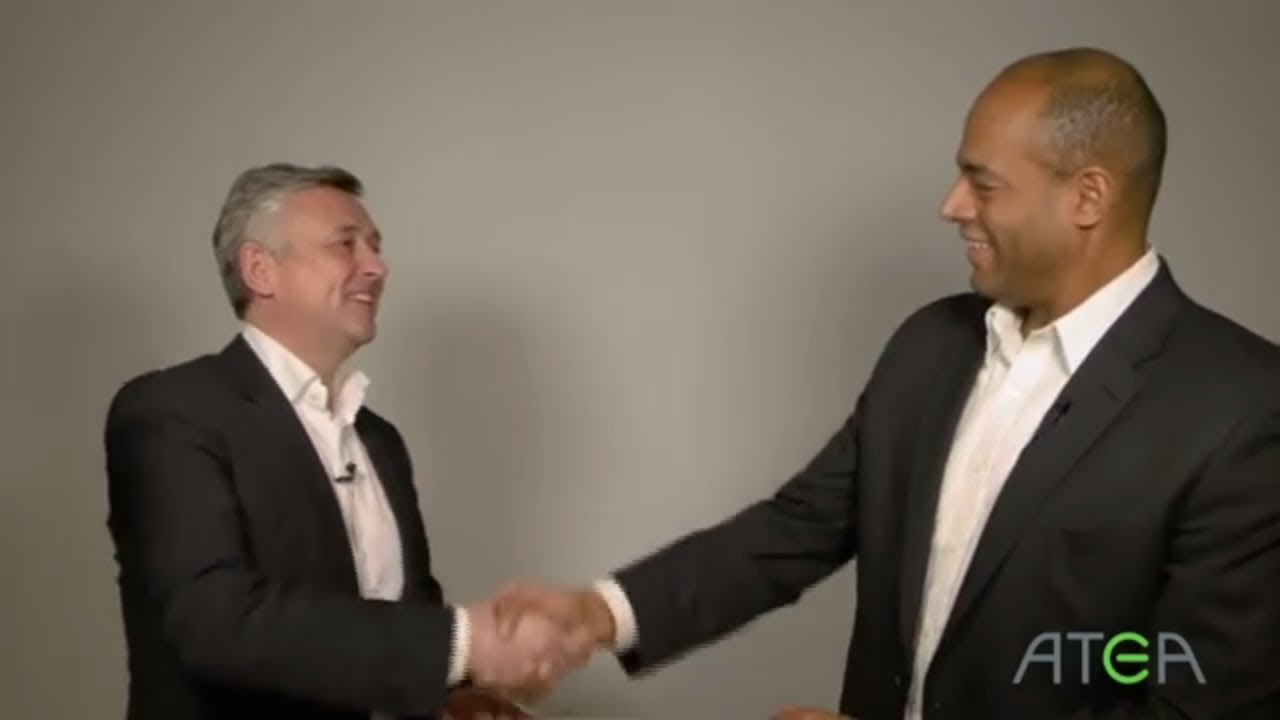
Steinar Sønsteby and Thomas F. Anglero discuss IBM's Watson and cognitive computing, including its cancer research collaboration with Memorial Sloan Kettering, the Bluemix platform, and IBM's partner ecosystem in the Nordics.
Chapters
Hi and welcome to this edition of my video blog. In this blog, we're gonna talk about some new exciting stuff with Thomas Anglero from IBM. And first of all, Thomas, a lot of stuff going on in IBM these days.
Yeah, yeah, yeah, these are the new exciting days of IBM. The old IBM's dying. The new IBM is really taking off. Yeah, super exciting.
So let's focus on a couple of them, or maybe more than that, but not all of it. Watson. I mean, everybody's talking about Watson. It's like taken on its own life.
Watson's become a movement, especially here in Norway. But the question is, what is Watson? Watson was the end result of the old IBM you were talking about a second ago. Where we were in the race to make the world's fastest supercomputer. And then we have 14,000 PhDs, really smart but boring people. We told them, make the human brain in software. And then we married these two parts. We took the world's fastest computer, then we took the human brain that we made in software, we put it together, and we gave birth to Watson. So the excitement around Watson today is what can you do with this? So 4 years ago we said, let's solve the biggest biggest problem there is in the world, and that is cancer, right? So with cancer, we partner with Memorial Sloan-Kettering, the number one cancer institute and hospital in the United States. We've been working for 4 years. So now we can help people with breast cancer, lung cancer, colorectal cancer, where Watson is reading all the information there is in the world on cancer up until the moment the doctor, the oncologist, comes into the room with the patient. The doctor on her iPad has all the information, everything published up until she walks in that door. To help that patient. So while she's sleeping, Watson's working, reading, learning everything. I mean, this is one of the exciting things about Watson is big data has created a big problem. There's too much stuff to keep up with. Watson's able to put it all together and walk in with the doctor and help that person with the latest information, the latest techniques, the latest drugs, everything. I mean, that's exciting, right?
Because a lot of this is really, as you touched, it's about the fact that it's impossible for a person— not only a doctor but a person in society today to take in all the information that this is, you know, it's available out there?
It is not possible. If you look just normal people at their desk, right? They have access to so many databases, they have their spreadsheets and things like that, spreadsheets are growing. And human beings, you know, I'm a guy, I'm a typical guy, you know, my wife tells me something, I can only remember one or two things and that's it. But when you're at work, a typical guy, it doesn't work. Your boss like you wants you to remember—
Well, talk for yourself now, Thomas Anglero.
Okay, okay, okay. Don't tell my boss. But you know, you have to take To take into account all these different things in different databases, different customer needs in different scenarios and all this stuff, it's too much. But with Watson, well, Watson reads 10 million words a minute. I mean, the amount of data we have is nothing. That's Watson's food, right? So all the data you have, you feed it into Watson and then you can actually have a conversation with Watson. Say, "Watson, what did you find?" or "Watson, what anomalies did you find?" or this interesting thing. So what I like to call it is that the good old days when you had an idea, you wanted to start up a company, it'd take you 6 months of testing, looking, researching. With Watson, the iterations of innovation are now in a couple of seconds. You feed Watson all the information, Watson, what'd you find? Really? Hmm, what if you do this? So all of a sudden instead what took you 6 months before, it's now taking you every minute. So you're like you're starting a startup every minute of your life. You could do this with your work as well. I mean, this is why it's exciting. You now have the best version of you as Watson working with you all the time. If you're a doctor or if you're an accountant or you're working in the field, I mean, that's why it's exciting. And it's no longer a future. We've been doing this now for 4 years.
And everybody talks about when they talk about— or a lot of people talk about cognitive when they talk about this. Could you try to put that into the context of Watson? I mean, it's two sides of the same thing, isn't it?
Cognitive is real simple and you're a guy and you probably like women so we'll do the women thing, right? You see a woman, she's very pretty. You see that she doesn't have a wedding ring on. You go, "Ooh, okay." And then she smiles at you. Okay, what do you do? You walk over and say hi. That's cognitive. You connected the dots. So what Watson does, it connects the dots. So we don't call it artificial intelligence, we call it a cognitive platform. It connects the dots. So that's why cognitive, you're hearing more and more, is not hype. It's actually taking the way we think but at an extraordinary level. Right?
So in all of this, Thomas Anglero, I mean, you have the cognitive possibilities. You have Watson, which is more than the cognitive. It's also a massive supercomputer type of capabilities. But then IBM is also leading in the field of analytics or big data or what have you. And of course, Watson is using that. But when you look into the data and the analytics of this for IBM, I mean, that's going to be massive too.
Yeah. I always look at business analytics and all that, that trend that's been around for about a decade or so. That was the precursor to Watson. The industry needed to do that as well as the big data movement and that's the food, the comida in Spanish, for Watson. So that whole generation of excitement and what we got out of that was great but that was the warm-up. Here's the main serving.
So you kind of see all of these technologies and all of these use cases as coming together into Watson.
All of them coming together as Watson and you don't have to be a data scientist to use Watson. You got to be a normal person. You don't have to have programming capabilities. You just have to be able to ask a question. It's that easy.
Which is cool. And you don't have to do a massive investment to get there. I mean, Watson is available in many forms or shapes and forms.
Yeah, exactly. So we have partnerships with universities, so they have access to Watson through our developer platform called Bluemix for free. A normal person when walking off the street can use Bluemix for 40 Norwegian kroner, which is 400 Norwegian kroner, which is about $50 a month. And you have access to services like Watson where it could see, it has feelings. Watson could tell your emotions. So if you're happy now, Watson could tell you're happy. If you're sad— you have access to all this for $50 a month. And you could build new services, mobile apps. You could build robots for $50. It's so simple. Our plan now is the new IBM is let everybody play and use your creativity. You know, go back to the Barnhager Norwegian kindergarten and just have fun again.
Yeah, and with technology, an engineer like me, of course, knows how to have fun with new technologies. And IBM want to work with partners, so Atea, of course, is excited to start this journey, even though, I mean, we probably need some help really get going, but it's all for partners. I mean, you really want to work with the ecosystem here.
Yeah. Partners are key. What I see, so I'm responsible for Watson for all of Norway and it's extending out into the Nordics, so I'm working with the partners all the time. The partners are making the biggest investment in number of people and their excitement. They're actually more excited, a little more excited than me, and that's kind of crazy because I thought I'm really excited. But for example, I got a call from a partner yesterday where they increased their workforce focused solely on Watson by 50%. But the Watson days are so early. Some people listening to this probably never heard of Watson. Partners are key. That's the future, is the partners. Yeah, absolutely. And I've been to all the Attea community things in Norway, and you guys are fun. You know, today is Christmas Day outside in the hallway. I mean, Attea knows how to have fun, so you guys are going to do great. You get the Watson thing.
Yeah, we will get it. We will get it.
You got it. You got it. You're on your way.
So you actually got to Norway, which is kind of strange, but I want to end this video blog as all my blogs and all my people out there know this, to ask you a more personal question. So Thomas, I know you're working a lot and I know that you're passionate about that. But outside work, what is your passion? What's your hobby?
Well, simple. We spoke a little bit about before and that was basically for the last 10 years I spent my whole life after work coaching basketball. But it's not the basketball. It's the taking kids, a group of kids from a very affluent neighborhood in Norway who are 6 years old to where now they're 17. And we've won several Norwegian championships. We won a European championship. And it wasn't the winning the games. It was raising kids, leading, being a role model, being the Ultra Human, finding out about myself, where after now I'll take care of other kids and my kids are also on the team. That's what I do. That's my passion. So whether I'm at work or I'm at home with play, passion, passion, passion, passion, passion. So I think I'm quite fortunate.
And you're also a good storyteller.
Just like you.
Thomas, thank you so much for participating and for driving this into the ecosystem and and helping us with that. And, uh, to all of you out there, until next time, you have a great one.
More from Thomas






IBM Watson AI Lab for Cancer presentation to Ullern HIgh School / Thomas Anglero

Will You Lose Your Job to AI / Oslo Business Forum / Thomas Anglero & Richard Qwest



