IBM Stavanger: Innovation and AI Keynote | Thomas Anglero
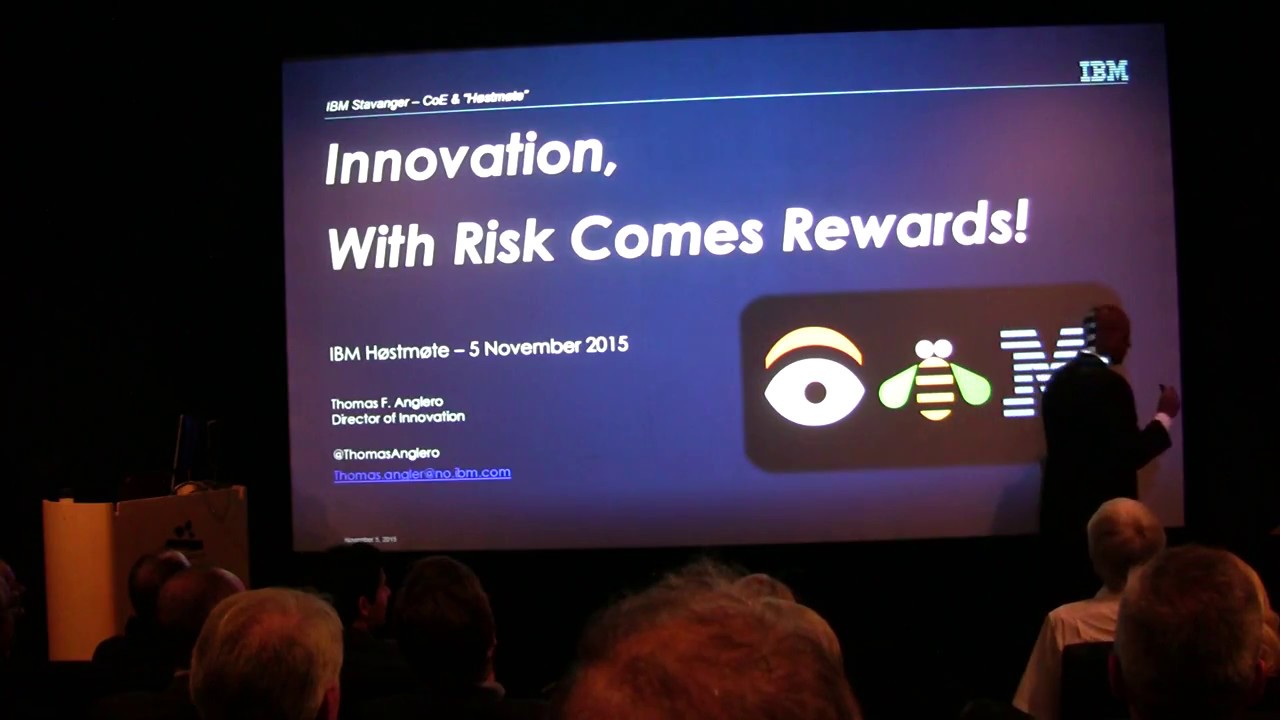
This content was created by Thomas Anglero. This content was uploaded by Thomas Anglero. This is a YouTube video titled "IBM Stavanger: Innovation and AI Keynote | Thomas Anglero" (published/recorded 2016-12-22). The excerpt contains a live event with audience interaction: a primary English keynote by Thomas Anglero (introduced as director for InnoMotion/IBM) in which he gives an energetic, anecdote-driven talk on innovation and disruptive thinking (stories about Kodak, Corning/Gorilla Glass, Airbnb, the sharing economy, and the need for cultural change to spot "ugly prototypes"). The session includes call-and-response with multiple audience speakers (labeled SPEAKER A/C/D) and some multilingual remarks. The excerpt then transitions to a different presenter (representing Rysta Energy) who gives an analytical presentation on the oil & gas industry, covering oil prices, supply/demand scenarios, U.S. shale, OPEC/Saudi production, storage levels, and medium-term forecasts. Overall this is a conference-style presentation session with multiple speakers and Q/A-style audience interaction.
Chapters
And the torch talks, et cetera. We hope it will be a satisfying and suitable in mostly familiar or hope also to please other foreign men in gay or varied and different types of foreigner programs, so I should be talking, see, what is available, topics, or lit— yeah, I'm sure some of you don't know anything about how gay, two-over, poppers, one-man, or solo, or before the teeth, arrow, or pedo, magro, or presented.
Noon Talk, Abendverstörung, liegt für einen anderen Titel vor. Wir haben da ja per E-Mail-Annahme Frau Rüster zugesehen, sozusagen. Wir haben einen kurzen Pause vor circa 5 Minuten, so habe ich Thomas Anglero aus dem Ellen-Zentrum sozusagen telefoniert, mehr gesprochen, gesagt, er hat da was So without further ado, I'd like to say Thomas Anglero, director for InnoMotion, and IBM, for a short, informative talk.
So, Thomas? That's not my presentation. How many people wish that was my presentation? Actually, by the end of my presentation, every one of you will be able to afford two of these. I solemnly swear. Are there Boy Scouts in the room? So I have the great challenge to motivate you and most importantly, innovate the hell out of you. Are you guys ready? Ladies ready? Yes. I like the ladies' motivation. Okay, so only 1 hour ago I changed the entire title of my presentation because I thought the best thing to do is to come at you as hard as possible, right? We only got a couple hours with strangers, but in the next 20 minutes I have to change you guys from boring people. Hey. I sound like your boyfriend or your husband? So in 20 minutes to be the most innovative people possible, not just on the personal level but also on the corporate level. When you're in the office, alright? A lot of you are leaders, a lot of you have been working for years and years and years to have all the power that you have. I'm about to embarrass the hell out of you. Can you take it? The women are here. I'm talking to the men who are looking there now. Are you ready, men? Yes. I like it. Women only. The presentation is women only. Let's go. You're a corporate leader. This guy walks into your office. What would you think? This is the Kodak story. I'm gonna tell you a lot of stories. I think the best way to convert you from the boring person that you are, I know a lot of you are excited, don't be insulted and all that stuff, right? But to convert you in 20 minutes for you to have that wonderful Audi R8, two of them, I have to upset you a little bit. This gentleman here, back in the 1970s, He came into his boss's office. So I want you to picture yourself right now. You're at your desk, right? He's smiling over your head. He's probably playing some games and not working really. You're at your desk and a guy like this comes in and he says, "I'm gonna change the entire history of our business." So Kodak in the 1970s, Kodak, who was Kodak in the 1970s? Everybody here is old enough to remember the automatic, right? You push the button, what came out?
Photograph.
And what did you do with it? Threw it away. He threw it away. He just ruined my whole presentation. So Kodak was the gorilla of the photo industry, right? Back in the '70s, everybody had a Kodak camera, raise your hand. Kodak? Of course. Of course, right? So Kodak was film, Kodak was everything. Kodak was the gorilla. They didn't have to worry about anything in photography. And this gentleman walked into your office, right? So you know the industry you're in. You're the gorilla. You're the leader. You're the boss. And this guy comes in and says, "The future is digital." What the hell is digital in 1970? What does that mean? Why would you want to change your entire business? Anybody know what happened to Kodak in the last few years? What did they file? And I stayed in Norwegian. Køkken. How come you yell out English and really low in Norwegian? They went bankrupt. How many times has your employees, your colleague, come into your office with a radical idea? Something as ugly a prototype as that. Now that's an ugly prototype, is it not? Has anybody ever seen a pre-prototype? This is a profound moment. You have to take that into consideration. All prototypes are ugly. That's the first digital camera. Where are digital cameras now? They're everywhere. They're in space. They're underneath the water. They're everywhere. But that's the very first one that mankind ever saw. Has an employee of yours ever come into your office with a radical idea? And you not paid him or her any attention. Did you have a Kodak moment? The girls are laughing, the guys are going, "Oh." Tony, I'm not going to be nice. I got 20 minutes to change you. Many of you probably have. And most of you cannot remember. And what a shame that is. How often is it that our colleagues come to us with great ideas and we don't do anything with it because I'm the boss, or no, not now, it's not in the budget, all these different excuses. Do you think Kodak does not regret not paying attention to this gentleman and his ugly prototype? Are there not moments possibly in your past that you possibly regret? Where's the absolutely? Let's keep on going. Anybody know what that is? It's a pot and a pan. Everybody should know what a pot and a pan is. Yes? Yes?
Yes.
I like interactive. I don't like this quiet stuff, right? Okay. So let's tell you the story of Corning. Anybody know Corning? If you're American, you know Corning. They were the Dural of Europe. They were the pot and pan company of the world. They had all the patents on glass. Well, actually, what is that, by the way? This one over here. That's not a— what is this, a bowl? What is that? Anybody cook? Not one person of 100 people knows what that's called in the kitchen? Wow, you guys are embarrassed. Corning was the king. They were the gorilla in this market. They had all the patents on glass. Tupperware or glass cookware, sorry. Okay? They've been in business for 160 years. In 1969, their CEO said, "There's got to be something else. We're number one, but there must be something else." How many number one CEOs, when they're number one, challenge to change the entire core of the business? Would you? Would you? Answer the question. Would you?
Probably not.
He did in 1969. What he did was he created a skunk's work. Skunk's work. He took a group of employees, a very small group, said you have 1 year, 365 days, Go off, you have an unlimited budget, do whatever you want, but in 365 days you report back to me what is the future of this company because it's not in that. Any of you think that way? Let's see what the result was. Optical fiber. This group of engineers Or your colleagues, possibly, went away for 1 year and they came back and here was their presentation. Are you ready? Now, I'm your colleague now. And this is what exactly what they did. They didn't have this, so just give me a second. He sat down. He was a large man, so he put his hand here on his stomach. That was a joke because his stomach is large. I'm not proud. So he sat down, leaned back on his expensive chair and his mahogany desk. He said, "Show me." And they stood up. And the guy stood up. He said— and he held one strand of glass fiber optic cable. What would you do? And he said, "In this one piece of glass is the entire future of humanity. Every conversation, everything we do will go through this piece of glass, and it's called the internet." Corning owns all the patents in fiber optic cable. Every single time your daughter, your son, your girlfriend, or you get on Snapchat or Twitter or whatever, Is my presentation over? They decide. Everything runs through the internet, through fiber optic cable. And he said to them, "Thank you. Now I'm going to take the fight forward." for you. Would you do that? When somebody comes to you with this? He turned around and had a meeting with the board of directors. The board of directors not only thought he was crazy, but they wanted to kill him. Literally, they were talking about putting out a contract out for him. We're talking about the gorillas of an industry, globally. And this guy's going to put it into this little strand of thing like this. He won the fight. He won the argument. They have the patents. Everything we do goes through corning fiber optic cable. What was the title of my presentation? With risk—
Take risk to get rewards.
To get great rewards. When your colleague comes to you with something like that, when your colleague comes to you with an ugly prototype, you started getting the feel of the presentation? These are those gentlemen that went away and did discomforts. The black and white, of course, was them, and there's their little fiber optic thing. That's who they are. I included the black and white. I thought that was really important. I thought it was important to include the picture of the older gentleman because they're just like you and me. Not as tanned as I am, but a little bit. My point is this. What is the difference between them and your wife and your neighbor, the guy that works the cubicle across from you, your client, your customer? They're the same people. And yet those 3 guys changed humanity. Do not overlook anyone you meet in your life. For their one little idea, their one little strand of glass changed humanity. Corning wasn't done. Corning said, "You know what? This is our new culture." And they innovated again. So, what did Corning do? Anybody got a mobile phone? Yes or no?
Yes!
Crap. Anybody already drop their mobile phone?
Yes.
Wow.
Anybody's mobile phone glass did not break?
Yes.
That's like half the audience. To the half that it did not break, thank Corning. In 2007, they created Gorilla Glass. So you probably heard, if you're a nerd, you've heard of Gorilla Glass. We know glass, that's corny. What did they say? We know glass. They're now a mobile phone company. They started off, and let's go back. That's where they started. Your business, what you do today, if you're there, do you see yourself as a mobile phone company in a few years from now? Funny, but I'm dead serious. I am dead serious. What does it take? It doesn't take another degree. You don't have to go back to school. It takes two big things. One, a belief in yourself. And two, a belief in the other person who's coming to you with the radical and crazy idea to go from the kitchen to your pocket and to everybody's pocket on the planet. And controlling communication of everybody on the planet. That's where they started. And it was just one CEO who said, "We're number one. We gotta change this." Do you feel me?
Mm-hmm.
I like that. What do you see? You're allowed to talk. What do you see? Anybody see a blue sofa?
Yes.
Does anybody have one of these at home? It doesn't have to be blue, though it'd be funny.
A sofa.
Huh? Use the curse word. I need to hear the curse word. So 7 years ago, there's a 23-year-old guy in California. Just like me and you, he needed a place to sleep in the night. Called a friend of his and said, "Hey, can I sleep at your place?" The guy says, "Hey, I have a sofa. Just crash on my sofa." Anybody ever crash on somebody's sofa before? Not in the days of college, that does not count. You guys don't remember those crashing on sofa days. Yes? Yes. Ah, interesting. He crashed on his friend's sofa, woke up the next morning, and changed everything. So I'm giving you a chance. What innovation do you see in that sofa? A sofa bed? Couch surfing?
Huh?
Yell it out. I'm sorry? Couch surfing. Couch surfing. Yes. This gentleman woke up in the morning and said, I'm creating a new company. I'm creating Airbnb. Who has heard of Airbnb?
You.
Did you know that was the story of Airbnb?
No.
Are you ever going to look at your sofa differently now? Do you understand the impact of this story? All he did was slept on somebody's sofa, and he created a $30 billion valuation company, because they're now listed, 1.5 million listings, 190 countries around the world, 34,000 cities. They are bigger than Sheraton, Marriott, Hilton combined. And they own nothing. They don't own one hotel room, they don't own one person to clean the room, they don't own one towel. And they're bigger than the biggest hotel chains in the world combined. All starting from him sleeping on a friend's sofa. You slept on a friend's sofa before he did. How come you didn't do this? Do you understand my point? We've all physically have done these things and been at these places that these people have been. The only difference is they had that aha moment, they had that epiphany. We all have it within us. The problem is we all only see what? The sofa. Some people who never heard of Airbnb are like, "Ah, they're not in Norway." So I put this slide in there. That was taken about 1 hour ago. So this is the latest listings if you're looking to a place in Norway on December 23rd. And there are 300+ rentals for that day. So if anybody going, "No, no, no, no, that's an American thing." Nope, that's Norway. Airbnb's not dumb. Let's see what this— they've done. Airbnb— can anybody see the date? October 28th, this is less than a week ago, they became disruptive again. Less than a week ago, Airbnb said, all these people who are hosting all you wonderful people, they keep asking their guests, good morning, have your cup of coffee, would you like to go on a tour of the city? Sure. So Airbnb is now in the city of San Francisco offering tours. So not only can you book a place to stay, but you also could book a tour package. Airbnb is about to disrupt and destroy the entire tourist industry and travel industry. Everything but the airplane, that will probably be next by Airbnb. In 7 years they went from the sofa to the largest hotel chain in the world. What do you think they're going to do to the travel industry? And what did they do? They said, "We already have hosts offering to give these tours. Let's make it a business." That's all they did. They didn't even pick up a piece of paper. Do you see where innovation is? Do you see how simple innovation is? It's right in front of— not even your nose, it's right there. It's in part of your reality. You don't have to change, you don't have to do anything different. What else did they do? I like this one. What's the date on that one? See the top left corner? What's today? November 5th? The date there says? Yesterday, November 4th, look what they did. Expedia, one of the world's biggest travel agencies, bought the number 2 competitor to Airbnb, HomeAway, for $3.9 billion out of pure fear. Airbnb doesn't own anything. They're a software company. And they made the world's biggest travel agency buy the number 2 competitor in the Airbnb space. And they made them spend $3.9 billion on fear. This happened yesterday. Innovation. When you miss it, it costs. In your past, every time you missed it, how much did that cost you and how much did it cost your company? This is the world's scariest and prettiest— for you girls, is this a pretty slide? Guys are going, "Oh God, another horrible slide." This slide is very simple. In the middle is all of us. We're the disruptors. We're the people who are saying, "Hey, let me lend you your sofa, I can make money. Let me lend you my empty bed, we can make money." This whole sharing economy, the collaborative economy, is attacking all these spaces. Space, money, goods, food, services, transportation. All those verticals are under attack —right now. And here's the scariest part of this entire slide. It's a year old. It's version 1.0. Version 2.0, the text was so small because there were so many disruptors, I couldn't put it on the PowerPoint. So if you're thinking, oh, this is going to happen, this is a year-old slide because the accurate one for this year is in the hundreds of companies disrupting each one of those vertical spaces. So this is not going to happen, it has already happened, people. So your homework is find version 2 and get scared. Whatever business you're in, whatever company you're in, you're under attack by people, by your neighbor, by the guy walking the dog down the street, by the guy taking the newspaper. It's people who are innovating, who are destroying— not destroying, but disrupting massive industries. So this is what you want to know, right? How can you innovate? Innovation in the core, innovation at its very, very core is cultural. It's all about you. All about you. This is as strong as a message I can give you. It's not about I gotta buy this new software, I have to buy this new hardware, it's about you. You looking at the sofa a little bit different. You looking at your colleague with the crazy idea a little bit different. So let's do the test. Let's see if you're an innovator now. What do you see? Do you see a strange colleague with a crazy idea? Do you see a strange box? Or do you see the future of digital photography? Everybody sees the future, yes? Yes. In 20 minutes you guys went from, "Hey, who's that nerd?" to, "Wow, that's the future of digital photography." Congratulations. Okay, next test. What do you see? You get a 6, right? Norway, 6 is a perfect. You get a 6. Okay? Now, the last one. And this one I can't be more serious, because every one of us have it. What do you see? For the rest of your life, whenever you see a sofa, You should think, what opportunity did I miss? No way. Can't live with that, nope. I'm an idiot. This slide should haunt all of you and at the same time lift you up. Because there are more things that are right in front of you, part of your day-to-day life, that if you look at it from a different perspective, you could redefine the business you're in, change your life, change other people's life, and change humanity. He changed humanity. They changed humanity. They're still changing humanity. Just by looking at day-to-day items a little different. Thank you very much.
Take a seat.
Okay, so thanks a lot for the invitation to come here and share some of the analysis and some of the perspectives we have on the oil and gas industry. I will mainly talk about the oil price, but can also touch a little bit upon the activity level globally in the oil and gas industry, and also round off with some pictures for Norway. So if you want to be innovative in my world, please think about how you can use more oil and gas— how are you going to produce more oil cheaper, because that is needed going forward. So please, please have that attitude. And I hope there's not too many Tesla drivers here, but I assume there are quite a lot. Okay, so we'll talk about the oil price, spend most time on that, and I'll start with the short term and then go into the medium term, or towards 2020, and then look on expanding. Just a few words about Rysta Energy. I hope most of you have heard about us, but We are a company growing. It's about 80 employees at the moment. We have been around for 10 years. And we are increasing and doing more and more internationally. And we have strengthened our office in New York and Houston, opened a new office in Rio, and also just opened an office in Stavanger, which I'm heading. But I mean, the founder here, I guess he was quite innovative. It was Jarle Andreessen. And he worked for McKinsey, and after a while he was quite fed up of spending all his time collecting data and then, you know, throwing it away. At least that's what McKinsey says they do. And so he wanted to build up, you know, a proper company with taking and collecting all the data systematically, and that's what he did. That's about 10 years ago. Okay, so first, first, just some words on taking some of the scenarios from IEA. I guess they're coming with a new— some new update again next week, I guess. But what this picture is showing is the global demand for oil and gas in 2012, in 2020, and 2040. And the key message in this is that these are some really big numbers. They're big numbers today. They're big numbers in 2020, and they will be big numbers in 2040 regardless of which scenario you believe in. But of course, the picture in 2040 will probably be different from what we see today. But there is a need, there will be a need for oil and gas for a long, long time. And I'm sure there are different views on this, but that's what we believe in. And then also, if you look on how much oil and gas that will be in the energy mix, it's a little bit more than 50% now in— today. And then going forward for the different scenarios, and they have 3 different scenarios, you know, it's going to be a high pop in the energy mix going forward. I'm not going to go into all these scenarios, but the kind of the 2-degree scenario is the one you see here in black. That's the one where you have less use of oil and oil and gas. Okay. And then, Let's talk a little bit about the oil price. Some of you may have seen this picture before. Basically, it shows the oil price from 1980 up to 2015. And, you know, every time where you— every place where you see that the oil price is falling, in the Asian crisis, the dot-com, and 9/11, and also in the financial crisis, They choked back the production and the prices came back. But they did not do this in 2014-2015, and now it is actually the opposite that we will talk about. So in a way, this is also similar to what happened in 1985. That's also where they started to increase production, and the oil prices were low for a long time, for those of you who remember that. And of course then there are similarities. On the other hand, there are also some key differences. And this is showing oil production from 1980 to 2015, same period. You have the non-OPEC production and you have the OPEC production. But the key difference, you know, compared to in the '80s and compared to today is most of OPEC or Saudi Arabia had a high, very high spare capacity, about 25% spare capacity of the global capacity. And that was not the case in 2014 and it's not the case today. So that's very important for the, you know, for the analysis we do and the assumptions and what the picture is. So that is a key difference to what you have had at that stage. So that means that some people now talk and say that it's not so much about what the call on OPEC is, so how much OPEC needs to produce. The swing producer now may be the US, US liquid or USA. And this is just showing the picture also you may have seen and read about in the press. This is the— this is the rig count that has fallen more than 60% since last year, end of last year. So this, you know, these mechanisms, they are very quick to adjust, and therefore we talk about that this would be the kind of new swing producer. And also, of course, this affects the production. It's not so that the production is like falling, but it's more like flattening out. And then, of course, the further development going forward depends on what you believe about oil price. We believe oil price will come back in '17, and consequently also think that the oil production will increase quite— it will be a high increase from the US. Okay, and then there are different ways to talk about the kind of prices and how long they will last. So the 10-year crisis we typically call like an L-shape., and if there is a kind of quick fix with the OPEC or someone choking back the production, it's a V-shape. If it's been around for some years, we call it kind of a U-shape. And if you ask us, you know, what do we think about now, what kind of period we're in now, we think it's going to be kind of a U-shape. The price is going to be down for some years and then come back in, as I mentioned, in 7 years. Also here, if you look a little bit on— this is on— this is year-on-year change quarterly, but if you just look on the gray line, which is the total supply, you can see here that in 2014, the supply has been much higher than the demand for oil. And consequently, you can see the differences here, which is on the right axis, about 1 to 1.5 million barrels has been put into storage, which means that there are record big storages oil around the world. But the key thing here now, I really just want to say, is that based on our analysis, supply and demand will start to meet sometime in '60, and consequently that we believe oil prices will increase after this. And of course there are a lot of uncertainties, and for example, if the Chinese demand is not as high as we had anticipated, than we assume, okay, then this will happen, happen later, yeah, where supply will meet demand. And also, of course, on the supply side, if Saudi Arabia produces much more than we assume, that could also take longer time. But we don't think that can last forever. Then just some little bit busy picture. This is also showing the, the, the, the world liquids demand on a year-on-year change. So you can see here back that some of the challenge that we had in '14 was that there was much lower demand than what we had expected. It was also combined also with the US shale shock and also that Saudi Arabia didn't choke back. So those 3 things together, you know, meant that the oil price fell. But then lately we've had very high demand for oil. And also going forward, we think that the demand— we are assuming a lower demand than what we see now, but it's is about the same as it's been historically, year on year growth. And if you look in the short term, it's really US and China who are the big single countries, and then there is a sum of a lot of these non-OECD countries, which is— we're assuming that the rest of the countries will come. Just a different picture. This is a total oil product demand, and this is by country. So just to illustrate that, you know, how it works. Talking to the U.S. and China. And of course, everything that happens in these countries when it comes to economic development or, you know, any trends, whatever people read, it affects oil price. Any speculation, for example, is being particular on, of course, China and rumors that if the demand falls, you can see that the oil prices may fall 1, 2, 3 dollars. And then Iran is a very hot topic, of course, with the nuclear deal. The nuclear deal and also probably it looks like the sanctions will be lifted. And how much will Iran produce? We are not— we don't think that they will produce so much so quickly as Iran, our community is getting, or the Iranian oil minister is communicating. But we think that it will take time. You need new contracts, new, you know, new contracts with the companies. And you have to do activities and get money in to get production up. But we think it will exist. Increase, and we have assumed it will increase in our numbers. And then this is the Saudi Arabian liquid production, and if you look in '85, this is where they were kind of at a very, very low level and had this big spare capacity, and they started to increase production and try to— wanted to get back their share of the world production. But actually now they are using at the record high level, never produce so much liquids as they are doing now. But the thing is that they can't go just open up a crane, they have to do activities. So on the right-hand side here you can see that these are the drilling rigs that are possible to come, and you can see that they have increased dramatically over the last year. So it means that they have to invest a lot and they have to do a lot of activities. So that's important to just be aware of. You can also read in the papers that Saudi Arabia is borrowing a lot of money and And you can see, so it's going to be very— it's very interesting, of course, then to follow Saudi. And the key question will be, of course, can they— how much more can they produce? Can they increase production? And of course, also, if they can increase it, will they at some time choke back or hold back such that prices will come up? So it's quite— so, of course, Saudi is a very important piece. And when you come to thinking about uncertainty, And of course what happens in Saudi will affect the price. But it can go both ways. This picture is showing the— just the share for each country of crude, how much crude production they have of the world market from 1970 to 2019. So this is like—
More from Thomas






IBM Watson AI Lab for Cancer presentation to Ullern HIgh School / Thomas Anglero

Will You Lose Your Job to AI / Oslo Business Forum / Thomas Anglero & Richard Qwest



